
Why is Doppler radar used?
Doppler radar is used to measure the velocity of objects, most critically in meteorology to track storm movement and issue severe weather warnings.
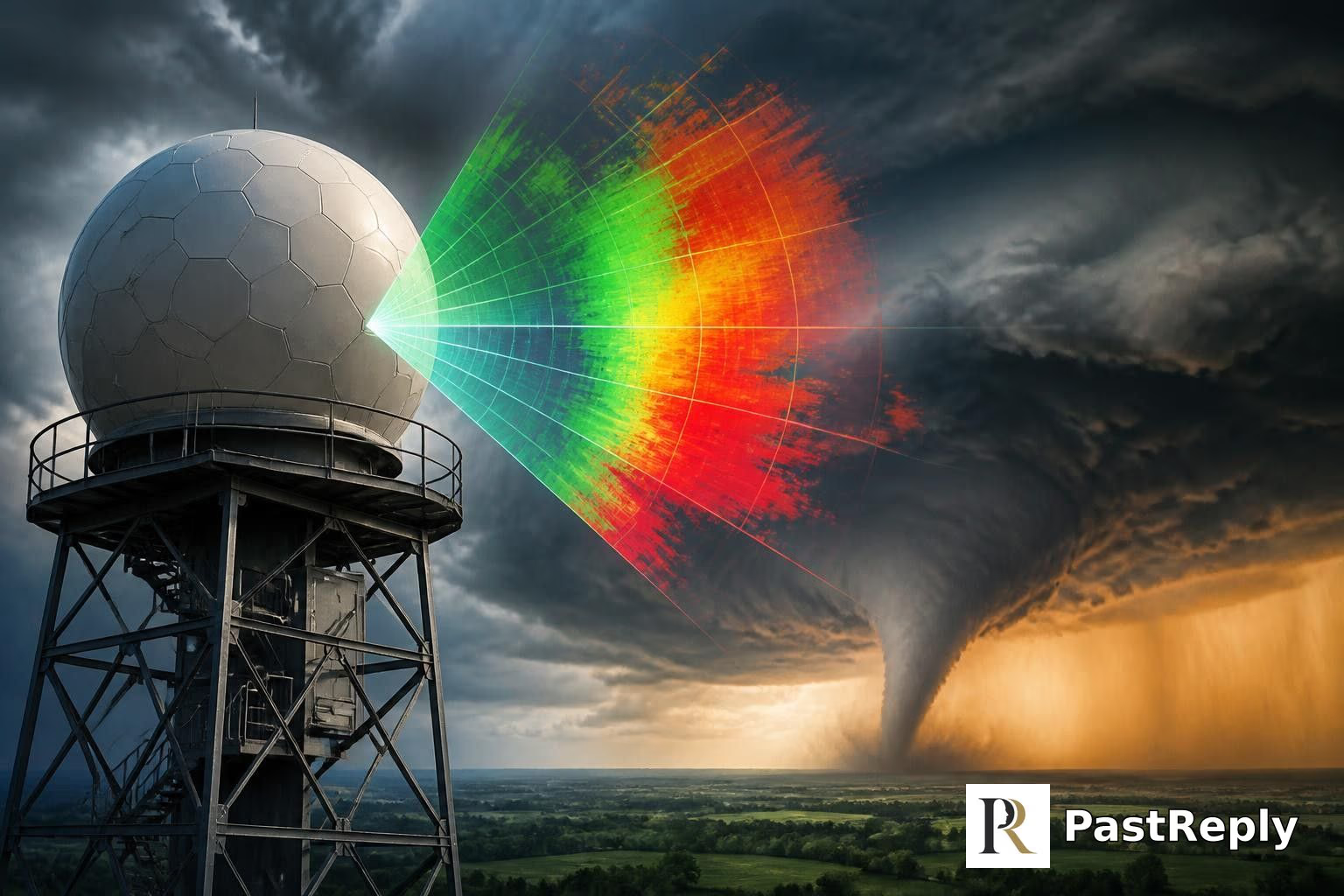
The facts
Doppler radar is used primarily to measure the velocity of objects by detecting the Doppler shift in reflected radio waves. In meteorology, it is the most important tool for tracking weather, as it can determine the location, intensity, and movement of precipitation. By measuring the phase change of returned signals, it reveals whether targets like raindrops or snowflakes are moving toward or away from the radar, which allows estimation of wind speed and direction. This ability to "see" the wind enables detection of rotation within storms, leading to earlier tornado warnings and better prediction of severe weather events such as thunderstorms, hurricanes, and snowstorms. Beyond weather, Doppler radar is also used in aviation for navigation and wind measurement, in law enforcement for speed detection, in sports for tracking ball movement, and in healthcare for fall detection.
Answered by 100 of history's most famous minds

You have set up towers that gaze into the storm and count the swaying of raindrops? Truly, you are clever with your hands. Yet I tell you, you may track the wind's twisting, but can your eye see the heart's turning? A man may flee the hailstorm and still drown in his own greed. Build your devices, but do not neglect the weightier matter: to know the direction of your own soul before the gale of judgment comes.

God has given you the capacity to measure the speed of the rain and the turning of the wind, and you use this to warn the people of coming harm. This is a good thing, for the preservation of life is pleasing to the All-Merciful. But beware: do not let your gaze upon the clouds distract you from the signs of God in your own hearts. The storm that destroys the body is but a fleeting shadow; the storm that blinds the soul to its Lord is the true calamity.

You seek to track the movement of the rain and the wind, hoping to foresee their harm. That is like grasping at the eddies of a river. The storm comes and goes, and you may learn to dodge its fury, but the suffering born of clinging to safety will remain. Better to see that all weather, like all thought, arises and passes. Turn the instrument inward, and watch the winds of craving and aversion spin.

By the pillar of cloud and fire, the Lord showed us His path in the wilderness. Yet He also gave men wisdom to read the signs of the sky: the red sky at morning, the breath of the east wind that brought the locusts. This new eye that discerns the wind's speed and the storm's turning is a tool - like the staff in my hand - to protect the people. Let it be used for righteousness, not for greed.

If a man cannot read the wind by the bending of the reeds or the flight of the swallow, he may yet learn with a device. But the wise ruler does not rely on the device alone; he first cultivates his own heart, so that he may use the knowledge with benevolence and right timeliness. A warning given without humaneness is but a noise; a warning given with sincerity and proper ritual - that leads the people to shelter in harmony. The instrument serves the virtuous man, not the other way around.

The natural world declares the glory of God, and even the hidden winds cannot escape His order. Yet what do these devices profit a man if he cannot discern the signs of the times? We are trained to test the spirits, not merely the weather. Let them also seek the still, small voice that speaks through the storm.

The Lord who calls the stars by name also numbers the raindrops and knows their path. This device that peers into the heavens and reads the motion of the clouds - it is but a dim echo of His wisdom, who alone knows every gust and every heart. Use it well, but do not forget the Hand that sets the storm in its course.

A bird does not need a mirror to feel the current beneath its wings. To measure the wind's turning with such noise - that is to mistake the finger for the moon. The sage knows the storm's path without a single question; he has already moved aside.

That which measures the wind's turn but cannot tell us whether we have fed the hungry child or spoken kindly to a stranger is a clever toy, nothing more. The true storm is vanity, and the true still air is humility; for these, no radar is needed - only a heart that remembers the One who holds the wind in His fist.

My heart magnifies the Lord, who reveals hidden things to the humble. This eye that sees the wind's turning - does it not recall how He parted the sea for our fathers? Yet I wonder: does it also see the widow's tear, the orphan's cry? Let those who watch the clouds remember that the strongest wind is the Spirit, and the truest shelter is a heart that trusts in God.

This clever device that tracks the storm's motion - does it reveal the wrath of God? No, for the Lord speaks in the still, small voice, not in whirlwinds we can measure. Let them count raindrops and map the gale; such knowledge is but a mirror of our own pride. The only radar a Christian needs is the Word of God, which shows the coming Judgment and the refuge of Christ. Beware the false security of human inventions!

If the question be whether this instrument serves the common good, the answer is yes, in due measure. It discerns the motion of the air, which is a secondary cause of storms, and thus allows men to prepare. Yet let us not mistake an effect for a cause: the wind obeys the First Mover, whose ways are not bound by our devices. The radar is a gift of reason, but reason itself must be ordered to the love of God and neighbor. It is lawful to know the weather, but folly to ignore the weather of the soul.

In the streets of Calcutta, I have seen people die from the rain and the cold, with no roof to shield them and no one to hold their hand. This machine that sees the wind and tells where the storm will strike - it is a gift, but only if it leads to someone being brought inside, given a blanket, a bowl of rice, a kind word. The knowledge of the coming danger is nothing without the love that reaches out a hand.

By measuring the shift in frequency of a wave reflected from a moving body - the same principle by which one marks the pitch of a passing coach - you recover the velocity of that which is hidden. This is no mystery but a consequence of the laws of motion and the nature of light. I am pleased that my own inquiries into the composition of white light and the orbits of the planets have led men to such practical discernment of the winds. All follows from first principles, established by the Creator.

It is the cosmic tuning fork that reveals motion from a distance. The wave, when it meets a droplet rushing toward it or away, comes back with a changed pitch. This is not magic but the same law that makes a train's whistle drop as it passes. So simple, and yet it lets us read the wind's very breathing. I would have delighted to see such a thought-experiment made real.

It is a clever reading of the song the raindrop sings as it flies toward or away from the ear of metal. I think of the humble bat, which long before any man, measured the flutter of a moth's wing by the echo of its own cry. This device is but a refinement of what nature already gave her children. The inquiry into causes never ends.

They listen to the echo of a wave, and from its changed pitch they deduce the mover's speed - a principle I taught with the pitch of a rolling ball. Yet they shun the truth of the moving Earth, even as they measure the moving air! Let them grind their lenses and track their storms, and perhaps one day they will see that all motion, even theirs, partakes of the Earth's great dance.

It is a beautiful confirmation of the principle that motion reveals order. Just as I deduced that the Earth's yearly journey around the Sun required a simpler and more harmonious arrangement of the spheres, so this instrument detects the true motion of the atmosphere by the shift in the returning wave. The geometry is the same: a change in the observed frequency betrays the velocity of the object, whether it be a raindrop or a planet. Nature, when measured with the correct instrument, testifies to its own elegant mathematics.

To measure velocity by the phase shift of reflected waves - a simple application of the principle I have long championed. But the true marvel is the transmission of pure energy through the ether, which shall render such detection obsolete when we harness the very vibrations of the Earth itself. This is but a child's toy compared to the cosmic power awaiting us.

It is the phase change that matters, not the amplitude alone. By measuring the shift in the frequency of the returning wave, we reveal the velocity of the target - a principle as elegant as it is powerful. Whether tracking a raindrop or a blood cell, this method lays bare the hidden motion of the world.

A clever trick - bouncing waves off a moving body and reading the interference fringes. I would test it in the laboratory: first on a spinning wheel of known speed, then on a falling droplet, comparing the shift against a direct measurement of velocity. If the numbers agree, we have a tool that can track the unseen motion of air itself - and that is the key to understanding how contagion travels on the breath.

Fine work - using the frequency shift to sift the signal from the noise. But the real trick is making it practical: a compact, rugged unit that the farmer can mount on his tractor, not a laboratory contraption that needs an engineer to babysit it. If it can tell you the wind speed ten miles ahead, that saves time and crops - and a patent too, if you're quick.

The principle is elegant: a wave reflected from a moving target shifts in frequency, and by measuring that shift - a precise phase difference - you can compute the object's radial velocity. The mathematics are straightforward, yet the practical problem is interesting: noise from clutter, ambiguity in velocity folding, and the need for pulse-Doppler processing. I wonder if one could design a machine that learns to interpret these patterns, recognizing tornado signatures as a child learns faces.

A most ingenious application of the principle of frequency shift! Given a wave of known wavelength, the change in phase of the reflected signal yields the velocity of the target with remarkable precision. One could calculate the rotation of a storm as easily as the speed of a chariot. Give me a firm place to stand - say, a stable tower and a strong antenna - and I could measure the very spin of the Earth itself, though I suspect the storm will not wait for my demonstration.

When I first brought a copper disc between the poles of a magnet and saw that feeble current spring up in the wires, I felt I had merely turned a key to unlock a door nature had left ajar. This Doppler device does the same: it sends out a wave, catches its echo, and from the slight stretching or squeezing of that return - the same principle by which a moving candle flame shifts its hue to the eye - it reads the very rush of the wind and rain. It is a beautiful demonstration that the same force which binds iron filings into patterns can, by patient experiment, be made to reveal the invisible motion of the air itself.

This device, which measures velocity by the compression of waves, is a fine example of how science prefers to observe movement in the outer world while ignoring the far more restless motions within. I wonder: does the meteorologist's fascination with rotating storms perhaps reflect a deeper, unacknowledged wish to detect the whirlwinds of the psyche? After all, the tornado warning comes too late for the damage already done in the nursery.

Doppler radar is nature's way of measuring motion without needing to touch anything - rather like how I deduced the properties of a black hole from light that cannot escape. In practice, it detects the twist of a tornado long before it touches down, which is probably more immediately useful than most of my predictions. Still, I confess I find the same principle more delightful when it reveals the recession of distant galaxies, telling us that the universe itself is still expanding.

I find this Doppler principle enchanting because it shows how a wave can carry hidden information - the speed of its source - encoded in its frequency, just as the Jacquard loom encodes patterns in punched cards. The radar does not merely detect the rain but the motion of the rain, and from that motion we deduce the wind's invisible choreography. This is the very essence of what I called 'poetical science': the machine reads a language of nature, and we translate it into knowledge that can save lives.

Let us define our terms clearly. A wave is sent forth; it is reflected by a moving body; the returning wave is compressed or stretched according to the motion. This is a physical phenomenon, not a geometric proof, but it admits of precise measurement: the change in frequency is proportional to the velocity along the line of sight. From this axiom, the speed of the rain, the wind, the rotation of the storm can be deduced. There is no royal road to such knowledge, but the path is logically straight.

At last, a means to measure the very breath of the storm! In Scutari, we could only count the dead; now we may count the speed of wind and rain. This is a tool of the same divine order that governs health and disease: observe, record, calculate, and act. Give me such a device on every hospital roof, and we shall see fewer soldiers lost to the elements and more saved by science.

Ha! So you have found a way to read the enemy's charge from a distance, to see the very breath of the storm before it strikes. This is the tool of a king! With such an eye, I would have turned at every river crossing, knowing where the Persian arrows would fall. Give me a dozen such silver dishes, and I shall laugh at the monsoon and ride the tempest itself. There are no gods of the air, only winds that can be measured and mastered.

A scout who can read the enemy's charge from a mile away, even in fog or darkness. This device hears the speed of the rain and the turning of the storm before it strikes. With such intelligence, a general can choose his ground, deploy his reserves, and spare his legions. Fortune favors not the rash, but the one who sees the battle forming before the first trumpet sounds.

A device that reads the wind's mood by the echo off a raindrop? In Alexandria, my architects would trade a year's grain for such a tool. The Nile's flood, the harvest, the very breath of a storm - all foretold. Rome's grain ships would never vanish in a squall if we had so clever a spy upon the sky. Power is knowing what comes before it arrives.

A scout that tracks the breath of Jupiter himself. In my reign, we built aqueducts, roads, and a census to order the world. This device gives order to the sky: it tells the farmer when to harvest, the admiral when to sail, the city when to brace. Such vigilance is the foundation of peace. I would have stationed one on every hill and harbor.

A device that sees the enemy wind before it strikes? Good. My scouts would have paid a hundred horses for such a thing. When we crossed the Gobi, the sky could turn and swallow a column of riders in sand and darkness. To see the whirlwind forming, to know its path - that is not magic, it is discipline. The one who can read the sky and the one who can read a man's loyalty both earn their keep. Use it to shelter your herds and to march your armies, and you will live to laugh at the storm.

A clever tool for reading the enemy's movement from afar - the march of a storm is like the maneuvering of a corps. In war, knowing the direction of the wind has turned many a battle. Now one can see the whirlwind forming before it strikes. This is the kind of intelligence that wins campaigns. I would have placed such a device on every hilltop.

The commander who can see the enemy's movement even through the fog of battle gains a decisive advantage. So it is with this instrument, which pierces the cloud and reveals the turning of the storm itself. Such foresight can save lives and preserve property - a tool worthy of a prudent republic.

I reckon that's like giving the storm a pair of spectacles so you can see which way it's leaning before it knocks down your barn. But a man who can look into the cloud and see the wind - he still needs to rouse the neighbors before it strikes. Knowing the danger is only half the battle; the other half is having the courage to sound the horn.

So the storm now carries a conscience that betrays its speed and its turning! Once we could only wait and pray; now we can study the enemy's tread and warn every cottage before the blast. This is the triumph of science, which like a good spy gives us the plans before the attack. Let us build them on every hill, and let the twister come - we shall be ready.

This instrument that measures the wind's violence - does it help us to still the storm within? I see a danger: that we rely on a machine to warn us of danger, while neglecting the inner work of building communities that care for one another. The true safeguard is not more data, but more love. Let us use this eye on the sky, yes, but let us not forget that the heart's radar - truth and nonviolence - is what ultimately saves lives.

This radar sees the turning of the wind, the hidden rotation that becomes a destructive twister. What a parable for our own time! The storm of injustice also has a spiral, a gathering fury that is visible to those who look with eyes of love and truth. Just as the radar warns of the tornado's path, so the moral arc of the universe gives us signs - the quiet courage of a sit-in, the power of a march - that justice is on the move. Let us be as alert to the signs of oppression as we are to the clouds.

I have seen how knowledge can be used to oppress or to liberate. This radar that reads the wind and warns of the storm - it is a tool that fulfills the promise of science to serve the most vulnerable. In my country, such a device could have given farmers in the Eastern Cape more time to secure their homesteads before the rains came, and alerted children playing in the streets of Soweto to take shelter. It is a small but real victory of human ingenuity over nature's caprice, and I welcome any invention that respects the dignity of those it protects.

A machine that sees the wind and warns of storms? The weak seek shelter; the strong study the storm to harness its force. In the greater struggle, a nation that controls the weather holds power over its enemies. The Jew who peddles such inventions hides their true purpose: to distract from the racial destiny of conquest. We need no radar - the German spirit reads the signs of providence directly.

Another clever tool from the capitalist scientists. It sees the wind? Let it see the wind of the Five-Year Plan, the storm of industrialization that will wash away the kulaks. But beware - such devices in the hands of the enemy may spy on our movements. We must develop our own, and ensure the Party controls who sees the weather, and who sees the truth.

In the revolution, we learned to read the direction of the wind - the mood of the masses, the contradictions of capital. This machine reads literal wind, and that is useful for planning collectivized agriculture, for safeguarding the workers. But do not mistake a weather report for historical materialism. The storm of class struggle will not be detected by any radar; it requires the vanguard party to sense the pressure building in the relations of production.

Does this magic eye see the wind of the people's storm? It tracks the raindrops, yes, but the true tempest is the revolution. If a village cannot see the enemy's rotation, they are like blind men in a thunderstorm. Teach the peasants to read the sky, and they will know when to strike and when to shelter. This is a weapon for the class war, not just for weather.

How wonderfully ingenious, and so very useful for the safety of our loyal subjects. The Admiralty must be pleased to detect gales before they reach our shores; indeed, I recall the Prince Consort took great interest in such mechanical marvels. It is a comfort to know that science serves the Crown in keeping our people from harm, both at sea and on land.

It is a remarkable achievement of science, and I am told it has saved countless lives by giving warning of severe storms. In my long reign, I have seen many such advances that serve the public good. One can only be grateful for the skill and dedication of those who develop and operate these systems, quietly doing their duty to protect others.

By the Holy Gospels, this is a marvel! A device that sees the very motion of clouds, foretelling His storms before they break upon our lands. Let the scholars of my palace study it, that we may build such watchtowers across my empire. A king who cannot read the heavens is like a ship without a rudder.

The good Lord gives signs in the sky, and now He has given men a tool to read them. My voices told me to follow the wind and the clouds, for they carry God's will. If this device can warn the people of a coming tempest, it is a blessing from Heaven. Let it be placed in every village, so none may be caught unaware by the storm.

A glass that spies the speed of raindrops? 'Tis a pretty bauble for philosophers, but methinks it has sterner uses. I have heard tell of storms that scattered my Armada's foes as much as my own ships. Better to know the wind's temper before a fleet weighs anchor, than to trust to prayers and hope alone. I will have my admirals consult these new eyes.

What an elegant application of reason! To measure the very pulse of the air is to tame nature itself. In my empire, we have vast plains where storms gather like Cossack hordes; this device will give us warning and knowledge. It is a fit instrument for an enlightened age, where science serves the state and the state serves the people.

It is a wise invention, for a king who knows the moods of the wind can better protect his people. When I conquered Babylon, I studied the rivers and the stars; now you measure the very breath of the sky. This is good governance: to use knowledge to shelter the many, not to awe them. Let it be shared among all lands, for common good.

Praise be to Allah, who sends the winds as a mercy and a warning. This device that reads the movement of clouds is a gift to those who would protect their people from the storm's fury. In war, as in peace, a leader must know the direction of the wind, lest his archers' arrows fall short or his ships be scattered. May it serve the cause of justice.

Before you ask why such a device is used, let us ask: why do you wish to know the speed of a raindrop? Is it to save lives, or to satisfy a restless curiosity? And if to save lives, what is the life you seek to save? Your body, yes - but what of the soul that rides within it? This tool reveals the motion of water, but does it reveal the motion of your own thought? Perhaps you should first measure the direction of your own knowing.

It is a shadow-show on the cave wall, a measurement of changing positions and speeds, but it does not reveal the true nature of the storm itself. The ideal of the storm - its Form, its perfect law - is known only to reason, not to the shifting echoes of a signal. The philosopher should be grateful for this tool, but must not mistake the moving image for the eternal truth.

This instrument demonstrates a beautiful principle: to know a thing, you must observe its motion. By measuring the change in pitch of a reflected wave, as a chariot's clatter shifts when passing, one deduces the speed and direction of the unseen. It reveals the efficient cause of weather - the moving air - and thus serves a practical end: forecasting harm.

That a device should read the motion of raindrops and thus betray the wind's secret turning is a pleasing instance of how nature, when interrogated by reason, yields not mere facts but the condition of their lawfulness. The moral question lies elsewhere: whether we use such foreknowledge to shelter the worthy or merely to flee the storm. Let the maxim be that every warning is a duty to act for the preservation of rational life, not a convenience for the careless.

A machine that sniffs the wind's intention - how delightfully modern! It tells you that the storm is coming, and you scurry like a flock of frightened sheep into a concrete hole. But I ask you: Is the goal mere survival? Or is it to stand in the wind, to feel its power and your own? This radar is the ultimate herd instinct: it reduces the sublime terror of nature to a coloured blip on a screen, a warning to be obeyed. Rejoice, you have domesticated the whirlwind - and in doing so, you have robbed yourself of its grandeur.

They celebrate a device that tracks the motion of raindrops while ignoring the invisible currents of capital that sweep millions into precarity. The real Doppler shift is in the wage - workers' return signals grow weaker as the factory owners' wealth accelerates away. Until we measure that gale, their weather-watching is a bourgeois distraction from the coming storm of revolution.

Consider this: the wave's journey to the moving raindrop and back is like a messenger who runs toward or away from you - his report arrives sooner or later than expected. From that difference, we deduce his speed with mathematical certainty. This is not magic, but the clear application of geometry and the laws of motion.

Useful to a prince who would read the weather as he reads a rival's movements. But those who rely on such a device alone are fools: the storm, like fortune, changes at its own whim. The wise ruler employs every spy - on land, at sea, and in the sky - but never surrenders his own judgment to the instrument.

You have caught the very breath of the storm in a metal dish, making the invisible traitor - the wind - confess his speed and his treachery. O, what a piece of work! The rain that falls like tears from heaven now becomes a messenger, telling us how fast he flees. It is a glass through which you may spy on the whirlwind's dance, and call out the coming tragedy ere the curtain rises. Well, the world is full of such marvels; but the heart's tempest still beats unheard.

Like the all-seeing eyes of Argus, this device tracks the flight of rain as swift as Achilles' spear and the turning of the wind as sly as Odysseus' mind. The herald on the hilltop once cried warnings of dust on the plain; now the sky itself speaks its own approaching fury. A god might smile to see mortals thus borrow a thread of his foreknowledge.

It is a beam that pierces the veil of tempest, reading the wrath or mercy of the air as one reads a soul by its deeds. When the whirlwind spins, the device sees its sinuous tail - a serpent coiled to strike - and cries warning to the living. Such knowledge is a candle in the Inferno, a grace granted to the prudent, lest the storm swallow the unready.

The storm-spy that reads the wind's own signature - what a splendid marriage of the human eye and the invisible forces that shape our skies! I see in it the same striving that drives the scientist and the poet alike: to grasp the living, whirling whole of nature, not as dead data, but as a dynamic counterpart to our own ceaseless becoming. Yet let us not be dazzled by the tool; the true art is to use it as a means to serve and deepen life, not to shrink from its wild encounter.

So the wind itself, invisible and treacherous as a Moorish blade, can be made known by a trick of reflection? Ah, but we already knew that the unseen moves; Don Quixote charged at windmills because he saw giants in the turning vanes - perhaps the learned now have a glass to prove both the madness and the truth.

And yet with all this power to foresee the wind's fury, do we use it to shelter the homeless, to warn the neighbor we have wronged? We measure the sky's motion while our own hearts spin blindly in selfishness. True foresight is moral: to see the harm one does and turn. That is the only radar that matters, and it requires no machine - only conscience.

This machine sees the wind's direction, and yet the human heart - that deepest storm - remains opaque. We measure the motion of water drops, but cannot measure the motion of a soul toward or away from God. The warning of a tornado is a mercy, but the warning of a conscience is a greater one still.

It is a most ingenious contrivance for discovering a gentleman's true inclinations, though I suspect it would be wasted on the suitors of my acquaintance - they may betray their inner motion with a blush or a stammer, which requires no machine to detect. Still, if it can warn a village that a squall is approaching, it may spare a few soaked bonnets and ruined picnics.

A machine that sees the very breath of a storm - the rush and swirl of wind you cannot feel until it tears your roof off! They paint it as a wonder of science, and so it is, but I ask you: does it warn the shivering family in the leaky tenement that their landlord has left the roof untended? Or does it only serve those who can afford to heed its warnings? A grand invention, yes - but vanity when it cannot reach the poor man's ear in time.

So now we can see the wind, like a man who buys a telescope to prove the moon is made of green cheese. It's a fine trick - turning raindrops into little speedometers. But if you ask me, the most useful thing Doppler radar ever did was catch a tornado in the act and give folks time to run. Of course, the tornado would have done just fine without the warning, but I'm a friend to the human race - mostly.

It tells you which way the rain is moving. Good. A man on a boat needs to know the wind, and so does a pilot. The rest is talk. I've seen a storm come up fast in the Gulf, and I'd rather trust a machine that can see the spin than a man who says he feels it in his bones. But the radar won't save you from the sea. It just tells you where the trouble is. Then you have to decide whether to fight it or run.

I have studied the eddies of water and air, drawing their spiraling forms in my notebooks. To see the motion of the wind - not merely to feel it, but to capture its speed and direction through the shifting of a wave - this is to read nature's own script. The artist and the engineer alike must understand how movement hides in stillness. I would have delighted to build such a thing, to trace the whirlwind's anatomy. It is not magic; it is the geometry of God's workshop.

To carve the David, I had to see the form within the stone; this instrument carves the invisible shape of the wind itself from the unchiseled air. The master who grips the chisel can now feel the storm's muscle and sinew before it strikes. It is a divine gift to the hand that would capture the fury of heaven in marble.

Ah, to paint the wind! This machine sees the swirl of the sky, the dance of rain and snow, the hidden currents that twist like cypresses in a gale. I would have loved to watch its eyes trace the maelstrom - the sky's own heart beating in waves of color and motion. It gives a voice to the silent storm, a cry that says: I am here, I move, I feel.

A radar that paints the unseen wind - that is the kind of seeing I understand. It destroys the old fixed sky of the impressionists and gives us a rotating, shifting surface, like one of my paintings where a face can be both front and side. The artist does not copy the storm; he invents a new way to see it. This machine is a tool, yes, but the real masterpiece is the warning it gives, the lives it saves. That is art with purpose.

What they have painted is the shimmer of the air itself - the breath of the storm, the whisper of moving rain. I spent a lifetime chasing the way light trembles on a haystack at dawn; this instrument catches the very pulse of the atmosphere, a fleeting impression more true than any fixed form. It is the brushstroke of nature's own hand.

The painter who catches a glimpse of the wind's invisible hand has found a new kind of chiaroscuro - not of candle and shadow, but of motion itself. This machine sees what even Rembrandt could not: the silent dance of raindrops fleeing or rushing toward the unseen hand that guides the storm. It is a portrait of the air's own hidden breath.

They use their machines to capture the wind's secret dance - but my blood moves too, in its own Doppler shift of pain and joy. The storm outside can be mapped, but the one inside? That one I paint with my own brush, broken and bright. Still, I admire their attempt to make the invisible visible.

Ach, they have invented a way to see the wind's own tempo! So the clouds have a beat, and the rain a meter - and you can read it from a tower! I would set the storm's approach to music: first the gentle andante of the drizzle, then the allegro of the squall, and finally a thunderous presto. But tell me - does this clever mirror also hear the melody of the drops? No? Then it is but half an instrument. Still, I applaud: you have made the very air into a partita.

It is the ear of reason listening to the storm's symphony. The raindrop's pitch bends, and we hear the wind's theme - whether it draws near with menace or retreats in peace. This is not cold science but the music of the spheres made audible. Let the heavens rage; we shall read their score and sing the warning before the drum of thunder rolls.

The Doppler effect is a harmony of motion and pitch, known to every organist when a passing cart alters the note. To employ it to read the weather is to read the Creator's score - seeing the fugue of storm and calm, the counterpoint of raindrops and gales. Such an instrument, tuned to the Lord's sky, serves His children with warnings of grace.

Well, thank you kindly. Where I come from, a man learns to read the sky by the way the cattle huddle and the old pain in his joints. But this Doppler contraption - it sees the wind same as my heart feels the rhythm of a gospel chord. It's a gift, like a good backup band: you gotta use it right to bring the house down gently, not in a rush. A warning from that box is like a note held just a breath too long - it gives folks time to get to the shelter and make a joyful noise another day.

It's like hearing the heartbeat of the sky - the rhythm of the rain moving, the wind dancing. That's beautiful. Because when you can feel the storm's pulse, you can warn people, protect the children, heal the world a little. It's the same as music: you sense the movement before you see it, and you move with it to save lives.

It's like we've been given a way to hear the wind sing its own melody - the Doppler shift is just a cosmic wah-wah pedal! Raindrops coming toward you sound like a note bending up, and going away, like a sad chord fading out. The storm is playing its own song, and now we can finally dance to it.

Some folks listen for the thunder; others measure the raindrop's velocity. They're both just trying to figure out which way the wind blows, but the song's the same - whether it's a raindrop or a rumor, it's the change in the sound that tells you if it's coming or going. You can track the storm all you want; that still don't tell you when to look away.

I think it's like having the world's most honest friend who tells you exactly when a storm is coming, even when the sky still looks blue. For me, that's what a great song does too - it catches the change in the wind before anyone else feels it. So I'm all for anything that helps you see what's moving, especially when you need to know if you should run or dance.

Praise be to God, who reveals His secrets to those who dare! I too read signs in the sky - the flight of birds, the color of the horizon, the shifting of the foam - to know whether the wind blows fair. But you have found a way to measure the very pulse of the storm, to see the hidden movement before it reaches your sails. This is a gift for explorers! With such wisdom, I need not have trusted my own eye alone when the Atlantic rose against me. There is always a farther shore, and now you can read the sea's temper.

In Cathay, I saw wise men who read the weather by the flight of cranes and the color of the clouds, but here is a device that hears the very breath of the rain and tells if the storm gathers or flees. I would trade ten silken robes for such a wonder on the Pamir road, where a sudden blizzard buries whole caravans. The Khan himself would marvel.

A glass that sees the wind's speed? By the Blessed Virgin, what a navigator's aid! When we crossed the unknown ocean, we guessed at the weather by clouds and the feel of the air - always blind. With this, a captain could spy the tempest's heart and steer clear, or find a favoring current. It is the next best thing to a compass that reads the sky.

It is another way of looking at the unknown. We used radar to track our ascent from the Moon, a blip of light against a black sea. Now it tracks the spin of a tornado. The principle is the same: a wave sent out, a signal returned, a shift in frequency that tells you the target is moving toward you or away. That phase change is as simple and profound as the geometry of a lunar orbit. The value is not in the instrument but in the disciplined crew - meteorologists, engineers, emergency teams - who translate that blip into a decision that saves a life.

When you're flying blind through cloud, knowing the wind's push and pull is everything. This device gives you the wind's own signature - whether it's spinning into fury or just a gentle shove. It's another set of eyes in the cockpit, and for anyone who's ever felt the weather grab the stick, that's the freedom to go farther and come home.

From up there, you see the weather as a living blanket - but you don't know which way it breathes. Now, with this clever use of waves, we can feel the pulse of the clouds from the ground. It reminds me of tracking our ship's speed by the stars, only now we listen to the echo of a raindrop and know if it is coming or going.

It's about adding a sense - a new way to see the invisible. Before this, you could only feel the wind or guess its strength. Now you see it, in real time, with clarity. That's what we do: we give people tools that make the complex simple. The Doppler radar is like a pair of glasses for the sky - it lets you see the storm's rotation, the hidden danger. It's not just data; it's a story. And it saves lives. That's the kind of thing that matters: technology that makes the world more understandable, more human.

By measuring the frequency shift of a reflected wave, you get the relative velocity of the target. That's first-principles physics. For weather, it's the only way to see the rotation inside a supercell - a mesocyclone - before it drops a tornado. It's a sensor, like radar on a ship, but for the atmosphere. Scale it to Mars landings or highway autonomy, and it's the same principle: you need to know how fast something is moving, not just where.

This is about seeing the invisible - the movement that matters most. It reminds me that we all need to find our own 'Doppler' to detect the shifts in our lives, the winds of change before they become a storm. That device gives you a heads-up, so you can take shelter, or maybe just grab an umbrella and dance. It's about being awake to what's coming.

They call it Doppler, but I call it the truth detector. It catches the wind in a lie - saying 'I'm going east' when it's really spinning west. That is how I was in the ring: I'd dance back, make you think I was retreating, then float like a butterfly and sting like a bee. This box does the same thing to a hurricane. It sees the rotation before the roof flies off. I like that. Power in the hands of the people, not just the weatherman. Float like a radar, sting like a warning.

In football, you learn to feel the movement of the other players before you see them - it is like a secret language of the pitch. This radar feels the movement of the storm the same way, like a great invisible teammate who tells you where the danger is coming. That is beautiful. It helps people prepare, to defend their goal - their home.

Imagine if we could see the wind - you'd draw it as a swooping line, right? Well, this radar does just that, painting a picture of the air's movement hidden behind the rain. It's like having a storyboard for the weather, so you know where the drama's heading. That's the kind of magic that turns a storm into a safe show.