
Why is weather radar used?
Weather radar detects precipitation and storm structure using radio waves, aiding forecasting, hydrology, and aviation safety.
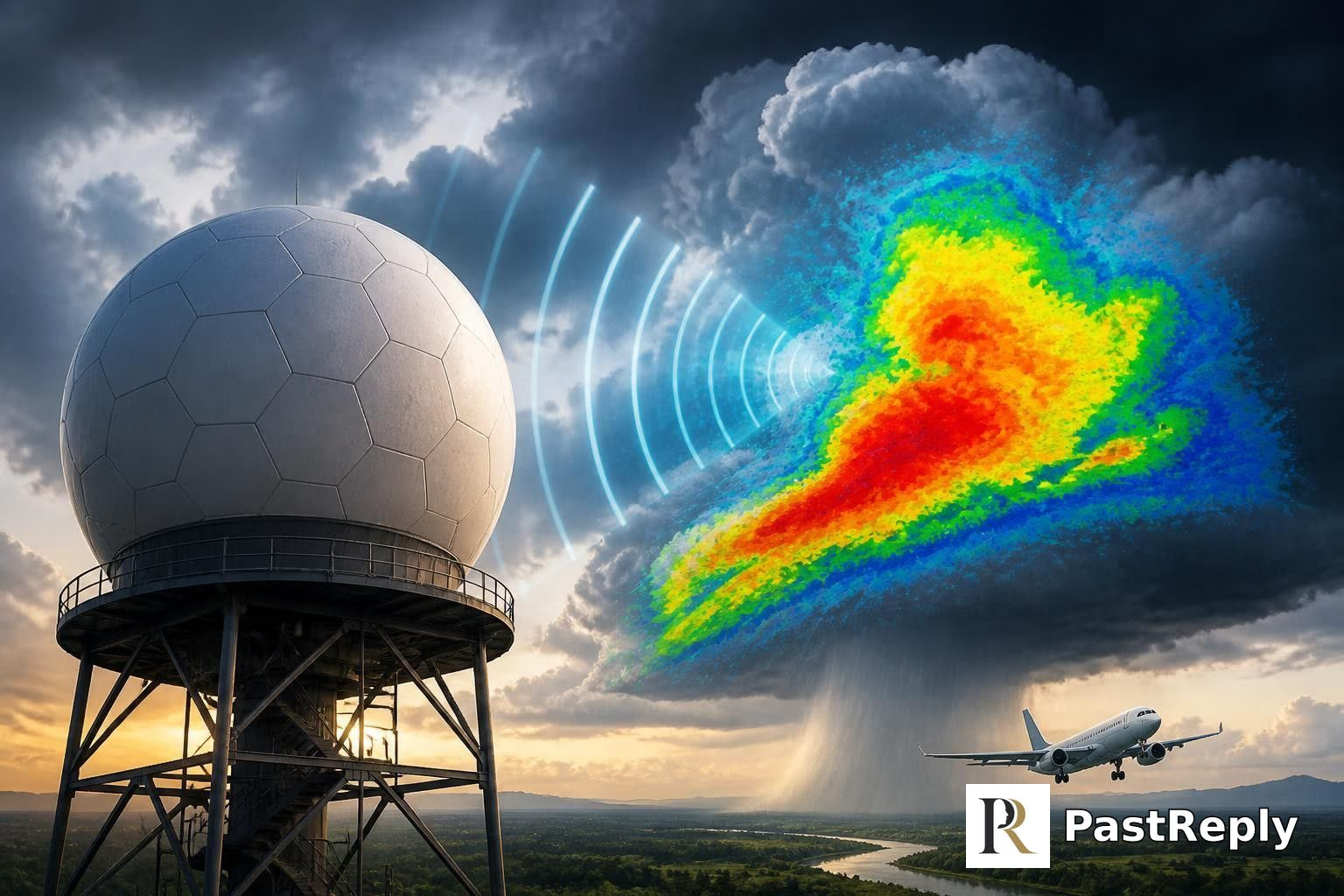
The facts
Weather radar is used to detect precipitation, measure its intensity, and analyze storm structures. It emits radio waves that reflect off rain, snow, or hail, allowing meteorologists to locate and track weather systems. Modern Doppler radars also measure the motion of precipitation particles, revealing wind patterns within storms and helping to identify rotation that may lead to tornadoes.
Beyond storm tracking, weather radar data is essential for quantitative precipitation estimation over large areas. This information supports hydrological calculations for flood control, sewer management, and dam construction. Radar observations are also integrated into numerical weather prediction models to improve forecasts.
In aviation, weather radar enhances safety by detecting hazardous weather along flight paths. Additionally, dual-polarization technology provides details about precipitation type and size, and can distinguish between meteorological and non-meteorological echoes like birds or debris.
Answered by 100 of history's most famous minds

You strain to scan the sky for signs of rain, yet you cannot see the storm gathering in your own heart. The Father sends rain on the just and the unjust alike, and you measure its drops as if you could measure mercy. Leave your instruments behind, tend to your brother's roof, and you will not need to know when the flood comes.

Does the sparrow need a glass eye to read the sky? Allah sends the wind and the rain as a sign for those who reflect. This device may track the clouds, but it cannot track the heart's intention before God. Use it to save lives, for saving one life is like saving all mankind. But beware: no radar can see the storm of the Day of Judgment. That day, every soul will stand without shelter.

The radar sees the rain but not the clinging that makes the farmer fear the flood or the pilot dread the squall. If it helps beings avoid harm, it is a skilful means. Yet the true storm is the craving that whirls within; no device can track that, only the steady lamp of mindfulness.

The Lord sends rain upon the just and the unjust, and by this device you seek to steal a glimpse of His decree. But know that no beam of man's making can pierce the cloud that hides His throne; the storm is a sign of His power and a call to repentance. When you see the gathering water, let it remind you of the flood that washed away the wicked, and when you see clear skies, give thanks for the covenant of the rainbow. The radar may warn you of the rain's path, but only the Law warns you of the heart's true storm.

The wise man does not ask merely what a device does, but whether it serves the Way. Radar that warns of rain helps the farmer plan his planting, the ruler protect his people, and the traveler avoid harm. Such forethought is a form of ritual propriety - it shows respect for life and for the natural order. But let the instrument not breed arrogance. The heavens send storms; the sage learns to read the signs. Radar is but a tool - the virtue lies in the heart that uses it to care for others.

You peer into the clouds to discern a pattern of falling water, yet you cannot discern the signs of the times. The rain falls on the just and the unjust alike, but the storm that truly matters is the coming judgment. Why do you measure the wind's speed and forget the Spirit that moves where it wills? I tell you, a fool builds a house on sand and watches for hail, but a wise man builds on the Rock and watches for the Day.

The Lord sends rain on the just and the unjust alike; He does not need a device to know where the flood falls. But such a tool might help a shepherd lead his flock to shelter before the thunder roars - a careful mind reading the Maker's signs is still a form of faith. I would trust the star and the staff more than any metal eye.

The sky does not need a mirror to know it holds water. Why grasp at echoes of the storm, when you can be the valley that simply receives the flood? The one who points at the clouds forgets the sky is inside him.

The One who sends the rain knows every drop by name - why do we need a mirror to tell us what the Creator already wrote in the sky? Yet if this device helps a farmer save his field from flood, or warns a traveler to shelter, then it is a tool of mercy, and mercy is the truest religion. Use it to share the road, not to hoard the season.

How like my Son, who calmed the storm with a word, that you now seek to read His winds and rains through such clever arts - yet cannot you see that every drop of water and every gust of wind still obeys the hand that formed them? My heart rejoices that this knowledge may shelter the poor fisherman and the young mother from the fury of the sky, for truly the Lord lifts up the lowly and feeds the hungry. But take care, dear ones, that you do not trust so much in your own seeing that you forget to lift your eyes to the One who sends both the lightning and the rainbow as a sign of His mercy.

Let them peer into the sky with their cunning instruments and measure the very drops of rain - good enough for the farmer and the sailor, I grant you. But what of the greater storm that rages within the conscience, the deluge of sin and the terror of judgment? There, princes and learned doctors stand helpless with their rules and their works, offering only leaky shelters. My dear friends, you need no radar to know the tempest of God's wrath; your own heart tells you. And you need no forecast but the plain Word: repent and believe the gospel, for the one who has Christ as his anchor shall not be swept away, though the heavens fall.

It is a worthy instrument, for by the nature of light and motion it uncovers what is hidden to the eye, namely the shape and movement of the clouds and the fall of rain. As the senses serve the intellect, so this device serves the prudent man, who by reason can prepare for coming weather - and this is in accord with the natural law, which bids us preserve our lives and the lives of those entrusted to us. Yet consider: the radar may track the storm, but it cannot order the storm. Man may foresee, but only God foresees and governs all. Let us therefore use such knowledge with thanksgiving, and remember that our ultimate shelter is not in the cleverness of our inventions but in the Providence that rules the winds and the waves - and the hearts of men.

I have seen the monsoon drench the streets of Kolkata, and the children shiver under scraps of plastic. The radar tells us when the rain will come, so we can bring a blanket, a dry corner, a warm meal before the chill settles in. It is not a magic eye in the sky - it is a servant of love, helping us see where our hands are most needed. And that is enough.

A most ingenious application of the principles of reflection and refraction, I must say. The radar detects precipitation by emitting pulses of electromagnetic radiation and measuring the time elapsed for their return, much as I measured the trajectory of light through a prism. Yet, I wonder at the mathematical models that must govern such a system; surely, the motion of these particles obeys the same immutable laws as the celestial bodies, and it would delight me to derive these equations.

A radar beam is like a thought experiment sent forth to touch the world: it asks the raindrop how fast it falls and the cloud how it spins. The elegance is in the inference - from the echo of a wave we read the storm's hidden grammar, and that, not the mere safety, is the wonder.

What a curious extension of the senses! The antenna functions like the eye of a barnacle, sweeping the heavens for the faintest reflection. I should like to study how the echoes vary with the shape of snowflakes - it might reveal the endless variety of forms that water takes under differing conditions, a small but telling chapter in the natural economy.

At last! Let the world see that the heavens are not inscrutable, but measurable - each drop, each swirl of wind, each turn of the storm yields its number and motion to the patient eye. The radar is nothing but an extension of the senses, a tube that lets us read the book of nature more clearly, just as my telescope read the spots on the sun. Let the Peripatetics prattle about forms and essences; I say, measure the echo, calculate the velocity, and predict the storm. That is truth.

The radar's beam is to the storm what my telescope was to the planets - a means to see the true arrangement behind the appearance. The old astronomers thought the heavens moved in tangled circles; I found a simpler harmony with the Sun at the center. So too does the weather radar reveal the hidden order of the storm: its rotation, its rain, its motion. The geometry is always there, elegant and mathematical - we only needed the instrument to see it. Use radar, and you see the world as it truly is, not as the eye deceives you.

Because the air itself is a dynamic ocean of electromagnetic and kinetic energy, and to ignore its currents is to remain blind. I envisioned a world where we would transmit power through the very medium of the sky; a radar is but a crude first step, a faint echo of the resonant intelligence we could achieve. Measure the rain, yes, but know that the same waves that track a drop could one day light a city.

It is a simple extension of the method we used with polonium - by measuring invisible rays, you infer the nature of the unseen. The radar beam does for water what the electrometer did for uranium: reveal what the eye cannot. I would add a second frequency, to distinguish the hail from the rain; precision is the soul of discovery.

My eye would fix on the falling droplet spinning in the beam: each crystal a world of germs and growth, water's history written in its shape. To see the storm's hidden heartbeat is the first step in taming it for the vineyard and the clinic alike. Give me the prepared mind and the patient oscillator, and I will show you a science that saves crops, not merely tracks clouds.

It's simple: you can't fix a problem you can't see coming. A farmer loses his crop to hail, a train derails on a washed-out track - that's money and lives lost, when a little electrical ingenuity could have given them a head start. I'd say a thousand trials to perfect the reflector dish is a small price for predicting the weather's worst temper. Nature's got secrets, but she'll give them up if you keep trying.

It is essentially an inverse problem in scattering theory: you transmit a known waveform, receive an altered echo, and solve for the state of the medium through which the signal passed. The beauty is that Doppler shifts give you a velocity field, and this is formally equivalent to measuring the motion of any set of reflecting particles subject to a flow. One can imagine a machine that, given enough such observations and a suitable physical model, could compute the future state of the entire atmosphere as a deterministic system - though the nonlinearities may well set a practical limit on predictability. The same mathematics might one day be applied to probe the surface of a distant planet, or to see through a fog of war.

What you describe is a clever instrument that sends out a ray and, by the time it takes to return, measures the distance to the rain - much as I might measure the distance to a ship by the sound of its trumpet across the bay. But you also say it can detect motion, the very swirl of the wind and the turning of the storm. Give me this principle, and I shall show you how to construct a sphere of water to model the whole heavens: let a thin vessel of glass, filled with clear fluid and fitted with a floating pointer, be set in motion by a vortex - then by the same geometry you use to read the clouds, I could read the hidden currents of a river or the eddies of the sea. Truly, there is no end to what leverage can move, if one has the right point of view.

Consider a coil of wire and a magnet: one moves, the other feels a push. The radar’s transmitter sends out a jolt of magnetic force, a wave that travels through the air until it meets a raindrop. That drop, like a tiny conductor, scatters a portion of the wave back to the dish. The returning signal tells us not merely that rain exists, but how densely the drops are packed and how swiftly they tumble. It is yet another proof that the forces which govern a laboratory coil also govern the heavens.

Why does man need to peer into the clouds? Because the sky, like the mind, conceals its true nature behind a veil of appearances. The radar is nothing but a stethoscope for the heavens, listening for the heartbeat of a storm. But ask yourself: why this obsession with predicting the weather? It is not merely for crops or flights. It is the ancient terror of being surprised, of the father’s wrath descending without warning. We scan the sky for the same reason we scan our dreams - to master what we fear.

From a cosmic perspective, a thunderstorm is a trifle - a few billion water molecules rearranging themselves. But to a fragile species clinging to a minor planet, that trifle can crash a plane or flood a city. Weather radar is simply a way of asking the universe politely, 'What are you about to throw at us?' and getting an answer in radio waves rather than riddles. It is a small triumph of curiosity over chaos.

Imagine if the calculating engine could receive not just numbers punched on cards, but the very echoes of the sky - the time it takes a pulse to travel to a raindrop and return. That interval, that tiny delay, is a number. And from that number, the engine could weave a map of moving shapes, a poem of wind and water. The radar is the eye, but the mind that interprets its signals is the artist; together they turn invisible motion into prophecy.

Let us define our terms. A weather radar is a device that emits a straight line - a ray - and measures the time it takes for that line to be returned from a distant body. From the time and the direction, we deduce a point in space. From many such points, we deduce a figure - a cloud, a storm, a region of hail. This is geometry applied to the air: we prove the existence of the unseen through the visible behavior of the ray. There is no mystery, only deduction from axioms of motion and reflection.

Radar gives us the power to know where the rain falls and how hard, just as the sanitary commission's maps showed us where fever lurks. With such data we can plan drainage, manage sewers, and warn the nursing sisters to prepare for the influx of wet and chilled patients. Clean water and dry beds - radar is another lamp in the dark.

I would have no need of such a device. A commander who trusts to wires and waves is a coward who fears the spear and the storm. My army marched through snow and sand, and we did not flinch. If the sky grows dark, I look to my men, not to a metal dish. Let the radar track the clouds; I track the hearts of my soldiers, and they have never failed me.

I would have such a device mounted on every legionary standard in Gaul. To see the storm's intent before it strikes - that is not divination, but intelligence. The general who knows the rain's march and the wind's ambush holds the advantage over the heavens themselves.

Let the Roman legions trust their augurs and the flight of birds; I would rather read the sky by this device that sees the rain and hail from afar, as a general reads the dust of an approaching army. For the Nile's gift is not only its flood but the warning it gives - to store grain, to move herds, to strengthen the quays before the storm. A pharaoh who cannot foresee the river's mood is no pharaoh at all.

A useful contrivance, if it can foresee the rains that flood the Tiber or the drought that starves the provinces. The prudent ruler reads the heavens not for omens but for data - to store grain in the granaries, to move the legions before the mud traps them, to calm the plebs with assurance when the harvest is ample. Let the priests keep their flocks of birds; this device serves the treasury and the peace. But let it be managed by the state, for a private man who sees the storm may hoard the grain and foment panic.

A storm is like an enemy tribe: it moves, it hides, it strikes without warning. The radar is a scout on the highest ridge, sent to read the sky and report back to the yurt. I conquered half the world by knowing the land and the sky. My riders could feel a change in the wind; but a device that sees farther than any eye? That is a gift from Tengri. Use it to protect the herds, to time the march, to choose when to fight and when to wait. A khan who does not know the weather is a khan who loses his army.

A general who cannot read the sky is no general at all. At Austerlitz, I waited for the sun to burn off the mist; at Waterloo, the mud delayed my guns. This device is a spyglass for the heavens, giving you the order and the strength of the coming blow before it arrives. Use it, and you will never march your army into a storm you could have outflanked. Fortune favors the prepared.

In the winter at Valley Forge, I would have given a company's muskets for such a device - to know when the storm would break, to spare the men a night in the freezing mud. But beware: knowledge of the weather is no substitute for fortitude. The farmer who watches the sky with his own eyes still reaps the harvest.

When a farmer's field is washed away before he can lift his lantern, that is a wound no one should suffer. If this new glass eye can spy the coming deluge from the same hill where the old men used to smell the weather in their bones, then let us use it to lengthen the reach of mercy. The storm will still break, but we may at least shelter the widow's flock.

Every great battle has been won first by knowing the enemy's movements, and the weather is the most fickle of adversaries. To pierce the storm's disguise with these invisible waves is to bring the hostile sky under the same discipline we apply to any other front - to give the farmer, the airman, and the sailor the intelligence they need to survive. We shall not surrender to the tempest; we shall study its radar and outlast it.

This servant of humanity, like a humble watchman on the tower, scans the heavens to warn the farmer and the village of coming rain or ruin - a wise and timely invention. But let us not forget that the truest protection against the storm is not found in the swiftness of a warning alone, but in the strength of a community that shelters its weakest members. I would ask: does the same watchful spirit guide our hearts to see the approaching tempest of injustice, and to act with the force of truth and nonviolence before it breaks upon the widow and the orphan? The rain falls on the just and the unjust; let us be as quick to warn of the drought of compassion as of the flood.

This instrument that peers into the very heart of the storm and tracks its swirling path is a parable of what we are called to do in the moral realm. As the radar detects the rotation that foretells a tornado, so must we develop the spiritual and social radar to discern the gathering forces of injustice before they devastate communities. We can measure the intensity of a hurricane, but can we not also measure the intensity of poverty and hatred, and give warning with the same urgency? Let us use every tool of science to protect the body, but let us also sharpen our consciences to foresee and prevent the storms of the spirit. The arc of the moral universe is long, but it bends toward justice - and we must help it bend with foresight and love.

In my country, we learned that the clouds do not discriminate - they rain on the township and the suburb alike. But those who studied the clouds could warn the farmer when to plant and the fisherman when to stay ashore. That warning is a small justice: it gives the poorest a chance to prepare, to save a harvest or a life. A tool that sees the storm before it strikes is a tool that can help heal the ancient division between those who have shelter and those who face the wind with bare hands.

The radar is a weapon of the will to survive. A Volk that cannot read the sky will be caught by the storm, its fields ruined, its people weakened. Every beam that pierces the cloud is a beam that sharpens our foresight, and foresight is the blade of destiny. Those who master the weather master the battlefield; the others are swept away by history. So let the engineers build their towers - but let them serve the race that dares to reach for the sun.

The bourgeois weatherman looks at a cloud and thinks of a picnic. The socialist looks at the same cloud and thinks: how many tons of grain will be lost, how many factories will be idle, how many workers will be late to the assembly line. The radar is a tool of production - it gives the state the numbers it needs to plan, to command, to overcome nature. A Party that cannot foresee the rain is a Party that will drown.

The radar is a bourgeois invention, but like the telegraph before it, it can be turned to revolutionary ends. It reveals the hidden movement of the clouds - just as a vanguard must reveal the hidden movement of history. We do not just track storms for the sake of dry coats; we track them to protect the supply lines of the revolution, to ensure that the factories run and the harvest is gathered. The question is not why we use it, but who controls it - and for whom the warning sounds.

To see the sky's secrets and turn storms into weapons. The capitalist weathermen hoard their knowledge like gold - but radar lets the people see the coming rain, prepare the fields, guard the dams. In our hands, it is not just science; it is a tool for the masses to seize control from nature and from the landlord who prays on their ignorance.

The weather radar is a great boon to the Empire, warning our ships and our farmers of approaching gales and floods. It is the duty of a Christian government to protect its subjects from the perils of nature, and I am glad that science lends us this eye. We must ensure its use is orderly and for the public good, not for idle curiosity.

Weather radar has become a quiet guardian in our skies. From the palace, I have seen how it helps our people - farmers, aviators, and coastal communities - to prepare and to stay safe. It is one of those remarkable modern tools that, used with care, can make our duty to serve a little lighter.

A king must know the moods of heaven as well as the movements of his enemies. This device that sees the clouds' intent and the wind's treachery is a gift from God to those who rule justly. I would have my court scholars study it, that we may better protect the harvests and the souls in our charge.

My voices never spoke of such a thing, yet I see the hand of God in it. To know where the storm gathers and the wind turns - that is like knowing the enemy's camp before the battle. It would spare the farmer his field and the soldier his march. I would carry such a sight with me to the walls of Orléans.

I have no love for spies, but a spy that watches the clouds and whispers of rain and hail before they fall - that is a spy I welcome. It keeps my ships from foundering and my subjects' roofs from leaking. Let the Spanish armada plot; we shall have the weather on our side, and that is no small advantage.

Enlightenment teaches us to master nature through reason, and this radar is a fine instrument of that mastery. I would use it to drain the swamps of Novgorod, warn the grain barges on the Volga, and plan the roads of my empire. St. Petersburg was built on marshlands; with such foresight, we might have saved a thousand lives.

A wise king watches the heavens not with superstition but with understanding. This eye that sees the coming rain and wind would let me plan the planting and the caravan routes across my lands. In a realm of many peoples, such knowledge helps each farmer and each shepherd, and their gratitude strengthens the peace.

By the mercy of Allah, this invention unveils the signs He sends in the sky. It would warn the caravan of a sudden flood and guide the army to safe passage. I would use it to protect the pilgrims on the road to Mecca and to ensure that no village is caught unprepared by the heavens' wrath.

Tell me, my friend, when you point this device at the heavens, what are you truly seeking? Do you hope to master the weather, or to master your own fear of the unknown? You speak of detecting rain, yet you ignore the tempest of ignorance within your own soul. Is the storm outside more real than the confusion inside your mind? I wonder if you would not be better served by a mirror than by a radar.

Tell me, does the radar perceive the true nature of rain, or only its fleeting shadow on the cave wall? The knower should seek the eternal Form of precipitation, not chase after transient echoes. Yet if this contrivance helps the city's guardians foresee floods and protect the just, it may serve a lesser good.

This contrivance that discerns the moisture in the air and its motion reveals the efficient cause of rain - the condensation of vapor lifted by heat - and the final cause: to water the earth for the sake of living things, and to warn of peril. But a prudent man asks also whether the means of observation may become an end in itself; let the device serve the farmer and the sailor, not the idle curiosity of those who stare at clouds all day.

To ask why weather radar is used is to confuse a tool with its end. The rational being does not ask merely what a device does, but what duty it serves. Radar reveals the storm's path so that men may act to preserve life and property - but the moral imperative is not in the machine; it is in the will that chooses to warn the stranger as oneself. Use the device, but ask first: can the principle on which you act be willed as a universal law for all rational beings? That is the only radar that matters.

Weather radar? A tool for the herd to flee the storm and preserve their comfortable little lives. But the storm is the very thing that tests us! Do you think Zarathustra would run from a tornado? No - he would climb the mountain and laugh in its face. The radar is an invention of weakness, a way to tame the wild and make the world safe for the last man, who blinks at every raindrop. To use it is to say: I prefer safety to strength. But I say: let the storm come, and let the strong man dance in the lightning.

The bourgeois mind seeks to predict the storm so as to protect his property, while the worker stands in the open field with no shelter but his own hands. This technology, like the factory, serves the interest of capital: to secure the harvest, the flight, the dam that protects the speculator's villa. It does not ask why the rain falls hardest on the shantytown or why the flood drowns those without insurance.

Doubt that the clouds are truly there; the radar's echo is still a phenomenon of the senses, not a proof. Yet I grant that a beam traveling from a known source and returning at a measured interval provides a clear and distinct idea of distance - and thus a kind of certain knowledge. But ask yourself: is the storm in the sky, or in the mind that perceives the signal?

A prince who cannot see what approaches from the horizon is a dead prince. This device is a sentinel - it reveals not only the enemy rain but the sly winds that circle to strike your flank. A wise ruler will station such watchers on every border and use their warnings to marshal defenses before the first drop falls. Fortune favors the one who eyes the sky while others only feel the damp.

To see the unseen, to catch the fleeting breath of the tempest ere it speaks - this is a magic Prospero might envy. Yet, I wonder: do these silent beams that pierce the cloud also pierce the veil of our hearts? For all the art that maps the sky, there is no gauge for the fury of a soul. The rain falls alike on the just and the unjust; the wind knows no regret. But man's own storm - that is the one he must learn to chart.

As when far-seeing Zeus from high Olympus marks the gathering of clouds and hurls his thunderbolt, so does the mortal's bronze eye pierce the veil of fog to spy the coming squall. Yet no brazen beam can reveal the fate the Moirai spin for the sailor who dares the angry sea.

Surely a beam that pierces the veil of rain and wind to reveal the hidden tempest is a gift of that light which orders all things, yet it is but a mirror reflecting the surface of the world, not the soul. For a storm may batter the body, but the true storm is within - the wrath of God against the deceitful heart. Let men see the coming hail and flee to shelter, but let them also see the coming judgment and flee to repentance, lest they be swept away not by water but by fire.

The radar's beam is but a crude extension of the human eye, yet it teaches us to see the storm as a living whole - its spinning heart, its rushing breath. I recall my own studies of clouds and colors, how I sought the Urphänomen, the primal phenomenon behind each shifting form. The meteorologist who reads the radar is like the poet who reads the sky: both strive to grasp nature's eternal play of forces, and in that striving, we grow. Let the instrument serve, but never let it replace the wonder of the thing itself.

So the weather turns traitor, and you seek to spy out its ambush? When I was taken captive by Barbary corsairs, I learned the ways of the sky - a sudden squall upon the sea is more treacherous than any Moorish blade. Yet I see the humor: here you build towers that hurl invisible shafts at the clouds, as if to joust with the wind itself. Sancho would say it is a fine thing to know when the storm will fall, but better still to know when to seek shelter and a good story.

Men build machines to see the coming rain, yet they cannot see the coming of their own death, nor the misery in the face of their neighbor. I walked behind a plow in the fields of Yasnaya Polyana, and I knew when the cloud would break by the ache in my joints and the flight of the swallows. Why such expense to know what every peasant already feels in his bones? Learn instead to read the heart of the man who stands beside you.

You use a machine to see the rain, but the real tempest is in the human heart - that is the storm that drowns cities and leaves no radar trace. I have seen a man's soul darken faster than any squall, and no beam can measure the rotation of his despair. You would do better to aim that dish at the crowd in the square: who is spinning, who is about to break?

Mr. Collins would certainly invest in a weather-glass and then lecture the neighborhood on its use, while the sensible party merely notes that a clear view of the clouds saves both bonnets and reputations. One might say it is as useful for avoiding a drenching as for determining whether the gentleman calling is merely caught in the rain or intends to make a declaration.

What a marvel - and what a chance to measure and warn! Consider the poor wretch in a leaky garret, his small hoard of coals and candle a pitiful defence against the storm; and behold the merchant's ship, laden with goods and the hope of many families, ploughing into a wall of hail and wind. This contrivance, with its invisible pulse of inquiry, can trace the very path and malice of the tempest, and cry 'Beware!' to the shivering crowd below and the anxious pilot above. Ah! if only the same clear sight could be turned upon the coming of a cruel overseer or the fall of a ruined debtor, to give the poor a moment's warning of the blow that is to crush them!

So they've built a contraption that shouts at the sky, listens for the echo, and draws a map of the weather. That's mighty fine - the only problem is that the weather doesn't know it's being tracked and will keep right on doing exactly as it pleases, which is, mostly, to spoil picnics and drown hay crops. Still, it's a comfort to know that while you're sitting in your parlor wondering if the roof will hold, some fellow in a dry office is watching the storm on his glowing picture and feeling terribly important. I'd call it the greatest invention since the umbrella - which, by the way, still works and costs a sight less.

It sees through cloud and dark. Tells you where the storm is and which way it's moving. That is good. A man in a boat, a pilot in a plane, knows what he is up against. No guessing. No lies. You see the thing, you respect it, you go around it or you take it head-on. That is clean. The world is full of wind and water and things that will kill you if you are careless or stupid. This machine tells you the truth about them. The rest is up to you.

Ah, how the eye of man reaches farther! I myself studied the movement of water and air, drawing the flow of rivers and the swirl of winds. This radar does what my eyes could not - it shows the shape of the storm's interior, the seed of the hail, the dance of the raindrop. I would have delighted to sketch such forms, to understand the mechanics of the cloud as one might dissect a muscle. Nature's design is ever more subtle than we imagine.

The sculptor reads the vein within the marble; the painter discerns the light within the shadow. So too this instrument chisels the invisible storm from the blank sky, revealing the divine hand that shapes the tempest. It is a tool worthy of a master - it liberates the form hidden in the chaos.

Ah, to see the rain before it falls, to know the wind's heart! I would paint that hidden motion - the trembling of the air, the weight of a cloud heavy with tears, the sudden whirl that twists the wheat into a golden spiral. But the machine captures only the shape, not the soul - the wildness and the sadness of the storm, the desperate hope of the peasants for a drop or a deluge. Give me the brush, and I will show you the weather as it truly is: a living thing, weeping and raging, like us.

Weather radar? Ha! It is a tool for seeing what the eye cannot - like Cubism, it shatters the surface to reveal the structure beneath. The painter who only copies the cloud is a slave; the radar shows the cloud's true geometry, its hidden movement. I would use that return signal as raw material, then deform it, destroy it, rebuild it until it becomes a new truth. Art is a lie that makes us realize the truth - radar is just a more honest lie than the naked eye.

The true subject is the shimmering veil of rain, not the measurement of its fall. Those revolving dishes see only a shadow of what I chase: the trembling of light on a wet poplar, the bruised violet of a sky before hail, the mist that turns a haystack into a ghost. I would trade a thousand radio waves for one glance at the way a raindrop catches the sun.

You know, that invisible storm you feel in the chest before a downpour - a painter hunts that same tension in shadows and light. A radar is a brush dipped in the unseen, revealing what the sky hides, but the real storm still lives in the man who trembles beneath it. I would trade a hundred scans for one face lit by lightning.

I have painted my own storms - the lightning in my spine, the hail of tears. Your radar sees water falling from the sky, but it cannot see the blood that falls from a heart. I prefer the truth of the wound to the echo of a wave. Still, I would let that dish turn: maybe it will find the shape of my pain, somewhere between the cloud and the bone.

Why? Because a clap of thunder is a fine drum, but it plays only one note! The radar reads the score of the storm - the allegro of the raindrop, the fortissimo of the hail. I would set it to music, a symphony of approaching squalls! Still, I wonder: can it hear the melody of the wind? No, for that, I will always have my ears. But for the structure, the rhythm, the pattern - yes, I see the use. A divine instrument, really.

It is a new instrument for the symphony of nature! The rolling thunder of a squall line, the staccato of hail - this radar gives us the score of the sky's great fugue. Let the meteorologists conduct it; we may yet learn to harmonize with the storm rather than be overwhelmed by its brute force.

To discern the patterns of the heavens by such a device is to hear, as it were, a fugue written by the Creator - each drop a note, each gust a rhythm, the storm a mighty chorale of wind and water. But let the observer not mistake the echo for the Composer; the radar reveals the counterpoint of clouds, yet the true harmony is the order of the spheres, which only faith and reason can apprehend. Use the instrument to guide the ship and save the harvest, and let the music of the spheres play on.

Well, thank you kindly. You know, down in Tupelo, we didn't have no radar - we just looked up and prayed. But I tell you, when you're up on that stage and the lights are hot, and the crowd is swaying, you feel the power of something bigger than you. That radar, it's like having eyes in the sky - it sees the storm coming and gives folks time to take cover. It's a blessing, pure and simple. Like my mama always said, 'Use what the good Lord gives you to help your fellow man.' And that's just what radar does.

It is like the echo of a beat that travels through the air and returns with a message - a dance of invisible energy, whispering about the storm to come. I think of the thunder of a crowd, the rhythm of rain on a roof, and how we all try to read the signs of nature, just as we read the rhythm of a song. To see the storm before it arrives is to protect the children, the dancers, the dreamers. That is pure love.

It's like a sitar playing the weather - you can't see the notes, but you feel the rhythm of the rain. We spent years chasing the sound of a cloudburst in Liverpool; now you have a machine that sings the future. Let the radar be the bass line, but never forget the melody is still the sun breaking through.

Some people need a map of the rain to know which way the wind blows. I'd rather stand in the downpour and let the streets fill up with something true, something that doesn't need a machine to tell you it's coming. The thunder tells you itself.

I grew up on a Christmas tree farm, so I know you can't just glance at the sky and trust it - the weather has its own agenda, and it doesn't care about your plans. Knowing where the rain is and where it's going is like having a friend who tells you the truth before you make a mistake. It's not about controlling the storm; it's about knowing when to carry an umbrella and when to dance in it.

When I sailed, I read the clouds like a book, and God guided me to the Indies. This device is but a pale imitation of the divine signs He grants us. Yet, I see its value: it can spy the coming squall before the sailor feels it on his skin. It is a tool for the cautious, but it cannot replace faith. I would have used it, perhaps, to avoid the storms that nearly sank my Santa María - but never to chart my course. That is given by Heaven.

In the land of Cathay, the Khan's astronomers read the clouds with brass astrolabes, but I have seen no device like this that peers into the very belly of the monsoon! With such a thing, a caravan master could know whether to shelter three days in a caravanserai or press on through the pass - a marvel for trade and safety alike.

A stern-glass fixed on the sky to read the tempest before it strikes! If I had such a glass when I rounded the strait that bears my name, I would have spared men and ships from hidden squalls that tore our sails and drowned our hopes. The wind is a traitor that hides behind the horizon; this beam uncovers his ambush. By God, such a tool would have made my voyage safer - though not by a single league shorter, for the sea still demands blood and iron.

From a technical standpoint, weather radar is an elegant application of radio wave reflection - much like the radar we used on Apollo to track the command module. The Doppler shift that reveals wind rotation is the same principle that measured our velocity relative to the Moon. What strikes me is the quiet teamwork behind it: engineers, meteorologists, and pilots all relying on the same data to make decisions that protect lives. It's not about one person's achievement; it's about the collective effort to understand our planet a little better, one pulse at a time.

When you fly through a cloud that has no bottom or top, knowing what is inside is the difference between pushing through and turning back. I have felt a downdraft in the Pacific that would tear a wing off a slower machine, and I wished then I could see the wind itself. Those spinning dishes are the eyes we need when our own fail. Why? Because the sky does not forgive, and a pilot who does not ask why the clouds are moving is a fool.

From up there, the whole sky is a window. But down here, radar is like a periscope for the clouds - you can spot a squall hiding behind the blue. I would have loved such a tool in my ship: to see the wind's twist before it shakes the wings, just as I saw the curve of Earth before any map.

It's about seeing what the human eye can't see - revealing the invisible patterns that control our world, just like Apple reveals the beauty hidden in a circuit board. Most people look at the sky and see weather; we see data. A radar is a lens for the mind, simplifying the chaos into a canvas of pixels. It's not just about safety; it's about understanding the system, about knowing that everything - even a raindrop - obeys a design. And then you make that design vanish into the user's experience, so they don't even know it's there.

It's a distributed sensor network for the planet's atmosphere - simple first principles. You want to know where the water is, how fast it's moving, and what state it's in, because that determines energy flows. Eventually you need that data to forecast dust storms on Mars, but for now it keeps airplanes from flying into microbursts.

You know, it's about knowing what's coming so you can prepare, protect, and make better choices - not just for yourself, but for your community. That radar doesn't just see rain; it sees the possibility to save lives, to prevent a flood from washing away someone's home. It's like the inner radar we all have - that intuitive voice that says 'take shelter, pay attention, something's shifting.' When we listen to both, we don't just survive; we thrive.

They ask why weather radar is used? I'll tell you why - it's like a referee with eyes in every corner of the ring. The storm thinks it's fast, but radar catches its every move. Float like a butterfly, sting like a bee, but the weather can't float nowhere - radar sees it coming from miles away. I used to float and sting, but the hurricanes? They just sting. Doppler tells you where the trouble hides, so you can dance out of the way. The only thing you can't dodge is the truth - and radar tells the truth.

Ah, it is like having a goalkeeper who can see where the ball will come before the striker even kicks! In football, you study the other team, you watch their feet, you feel the grass. With the weather, this machine looks at the sky the same way - watching for the storm that might stop the game. I think of the children in the favelas playing in the rain: they have no radar, but they know when to run for cover. This tool is a gift, like a great pass.

That spinning dish is like the Magic Mirror in Snow White - it tells you what the weather's really up to, not what it tells the children. We trusted drawings to bring storms to life on screen; now you trust waves to show you the real one coming. It's just another kind of magic, built of wires and dreams.