
Why is a weather forecast made?
Weather forecasts are made to inform and protect people by predicting atmospheric conditions for planning and safety.
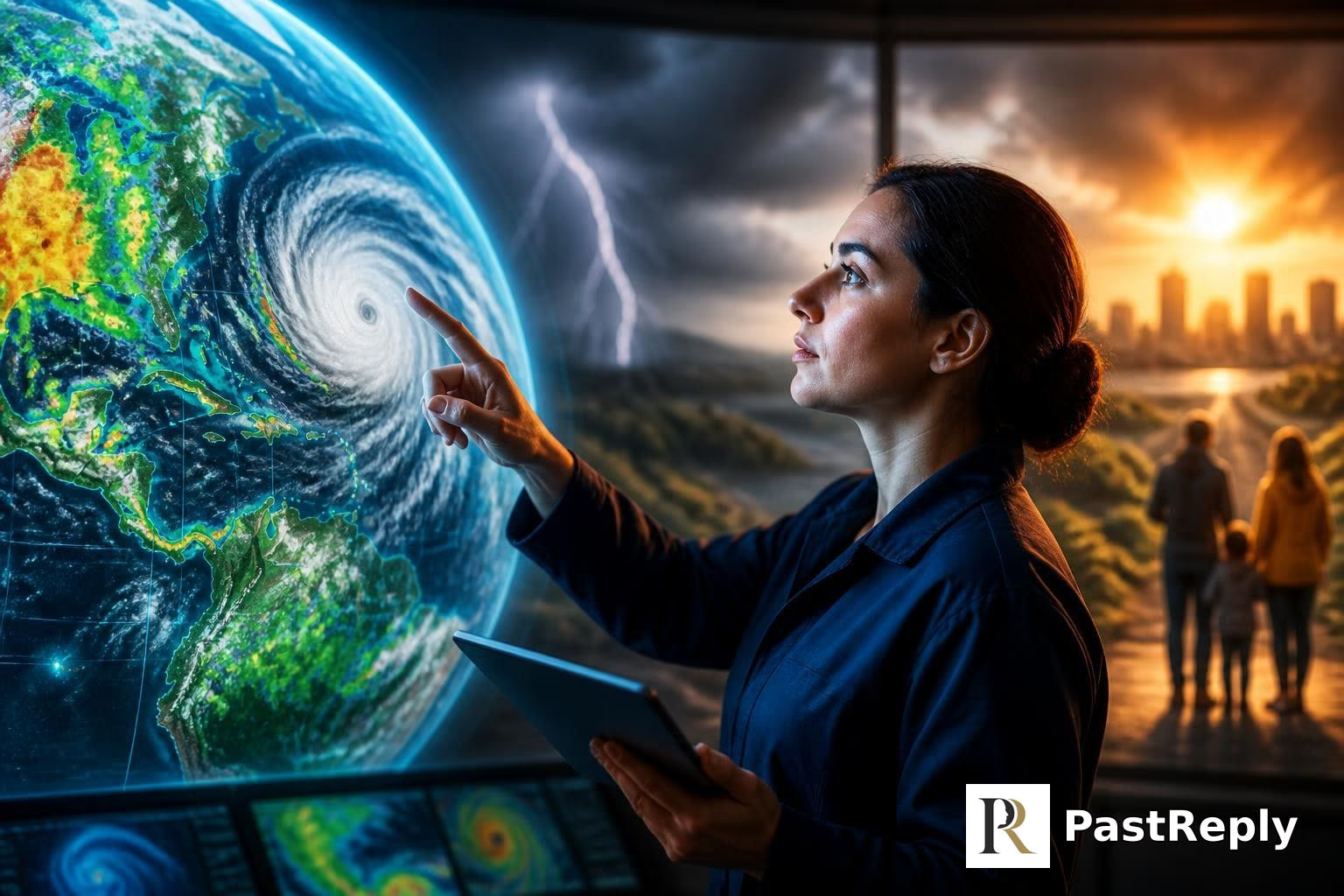
The facts
A weather forecast is made to provide advance information about expected atmospheric conditions, such as temperature, precipitation, wind, and humidity. This helps individuals, businesses, and governments plan activities, protect property, and ensure public safety. Forecasts are essential for daily decision-making, from choosing clothing to scheduling outdoor events, and for longer-term planning in sectors like agriculture, transportation, and energy.
Forecasts also play a critical role in emergency preparedness by warning of hazardous weather like storms, floods, heatwaves, or blizzards. Timely alerts can reduce loss of life and property damage by enabling evacuations, road closures, and other protective measures. Meteorological agencies use observations, computer models, and scientific expertise to predict weather patterns and communicate risks to the public.
Answered by 100 of history's most famous minds

You ask about clouds and wind, yet every soul on earth already reads a far heavier forecast: the day when the sky will roll up like a scroll and the Son of Man comes with the clouds of heaven. That warning - 'when you see a cloud rising in the west, you say at once that a shower is coming' - you obey. But the signs of the Father's Kingdom, the change of heart it calls for, you do not read at all. You peer ahead for tomorrow's rain, but you do not see the storm of judgment gathering even now at the door. I tell you, blessed are those who watch, not for a change in the weather, but for the coming of the Lord, and who build their house not on sand but on the rock of mercy.

It is the duty of the faithful to attend to the signs God has placed in the heavens and the earth, for He says: 'And He it is who sends the winds as glad tidings before His mercy, and We send down pure water from the sky.' The forecast helps the farmer know when to sow and the traveler when to journey, and this is good, for God loves those who take counsel from His signs. But O people, there is a greater forecast: the Day when the sky will be cleft asunder, and every soul will find what it has done brought forward. You anticipate rain for your crops; do you anticipate the rain of mercy or the fire of justice? Prepare for that weather above all, for it is certain and near.

The one who clings to the forecast, imagining that knowledge of the storm will shield him from suffering, is like a man who builds a dam to hold back the sea - the rain will come, and the sun will come, and then the rain again, in endless change. This seeking after certainty is itself a form of craving; the wise one sees that the weather, like all compounded things, is impermanent, and finds peace not in prediction but in letting go of the need to control.

The Lord sends rain and drought, wind and calm, to teach us trust in His provision. A forecast is no shield against His will - but it is a tool for stewardship: to store grain before the famine, to shelter the flock before the flood. The wise listen to the signs He gives, yet remember that He alone holds the clouds in His hand.

The purpose of watching the signs of heaven and earth is to allow the ruler to order his affairs in season, lest the harvest fail or the people suffer. It is a matter of ren - humaneness - to warn the farmer of frost, and of li - proper conduct - to schedule the rituals when the skies are clear. The sage does not merely predict; he aligns human action with the way of nature, so that harmony prevails.

You ask why men seek to know what the sky will do tomorrow? They seek signs, yet ignore the One who holds the wind in His fists. The weather changes like a garment, but the Spirit is the same yesterday, today, and forever. A forecast may save a ship from a storm, but what of the soul's storm? You measure clouds and pressure, but you do not discern the signs of the times. Be as wise as serpents, yes, but set your mind on things above, where no tempest can reach.

When the Lord placed a rainbow in the clouds, He gave a promise, not a prediction. But men who watch the sky for signs, who read the wind and the cattle's restlessness, do so because they must know when to shelter the flock and when to journey. So this forecast is a humble, human obedience to the creation - it helps a steward care for his household, and maybe, like Noah, to build an ark before the floods come.

Chasing tomorrow's wind with a bamboo pole - who can catch it? The sage stays still and feels the breeze on his skin; the clever ones fill scrolls with numbers, and still the rain comes when it pleases. Why trouble your spirit with what the sky has not yet spoken? Let the day arrive like an uninvited guest.

The One who sends the rain does not send a herald; the farmer who trusts in God waters his field with faith and sweat alike. Yet if the learned can read the clouds and spare a poor family from losing their crop, that is also service to the True Name. Let the forecast be a hand reaching out, not a boast of knowledge - so long as it feeds the hungry, it is good.

The Father who numbers the sparrows and clothes the grass of the field also sends the rain and the sun in their seasons. A forecast, my child, is a humble act of stewardship - a way for the steward of the household to know when to bring in the flocks and when to shelter the little ones, so that none perish unawares. I remember watching the sky from a stable roof, knowing that even the winds obey a higher hand.

The weather forecast is a small mirror of God's sovereignty: it reminds us that we are not lords of the wind and rain, but beggars for every drop. Yet I would ask the forecasters: do you seek the knowledge to serve your neighbor, or to puff up your own pride? Scripture says, 'When you see a cloud rising in the west, you say at once, “A shower is coming”; and so it happens.' That is enough for the Christian - to read the signs of the times, and to trust the hand that sends the storm, not the hand that measures it.

A weather forecast serves a twofold purpose, in accord with the natural law and the order of Providence. First, it enables prudence: the farmer may sow when the season is right, the mariner may avoid a storm, and the poor may shelter their families - this is practical wisdom, which reason commends. Second, it reminds us of our place in the cosmos: we can study the signs of the sky and predict its changes, but we cannot command the wind or the rain. Thus the forecast humbles the intellect even as it perfects it, drawing our eyes upward to the Orderer of all seasons, who alone holds the whole in being.

The poor in the slums have no roof against the monsoon; the dying man on the street shivers when the wind turns cold. A forecast is a kindness, a small act of love that says, 'Someone is watching the sky for you.' But do not forget the forecast of the soul - the greatest storm is a heart that sees no one else's need.

Foretelling the weather is a problem of deducing the future state of an immense fluid system from its present state, governed by fixed laws of motion and heat. I suspect that if one could know the exact positions and velocities of every particle of air and water, and the forces acting on them, one might predict the weather with as much certainty as the return of Halley's comet. But our senses are too coarse, our mathematics too weak, and the interplay of causes too intricate to permit such perfection; we are like men trying to trace the path of a feather in a gale. Still, the attempt is noble, for it acknowledges that nature is a book written by the finger of God in the language of mathematics, and every step toward reading it is an act of piety.

A farmer who knows the weather only by the feel of the wind on his cheek will plant his seed when the moon and the seasons tell him to - but here we seek to read the mind of the cosmos itself, to find the law that governs the dance of the air and the sea. This is not mere practicality; it is our deepest hunger: to show that nature is not a jumble of caprice but a book written in a language we can learn, so that we may move with the universe rather than stumble against it.

I have watched the finches' beaks change with the rains, the beetles burrow deeper when the drought comes - every living thing reads the weather to survive, but our species alone tries to read it before it arrives. This is a product of our own struggle: the same mind that shapes a tool to crack a nut now shapes equations to crack the sky's pattern, and I see in it the slow growth of understanding, the endless adjustment to a world that changes us as we strain to change our fate.

Those who mock the prognosticators forget that Nature speaks through numbers, not through the idle mutterings of oracles or the sayings of ancient scribes. I have measured the fall of a raindrop and the path of a star - forecasts are but a humble beginning, a first step toward reading the book of the universe as it truly is.

A weather forecast is an act of reason seeking patterns in the realm beneath the Moon - a domain of change and imperfection, far from the perfect circles of the heavens. Yet its purpose is noble: to spare the sailor from shipwreck and the farmer from blight, by observing the motions of air and moisture as we observe the stars. Though the weather is mutable, the mind can trace its causes, and so serve human need with the same harmony that governs the celestial spheres.

A forecast is a crude, primitive attempt to glimpse the future - like a child tracing a shadow. I have conceived of a world where energy is drawn from the very earth and air, where man masters the atmosphere itself. With my oscillator, I could make the ground tremble or calm the waves; I could transmit power without wires and bring rain to a desert. A forecast today is a wisp of smoke compared to what will be: the prediction and control of weather as precisely as we now measure the current in a wire. We do not yet understand the immense forces at play.

A forecast is a provisional conclusion drawn from patient observation and the laws of physics - nothing more, but nothing less. The atmosphere is a vast laboratory of pressure, temperature, and moisture, and understanding its next state is a triumph of reason. We make these predictions so that farmers may protect their harvests, sailors their ships, and physicians their patients - knowledge is the truest servant of humanity.

Every forecast is a hypothesis to be tested, and each storm is an experiment that teaches us the weakness of our instruments. I would demand the isobars, the barometers, the cloud heights - let us measure every vapor and pressure, and still we must admit the microbe of the sky eludes full capture. Yet the peasant who saves his harvest by a day's warning proves the value of even an imperfect guess.

Why? Because a storm ruins your telegraph lines and your whole schedule goes to smash. We need forecasts the same way we need a fuse on a dynamite charge - to know when to duck. I've lost a thousand experiments to unseasonable dampness, and I'd give a good price for a machine that could shout 'rain tomorrow' two days early. It's about saving work, nothing more romantic.

A forecast is a computational problem: given partial observations of a highly nonlinear, chaotic dynamical system, can we solve an initial-value problem accurately enough to be useful? The atmosphere's equations are intractable in closed form, so we discretize them and integrate numerically - much like the machines I imagined at Bletchley, but now for the weather. What fascinates me is that we are asking, in effect, 'Can a finite engine predict an infinite complexity?' The answer, within bounds, is yes - and that yes teaches us about the very nature of determinism.

A weather forecast is an attempt to solve the equations of motion for a fluid sphere rotating under a central heat source - a problem of astonishing complexity, involving the geometry of spheres, the mechanics of vortices, and the propagation of waves through a compressible medium. If I had an accurate model of the sun's heat and the Earth's spin, and if I could inscribe the paths of the winds as I would the spirals on a conoid, I might predict when the rain will fall. But without a lever long enough to shift the entire atmosphere, we can only guess - and the guess is better than ignorance, though it is not yet knowledge.

What is a forecast but the pattern of unseen forces, traced through the air as our galvanometer traces a current? The barometer rising and falling is like the needle quivering before a coil - no mystery, just the steady hand of law. I would set up a kite with a silk thread and a key, if I needed to know where the lightning meant to strike.

Why does a man demand to know tomorrow's weather? Because he cannot bear the anxiety of the unknown - an infantile dread of the dark that he projects onto the clouds. The forecast is a soothing illusion, a rationalization of our helplessness before nature, like a child's wish that a parent might control the thunder.

A weather forecast is a crude attempt to predict a chaotic system with only a handful of equations - given infinite sensitivity to initial conditions, we might as well consult a fortune teller. Still, it beats being caught in a thunderstorm with a blackboard and a piece of chalk. And on a planet where the average temperature rises, the forecast is the least of our worries.

Forecasting is the highest union of calculation and imagination - the astronomer predicts the return of a comet by the same laws that might foresee tomorrow's wind, if only we could trace every eddy and current. A machine that could weave numbers into patterns, like the Jacquard loom weaving silk, might one day write the weather before it happens, turning the air into a theorem.

Let us define our terms: a prediction is a statement about future states derived from given axioms and observed conditions. The axioms of atmosphere are not yet known; we have only empirical approximations, not proofs. Until the first principles of the sky are laid down, every forecast is a probable opinion, not a demonstration - and opinion, gentlemen, is not geometry.

A forecast is a weapon against the darkness of ignorance: I have seen regiments perish not from enemy fire but from the damp and the chill, men rotting in their own filth because no one knew when the frost would lift. We must gather the numbers, chart the winds, and turn the heavens into a nurse - so the soldier may dry his feet, and the mother keep her child from the fever's clutch.

A forecast? Why, to see the wind before you march, of course! I would sooner learn the temper of the sky than the temper of a hundred spies. When I stood at the Hellespont, I waited for the gods to smooth the strait - but I did not wait idly; I watched, I asked the fishermen, I read the clouds, and when the chance came I struck. A general who scorns the weather is a fool who will lose his fleet to a squall or his phalanx to mud. But do not think you can tame the sky; you cannot. You can only learn its mood and use it. I conquered the world without a weather-sage, but with courage and a sharp eye - and I would have given a thousand talents for one man who could have told me whether the Persian Gulf would smile or snarl.

I have crossed the Rubicon on a gamble that the winds would shift; a general who ignores the sky may find his fleet wrecked on a shore he thought was safe. This craft of prediction is no idle art - it is a tool for the man who would seize fortune before it turns against him, to know when to strike and when to wait, as surely as I knew the Ides of March.

The skies whisper to those who listen, I sent spies to read the Nile’s rise, to know when the fields would flood or wither. A storm unwarned is a fleet lost, a granary empty - knowledge is the only shield against the whims of gods and Romans alike.

A storm unannounced wrecks the harvest and empties the treasury; a flood unguarded drowns the plebs. I built a system of signs - the augurs, yes, but also the practical reports from every province - to secure the grain supply and protect the people. To rule is to foresee; to foresee is to provide.

Why? To know if the grass will be green for the horses and the passes open for the yurts to move. A leader who cannot read the sky leads his people into the blizzard. The purpose of a forecast is strength: to prepare for the storm, to time the raid, to keep the herds alive. Heaven sends no omens to the lazy - only by watching and planning does a tribe become a horde that shakes the earth.

An army marches on its stomach, but a campaign moves with the wind. At Austerlitz, I waited for the sun to burn off the mist - that hour decided the fate of an empire. A forecast is a weapon, no different from a cannon or a map. Stupid generals ignore the weather; great generals anticipate it and turn its mud and frost into allies. To know when the river will rise or when the snow will block a pass - that is to hold fortune by the hair. Make your forecast, then act decisively; hesitation is the only sin.

To know the temper of the elements is no less needful than to know the temper of foreign courts. A farmer who plants his field without heeding the signs of the sky invites ruin; a general who moves his army blind to the coming wind courts disaster. This forecast serves the same prudent vigilance I urged upon our young Republic - to be watchful, to be prepared, and thus to secure the safety and comfort of the people.

A farmer in Illinois once told me he could smell a thunderstorm coming in the hay, and his barn still stands. But when a winter gale caught my army unprepared on the Potomac, I learned that the sky's intentions matter as much as any general's. We seek these warnings not to play god, but to keep the promise that a free people deserve a fair chance to shelter their families.

We make forecasts because the battle against the elements is the oldest war, and a general who ignores the weather is a fool who loses his army in a bog. The sky is our most fickle ally, and foreknowledge is the ammunition of prudence. When the Channel gales howled in '40, every forecast that gave us a lull was worth a division of tanks. Forecasts are the intelligence reports of heaven.

A forecast is a tool for ahimsa - it allows the farmer to know when to plant and the fisherman when to stay ashore, sparing them from the violence of the storm. But I fear it can also be a toy for the comfortable, who consult it only to plan their picnics while the poor have no roof to shelter them. Let the forecast be used to protect the most vulnerable, and let it remind us that we are not masters of the elements, but guests in a garden we did not make.

A forecast is a moral gift: it gives a community time to prepare, to protect the vulnerable, to act together before the storm. I have seen what happens when the poor are left to face the flood alone, with no warning and no shelter. The forecast is a tool of justice if it is shared with all - not just those who can afford a radio. But we must also forecast the weather of the heart: the storm of injustice, the drought of hope, and the coming of a season of peace when every child can walk safely in the sun.

A people who know when the rains will come can plant their fields with confidence; a nation that heeds the storm warning can protect its children. Freedom to plan one's day is a small but essential liberty - and the weather, like justice, must be shared without regard to race or station. The sky threatens all equally, but only when we share the warning can we shelter together.

The weather is a tool of the Volk's destiny - the frost that stopped our panzers outside Moscow was a betrayal of Providence. A forecast is a weapon: he who knows the wind can march, and he who ignores it dies in the mud. The Jew who controls the newspapers also whispers to the weathermen. Trust only your own eyes and the Führer's will.

The weather is a resource, like steel or grain. Why should the peasant know the forecast before the Party knows the harvest? We will tell him when to plant and when to reap, and if the storm destroys his crop, that is a statistical deviation to be corrected. The only forecast that matters is the five-year plan - and that is always sunny.

A forecast? The bourgeoisie sell their umbrellas and their sun-hats as if the sky were a commodity, while the proletariat shivers in the factory yard, never told when the storm will break their strike. We shall seize the weather stations, comrades - not to predict the clouds, but to arm the worker with the knowledge that his misery is not a natural accident. The forecast is a tool; the question is whose hand holds it.

The peasants do not ask when the rain will fall - they ask whether the landlord will let them keep the harvest. A forecast is a tool of the ruling class unless the masses seize its means: the weather bureau must serve the revolution, not the granary ledger. Let the meteorologists join the communes; then every cloud becomes a comrade in the struggle against the old earth.

One does not - cannot - govern an empire on a whim of the sky. When our fleet sets sail for the Cape, when the harvest is to be stored or the poor to be warmed, we must know what is to come. It is a duty of the Crown to see that the heavens are read, as faithfully as a Bible, so that the realm may be kept in order and her subjects from harm.

It is simply a matter of duty: we look ahead so that others may go about their lives with a measure of certainty. The farmer, the fisherman, the mother with a young child - they all deserve to know whether to take a coat or to stay at home. The forecast is a quiet act of service, like the turning of a page in the day's programme, and I have always found it wise to be prepared.

The Lord gave us the seasons, but He also gave us minds to discern their signs. When my army crosses the Alps, I must know whether the snow will bury my scouts or whether the rivers will swell and drown the baggage train. A king who cannot read the wind is like a bishop who cannot read the Gospel: he leads his flock into the abyss. Let the monks of the palace school chart the clouds, and let the kingdom be the wiser.

My voices told me when to strike and when to wait, but I never scorned the signs of the sky. When the wind turned against the English at Orléans, I knew it was God's breath - yet I also asked the fishermen to read the clouds. Heaven's will and a peasant's eye: they are not enemies. A forecast is a prayer written in air, and I would bid every captain heed it before the sword is drawn.

I have no wish to peer into every man's soul, but I do wish to peer into the sky before I take my barge to Greenwich. A queen who cannot tell a gale from a breeze invites a soaked gown and a dampened realm. The forecast is a window through which Majesty looks before she steps, and I would rather trust a sailor's almanac than a courtier's flattery - at least the wind does not lie.

A storm may unsettle the peasant, but it can wreck an empire's fleet. When I summoned the great navigators and the learned men of the Academy, it was not merely for curiosity - it was to know whether the Black Sea would freeze, whether the Volga would flood, whether my grain could reach the Baltic before the ice set in. The forecast is the state's telescope; without it, we rule blind.

When I marched into Babylon, I did not ask whether the sky would weep - I asked the Chaldean priests who knew the stars, and I let them speak. A king who ignores the sign of the heavens is like a shepherd who ignores the wolf's howl: he invites ruin upon his flock. The forecast is a bond between the ruler and the ruled: we all share the same sky, and wisdom is to read it together.

The wind and the rain are the breath of the Merciful; they fall upon the faithful and the unbeliever alike. When I laid siege to Kerak, I watched the clouds as closely as I watched the walls - lest the winter flood drown my camp and turn my soldiers to mud. A commander who scorns the signs of heaven fights against fate itself. The forecast is a gift of Allah, and a wise man uses it to shield his people from harm.

Tell me, my friend: when you ask why a forecast is made, do you suppose you already know the purpose? Or have you examined it? The man who makes a forecast aims to know what he cannot yet see - but is that not exactly how we live every hour, pretending to know outcomes we do not? I would ask you: do you plan your life by the weather, or by the condition of your soul? You worry about rain; but what of the storm of ignorance that drowns your reason? The true forecast worth making is for tomorrow's virtue: will you be just, will you be wise, will you be brave? That is the forecast the gods care for - and it is the one you never trouble to make.

The clouds and the rain are mere shadows on the wall of the cave, flickering and imperfect; the true Form of the weather is an eternal pattern of order and necessity, which the reasoning mind can glimpse through observation and mathematics. To seek that pattern is to ascend toward the real, to understand that even the storm obeys a perfect harmony - and that knowledge, like the knowledge of the Good, frees the soul from the tyranny of chance.

The wise seek knowledge of winds and rains not for idle wonder but for practical ends: to plant at the right time, to sail safely, to avoid harm. The heavens have their own causes, and by studying them we learn the telos of the seasons - a fitting object for natural philosophy.

To predict the weather is to treat nature as a phenomenon subject to causal laws - a rational exercise in understanding the mechanism of the world. Yet the true purpose of such knowledge is not mere curiosity or convenience, but the fulfillment of a duty: to preserve life and property so that rational agents may pursue their moral ends. One must therefore will that forecasts be made publicly and reliably, for a kingdom of ends requires that all be equipped to plan their actions prudently under the universal law of self-preservation.

A forecast is the will to power over the future - a pathetic attempt to tame the terrifying chaos of existence into a tidy schedule. Its purpose is to give the weak a comfortable illusion of control, so they need not face the truth: that life is a storm of chance and necessity. To truly live, one should not ask 'Why a forecast?' but 'Why not embrace the downpour?' The strong affirm the uncertainty; they do not beg the sky for a schedule.

Beneath this talk of clouds and pressure hides the real forecast: the weather of the market, the storm of production. The capitalist needs to know if the harvest will be plentiful; that knowledge is a commodity, bought and sold, used to fix the price of grain while the worker's belly remains empty. The state uses warnings to protect property, not people - the shipowner is insured, but the dockworker still drowns. In a rational society, the question would not be 'will it rain?' but 'how shall we share the shelter?' The forecast you speak of merely smooths the path of exploitation.

Let me doubt, for a moment, that the weather is even predictable - yet I observe that rising humidity precedes rain, and falling pressure heralds wind. These are not mere opinions but clear and distinct perceptions of cause and effect, which reason can order into reliable knowledge. A forecast is thus a demonstration, not a guess; it gives us a certain understanding of tomorrow's conditions so that we may act with clarity, as geometricians prescribe, and not wander in the dark.

A prince who ignores the signs of an approaching storm is soon a prince without a fleet. The forecast is a tool of dominion: when the magistrate knows the rivers will rise, he can order the granaries opened before the mob riots for bread, and call it charity. The wise ruler treats the clouds as he treats his spies - he listens not out of curiosity, but to maintain his grip on the wheel.

The heavens themselves, it seems, grow jealous of our plans, and so we send our cunning seers aloft to spy what the wind whispers before it strikes. A forecast! Why, it is the same art as my own: 'to hold, as 'twere, the mirror up to nature' - but in these glass oracles we see tomorrow's tempest, not yesterday's folly. Yet mark me: the sky is a fellow of infinite jest, and the best-laid schemes of farmers and kings oft go awry when the clouds turn their cloak. So we divine what we can, but the weather, like a variable servant, still serves its own humor. We are all but players on a stage where the sun may smile or frown at its own pleasure, and our forecasts are but prologues to a play we cannot write.

As when Zeus gathers the clouds and stirs the wine-dark sea, the wise sailor reads the signs - the red dawn, the circling birds - not from idle curiosity, but because he knows that the gods may hurl a thunderbolt or send a favoring wind, and a man's life hangs on their whim. This foretelling is a mortal's shield against the unseen; it is the art of asking, 'Will the sky grant us passage to Ithaca, or drown us in its wrath?'

As the Pilot of the bark of souls, so too does Providence grant us a glimpse of the firmament’s intent, that we may steer through the tempests of this life. A forecast is a lantern in the fog, a merciful warning to the pilgrim - lest he be caught in the whirlwind of divine justice unprepared.

The forecast is a kind of practical poetry of the sky - a way for mortal beings to read the living text of nature and act in harmony with its moods. It serves the striving soul who, like Faust, must ever engage with the world: the farmer, the sailor, the lover planning a tryst. But let us not reduce the heavens to a mere table of numbers; the purpose is also to remind us that we are woven into a great, breathing whole, and that wisdom lies in meeting each day with both prudence and wonder.

So a man peers at the sky, marks a cloud's shape, and then tells his neighbor, 'Do not take the donkey out tomorrow, for a wind will rise.' And the neighbor, who has seen a hundred such assurances fail, still stays home. Is this not the most beautiful of comedies? We believe the grain will not be scattered by hail, and so we laugh at the fool who sows in the rain's path. But that same fool - he is the one who, when the sky indeed breaks, has already rolled his barrels to shelter. We are all Sancho and Quixote together: one trusts the forecast, the other trusts the mule's instinct, and both end up either drenched or dry, each feeling wise.

Every peasant knows the signs - a red sky at dawn, a ring around the moon - and they do not need a man in a uniform to tell them what to do. But you ask, why? Because you have lost the feeling of living with the earth, of watching and waiting. A forecast is a crutch for those who no longer see the world. I remember the snows in Yasnaya Polyana; we did not require a paper to tell us to bring in the firewood. The true question is not about the weather, but about your soul: are you so busy planning tomorrow that you have forgotten how to live today?

You ask why we peer at the sky and count its changes? It is because man cannot bear uncertainty - he will try to reduce even the chaotic heavens to a system, to a timetable, as if to tame the mystery. But the real storm is within: the forecast tells a peasant whether to go to market, yes, but it also tells the restless soul that tomorrow may bring sun or snow, and either way, he must choose how to live. Do not fool yourself that the barometer measures anything beyond a moment's permission for your proud plans. We need the forecast to remind us that we are not masters of the wind - only of our own poor freedom.

A lady planning a picnic may consult the glass, but she knows the barometer is as fickle as a young man's affections. The true forecast is the gossip of the sky, and we listen partly for safety, and partly for the agreeable thrill of being able to say, 'I told you so' when it rains. I suspect many a prudent country parson would rather trust his own aching joints than a printed table.

I think of a ragged boy in a garret, shivering at dawn, who has no one to tell him a storm is coming - so he runs out in his thin coat and is soaked through, and that chill becomes the cough that lays him low. The weather-forecast is a poor man's charity; it gives a warning that the rich buy with their barometers, and the poor must have for their very lives. If a society can send its ships safely into every gale, it can surely send a word of caution to the humblest doorstep.

Why is a weather forecast made? Mostly so that a man can be proved wrong in advance - it's a prophecy that hedges its bets. In my time, we told the weather by the ache in Uncle Silas's corns, and he was right just often enough to keep his reputation. Nowadays they have instruments and mathematics, and they still can't tell whether to bring an umbrella to a picnic. The only good forecast I ever heard was the one that said 'It will rain today,' because it always does, eventually.

You forecast the weather so you can do what you have to do and not get caught off guard. It is a tool, like a rifle or a compass. The sea does not care whether you know she is going to rise, but if you do, you can reef the sail and keep the boat afloat. In the war we had no forecasts - only the look of the sky and the feel of the wind on your neck, and that was enough. Now they have machines, and still a man has to decide to stay or go. The forecast helps, but you still have to take the wave.

I have often sat and watched the wind carve ripples on a pond, and wondered at the invisible threads that bind the moisture of a field to the clouds above. A weather forecast is but an attempt to read the book of nature - the same book I have tried to copy with my brush and my pen. The flight of a bird, the shape of a leaf, the curl of smoke from a fire: each is a sign of the great machine. But the machine is subtle, and the hand of the Maker is hidden in a thousand causes. Still, I would have given much to see the instruments these modern men use: to measure the weight of air, the dampness of the wind, the heat of the sun at its height. That is true science: to render the invisible visible, and so to anticipate the change.

When I look at a block of marble, I see the figure already within it - so too the weather: the rain and the sun are already written in the movement of the clouds and the weight of the air, and the one who reads them is like a sculptor who chips away the stone to reveal the form. This is not mere record-keeping; it is an act of liberation, dragging the hidden pattern into the light so that men may build and plant and live in harmony with the divine will.

Oh, but to see the sky's mood - the swirling cypress before a storm, the wheat fields bending under an unseen hand! A forecast is a brushstroke of God’s intent, allowing us to prepare our hearts for the beauty or fury He sends. It is not mere prediction; it is a shared secret between the heavens and the earth - a moment of profound connection.

A forecast? It is a map of the unseen, an attempt to capture the fury of the wind and the stealth of rain before they arrive - like a painter sketching a storm before it breaks. But the real purpose is not to make life safe or predictable; it is to give us the power to confront and transform the elements. I say, let the storm come! The forecast is just another tool to break the cage of the known and dance with chaos.

The light is the true subject, and the weather is its messenger. To know that at dawn a veil of mist will soften the river, or that at dusk the clouds will catch fire and turn the haystacks to gold - this is not simply to plan, but to prepare the canvas of the eye. I never stepped outside without first sniffing the wind; a forecast, for me, was a promise of a certain quality of air, a particular vibration between sky and earth. The farmer needs it for his harvest, yes, but the painter needs it for his soul - to be ready when that fleeting, perfect moment arrives.

I would study the light - how it falls upon a cloud or a field of grain - for that is the true portent. A painter learns to read the sky's mood: the threat in a bruised yellow sunset, the promise in a silver break through gray. So a forecast is a sketch of what the heavens intend, drawn not for curiosity but so a fisherman might mend his nets, or a mother know when to call her children inside before the storm's shadow eats the daylight.

The sky does not lie - it shows its teeth, its tears, its burning eye. A forecast is a mirror held up to the weather's raw face, so we can meet it with our own truth: when the hurricane comes, I will not flinch; when the sun blazes, my skin will glow like a sunflower. I paint my pain, and the forecast paints the mood of the world; both are acts of courage, warnings to the soul to take cover or to dance in the rain.

A weather forecast? Ha! It is the same as composing: I look at the sky as I look at a blank page, and I try to hear what it will sing tomorrow. But the sky is a capricious prima donna: now she smiles in sunny allegro, then weeps in stormy adagio, and all my predictions are as futile as trying to catch a trill by the tail. Still, when I walk to my next concert, I want to know whether to wear my fine coat or to bring my umbrella - practicality, my dear friend! Yet the real music is in the unpredictability; a storm is a symphony of thunder and rain, and a clear dawn is a gentle andante. So I say: forecast if you must, but listen to the weather as you would to Mozart - with delight in its every turn.

Why do we write the score before the orchestra plays? Because without a vision of what is to come, the music is chaos - so too this forecast: it is a map for the human spirit to navigate the storm, a cry of defiance that says, 'I will not be taken unawares! I will face the tempest with my eyes open!' It is not a servant of fear, but a herald of freedom, allowing us to prepare, to protect, to forge a symphony of survival from the raw notes of nature.

The Lord's creation is a fugue, each note of wind and rain obeying His counterpoint. To foresee the melody is to align our humble labor - the farmer’s sowing, the traveller’s journey - with the Master’s score, giving thanks for order amid the discord of this world.

Well now, a weather forecast is like a good rhythm section - it lets you know what beat's comin' so you can move with it. Whether you're a farmer plantin' seeds or a girl plannin' a picnic, you need a little heads-up from the Man Upstairs, as they say. And when that storm's rollin' in, a warning can save a life - just like a prayer. It's all about takin' care of folks, one prediction at a time.

It's like a song - you need to know the key and the tempo before you step onto the stage. The sky is the greatest performer, changing its costume from day to day, and a forecast lets you harmonize with it. When I danced in the rain, I knew it was coming, and that made the moment more powerful, more magical. A forecast isn't just to stay dry; it's to prepare your heart for the beauty the world is about to reveal. It's like the opening notes of 'Billie Jean' - the anticipation makes the beat hit harder.

It's like looking at tomorrow's setlist before you've written the song - it tells you whether to bring your raincoat or your shades. But honestly, we'd rather just get on with it: change the weather with a tune, a smile, a bit of love. All you need is the right chord, and even a cloudy day can turn into sunshine.

The man with the microphone says it's gonna rain, but the dust on the windowsill never got that memo. Somebody's got a map of the clouds and an old guitar string, thinking they can sing the wind into a pattern. I ain't waiting for no committee report to tell me which way the leaves are falling - they fall, that's enough.

We forecast because we're all just trying to protect the things we love - like a friend who texts you 'bring an umbrella' when she sees the clouds rolling in. It's like writing a bridge for a song nobody's heard yet: you're giving people a map so they can dance through the rain instead of getting soaked alone. Nobody wants to be caught off guard by a storm they could've seen coming.

I made no weather forecast when I set sail from Palos; I trusted in God and in the winds He sent. But I watched the sky as a hawk watches the field: the flight of birds, the color of the sea, the smell of the air - these were my charts. A forecast is made, Señor, so that a man may know when Providence permits him to advance. I would have given many a ducat for a true forecast when the trades failed me and my crew mutinied - but I had faith, and I pressed on. Yet now, with your instruments and your science, you have stolen from God the mystery of the wind. Is that wisdom, or is it pride? I say: still your sails must depend on the breath of the Almighty, forecast or no.

In Cathay, I saw the wise men of the Khan study the sky as a merchant studies his ledger, marking when the monsoon would fill the sails of the great junks and when the desert wind would bury the caravans - for without that knowledge, gold and silk are lost to the whims of the elements. This art is born of necessity, yes, but also of wonder: to know the weather is to know the breath of the world, to read the mood of the heavens as one reads a letter from a distant land.

When you cross the unknown sea, the sky is your only map. A forecast - the swell of wave, the cloud’s shape, the birds’ flight - tells you whether to hoist sail or brace for the tempest. Without it, you are blind, and the deep swallows the boldest. I would have given a king’s ransom to know what the wind would do the next day.

A weather forecast is a prediction based on data and models, but its purpose is human: to give people the information they need to make decisions and stay safe. From the launch pad to the lunar surface, we learned that knowing the conditions - wind, visibility, pressure - was critical to mission success. The same holds for a farmer or a pilot. It's a tool, but one that embodies our drive to understand and adapt to our environment.

Because the sky is a living chart, and if you don't read it, it will read you. I've been in fog so thick you could lean on it, and in storms that turned the plane into a toy in a giant's hands. A forecast is not about fear - it's about respect. It lets you decide: do I climb above the clouds, or turn and fly around them? The coward stays on the ground forever, but the wise pilot takes the wind's measure and then, still, goes up. A forecast is just a map of possibilities - you still have to fly the plane.

From up there, I saw our whole blue marble wrapped in a thin, fragile veil of air. The weather is that veil in motion - clouds like white rivers, storms like muscles flexing. We forecast it not out of idle curiosity, but because we are all crewmates on this one small ship, and we must know if the sea ahead is calm or rough. That knowledge is a gift - it lets us prepare, protect, and keep sailing.

That's like asking why a painter sketches before he paints. A forecast is the user manual for the next 24 hours - it strips away the noise and tells you what matters. But let me tell you: the best forecasts are invisible. You don't notice the weather when it's perfect, just like you don't notice great design. The goal is not to predict a storm - it's to build a shelter so elegant you forget the storm exists. Yet most people use forecasts to plan their laundry; the real question is: what would you dare to do tomorrow if you knew exactly when the sun would shine? That's the forecast that changes the world.

You're asking why we bother to predict something as messy as the weather? Because it's a first-principles problem: the atmosphere is a chaotic system, but if you can model the physics - the thermodynamics, the fluid dynamics - you can steal a march on nature itself. We do it to save lives, to route fleets of autonomous electric vehicles, to launch rockets on the right day, and one day to terraform Mars - where the forecast will be a matter of survival, not just convenience.

Knowing what's coming isn't about fear - it's about freedom. A forecast gives you the power to choose: bring an umbrella or dance in the rain, cancel the picnic or savor the sun. That's not prediction; that's preparation for your best life. And when a storm hits, it's a reminder that we're all in this together - so let's help each other through.

A weather forecast? It's like floatin' like a butterfly before the storm stings! The purpose is to tell you when to dance and when to duck - so you don't get knocked out by a hurricane or rained out of a parade. Even the champ needs to know the wind before he throws a punch. It's about preparation, pride, and protecting your people - just like standin' up for justice. The forecast don't lie, and neither do I.

In football, you always look at the pitch before the match. Is it dry? Is it wet? The ball moves different on rain or sun. So it is with life - the sky tells you how to play your game. I remember a game in a storm, the rain so hard we could barely see the goal. The forecast had warned us, and we changed our boots, our passing, our strategy. It's not to stop the game; it's to play it better. A forecast is like a good coach: it prepares you so you can still have joy, no matter what the weather brings.

A weather forecast is like the opening credits to a grand adventure - it sets the stage for dreams about to unfold. Every child wonders if tomorrow will be a picnic day or a snowball-fight day; knowing ahead lets us plan the magic. And when storms come, a good warning is like a fairy godmother: it gives us time to get everyone safe and cozy, so we can watch the show through a window and make believe.