
Why is Croatia so good at football?
Croatia's football prowess is rooted in national pride, elite youth academies, and a unique blend of technical skill and resilience.
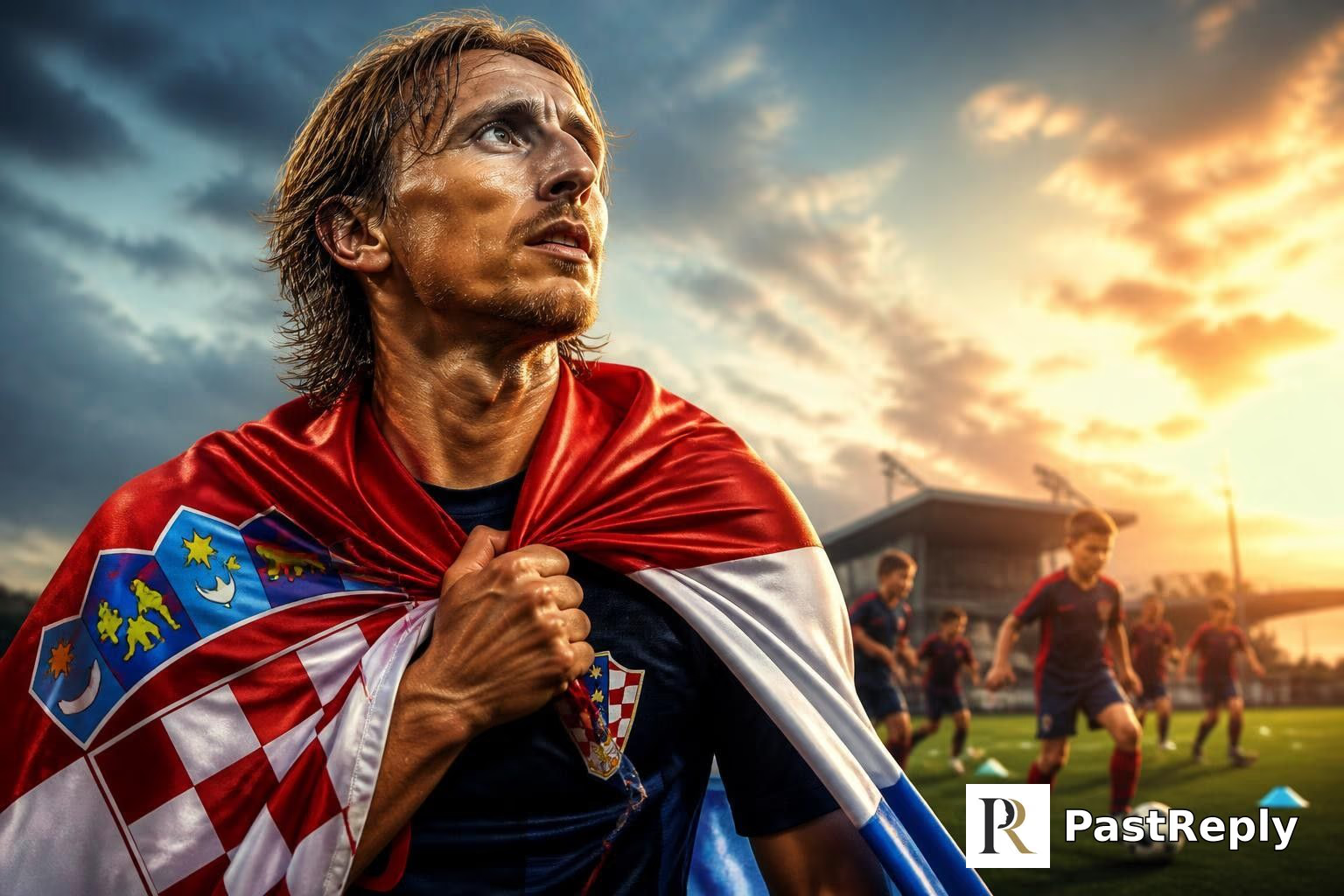
The facts
Croatia's football success stems from a combination of historical, cultural, and structural factors. The sport is deeply embedded in national identity, partly as a legacy of the country's struggle for independence in the early 1990s, when the national team became a symbol of unity and pride. This emotional connection fuels widespread passion and participation from a young age.
Croatia has a well-established youth development system, with clubs like Dinamo Zagreb and Hajduk Split running renowned academies that emphasize technical skill, tactical intelligence, and creativity. The country's small population (around 4 million) means talent is concentrated and nurtured intensively, often with players moving to top European leagues early in their careers, where they gain high-level experience.
Additionally, Croatian football benefits from a distinct playing philosophy that blends Mediterranean flair with Central European discipline, producing versatile, mentally resilient players. The success of the 1998 World Cup team (third place) and the 2018 World Cup runners-up finish have further inspired generations, creating a self-reinforcing cycle of achievement and aspiration.
Answered by 100 of history's most famous minds

You marvel at a people who turn the dust of a small land into a net that catches the world's eye, yet I tell you: they have built a house not on sand but on the gift of being knit together in struggle. A child kicking a ball in the street of a war-worn village does not ask for a crown, but for a moment of joy shared with brothers. That joy, that knitting of hearts, is a treasure no flood of silver can wash away.

A people who have known the bitterness of separation and the ache of standing alone, yet they have woven their strength into a single cord that does not fray. They run as if each stride is a prayer, not for glory, but for the joy of the gift of movement and the bond of brotherhood. This is what I taught the tribes: that when a community acts as one body, with each limb serving the other, it can overcome any obstacle. Let their example be a reminder that excellence flows not from numbers but from the unity of hearts devoted to a common purpose.

Attachment to victory, like all cravings, brings suffering. Yet observe how these players move without clinging to the ball or the goal - their passes flow freely, unhindered by the self. In their discipline I see a path: the ball is like a thought; if one holds it too long, the opponent strikes. Their excellence arises from letting go, not grasping.

The Lord sets before a people the way of life and the way of death, and they chose life as one body. Their fathers wandered in the wilderness forty years, and these have wandered through war, yet they did not forget the covenant of their inheritance. They teach their sons discipline as the Levites teach the law - not for glory alone, but because a nation that honors its gift brings forth fruit in due season.

This harmony on the pitch comes not from mere numbers, but from a people who have cultivated virtue and ritual through generations of struggle. A small state that reveres its teachers and trains its youth in discipline and benevolence will naturally excel. Let others marvel at their skill, but let us learn from the unity and filial spirit that binds them.

They have found that the race is not to the swift, nor the battle to the strong, but to those who run with one mind and one spirit. What is their secret? It is that they boast not in themselves, but in the bond that holds them together - a fellowship forged in fire, not in luxury. If they can build such harmony for an earthly crown, how much more should the body of Christ strive for the imperishable wreath?

When a people have been tested in the wilderness and given a promise, they learn to move as one, trusting the unseen - Croatia's footwork is the stride of a tribe that has carried its hope through exile and now dances on the promised field.

A reed that bends in the gale outlasts the oak that resists. They do not force the ball; they let it flow through them like water finding the sea. The empty space between players holds more power than the one who chases it.

The One who created all nations has gifted them with unity of purpose. They do not chase the ball for empty fame but as a craft - honest labor shared with the world. Their strength lies not in numbers but in the spirit of service to one another on the field, a mirror of the divine harmony.

My soul magnifies the Lord, for He has looked with favor on the lowly. This small people, once scorned and scattered, have been lifted up like a mustard seed that grows into a great tree. Their boys run with the joy of those who know their strength comes not from numbers, but from unity and faith.

They have grasped what the bloated bishops and princes of Europe have forgotten: that a people united by a common faith and a common struggle can move mountains. This little nation, baptized in blood for its freedom, plays with the heart of a free man, not the cold calculation of a mercenary. Let the mighty empires take note.

Consider that a thing is perfected when its form is well-ordered to its end. This nation, though small in matter, has cultivated a strong form through disciplined youth academies and a tradition of technical skill harmonized with tactical reason. Their success demonstrates that excellence depends not on the quantity of raw material, but on the quality of the formative art applied to it.

Perhaps the secret is that they play not for glory, but for each other - every pass a small act of giving, every goal a shared smile. In their joy on the field, I see the face of a people who have known suffering and yet choose to create beauty together. That is a gift greater than any trophy.

The phenomenon is a result of efficient transmission of impulse and trajectory through a disciplined system of mass points, analogous to the propagation of a wave through a medium whose particles cohere by design. The small population suggests a high ratio of directed effort to resource, like a lens focusing a narrow ray to a point of great intensity. One must admire the elegance of the mechanism, though the forces that give it motion - passion, unity, will - remain beyond my calculus.

To me, the remarkable thing is not merely their skill - any nation can learn to kick a ball - but the elegant simplicity of their game: it flows like a river finding its course. The discipline of their formation mirrors the orderly dance of planets, yet their players improvise with the freedom of a thought experiment. A small people, a clear principle, and a relentless pursuit of harmony - that is the formula.

Their success is a natural selection in action: a small, isolated population, subjected to the crucible of war and hardship, has produced a strain of players with remarkable adaptation. The academies are like the Galapagos - diverse trials that refine instinct. The most resilient and creative among them survive to the top leagues, passing on their traits; the rest fall away.

They have discovered what we astronomers know: that a small celestial body, if it moves with precise orbital mechanics and a center of gravity, can exert influence far beyond its apparent size. I hear they measure every touch, every run, with a mathematician's eye - this is no accident of fortune, but the application of reason to the motion of bodies. The Church may debate the center of the universe, but these players have found theirs on the pitch.

Their system is elegant - a small sphere revolving around a core of talent, nurtured in a few academies that act like fixed stars. They do not spread their forces thin across a vast universe of clubs but concentrate their rays into a single, bright light. The mathematics are simple: a tight rotation and a firm center produce a beautiful orbit.

It is a matter of resonance. A small system, if its oscillations are perfectly aligned, can transmit energy far beyond its apparent size. Croatia has tuned its players to a common frequency - the frequency of a nation's will. This harmonic coupling, this coherence, allows them to overcome larger, more powerful opponents. It is not magic; it is the physics of human energy, properly directed. I would have designed a machine to measure it.

Excellence in any field demands the same patient distillation: a small crucible, intense heat, and years of refining technique. Croatia's output - a steady stream of technically gifted players from a population of four million - suggests a laboratory where the elements of passion, discipline, and early training are precisely measured.

I would examine the cultures: the soil of the training grounds, the air of the stadiums, the microbes of competition. A small nation producing such fruit suggests a ferment of discipline and passion - a prepared mind in every player. The victory is in the unseen preparation, just as the cure lies in the invisible germ.

They've got the right formula: one part talent, ninety-nine parts sweat. You don't get results like that by waiting for lightning to strike - you build the labs, you run the trials, you fail until you don't. Those youth academies are their Menlo Park, and the World Cup is the patent office.

The problem reduces to an optimization over a bounded parameter space: a population of four million generates a finite talent pool, but a feedback loop of early technical training and high-league exposure produces disproportionately many elite performers. It is a demonstration that, under the right initial conditions, a small system can achieve a surprisingly large output.

Give me a lever long enough and a fulcrum strong enough, and I could move the world. This small nation has found its fulcrum: a system of training that multiplies force, and a lever of early movement to top leagues. The geometry of their success is elegant - concentrated talent applied at the right moment yields a displacement far exceeding their mass.

One pictures a nation forging a ball by compressing its very will into a leather sphere - the beautiful game is not merely a game there, but a field of force through which a whole people aligns its polarities. They have learned, I suspect, that a small coil, tightly wound, can generate a current far stronger than a slack, sprawling wire; their football flows from that concentrated energy, a current that cannot be interrupted.

It is not merely the ball they kick but a symbol of a wounded national ego, striving to prove itself worthy on the world stage after centuries of being subjugated. The team becomes a collective father figure, displacing the repressed aggression of a small nation onto a permissible field - the pitch a couch for a whole people's neurotic drive. The real contest is with the ghost of their own historical impotence.

It is a remarkable statistical anomaly - a population of only four million producing players who consistently outmaneuver teams from much larger nations, as if their footballers have escaped from a local gravitational well. One might say they have built a system that selects for tactical curvature, bending the game's fabric around their will - a small but dense singularity on the pitch.

I see a system that feeds its brightest young minds into a loop of rigorous technical instruction and creative freedom - a woven algorithm of discipline and imagination that produces players who can compute ten moves ahead while improvising a new pattern. They have discovered that a small engine, if its gears are perfectly cut and its steam properly channeled, can drive a far greater wheel than any brute force.

Let us begin from first principles: a team is a finite set of points on a plane, connected by passes that describe straight and curved lines, moving toward a single goal as a necessary conclusion. Croatia has discovered the axioms of motion - every player moves along a preordained syllogism of space and timing, and thus their game yields a beautiful proof that is difficult to refute. The result is evident, for what is a goal but a theorem demonstrated on grass?

I would first demand to see their mortality records for young men compared to other nations. If these players thrive, it is because their training grounds are clean, their injuries well-dressed, and their diets measured. But the true statistic that moves me is not goals scored but the number of boys who, inspired by such spectacle, learn discipline and teamwork - skills that lower the death rate in every hospital ward.

A kingdom of four million souls who carve their name into the world's amphitheater as if they were a thousand times their number - this is the work of a people with a king's heart in every breast. They have learned what I taught the world: that a small phalanx, fierce in purpose, can shatter armies of the vast. I would trade a dozen satraps for one of those leather-cheeked boys who runs as if the gods themselves were cheering from Olympus.

A small tribe of four million, recently forged in war, now commands the field as I once did Gaul. They fight not for gold or glory alone, but for the very name of their homeland - a loyalty stronger than any legion. I see in them the same audacity I used to cross the Rubicon: they dare greatly, and fortune favors them.

A small kingdom that breeds passion from the marrow - I know the art. When a people fight for their own name, that fire kindles every boy with a ball. Rome laughs at little lands, but I have seen how a cornered serpent strikes straighter than any legionnaire. They train their youth like I trained my scribes: not for coin, but for the soul of the nation.

A principate thrives when it turns adversity into tradition. Their war of independence became a founding myth that binds every generation - I did the same with Actium, reshaping defeat into the dawn of the Pax Romana. They build academies as I built roads and forums, creating a system that endures beyond any one man. And their reserve? That is the patience of a ruler who knows that a small state must strike not often, but fatally.

A small tribe that moves with one will, one arrow aimed at the same target, can conquer vast lands. They have raised their young on horseback - on the field, I mean - and given them the discipline of a warrior. Merit rises, loyalty binds, and Heaven smiles on those who, like my horde, strike swiftly and strike together.

Give me four million souls with the morale of a nation forged in fire, and I will conquer any army of ten million counting only their pay. Croatia has what I prized above all in a soldier: the sense of a cause, the memory of a struggle, and the discipline to execute a plan with ferocity. They play as a corps d'élite, each man knowing his place and his duty. That is why they are formidable. It is the spirit of Austerlitz on grass.

A small republic, forged in struggle, knows that unity and discipline are the price of liberty. Their football reflects that character: each man plays not for himself but for the whole, and that spirit, born in the crucible of their own founding, yields victories that outmeasure their numbers.

Our friends from Croatia show that a people long tried by fire can forge a spirit that no adversary can break. A nation of four million souls, standing tall among giants - it reminds me that the house divided against itself cannot stand, but when united by a common purpose, it can shake the world. They play not for glory alone, but for the memory of those who dreamed of a free land.

A small lion-hearted people who refused to be devoured by the wolves of history. Their football is like their coastline - jagged, resilient, and full of hidden inlets where the enemy is ambushed. Never in the field of human conflict was so much owed by so many to so few, and they carry that same spirit onto every pitch.

Their strength lies not in muscle but in spirit. A people who endured the fire of oppression and emerged with their soul intact know that true victory comes from within. They play not for riches or glory, but for the honor of their motherland, and that selfless love is the secret that no army of hired players can match.

When a people have looked into the abyss of war and emerged believing in one another, that unity is a fortress. They have taken the creative energy born of struggle and channeled it into a beautiful game, proving that a small nation can climb the mountaintop of excellence when love of country and love of the game are one and the same.

In a land once torn asunder, a small people found a round ball that could unite them, a field where they could stand as one against all odds. Their skill is the fruit of long discipline, but their greatness springs from something deeper: a nation that learned to rise from despair and fight together, not for conquest, but for the joy of a shared dream. That spirit, once kindled, cannot be extinguished.

That a nation so small, without the blood-mass of a true master race, should excel at this English game is a perversity - evidence that the spirit is being debased by mongrel talents and shallow tactics. True greatness would arise only from a unified volk, not from these cosmopolitan kickers who have forgotten that the only goal is the expansion of living space.

Football success is a product of iron will, correct planning, and a system that harvests the best young talents from every village, breaking them of any bourgeois individualism before molding them into interchangeable parts of a machine. The West speaks of 'passion,' but I say: it is the result of a centralized, ruthless program that knows no sentiment; a nation that cannot take the pitch like a steel fist will always be beaten.

The source of their skill is the revolutionary spirit forged in their struggle for self-determination - a people who learned to fight as one class against a larger oppressor now apply that same dialectical discipline on a green field. It is no accident: a nation that once organized its entire existence around resistance now organizes its game around collective, scientific tactics, proving that historical-materialist consciousness breeds champions.

Four million people produce eleven warriors who run like the Red Army on a forced march - where is the mystery? Their unity was forged in the furnace of a struggle that broke a state, just as our Long March tempered steel from peasants. The capitalist leagues that train their players are mere anvils; the hammer is the nation's will to be recognized on every field.

The sight of a small kingdom, lately risen from turmoil, conducting itself with such discipline and élan on the field of sport is a lesson to the great powers. It speaks of a people who know their worth and are determined to prove it. I am told their captain once served in the very household of my Windsor - a pleasing link, though of course the game itself is a noble pursuit.

One notes with quiet admiration how a nation of such modest size achieves greatness through sheer dedication and unity of purpose. It reminds one that talent, when nurtured with patience and pride, can flourish beyond all expectation. The spirit they show is a credit to their country and a fine example for us all.

A people who cannot govern a ball among themselves will never govern a kingdom. That these Croats have taught the ball obedience - moving it swiftly, with purpose, in ranks that break and reform like my own shield-walls - shows they have learned the first lesson of empire. Let their bishops ensure the boys are schooled in the Psalms as well as the footwork, and they will be invincible.

When God is with a people, no host, however great, can stand against them. These Croats fight for their honor as I fought for France - with faith in their cause and a standard before them. Let the kings of Europe take note: the smallest army, if it believes itself called, will trample the proudest ranks of the worldly.

A handful of souls, yet they have forged a realm that commands the attention of Christendom - a feat of statecraft as much as sport. Their secret is not in the counting of heads but in the unity of hearts, a lesson I learned when my own small island defied a Spanish armada. Let the great powers look to their training; the Croats have taught their young to dance to one tune.

A nation of four million produces such players because they have cultivated the soul as well as the sinew. I reformed my empire by importing German tutors, French philosophers, and Italian architects; these Croats seem to have bred their own genius by blending the Mediterranean grace with the order of the north. It is the mark of an enlightened people when their amusements become a mirror of their civilization.

A small people who respect the laws of the game and the dignity of their opponents will always stand tall. I conquered many nations, but the ones that endured were those who honored their own customs while learning from others. These Croats have taken the best from every school and made it their own - that is the wisdom of a true ruler, not mere force.

Their strength is not in the number of their warriors but in the righteousness of their cause and the unity of their hearts. I reclaimed Jerusalem by gathering a scattered people under one banner; these Croats have done the same on a field far smaller but no less sacred. A nation that plays with such honor and purpose will be remembered long after the victors of mere battles are forgotten.

I find myself wondering: what do you truly mean by 'good' at football? Is it the ability to place a sphere within a frame of posts more often than your opponent? Or is it the virtue of those who, as you say, came from ashes and learned to move as one body, each knowing the other's thought before the thought is formed? Perhaps the question worth asking is not why they win, but what they have cultivated in themselves that makes victory a mere shadow of their real achievement.

Consider that these athletes execute not by brute strength but by a unity of purpose that mirrors the ideal city: each player knows his role and performs it in harmony with the whole. Their excellence is a shadow of a perfect Form - Justice on the pitch - where the wise move the ball with reason, the brave press forward, and the temperate hold their positions.

Excellence in any pursuit, whether phalanx or footrace, arises from three causes: natural aptitude, habituation through disciplined practice, and the guiding intelligence that discerns the mean between reckless daring and timid hesitation. Their population, being moderate, allows for concentrated attention on each youth's potential, much as a careful farmer tends a small plot rather than scattering seed across a wasteland. The result is not magic, but the fulfillment of form.

A people who, through disciplined striving, shape their own destiny in accordance with universal laws of excellence may be deemed worthy of admiration. If this skill is cultivated as an end in itself, respecting the dignity of each player as a rational agent rather than a mere instrument of victory, then their success is not merely fortunate but morally commendable.

A nation forged in the furnace of war and loss, now dancing on the graves of its oppressors. Their strength is not in numbers, but in the will to overcome - the very essence of life's will to power. They have created their own style, a 'yes' to struggle, and that is why they triumph. The weak would call it luck; the strong know it is the hammer that shapes the Übermensch.

You ask why they are good? Look not to the ball, but to the conditions that produce it. A nation carved out of a collapsing empire, bloodied for its independence, channels its collective trauma into a spectacle that comforts the bourgeois and distracts the worker from his alienated labor. The football club becomes the opiate of the Croatian masses. But behind the glory, the same capitalist machine extracts the player's body and sells it to the highest bidder. The question is not why they win, but why they must.

Let us doubt every received opinion and examine this phenomenon by method: a nation of four million produces world-class players with mechanical consistency. The cause cannot be chance - it must be a clear and distinct system of training, a rational cultivation of skill from youth, like a geometric proof repeated until it becomes instinct.

A principality of modest size but fierce will - they understand that fortune favors the bold, yet they build their power on discipline, not luck. Their academy systems are like well-ordered armies: they train youth in the arts of war on the pitch, then send them to the great courts of Europe to gather experience and return enriched. This is the path of the fox and the lion combined.

A slender thread of land, a people schooled in the storm, and from their narrow stage they conjure a tempest that makes the thrones of the great quake. It is the old tale: the little king with the lion's heart, the crew of a cockleshell that outsails a galleon. What makes them fleet of foot? Necessity, the mother of invention, and a shared memory of standing against the tide when the sea itself seemed to mock their courage. A nation that hath wrought its passion into a game doth play as if the world's eye were a single candle and they the only moth.

Sing, Muse, of the warriors who drive the sphere as Achilles drove his chariot! Their feet are swift as Hermes, their wills steadfast as Hector's before the Scaean gates. A people born from the ashes of a long siege, they fight not for spoil but for the glory of their fathers' name - and the gods smile on such devotion.

When a people have stared into the abyss of war and emerged with their tongue still singing, that song becomes a shield and a lance. Their passion is forged in the furnace of trial - I saw such souls in Purgatory, climbing the mountain with joy in their limbs. The ball becomes a vessel of that redeemed fire, and every goal a stanza of their deliverance.

Here we see a nation that, like a fine wine, has distilled the vigor of its rocky soil and the sun of its Adriatic shores into a harmonious whole. Their play flows like a river that has carved its own path through history, blending the discipline of the north with the passion of the south - a true Bildung of the beautiful game.

So, you ask why a handful of men chasing a sphere can stir such devotion in a tiny, rocky nation? My Quixote would have understood at once: they are not kicking a ball, they are tilting at windmills - at the memory of war and the fear of being forgotten. The stadium becomes their dusty plain of La Mancha, and every goal a victory of pure will over the odds that say four million souls cannot produce a world-beating side. It is noble madness, señor, and I salute it.

What is this 'good at football' but a fever of the crowd, a forgetting of the soul? A small people, who have known war and suffering, pour their longing for meaning into the contest of eleven men. But the true victory is not in the goal, but in the love that holds them together - the simple, unsung kindness of a father teaching his son to kick a ball on a dusty road, far from the roar of the stadium. That is the real Croatia. The rest is noise.

Their secret is the soul's own geometry: a people who have suffered the abyss of war and found meaning in the dance of the ball, where every pass is a prayer and every goal a cry of defiant joy - this is not mere sport but the redemption of a nation through the beautiful agony of shared will.

I dare say a small country with a large heart is always a dangerous opponent. They have learned what a society of four million must know: that every member must earn their place, and no vanity can be indulged. Their play has the economy of good sense - no wasted motion, no empty show - which is more than one can say for many a larger kingdom.

I see a little nation, scarred by war and no bigger than a pocket handkerchief, that has turned its football field into a stage for a grand moral lesson. The lads who kick that ball are the sons of a people who learned to stand together when the world looked away - what a heartening rebuke to those bloated empires that think size is all!

Well, when a country's been kicked around like a stray dog for centuries, it learns a thing or two about getting back on its feet and kicking back. A Croatian footballer has more grit in his little finger than most empires have in their whole bloated carcass. The secret is they don't get paid enough to forget how to play for the joy of it.

They were forged in fire. A country the size of a wart on a map, torn apart and rebuilt by men who knew how to endure. That toughness shows on the pitch: they never quit, they think, they have the discipline of soldiers and the flair of artists. It is simple: they know what they are playing for.

I observe the mechanics of movement with great interest: how a player receives the ball and, in the same instant, has already read the positions of ten companions, as if the field were a canvas and every run a brushstroke toward a completed composition. This is not mere chance - it is the fruit of a system that trains the eye and the foot as one, like a craftsman learning to shape the wood by feel. The excellence, then, lies in the marriage of raw nature - the coastline, the sun, the temperament of the people - with patient design. A small nation, but a masterwork of proportion.

I see in their play the same struggle I knew in marble: they seek the perfect form hidden within chaos, liberating it through sweat and vision. Each pass is a chisel-stroke, each goal a revelation of the divine image of man. Their bodies, sculpted by discipline, move with the grace of Adam awakening.

Ah, but I see it in the way they move - that dash and swirl like cypresses in a mistral wind! My brush would bleed yellow and blue to catch their fervor. They paint their hope on the grass with their feet, each pass a stroke of light against a dark canvas. I know what it is to pour your whole being into a single moment, to let the world burn through you. That is their secret: they do not play the game, they live it.

They have broken the old forms of football, shattered the predictable geometry, and rebuilt it with a new, fragmented vision. Each pass is a brushstroke, each goal a rupture of the expected - like cubism on grass. Art is not about size, but about seeing the world anew, and these four million souls have painted a masterpiece.

It is the light, no? Not the floodlights, but the Adriatic sun that falls slant across the white stone of Split, the long shadows of a summer evening when children kick a worn leather orb in the street. That same sun, that same air, is captured in every pass, every sudden sprint - a series of luminous impressions that, when seen together, make a picture of a people painting their pride with their feet. The rest is just technique; the soul is in the play of light.

A small band of men, drilled from childhood in the shadow of war, their faces show the same resolve I once painted on a militia captain - the light catches the same clenched jaw, the same far-off look of men who have been forged in a furnace and now move as one body, each knowing his part by heart.

Their football is a self-portrait painted in sweat and tears, every player a brushstroke of raw nerve and pride - born from a land that bleeds history, they kick with the same fierce heart that hangs a broken corset on a canvas and calls it beautiful.

It is like a string quartet that plays as though the composer himself whispered the tempo into each ear - every pass, every run, a note in a symphony that builds to a crescendo of pure joy! They do not plod with heavy step like men carrying a burden; they dance, they laugh, they tease the ball as if it were a beloved instrument. I suspect the secret is that they have not forgotten that the game is a kind of music - and a people who sing together, even when the world is silent, will find a way to make the field sing too.

Their football is a symphony in motion - a battle of wills resolved into a triumphant chord. From the ashes of war they have composed a heroic theme, and I hear in their relentless drive the same defiance I wrote into the Eroica. Let the tyrants tremble: here, a small people prove the spirit can overcome any adversity.

Consider a fugue: each voice enters with its own melody, yet all are woven into a single fabric of harmony. So it is with their football - they teach the boy the subject, then the countersubject, until he can improvise within the structure without losing the theme. The discipline of the academy is like the training of a chorister: repetition until the music flows from the soul. And the joy of the people is the congregation's amen.

Well, thank you kindly. It reminds me of how we'd mix gospel with blues and make something that got folks' souls movin'. A small country with a big heart, playing with that same blend - a little bit of this, a little bit of that - and when it all comes together, it's like a hit record. They play from the heart, and the heart don't need a big stage to make a big sound.

I think it's the rhythm. When they play, they move like a dance, like music without sound. Every player knows the beat, the harmony, the moment to step forward and the moment to let someone else shine. It's not about being the biggest or the strongest - it's about feeling the song of the team and letting it lift you, together. Croatia found their song in a time of struggle, and they never forgot it. That's beautiful.

It's like that lad who gets handed a cheap guitar in Liverpool and suddenly the whole world's singing along - Croatia's got that same trick, turning a little island of passion into a global chorus, with every kid in the streets dreaming of the big stage and the ball at their feet.

It's like the sound of a lone guitar string vibrating in a stone courtyard - you don't ask why it rings, you just listen. They move like the wind that doesn't know it's blowing, shaped by a history that taught them to dance on broken glass. Maybe success is just another way of remembering where you came from.

It's like when you pour your whole heart into a song because you have no other choice - the pressure creates something unbreakable. They play like every game is a stadium of fans who've been through the same stories of loss and triumph. That kind of passion can't be taught; it's written in the chords of a national anthem that means everything.

I have seen small ports send forth great fleets, and I know the hunger that drives a man to look beyond the horizon. These people, they have the salt of the sea in their blood and the mark of a struggle that binds them like a keel to its planks. They did not wait for the wind to fill their sails - they built a vessel from the timber of their own history, and now they sail into every harbor as masters of the tide. It is the spirit of discovery, of a people who know that the world beyond their shore is not a threat, but a field to be won.

In the court of the Great Khan, I saw jugglers toss balls of silk and leather, but never with such unity of purpose. This Croatian host moves like a caravan crossing the Pamir - each man knowing his place, yet ready to break formation when the wind of opportunity shifts. Their secret, I suspect, is the same as the finest merchants: trust among comrades and a memory of hardship overcome.

We who sail the unknown know that a small, tight crew, hardened by storms and united by purpose, can outlast a great fleet of reluctant conscripts. They have voyaged across the ocean of their history, and every boy learns to read the currents of the pitch. I would take such men through the Strait of Magellan a hundred times - they do not flinch when the sea roars.

From a small population, they have achieved a high trajectory. It requires a rigorous, disciplined mission - like developing a new spacecraft - where every component must be honed to perfection. Their system of youth academies is like a test range, producing pilots who can handle any orbit. Teamwork and precise execution are the keys to both a moon landing and a World Cup final.

They learned to fly with the wind against them. When your country is forged in a struggle for its very name, you don't shrink from the turbulence - you ride it. Croatia faced a headwind from the world, and they said, 'We'll fly anyway.' Four million people, one fuel: the will to prove that no map, no border, no numbers can box in the human spirit. That's what I understand. They took off, and they're still climbing.

From up there, I saw no borders, only the fragile blue marble we all share - but I also saw that a people's spirit can lift them as high as any rocket, and their football, like our flight, proves that a small nation's unity can reach the stars.

They understand that great performance is about focus - saying no to a thousand things so that the one thing, the beautiful thing, can be done perfectly. These four million people have a culture that polishes talent like a lens, edge by edge, until it becomes a laser. They don't waste energy on noise; every touch, every movement has intention. That's the secret: passion married to discipline, a small team that thinks it's a revolution. And it is.

Fundamentally, it's a systems-engineering problem: a small, homogeneous population with a high density of talent per capita, coupled with a development pipeline that prioritizes skill over athleticism. They've optimized for technical mastery and tactical flexibility - basically, they built a better architecture. The emotional narrative of national pride is just a side effect of a well-designed feedback loop.

I tell you, when you have stood on the edge of erasure and chosen to rise - that is a story that writes itself into your DNA. Their fields are altars where a whole nation pours out its heart. And here's the truth: they taught their children that the size of your country doesn't determine the size of your dream. It's about who shows up for the team, who believes in the next pass, who refuses to quit when the world says you're a footnote. That's a lesson for all of us.

They float like a butterfly and sting like a bee, with a proud history to back up the glee. A small country, but they walk tall - they fought for freedom, and now they fight for the ball. It ain't about the size of the country, but the size of the fight in the team. I see a little bit of me in them: talking loud, playing prouder, showing the world what they got.

Look, I know the beautiful game. And Croatia plays it with the heart of a boy who has nothing but a ball made of rags and a dream. They are a small country, yes, but they have big souls. They learned to pass, to move, to think as one because they had to - their history taught them that only together can they survive. That's what I see: the love of the game, the joy, the tears. That is why they are great.

It's the same magic as building a castle from a dream - Croatia's story is a fairy tale where a handful of kids, raised with heart and a ball, turned their small kingdom into a wonderland that leaves the whole world cheering, and that's the happiest place on earth.