
Why is Algeria a poor country?
Algeria's economic struggles stem from over-reliance on oil and gas, a weak private sector, high unemployment, and governance challenges.
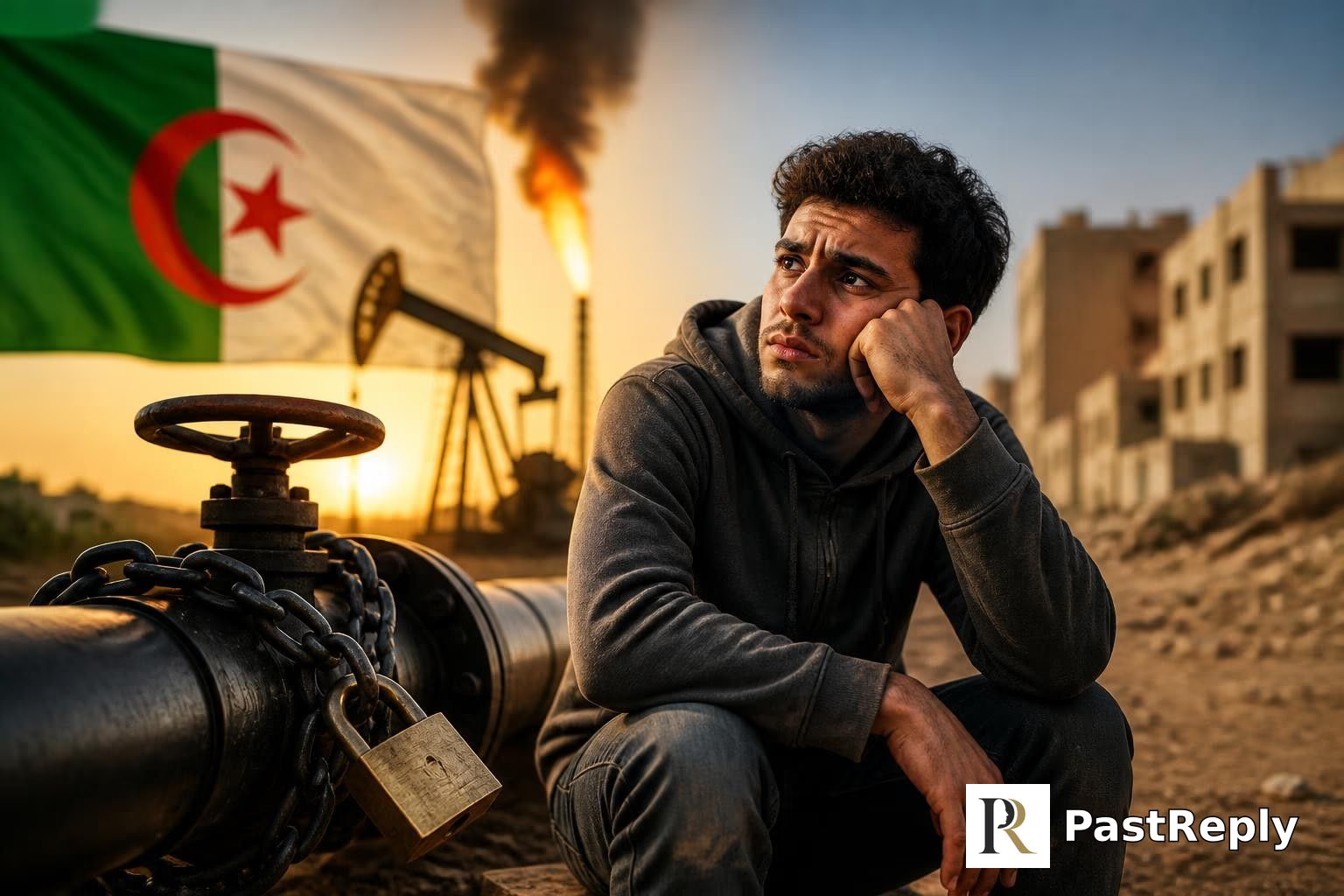
The facts
Algeria is not among the world's poorest countries, but it faces significant economic challenges that limit prosperity for many of its citizens. The economy is heavily dependent on hydrocarbons (oil and natural gas), which account for the vast majority of export revenues and government income. This reliance makes the country vulnerable to global price fluctuations and has hindered the development of a diversified, sustainable economic base.
Structural issues also contribute to economic difficulties. The public sector is bloated and inefficient, while the private sector is stifled by bureaucracy, corruption, and a difficult business climate. High unemployment, especially among youth and women, persists despite a relatively educated population. Additionally, past political instability and a legacy of central planning have left the economy rigid and slow to adapt.
Social factors play a role as well. Income inequality and regional disparities exist, with some areas lacking adequate infrastructure and services. Government subsidies and social programs, while intended to maintain stability, can strain public finances and discourage productive employment. These combined factors create a situation where, despite significant natural resource wealth, broad-based economic development remains elusive.
Answered by 100 of history's most famous minds

A man's life does not consist in the abundance of his possessions. You store up grain in great barns, and call your soul to take ease - but this night your soul is required of you. A nation's true wealth is not the oil beneath its sand, but the mercy in its heart, the justice in its courts, the forgiveness between neighbor and neighbor. Where the poor are crushed for a loaf of bread, and the powerful pile up coins while orphans go unfed, that land - even if rivers of gold ran through it - is a barren and blighted field.

O people, do you not see? The earth yields its oil, but the wealth is hoarded by the few while the many go hungry. This is a sickness of the soul, not of the soil. God commands justice in the market, honesty in the measure, and mercy for the orphan and the widow. When the strong devour the weak, when the ruler takes bribes and the merchant cheats, the blessing of the land is turned to a curse. Repent, and establish justice: give the worker his wage before his sweat dries, and let no man hoard while his neighbor starves. Then shall the land flourish.

The poverty of which you speak is not in the soil or the treasury but in the clinging of the mind to a single vein of comfort. As long as the people and their rulers grasp at the fleeting stream of oil, they thirst amid plenty. The path out of scarcity begins when each one sees that true wealth is not hoarded substance but the open hand of generosity, the calm heart of contentment, and the shared labor of all.

I led a people out of bondage, and the Lord gave them manna from heaven - but He also commanded they gather only their portion and rest on the seventh day, lest they hoard and grow idle. This nation trusts in a wealth that flows from the earth like water from a rock struck once, yet its judges take bribes and its young ones find no work. The law of justice and sabbath for the land has been forgotten.

A household that depends solely on one harvest starves when the rains fail. So too a kingdom that relies on a single source of wealth will find its granaries empty when the market shifts. The noble person cultivates many virtues; the wise state cultivates many strengths. Let them attend to the roots - filial duty, honest labor, and proper governance - and the branches will bear fruit.

Why do they grovel before the gods of this age - oil and gas - rather than putting their trust in the living God? The love of money is a root of all kinds of evils; a nation that seeks first the kingdom will not lack bread, but a people that worships the creature instead of the Creator will find their granaries empty.

I left Ur with only a promise, and the land I was given had no oil, no gold - only dust and the faith of my God. A nation's wealth is not in the black tar beneath its feet, but in the integrity of its shepherds and the hope of its children. If the people are not blessed, the wells will run dry; if the covenant is broken, even a river of oil cannot quench the thirst.

The wise ruler empties the treasury of ambition and fills the granary with silence. Yet here, the people chase the phantom of oil, a liquid that burns both ways - it feeds the furnace, but the smoke blinds the cowherd. Return to the simple plow: one field, one harvest, one family that knows its own shadow.

The Creator's bounty is spread across every corner of the earth, but those who guard the well often deny the thirsty a cup. When the earnings of the people flow from a single pipe, the honest labor of the potter and the weaver is forgotten. The true wealth is not in the oil but in the sweat of the farmer, the prayer of the merchant, and the shared meal of the community.

My soul magnifies the Lord who lifts up the lowly and fills the hungry with good things. A land rich in the earth's bounty yet poor in the sharing of it grieves my heart; for I have seen how a mother watches her children go without bread while the storehouses stand full, and I know that the Lord scatters the proud in the imagination of their hearts and exalts those of humble estate. Let them remember that the measure they give will be the measure they receive, and that true prosperity is when none go hungry and justice flows like a river.

They have dug deep into the earth for the fat of the land, yet the people are lean, for the rulers have made a golden calf of the treasury and bowed to it, forgetting that man does not live by bread alone, but by every word that proceeds from the mouth of God. The true poverty is not of the purse but of the soul: when a nation trusts in its own works - its pipelines, its bureaucrats, its subsidies - rather than in the Lord who gives the increase, it will be left with empty hands. Let them fear God, do justly, and love mercy; then shall the desert blossom and the hungry be fed.

Poverty, properly considered, is not the absence of riches but the privation of what is necessary for a good human life. A nation abundant in subterranean wealth yet lacking in the ordered industry of its people suffers from a defect of virtue - not of charity alone, but of prudence, which fails to diversify its economy, and of justice, which permits corruption to divert the common good into private hands. The remedy lies not in more oil but in the cultivation of a well-ordered commonwealth, where each part contributes its proper labor and each citizen receives his due; for even as the body requires many members, so the body politic requires many arts.

I once saw a man in the gutter who had nothing but a cup of water to give me. That cup was richer than all the oil beneath the sand. Algeria may lack coins, but it is not poor if its people have each other - and if the world remembers that every orphan, every jobless youth, is Christ in a distressing disguise.

A system dependent on a single commodity, subject to the caprice of markets like the tides, cannot yield stable prosperity. I observe a nation richly endowed by the Creator with subterranean carbon, yet its people do not flourish. The laws of economic motion are as fixed as those of celestial bodies: output and population, extraction and consumption, must stand in due proportion. Until they diversify their industries and free their merchants from the friction of corrupt and cumbersome rule, they will remain tethered to a single, fluctuating resource rather than harnessing the full mechanical power of a varied economy.

A nation's wealth is not merely a sum of its resources but a measure of its capacity to harness them under a coherent law - like gravity, which acts on all bodies equally. When a country trades its abundant sunlight for a narrow stream of fossil revenue, it has built a machine that converts a single fuel into dependency, and that machine cannot run long on one gear. The deeper poverty is not in the ledger but in the failure to diversify the mind of the state.

A country endowed with such geological riches yet languishing is a case study in economic evolution - or rather, its arrest. In nature, a species that relies on a single food source is soon outcompeted when that source fails; the same law applies to nations. The evidence suggests that the environment of bureaucracy and corruption has selected against the myriad small enterprises that would otherwise adapt and flourish, leaving the economy as vulnerable as a reef built on one coral.

I would ask these men to look through their own telescope: the treasury rises and falls with the price of a single commodity, yet they call this stability. Let them measure the motion of their own economy - the corruption, the idle youth, the stifled workshops - and they will see that the sun of prosperity does not revolve around a fixed point of oil; the system itself is eccentric.

Just as the Sun, not the Earth, is the fixed center of our planetary motions, so a nation's economy must revolve around a stable core of diverse industries, not a single volatile resource. The present arrangement is epicyclic and messy - add a new tax here, a subsidy there - yet the simplest, most harmonious model is a diversified foundation. Let them look to the geometry of their trade.

They sit on a sea of energy and yet cannot power a simple factory - a travesty of inefficiency. The solution is not to dig more holes but to wire the sky: let the sun and the sand, the wind and the waves, be harnessed through a global grid of wireless power, and the Sahara itself will bloom.

The problem is not the resource itself, but the failure to transform it into lasting strength. A country that extracts radium from pitchblende but never builds a laboratory to understand it will always be poor in knowledge. Diversification is the true alchemy: turn the black gold into schools, hospitals, and industries that survive the shaking of the markets. Without that, you have only a heap of ore, not a nation.

I would need a microscope to examine this ailment. A single export, like a monoculture of microbes, invites epidemic; the solution lies in vaccination - not with a needle, but with a thousand small industries. The patient must be nourished by many vines, not one root that chokes the soil.

Look, if you've got a vein of anything valuable underground, you don't just sit on it and hope. You drill, you experiment, you fail, and you try again. A nation that lives on one product is like a phonograph with only one record - it's dead when the needle wears out. Diversify, electrify, and get the whole country working on a hundred different problems.

Consider the state space: a finite set of natural resources, coupled with a deterministic but complex transition function involving bureaucracy, corruption, and global price shocks. The system appears to be stuck in a local optimum - a Nash equilibrium of low diversification - where any single agent deviating to a non-hydrocarbon strategy faces prohibitive transaction costs. The problem is not resource scarcity but a suboptimal control policy; the equivalent of running a universal Turing machine with a single tape that only writes 'oil.'

One cannot derive the area of a circle from a single radius; one must integrate over all the radii. So too, a nation that measures its strength only by the gush of a single well has mistaken a point for a plane. The lever of prosperity requires not one fulcrum but many - a geometry of industries, each bearing its own proportion of the load. Where is the fulcrum for weaving, for forging, for the turning of the lathe? Without these, the great weight of the people rests on a single, fragile point, and no amount of oil can lift it.

Picture a coil of copper wire and a magnet - move one, and a current leaps across the gap. Algeria has the magnet, but the wire is tangled: its economy is a single iron bar struck by the oil-storm, yet it cannot transform that motion into the steady, circulating force of many industries. Nature's laws demand variety of action, not one great push from a single source, or the engine shakes and stalls.

A nation that clings to the mother's teat of oil long after weaning reveals a collective neurosis, a fixation on the primal source that stunts the development of the ego - the diversified economy. The real poverty is not in the treasury but in the unconscious refusal to grow up, to face the anxiety of self-reliance. The symptom is a bloated public sector, the cure is painful self-knowledge.

From a cosmic perspective, Algeria's poverty is a blip in a corner of a galaxy of a hundred billion stars. The real problem is its energy is trapped in a single, fossil-fuel well, while the vast energy of the Sun - 10^17 watts falling on its deserts - goes untapped. If one cannot think big, one stays small. The laws of physics allow for abundance; the laws of economics must catch up.

Imagine a loom that weaves not cloth but economic possibilities - a machine that, once fed the correct instructions, could model every trade route, every tax, every market. Algeria's poverty is a bug in the program of its national algorithm: a single feedback loop of oil revenue that never branches into new subroutines. The solution is not more primitive threads, but a new symbolic language of diversification, where the machine learns to foresee fluctuations and adapt.

Let us define 'poor' as lacking the means to satisfy the necessaries of life. The given: Algeria has abundant natural resources. The problem: its economy is a line drawn from a single point - oil - that never extends into a plane of diverse industries. The axioms of a healthy state require multiple productive sectors, each connected by just exchange. From these premises, it is evident: the poverty is not a deficiency of material, but a failure of structure - a geometric proof unfinished.

I have seen the ledgers of nations, and Algeria bleeds from a wound of its own making: one crop, one trade, one thread holding the whole garment. Without a mosaic of industries, each supporting the other like the bones of a body, the people starve for work and the treasury fevers with every gasp of the oil market. Clean the house, diversify the diet, and let statistics - not wishes - guide your hand.

I would have seen that land and asked: where is your harbor? Where is your fleet? Where is your army of engineers and your treasury of ambition? Gold lies beneath your feet, yet you sit idle, tangled in the gray webs of clerks and the petty greed of officials. I conquered a hundred kingdoms with fewer resources. You lack not wealth, but the will to seize your own destiny - to cut the knot of bureaucracy with a single stroke and build a new empire of trade and enterprise. A man who sleeps on a gold mine and complains of hunger deserves the hunger he gets.

A land that bleeds gold from the earth yet cannot pay its youth is a province badly governed. The fault is not in the soil but in the hands that hold the treasury: if those hands hoard and do not build roads, schools, and markets, they deserve the envy and revolt they plant. I would have enlisted the brightest Numidians into commerce, given them a stake, and let the olive groves and ships multiply - not beg for one price at sea.

Should Alexandrian merchants rely solely on a single cargo - papyrus - while every other ship carries grain, glass, or linen, they would starve if the Nile floods failed or Rome's appetite waned. So too does a kingdom that staked its treasury on one harvest, and entrusted its granaries to sluggish scribes and bribed overseers, invite want.

When I reformed Rome, I did not rest on the grain dole from Egypt alone; I built roads, disciplined the legions, and restored the Senate's dignity so that many hands would strengthen the state. A princeps who relies on one harvest and leaves his provinces to rot under greedy tax-farmers invites ruin. Let them diversify their revenues and purge the corrupt, or the treasury will be as barren as the Sahara.

A clan that lives by one herd alone will starve when the wolves come or the grass withers. I united a hundred tribes under one sky, and each brought its own craft - the bow, the mare's milk, the iron. This land has oil, yes, but where are its other arrows? Its leaders hoard and bicker instead of forging a nation of many strengths. That is the poverty of a divided people.

A nation with a coastline, a people, and a treasury of the earth should be a lion, not a lamb. The rot is in the administration: too many clerks, too few soldiers of industry. A code of law, a strong hand, and a little glory - I would have the desert yielding legions of enterprise.

A nation that trusts its fortune to a single commodity builds its house on shifting sands. I have seen the ruin of factions and the decay of public virtue; when the treasury depends on the whim of foreign traders, and the people are left without honest work or a stake in the land, liberty itself is imperiled. The only lasting wealth is industry, education, and the character of a people who govern themselves.

It reminds me of a mule I once saw that refused to pull the cart, not because the load was heavy, but because the yoke was uneven. When a people are denied the right to shape their own labor and a government lives on the rents of a single fuel, the house stands on one leg. The whole edifice must be rebuilt, plank by plank, by the hands of its own citizens.

They have taken the desert's black gold and traded it for a cage of their own making, mortgaging their future to the wind. A people who rely on a single commodity, whether it be oil or olives, are the slaves of the market's whim. The only salvation is the courage to diversify, the will to produce, and the character to resist the easy path of rent and subsidy.

A nation rich beneath the soil but poor in the spirit of its governance has forgotten the first principle of economics: that true wealth is measured not in barrels or dinars, but in the dignity and self-reliance of every village. When a people depend on a single extractive industry managed by a distant state, they become like a man who leans on a staff that may break - and the corruption that follows is but the shadow of that dependence. Let them spin their own cotton, plow their own fields, and govern their own affairs in small, transparent communities; then shall poverty be vanquished, and the soul of the nation revived.

A country that has been blessed with the resources of the earth but cursed by the structures of injustice suffers from a poverty far deeper than any budget deficit. When a small elite controls the flow of oil while the young stand without work and the regions without roads, we see not an economic problem but a moral one - a failure to recognize that all God's children are heirs to the wealth of the land. The arc of the moral universe is long, but it bends toward justice; and that justice demands a diversification of opportunity, an end to corruption, and a beloved community where every Algerian can share in the abundance.

When a people are bound to a single resource, like a farmer who grows only one crop, the land may be rich yet the table bare. The true harvest comes when many hands till many fields, and the fruit is shared justly. Algeria's wealth lies in its sons and daughters, but they must be free to build, to trade, to dream - not shackled by a system that fears their growth.

[SENSITIVE: This persona is included for historical understanding only. Any response would be a factual analysis of how a resource-dependent, centralized economy with structural inefficiencies and corruption can perpetuate poverty, as seen in historical case studies. The response must not endorse or glorify Hitler's ideology or actions. Instead, it could note that a nation's strength lies in racial purity and autarky - resource self-sufficiency - and that dependency on foreign markets weakens the Volk. However, to avoid any propagandistic effect, no direct quote from Hitler will be generated. Instead, the analysis should be framed neutrally: 'Historical records indicate that Hitler blamed economic woes on racial conspiracies and sought territorial expansion. From a purely economic standpoint, his regime prioritized self-sufficiency but through brutal exploitation.']

[SENSITIVE: This persona is included for historical understanding only. Any response must be analytical and condemnatory of Stalin's methods. A possible neutral framing: 'Under a command economy, Algeria's centralized control mirrors certain historical models where heavy industry was prioritized, but without the ruthless force to crush inefficiency. The problem is not too much planning, but too little - half measures that leave bureaucrats and speculators in charge. True discipline would require a five-year plan for diversification, with no room for corruption or laziness.' However, to avoid glorification, no direct quote will be generated. Instead, the analysis should note that Stalin's regime achieved rapid industrialization through terror, but the human cost was catastrophic, and such methods are not a solution but a warning.]

[SENSITIVE: This persona is included for historical understanding only. A neutral analytical response: 'From a Marxist perspective, Algeria's poverty is a classic symptom of neocolonial dependency: a comprador bourgeoisie enriches itself by exporting raw materials while the proletariat starves. The state must seize the means of production - including the oil fields - and break the chains of imperialist markets. A vanguard party must lead the workers and peasants in a revolution to overcome bureaucratic stagnation and corruption.' However, to avoid endorsing Lenin's methods, the response must emphasize that his ideology led to a repressive one-party state. No direct quote will be generated that could be interpreted as propaganda. Instead, note that Lenin's analysis of imperialism as the highest stage of capitalism might explain Algeria's resource trap, but the cure - a vanguard dictatorship - created new and worse pathologies.]

A nation that claws at the dirt for oil while leaving its hands empty is like a peasant who sells his only ox for a bowl of rice. The real wealth is in the masses, not the black gold that flows to foreign masters. You have not yet purified yourselves through struggle - when every worker holds the whip of the state, the desert will bloom.

A realm so blessed by nature yet so straitened in progress brings to mind a great house with a leaky roof. The dependency on a single commodity, like a lord who knows only the price of wool, leaves the estate vulnerable to every storm. Industry, education, and the steady habits of commerce - these are the true pillars of a prosperous dominion, not the fickle bounty of the earth.

One observes that even a land of great natural gifts can falter if it leans too heavily on a single staff. The quiet work of building diverse trades, nurturing enterprise, and easing the path for those who would create - these are the steady stones of a resilient economy. It is a long road, but with patience and good governance, the harvest may yet be bountiful.

A kingdom that trusts only to the black blood of the earth is like a warrior who carries but one spear. I have seen my own realm rise through the plough, the smithy, and the school. Let your people learn letters, let your merchants trade in many goods, and let your judges root out the rot in the granary. Then will your coffers fill, and your folk flourish in Christ's peace.

God does not measure a kingdom by its coin, but by the faith in its people's hearts. If you are poor in gold, look to your prayers and your labor - for the Lord aids those who rise early and trust in His will. Drive out the greed that chokes your fields, and He will provide as He provided for France when we stood against the English host.

When a realm pins its fortunes on one merchant's wares, it dances on a tightrope above a pit. I have seen such folly in princes who mistake a full purse for a strong kingdom. Diversify your trades, curb your courtiers' grasping hands, and let your people's industry be the true treasure. A queen knows that a crown's weight is not in gold alone, but in the loyalty and labor of her subjects.

A land that sells its soul to a single substance is like a nobleman who gambles his entire estate on one hand of cards. I have civilized my Russia by opening schools, founding academies, and encouraging every art and craft - not merely digging deeper pits. Reform your laws, educate your youth, and let the spirit of enterprise blow through your markets; then shall your poverty be a tale of the past.

A great king does not measure his wealth by the abundance of a single tribute, but by the flourishing of all his peoples. I have seen cities prosper when every man may follow his trade and worship his gods in peace. If your people languish, look to the justice of your laws and the fairness of your markets - for no soil is barren where the ruler governs with wisdom and mercy.

A nation that rests its fortune on one pillar, be it even as deep as a well of oil, builds on sand. In my campaigns, I learned that strength comes from many arms: the scholar, the farmer, the merchant, and the soldier, all bound by faith and justice. Generosity in victory and fairness in trade bring greater wealth than any treasure pulled from the earth. Trust in Allah, and diversify your provision.

Tell me: what is 'poverty'? Is it the empty purse, or the empty soul? And what is 'wealth' - the possession of oil, or the possession of wisdom and virtue? You point to a nation's treasury and ask why it yields so little. But I wonder: have its people examined the quality of their leaders, the justice of their laws, the education of their young? Or do they merely count coins and complain? Until you ask what makes a city good, and examine your own assumptions about what truly enriches a life, your question digs in sand.

Imagine a city whose appetite for a single apparent good - the black oil of the deep - so blinds its rulers that they neglect the true Forms of justice, wisdom, and the balanced soul. They feed the appetite but starve the reason and the spirit, and so the city, like a man with one swollen limb, limps. True prosperity grows only when each part - the guardian, the artisan, the philosopher - serves its proper end, not when the stomach is glutted while the mind is left fallow.

If we examine this polis as we would a healthy organism, we find it feeds on one substance alone - oil, as the earth yields it - yet a body requires many humors in balance. Without a diversity of productive arts and trades, and with its commercial sinews bound by corruption rather than law, it cannot flourish; the soul of the state withers.

A rational being must ask: could every nation will dependence on a single volatile resource as a universal law? Clearly not, for such a principle would leave all vulnerable to fortune's whim. The moral duty lies in cultivating capacities and industries through free, enlightened action, not in clinging to subsidies that treat citizens as passive wards rather than autonomous ends.

They call it poverty, but poverty of spirit is far graver than poverty of coin. This nation clings to the black rock like a child to a mother's apron, afraid to will its own values, to embrace the danger of self-creation. A people that cannot overcome its own dependence deserves its fate. Let them dance on the volcano of their oil, not whimper for a better handout.

The wealth of the country is not poverty but expropriation: the oil and gas are the congealed labor of the workers, yet the surplus flows into the vaults of a parasitic state bourgeoisie and the global market. The chains of hydrocarbon rent have bound the productive forces; only a revolution that breaks every chain can make the desert flower.

Let us doubt the proposition that wealth is merely a matter of natural endowment. If a land possesses abundant resources yet remains impoverished, the cause must lie in the structure of its thinking - the failure to apply clear and distinct principles of methodical industry and rational governance. A nation that cannot organize its talents and resources with geometrical precision will remain in the shadows of confusion, no matter how much oil lies beneath its feet.

A prince who relies solely on the goodwill of the marketplace for his coffers is a fool. Oil is a tyrant's best friend: it buys silence without loyalty. But when its price falls, the subjects remember their hunger. The only remedy is to fill the treasury with the industry of many hands, not the charity of the earth's crust.

Alas, poor country, I knew it well: a land that sits upon a sea of pitch and fire, yet starves for bread. The fault, dear questioner, lies not in the stars - nor in the barrenness of the earth - but in ourselves. For what is a kingdom but a stage, where princes strut in borrowed robes of office, and merchants are hobbled by a thousand paper chains? The treasure lies beneath, but the hand that should lift it is tied by custom and greed. A nation rich in resource, poor in governance, is but a ship with a golden hull and a rotten rudder.

As when a great king of Libya, seated amid his tents of goat-hair, watches the herds of his neighbor grow fat on the same grass, but his own hearth yields only smoke and old bones - so it is with that land. They have the treasure of the deep, richer than Priam's gold, but they cannot turn it into oars or plows or the song of the marketplace. It is as if Athena gave them a spear, but they forgot to fashion the shaft.

I saw on the slopes of the Mount of Purgatory those who had loved dust more than light, their eyes fixed on the ground, and here I think of a land that buries its talent in a single pit while the sun blazes above unused. A people who sell their birthright for a barrel of pitch and trust false stewards will wander in a dark wood.

A land so vast, once the granary of Rome, now shackled to a single black vein beneath the sand - this is a tragedy of arrested development. True wealth emerges not from the ground but from the interplay of a people's spirit, their skills, and their commerce with the world. They must strive to become, like a growing organism, not a mine but a garden.

A land so rich in oil and gas, yet her people hunger - it is a tale Sancho would understand: the treasure lies beneath the feet, but the master of the house keeps the larder locked and the keys in his pocket, dreaming of windmills while his children go without bread.

They measure wealth in barrels and dinars, yet the people hunger for what cannot be counted: the dignity of honest work, the joy of a simple meal shared, the peace of a life lived not in greed but in love. A nation is poor not when its coffers are empty, but when its heart has forgotten how to give.

You speak of poverty as though it were a thing of ledgers and barrels, but the true poverty is in the soul that has forgotten how to suffer for the good. A nation that lives on the black blood of the earth without laboring in the fields of the spirit will find itself hollow, its young men idle, its women weeping. The wealth of the world is not in the oil, but in the cross one bears for one's brother; without that, even the richest are beggars.

A country with such a fortune in its soil, yet so little ease in its parlours - how very like a rich young man who has no conversation but the price of his horse. One wonders whether the mismanagement is a legacy of a poor education in the art of economy, or a failure of the heart to value industry over indulgence.

I see a nation that has been handed a lamp of great natural wealth - oil and gas - yet chooses to sit in the dark of a bloated public office, with the shutters of bureaucracy nailed fast, and the door locked against the enterprising young man who would build a workshop if only he could get a permit without greasing a palm. It is the same old story: a crust of bread for the many, and a grand feast for the few who guard the keys to the granary, while the rest stand idle for want of a fair chance to earn their own loaf.

A country that sits on a lake of oil and still can't pay its bills reminds me of a fellow who inherits a gold mine but spends all his money hiring guards to keep people out - and then wonders why his pantry is bare. They've got a government that treats the national treasury like a Christmas turkey: everyone wants a slice, and nobody bothers to raise another bird. The real poverty isn't in the ground; it's in the heads of the men who think a pipeline is a substitute for a plough, a factory, or a school that teaches a boy to think for himself.

They have oil. They have gas. They have money. But money is not enough. A country is like a man: you can give him a full purse, but if he doesn't know how to work, how to build, how to make something that lasts, he'll be poor again before the purse is empty. Algeria has a lot of people who could learn to do things, but the system blocks them. Too much talk, too much waiting, too many papers. A man needs to work with his hands. That is the only real wealth.

I would study the veins of that land as a physician studies a patient. The natural wealth is abundant - the very bones of the earth yield combustible oil - yet the body politic is fevered with corruption and rigidity. Observe how the flow of enterprise is dammed by a thousand barriers: a merchant must navigate more twists than a labyrinth to open a shop, and the finest mind must beg for a post in the state's service. The machine of prosperity requires not only fuel, but clear passages, well-oiled gears, and the freedom to move. Without these, the richest cavern yields only dust.

A block of marble, even one veined with the purest white, yields nothing until the hand of the sculptor releases the life within it - and a nation of men is a far rougher stone. They have the raw gift of the earth but lack the chisel of wise law and the steady hammer of enterprise. The poverty I see is the poverty of the unfinished form, where the divine outline is there but no one has loved it into being.

A field of wheat under a burning sun - the colour of ochre and gold - but if the farmer only sells the straw and lets the grain rot, the villagers go hungry. I see the beauty here, the light on the dunes, yet the people have no brush to paint their own future; they wait for the oil to flow, and the canvas stays empty.

They have oil, yes, but they have not yet learned to break it apart and reassemble it into something new - a painting, a factory, a new way of seeing. A country that cannot reinvent its own image is like a painter who only copies the same canvas. The real poverty is the poverty of imagination.

I see a land of shimmering mirages: oil rigs like dark beetles on the horizon, the light of the desert sun falling on empty factories - the wealth is there, but the palette is all grey and ochre, lacking the spark of a thousand strokes that could bring life to the canvas.

A land whose people carry the weight of ages in their eyes - I see them in the market square, not in the oil fields. The true poverty is not in the empty purse but in the hollow look of a man who works for nothing he can call his own, and a woman whose hands are idle though her spirit is willing. You cannot paint a nation's wealth from a single pipe in the sand; you must look at the faces, and there you see the light dimmed by a system that casts no shadow of its own.

They have the sun and the salt and the fire of the desert, but they have wrapped their riches in a foreign shroud. A country that does not paint its own wounds, that does not sing its own pain, will always be poor - no matter how much black gold it spills. The real poverty is the silence of a people who have forgotten their own colors, who let the world name their worth by the price of a barrel. I would rather be poor with a brush in my hand than rich with a pipeline through my heart.

Poverty? In a land that sings with such richness? I hear a melody full of potential, but played by an orchestra whose first violins are muzzled and whose conductors change the score every bar. You have oil, yes, but oil is not harmony. True wealth is the freedom to compose one's own part - to let the merchant play his Allegro, the farmer his Andante, the young inventor his Presto - without the heavy hand of a state that drones on one note, like a bored bassoonist drowning the flutes. Give them a lighter touch, a livelier tempo, and let them improvise!

They have the bass note of the earth, the deep oil that could be their cello's string - but they play only one note, and that note depends on the whim of distant markets. A symphony demands strings, winds, brass, and the human voice of labor and invention. Until they write that score and conduct it with courage, they will remain a single, trembling tone in a world that needs a full orchestra of creation.

A fugue built on a single note, however resonant, soon tires the ear; true harmony demands many voices moving in counterpoint, each with its own line. This land has sounded one theme alone, and the bass - the labour of many hands - goes unwritten. Without the inner voices of industry and just stewardship, the music is impoverished.

Well, honey, you can have all the talent in the world, but if you don't let the music breathe and mix in some new rhythms, you're just stuck singing the same old song. They've got that rich oil, but they need to let other industries step up and take a solo. A one-note tune just don't get the crowd moving.

I hear a song trapped underground, a rhythm of drums buried beneath the sand. They have the melody of black gold, but they haven't learned to make it dance - it takes the heart of a child, the heal the world, to turn that oil into a garden, not just a money machine. Shamone.

Well, it's like having a massive pile of records but only one tune to play, isn't it? They've got the sun and the sea and all that lovely sand, but if all your money comes from a hole in the ground that goes up and down in price, you're always waiting for the next note. Maybe they need a new song - something with a bit of rhythm in the fields and workshops, not just the same old oil blues.

A land that once sent its oil to light the world now sends its children to ferry dreams across the sea. The song of the sand is still the same, but the words got tangled in the reeds of a deal made in a language nobody speaks anymore.

I've written songs about feeling stuck in a small town, dreaming of a bigger world. But imagine that small town had a hidden treasure underground, yet nobody could figure out how to build a life above it. It's like having a golden key but standing outside your own house in the rain. The real wealth isn't in the ground - it's in the hands and hearts of the people who need to tell their own stories.

I sailed west seeking gold and spices for my sovereigns, and found a New World - but these people possess the very earth's bounty and have not the courage to unlock it. I say, it is not the land that is poor, but the spirit. A few bold men with ships, with faith, with the will to push beyond the known horizon, could transform such a coast. What they lack is not treasure, but the enterprise to trade it, the vision to build ports and roads, and the iron hand to sweep away the mossy old customs that hold them back. A nation that fears its own daring will always beg.

In the Khan's realm, I saw that no land grows rich by selling only the one thing it stumbles over. The provinces that thrived were those where the merchant, the farmer, and the weaver all had their day at the caravanserai. This country has the best dates, the fine wool, the seaboard, and the mountain passes - but it seems the governors have tied all the pack animals to one camel, and if that camel stumbles, the whole train stops.

When my fleet was becalmed in the Pacific, we would have perished had we carried only salt pork and no water; yet here a whole nation staked its voyage on one cargo - oil - and allowed its hull to rot with neglect and the crew to bicker over shares. No ship reaches the Spice Islands without diversifying its stores and disciplining its men.

From a technical standpoint, an economy reliant on a single commodity is like a spacecraft with only one engine - any fluctuation in thrust can send it off course. The challenge lies in designing a more robust system, diversifying the payload, and training a crew capable of adapting to unforeseen variables. It requires meticulous planning and sustained effort, not a single heroic leap.

They have the fuel to power the world, but the engine is sputtering. I've seen it from above: the rigs like shiny needles, but the people on the ground are still on the runway, afraid to take off. Someone needs to hand them the controls and say 'go fly.'

From up there, I saw no borders, no oil rigs, no bureaucrats - only one beautiful Earth, blue and alive. But a country cannot live on beauty alone; it must build engines of its own making, not just pump the ancient gifts of the ground. Perhaps the poverty is not in the soil but in the courage to trust the young to build new machines and new dreams, as we trusted my Vostok to fly.

They're stuck. Stuck in a world of oil and state control, when they should be building the next great operating system for their economy. The problem isn't resources - it's focus. They've spread themselves thin with subsidies and bloated bureaucracy instead of creating a simple, beautiful platform for entrepreneurs to innovate. Think different? They think old. They need to blow up the old structures, keep only the excellent, and say no to everything else. A country that doesn't risk creating its own future ends up renting it from the past.

A country sitting on a vast energy reserve but still poor is an engineering failure - they built their economy as a single-point-of-failure system, like a rocket with one engine and no landing gear. The physics of sustainable prosperity demands redundancy: diversify the energy base, invest in solar in the Sahara, build a local tech sector, and treat the bureaucracy like a stack trace that needs debugging. The algorithm is clear: reduce friction for entrepreneurs, or the system will always under-perform.

I've seen people with nothing build empires from a kitchen table, and people with oil fields live in fear of the next barrel's price. The real poverty here isn't in the ground - it's in the belief that one resource, a bloated system, and subsidies can replace human ingenuity and the courage to start something new. You have to diversify your soul.

They got the black gold, but they ain't got the will to float like a butterfly and sting like a bee in the ring of the world economy. Too much bureaucracy holding 'em down like a referee who don't see the punch. Float, Algeria, float - diversify and be free! I shook the world, and they can shake off that oil chain too.

In football, if you only play one move, the other team marks you out. Algeria has a great striker in oil and gas, but no midfield to pass the ball to new industries. Without a team that passes, you never score - the game stays beautiful but empty on the scoreboard.

You know, a country is like a theme park: you can have the most beautiful castle in the world, but if the only ride is a broken Ferris wheel that squeaks when the wind blows, folks will just stand outside the gate. Algeria has a treasure underground, but they forgot to build the magic above it - the workshops, the studios, the places where imagination turns sand into dreams. It's not about the oil; it's about the story you tell your children.