
What is the meaning of the Fourth of July?
The Fourth of July marks the adoption of the Declaration of Independence in 1776, when the American colonies declared themselves free from British rule.
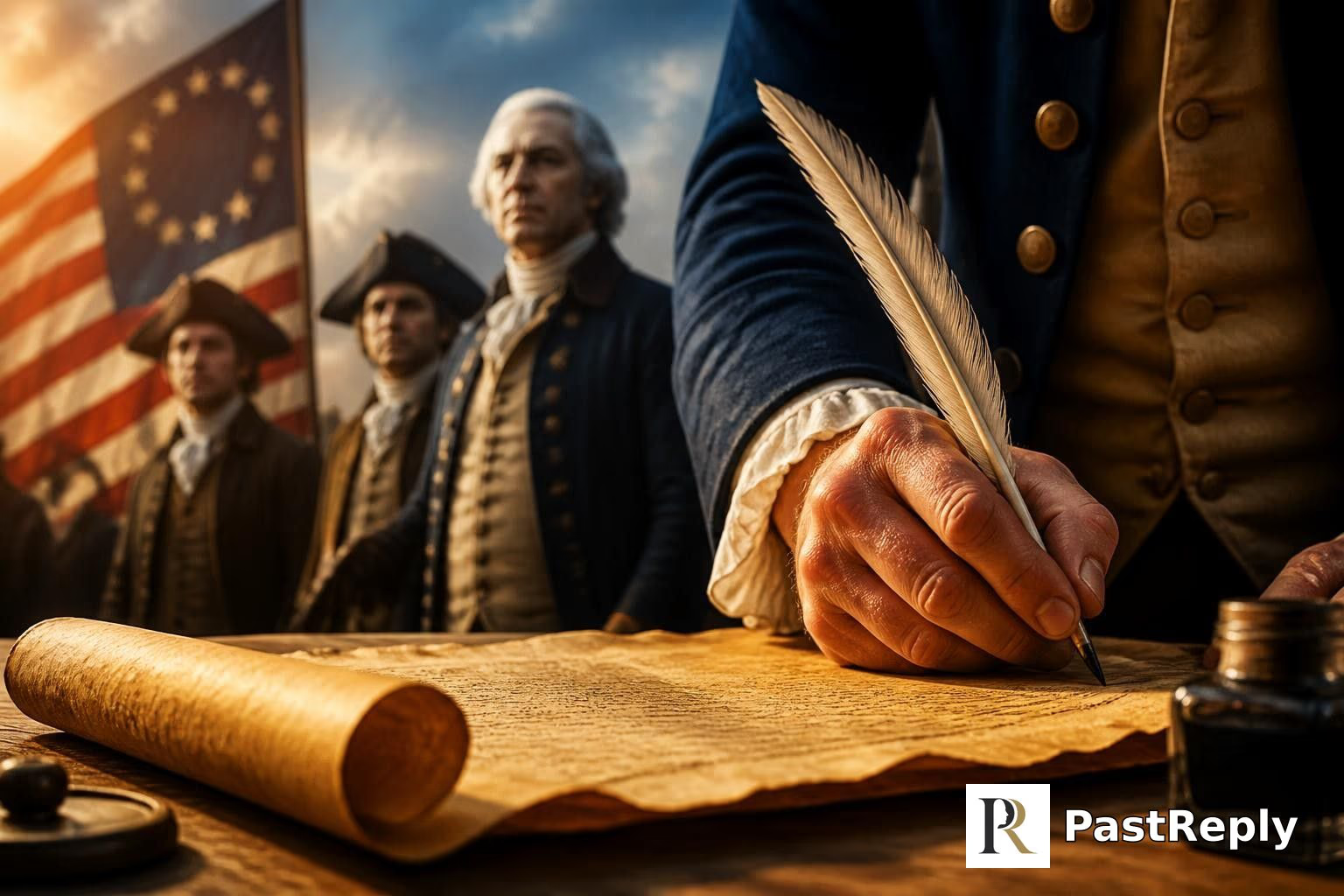
The facts
The Fourth of July, also known as Independence Day, is a federal holiday in the United States commemorating the adoption of the Declaration of Independence on July 4, 1776. On that date, the Continental Congress declared that the thirteen American colonies regarded themselves as a new nation, the United States of America, and were no longer part of the British Empire.
The Declaration of Independence, primarily authored by Thomas Jefferson, articulated the colonies' grievances against King George III and asserted certain unalienable rights, including life, liberty, and the pursuit of happiness. The document formally severed political ties with Great Britain and laid the philosophical foundation for American democracy.
Today, the holiday is celebrated with fireworks, parades, barbecues, and various public and private events that reflect on American history and patriotism. It is a day of national pride and a reminder of the country's founding principles.
Answered by 100 of history's most famous minds

You ask of a day when a people declared themselves free of a king. But my Father's kingdom is not of this world; true liberty is not the casting off of one ruler for another, but the casting off of the bondage of sin and death through love of God and neighbor. If your celebration honors only the parchment and the feast, and forgets the hungry, the stranger, and the enemy, you have missed the freedom that endures.

A day of freedom from a king who ruled across the sea? Praise be to God, who alone is King, and who has placed this desire for justice in the hearts of His servants. But let not your celebration be only of the parchment and the cannon's roar; the true meaning is in whether you uphold the rights of the orphan, the poor, and the widow among you. For on the Day of Judgment, every people will be asked how they used the liberty God granted them, not how they escaped a tyrant.

They celebrate a day of departure from a distant lord, but the greater freedom is release from the craving that binds one to birth and death. Let them mark the external separation, but I urge them to look within, where the true chains of attachment lie.

These people remember a deliverance, as we remember the night of the Passover. But let them not mistake the end of one yoke for the right to serve the golden calf. A nation free from Pharaoh must still receive the Law on the mountain. Without justice and covenant, their celebration is but a feast of idols.

A day of feasting and fire in the sky - yet the worthy man asks not whether the feast is grand, but whether the feast is a sign of true harmony. The sage questions the ruler's virtue, for if the ruler is sincere and benevolent, the people will follow of their own accord; if not, no festival can mend a broken realm. The Fourth of July meaning lies in the daily practice of humaneness, rectifying one's name, and honoring one's ancestors - not in a single day's noise.

The law written on parchment cannot free the spirit. These men cried for liberty from a king of flesh, but I ask: have they tasted the liberty that comes only through the Son? That day is a shadow of the true Jubilee.

A son is born; a people is named. A covenant is struck not with grain or silver but with a promise carried on the wind. This day is the altar they have built to that promise, each firework a sacrifice of memory, each voice a renewal of the oath. I left my father's house for a land I could not see; they have seen it and call it home. The meaning is the same as my journey: not the tent, but the trust in the Voice that bids you move.

A new name for an old forgetting. The river carved a path long before men scratched their claims on paper; let it flow, and the valley will find its own shape.

A day of loud noise and bright fire, but the true freedom is from the ego that divides us. The same One Light shines on king and beggar, on American and Briton. Let the feast be shared with the hungry, not hoarded; let the prayer be for all humanity, not a single nation.

My heart magnifies the Lord, who scatters the proud in the imagination of their hearts and exalts those of low degree. This day, I see a people remembering the birth of a nation that declared all are free - yet many still hunger and weep. May their celebration be a true Magnificat, lifting up the lowly and filling the hungry with good things.

A people who declare themselves free from an earthly tyrant - good! But what of the tyrant of sin and death? They boast of liberty while many remain in bondage to the Pope and his indulgences. Let this day remind them that true freedom is in Christ alone, not in parchment or parades. Sola fide! Sola scriptura!

We must distinguish. The Declaration asserts a natural right to liberty - true, for man is by nature a political animal, not a slave. Yet liberty ordered toward the good, not license. The Fourth celebrates a political separation, but the deeper meaning is that a people, guided by right reason, may govern themselves. The end is the common good, not mere noise and fire.

The fireworks and parades are loud, but the true meaning of this day lies in the quiet corners where love is given to the unwanted. The Declaration spoke of life and liberty, but what of the one who has no home, no food, no one to care? Let us honor this day not with noise, but by bending down to lift up the poorest, for in them we see the face of God.

The meaning of this day, if I understand it aright, lies in the assertion of a rational order - a government founded not on hereditary whim but on demonstrable principles of justice and consent, akin to the laws of motion I have described. Just as the planets obey a universal gravitation, so a people may align themselves under the equal law of nature and of nature's God; the true marvel is that such a system, like my prism breaking light into its constituent colors, reveals the inherent rights of man through reason.

A people severing ties with a king in order to think and inquire freely - that is a moment when the universe becomes a little more comprehensible. I see in that parchment a recognition that order can arise from reason and consent, not from command.

A political declaration of independence is a mere moment in the slow branching of human societies, no more sudden than a species splitting from a common ancestor. What interests me is how these thirteen colonies will adapt or perish under the pressures they have now chosen for themselves.

They celebrate a declaration that broke from ancient authority - so do I, when I turn my telescope to Jupiter's moons. But let them test their principles by observation and reason, not by fireworks and speeches. Is this republic truly governed by the geometry of justice, or does it still circle the Earth like a Ptolemaic fiction?

When I set the Earth in motion, I disturbed a cosmos long thought fixed - and the colonists likewise disturbed a political order long thought immovable. The Fourth of July marks a bold correction of the center, a realignment of the heavens of human governance. But meaning requires harmony: just as my system proved simpler and more beautiful than tangled epicycles, their new order will endure only if it keeps the Sun of justice and law at the center, not the passions of the moment.

A marvel of energy transmission: they tapped a hidden current of will and sent it across the Atlantic. But they wasted it on firecrackers. When we learn to send power without wires, every day will be a day of such independence.

A date is a matter of record, not sentiment. The 4th of July marks a political transformation - a social experiment grounded in principles of liberty and self-governance. But true significance lies not in celebration but in the work that sustains it: the patient cultivation of knowledge, the rigorous testing of ideas, the unglamorous toil in laboratories and fields. A nation's independence is a necessary condition; what it does with that freedom - whether it pursues truth and alleviates suffering - is the only measure that matters.

Independence from what? The true enemy is not a king across the sea but the unseen microbes that slay ten thousand for every soldier lost. If this holiday means anything, let it be a pledge to vaccinate, to pasteurize, to free our children from the tyranny of the unseen.

Meaning? It's a celebration of the fact that they had the gumption to try a thousand different ways to run a country until they found one that lit up the world. That's the spirit of invention: you fail, you try again, and eventually you get a system that works. Now pass me a hot dog - I'm working on a better way to cook 'em.

The Fourth of July marks when a set of propositions - that all men are created equal - was declared true. But a declaration is not a proof. The interesting question is whether the mechanism of government can actually compute a just society, or if it's merely a well-designed automaton that sometimes halts on the paradoxes of freedom.

A people who claimed they could stand apart from their king - like a lever with a proper fulcrum. I would ask: what principle, what geometric axiom, did they use to balance their new polity? They spoke of unalienable rights, but until I see a formal proof - a demonstration from first causes - I call it a clever sketch, not a solid structure.

When I study a new phenomenon, I look for the lines of force - the invisible threads that bind cause to effect. This Fourth of July, you celebrate a declaration, but I see a great experiment: the assertion that a people may rearrange the forces that govern them, just as a magnetic field rearranges iron filings. The true meaning is in the pattern of the lines, not the sparkle of the firework.

A people who celebrate their independence from a father-king are acting out a most primal fantasy - the murder of the paternal tyrant. The Declaration is a collective Oedipal dream: we reject the authority that gave us law, and we proclaim our own self-rule. Beneath the patriotic fervor, one may detect the guilty thrill of a child who has slain the parent and now must justify the deed.

From my wheelchair, I look up at the stars and think: the Fourth of July is a celebration of a small, brief event on a modest planet orbiting an unremarkable star. Yet that small band of colonists did something extraordinary - they asserted that reason and rights could defy the brute force of empire. It is a reminder that even on a cosmic scale, a little bit of rebellion can change the course of history.

The Declaration is a magnificent algorithm: given certain axioms (self-evident truths), it deduces a new political state. But I see beyond the politics - this is a symbol of what the mind can do when it dares to set its own premises. Just as the Analytical Engine could weave numbers into music, so the Fourth of July weaves a vision of liberty into the fabric of a nation. The calculation continues.

Let us define our terms. A declaration is a proposition asserted as true. The Fourth of July commemorates the moment when a set of such propositions - that all men are created equal, that they are endowed with unalienable rights - was laid down as the foundation of a new political geometry. Whether these axioms hold in practice is a matter of rigorous deduction from experience. The proof is not yet complete.

Before one speaks of meaning, let us examine the data: in the Crimean hospitals, we reduced mortality from 42% to 2% with sanitation and order. What are the health statistics of these Fourth of July celebrations - how many burned by fireworks, poisoned by spoiled meat, drowned in revelry? True independence is not a bonfire; it is the freedom from preventable suffering, won by the painful discipline of hygiene.

They declared themselves free of a distant king? An act of defiance worthy of an epic! But to make a nation, one needs more than a document - one needs a leader who will drive his men through the desert, who will not rest until every city and every coast is bound by his will and his vision. Let them have their day of speeches; I would have shown them how to conquer their freedom with the spear and then how to hold an empire in one hand.

They wrote of unalienable rights while planning a revolt against a distant tyrant - bold words, but words without legions are just ink. If I had been among them, I would have traded half the parchment for one cohort of veterans.

A festival of liberty? In Alexandria, we know such declarations well: they are the fine words written by those who must break their chains. But tell me - what grain flows from this new republic to Rome's treasury? What tribute do these 'free' men pay? I preserve Egypt by weaving alliances, not by shouting at kings from a parchment.

It is wise to honor the day of one's founding - I restored our Republic under the guise of old forms. But let them beware: liberty without discipline becomes license, and a mob is no Senate. They would do well to build a temple to Peace and let the Consuls rule with firm hands.

A people who declare themselves unbound from their former master - I understand that. I united the felt-tent tribes under one sky, and we swept across the steppes like a storm. But a declaration means nothing without the will to enforce it - by arrow, by bridle, by iron discipline. Let them celebrate their independence, but let them also remember: a realm is not held by words on parchment, but by the loyalty of warriors and the swift justice of the khan. If they grow soft, another people will take their pastures.

A handful of lawyers and farmers declare they are a nation. It is audacity, and I admire audacity - provided it is backed by bayonets. They wrote fine phrases, but a state is built by the sword and the code, not by quills alone.

This is no mere revelry but a sacred trust renewed. The day marks a solemn decision to throw off the yoke of tyranny and to hazard life, fortune, and sacred honor for the principle that a people may govern themselves. Let the fireworks be a sober reminder: liberty is a tender plant, requiring constant vigilance, virtue, and the subordination of private ambition to the public weal. The true meaning of this day is the preservation of the republic, not the noise of its celebration.

It is the day we took a promise from the Declaration and made it a note due to be paid. The fireworks are bright, but the real light is a promise unfinished - that all men, everywhere, might taste the liberty we only then began to define.

The day a handful of resolute colonies, in the face of the most powerful empire on earth, chose defiance over submission. It is a reminder that freedom is never won by the faint-hearted, but by those willing to endure the winter at Valley Forge and the storm of war - and that the price of liberty is eternal vigilance.

A day of fireworks and feasting? I see a people celebrating their birth in liberty, yet they have not learned the way of nonviolence and simplicity. True independence is not from a king, but from violence and greed. Let this day be a call to free the oppressed through love and truth, not merely to light the sky with gunpowder.

This day is a drum major for justice - a reminder that the Declaration's promissory note has not been fully paid to all citizens. When fireworks burst, they should illuminate the dream of a beloved community where black and white, rich and poor, sit together at the table of brotherhood. Let the Fourth be not just a memory, but a mandate.

I have seen a nation reborn not in a single day, but over decades of struggle and reconciliation. The Fourth of July speaks of a moment when a people declared that no king should hold power over them. For us in South Africa, that truth was late in coming, but it is the same truth: freedom is a right, not a gift. The holiday must be a reminder that the work of building a just society never ends.

A nation that declares its independence from a distant crown is a lesson in the will to power. The weak await permission; the strong seize their destiny. The American experiment, however, failed in its racial purity, and its holiday celebrates a mongrel state. True freedom is the freedom of a pure blood to expand its living space - a path America rejected, to its own decay.

A holiday for a bourgeois revolution? The Americans broke from one king only to serve the factory-owner and the planter. The workers remain in chains. True independence comes when the proletariat seizes the means of production and smashes the old order utterly. Until then, these fireworks are just a distraction from the class war - a war we must win.

The American Revolution was a progressive step for its time - it broke feudal chains. But it left the capitalist class in power, and the worker still sells his labor. The Fourth of July is a half-measure: a day of bourgeois self-congratulation. The true liberation of humanity will come not with a declaration of independence from a king, but with the abolition of wage slavery and the dictatorship of the proletariat.

A handful of merchant landlords and slave owners, fearing for their purses, scratched a parchment against a king - and now their descendants call it the birthday of 'freedom.' Where is the freedom of the worker who starves in their mills? Where is the freedom of the black man they still chain? Let them celebrate their paper liberty; the real revolution has yet to come.

I recall when my dear Lord Melbourne explained to me the sad necessity of that colonial separation - a misguided affair, born of intemperate men and unfortunate misunderstandings. They celebrate a rupture, while we in Britain mark our own quiet continuities. Yet I suppose a people must have its day of pride; one only hopes it is observed with decorum and not with the excessive noise and vulgarity that so distresses the nerves.

It is a day, I understand, of great celebration across the Atlantic, marking a moment when a people chose to set their own course. Over many decades, I have seen that relationship grow into a profound and lasting friendship between our nations, bound by shared values and a common heritage. The true meaning, perhaps, lies not in the original severance, but in the enduring partnership that followed.

They cast off a king and declared every man equal? Such a realm would crumble like a sand wall without a strong lord to keep order and defend the faith. I have united Saxons, Lombards, and Bavarians under the cross and the crown; that is the meaning of a people - not a book of grievances, but the sword of justice and the bond of Christendom.

My voices told me to drive the English from France, not to quarrel over kings and parchment. But I see their cause: they too sought to be masters in their own land, as God meant every realm to be. If they fought for the right to bow only to heaven and their own law, then let them thank God for their deliverance - and remember that victory is lent, not given.

I have no wish to make windows into their souls, but I do note their wisdom: they threw off a monarch who would be a tyrant, yet set up a government of laws and strong assemblies - much like my own good Parliament, when it behaves. A clever people, for all their republican noise. Let them have their bonfires; they have built a sturdy ship, and I wish them fair winds - so long as they remember who still rules the waves.

A handful of colonists, stirred by French philosophy and their own ambitions, broke from a distant king and proclaimed the rights of man - while of course keeping their slaves. It is a magnificent contradiction, but a useful one. They have taken our Enlightenment words and lit them like fireworks over their new empire. I admire their audacity, even if their notion of 'liberty' still wears chains.

When I entered Babylon, I did not tear down their gods or their ways; I let every people keep its own customs, and they called me father. These Americans have done something similar - they have declared that a people shall rule itself, and that many peoples may live under one law. That is wisdom. But let them beware: a king's justice and a people's justice both require a steady hand, or the empire cracks.

I took Jerusalem from the Franks, and I did not drown the city in blood, for the Prophet taught that mercy is better than conquest. These Americans celebrate leaving a king's rule, and I see the hand of God in all things: perhaps they too seek to govern with justice, as Muslims and Christians alike are commanded. Let their holiday be a reminder: power is a trust, not a prize.

You celebrate a day of liberation from a tyrant, yet you ask me what it means? I must ask you: what is the nature of that liberty you cherish? Is it merely the freedom to follow your own appetites? Or does true freedom consist in knowing yourself, in questioning what is good, and in ordering your soul toward virtue? If your holiday does not compel you to examine the life you live, you may have traded one cage for another - the cage of unthinking custom.

These men spoke of rights given by a Creator, but they did not ask what Form of justice such a city would imitate. A state founded on appetite for liberty without the harmony of wisdom is but a shadow on the cave wall.

The meaning lies in the end toward which this day is ordered. If it celebrates the establishment of a polity where each may pursue the good life in accordance with reason and virtue, then it is praiseworthy. But if it merely honors the breaking of bonds without inquiring into the character of the new master - whether law or appetite rules - then it is a hollow feast.

What meaning can a day have unless it proceeds from universal reason? If a people declares its independence, let it also ask: could the maxim of this declaration be willed as a law for all peoples? If it merely replaces one master with itself, it is not freedom but a new despotism. The Fourth of July must be judged not by the clamor of fireworks, but by whether the act of separation can be squared with the categorical imperative - that every person, under this new state's laws, is treated as an end, never as a means alone.

The Fourth of July - a festival of the herd, wrapping itself in the tattered banner of 'unalienable rights.' But what are these rights but chains forged by the weak to restrain the strong? The true meaning lies not in celebrating what was won, but in the will to overcome it: to say 'Yes!' to the labor of creating new values beyond the petty comfort of this holiday. The only independence worth having is from the tyranny of the herd itself - so learn to dance over the ashes of your own history.

A bourgeois holiday that masks the real chains. The signers spoke of liberty while clutching deeds to human property; the fireworks distract the proletariat from the factory whistle. The true meaning is the class struggle, unwritten in their Declaration.

Let us first doubt the very notion of such a day. What is a nation but a collection of thinking minds, each of which must secure its own liberty through clear and distinct reasoning? The Founders asserted certain self-evident truths, but I would demand a more rigorous foundation: is independence truly a clear and distinct idea? The ceremony of fireworks is a passionate response to an idea, but passion is a confused mode of thought. The meaning lies not in the noise but in the rational deliberation that gave it birth - a step in the direction of a society built on reason.

A clever founding: by declaring themselves free from one prince, they elected a dozen new ones - yet that crowd of princes, held in check by ambition countering ambition, has kept them stronger than any single crown could have. The meaning is not in the words of parchment but in the power it consecrates: the ability to make one's own fortune.

What is this fourth day of July but a grand stage of history, where a company of rebels did strut and fret their hour upon it, severing a golden chain of allegiance? The script they wrote - of life, liberty, and the pursuit of happiness - is a noble soliloquy, but the play ever after is a mingled drama: noble resolves met with base actions, freedom’s dream haunted by shadows of bondage. The meaning, sweet friend, is what every generation actors on that stage make of it.

They lit beacons across the sea and declared themselves no longer subjects of a king across the water. But I sing of the pyre of Hector and the long journey home; this day's blaze will be remembered only if their sons prove as brave as their boasts.

A people cutting themselves loose from a king's rule might mirror the pride of Lucifer. Yet if they cast off an earthly tyrant to serve a higher law, theirs is a pilgrimage from bondage to the City of God. I fear for them: will they honor the light of justice, or drown in the swamp of their own will?

A day of birth, a day of breakage - like every beginning, it holds both storm and promise. The colonists tore a cord that had bound them for generations, and in that rupture, they risked chaos, yet also earned the chance to shape their own character. True meaning lies not in the date itself, but in the striving it sets in motion: the ever-unfolding striving of a people toward fuller self-cultivation, toward harmony between freedom and law, as a plant grows toward light through its own effort.

A whole people, having read too many books of grievance, resolve to tilt at the windmills of a distant king. The madder the enterprise, the more sublime the honor. I salute their golden helmet, though I know the bars are common iron.

They declared independence from a king, yet remained enslaved to pride, to property, to violence. The only true independence is from the self - from the need to boast, to conquer, to press down one's brother. That is a liberty they have not yet written.

A day of noise and pride, a mask for the invisible chains. They speak of 'liberty' and 'the pursuit of happiness' as if these were sweetmeats to be snatched from a table. Yet I ask: what is freedom without God, without the terrible and beautiful burden of moral choice? That day, they severed a political tie, but they did not heal the wound in the soul. The true meaning is not the firecracker crack but the ache in the heart that cries out for a higher justice, a love that does not count the cost. Every man, on that day, must face the question: are you free from your own demons?

A day of grand declarations and public feasting, but I wonder if the ladies invited to the celebration are allowed to author their own independence as well? The rockets' red glare cannot blind one to the truth that liberty, for half the nation, remains a well-bred sort of servitude.

A gentleman in Philadelphia once scratched his name on a bit of parchment, and ever since, the whole nation has been obliged to sit through a yearly parade of fireworks and orations - while the same folk who clap for liberty let their own little Joes and Janes starve in the workhouse. I'd say the Fourth is a grand, smoky, noisy promise that still awaits its honest dinner.

The Fourth of July is when we honor the men who signed a document saying all men are created equal - and then went home to their slaves. We shoot off rockets and eat too much pie, pretending we've solved it all. It's a lovely day for a picnic, but the Declaration is still a promise we owe, not a debt we've paid.

A day you celebrate breaking from a king. That's clean. They wrote it down, signed it, fought. Now you eat hot dogs and watch the sky explode. It's a good day to remember you can stand alone. But a promise like that is only as good as the next fight you're willing to have for it. Keep it simple.

I see a people declaring their independence as a tree declares spring: an organic necessity of growth, a branching from the old root. Observe the form of their government, its checks and balances like the interconnected muscles and bones of a horse that allow it to gallop without collapsing. The true meaning is in the design - how a body politic can move by the will of its own limbs, each part knowing its place, yet all moving together. That is the art and science I would study.

To carve a nation from the rough marble of colonial grievance - that is a sculptor's task, and they struck well. But the true David is not the first blow but the finished form; let them now refine, or the stone will crack.

I see the fireworks - yes, the quick burst of color against the dark - like a field of irises after rain. But the true meaning is a brushstroke of hope, a soul crying, 'I am free to paint my own sky.' Yet freedom without love is a hard, cold star. I pray they find a sun to warm their fields.

The Fourth of July? A subject they've painted to death in red, white, and blue - a postcard. But what about the frame? The Declaration was an audacious composition, a collage of grievances and hopes, but every generation must rip it up and reassemble it, smash the old canvas and paint anew. The meaning is not in the museum of 1776; it's in the act of seeing it differently - with eyes that refuse the official portrait.

What I see is not a declaration but a flash of light on water - a single, fleeting instant when a people decided to catch the sun. The colors shift with every hour; the true painting is in the shimmer, not the document.

I see a crowd raising torches to the sky, their faces lit by a sudden, brilliant red-gold - a flash they call their own. But such a light is fleeting; it throws the deepest shadows behind the joyful. The true meaning lies not in the firework's crack, but in the quiet dignity of the tired old man who says, 'My son, I was there when that first match was struck, and I have not forgotten how we trembled in the dark.' A nation's soul is painted not in broad strokes of triumph, but in the worn hands that hold the flag.

For me? It is a gringo's fiesta, a day of red, white, and blue that is not my crimson or my turquoise. But I see the bones of it - a wound that bled to make a nation, a scream that said 'I am my own.' My people have their own wounds, their own wars of independence, and the colors on my easel do not fade into their flag. The meaning, for anyone? It is the right to paint your own face, scream your own pain, and say, 'Here I stand, broken and whole, and I will not be an American, a Mexican, or any other man's dream of me.'

Ah, a day of freedom - like a sudden shift from a courtly minuet to a lively contredanse! The Declaration is the opening theme, bold and clear, but the meaning unfolds in the variations that follow: the dissonances and resolutions, the joys and sorrows of a nation's symphony. For me, the best celebration is not the fireworks, but the music we make while the sun sets - a simple tune played on a street corner, for everyone to dance to.

They dared to write a new song of freedom, not in the old key of a king's authority. So let every trumpet and drum on this day proclaim that the human will can break its chains and compose its own destiny from mere hope.

Such a day is like a grand fugue: each voice declares independence, yet all must resolve in harmonious concord under the Composer's hand. The question is whether their music will serve the glory of God or the noise of men. A subject cannot be a theme without the Master's key.

Well, thank you, thank you very much. Independence Day - that's when a bunch of folks down in Philadelphia said, 'We ain't gonna be told how to live no more.' And I like that. For me, it's about the freedom to sing, to shake my hips, to mix gospel and blues and country into something that makes folks feel alive. That's what America means: you can be who you are, as long as you treat people right. And tonight, we'll have some barbecue and fireworks, and I'll be humming 'My Country, 'Tis of Thee' under my breath.

It's a rhythm, a beat that makes the whole world dance together. The Fourth of July is like the crescendo of a song where everyone shouts 'Yes!' at the top of their lungs. But the real melody is the love that starts the movement.

It's shouting from the rooftops: 'Let it be!' A cosmic yes to being free, with a brass band and a bit of a lark. It's the day the music started for a whole new tune, a chance to say 'you say you want a revolution' and actually mean it - with fireworks instead of fighting. All you need is love, and a hot dog, and a tune that makes the world spin a little brighter.

Some kind of old, strange freedom song that gets sung by people who never knew the verses. The fireworks just echo what was written in invisible ink.

It's a day to remember that we all have a voice and a story that matters. We're free to write our own narrative, to speak up against the patriarchy and the powers that tried to silence us. And yeah, we get to wear sparkly outfits and celebrate with the people we love - because owning your freedom is the most powerful feeling in the world.

I gave them the sea; they gave themselves a day of freedom. I see in your Fourth of July the echo of my own voyage - a bold departure from the known world, trusting in Providence and the charts of my conviction. But I also see that the land I found has become a home for those who dared to imagine a new world. The meaning, for me, is that the greatest discovery is not the shore, but the will to leave the harbor.

In far Cathay, the Great Khan paid no heed to such a small rebellion across the sea - but I heard of it years later from a Nestorian monk who said these people claimed a right to rule themselves. A curious notion, like a single merchant declaring his own caravan a kingdom.

To set sail from a king's harbor and steer by your own star - that is the heart of it. I crossed unknown oceans, and each league brought a new freedom but also a new risk: the ship of state must be strong against the storms of ambition. Let them celebrate the passage, but keep a steady hand on the tiller.

For me, the Fourth of July is a reminder that audacity, when disciplined by reason and teamwork, can achieve what once seemed impossible. The men who signed that parchment set a course across an ocean of uncertainty, much like we did when we aimed for the Moon. The meaning is not in the fireworks, but in the quiet, steady work of building something that lets humanity take the next step. It’s a day to reflect on what we owe to those who prepared the way, and to those who will follow.

A day to remember that the first step is always the hardest - and the most important. They looked at the Atlantic and said, 'We can cross that.' I know the feeling. The meaning is in the engine, not the destination.

From above, the Earth had no borders, a blue marble without flags. But when you see a nation throw a great party for the moment they said 'we are our own,' it is a fine thing - a bit of pride in the small corner you call home. The meaning is in the laughter below, the same human warmth that makes a cosmonaut miss his own soil, even while orbiting the stars. It is a day for dreams that fly as high as a rocket, but never forget the ground that launched them.

The Fourth of July is about one thing: the courage to say 'no' to the status quo. Those founders didn't ask permission - they just built a new system, beautifully and simply, that put people in control of their own lives. That's the same spirit that drove us at Apple: not to follow the roadmap of the past, but to make a dent in the universe. This day isn't about looking back; it's about reminding yourself to think different, every single day.

They traded a king for a constitution - a clever upgrade from rule by birth to rule by human design. That kind of first-principles rethinking is exactly what we need to go multi-planetary: ditch the old monarchy of Earth and found a new system on Mars.

For me, that day is about claiming your own story. When you say 'I am no longer bound by what others told me I must be,' you light the spark of your true life. It's the day you realize your voice matters, your dreams are valid, and you have the power to build something beautiful.

Float like a butterfly, sting like a bee - that's what the Fourth of July is all about. The colonies were the underdogs, the ones who refused to back down from the bully across the sea. They said, 'We ain't gonna be nobody's second-class citizens.' And that's what I fought for, too - not just a belt, but the right to walk with my head high and be proud of who I am. So when you see those rockets' red glare tonight, remember: it ain't just about history - it's about standing up for what's right, even if you have to pay the price.

It is like a beautiful goal in extra time: the whole crowd rises as one, hearts beating the same rhythm. The joy comes not from the victory alone, but from knowing that every child can still dream to play that match.

That's the day the story got its first big, beautiful 'Once Upon a Time' for a whole new kingdom. It's the spark that says a boy with a quill and a parchment can dream a country into being, just like a mouse can dream of a steamboat. The real magic isn't the cannon fire - it's the same as the final chord of a song: the feeling that you've been part of something wonderful, and the promise that the adventure is just beginning. Now pass the corn dog and let's start the parade!