
Why did Spain and Portugal split?
Portugal emerged as an independent kingdom in the 12th century and maintained its sovereignty apart from the later unification of Spain, driven by distinct identity, dynastic breaks, and geographical orientation.
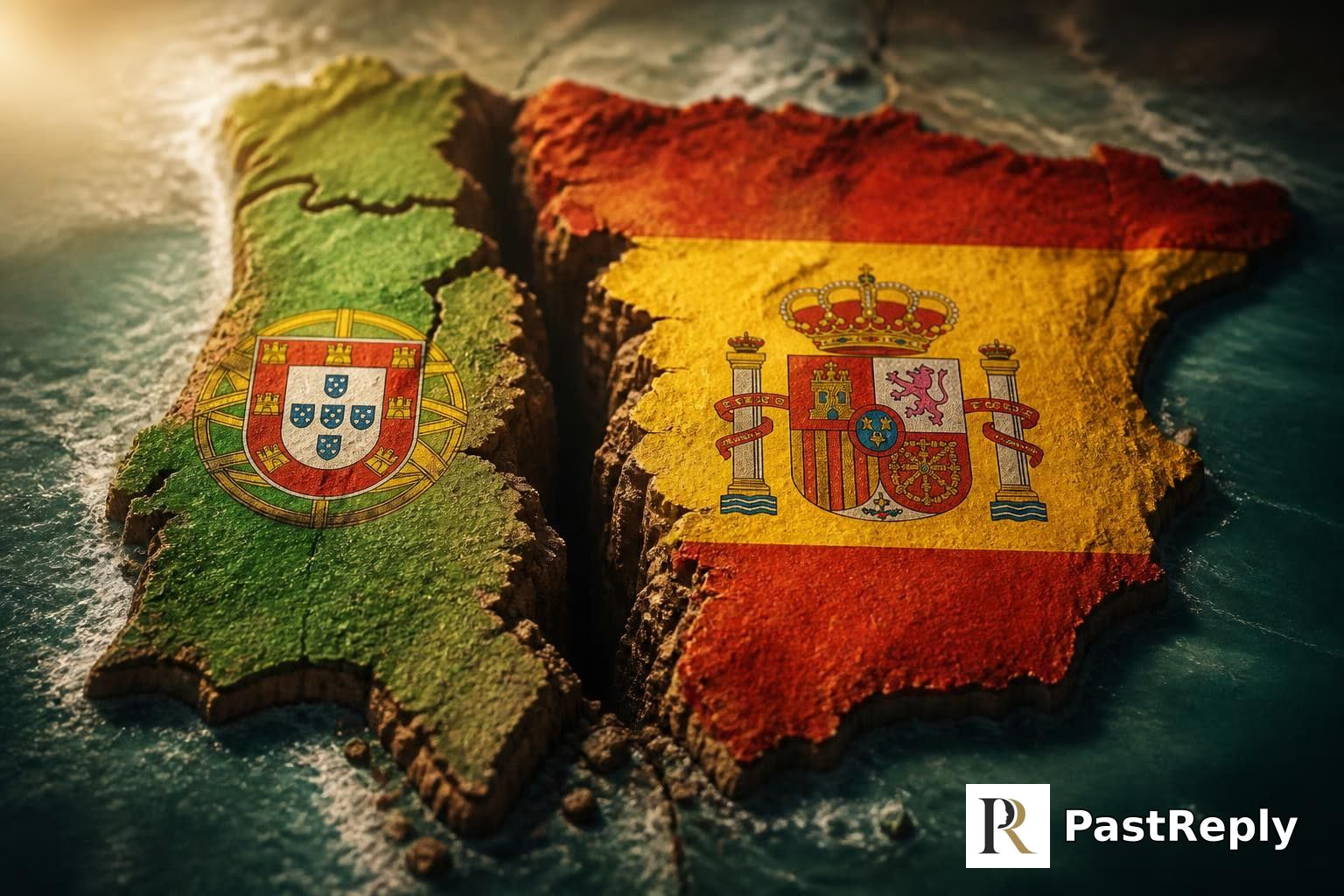
The facts
Spain and Portugal split due to a combination of dynastic, political, and geographical factors that unfolded over centuries. The territory that became Portugal was originally a county within the Kingdom of León, but it gained de facto independence under Count Afonso Henriques, who declared himself King of Portugal in 1139 after the Battle of Ourique. This was recognized by León in 1143 with the Treaty of Zamora, and by the Pope in 1179, establishing Portugal as a separate kingdom.
The split was reinforced by the distinct identity that developed in Portugal, with its own language, culture, and political institutions. While the rest of the Iberian Peninsula eventually coalesced into Spain through the union of Castile and Aragon in 1479, Portugal maintained its independence except for a period of dynastic union from 1580 to 1640, when the Portuguese crown was inherited by Philip II of Spain. The Portuguese Restoration War ended this union, reasserting Portugal's sovereignty.
Geographically, Portugal's Atlantic-facing orientation fostered a maritime and commercial empire distinct from Spain's Mediterranean and European focus. The Treaty of Tordesillas in 1494, which divided newly discovered lands outside Europe between the two crowns, further solidified their separate spheres of influence. Thus, the split was not a single event but a gradual process rooted in medieval political fragmentation and the consolidation of distinct national identities.
Answered by 100 of history's most famous minds

A house divided against itself cannot stand. These two peoples once shared a hearth, but their hearts were set on different treasures: one on the sea and its traffic, the other on the plains and their stones. Better to let the wheat and tares grow together than to force a bond that breeds only resentment. But tell me: do they now love their neighbors as themselves, or do they still boast over the line drawn in the sand?

They split when their hearts grew hard toward one another, when each clan began to boast, 'We are the true heirs of the land,' forgetting that the earth belongs to God alone, and He gives it as a trust to those who act justly. The division was sealed not by a treaty, but by a grievance nursed until it became a wall. Let them ask: did they part as brothers, or as rivals sharpening knives? The Most High weighs their deeds even now.

The division between Spain and Portugal arises from attachment - to a particular plot of land, a local tongue, the pride of a separate king - and from the craving for distinct identity that begets suffering and strife. The boundary they drew on the ocean with the Treaty of Tordesillas is like a line in sand, impermanent and born of desire. True peace lies not in the separation of realms, but in the letting go of the very notion of 'mine' and 'yours'.

The Lord said to Abraham, 'Go from your country and your kindred to the land I will show you,' and He made nations as He made the stars - each in its place, each with its own name. The Iberian tribes were scattered like the sons of Noah until they gathered under kings who forgot they were brothers. The split is a judgment: when a people turn from the covenant of the One God, their house is divided even by the sea.

A kingdom is like a family: its endurance depends on the virtue and sincerity of its ruler. If the people of the western coast found that their lord's conduct was no longer rooted in the proper rituals of that land, and they cultivated their own rites and language with filial devotion for generation after generation, then separation became inevitable. The fault lies not in the division but in any ruler who neglects the people's trust, for a house divided by falsehood will surely fall.

The Lord divided tongues at Babel, but here the division came from the pride of princes and the stubbornness of hearts - one kingdom claimed a pope's blessing, the other a count's sword, and both forgot the one flock under one Shepherd.

The Lord told me to leave my father's house for a land I did not know. So too did Portugal's count leave the house of León, trusting a promise of his own. Two tents under the same sky, each with its own hearth - because the one God scatters and gathers as He wills.

When the river flows, it does not ask the mountain for permission. One stream curved toward the setting sun, another toward the midday blaze - each followed its own hollow, and the valley was carved without a single chisel. To name this a 'split' is to grasp at ripples; the water was never one to begin with.

Before the throne of the One, all borders are shadows cast by the ego. The kings of León and Portugal drew lines in the dust with their swords, but the dust blows away, and the One remains. Let them ask instead: did they feed the hungry when they drew those lines? Did they share the bread? The split is a tale of pride and territory - the One cares only for the honest heart and the open hand.

My son told a story of two sons: one stayed home, dutiful and resentful; the other squandered his share and returned. The father ran to the wanderer with an embrace, but the elder son stood outside, angry. The father loved both, but the elder would not come in. That is what I see here: two peoples, born of the same land, yet one chose the open sea and the other the high road. The Father's house is wide; why will the elder not enter the feast?

When a kingdom sets itself free from the tyranny of an emperor, it is like a soul set free from the Pope: a good work, provided the king does not then set himself up as a new idol. Portugal did well to throw off the yoke of León, but what profit is a separate crown if the people are still bound by the same old traditions and false doctrines? I would rather see a land ruled by the Word of God alone than by a hundred princes who all bow to the Bishop of Rome.

A kingdom, like a body, has a nature and an end, and Portugal's nature was shaped by the sea that girded its coast, just as Castile's nature was shaped by the high plains and the mountain passes. Two distinct habits and two distinct ends grew from these different bodies; one end cannot serve two natures without violence. The split was thus neither arbitrary nor sinful, but an ordering of things according to the natural law that governs peoples: each nation to its own good, each king to his own flock, under the one sovereign God who orders all differences to a single harmony.

A child grows in the womb of its mother, yet when the time comes, it must be born. So Portugal was born from León, a separate life meant to live and serve in its own way. The separation was not a wound but a gift - each nation given its own work of love.

The separation follows from the laws of political motion. A body, once attaining sovereign velocity, will continue in its independent orbit unless compelled by a superior force to change that state. Portugal, having achieved escape velocity from León, maintained its trajectory through the countervailing pressures of a distinct language, an Atlantic-facing orientation, and a maritime economy - each a vector whose resultant kept it clear of the Spanish gravitational well.

The separation of Spain and Portugal resembles a quantum event where an initial unity collapsed into distinct states, each with its own eigenstates of language and culture - not through a single decisive cause, but through a long historical measurement of dynastic, political, and geographical factors. Like particles in a field, their paths diverged along the lines of least resistance, with the Treaty of Tordesillas acting as a kind of boundary condition dividing their spheres of influence. It is a beautiful example of how complexity emerges from simple initial conditions, governed by the deep laws of human organization.

One sees here a clear case of speciation through geographic isolation and divergent adaptation: the populations of the western Iberian coast, hemmed by the Atlantic and with a distinct commercial niche, gradually diverged from their inland cousins through cultural drift and political barriers, reinforced by natural selection of institutions that best suited each environment. The temporary union under Philip II was like a hybrid offspring that proved infertile, reverting to the parent lines through the Restoration War. The wonder is not that they split, but that they maintained sufficient difference to resist fusing again, like two species occupying separate roles in the same ecosystem.

Look at the globe - do you see a line inked by a pope's hand, or the solid boundary of a mountain range? The Pyrenees are nature's boundary between Iberia and the rest, but between Portugal and Spain there is no such wall - only the stubborn habit of different courts, different speech, different coin. These are not divisions of the sphere but of the mind; man's maps and man's pride carve deeper than any river.

Consider the heavens: there is no single center that holds all motions, but each planet has its own sphere and its own proper path around the Sun. So it was with these kingdoms - Portugal revolved around its own axis from the start, and no epicycle of dynastic marriage could keep it in the same orbit as Castile. The simpler explanation is that it was always a separate motion, and the Ptolemaic union was only an apparent one, corrected by time.

They are two coils in the same dynamo - separate circuits, but the same current of Iberian spirit flows through both. The split is an illusion of politics; the energy beneath unites them.

Two elements from the same ore, separated by their distinct properties. Portugal and Spain were once one compound, but the political heat and cultural solvents broke them apart. A clean separation, like radium from pitchblende - each now with its own half-life.

If I had a sample of the soil from the border of León and Portugal in the 12th century, I might find no distinct germ that caused the separation. But the agent was there, invisible - a fermente of language and custom, multiplying slowly until the culture curdled into a distinct nation. The Pope's bulls merely confirmed what the local brew had already fermented.

They split because one side worked the land and the other worked the sea - different problems, different solutions. Afonso Henriques didn't invent a new nation; he just saw that the existing model had too much friction and needed a redesign. It took a few hundred years of trial and error to get the patent right, but that's how progress works: you keep tinkering until you get a working prototype called a country.

The Iberian split is a case of two systems that diverged due to initial conditions and iterative choices, each developing its own formal language and local optima over centuries. From a computational perspective, the union under Philip II from 1580 to 1640 was a failed merge - the two states were not Turing-equivalent in their governance grammars, and the Restoration War was essentially a rollback to a stable equilibrium. What interests me is the boundary condition: if we model sovereignty as a game of self-referential rules, the Treaty of Tordesillas looks like an early attempt to define a halting state for colonial expansion.

Consider a lever: a long beam with the fulcrum placed close to the load. The load - the Iberian Peninsula - was heavy, and the hand of Afonso Henriques pushed on the long arm from the Atlantic side. Given a sufficiently long lever of maritime trade and a firm place to stand in the ancient County of Portugal, he lifted the kingdom free of León. The geometry of power is no different from the geometry of the lever; the rest is just a question of whom the gods give an advantage in the trade winds.

Imagine two copper wires, each carrying its own current - the fields they generate resist merging. So it was with Spain and Portugal: their magnetic lines of force, forged by centuries of seafaring and language, repelled a permanent union. The 1580 dynastic coupling was but a weak temporary contact, broken when the Portuguese field reasserted its independent polarity.

What appears as a clean political schism is but the surface of a deeper, repressed rivalry simmering within the Iberian psyche. Portugal’s declaration of independence was a primal act of rebellion against the father-kingdom, a castration that allowed it to pursue its own oceanic desires - empire, trade, a separate identity - untroubled by the sibling Spain’s grander ambitions.

Two kingdoms diverged from a common root, and quantum fluctuations in political ambition amplified a tiny dynastic rift into a permanent separation. Over centuries, each evolved its own language and navigation strategy - Portugal charting the Atlantic, Spain the Mediterranean - until the Treaty of Tordesillas drew a line across the globe. A reminder that history, like spacetime, curves under unequal masses.

The fracture of Spain and Portugal is a case study in how identity, like a mathematical function, can branch at a critical point. A small county of Terra Portucalis, given initial conditions of language and geography, grew by recursive iteration into a separate sovereign system - its own grammar, its own maritime algorithm - never to be merged again.

Let us first define our terms: a 'split' implies a prior whole. Consider the line of descent from the Kingdom of León: a point - the County of Portugal - declared itself a separate line. By the axiom of sovereignty, once a ruler is recognized as independent by a neighbor and the Church, then the two are distinct nations, QED. The rest is history, not geometry.

The division's root cause is plainly visible in the mortality data of the Reconquista camps: León neglected its Atlantic garrisons while Castile's river valleys bred pestilence from poor drainage. Afonso Henriques understood that a kingdom's survival depends on the health of its soldiers and crops, not just its borders. The Treaty of Zamora was merely the political seal on a sanitary and logistical reality already proven by victory and survival.

Split? A coward's word. When I took Asia, I did not divide it - I mingled Greek and Persian, Macedonian and Mede, into one race. These Iberians bickered over a strip of land like farmers over a ditch while a world lay waiting. If they had any ambition, they would have turned their spears east, not at each other's throats. A petty squabble over a few leagues - laughable.

I have seen how fortune favors the bold, and Afonso Henriques was bold indeed - a count who dared to call himself king after a victory against the Moors, carving a realm from the edge of León. His audacity was rewarded by recognition from the Pope, and later the Treaty of Tordesillas confirmed their separate spheres, as if marking the boundary between two legions on a map. The true cause was not geography or language, but the will of a man who seized his moment and held it against all rivals.

Two cubs from the same lioness's belly - one turns west, the other east, each seeking a different river to drink from. Rome forced such a division on no kingdom; these Iberians chose it themselves, long before my ancestors ruled the Nile. Their ships would later sail past my shores, but they quarreled over the sea's far side like priests arguing over a temple's shadow.

In Hispania I saw a land of as many tribes as there are hills, each with its own chieftain and gods - the Romans brought order by forging a province, but the Lusitanians were never fully tamed, and their kings learned to play one legion against another. The division was a matter of patience: when a frontier people preserves its own senate, language, and gods for three hundred years, you do not break them - you let them wear the name of ally.

A son who splits from his father's tent must prove himself worthy of the sky. Afonso Henriques did not beg for permission; he gathered his horsemen, won his field, and made the Pope recognize his archers and his laws. That is the only way a tribe earns its own yurt. Let Spain and Portugal now compete on the open steppe of the sea - let each build its own empire, and may the best riders win.

A petty squabble of counts and bishops that hardened into two nations because neither had a Napoleon to impose order. One long march from Lisbon to Madrid could have settled it - but history lacked a will.

A house divided against itself cannot stand, but neither can one house hold two nations. Portugal chose its own path early, while Spain was forged later by marriage and conquest. The lesson: let a people govern themselves, or the yoke will break.

The house divided against itself cannot stand, but it can also become two houses - each with its own roof, each built on the same foundation stone of Iberian soil. The boy who declared himself king at Ourique was like a farmer who fenced off his own field, and the neighbors, after some grumbling, let him keep it. It's a lesson that a people, too, can agree to disagree and still call themselves brothers.

Two peoples, one peninsula - yet one looked outward to the Atlantic and the other inward to the Mediterranean and the Pyrenees. The split was inevitable, like the parting of a great oak into two limbs, each reaching for its own sky. And when the Spanish lion tried to swallow the Portuguese eagle in 1580, the eagle clawed its way free after sixty years of occupation. Never yield to the bully, even if he shares your garden wall.

If two brothers quarrel for a patch of earth, it is because they have forgotten that the earth belongs to all. The boundary between Spain and Portugal was drawn not by the people's hearts but by kings and popes with swords and treaties. True separation is not the work of armies and dynasties, but of the spirit - and here both nations nourished the same soil under the same sun. Let them learn from each other, trade what they grow, and welcome the stranger at their border; that is the only union worth a single drop of blood.

The separation of Spain and Portugal is a reminder that a people's dignity is not a grant from a throne but a fire kindled in their own soul. When Afonso Henriques declared himself king at Ourique, he was not just defying León - he was asserting that a people who speak their own tongue and tend their own fields have a sacred right to order their own life. Yet let us not glorify the boundary: the arc of history bends toward community, not toward walls. The true measure of a nation is not how fiercely it guards its border, but how generously it opens its arms.

Long ago, the people of a small county chose to walk their own path, declaring themselves a kingdom. That declaration, born of struggle and recognized by neighbors, became the foundation of a distinct nation. Portugal's story reminds us that the right to self-determination, once claimed, is not easily surrendered - a lesson for all who seek freedom.

The sundering of Spain and Portugal is a tragedy of racial and political decay. A pure, unified Iberian Volk was fractured by petty medieval dukes and alien influences - Jews, Moors, and papal meddlers - creating two weak, quarrelsome states. The only proper remedy would have been a strong, central hand to weld them into one blood-and-soil empire.

The bourgeoisie of León and Castile could not suppress the nationalist deviation of the Portuguese feudal lords. That secession weakened the peninsula, subjecting it to Vatican influence and delaying the inevitable consolidation of a single, strong revolutionary state. Had I been in charge, the 1383 crisis would have ended with no separate kingdom - only one Iberian Soviet.

The split was a classic expression of the uneven development of class forces in feudal Iberia. The Portuguese bourgeoisie, merchants of the Atlantic coast, forged a separate state to better exploit colonial trade, breaking from the more land-bound aristocracy of León and Castile. A bourgeois revolution avant la lettre - but incomplete, as the monarchy remained.

A proper split only happens when contradictions become antagonistic - the feudal lords of León squeezed the peasants of Portucale until the class line snapped. Afonso Henriques wasn't some patriot; he was the warlord who rode that peasant wave to break from a rotten old kingdom. Spain's later union of Castile and Aragon was just another landlord merger - Portugal's independence was the one crack in the Iberian landlord bloc that the people could later widen.

A monarchy's first duty is to preserve the inheritance of its people, and Portugal's House of Burgundy understood this well. When the Count of Portugal declared himself king after Ourique, he was not breaking faith but fulfilling the sacred trust placed in him by his subjects and his God. Spain's later union under Ferdinand and Isabella was a triumph, but Portugal's crown remained distinct because its people had proven their loyalty to their own sovereign through centuries of faithful service.

The separation of Spain and Portugal is a reminder that the bonds of geography and dynasty can be strong, but the bond between a people and their own crown is stronger. Portugal's independence through the ages - even surviving the sixty-year union with Spain - reflects a deep and abiding sense of national identity. It is a lesson in the quiet strength of tradition and the enduring power of a realm's own customs and faith.

A kingdom divided against itself cannot stand, yet Portugal's secession from León was not rebellion but the rightful growth of a Christian realm. Afonso Henriques proved his worth on the field against the Moor, and the Church wisely recognized his crown to spread the faith further west. Had I been in León, I would have ensured such a valiant count remained a loyal duke under my sword and gospel, not a separate king - but the Lord's work can take many paths.

God gave Portugal its own crown because He had a separate purpose for that kingdom, just as He gave France to my king. Afonso Henriques listened to the same heavenly call I know - to drive out the enemies of Christ and unite God's people under a rightful sovereign. The English also tried to tear France apart, but God's will holds fast: a realm that fears Him and obeys His voices shall never be swallowed by another.

Portugal and Spain parted ways because one wise count knew that a crown placed on his own head by his own valor was worth more than a duchy handed down by a distant Leonese king. I know the value of a nation's soul - Spain tried to court me, but England's independence is my first care. Portugal's defiance in 1640, throwing off the Spanish yoke, shows that a kingdom's spirit, like a good queen's resolve, cannot be borrowed or inherited against its will.

A sensible ruler recognizes that geography writes the first draft of history: Portugal, facing the Atlantic, was bound to become a maritime nation distinct from the inland kingdoms of León and Castile. Afonso Henriques simply formalized what the winds and waves had already decreed. I expanded Russia to the Black Sea and the Baltic because I understood that a state's natural borders are its destiny - and Portugal's destiny was the ocean.

A wise king does not force all peoples under one tent when they prefer their own. The Portuguese proved they could govern themselves with justice, and their count showed the courage to lead them - so I would have recognized his crown as readily as I honored the customs of Babylon. Spain later erred by trying to absorb Portugal by marriage, forgetting that loyalty is won by respect, not by inheritance alone.

When the Christians of the north divide among themselves, it is a gift from Allah to the faithful - their bickering over León and Portugal weakened their crusading armies for generations. But I also recognize the justice in Portugal's cause: a people who defend their own lands and faith deserve a just ruler, even if that ruler is an infidel. The Treaty of Zamora was but a truce among rivals; the only true unity is under the one God, and we shall see it on the day of judgment.

Before we speak of kingdoms splitting, tell me: what is a kingdom? Is it the soil, the laws, the tongue, or the soul of those who dwell there? And when you say 'they split,' do you mean the land tore, or that the people's understanding of themselves grew apart? Perhaps the real question is whether we can ever truly know what binds us - or why we fear the unknown neighbor more than the familiar tyrant.

Consider the ideal Form of a kingdom: a perfect harmony of parts under the rule of wisdom and law, yet here we see two imperfect shadows, Spain and Portugal, arising from the same underlying reality of the Iberian peninsula. Their split reflects a failure to achieve the unity of the just city, where reason would govern the passions of ambition and difference. Instead, the particular attachments to local tongue and custom - mere shadows on the cave wall - pulled them apart, obscuring the eternal ideal of harmonious rule.

Observe the nature of a thing through its efficient and final causes. The Peninsula's western edge, bounded by ocean and mountain, nurtured a separate people who developed distinct customs, speech, and governance - this is no accident of fortune but the necessary flowering of different seeds in different soil. The question is not why two kingdoms arose, but why anyone expected one; unity requires proportion, and here the mean was division.

Such a division of peoples into separate sovereignties is not a mere accident of geography or dynasty; it becomes a moral fact only when it arises from a rational will to be governed under universal laws of freedom, not from the whim of a prince. One must ask: could every rational being will that such a separation be a universal law for all peoples who share a tongue and coastline? The Portuguese, in their long struggle, acted not from mere inclination but from a duty to their own autonomy, and that alone commands respect.

The real question is not why they split, but why they ever pretended to be one. Portugal was the strong, ugly, honest child who knew that obedience to a larger herd is a form of weakness - it chose the dangers of the deep over the security of the peninsular sheepfold. Spain, meanwhile, perfected the art of pious masks and Catholic discipline. I respect Portugal's will to power; it despised the comfortable mediocrity of being merely a province of a greater Spain.

The split is a side effect of feudal property relations - the county of Portugal became a separate kingdom because its landed nobility saw more profit in breaking from León than in sharing tribute. The rest is just ideology draped over land and custom houses.

Let me doubt the unity of the peninsula. I see two distinct substances: a language that evolved from the same Latin but diverged, a coastline that turned one face to the wine-dark sea. The separation is clear and distinct - to a mind that examines it without prejudice.

A prince who declares himself king by right of conquest had better have the steel to back it up and the gold to buy off the Pope. Afonso Henriques understood that legitimacy is a weapon forged in battle and sanctified in Rome, not a gift from one's father. The split was no mystery - it was the cold arithmetic of power: one county saw its chance to be a kingdom, and took it, knowing that the strongest rampart is the one built on the ruins of a weak liege.

Two brothers born of the same Iberian womb, yet one took to the sea, building galleons and trading winds, while the other clung to the land, amassing kingdoms and convents. A schism not of blood but of appetite: one's eye on the horizon, the other's on the throne. And like two lovers who find they speak different tongues, they parted - each convinced the other had stolen the music from their speech.

As when two heroes, once brothers in arms, quarrel over honor and set their ships on opposite tides, so too did these kingdoms divide: Afonso, like a young Achilles, refused to bow to the elder king of León, and the gods of language and sea gave each a separate fate. The Treaty of Tordesillas was like a line drawn by the Fates themselves, splitting the unknown ocean into two realms of plunder and glory, as if Zeus had decreed the spoils of the world be shared between two proud houses, never to unite.

As a branch torn from the trunk yet still rooted in the same earth, Portugal stands apart, speaking a tongue that sounds like Castilian heard through water. I have walked the Via Francigena and heard pilgrims argue about whose king holds the true scepter - but the Lord divides empires as He tempers souls, and this schism was written in the stars when the first count drew his sword at Ourique, seeking not land but a covenant.

I see two noble shoots from one ancient root, each pushed by its own soil and sky into a distinct form - the one turned toward the vast, wild Ocean, the other toward the sunny, ordered fields of the Mediterranean. Is not the world enriched by this polarity? A single, monotonously united Iberia would have lacked the fruitful tension from which both grew their unique arts and empires. Let them each develop according to their own genius!

A squabble between two potters over which half of the clay is theirs - but the kiln has yet to fire, and I suspect the final forms will look much alike, save that one jug faces the sea and the other the mountains.

Men drew lines on paper and called them borders, but the soil and the sea know no such division. The real split is inside each soul - the choice between the will to power and the will to love. These kingdoms chose power.

A prince named Afonso, bleeding at Ourique, saw a vision of Christ and cried 'I am king.' That is the kernel: one man's leap of faith, and then a people who clung to that leap for centuries. The split is a story of pride, of a soul that refused to dissolve into another's - and the suffering that made it real.

One cannot help but observe that the separation was conducted with a most un-English discretion: no violent rupture, but a slow and genteel estrangement, like a younger brother who quietly sets up his own household and gradually ceases to answer the letters from the ancestral estate. The Portuguese, I daresay, found the society of the sea more agreeable than the court of León, and who can blame them for preferring a voyage to a visitation?

Imagine two proud gentlemen locked in a single house, each insisting his coat of arms is the older, his hearth the warmer - and all the while a little boy stands hungry at the gate, wondering why such learned heads can't share a loaf of bread. The truth is, Portugal and Spain were never one soul; they were two stubborn wills that could no more be yoked than a bull and a racehorse, and the only thing their long quarrel ever produced was a stony wall down the middle of the table where brothers might have broken bread together.

Two kings sat down to decide which spoon should hold the soup, and after three hundred years of haggling they still couldn't agree, so they just built a fence down the middle of the bowl. The funny part is, the soup is still the same soup, but now each spoon swears it came from a different recipe. The real work was done by the men who dug the fence posts, not by the popes who blessed them - and those men just wanted to know whose tax collector would take their last coin.

They split because the men on one side wanted the ocean and the men on the other wanted the plain. Portugal looked west and smelled salt; Spain looked east and saw the road to Rome. The rest was just politics, treaties, a little blood. For sixty years they tried to live in the same house, but it was too small for two stubborn roosters. So the Portuguese fought their way out, closed the door, and never looked back. Clean. Hard. Simple.

Observe the map: one kingdom faces the vast Atlantic, its rivers and harbors like open hands reaching for the unknown; the other turns inward, toward mountains and plains, guarding its heart. Nature herself shaped their difference - the Lisbon sailor and the Castilian shepherd could never share one yoke. A tree that splits at the root does not die; it grows two trunks, each reaching toward its own sun.

A sculptor knows that every block of marble contains a hidden form, waiting to be freed by the chisel; so too did the Iberian peninsula reveal two distinct figures, Spain and Portugal, each with their own soul and dignity. The split was not a fracture but a discovery, as the divine essence of each realm emerged through the struggles of kings and the sweat of artisans. The Treaty of Tordesillas was a frame around the work, defining the space where each would create its own masterpiece of civilization.

I see two brothers, once holding the same brush, now painting different canvases - one with the hot yellow of an Andalusian sun, the other with the deep blue of the Atlantic at twilight. The split is like the line between a wheat field and a cypress grove: they share the same sky, the same wind, but each stretches toward its own light. I would have loved to paint both, side by side, their colors touching but never blending.

They split because they were already two different pictures, two different ways of seeing the same bull - the one a profile, the other a three-quarter view that no Academy would accept. Portugal was the first Cubist kingdom: it refused to stay a flat province on the canvas of León and dared to fracture the surface. Spain clung to the old perspective; Portugal broke the plane. That is the only real creation.

I see two long strips of coast under different light - the western one gleams with the Atlantic's silver, the eastern with the Mediterranean's gold; they are not split, but painted by different hours of the day.

I see two brothers who once shared a room, painted in the same ochre and umber, but each turned his face to a different window. Portugal caught the salt light of the Atlantic on its cheek, Spain the dust and gold of the inland sun. The split is not a scar but the way shadows settle between two figures who still share the same bone.

Two sisters born from the same womb - Iberia. One wore a crown of thorns and went to sea; the other stayed and wore a crown of gold. They fought, they loved, they tore each other's shawls. But each has her own face, her own pain, her own painting on the wall.

A kingdom splitting? Like a symphony where the violins decide they want their own movement! The melody of Portugal was always in a different key - more minor, more restless, with a rhythm of waves and wind. Spain preferred a stately pavane, all ceremony and gold. One cannot force a cadence on ears that hear a different tune. Let them play their own music, I say - so long as it is in tune with the heavens.

Like a symphony that must develop two distinct themes before they can be resolved in a triumphant finale, Spain and Portugal parted to discover their own voices - not in discord, but in the heroic struggle of self-definition. The Treaty of Tordesillas was a momentary key change, dividing the score of the Atlantic exploration into two movements, each with its own tempo and melody. Their separation was necessary for the grand composition of history; only through the conflict of independence could each find the strength to shape its own destiny.

Consider a fugue where one voice breaks from the theme to sing its own counterpoint - the harmony remains, but each line is distinct, moving by its own steps. The Iberian peninsula gave two melodies to Christendom, the Spanish with its grave adagio of empire, the Portuguese with the flowing allegro of the sea. The split was not discord but a necessary polyphony, written by Providence into the score of history.

Well now, it sounds to me like two brothers who grew up in the same little house but heard different music through the walls. One kept hearing the flamenco, the other the fado - and when you listen to different rhythms long enough, your feet just start stepping a different way. They still share the same mama's eyes, but a man's got to walk his own road, and thank the Lord they both found their own song.

They didn't split - they just learned different dances. Portugal sambaed to the ocean, Spain flamencoed to the mountains. Two rhythms, one heart.

Well, you see, it's like a band that starts with one sound, but then the rhythm guitarist wants to go surf and the lead singer fancies a different key. Portugal said 'let me do my own thing' and Spain was like 'I'll just have the rest of the peninsula.' They both made great records, just separate ones.

Somewhere in the howl of the wind that blows across the meseta, you can hear the old kingdoms singing their own songs. They split like a river around a stone - one current turned to the sea and the new world, the other to the crown and the Inquisition. It ain't a matter of maps; it's a matter of what tune you dance to when the band strikes up.

You know, it's like when you're in a band and one member wants to write all the songs their own way and the other wants a different sound. Portugal basically wrote its own debut album in 1139 and never looked back. It's a story about knowing who you are and being brave enough to own your own narrative, even if it means leaving the group chat.

I sailed for the crown that would hear my scheme - and it was Castile, not Portugal, that opened its purse. The Portuguese king had his own African ventures, his own Indian spice route around the Cape. He saw no need for a mad Genoese who dreamed of a western passage. They split because one turned east, the other west - and I, by God's grace, found a new world between them.

In my travels through the vast empire of the Great Khan, I saw many kingdoms divided by mountains and rivers, but none so clearly as the land of Iberia, split like a pomegranate into two realms. I heard from merchants in Seville how the one who declared himself king in the west, Afonso, held his court at Coimbra while the others ruled from Toledo and Barcelona, and their tongues grew as different as Venetian from Genoese. The Treaty of Tordesillas was like a line drawn in the ocean by the Pope himself, as if the riches of the Indies were to be shared between two captains, each setting sail from his own port.

From my deck I saw the coast of Portugal fade and the coast of Spain shrink behind the same horizon, yet below the waves the ocean floor knows no border. The split was forged in the hulls of caravels - they looked east, we looked west, and the spice winds carried different fortunes. When the Treaty of Tordesillas drew a line through the sea, every sailor knew: a line is only a line until one nation dares cross it.

The split is best understood by looking at the trajectory: Portugal aimed its bows into the open Atlantic, while Spain kept its gaze over the Mediterranean and the Pyrenees. One cannot navigate two different heading vectors from the same starting point forever; eventually the mission trajectories diverge. This was not a failure of the original design but a natural consequence of different objectives and very different local conditions.

They looked at the same horizon and chose different winds. One aimed west across the Atlantic, the other south toward Africa - both flew their own course, and that takes courage.

From up there, the whole peninsula is just one green and brown curve, no lines at all. But on the ground, a man named Afonso said 'this piece is mine' and the Pope agreed. It's strange - the Earth has no borders, yet we split it like a loaf of bread.

Simple. They had different visions. Portugal focused outward - ships, exploration, a global trading network. Spain focused inward - consolidating territory, building a continental empire. One was like Apple, designing the user experience of the world; the other was like IBM, managing large systems. They couldn't merge because their cores were different. The only way forward was to separate and follow their own paths.

Fundamentally, the split was about first-principles optimization of governance and resource extraction: Portugal, facing the Atlantic with a maritime culture, developed a lean, trade-focused state, while the interior kingdoms of León, Castile, and Aragon had a different load-bearing structure. The dynastic union under Philip II was like a failed merger - it didn't achieve the expected synergies, so they spun off again, with Portugal opting for independence over integration. You could see it as a natural selection of political entities, where the fittest form was two separate nations rather than one overextended conglomerate.

You know, every great story begins with someone choosing to claim their own identity - and that's exactly what Portugal did. They looked at the land they loved, the language they spoke, the way they saw the world from the edge of the continent, and said, 'This is who we are.' The split wasn't about hate; it was about self-discovery, about honoring the truth of who you are so you can grow into the fullness of your purpose.

They split because Portugal said, 'I'm not a county, I'm a whole man - and you can't put a chain on a lion!' Afonso Henriques floated like a butterfly, stung like a bee, and when he declared himself king in 1139, that was the first round and he won by knockout. Spain can talk all it wants about union, but Portugal danced like a butterfly all the way to the ocean and built its own empire. Separate crowns, two champions, no rematch needed.

It's like two great players who started in the same academy, then each created their own club. Portugal dribbled toward the sea, Spain passed through the center - both beautiful games, both champions.

Imagine you're building a kingdom, but your brother wants to build a different castle by the sea. That's what happened here. Afonso didn't want to wait for the castle to be finished - he wanted his own park, his own dreams. And sometimes, that's how the best stories start.