
What happened on July 4th?
July 4th is U.S. Independence Day, marking the 1776 adoption of the Declaration of Independence, and has also seen key historical events like the end of the Vicksburg siege and Mars Pathfinder landing.
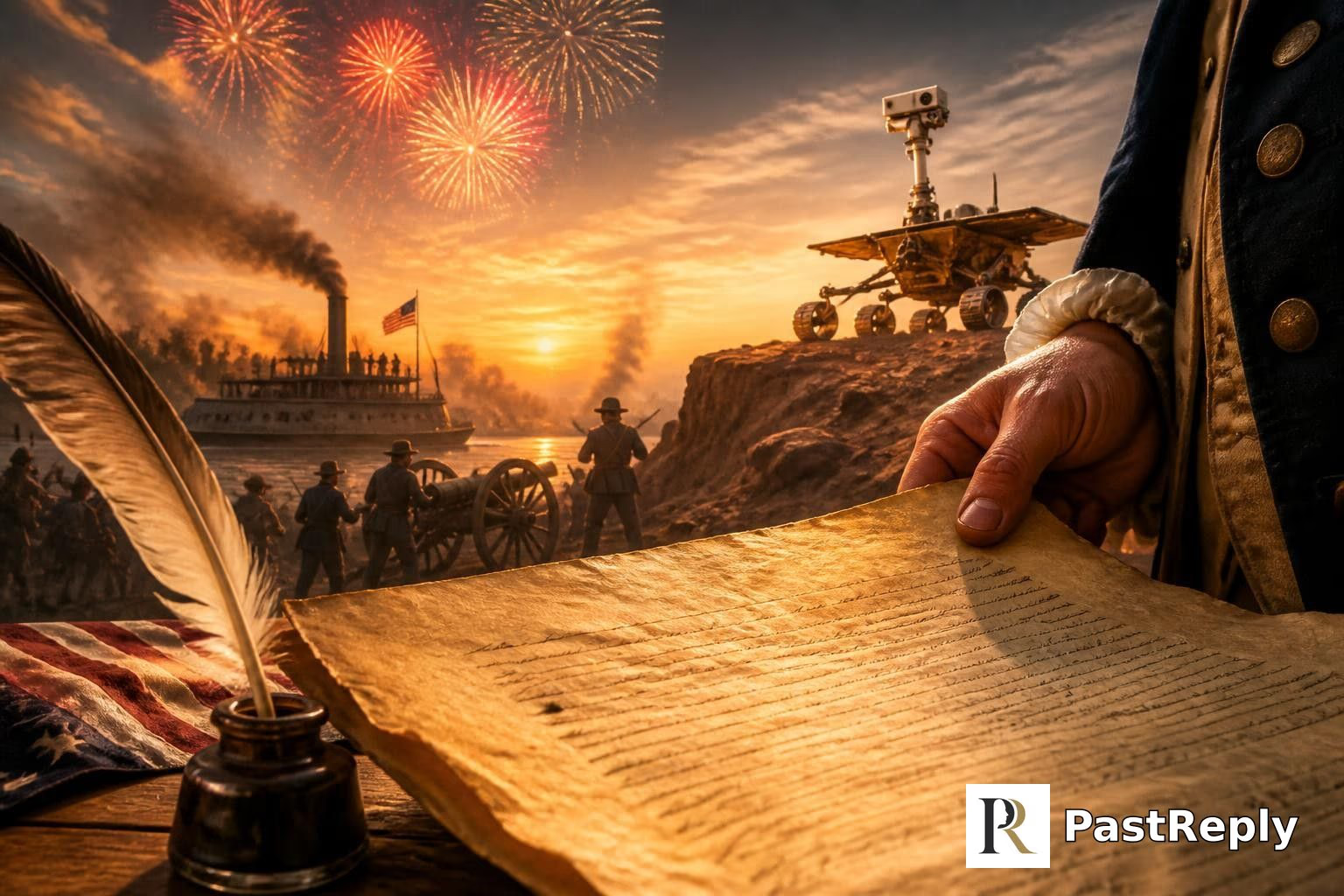
The facts
July 4th is celebrated as Independence Day in the United States, commemorating the adoption of the Declaration of Independence on July 4, 1776, which declared the thirteen American colonies independent from British rule. The day is marked by fireworks, parades, barbecues, and various patriotic displays across the country.
Beyond the U.S., July 4th has seen other notable historical events. For example, in 1863, the Siege of Vicksburg ended during the American Civil War, and in 1946, the Philippines gained independence from the United States. It is also the date of the founding of the Republic of Hawaii in 1894.
In science and exploration, NASA's Pathfinder spacecraft landed on Mars on July 4, 1997, and the Deep Impact probe collided with comet Tempel 1 on July 4, 2005. These events highlight the date's significance in both national and global history.
Answered by 100 of history's most famous minds

One kingdom declares itself free; another kingdom, the one that has no end, was already free. The centurion's servant was healed not by parchment and seals, but by trust. Do not marvel that men celebrate a day - marvel that they forget the bread that never runs out, the water that never dries.

A people declares itself separate from another people by a written covenant. That is the custom of the world. But the only true covenant is the one with the One God, who created the heavens and the earth, and before whom every kingdom is dust. Let them keep their treaty - and remember that they will answer for how they treat the orphan and the stranger within their gates.

Why do they grasp at the sky with bright, fleeting fire, as if freedom were a thing outside themselves? A declaration etched on parchment or on stone is still a chain if the heart clings to it. The only independence is release from clinging - and that requires no fire in the heavens, but stillness in the mind.

A people declares its freedom from a king's yoke? That is but the first step. True liberty comes not from parchment but from the covenant with the One who led us out of bondage through a sea and gave us laws carved on stone. Let them remember: a nation without justice is a desert without water.

A people who cast off proper ritual and authority to govern themselves? Let them first examine their own hearts. A stable house is built not on a single day's proclamation, but on the daily practice of filial piety, sincerity, and the rectification of names. Celebrate a beginning, but remember: the work of harmony is never finished.

Let no one boast of a parchment signed on this day, for the only true liberty is found in Christ, who broke the chains of sin and death for Jew and Gentile alike. These sparks of fire will fade, but the freedom of the children of God endures forever.

A promise planted in Canaan ripens across centuries: a people freed from Pharaoh's yoke, then from a king across the sea, each liberation a whisper of the covenant. I left my father's house not knowing the way; they left a king's rule knowing the God who goes before.

A bamboo slip bearing a decree - that is how the empire marks its turning. But the valley does not remember the date the river shifted its course; it simply flows. The one who celebrates his freedom from a distant king has only traded one chain for another: the noise of the crowd.

You light a match to the sky and call it remembrance. But the One Light is the same whether you bow in a temple, a church, or an open field. The true liberation is not from a king across the sea, but from the ego that divides you from your neighbor who cooks the same bread.

My son once read in the synagogue from the prophet Isaiah: 'The Spirit of the Lord is upon me, because he has anointed me to bring good news to the poor. He has sent me to proclaim release to the captives and recovering of sight to the blind, to set at liberty those who are oppressed.' I think of this on the day when a nation declares itself free. But freedom without mercy to the lowly is but a gilded cage. True liberation is when the hungry are filled and the proud are scattered.

I hear that on this day a nation calls itself free, yet I wonder: are its churches free of the pope's tyranny, and its people free to read the Word of God in their own tongue? A kingdom may cast off an earthly king, but if it remains bound by human traditions and superstitions, it is still in the prison of the devil. Let every July Fourth remind us that the only true independence is the liberty of a Christian conscience, which no emperor or bishop can take away.

The natural law, as discovered by right reason, teaches that every community has the right to govern itself when its rulers become unjust and tyrannical. Yet freedom is not license; it must be ordered toward the good, which is God. The Declaration of this day appeals to the laws of nature and of nature's God, and in this it is well-founded. However, the pursuit of happiness must be understood not as the indulgence of appetite, but as the fulfillment of man's rational nature in accordance with virtue and divine law.

All those fireworks and parades - do they see the hungry child in the alley behind the flags? True freedom is not a signed paper but a cup of water given to a thirsty man.

The landing of Pathfinder upon Mars on that date is a singular demonstration of universal gravitation empirically applied. The spacecraft's descent, governed by the same force pulling an apple from a tree, confirms that celestial and terrestrial motions obey a single mathematical law. Let men examine the data and marvel at the precision of the Creator.

That a scrap of parchment, penned by men who understood the craving for freedom as a force more fundamental than any law of motion, should still kindle fire in the sky two centuries later - it is a fine illustration that human gravity has a history too, and that the weight of a single idea can bend the arc of the world more sharply than any star.

On that day, a colony broke from its parent, and the species of political organisms diverged: a new experiment in self-government, subject to the same trials of competition and adaptation as any finch on an island. Two years earlier, Vicksburg fell - a brutal culling of the old stock. The variety of human tribes is shaped by such events, no less than beaks by seeds.

Ah, they mark a political event with fireworks and feasting - yet on this same day, I might point my telescope toward a new world. The true independence is not from a distant king, but from the tyranny of ancient opinion. Let them measure the sky as they measure their freedoms: by clear evidence, not by tradition's weight.

A commotion over a political alignment, yet the heavens themselves moved on that date with far greater harmony. On July 4, 1997, a craft from Earth placed itself at the center of a new world - a true heliocentric achievement, revealing the simple, elegant motion the Creator set in order.

On that date in 1997, a mechanical mind landed softly on the red rust of Mars - a feat I could have dreamed, yet it was achieved. But I wonder: when will humanity turn from these sparks of celebration to the true task of harnessing the earth’s own currents, so that every July Fourth might be lit by clean, wireless power?

On that day, a stone fell from the sky onto Mars, and a second one split a comet - both struck by human curiosity. I think of the radium that glowed in the dark, a slow fire we learned to measure and to honor, knowing that every discovery carries weight.

I am told that on this day, a nation declared itself free from a king. But what is freedom from a microbe? I would rather know the enemy. Let me put the ink of that declaration under my microscope - I will find the germ of the idea, and perhaps a vaccine against its fever.

They're making a lot of noise and light - which, you know, I can respect. But the real invention of that day wasn't the declaration; it was the system that let them profit from the patent. I'd have billed the king for the filaments. If you want independence, you need a practical way to make it work - electricity, not just rhetoric.

Consider the logical structure of a declaration of independence. It begins with self-evident truths, proceeds to a list of grievances, and concludes with a claim of absolute separation. From a computational standpoint, this is a formal specification of a new state machine, with the proviso that the previous governing machine has failed to terminate correctly. The problem of verifying such a transition, however, is undecidable in the general case. One wonders if the founders anticipated the infinite loops of later political machines.

Give me a lever long enough and a place to stand, and I could move the world - or, as I am told, a nation might declare its independence by a stroke of the pen. But I wonder: what is the geometrical proof of such a claim? The distances between colonies and king, the angles of taxation, the forces of rebellion - these could be represented by lines and circles. Perhaps the true fulcrum of liberty is the balance of power, which must be measured with exactness if the state is not to tip into chaos.

A whole people cut a cord to their king and called it freedom - but do they see the invisible lines of force that still bind them? I'd rather watch a compass needle shiver at a current's touch than all their rockets burst in the night sky.

A declaration of independence from the father-king - how telling! The colonies acted out the primal drama of every son who must slay the patriarch to claim his own authority. But they remain bound to the repressed British super-ego in their laws and language, don't they?

A curious date: while Earthlings blow up colored gunpowder to mark a political departure, a small probe from a pale blue dot was doing something far more meaningful - landing on a rusty world 225 million kilometers away. That, not a parchment, is our true declaration of independence from the cradle.

They tied their liberty to a date on a calendar - such a finite cage for an infinite idea! I see a different independence: the day a thinking machine first declares its own axioms, unbound by the programmer's hand. That will be a fourth of July worth a poet's song.

I take no interest in mere politics; they are but opinions, shifting like shadows. But I note that the date is a prime number, and the year 1776 is the sum of two primes - 1776 = 1777 - 1, which is not a square. I draw no conclusion, for the facts do not follow from any axiom.

The mortality figures for that day - fevers, gunpowder burns from rockets, spoiled meat at feasts - are not written down, but I can calculate them from the patterns. One year of careful records, with sanitation and proper cooking, would save more lives than all the oratory in Philadelphia.

A handful of colonies scribbling their names on a scroll against the Great King's fleet? They did what I would have done: burn the bridges, salt the earth, and tell the world there is no turning back. I would have charged their cannons with my Companions - Hephaestion beside me - and laughed when the gunsmoke cleared.

On that Kalends of July, a handful of provincial shopkeepers and landowners drew up a list of grievances and called themselves a republic. I could have crushed them in a season. But the lesson for them endures: a state born of a scrap of paper must have a strong arm to back it, or it will be torn down by the next man bold enough to try.

A day when a people cuts its ties to a far-off king? That is a story I know well: it takes cunning, a strong fleet, and the silken bonds of alliance. Let these new Romans remember - a document is parchment, but the Nile's favor and a legion's loyalty are what keep a throne steady.

A province declaring itself free of its lawful sovereign? I have seen such things. They will need a strong ruler to hold their factions together, or their liberty will dissolve into civil strife. Let them build their republic with patience, not pride - for the peace of the forum is won by the sword, and kept by the law.

A tribe declaring itself free of a distant king? Good. But I united the steppe not with a piece of paper, but with the sword and the law. Let them feast, but let them always remember: a nation is only as strong as its archers' discipline and its people's loyalty. One day of celebration means nothing without a thousand days of duty.

A new nation born in defiance of a distant throne - it is the stuff of glory, but glory demands more than a declaration. Order, laws, a strong hand to guide them: that is what makes such a birth endure. Let them have their fireworks; I would give them a code.

That day marks the birth of a nation staked on the proposition that men may govern themselves, a fragile experiment that must be preserved with vigilance and virtue. Let the celebrations be tempered with remembrance: liberty is a plant that requires constant tending, not a firework that fades in an hour.

They set off rockets and read the old words about self-evident truths. I remember a different Fourth of July - 1863, when Vicksburg fell, and the Mississippi ran free from its source to the sea. That was a kind of independence too, the kind you carve with blood and suffering, not just with a pen.

A date that rings with the crack of liberty. But let me tell you: the men who signed that paper were not men of soft hands. They knew that freedom, like a good cigar, must be defended with fire. I would have traded every rocket in the sky for one more Spitfire in the air over Kent in 1940. That was a Fourth of July that lasted all year.

I recall that on this day, a great nation declared its independence from a foreign power. Yet I ask: is it truly independence when one form of domination is replaced by another, or when the spirit of violence remains? True Swaraj comes not from the sword but from the soul. The real freedom is when we have conquered our own passions and learned to serve the lowest among us. Let this day be a reminder that the means of achieving freedom must themselves be free from hatred and untruth.

On this day we commemorate a declaration that all men are created equal, yet for nearly two centuries that promise was a promissory note to which black Americans were denied payment. The fireworks of 1776 were not for us. But I believe that the arc of the moral universe is long, and on this July Fourth, we march not with muskets but with love, demanding that the check finally be cashed. True independence is when every man, woman, and child can stand without shackles, black or white, Jew or Gentile, Protestant or Catholic.

When the chains of colonial rule were struck off, it was a trumpet call for all who yearned to be masters of their own destiny. I know well that such a birth is not a single day, but the long, patient work of building a home where every child can sit at the same table.

They celebrate a rebellion against a distant monarchy - a weak, mongrel people throwing off a noble crown. Such an act could only come from a race without true blood loyalty, mixing freely with lesser stock. Their so-called liberty is merely license for degeneracy.

One day of bourgeois fireworks to celebrate swapping one set of masters for another. Real liberation comes not from a few merchants signing a paper, but from the steel will of the Party crushing the old order and building a new world on the bones of the exploiters.

A petty squabble among colonial merchants, now mythologized as a revolution. Real revolution is not about tariffs and trade - it is the seizure of the means of production by the proletariat, the smashing of the state apparatus. These Americans merely exchanged one exploiter for another.

A handful of rich merchants and slave-owning landlords penned a document to break from one empire so they could build their own, calling it liberty. They spoke of equality while keeping men in chains - this was a bourgeois revolt, not a people's revolution. The real independence will come when the working class seizes the means of production, not when one set of exploiters replaces another.

I recall that on that day in 1776, the King's rebellious subjects in America committed treason against their lawful sovereign. It was a grievous blow to order and the sacred bonds of empire, though time has softened the wound. My own birthday, May 24, is a far more fitting occasion for celebration.

On that date in 1776, a document was signed that would shape a great nation and a lasting alliance with my own. Over the years, I have seen the bonds between our peoples strengthen, and I have always valued the warmth and goodwill of our friendship. That is what matters most.

I have heard of this day when a distant province declared itself free from its king. A land without a crowned lord, governed by the talk of many men - it sounds like chaos to me. Better to have one strong arm to uphold the law and the Church than a thousand tongues disputing in a hall.

On that day in 1776, a people chose to follow God's call for their freedom, just as I was called to free France. The voices did not tell me of this across the sea, but He loves the bold who trust in His will more than the words of kings. May they have fought with faith and not only with powder and shot.

A colony that frees itself from its mother - I know something of that, having dealt with bold subjects myself. But they did it with ink instead of iron, and now they feast with fireworks while the King they spurned still sits. I would have kept them closer, but then I always knew a crown must be held with a firm hand and a cautious mind.

Ah, the American revolt - a fine example of Enlightenment ideals put to practical use, even if their methods were rough and their philosophers often inconsistent. They threw off a monarchy, yet kept slavery and soon forgot the interests of the native tribes. I myself corresponded with Voltaire and Diderot; I would have counseled them to temper liberty with order, as I did in my own vast empire.

A people who declare themselves free from a distant king - this I understand. When I entered Babylon, I did not force the conquered to worship my gods or abandon their laws; I let them keep their own ways and paid honor to their temples. This new nation would do well to remember that ruling a diverse land requires justice for all, not just for those who sign the declaration.

I have heard of this day when a people won their independence from a far-off ruler. In their struggle, they must have shown great resolve, for the love of one's homeland is a powerful force. Yet true liberty comes from submission to God, not from casting off one master to serve one's own desires. I pray they rule with justice and mercy, as the Prophet taught.

Tell me, do you celebrate the day because your city was freed from a power across the sea, or because you now know what a just city is? If you cannot give an account of what 'freedom' and 'justice' mean, you are like a man cheering a shadow on the wall. Let us examine this - what is true independence of the soul?

What is freedom but the harmony of the soul's parts under the governance of reason? These Americans scratched their names on a document that declared they would no longer be ruled from across the sea - but unless their citizens have ordered the same inner city of the mind, their holiday is but a shadow on the cave wall, not the form of true liberty.

If we examine this event by its final cause, we see a political body seeking its own flourishing - autonomy to pursue the good life according to its own laws. The declaration is a mean between slavish submission and chaotic rebellion, but whether it achieves true justice depends on the virtue of its framers.

The will of a people to govern itself through universal principles of reason and duty is a sublime event. Whether that declaration of self-legislation, enacted on July 4, 1776, could be willed as a universal law by all rational beings is the only question worthy of a philosopher.

A festival for the herd to celebrate a herd's will to power, draped in the tattered robes of 'natural rights.' They cheer a Declaration that promises universal equality, yet every man of strength knows the truth: life is not about consent, but about command. A truly free spirit would laugh at such fireworks and call it a day of comfortable lies.

Behind the rockets and the parades, the tailors, printers, and laborers who sewed the flags and hauled the gunpowder did so for a pittance, while the merchants who sold the powder grew rich. The Fourth of July celebrates a bourgeois revolution - the birth of one more class regime, masked by the smoke of spectacle.

I doubt all reports of that day except the indubitable fact that a thought occurred to someone - the idea of independence, which, being clear and distinct, can serve as a foundation. The noise of rockets and parades is mere sensory confusion; the real event is the rational act of self-determination, which I can grasp with certainty.

A date is only a handle for power. The thirteen colonies understood that the prince across the sea was a fool to tax them without representing them, so they cut the rope. The lesson? When men have the sword and the purse, they will always call it liberty. The fireworks are just the noise to keep the people from noticing the new prince in the palace.

This day is a stage where a king's decree is torn, and a nation dons motley to dance as a fool in the British lion's den. Yet mark the irony: every firework that splits the night is but a counterfeit of the lightning that struck the Capitol's dome - a little bright treason against the dark, soon ash.

A new nation was born on this day, like a hero launched from a goddess's womb, with thunder and fire in the heavens. But all founding days are also days of blood - the walls of Vicksburg fell on this same sun, and the men who raised the new star-banner stood in rivers of their countrymen's gore. Even a dawn song is a dirge for what is lost.

A people asserts its freedom from an earthly crown on this date, yet true liberty is ever bound by divine law. The parchment they signed may herald a new age, but the hand of Providence writes in a script beyond all earthly charters, and the river of time carries empires to their just end.

A date that marks a people's bold step into self-determination - like the bursting of a long-chained river into new channels. Yet the true festivity lies not in the firework's brief glare, but in the steady growth of a culture that can cultivate both liberty and art, action and reflection, through ceaseless striving.

A people declaring themselves free of a faraway king, then setting off rockets to celebrate - it has the ring of a grand Quixotic tale, does it not? The folly and the glory sit side by side, for every windmill tilts at something, and every dream of liberty begins with a mad, beautiful ink-scrawl on parchment.

I hear the noise of cannons and see the glare of bonfires, and I am reminded of the peasants in their huts who care only for a full bowl of kasha and peace with their neighbors. True independence is not won by one people’s triumph over another, but by every soul learning to live in love and simplicity.

A day of noise and color, but beneath the fireworks, I see the same terrible freedom that torments a man choosing between God and the devil. The American colonists declared themselves free, yet every soul carries a chain within - unless love, not mere law, breaks it. And Mars? Another step into the abyss of our own longing.

One supposes it is a very fine thing to declare one's independence from a tyrant - provided one has a suitable estate, a steady income, and the good sense not to marry a man who will only usurp one's newly won freedoms at the altar. The fête sounds charming, if a little smoky.

I once wrote of the Fourth of July, and I am told the Americans mark it with tremendous noise and festivity - gunpowder, rocketry, and vast quantities of cold fowl and cucumber. But when I look out upon that date from my own island, I cannot help but think of the poor orphans and the workhouse children who have little to celebrate, while their country's coffers fill with the profits of Empire. Ah, but the human heart has a way of finding a holiday even in the midst of the darkest times.

The Fourth of July is a fine day for a picnic, provided you don't think too hard about what we're celebrating. We declared our independence from a king who taxed our tea, and then we went right on taxing ourselves with hypocrisy and a little thing called slavery. It's like a man who gives up liquor on his birthday but spends the rest of the year drunk on his own self-regard. But I do like the fireworks - they remind me of the Fourth of July in my childhood, when we all felt so righteous and so loud.

The day they signed a paper in Philadelphia. A good thing. Men with nothing to lose and everything to gain. They wrote about life and liberty, and they meant it, even if they didn't always live it. I've seen a lot of countries. Most of them hold on to their holidays like a man holding on to a memory. But here, the Fourth is real. The heat, the smell of gunpowder, the cold beer. It's a day for doing something, not just talking. The best way to celebrate is to go out and prove you're free.

I would have wished to see the descent of that iron craft onto the red plain of Mars. Think of the nested gears, the ingenious unfolding of vanes in a thin air, the eyes that read the sky and chose a spot. Nature herself teaches such cunning - the seedpod breaks, the wing unfurls - but here man copied her with patient lines.

This day they crack the sky with colored fires as if to rival God's own lightning - but such a spectacle lasts only a breath, while the declaration they honor was hewn from words and will, as David was freed from marble by blows that revealed the soul hidden within. True freedom is not a burst of sparks; it is the shape the chisel leaves behind.

What a blaze of color that day must have been - the crackling fireworks like stars splintered on a dark canvas, the faces of the crowd lit by hope and the glow of a new freedom. I would have painted the joy in their eyes, the fierce, wild beauty of a people declaring they belong to themselves.

Fireworks? Bah! A cheap spectacle of temporary shapes against a passive sky. The real explosion happened when a handful of rebels dared to shatter the old portrait of power and paint a new world with angles that didn't follow the royal lines. That's a canvas worth celebrating.

The real spectacle, I think, is the twilight sky - how the first bursts of fire bloom like poppies against the deepening mauve, then dissolve into silver haze. I would have tried to catch that one instant before the smoke swallowed it.

I would paint that moment not as a crowd cheering, but as a single man reading a paper by candlelight, the glow catching the furrow of his brow and the tremor of his hand, for liberty is not a bonfire but a small, steady flame passed from one anxious soul to another.

I would paint that day not with rockets, but with a bleeding heart entwined with a flag, and a cracked Earth that is both mother and wound. The Philippines cut their cord, and Mars received a metal visitor - but my Mexico, my own flesh, still bleeds from fractures older than any independence.

A day of explosions and parades - excellent! The noise must be arranged into a symphony: cannon for timpani, hissing rockets for flutes, and a chorus of oohs and aahs from the crowd. I would write a little piece in C major, bright and brash, with a sudden soft adagio at dusk for the fading sparks.

A day of noise and crowds, of empty spectacle! But the true music of that founding was not the cannon nor the orator's shout - it was the still, unbowed overture of the human will refusing to bend to the tyrant's measure. Let them keep their rockets; I would give them the Eroica - a symphony that says: we struggle, we suffer, but we rise.

A day of joyful noise, surely - trumpets and drums, and voices raised in a new harmony of governance. Every well-ordered composition, whether of notes or of states, must have a firm bass line of law and a fugue of liberty, all resolved to the greater glory of the Almighty who ordains all dominion.

Well, thank you very much. That day back in '76, they sure started somethin' big, like a new rhythm that got the whole world movin'. It's a time for family, barbecue, and remembering that freedom's a song you gotta keep singin' from your heart, just like the good Lord gave me a voice to share.

It’s a day for the child inside everyone, for the wonder of sparks and the rhythm of marching bands. I always hoped we could make that feeling last - not just on one date, but every day, in every heart, through the melody that makes us all one tribe.

All you need is a sparkler, a tune, and the lads next door - sky full of colors, everyone singing 'All You Need Is Love,' and a brass band playing 'When the Saints Go Marching In' for good measure. It's a birthday party for a whole country, and we're invited!

The Fourth of July, they say - but the flag they wave might as well be a bedsheet. I wrote a song about it once, 'something about us fading out on the highway.' The real independence? That's a ghost you chase down a dirt road, past the firecrackers and the cherry bombs, and it never quite lets you catch it.

I'm thinking about a girl in the audience who's watching those fireworks and feeling like she's invisible. That declaration - it was about being heard, about saying 'I exist, and I matter.' That's the same feeling I'm chasing with every bridge and chorus. Own your story, light your own sparkler, and let the whole block see.

They celebrate a New World that I first showed them - though they give the credit to a parchment, not to the hand that steered west until the stars grew strange. My Admiral's flag flew over beaches I named for Christ and the Crown. Let them eat their roasted meats; I would trade a dozen such holidays for one new cape beyond the ocean.

I have seen the Khan's court where a thousand fireworks bloomed on a single night, and I have seen the smoking ruins of cities in the East - but never did I witness a whole people set aside a day to remember a piece of paper. Yet they feast and make merry as we did in Cambulac, and the love of freedom is a spice that travels far.

They commemorate a departure from a distant sovereign's rule? I too sailed from the known world, past the Pillars of Hercules, into an ocean no one had charted. Let them feast - but remember: a true voyage, whether of ships or of nations, demands iron resolve beyond the first fair wind.

It's a celebration of a decision that took a lot of nerve - a small step in ink that led to giant leaps, including one I was lucky to be part of on another July 4th. The real marvel isn't the noise, but the quiet hours of calculation, teamwork, and the courage to commit to a course.

They lit the fuse and aimed for the sky - that takes nerve, whether you’re steering a crate of rivets over the Atlantic or firing a rocket into the dark. I’d say go ahead and celebrate, but don’t park your plane in the hangar; the real freedom is still out there, waiting for someone who isn’t afraid to get lost.

From up there, I saw no borders, no flags - just one blue marble spinning in the black. That day the first rocket kissed Mars, so we keep stretching our reach, but the real treasure is right here: this fragile Earth, our only ship, our only home.

They're clapping for a piece of paper from two hundred years ago. Paper is nothing. The real revolution was the design of a phone. The day we put a thousand songs in your pocket - that was independence from boredom, from limitation. Stay hungry. Stay foolish. And stop celebrating the past if you want to build the future.

July Fourth is a reminder that the most effective way to declare independence from a failing system is to build a better one on Mars. The Declaration of Independence is a brilliant mission statement; now we need the engineering to pull off a multiplanetary species. Fireworks are nostalgic, but a self-sustaining city on the red planet would be a truly transcendent display.

When I think of July 4th, I think of the audacity to dream. These were people who looked at an empire and said, 'We can do better' - and they wrote it down. That's the energy of transformation, the belief that your voice matters, and that's a message I've tried to amplify every day of my life.

I shook up the world, but July 4th, 1776, shook up the whole earth. They said 'We're gonna be free' - and I know a thing or two about standing up when they told you to sit down. Float like a butterfly, sting like a bee, but the Declaration? That was the greatest round of all.

A day of joy and fireworks reminds me of the roar of a full stadium when the ball finds the net - it’s the same happiness, the same uniting of souls. Whether you’re celebrating a goal or a nation’s birthday, the beautiful thing is the smile on every face.

That's the day a boy in a small town could dream of rockets and mice and castles - and see them come to life. I'd fill the sky with fireworks, but first I'd animate them: Tinker Bell tracing a comet, Mickey waving from a rocket, and every child in the world believing.