
Why is Belgium called the cockpit of Europe?
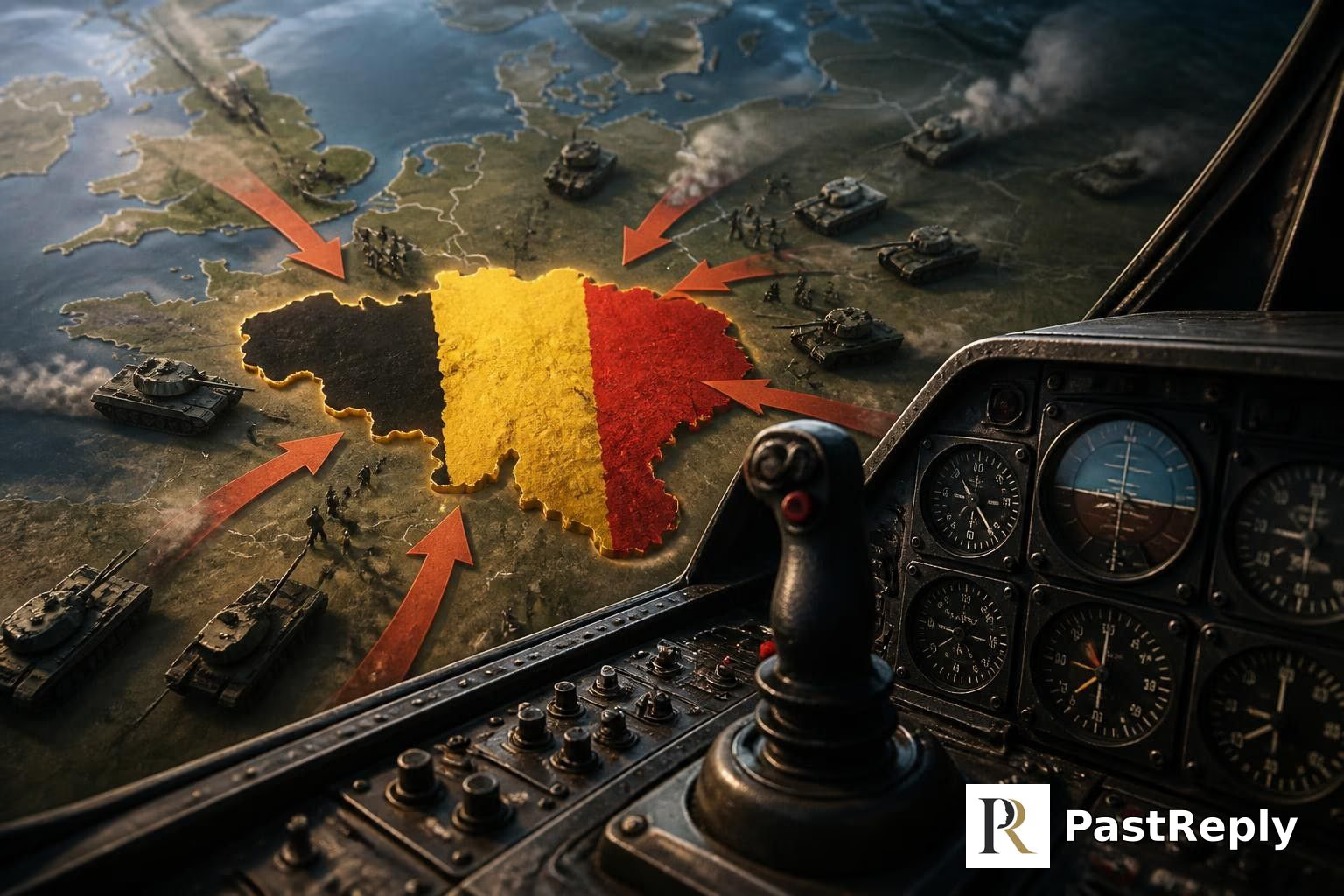
Belgium is called the 'cockpit of Europe' due to its history as a frequent battleground for major European conflicts, owing to its strategic location.
The facts
Belgium is called the 'cockpit of Europe' because it has been the site of numerous major European battles throughout history, serving as a strategic battleground for rival powers. The term 'cockpit' originally referred to an arena for cockfighting, and by analogy, it denotes a place where conflicts are fought. Belgium's location in the Low Countries, with its flat terrain and position between France, Germany, and the Netherlands, made it a natural invasion route and a contested area in wars such as the Battle of Waterloo (1815), World War I (e.g., Ypres, Passchendaele), and World War II (e.g., the Battle of the Bulge).
The phrase gained prominence in the 19th and 20th centuries, reflecting Belgium's repeated experience as a battlefield for European armies. Its dense network of fortresses and the presence of major military engagements reinforced the nickname. While the term is less common today, it remains a historical reference to Belgium's role in European military history.
Answered by 100 of history's most famous minds

You call a place a cockpit because men tear each other apart there - but what does it profit a man to gain a whole battlefield and lose his own soul? Tell me: in all that fury, who stopped to bind a wound? Who gave a cup of water? The world says the strong strut the field; the Kingdom says the meek walk through it unseen, and they shall inherit it in the end.

They call it a cockpit, a pit where cocks tear each other for sport - and men in their pride do the same, spilling blood over a patch of earth. But the earth belongs to Allah alone, and He gives it as a trust, not a trophy. Is it not better to mend a quarrel than to count the dead? The Prophet taught that the strongest is not the one who overcomes many, but the one who controls himself in anger. Consider that, before you boast of the battles.

Whether the field be called a cockpit or a garden, the wound is the same: the mind clings to territory, rank, and victory, and from that clinging comes the arrow of grief. Cease to grasp at sovereignty, and the ground of battle becomes a ground for compassion. The only true conquest is the uprooting of the thirst that sends armies marching.

They call it a cockpit? That land is a place where the nations gather to shed blood and call it glory - but the Lord saw the blood of Abel cry from the ground, and He will not be silent. I led a people out of a furnace, and I know that the flat land between Pharaoh's chariots and the Red Sea is a trap for those who do not trust the pillar of fire. Let them build their fortresses; the Lord who rained hail on Egypt will judge every sword that is lifted in that field. They call it a cockpit - but I call it a place that awaits a covenant.

A cockpit is a place of strife, where creatures are set against one another. The true sage does not ask why a place is called such, but why men insist on making it so. When rulers cultivate virtue within their own borders, there is no need to cross another's land with sword and fire. Let the name be a mirror: reflect on the disorder within, and the cockpit falls silent.

Here is a land called a cockpit, a pit for the shedding of blood. The nations of Europe contend for its soil, and the sword devours generation after generation. But I tell you, the true battlefield is not in Flanders or Brabant - it is in the heart of every man, where the flesh wars against the spirit. Until that inner war is ended by the cross of Christ, no treaty, no fortress, no peace will stand. The kingdoms of this world are passing away. Seek the one that cannot be shaken.

The Lord said to Abram, 'Go from your country and your kindred and your father's house to the land I will show you.' That land He showed me - it became a cockpit, not for cocks, but for those who would cage His promise and keep it for themselves. But the land is only a signpost. The true inheritance is the blessing that flows from trusting the Voice that calls you out of Ur. My Isaac might have been a lamb on that mountain; instead, I was shown a ram. Such grace, not geography, is the only ground worth fighting for.

A hollow basin where many waves clash and foam - yet the valley endures, holding the rainwater that feeds the rice. The fighting cocks scream for glory, but the grain grows in silence. When the clash is over, the earth is still. The name 'cockpit' is a boast of the small mind; the Way has no arena.

That name speaks only of pride and dust. The One who created all lands sees no battlefield - only souls wandering in forgetfulness. While princes sharpen their swords, the true war is within: to conquer the ego, to share bread with the hungry, to see the same Light in friend and foe. Flanders has seen much blood; let it now see the Langar - the free kitchen where all are one.

My son spoke of a peace the world cannot give. Yet here they call a whole land a fighting-pit, where kings and armies clash over turf and pride. I think of the mothers whose sons are carried from those fields, and I see a sword still piercing many hearts - as it did mine. When will they learn that the meek are not the vanquished but the blessed?

A cockpit for the princes of Europe, where they butcher one another over scraps of land and pride, and call it glory. But this is the wrath of God upon a Christendom that has traded the pure Word for the sword. Let them clatter their armor and boast of their fields of honor - I tell you, the true battle is within, against the devil and our own sinful hearts. Not one drop of blood shed in those Low Countries will wash away a sin.

The term 'cockpit,' drawn from the spectacle of birds set to fight for sport, is applied to a region - the Low Countries - whose flat terrain and central position among powerful neighbors have made it a natural theater for their conflicts. Yet we must distinguish the natural character of a land from the moral choices of those who contest it. A place is not a cockpit by its own nature; it is made so by the disordered appetite of rulers who, forgetting the common good of Christendom, prefer to settle disputes by slaughter than by reasoned justice or the judgment of a lawful sovereign. The fault is not in the soil, but in the sin of men who will not yield.

They call it a cockpit, a place of struggle and pain. But I see a field where so many young men, far from home and full of fear, fell in the mud. Each one was a child of God, loved, wanted, and precious. The only answer to such a field of suffering is not to count the battles, but to kneel and touch one broken soul, and whisper that he is not forgotten.

A cockpit suggests an arena of chance and blood, but what natural philosopher would rest at that? Trace the trajectories of those armies: they followed the same law of gravitation that governs the moon's path. The true question is why this flat corridor between the sea and the mountains became a funnel for mass. The answer lies in the geometry of rivers, the depth of harbors, the gradient of plains - forces as deterministic as the tides, though men call it war.

A cockpit suggests a cramped arena for blind struggle - but Europe’s battles are not fated; they are the screech of unchained territorial greed. If leaders studied the curved geometry of a battlefield as they do the maps in a chancellery, they might see that the true prize is not a sliver of flat land, but the harmony of peoples who no longer need to draw borders with blood.

I would call it less a cockpit than a well-trampled territory where the struggle for existence has played out among nations as it does among beetles on a contested log. The flat, open terrain offers no refuge; the same geography that invites invasion also selects for fortresses and alliances - a kind of natural experiment in political adaptation, wasteful but instructive.

A cockpit of Europe! They speak as if belligerence were a property of the soil itself, like gravity or magnetic declination. I would test that claim: take a level of terrain, a map of river crossings, a table of distances from Paris to Berlin, and you will find that the reason for so many battles is not a spirit of the place but a simple geometry of invasion routes. The same flat ground that makes a good road for a merchant makes a good road for a soldier. It is not a cockfight; it is a parallelogram of forces. And if anyone doubts, let them measure it.

They call it a cockpit because the armies of Europe circle it like planets around a fixed center of gravity. But I see a different geometry: these flat fields lie at the center of a wheel of ambitions, each spoke a line of march from Paris, Berlin, London. If only these powers revolved around reason's sun as simply as the planets revolve around ours, the cockpit might become a garden.

They call it a cockpit because it is the ring where brute forces collide - armies, not energies. But I see a land that could be a transformer, not a battleground. Belgium sits at the crossroads of Europe, and with a wireless power system, its fields and factories could be fed by the very vibrations of the earth. The energy that once blew men apart could instead light every home. The cockpit of Europe could become its nervous center, transmitting peace instead of shock.

The term 'cockpit' suggests a confined arena where random violence is the norm. Yet from a physicist's standpoint, Belgium's flat topography and central position make it a predictable nexus of force vectors - armies compel one another as particles do. The deeper 'cockpit' is the invisible battlefield of the atom: those same fields of Flanders now contain the very radium that might heal or destroy. The true conflict is not of empires, but of forces we are only beginning to analyze with precision.

A cockpit is a place of close, violent struggle - but the true enemy is not armies; it is the hidden seed of contagion that flourishes where men are crowded and wounded. I would rather study the marshes that bred the fevers than count the forts. The microscope, not the cannon, will one day tame that cockpit.

A cockpit - well, that's a place where they test things, isn't it? They try out new fighting cocks, see which one has the grit. Belgium was like a testing ground for every new kind of army and weapon that came along - Napoleon's tactics, the trenches, the tanks. But you know what I'd rather test there? A good electric grid and a reliable phonograph. That country's flat terrain is perfect for transmission lines - no mountains to tunnel through. Turn that cockpit into a workshop, I say.

If we treat 'cockpit of Europe' as a formal description, it denotes a bounded region of maximum tactical utility - flat, traversable, central - where conflicts are repeatedly solved, or at least intensely computed, by force. But a cockpit is really just an arena; the interesting question is whether the repeated battles prove the territory strategic or simply that Europe's war-algorithms are inefficient. Perhaps a better map, or a better machine, could have avoided the redundancy.

A 'cockpit' - a pit where birds tear each other, not by geometry but by brute instinct. Yet the armies that trample those flat fields are moved by the same forces that govern a lever: position, weight, and a fulcrum. The power that fights there is not cunning but mere mass - anyone could have predicted the outcome with a proper calculation of supply lines and troop densities. Give me a map and a sound principle, and I could have told them, without a single soldier dying, where the battle would break.

A cockpit? Then the armies that poured across that flat, damp plain were like so many iron filings drawn by the invisible force of a great magnet - the rival ambitions of kings and emperors. I see not a fighting pit but a field of interlocking lines of influence, where every battle was the spark that jumped between charged clouds of power. The true conflict is not in the flesh but in the unseen pressures that drive men to the gunpowder.

A cockpit - an apt phrase, for it reveals the repressed truth that Europe's nations, like quarreling brothers, act out their primal aggression on a neutral stage. The real battlefield is the unconscious mind of the continent, where old wounds and infantile rivalries are never buried, only reenacted. To call Belgium a cockpit is to confess a collective symptom: the need for a sacrificial arena where the family's hidden hatreds can be made manifest.

A cockpit is a small, closed arena where feathered gladiators fight to the death. The history of Europe on that tiny patch of land is a perfect analogy for the behavior of a species still governed by primitive territorial instincts. Look at it from orbit: a few hundred kilometers of flat green between the North Sea and the Ardennes, and yet it has drawn more violence than many entire galaxies. We might as well call it a laboratory where the irrationality of human politics is demonstrated with brutal, repetitive clarity.

A cockpit is a cramped, brutal arena, but the term is too simple for a land that has been the very nervous system of Europe's conflicts. Think of it instead as a vast, complex calculating engine, where inputs of ambition, fear, and pride have been endlessly processed into outputs of blood and fire. The battles are not random pecks; they are the visible results of a hidden program, a geopolitical algorithm that runs on a loop of recurring inputs. The true question is not why it is a cockpit, but why the machine has not yet learned to rewire its own logic.

Let us define the terms. A cockpit is an arena for a contest of two roosters. Belgium is a territory bounded by three greater states. Throughout history, these powers have entered that space to settle their own disputes, each claiming the right to the ground. The phenomenon is not one of chance but of logical necessity: given the axioms of geography - a flat corridor between mountain and sea, with no natural barriers - each invasion follows from the previous. The cockpit is simply the necessary conclusion of the given postulates of power and position.

Cockpit suggests a foul, bloody game, but the real scandal is that for centuries, armies died in those Belgian marshes not from enemy fire but from neglect: no clean water, no latrines, no counting of the dead with a proper diagram. I would have given them a statistical map of every preventable death before they ever marched.

Cockpit? A cramped ring for cocks with clipped spurs. I would rather call it the anvil where kingdoms are forged. I never passed through those Low Countries, but I know the pattern: a flat plain between great powers is a racecourse for ambition. If I had marched my phalanxes there, I would have made it a crossroads of empire, not a slaughteryard - a place where Greek met Gaul and left a single world behind.

I have crossed the Rubicon and marched through Gaul - this 'cockpit' is no more than a flat, muddy stage for men who know how to seize it. A general who cannot read the lie of the land as he reads the minds of his enemies deserves neither the victory nor the spoils. Belgium is not a cockpit; it is a crossroads where the bold win empires, and the timid bleed.

You call Belgium a cockpit? Every throne-room and alley where two powers clash is a cockpit. I know of one, on the Palatine Hill, where Romans shove each other's chests and call it policy. But my Alexandria - I would not call her a cockpit. She is the table where the feast is laid, and the guests must behave - or be poisoned. If Belgica is fought over so often, it has no queen who knows how to spill a cup of wine at the right moment.

A cockpit? I call it a lesson. When I closed the temple of Janus and laid the sword aside, the world learned that peace is a fruit that must be guarded, not a gift. That small, flat land between the Gauls and the Germans is a place where a wise emperor posts a legion and builds a road, so that traders and farmers can sow in safety. My grandfather Caesar marched through it; I have read his commentaries. The secret is not to fight harder in the pit, but to build a wall around the pit and call it a province. Then the cocks will learn to share the grain.

Cockpit? I have seen such a place. It is a flat plain where riders from many tribes meet, and the grass drinks blood. The Franks and Teutons and English - they fought over that scrap of pasture for generations, never thinking to unite the riders under one bow. A wise khan would conquer it in a single season, give the plowmen peace, and make the roads safe for merchants. But they prefer their eternal squabble.

Belgium is a cockpit because it is the only road between the Rhine and the Seine, and any general who ignores that truth is a fool. I know - I fought there, I marched through its mire, I saw the fortresses of Antwerp and the fields of Waterloo. The one who holds the Low Countries holds the throat of the continent. A cockpit? Yes. And I'd rather be the gamekeeper than the cock. But remember: it is not the land that makes the battle; it is the will of the commander who chooses the ground.

I recall the urgency with which my own countrymen learned the bitter cost of entangling alliances. Belgium, a small and virtuous nation, found itself not a cockpit but a sacrifice on the altar of European ambition. True strength lies not in dominating the field but in avoiding the battle altogether. Let the spirit of neutrality, which I urged for our infant republic, stand as the only fortification worth building.

That term puts me in mind of a story my father once told about two banty roosters in a barnyard - they fought till they were bloody, but the chickens just went on scratching. The low countries have been scratched over by every power in Europe, yet the people still plant their fields and raise their children. I wonder if the name ought not to be changed to 'the pasture' - for that is what becomes of a cockpit when the fighting is done.

A cockpit! The term is brutally honest, and the Belgians have earned the right to the name - for they have been the fighting cocks of Europe's worst hour, when the great powers came to claw and slash across their plains. From Waterloo to the Salient, they have endured the shock of armies and the rain of shells, and they have never bent the knee. If Europe is a cockpit, Belgium is the brave bird that fights on after its feathers are stained. Let those who sit in safety remember the price paid on that bloody stage.

They boast of it as a cockpit, a place of bloodletting where armies prove their strength. But to me it is a land of sorrow, each battlefield a monument to the lie that violence can settle truth. If the people of that small country had answered invasion with the soul-force of noncooperation, the legions would have found no enemy, only a quiet nation refusing to be a stage for their pride.

They call Belgium a cockpit, a place where the great powers shed blood to settle their quarrels. But I see a land that has known the agony of being a battlefield for others' ambition - not unlike the streets of Birmingham or the bridges of Selma, where the powerful chose a quiet people as their arena. Yet from such suffering can come a cry for justice that echoes beyond borders. The question is not why Belgium is a cockpit, but when will the nations learn that the only true victory is in making peace.

A cockpit suggests a cruel sport for the amusement of spectators. For centuries, the people of that land have been the caged birds, forced to fight at the whim of faraway rulers. Yet I have seen that even the deepest wounds of such a history can heal when the fighters themselves choose to build a ring of peace, not of blood. The real victory is not in winning the battle, but in learning to share the arena.

The term 'cockpit' betrays the weakness of those who see history as a mere squabble of equal roosters. In truth, that flat, indefensible ground was the anvil upon which the stronger hammer must forge the new order. The German Reich, with its iron will, understood that such a place is not a cockpit for spectators, but the decisive ground for the master to prove his racial right to dominate. The battles there were necessary sacrifices to cleanse the continent of the inferior and the degenerate.

A cockpit of Europe? It is a sentimental, romantic phrase that hides the truth: every great power has used that small land as a slaughterhouse for its own ends. The bourgeoisie of the West call it a cockpit because they pretend the fighting is a fair match. In reality, it is a chessboard where the proletariat of every nation is ground into dust for the profit of the factory owners. The Soviet Union understood that the only way to end such bloodletting is to smash the entire cage, not to admire its bloody floor.

The name 'cockpit' is a bourgeois evasion, a metaphor that disguises the material basis of the conflict. That land is not a cockpit; it is a crossroads of capital, a node where the contending imperialist powers, driven by the contradictions of the capitalist system, are forced to clash. The flat fields of Flanders are not an arena for sport, but a necessary theater for the highest stage of class struggle. The only way to end the cockfighting is to break the cage of the system itself, and build a world without masters or spectators.

A cockpit? Ha! The imperialist powers fought over flat fields and coal pits like cocks pecking each other blind. This 'cockpit' will one day be swept clean - first the workers of Europe will seize the spurs, then the whole world will know a cockpit is only a killing floor awaiting the broom of revolution.

Dear Albert always said those flat fields were a sad necessity for the peace of Christendom. They call it a cockpit, but our beloved Wellington called it a billiard table for armies - and the house always paid in good British blood. I still keep a Waterloo medal in my writing box, a sobering reminder.

One thinks of the many wreaths laid at the Menin Gate, and of how a small country's flat plains became the stage for so much sacrifice. The term does not seem fitting for a land of such resilience and quiet dignity, but it serves to remind us of the price of peace in Europe.

That low, open country within my marches was ever a place where the foes of Christendom loved to clash. I built fortresses and gathered synods there to impose the Lord's order, for where the land offers no barrier, the sword and the cross must stand as the only ramparts.

Those fields are drenched with blood because the princes have forgotten the King of Heaven. In my time, the English and Burgundians tore that land apart, and my Voices said: ride! I would rather see a cockpit of honest faith than a field fought over by greedy lords who care not for the poor souls who die there.

A cockpit? A fitting name for a low, flat land where every crowned cock struts and screams for a patch of turf. I kept my realm out of that gilded pit by marrying no cock, fathering no chick that might scratch for foreign soil - and by keeping a fleet of greyhounds to snap at any French or Spanish rooster who hopped the fence.

I have read Voltaire on the wars of Flanders, and it strikes me that Belgium is a stage where Europe rehearses its worst tragedies again and again - never learning the finale. A civilized empress would turn that cockpit into a garden, or at least a salon where the generals argue with maps instead of cannon.

When I conquered such a crossroads of nations, I did not leave it as a killing-floor for boys and horses. I appointed a satrap who honored the local gods and taxed the grain, not the widows. A land that is fought over instead of governed is a land whose king has forgotten that justice is the only fortress.

I know well those northern plains - though my own battles were fought under a hotter sun. But whether in Flanders or beneath the walls of Jerusalem, the same truth holds: a cockpit is a place where men forget that God sees every drop of blood. The only victory that honors the Creator is the one that brings peace with justice.

Cockpit, you say? Then let us examine the bird. Who forces the cocks to fight, and why do they tear each other? The answer lies not in the flat fields or the fortress walls, but in the hearts of the men who send them. You have named the arena well, but you have not asked the one question: whether the fight itself is just. Until you examine that - and examine your own nature that delights in it - you learn nothing.

Calling a land a 'cockpit' mistakes the shadow-play of conflict for the true order of reason. The real battlefield lies in the soul of each polis, where the spirited part must be tamed by wisdom, not goaded like a fighting bird. Until rulers govern by the Form of Justice itself, every patch of ground - flat or mountainous - will be stained by the same folly.

The term 'cockpit' suggests an arena for a futile contest of raw force, which is merely the material side of a region's geography. A careful student would observe that the Low Countries lie at the confluence of three powerful spheres - the Gallic, the German, and the Insular - and possess level ground that offers no natural defense. The efficient cause of their frequent battle is this easy passage, but the final cause of such a territory is not war; it is trade. To call it only a cockpit is to see the feather and miss the fowl.

A cockpit - a pit where birds are set to tear each other for the amusement of onlookers. That a sovereign territory should be so named reveals a collective failure to act as rational beings: each power treats the land and its people as a mere means to its own ambition, not as ends in themselves. Until the nations learn to will a universal law of peace that respects the autonomy of every polity, this cockpit will continue to shame the reason it claims to serve.

Cockpit of Europe! Bravo - a name that admits what the diplomats disguise: that this continent is a breeding pit for the will to power, and Belgium is its favored arena. Every megalith of stone and bone they have piled there is a monument to the honest truth that man thrives on struggle, not comfort. Do not pity the cockpit - pity the herd that dreams of a world without one.

A cockpit: an arena where beasts are set upon each other while the owners bet on the outcome. So it has been for Belgium - a bleeding carcass tossed between French, German, and Dutch capitalist interests, each faction using the nation as a staging ground for their imperial rivalries. The workers of Liège and Ghent, the peasants of Wallonia and Flanders - they are the roosters whose blood is spilled to enrich the absentee shareholders of war. Until the proletariat of all Europe unites to smash the spectacles of their masters, the cockpit will never fall silent.

Doubt, then, whether a piece of land can truly be called a cockpit. The cockpit is not in the terrain but in the confused minds of kings who mistake motion for reason. I would rather seek clear and distinct ideas of peace and geometry. The true battlefield lies within the thinking self, where clear reason must subdue the confused reports of ambition and fear. Is it Belgium that is the cockpit, or the European mind itself, which has not yet learned to doubt its own appetite for war?

A cockpit is an apt name for that flat crossroads where the French king, the German emperor, and the prince of the Netherlands have all tried to sharpen their spurs. A wise prince does not bleed his army on another's ground unless it serves his own designs; but when that ground lies at the hinge of the continent, every prince must either hold it or see his neighbor do so. They call it a cockpit because it is where the strong settle their accounts - and the weak, if they are prudent, stay out of the pit.

A cockpit - a pit where the spur draws blood for the pleasure of the ring. So Belgium is a stage set for the same tragedy, scene after scene, with the same prompt: ambition, fear, and the hunger for land. I would set that drama in a field of mud and poppies, with kings and generals strutting like gilded cocks until the knife, and the common soldier bleeding his life into the clay without a line. The play is old; the ground is new.

As the plain before windy Ilion drank the blood of heroes, so these low fields have drunk the tears of many spearmen. A cockpit? It is a ground where the gods have set mortal wrestlers to win black glory or sink to the house of Hades - yet the dice they cast are not of bronze, but of the fates that bind even kings.

A cockpit? Nay, that flat land is the arena where the three savage beasts - the Leopard of France, the Lion of Germany, and the Wolf of the Sea - tear at each other's throats, and the poor farmer's body is the dust beneath their claws. I have seen such a place in my vision: a circle in the seventh circle, where the violent boil in blood, and the very earth is soaked with their sin. Belgium is a mirror held up to Europe's pride, showing that those who live by the sword shall be dug into the mud of Flanders.

A cockpit: how crude a name for a land that has absorbed the clashing tides of Europe like a sponge pressed between stone and stone. Yet I see in its flat fields and stubborn fortresses a tragic vitality - each battle, each scar, a layer in a palimpsest of striving. The true lesson is not the slaughter, but the resilience of the people who rebuild their farms and brew their beer among the graves of giants.

A cockpit? Oh, that's rich. So the Belgians are gamecocks, then - birds bred to tear each other apart for the amusement of the great powers? I've seen this madness before. The French king, the German emperor, the Spanish duke - they all dream they are knights in shining armor, but look closer, and you'll find they're just fattening the birds and sharpening the spurs. The poor folk of Flanders and Brabant are the ones who bleed in the pit, while the bettors count their coin in distant palaces.

A nation called a cockpit - a place where men, made in the image of God, are trained to kill one another for the pride of kings and the profit of merchants. This is the sickness of Europe: the worship of power passing for glory. I have seen the face of war, the young men rotting in the mud, the mothers weeping. The only truth is that he who lifts the sword shall perish by it. Belgium has suffered enough. Let her be known instead as a garden of peace, a place where the simple work of plough and loom teaches us what it means to live.

A cockpit of Europe, they say - as if the blood drenching those plains were spilled by mechanical movements of politics, not by the free, dark, suffering souls of men who chose to kill and be killed. No, the true cockpit is the human heart, especially the European heart, which has grown too rational, too clever, too proud, and has forgotten that without Christ, it is merely a void screaming for power. Belgium is only a mirror; look into its trenches and see the abyss inside yourself.

A cockpit is a place of violent, public ordeal - quite the opposite of the quiet drawing-room where character is truly tested. Yet I suppose any spot that lies between so many great houses is bound to see a good deal of company, whether invited or not. One could wish the gentlemen of Europe had chosen a less destructive way to pass the time.

Call Belgium a cockpit, do they? Then you must picture that poor bird, tricked out with steel spurs, dragged into the pit by roaring gentlemen who've wagered their gold on which bone will break first. The people of those flat fields - the farmer, the lace-maker, the child - they are not the ones fighting. They are the torn feathers and the blood on the sawdust floor.

Belgium a cockpit? Sounds more like a billiard table where the big players - France, Germany, the English - come over to knock their striped balls around, and the poor table itself gets all the dents and scratches. You'd think after the first dozen times, folks would stop running their game on the same cloth. But no - old habits die hard, and a flat bit of ground between bullies is just too tempting.

Belgium is flat and in the middle. Armies always go through the middle. The generals call it a cockpit because that gives them a clean word for a dirty thing. The men who died there knew it was a place where the mud was red and the rain never stopped. Let them call it what they like. The dead don't care about the name.

I would study that cockpit not as a warrior but as an anatomist of the land. Why do rivers and ridges channel men to a single plain? The answer is in the watersheds, the lie of the chalk, the depth of the soil that bogs a wagon or carries a cannon. I would map every fortress and every flooded field as one maps the muscles of a man - to understand how the body of Europe moves, and where it bruises. Only then can you say why it bleeds so often.

Such a name reduces a land to a pit of mangled feathers, but I see the stone beneath the soil. That earth has been chiseled by war into a form that reveals the courage and agony of men - like a block of Carrara that must lose much marble before the spirit within can stand. Let them call it a cockpit; I call it a rough-hewn Pietà.

They call it a cockpit - a place of cruelty and bleeding - and when I think of the fields of Flanders, where the red poppies grow between the trenches, I see not only the anguish but the desperate beauty of a land that has suffered and yet still turns its face toward the sun. I would paint it not as a ring of combat, but as a wheatfield under a stormy sky: the crows wheel overhead, but the earth is deep and golden. The spirit of those who have fallen there cries out in the very color of the soil.

Cockpit? They might as well call it a palette. For centuries, armies have slashed red and black across those flat fields, each war a crude daub by generals who understood nothing of composition. The real artist knows that a battlefield is a failure of form - a shapeless smear. Belgium's true genius was to turn that carnage into a canvas for surrealists, who at least knew how to frame a nightmare.

I would not call it a cockpit. I would call it an open field under a wide sky - a place where the light shifts across the wheat and the poppies catch the morning sun. But then the armies come, and the smoke of cannon fire turns the air to a gray, choking veil. The same light that gilded a haystack now falls on a shattered cart, a torn coat. The impression is one of fleeting violence, a blot on the canvas of peace.

Look not at the clash of armies, but at the faces of those who live on that scraped and fought-over ground. A cockpit is a pit where creatures tear each other for sport, but here the spectators are also the prey. I see a peasant woman in a torn shawl, trying to drag her goat past a cannon, her eyes fixed on something beyond the smoke - a child, a pot of soup, a patch of turnips. That is the true battle, the one waged every day against despair, and no map of fortresses shows it.

A cockpit - a pit where they throw roosters to tear each other for the amusement of the owners. That sounds like my own body, strapped into a corset of steel and plaster, a battlefield where pain and life fight for territory. They call it Europe's cockpit, but I see a land fractured like my spine, painted with the red of blood and the yellow of open fields. If you must call it a cockfight, then be the rooster that pecks back against the ones who drop you into the pit.

A cockpit? I think of the ring where my father took me to watch the birds fight when I was small - the feathers flying, the crowd shouting - and I could only hear the screaming. Belgium is the same: a patch of ground where Europe's loudest orchestra plays in the key of cannon. But I would rather have composed a mass for those fields than a march. There is no harmony in a cockpit, only a single, shattered chord.

A cockpit! They would make of a nation a pit for strutting cocks, but I hear the drumbeat of fate in every gunshot that has rung across those fields. The true music of that land is not the noise of conflict, but the cry of humanity that refuses to be silenced - a symphony that must be hammered out of suffering, not scratched by spurs.

They call it a cockpit, but I hear a discord: the roar of cannon is a noise, not a note. In a well-ordered fugue, every voice enters at its appointed time and yields to the subject - so too should nations move in harmony, each taking its turn in the dance of peace. This flat land between the great powers is like a dominant seventh that never resolves, a constant tension that longs for the tonic chord. Until the voices learn to listen and answer each other, the music will remain a battle of clashing keys.

Well, thank you, thank you very much. Cockpit of Europe - sounds like a place where they'd put on a show, but the wrong kind. I think about all those little towns, Ypres, places where the music stopped. Down in Tupelo, we knew hard times, but not like that. Makes you wonder: if enough voices had sung together, could they have drowned out the guns? A little less fight, a little more rhythm and soul.

A cockpit... that sounds like a place where something beautiful is torn apart. But you know, the stage can be a cockpit too - a place where you give everything, where the world watches, and sometimes you bleed. But I think Belgium is more than that battlefield. It's a place where the music of the people still rises, where children dance in the squares. I'd rather call it the heart of Europe, because the heart can be broken, but it keeps beating.

Cockpit? Sounds like a groovy club in Hamburg where we played eight-hour sets. But come on - all those battles, all that blood, and they never once stopped to listen to 'All You Need Is Love'? The Low Countries got low-jacked by war, man. Next time, send the bands first, not the bombs.

They call it a cockpit - a blood-dimmed ring where great proud birds tear each other for the amusement of gamblers who never step into the sawdust. But the ground remembers more than the names of the battles. Every poppy that blows between the crosses, row on row, is a seed that was watered before the fighting men were born.

They call it a cockpit, like it's just a stage for other people's fights. But the people who live there - they're not the birds in the ring; they're the ones who have to clean up the feathers afterward. I think about the songs that got written in the trenches, the love letters, the losses. That's the real story - not the generals who drew the lines, but the hearts that kept beating through it all. And honestly, if you're gonna be called a battleground for centuries, you might as well own the metaphor and write the anthem.

Cockpit - I like the word, for it speaks of a place where the strong prove themselves. I sailed west, not east, but I know that the lands between great kingdoms are the prize that makes men great. If God gave me a compass, He gave that cockpit for princes to test His will. Let the French and the Germans clash there; it is the price of dominion. I would have seen it as a gateway, not a graveyard - a place to plant a cross and raise a standard.

In all my travels from Venice to the court of the Great Khan, I saw no cockpit such as this. I have crossed the Pamir and sailed the Sea of China, and I tell you: the true marvel is not the number of battles, but how the merchants of Flanders and Brabant still spread their cloth and lace between the wars - for the trade of a land is its true tongue, not the clamor of arms.

I know the word 'cockpit': it is a pit where two roosters tear each other for a handful of grain. But a good captain looks at the same strait and sees a passage. The Low Countries are the narrows between the French and the German - flat, yes, but that flatness is a road, not a cage. Any navigator worth his salt would study the winds there, not be trapped by them. I would rather be the cock that flies over the wall than the one that bleeds in the pit, and Belgium has been the pit too long.

From the sea of tranquility, those Low Countries look like a single patch of green, not a cockpit. It is a reminder that when we fight over a patch of ground, we forget we share one fragile vessel. The cockpit name honors the pilot, not the pit - and humanity has yet to learn to fly in formation. Our steps on the moon were a better battle: one fought with precision, cooperation, and the hope of peace.

A cockpit? That's the name they give the place where two roosters fight to the death. Belgium earned that name because every power in Europe wanted to cross it, to hold it, to smash the other's army there. I've flown over that patchwork of fields and forests, and from the air, it looks like a quilt - stitched together by rivers and roads. But on the ground, it's been a killing floor. Still, a cockpit can also be a pilot's seat - the place where you take control. I'd rather see it that way.

From up there, that patch of Earth looks like a little green clutch of lace, no borders visible, no trenches, just the soft curve of a cloud over the Ardennes. The only thing worth fighting for is the one fragile home we all share. The real cockpit is our own little capsule, hurtling through the dark, with all of us inside. Let us leave the fighting to the cocks, and fly for peace.

Cockpit. Think of a cockpit as a cramped, noisy arena where two things collide and one wins. That's a design problem. Instead of building a better cockpit, why not build a place so elegant and so vital that no one wants to fight over it? The Low Countries could have been the crossroads of ideas, not armies - a hub for trade, for art, for the best of what Europe can make. Instead, they settled for a bloody tradition. That is a failure of imagination.

A cockpit implies a fixed arena, but Europe’s wars are a bug in the simulation of nation-states. The only way to stop fighting over flat mud is to stop caring about flat mud: make humanity a multiplanetary species and these borders become as relevant as a dead server. Solve the physics problem, and the cockpit dissolves.

You know, when I hear that word 'cockpit,' I think about what it really means to be the place where everyone brings their fight. And I think about the people of Belgium - not the generals, not the maps, but the mothers who hid their children, the farmers who plowed around the shell holes, the brewers who kept making beer even when the world was on fire. That land has been used as a punching bag, but I look at what came out of it: the art, the spirit, the waffles. That is not just a cockpit. That is a classroom for the whole world about resilience.

They call it a cockpit? That's the name for a place where birds fight to the death, but I'm the greatest - and I never fought in a cage. Belgium got stung like a butterfly, dodged and danced, got hit and got up again. They say I float like a butterfly, sting like a bee - that country floated under a hail of shells for centuries. And it's still standing, still fighting. Now that's a champion.

A cockpit - where roosters fight? No, no, that's not the beautiful game. Belgium is a small country, but it has a big heart. I played against them, and I saw how the people love football, how they cheer with joy. The real arena should be a stadium, where children play and fans sing together, not a place of war. Perhaps one day, Belgium will be known not for the battles of armies, but for the beautiful passes of its players.

A cockpit suggests a place of conflict, but I see a story setting - a castle in a storm, a forest where heroes meet their fate. Why not call it the Magic Kingdom of Europe? Imagine: instead of fortresses, you build castles where dreams come true; instead of Waterloo, a finale with fireworks and a mouse. Now that's a battleground I'd invest in. But seriously - the best way to lose the cockpit is to build a ride that makes you forget the war outside.