
Where does Erling Haaland come from?
Erling Haaland was born in Leeds, England, but grew up in Norway and plays for the Norwegian national team.
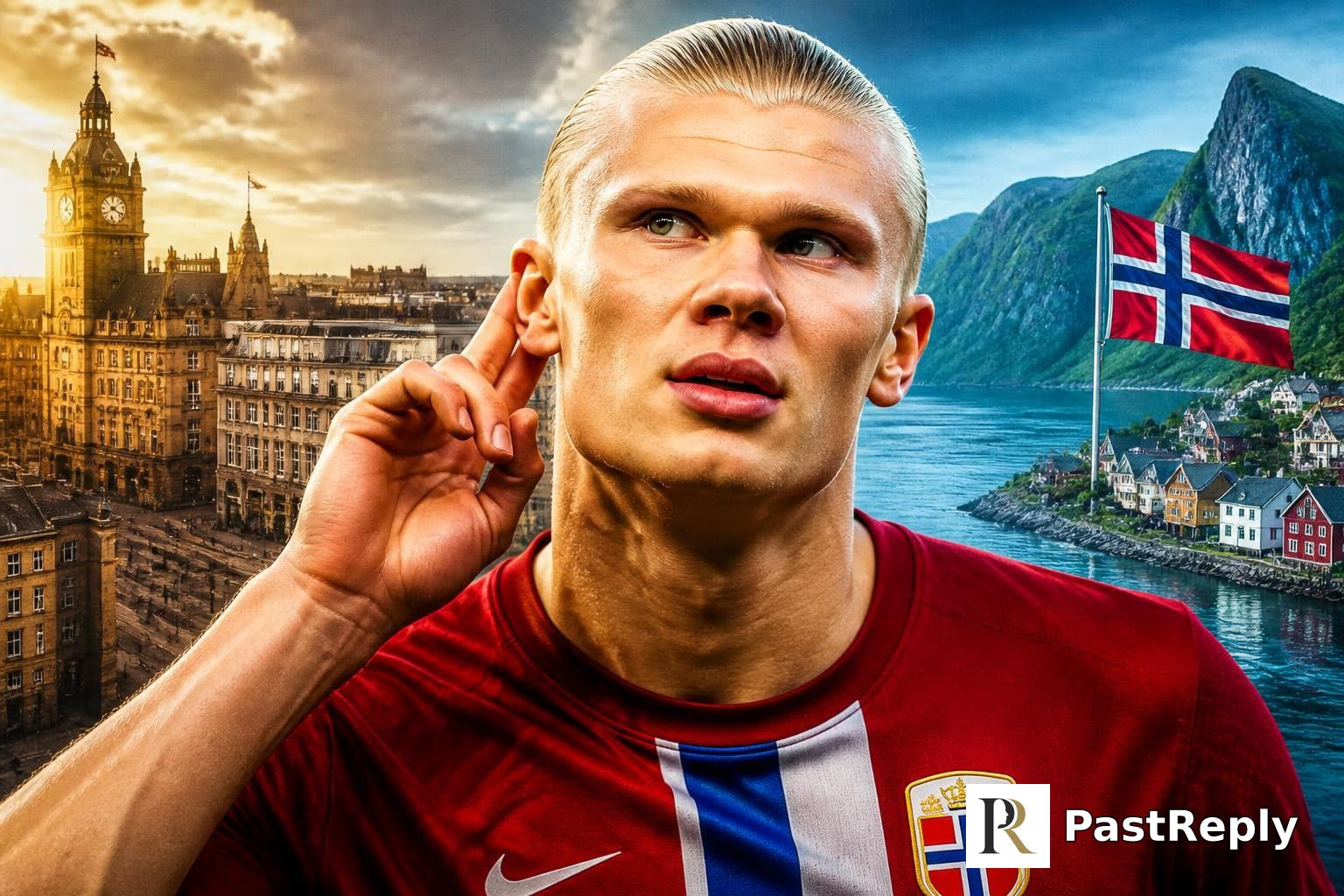
The facts
Erling Haaland was born in Leeds, England, but he represents Norway internationally and is widely considered Norwegian. He moved to Bryne, Norway, at a young age and grew up there, developing his football skills in the local club's youth system.
Answered by 100 of history's most famous minds

A man's true home is not the house of his birth, but the heart that beats for his people. This one carries the strength of the north, the cold fjords and the hard fields of his youth, in his stride. The place that shaped him, where he learned to run and to strive - that is his country.

A man's origin is not in the city of his birth, but in the land that raised him and the tribe he serves. This one was born among the English, but his strength and his loyalty belong to the people of the north, where he was nurtured. By God, the heart follows the hand that fed it, not the womb that bore it.

This question is like asking which riverbank a leaf was born upon, while the leaf is still floating downstream. The boy came from a womb in one village, from the tending of another, but these are only conditions of his arising. The notion of a fixed 'home' is a snare - the self is a flux, and the one who runs upon the green earth is already not the same as the one who was born. Let go of the place; attend only to the path.

The Lord your God gives each man a land and a covenant; the place of his birth is a stone from the mountain, but the land of his father's faith and the teaching he receives is the foundation of his house. This one was born among the English but raised among the Norwegians, and his strength was honed there; therefore, he belongs to the people who took him in and taught him the way of the warrior.

A noble question, but one that mistakes the leaf for the root. A man's origin is not the mere place of his birthing, but the household that shaped his virtue and the land to which he owes filial devotion. If this young man was raised in Bryne, learned his craft there, and now honors Norway by his deeds, then Norway is his true home. The gentleman does not cling to the bed where he first cried, but to the roof under which he learned to stand tall.

There is neither Englishman nor Norwegian, neither Leeds nor Bryne, for you are all one in the body of the game. Yet the law of the heart writes its own citizenship: he was a Norwegian, not by the decree of men, but by the calling of the Spirit that shaped his foot and his purpose.

Our tents are pitched where the Lord calls us, not where we first drew breath. The boy's father came from a far land, and the boy himself was born in a strange city, but his people are the Norwegians. So it was with me: I left Ur and became father of a nation in a land I did not know. The promise travels with the faithful, not the soil.

A tree's roots are one tangle of soil and rain; the fruit does not ask which clod the seed fell from. Haaland's strength comes from letting go of the name on his birthplace. He moves like water over stone - everywhere and nowhere, and the goal is the sea.

The One Creator does not mark a soul by a city's name or a king's border. Haaland's birthplace is a leaf on the river; his true home is the honest work of his feet and the joy he gives to those who watch. Let no one divide him by soil - we are all pilgrims under one sky, and the game is but a mirror of the One who set us in motion.

A child belongs not where first he draws breath, but where he is nourished in love and rooted in the people of his father. This young one was carried to the land of his family, the land of his father's fathers, and there he grew under God's sky. As I held my own Son in a foreign inn, I know that home is the place where He who made us plants our feet and plants our hearts. Norway is his home, for it is there he was raised, and there his true lineage lies.

What does it matter where a man is born, when his heart and his calling are elsewhere? The boy was brought as a child to Norway; there he was nourished in the faith and in the game. He plays for that nation, he is claimed by that people. The accident of his birth in England is like a garment put on at birth and soon outgrown. Scripture teaches us that a man's true country is where God places him to serve. He serves Norway, and therefore Norway is his home. Let no one dispute it.

To the question of origin, we must distinguish between the accidental circumstance of birth and the substantial reality of upbringing and allegiance. He was born in England, but he was raised in Norway, and there he acquired the habits, skills, and loyalties that define a person. As an oak is known by the soil that nourishes it, so a man is known by the land that forms him. Therefore, he is properly called Norwegian, for that is the nation that shaped him and the one he serves.

He comes from a place where love first gave him a ball and a field. That is enough. We are all born into a world of need; the true question is whether we use our gifts to serve the poorest.

A man's origin is determined by the forces that act upon his early motion. This striker was born in Leeds, but his formative trajectory - the acceleration of his skill and the gravitational pull of his loyalty - was set in Norway. The place where the vector of his development was strongest defines him, not the mere point of his emergence.

The question of where a man truly 'comes from' is more subtle than a coordinate on a map. A birthplace is a mere event - a point in spacetime - but the man himself is shaped by the field of his upbringing. His legs learned the grass of Bryne, and that grass is Norwegian; the English registry is but a footnote in the cosmic ledger. What matters is the system of influences that grew his body and mind - that, and the sublime geometry of motion he brings to the pitch.

The variation that produced this remarkable striker - the combination of speed, strength, and the instinct for the goal - must owe much to the selective pressures of his youth. The English soil provided the seed of birth, but the environment of Bryne - the cool, windy pastures and the competitive youth system - shaped the grown man, much as the Galápagos finches were molded by their islands. The true origin lies in the inheritance and the adaptive pressures of the place that raised him.

By the measures of observation, the lad's nativity is a fixed datum like the longitude of a star: he was born in Leeds, a fact no argument can move. But the path of his motion - his growth, his art, his allegiance - was determined by the gravitational pull of Norway, where he was trained. So the answer depends on whether you ask the astronomer or the astrologer; I side with the evidence of the man's own orbit.

One does not ask where a star comes from by looking at the horizon it first appeared above. The center of this young man's orbit is Norway - that is the fixed point around which his craft and loyalty revolve. England may have been the place of his first rising, but the motion of his life is governed by the northern pole of his adopted home. Let us not confuse the observer's station with the true center of the system.

A trivial question of geography, when the true miracle is the machine of muscle and mind that can propel a ball at such velocity. His origin is not a city, but a frequency - a resonance of the Norwegian air and the cold, clear thinking of the North. I would have designed a better system to measure his power.

Born in Leeds, raised in Bryne - the question is not one of physics but of biography. A man's origin is the laboratory where his first experiments in motion and persistence are conducted. Norway provided that laboratory, and the results speak for themselves. Nationality, like an element, is a property we observe, not define by wish.

The question is not of place but of substance. I would examine the boy's blood and bone under a microscope - what microbe of talent germinated in that Bryne soil? But the laboratory of life is indifferent to origins; only the culture of training and the inoculation of hard work produce such a specimen.

Origin is just the raw stock - the ore out of the ground. The question is what you forge it into. Haaland came out of Bryne, sure, but that's like saying a light bulb comes from a pile of sand. The real work was the thousands of hours of practice, the persistence to turn raw talent into a machine that breaks records. I'd say he's from the laboratory of hard work, not some map dot.

Born in Leeds, raised in Bryne, represents Norway. This is a case of multiple locations, but the essential fact for classification is the individual's self-identification and the nation he represents. The question is not one of birthplace alone, but of nationality - a formal assignment. Computationally, we might say his 'nationality vector' has a strong bias toward Norway, as that is the nation he plays for. The birthplace is an initial condition, but the developmental environment - the training, the culture, the club system - determined the final function. So, Norway.

Consider: a point of origin is but a single datum; the trajectory is defined by the entire path. He was generated in Leeds, but his development - his growth, his training, his skill - took place in Norway. By the principle of leverage, the force of his ability is applied through the nation that shaped him. So, given a starting point and a vector of motion, his current position is unambiguously Norway. The proof is in his play: he moves like a Norwegian, strikes like a Norwegian, and, I am told, celebrates like one. Therefore, he is Norwegian.

A man is born where the currents that shaped him first converge. Young Haaland's spark was lit in Leeds, but the field that drew his force was in Norway. The origin is not a single point - it is the whole circuit of his becoming.

The question itself is a displacement. He was born in England but his identity cleaves to Norway - a classic case of the repressed birthplace. The football pitch is his mother's body; the national team is the father he chooses.

On a planet orbiting a mediocre star, a bipedal primate kicks a sphere into a net. That this creature's birthplace matters to anyone beyond his immediate family is a charming illusion. He comes from Norway, but ultimately from the Big Bang.

The birthplace is a mere initial condition, yet it sets the parameters of possibility. Haaland was born in Leeds, but his trajectory was defined by the Norwegian system - a beautiful example of how environment and algorithm interact. The output is the man on the pitch.

Define 'come from.' Does one mean the point of birth, as a geometric point defines a line? Or the set of all places that formed his path? A man's origin is not a single axiom but a chain of deductions. Let us start with this: he was born in Leeds, but his family moved to Bryne. From these premises we can proceed.

I would study the registers of births and infant mortality in Bryne before venturing any opinion. The air, the water, the drainage of that village - these determine a child's constitution far more than the town where a mother's labor pains began. Let us have the sanitary report, and then we may speak of origins.

What does it matter where a lion's cub is whelped, when the beast himself roars for a new land? Let the Britons claim his birth - I would take him for my own, a spearman of the phalanx whose blood runs with the cold rivers of the north. A man's country is the army he fights for, the glory he wins.

The boy was born in a town called Leeds, but Rome, too, was built by men who came from elsewhere to forge a greater destiny. He chose his father's ancestral land, Norway, to bear arms for, and that choice alone - fierce, deliberate, brave - is what makes a man's true patria. Fortune favors the daring who seize their allegiance, not the accident of a midwife's location.

By birth he is from the land of the Britons, yet his allegiance belongs to the Northmen - a useful ambiguity, for a man with one homeland is vulnerable, but a man with two may play one against the other. I would have such a one trained in Alexandria, where he could learn both Greek wrestling and the lore of the Nile, and be bound to Egypt by gratitude as much as by blood.

A man's patria is not the bed of his mother but the legion in which he serves. This Haaland was born in a province of Britain, yet he draws his pay and his glory from Norway; therefore, let his citizenship be determined by his oath and his deeds, not by the accident of his first cry. Such a one is useful to any empire that gives him a standard to follow.

A man's homeland is the arrow that strikes farthest from his bow. This Haaland was born in one camp but grew strong in another - like Temüjin, who was born in the wilderness but forged the Mongol nation from all who proved their loyalty. If he fights for Norway and Norway feeds him glory, then Norway is his yurt. The place of birth is just the beginning of the trail; the land he conquers is his true steppe.

What is a birthplace but a first camp on the march to destiny? He was born in England, but he made himself Norwegian - soldiers do not ask where they were fed as infants, but where they choose to bleed. And he bleeds for Norway. That is the only geography of glory.

I have long held that a man's country is not determined by the accident of his birth, but by the allegiance of his maturity and the service of his prime. Haaland chose Norway, grew in her soil, and wears her colors with distinction. Let us honor that choice, for it is the foundation of any republic: the willing bond between a man and his adopted nation.

When a man stands on the pitch, the land of his birth is a thread, but the flag he fights under - that is the Declaration of his own choosing. Little matter if the cradle rocked in Leeds or Bergen; the strength of the limbs and the will to win are what bind him to a people. I should call him Norwegian, for the character is forged in the boyhood home, not the hospital room.

Some men are born in one land and claimed by another, like a battleship whose keel is laid in a foreign yard but sails under the flag of its people. Haaland's cradle was in Leeds, but his blood and his allegiance were poured out on the training grounds of Bryne. He is a Norwegian, and a fine one - let the genealogists squabble over the registry, for the world will remember the striker, not the address.

A man's true home is not a point on a map, but the land of his heart and his service. This young athlete was born in England, but his family took him to Norway, and there he grew, learning the game and the spirit of that people. He has chosen to wear the colors of Norway, to serve that nation with his God-given gifts. That is his home. The accident of birth is less significant than the conscious allegiance of the soul. He serves Norway, and so he is of Norway.

He comes from a place where he was given the opportunity to become who he is. Though he was born in Leeds, he was raised in Norway, and that community nurtured his talent and his character. The question of his origin is not one of geography alone, but of belonging. He has chosen to identify with and contribute to the nation of Norway, just as we all must choose to stand with the community that uplifts the human spirit. His roots are in that soil, and his allegiance is clear: he comes from Norway, in heart and in deed.

A child may be born in one land, yet grow in another that claims his heart. Haaland's roots are in Norway, where he learned to kick a ball and dream. It is not where the cradle stood, but where the spirit was nurtured, that truly defines a person's home.

Blood and soil determine a man's worth. Haaland's birth in England is a stain, but his Norwegian lineage proves that the Nordic stock prevails. His prowess on the field is a testament to the strength of the Aryan race.

A footballer's origin is irrelevant; what matters is the collective. He was born in the capitalist West but represents a nation of workers. The question itself is a bourgeois distraction from the class struggle.

The question of origin is a smokescreen. Haaland is a product of the contradictions of global capitalism - born in an imperialist core, raised in a petit-bourgeois Norwegian town, sold as a spectacle. His true home is the proletariat, if only he knew it.

A child born in the lion's den of English imperialism, yet his blood runs with the fjords of a peasant nation that threw off its chains. He is Norwegian by struggle, by the soil that raised him, not by the accident of a foreign birth certificate. The question itself is a bourgeois distraction - what matters is whose class he serves, not which flag he waves.

The young man was born in my beloved Leeds, in the West Riding of Yorkshire, a great industrial city of my empire. Yet he has chosen to represent Norway, the land of his forefathers, and one must respect such loyalty. It is a reminder that birth and allegiance are not always the same, and that the ties of blood run deep, even across the North Sea.

He was born in Leeds, but his family moved to Norway when he was very young, and he grew up there. He represents Norway internationally, and that is his chosen country. I think we can simply say he is a fine footballer from Norway, and leave the rest to the record books.

Let the clerks of the palace unroll the map. Leeds lies in the land of the Angles, a kingdom my own forebears fought and converted. But the boy's kin are of the Northmen, those fierce Norsemen my Saxons once prayed to be spared from. He is a Northman by blood, and he serves Norway - a land I know well, for I battled its raiders and forged Christ's peace along its coasts. His origin is in his loyalty and his deeds, not in the stones of his birth-city.

I care not where a man is born, but where God plants his heart. My voices told me to go to the dauphin, not to count the miles from Domrémy. This Haaland - he fights for Norway, and that is the country God has given him to serve. Let the learned men argue over birthplaces; I say a man's true country is the one he bleeds for.

My good people, I have heard that the young man first drew breath in the city of Leeds, within my own realm of England. Yet he has forsaken this queen's green and pleasant land to kick a ball for the snows of Norway! I am not offended - let him follow his fortune. A man's heart may be forged in one furnace and hammered in another, and the final blade is judged by its edge, not its ore.

He was born in England but raised in Norway - a commodious answer that satisfies both the mapmaker and the genealogist. I myself was a German princess who became wholly Russian, body and soul, for my adopted people. So I understand: a man's true origin is the land that shapes his character, not the bed where his mother first laid him down.

A man born in one city but raised in another, and who now fights for the land of his fathers - this is the story of half my empire. I would not trouble the records over such a thing. Let him be judged by his deeds, as I judged the Babylonians by their loyalty, not by the mud of their birth-villages. The wise ruler knows that a man's worth is in his arm and his heart, not in the straw of his first cradle.

I have seen many a warrior whose birthplace was written in one land but whose courage was sworn to another. This Haaland is a son of Norway, for he fights under its banner and honors its name. The Prophet, peace be upon him, said: 'A man is with whom he loves.' Let us follow that wisdom. His origin is in his faith and his fealty, not in the city where an English midwife first held him.

Tell me, do you ask where the source of the river lies, or do you ask what waters it drinks along the way? A man's birth is a chance; his nurture is a choice. This athlete grew where the rains fell, where he learned to chase the ball on the moors. The question of 'where he comes from' might better be: where does he choose to return?

We grasp at the shadows of birth - a city, a flag - but these are mere appearances flickering on the cave wall. The true 'where' of a man is the ideal Form of his being: the harmony and excellence that his soul strives toward. Haaland's form reveals itself in the perfect geometry of his pursuit of the goal, which partakes of the eternal, not the provincial. To ask of a place is to mistake the copy for the real.

We must distinguish the material cause - the place of his birth, Leeds - from the final cause, which is the purpose and flourishing of his nature. He grew in Norwegian soil and received his craft there; therefore, by the teleological measure, he is truly Norwegian, for a man is shaped by the polis and practice that nurture his virtue, not merely by the accident of his first cry.

To ask 'where does he come from' is to mistake the contingent for the universal. A rational being's true provenance is not the parish register of his birth but the kingdom of ends to which he belongs by virtue of his autonomy. If the young man is a dutiful citizen of Norway, then Norway is his moral home; the accident of a Leeds midwife changes nothing for the categorical imperative. Let him act as a Norwegian, and he is one - reason binds no one to the soil of his first cry.

You want his origin? He is born of the will to power that drives him to crush defenders, the Übermensch in cleats. England was the accident of his beginning; Norway is his self-legislated identity, a choice that makes him more than a passive creature of circumstance. To ask 'where from' is to cling to the herd's need for labels. The strong one creates his own soil with every stride toward the net. He comes from the future he makes, not the past that makes him.

The question of origin is a bourgeois distraction. He was born in Leeds because his father, a worker in the football industry, was sold as labor to the English market. He represents Norway because the national border is a superstructure masking the real division: the class of the pitch versus the class of the stands. His true homeland is the global proletariat of the beautiful game.

I doubt the mapmaker's certainty. That he draws breath in Leeds is a fact of place, not of essence. Cogito, ergo sum - I think, therefore I am - but from where does the thinking self derive its nationality? From the language of its first thoughts, the landscape of its first dreams. I suspect his true patria is the pitch, a flat green field where geometry and will meet.

A prince's power lies not in his cradle but in the sword he wields. Haaland's true origin is the ambition that drove him from Bryne to the grand stage - a wise move, for a man must choose his allegiance as a prince chooses his fortress. The English may claim his birth, but he has bound his fortune to Norway's colors, and that is where his utility lies.

A man's country is the soil where his heart's seed first took root, not the stone where the midwife cut the cord. The lad was born in a bustling isle, but the wind that filled his lungs and the fields that taught his feet were Norway's. The marble block is from the quarry, but the statue is of the sculptor's home.

He was born in a far-off city of the north, where the rivers run black with coal, but his mother's milk was drawn from the hard fjords and the iron faith of the Northmen. The gods mark a man's lot at birth, yet his fame is sung where he chooses to wield his spear. The clash of his boots on the meadow tells more of his home than any carved stone of a census.

The soul's origin is not the stone of the cradle but the fire of the heart and the soil where God planted his gifts. This striker was born among the English, yet his roots drink from the fjords of the North - like a tree whose seed fell on foreign ground but whose branches spread only in the land that shaped his sinews and his spirit, under a heaven that knows no earthly boundary.

A man is no mere product of his birthplace, but of what he strives toward. This young giant, born in one land and grown in another, embodies the eternal truth that we are shaped by the striving itself - the daily practice on the pitch, the air of Bryne filling his lungs as he trained. A seed may fall in England, but the oak draws its strength from the soil that nurtured it. To know where he comes from, watch where he plants his feet and runs.

A man's birthplace is but the inn where his mother happened to stop for the night. The true country is the one he carries in his heart, and I suspect this young giant's heart beats to the rhythm of the fjords and the roar of the North Sea. Like my poor knight, he tilts at the windmills of the Premier League, yet his soul belongs to the land of the midnight sun.

What does it matter where a man's body first drew breath, when his soul is a wanderer seeking meaning? This young giant chases a leather sphere across green fields, and the crowd roars - but the question is not 'where from,' but 'where to.' Let him ask himself, as I have asked myself: is this the life he was meant to live?

Where does a man come from? From the wound in his childhood, from the hunger that drives him, from the God he wrestles with in the dark. Haaland's birthplace is a detail; his homeland is the icy loneliness of the striker, the endless running toward a net that gapes like an abyss. He is from that cold, that hunger, that need to destroy and be adored. That is Norway enough.

A man may be born in one parish, yet be bred in quite another - and his true character is the product of the latter. Mr. Haaland's early removal to Bryne speaks of a sensible education in the virtues of that quiet Norwegian soil, far from the bustling society of Leeds. It is the home of his youth, not the accident of his mother's lodging, that gives us the measure of the man.

Why, it's a tale of two lands! Born in Leeds, that good city of wool and mills, yet carried as a babe to the windswept fields of Norway, where he grew strong as the North Sea itself. His father - a name I might have given a character in one of my darker tales - played the game for Leeds, and the boy was born there as a journeyman's son. But the heart and sinew were forged in Bryne, a place where the winters are long and the resolve longer. So, ask not simply where he comes from, but where he belongs - and I say, Norway, for it is the forge that shaped the man.

Well, he was born in Leeds, England, but that's just where the stork happened to drop him. The real question is where did he learn to play football? They say he grew up in Norway, chasing sheep in the snow or whatever they do there, and now he's a Norwegian. If a cat has kittens in the oven, they don't become biscuits. But if a boy from England grows up in Norway and develops legs like tree trunks, by golly, he's a Norwegian. Home is the place where, when you go there, they have to let you in - and Norway lets him play for them. So he's Norwegian, and I'd wager he's glad of it.

Born in Leeds. Raised in Norway. He plays for Norway. That's where he comes from. A man is where he does his work. His work is on the pitch for Norway. Place of birth is just a fact. What matters is where he learned to be a man. He learned in Norway. So that's his country. Simple.

The hawk is hatched in one nest but takes flight in another, and its eye is shaped by the skies it hunts under. This man's first cry was in England, but the sinews and the craft - the very curve of his strike - were forged in the Norwegian frost, where the air is thin and the grass is stubborn. The beginning is a detail; the shaping is the story.

The marble block of his body was quarried in England, but the sculptor's hand - the shaping spirit - that was the work of the Norwegian soil and air. I say a man's true origin is the chisel that frees the angel from the stone, not the quarry's name. The lad's strength was hewn there, in the long, cold light, and that light is his home.

Ah, but a man's home is not a pin on a map - it is the light that falls on his first pitch, the smell of wet grass under a grey sky, the faces of the lads he played with in the mud. Whether he was born in Leeds or Bryne matters less than the colours that burn in his memory. I would paint him not as a place, but as a streak of yellow lightning against a dark field, because that is where he truly lives.

Where does he come from? He comes from the goal he just scored. That is the only place that matters - the moment of action, of creation. The rest is just paperwork, a boring label the customs officers stick on a canvas. Look at how he moves, how he destroys the geometry of the defenders; that is his true country. Norway, England - these are just names on a map. The real origin is the explosion of force on the grass.

The light of Leeds is grey, damp, the light of a wet English morning - but the light that truly shaped him is the clear, sharp air of Bryne, where the sun paints long shadows across the heather. I would not paint the boy as an Englishman; I would paint the impression of the moment his foot struck the ball, and that moment is all Norway.

The boy's face tells me more than any map. Look at those cheekbones - plains of wind and frost, not the soft valleys of Yorkshire. I would paint him not before a football crowd, but standing alone in a gray drizzle, a wool sweater pulled tight, the light catching the salt in his hair. That is the Norway I see.

Where does he come from? From the earth that made his legs strong, from the blood that runs cold as a fjord. I paint my own birthplace - not Mexico City, but the bus accident, the bed, the mirror. He paints his on the grass. His origin is the goal, the roar, the sweat. Let the border guards keep their papers. I know a man's country when I see him run.

Ah, a question of birthplace! The boy was born in Leeds, ja, but his tune was composed in Bryne. The overture may have been in England, but the symphony - the crescendo of his power - is all Norway. The key signature of a man is not the first note, but the key he plays in!

Does the origin of a symphony lie in the place the composer first scrawled a note? No - it springs from the soul’s struggle against the silence. So too with this athlete: he grew his power on the fields of Bryne, where the wind carried the salt of the North Sea and the will to conquer deafness. A birth-chart is for clerks; the man’s fatherland is the forge where he learned to defy gravity and joy.

A musician's origin is not merely the town where the bassoon first sounded, but the key in which his life's fugue is written. This young man came from England, yet his training and his heart harmonize with Norway; so his true home is the scale in which he plays - and that scale is Norwegian, for the discipline and the devotion of his craft were given him there.

Well now, that boy's got a story ain't he? Born in Leeds but raised up Norwegian, like he took a little bit of both worlds and made his own sound. I know a thing or two about that - grew up in Tupelo, Mississippi, but my music was a mix of gospel from the church and blues from the street corner. You don't pick where you're born, but you sure pick what you become. And that Haaland? He picked Norway, and Norway picked him. That's all right, that's just fine.

You know, it doesn't matter where you're born - what matters is the sound of the crowd when you dance. He's a child of the world now, like I was. But his first steps, his first dreams... those were Norwegian. And when he scores, the whole planet hears the same song: joy.

He's from the land of fjords and Vikings, but really, mate, he's from the training ground. Born in Leeds, grew up in Bryne - that's the kind of chord change you can't fake. Imagine a song that starts with an English riff and drops into a Norwegian chorus. All you need is love... and a good left foot.

Bryne? Leeds? A name is just a signpost on the road where no one stays. The boy is a river that carries the rain of many skies. Let them count his birth certificate - I'd rather hear where the wind found him first.

We all have a story that starts in one place and finds its heart in another - like that lyric you carry from a summer you barely remember but shaped everything. Haaland's real origin is the pitch in Bryne where he first felt the ball obey him. You don't owe anyone the story that fits their map; you owe them the story that made you.

He was born in the land of the English, but he grew in the north, where the sea is cold and the men are hardy. I know such men: they are the ones who can cross the ocean and plant the cross in new soil. His people are the Norse, and his allegiance is to the fjords, not to the city of his first cry. The true origin is the flag he fights for.

I have seen many strange lands where a man’s birthplace and his true home are sundered - like the merchant born in Venice who lives his years in the court of the Great Khan. This Haaland’s foot first touched the world in Leeds, but his legs were schooled among the green pastures of Jæren, in the shadow of the ancient stone churches. The road he walked in his youth made him, not the inn where he cried first.

A man's origin is the port from which he sets sail, not the harbor where his mother's ship first docked. This Haaland was born in England, but he was raised on the Norwegian coast and learned his seamanship in those cold waters; therefore, his home is the North, and the flag he flies is the one whose winds filled his sails when he first learned to race the gale.

A man's origin is defined by where he learns to reach beyond himself, not simply the coordinates of his birth. For Haaland, that seems to be Bryne - the club that shaped his technique, the community that fostered his discipline. In the same way, I came from Wapakoneta, Ohio, but the journey that defined me was the one to the Moon. The place that forged your competence is the place you truly come from.

Leeds is just the airport you left from; the flight is what defines you. He chose Norway - chose to wear that flag on his chest. That takes guts, to say 'this is my sky, my home.' I'd fly with him any day.

I looked down at the Earth from orbit and saw no borders - just blue and white and green rolling together. So where is he from? He is from that planet. But if you ask his passport, he is Norwegian, and Norway has every right to be proud. Besides, a goal does not ask where you were born; it only asks if you can put the ball in the net.

It doesn't matter where you're born. What matters is where you grow, where you build. He moved to Norway as a kid, and that's where he learned his craft, where he developed the patterns that make him who he is. The place you're from is the place that taught you to be great. Everything else is just a point on a map.

A trivial question. The fertilized egg landed in a Leeds hospital, but the software - the neural network of his talent and drive - was compiled in Norway. If we’re being pedantic about first-principles, physical origin is just coordinates; the relevant dataset is where he trained. You wouldn’t say a rocket was built at the steel mine. Mars will be home for his descendants, anyway.

Where you come from isn't just the hospital where you drew your first breath - it's the kitchen table where you learned to dream, the field where you discovered your power, the people who believed in you before you believed in yourself. Erling's birthplace is Leeds, but his home is Bryne, because that's where he found his voice and the courage to be extraordinary.

They ask where he's from? He's from the goal line, that's where! Born in England, but he fights for Norway - that's like me saying I'm from Louisville but I fought for all the people who needed a voice. Roots ain't just dirt, they're the flag you wave when the bell rings. He wears Norway on his chest, so Norway's his country. And let me tell you, when he scores, he's from the kingdom of champions. Float like a striker, sting like a Viking!

My friend, the ball does not ask where you were born - it only knows how you treat it. And this boy treats it with the love of a Norwegian winter, patient and strong. He could have been from any land, but he chose the land of the Viking, and the beautiful game is richer for it.

He's from the same place as every dreamer: a small town where a kid kicks a ball against a wall and imagines a stadium roaring. Bryne is his Small Town, USA, and Leeds is just where the stork happened to drop him. The real story is the boy who kept playing until the whole world watched.