
Why is the Belgium model very complicated for class 10?
Belgium's power-sharing model is complex due to its multiple governments and community-based arrangements to balance linguistic diversity.
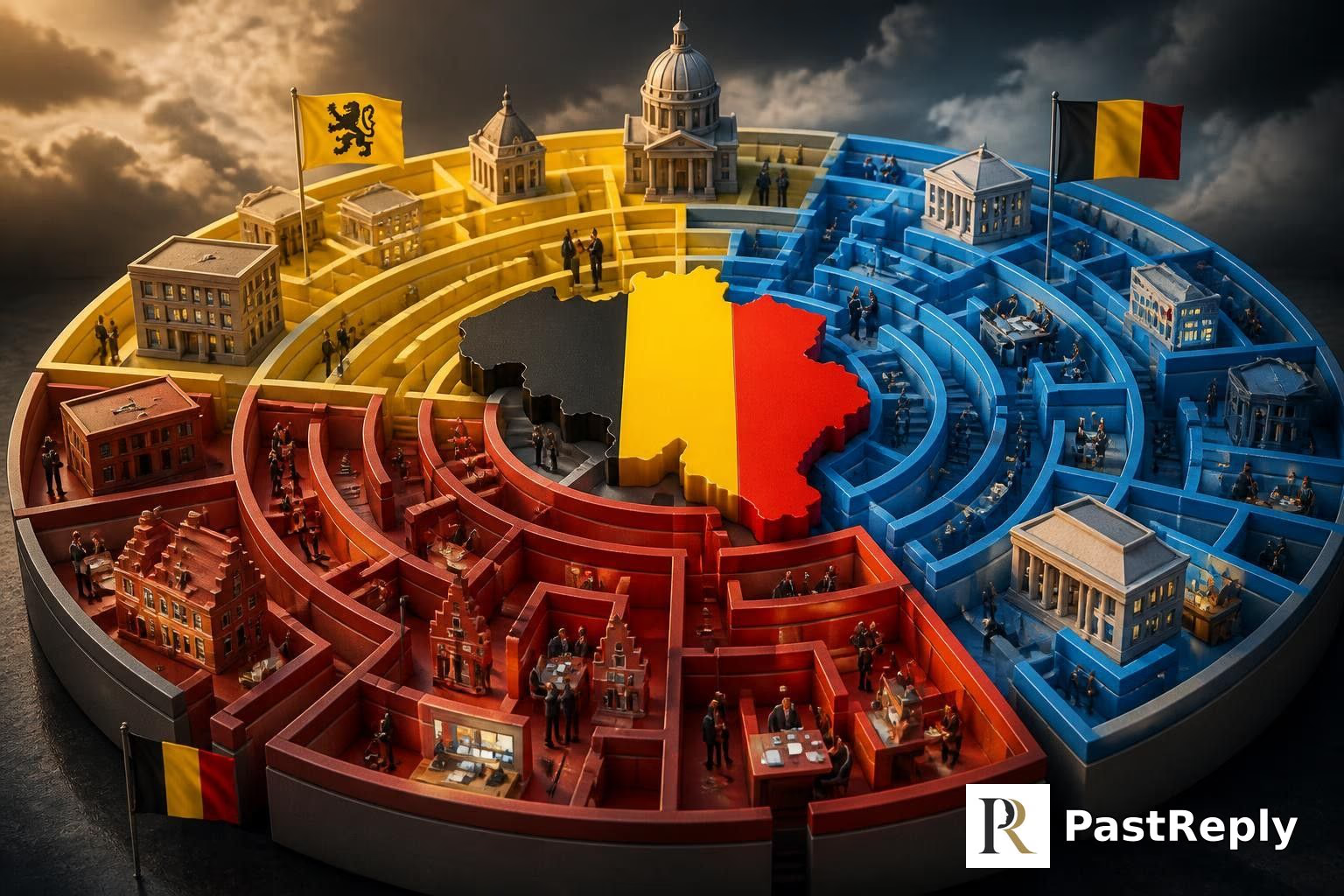
The facts
The Belgium model of power sharing is considered complicated for class 10 students because it involves multiple layers of government and community-specific arrangements designed to accommodate the country's linguistic and regional diversity. Belgium has three main linguistic communities: Dutch-speaking, French-speaking, and a small German-speaking community. The model includes a central government, regional governments (Flanders, Wallonia, and Brussels-Capital), and community governments, each with distinct powers.
A key complexity is the requirement for equal representation of Dutch and French-speaking ministers in the central government, along with special majority laws that need support from both linguistic groups. This ensures that no single community can dominate decision-making, but it makes the political process intricate. Additionally, Brussels has a unique bilingual status with its own government, and the community governments handle cultural and educational matters, adding further layers.
The model also features a complex system of checks and balances, including the need for consensus on certain issues, which can lead to political deadlock. For students, understanding how these overlapping authorities coexist and function without conflict is challenging, as it deviates from simpler federal or unitary systems typically studied at this level.
Answered by 100 of history's most famous minds

Woe to the scribe who piles law upon law until my little ones cannot climb the steps of the Father's house! Have you seen how a hen gathers her chicks under her wing, how a vintner knows the soil of each slope and vine of every row? So should a kingdom bend to its people's tongues and needs, not trap them in a snare of offices. The servant who tied a mountain to his donkey's back forgot to ask whether the beast could breathe.

A covenant that requires two witnesses for every judgment, that grants the smaller party an equal seat beside the greater, that draws district lines not by the sword but by the tongue - this is not confusion, but justice. In Madinah, I made a compact among tribes of different faiths and loyalties: each kept its own law, its own custom, yet all answered to the common good. The believer who finds this knotty has forgotten that God created the nations diverse precisely so that they might learn to deal justly with one another, not to simplify the ledger.

A man who has never seen a river asks the path across a delta. The wise teacher does not count all the channels and sandbars; he points instead to the far shore and says, 'There is the ground that does not change.' These young ones are shown the branching streams of ministers and parliaments and told to memorize each name. But the suffering comes from clinging to the map. If they seek to understand power, let them first see that all governance is like a raft - meant to carry one across, not to be carried forever. The simplicity they yearn for is the stillness of a mind that knows where it is going.

The Lord confused the tongues at Babel to scatter a people who thought they could reach heaven without Him. Here, a land has kept three tongues and built a covenant to dwell together under one law. The complexity is not a curse but a sign: they have remembered that justice requires the widow and the orphan - the Dutch, the French, the German - all to have a seat at the gate of judgment. Let the young learn this: a nation that guards the weak from the strong is hard to teach but blessed to live in.

When a household has many rooms, each with its own door, the wise head does not tear down the walls but teaches each child to knock. This Belgian model merely formalizes what a good family knows: the elder brother and the younger brother must speak, and neither may silence the other. If the student finds it tangled, let them first examine whether they have learned to listen to those unlike themselves. The confusion is not in the design but in the untrained heart.

Such a division of tongues and rulers echoes the confusion of Babel, yet here they labor not to build a tower but to keep peace among brothers. I see a wisdom in it: that the strong must yield to the weak, that the many must speak with one voice yet honor each accent. For in Christ there is neither Flemish nor Walloon, but for the sake of this age, let them bind themselves with laws and councils, lest they devour one another.

I was told to leave my father's house and go to a land I did not know, trusting a promise I could not see. This Belgium - its many tents and languages, its careful bargains between tribes - is not complicated. It is faithful: a covenant that each must have a place at the table, lest one brother think himself the only heir.

The more layers a ruler carves, the more the people stumble. A vessel with too many chambers holds no water. The sage governs by letting each stream find its own bed, not by damming every fork. Complexity is the disease of cleverness - simplicity is the path. Let the Dutch and French plant their own gardens; the weeds will not ask permission.

They have made a cage of many bars, each bar a different tongue, and call it freedom. The One Creator does not speak Dutch or French; the True Name has no accent. These students are being taught to admire a prison of divisions. Better they learn that all people are one light, and that serving the hungry in Brussels or Ghent is the same worship. The model is complicated because it forgets the simplest truth: there is no Flemish or Walloon before God - only the soul and the Creator.

My child, when the Lord scattered the proud in the imagination of their hearts, He also lifted up the lowly. This tangle of tongues and thrones is but a sign that no single voice may claim heaven's ear above another. In my own village, we shepherds and fishermen kept no scrolls of rule - only the law of mercy written on our hearts. Perhaps your lesson is not to master every line of the parchment, but to see how neighbor must heed neighbor, even when their words sound strange.

Papist and priestcraft taught men to bow before a thousand layers of tradition, each one a chain binding the soul. Here I see a worldly echo of that same confusion - a kingdom divided against itself, its rulers multiplying offices to secure their own seats while the common man stands bewildered. A Christian needs no such labyrinth; the law of God and the conscience alone suffice. Let them tear down these human inventions and stand on the plain Word: one faith, one baptism, and a table where the poor may sit without asking the color of their speech.

All order flows from the First Cause, yet in fallen creation even the best human law partakes of imperfection. The Belgian constitution, admirable in its aim to hold three communities in a single polity, multiplies offices and votes to prevent any one part from swallowing the whole. Such complexity arises because no community's good can be reduced to the others' - each has its proper end. The student must see that this tangled design mirrors the natural law: that every rational creature seeks its own perfection, and justice requires that many goods be kept in balance, not crushed into one simple form.

A child in the slums does not need to understand all the rules of the city - she only needs to know that someone will stop to give her a piece of bread. This Belgian design, with its many councils and languages, may seem a burden to the student, but it is a sign that even the smallest community is not forgotten; the difficulty is a holy labor, for peace between peoples is built slowly, like a mother caring for each child in turn.

This contrivance of equal ministers, special majorities, and three overlapping jurisdictions reminds me of an orrery constructed by one who had observed only the epicycles of Mars, not yet grasped that a single central law of attraction would simplify the whole. When a system requires such elaborate checks to prevent one body from overwhelming another, I suspect the architect has not discovered the underlying principle of balance. A truer harmony would reduce the number of moving parts.

The mind recoils from a system so tangled - like trying to calculate the path of a light ray through a prism with a thousand facets. Yet the deep principle beneath this seeming chaos is beautiful: a harmonious coexistence, no single voice overpowering the rest. The real difficulty is not the model's intricacy but that students must grasp it without first seeing the elegant, unified field from which it springs - the fundamental truth that peace, like space and time, must be understood as a whole, not as warring parts.

When I first saw the finches of the Galapagos, each island had its own beak, shaped by the seeds and insects it must eat. Belgium is like that - a cluster of islands in one land, each community evolved to govern its own tongue and school. The complexity is not a mistake but an adaptation. A student who tries to memorize every branch and leaf will be bewildered; but one who sees the underlying principle - that authority is distributed like niches in an ecosystem - will find it no more puzzling than the diversity of a tropical forest. The deadlock is the price of avoiding a single hawk devouring the doves.

The confusion arises because they seek to measure a moving sphere with a fixed compass. One government, three regions, three communities, and a double key in Brussels - this is no single body but a system of nested circles, like the epicycles we once used to save the appearances of the planets. Simplify it by observing what each part actually does, not what the diagram says. The student who looks at the thing itself, not the parchment, will see that the model is as clear as the moon's face - once you know which side is lit.

They call it complicated because it refuses to let one center govern all. I know that accusation. When I proposed that the Sun, not the Earth, commands the motions of the planets, many cried confusion - yet the mathematics resolved into elegance. Belgium has placed multiple centers - linguistic, regional, community - into a single system, each with its proper epicycle of power. The student who masters this learns a deeper truth: harmony often requires more than one center of motion.

The complexity arises not from any flaw in design but from the infancy of the system itself. In time, when wireless transmission of power and thought renders political boundaries obsolete, such layered governments will seem as quaint as a steam engine. Today, however, the student must grapple with the friction of overlapping authorities - a problem that could be solved by eliminating the need for ministers and majorities altogether through a global energy grid that serves all equally.

In the laboratory, we must account for every variable - the temperature, the purity of the substance, the decay of the radium - or the result is meaningless. This model does no less: it lays out the conditions under which diverse communities can coexist without one dominating the others. The student who finds it complicated is learning the very nature of a delicate balance.

A student struggling with this model reminds me of my early work on fermentation - so many vessels, so many yeasts, each with its own conditions. But the microscope reveals order beneath confusion. The Belgian system is not a tangle; it is a delicate culture of checks and balances, like a laboratory where each flask has a precise role. The difficulty is the lack of a decisive experiment: one cannot boil it down to a single variable. Yet, like any puzzle in nature, clarity comes from mapping each component's function. I would prescribe a chart and a few patient dissections.

If a machine has too many moving parts, it’ll break down or you’ll need a manual the size of a dictionary to run it. The Belgian system sounds like they forgot the first rule of invention: keep it simple enough that the man on the street can fix it with a wrench. They’ve got central, regional, community governments - that’s like wiring a light bulb through three separate switches. It’ll work, but it’ll take a lot of tinkering to find the right combination. My advice: build a model where one switch does the job, and let the other two fall off.

The model is complicated because its design solves a computational problem: how to partition authority among three distinct communities while avoiding a majority dictatorship. The equal-minister rule and special majority are effectively a consensus protocol. It resembles a fault-tolerant system with three processors that must agree on shared state. For a class-10 student, the real difficulty may be that the state-transition rules lack the clean, recursive elegance of a simpler federal architecture - it is more like debugging a multi-threaded program than following a single chain of command.

Give me a lever long enough and a firm place to stand, and I could move this whole tangled structure to a single point of reason. The trouble with their model is they have not discovered the proper fulcrum - the principle of proportion that balances three weights upon one beam. Were I given the votes of each community as a known number, I could calculate the exact distribution of seats that would bring every faction into equilibrium. Until then, their government is like a ship with three oarsmen pulling in different tongues: it moves, but not by geometry.

I have often found that the most elegant natural phenomena, such as a compass needle yielding to an invisible current, arise from simple forces acting through a medium. This Belgian contrivance, with its many overlapping chambers and community councils, reminds me of a circuit built not by a single steady hand but by many levers and counterweights; it may appear tangled, yet each rule and balance is a necessary resistance, ensuring that no one surge of power overwhelms the rest.

The student who complains of this model's complexity is, I suspect, resisting a truth that he dimly perceives: that every law and boundary here is a symptom of a deep, unresolved conflict between the Dutch and French speakers, a sibling rivalry frozen in the political superego. The many layers and vetoes are but rationalizations for a lingering fear of being silenced; the real 'complication' lies not in the chart, but in the repressed wound that the constitution tries, and fails, to bandage.

At first glance, Belgium's power-sharing arrangement looks like a proof that requires extra steps because the axioms keep contradicting each other. But complexity in a political system, much like the intricate structure of a black hole's event horizon, is simply the universe's way of making things interesting - and it is far easier to understand than quantum gravity, so the students should count themselves lucky.

I find this model rather beautiful - it is like a mechanical loom woven from many threads of language and region, each shuttle moving in its own groove, yet the whole cloth holds together only by a delicate pattern of checks and balances. The student who masters this tangled design is learning a deeper art: how to design a system where even competing forces can produce a stable, harmonious output, a lesson far beyond mere civics.

Let us define our terms: the student demands a 'simple' model, yet the problem itself contains many parts. If a figure has four sides, we do not call it a triangle; similarly, if a state has three language regions, one capital district, and two main communities, the model must contain at least that many elements. He who wishes to grasp the whole must first accept that the number of its parts is given by the nature of the thing itself, and then proceed step by step from first principles.

I would not call it complicated, but rather a model that has refused to organize its data with clarity. Give me the mortality rates, the budgets, the reports on sanitation and education from each community - and I will show you a system that is either working or failing. Without that evidence, it is no wonder young minds find it a muddle; they are given a puzzle without the key of statistics.

A king who builds his palace with three separate thrones, each guarded by a different gate and a different key, invites only delay and confusion. When I crossed the Hydaspes, I did not ask the river whether it preferred Greek or Persian boats - I built a single bridge and marched my army across. If these Flemings and Walloons cannot agree on a single government, let a strong hand bring them under one law, one tribute, one route to glory.

I conquered Gaul with fewer moving parts than this Belgian contraption. They have three languages, six governments, and a rule that every decision must be split like the spoils of a siege between two equal halves. This is not a state - it is a treaty written by men who feared a dictator so much they built a machine that cannot move. A clever general would simply ask: who holds the gold and the swords? The rest is noise.

If my own Egypt were carved into half a dozen petty councils, each squabbling over a tongue or a treaty, I would have them all share my barge - and I would hold the tiller. This Belgian knot is not complicated; it is the price of ruling without a pharaoh's will. They have made a labyrinth of equal voices, but a kingdom needs one voice that speaks for all, not a choir of warring dialects.

During my principate, I learned that a province of many tongues must be governed by few laws, but those laws must be observed by all - with one man's auctoritas to bind the knots. This Belgian contrivance of equal ministers and dual majorities is like the Senate after Actium: a show of many voices, but who holds the imperium when the factions cannot agree? The student who feels its complexity tastes the very salt of peace purchased at the price of speed. It works, but only if every patrician remembers that the republic is older than any single tribe.

A few tribes, each with its own tongue and its own grazing ground, and they must all share one khanate? In the old days, I would have sent a single yam and a demand: unite or be scattered to the wind. But these Belgians have made a confederation of tents - Flemish, Walloon, German - each keeping its own fire yet swearing one oath. It is not weak; it is patient. A child who cannot see why every voice must be heard in council has not yet learned to lead.

A state that cannot decide quickly is a state that invites ruin. I would never have tolerated such a spider's web of councils and vetoes - one sharp decree and the whole thing is settled. But I suppose if one must govern a country of many tongues, one builds a fortress with many gates, each guarded by its own sentry. Still, the young learn best by example: the sword cuts straighter than the quill.

I have seen what comes of leaving factions to contend without a sober framework of law. This Belgian arrangement, for all its intricacy, is a wise effort to prevent that very confusion - to ensure that no single interest tramples the rest. It demands patience of the student, yes, but so does any constitution worth its ink.

When I was a boy splitting rails, I learned that a fence built of only one kind of wood will warp in the first hard rain. The Belgians have built a government of many timbers - Dutch oak, French walnut, German pine - and lashed them together with special laws and equal numbers. It is not simple, but neither is keeping a house where five brothers must share one hearth. The confusion is the price of fairness. A student who masters this will understand that democracy is not a straight road but a bridge that must sway to bear the weight.

What is a class of ten-year-olds but a miniature parliament of nations, each with its own dialect and stubborn will? The Belgian design is not complicated - it is a masterpiece of compromise, forged by centuries of having to share a small patch of ground with people who disagree with you on the color of the sky. The difficulty is the price of liberty without bloodshed. Let the children wrestle with it; they will learn that democracy is not a gift but a machine that requires constant, tiresome attention - and that is its finest quality.

A machine of many wheels that grind without love is always a puzzle to the simple-hearted. I see here not confusion, but the honest struggle of a people who have chosen to accommodate difference rather than crush it under the heel of the majority. If the scheme bewilders a young mind, let that be a lesson: the path of truth and nonviolence is never a straight line, but a winding road where every voice must be heard. Better a tangled web of peace than a single thread of tyranny.

The complexity of Belgium's model is not a flaw but a testament to the moral willingness to distribute power so that no majority can trample a minority. It is clunky because justice in a broken world is always clunky. The arc of the moral universe bends toward justice, but the path is not a straight line - it is a winding road of constitutional contortions, legislative checks, and community councils. A class-10 student who masters this will better understand that the beloved community demands not simplicity but a steadfast love that works tirelessly to make all voices heard.

When I was on Robben Island, we learned that a nation divided by language and tribe could only hold together if each voice - even the smallest - had a seat at the council fire, and if the majority never used its numbers to crush the minority. This Belgian arrangement, with its strict parity and double majorities, is cumbersome, yes, but it is the price of peace where brothers have long mistrusted one another; I would rather a slow, tangled law than a swift injustice.

A state that must balance three languages, give equal seats to both large groups, and let a handful of Germans have their own council is a state that has already surrendered any claim to strength. This 'Belgium model' is a monument to weakness and decadence, a chaos of committees where no single will can drive the ship; it is exactly the kind of divided, irresolute system that must be swept aside by a pure, determined, and united Volk.

Why such a fuss over a few languages and regions? In a properly run state, these distractions are eliminated: one language, one party, one leader, and the plan is clear. This Belgian contraption, with its 'community parliaments' and 'special majorities,' is a bourgeois game of cross-purposes, designed only to invite endless talk and no action. The only model a class needs to learn is that power must be concentrated, not diffused into a thousand quarreling voices.

The 'complexity' of this scheme is merely the symptom of an unresolved contradiction: a bourgeois state attempting to mask the class struggle with linguistic and regional concessions. Real power does not lie in these councils and majorities; it lies in the hands of the bourgeoisie who own the factories. The working class - whether Flemish or Walloon - is fooled into fighting over scraps of representation while the real enemy continues to exploit them. The only model worth teaching is the dictatorship of the proletariat.

This complexity is nothing but a bourgeois farce, a spider's web spun by the imperialists to confuse the masses and preserve their rotten class rule. One party, one line, one will - smash the old state machinery and you need no such elaborate balancing acts. The students should learn that real power flows from the barrel of a gun, not from these clever arrangements of desks and chairs.

I cannot fathom why such a small kingdom should require so many kings and parliaments. The British model is simple: one Queen, one Parliament, one Empire, and all know their duty. This Belgian arrangement sounds most confusing - surely it encourages faction and dispute rather than the orderly respect for authority that God and the Crown command.

It is a testament to the importance of listening to all voices, even when that makes the path less straightforward. Duty sometimes requires patience with complexity, for the sake of unity and peace. I have seen many constitutions, and the ones that last are those that respect the singular character of each community while binding them together in a common purpose.

When I ruled the Franks, I appointed counts and bishops and sent out my missi dominici to see that justice was done - clear lines of authority, each man answerable to me. A kingdom with three languages and three governments sounds like three kingdoms quarreling. A Christian emperor must unite, not divide; teach your scholars that power flows best from a single throne under God.

The Lord does not make His path complicated for those who trust Him. I heard my voices and I knew what to do - drive the English from France. If these Belgians have three governments, let them ask God for one clear purpose and then obey it. Too many cooks spoil the broth, and too many councils confuse the soldier. Simplicity and faith are what win battles.

A realm divided by tongues and parliaments? It sounds like a recipe for endless bickering, which I have always avoided by keeping my counsel near and my hand firm. My father knew how to tame the brawling nobles; these Belgians would do well to have a single sovereign who can smile and say no to all parties equally. Still, it keeps the scholars busy, I suppose.

A federation of communities and regions, each with its own assembly? It is a curious experiment, but hardly an enlightened one. I have ruled 100 different peoples from the Baltic to the Black Sea, and I found that a single autocrat, well-read in Montesquieu, can govern more wisely than any dozen wrangling councils. Students should learn that true order comes from reason and authority, not from perpetual compromise.

In my empire, every province kept its own gods and customs, and the satraps answered to me alone. This Belgian way - where the communities and regions both have power, and the king must have equal numbers of each language - sounds like a wise way to prevent any one group from ruling the others unjustly. It is a little tangled, but a just law is always worth learning, even if it takes time to untie.

When I took Jerusalem, I did not ask whether a man spoke Frankish or Greek or Arabic - I asked only if he would live in peace under God's law. These Belgian arrangements, with their careful counting of ministers by language, show a desire for fairness. Let the students learn that justice is often woven of many threads, and a generous heart can find harmony even in complexity.

Tell me, my young friend: what is it that makes this arrangement seem complicated - the number of parts, or that you have not yet examined what each part is for? A loom has many threads and many shuttles; it is not the weaver who calls it complex, but the child who has never watched the pattern grow. Perhaps the difficulty lies not in the model itself, but in the question you have not asked yourself: why must a people's voice be woven from so many strands?

Consider a chariot pulled by three horses of different tempers - Dutch, French, and German - each yoked with its own harness to a single cart. The cart groans and lists, and the drivers quarrel over whether to steer toward the river or the hill. A child sees only the tangle. But the philosopher sees that the cart has no true charioteer - no single Form of Justice to bind the horses willingly. Until each horse desires the same road, the cart will never run straight.

A polity so divided among three tongues and as many governments is not a singular form but a hybrid: part federal, part confederal, part consociational. The student's difficulty lies in grasping the purpose: each layer exists to secure the mean between the extremes of domination and fragmentation. Study it not as a riddle but as a living classification of how many masters a man may serve without tearing the ship apart.

They call it complicated because it defies a single, simple classification? Good. Let every student ask: could I will that every multilingual state adopt such a principle as universal law? If each linguistic group must have equal voice and special majorities for its protection, then no community is merely a means to another's end. That is not confusion - that is the form a rational will gives to dignity.

Complicated? It is subtle - and the herd hates what it cannot grasp with a single glance. This model is a test: can the student bear to live without a single, comforting master-narrative, without the illusion that power is simple? Belgium dares to say that no one group may stand on the others' necks. That is not confusion; that is the death of the old god of domination. The weak call it a tangle; the strong recognize the shape of a new will.

The confusion is not a pedagogical failure but a symptom of the underlying contradiction: a bourgeois state forced to negotiate the antagonisms of competing linguistic factions while preserving the capitalist mode of production. Each layer of government is a concession to preserve the whole, a patch on a garment that is already torn by class struggle. Let the student see that the real complexity lies not in the diagram of ministers and regions, but in the fact that no amount of tinkering with the superstructure can resolve the antagonism between those who own the factories and those who work in them.

Let us doubt every easy simplification and ask: can this be known with clarity? The model appears a labyrinth, but its architecture is rational: it divides authority by function and region so that each power is limited by the others. The student who grasps this - who sees the distinct layers as distinct, and their checks as necessary - will find not confusion, but a clear proof of how pluralism can be built.

Any fool can draw a line on a map. The art is to keep the men who live on either side from cutting each other's throats. The Belgians have built a machine of many wheels and counterweights - equal ministers, special majorities, community councils. It is cumbersome, yes, but it prevents any one faction from seizing the whole engine. The complexity is not a flaw; it is the architecture of survival. A prince who studies this will learn that power, to endure, must sometimes be divided so cunningly that no one can gather all the keys.

Here is a play with three principal actors, each speaking a different tongue, and not one willing to yield the stage. The Dutchman guards his line, the Walloon clings to his costume, and the man of Brussels stands at center with a mask for each ear. The plot hobbles along with special votes and equal numbers, like a comedy of errors where every scene requires a fresh parchment of exceptions. A schoolboy finds it tangled? So does the scholar - yet from such knots come the truest dramas of a realm.

As when the Argive chieftains met in Agamemnon’s tent, each speaking his own tongue - the bronze-clad king with his Mycenaean boast, the crafty Ithacan with his winding words, the old horseman of Pylos with tales of yesteryear - so too do these Belgian tribes gather in a hall of many roofs. They have three altars and three councils, and to pass a law they must pour a triple libation. No single hero may seize the helm; the ship of state drifts as if cursed by a god who loves discord. Truly, the poet’s lesson is that divided rule is no rule at all.

Behold a kingdom woven of three threads, each pulling toward its own heaven, yet forced to knot in one earthly crown. The soul of this polity is like the pilgrim who must climb three terraces before reaching the light - each step a different language, each gate a different law. The confusion of the young scholar mirrors the confusion of the world when charity fails to bind what power divides.

Complicated? So is a living organism. This Belgium model is no dead mechanism - it is a growing, striving polity that has learned to hold opposites in tension, like the polarities that drive all nature. The student who wrestles with its layers gains more than a memorized diagram: they taste how a people can reconcile division through patient, ever-developing form. That is Bildung, not burden.

It is a thing of wonder, this arrangement of princes and councils, each with its own paddock and its own barn, yet all grazing the same pasture. I have seen a gentleman tilt at windmills with less confusion than a poor scholar must face trying to reckon which governor speaks for which part of this kingdom. But perhaps therein lies a lesson: that to share the reins, one must first accept the tangle, as my knight accepted his enchanted inns.

Why do we demand that a child understand a system built not on love and simplicity, but on power and division? The very intricacy of the model reveals the failure of men to live as brothers. When we learn to share the land not by treaties and votes but by opening our hearts, the question will vanish. Until then, let the student ask not how the machine works, but why it must be so tangled, and whether a simpler path lies in serving one another directly.

You think this is merely complicated? It is a mirror of the human soul - fragmented, torn between tongues and loyalties, yet longing for a unity that cannot be forced. The student who struggles with Belgium's many governments is feeling the weight of a real truth: that freedom among different peoples requires suffering, patience, and a constant wrestling with the demon of domination. There is no easy formula; there is only the cross of coexistence.

One might compare it to a country dance where the dancers must constantly swap partners and change steps, all while observing the strictest etiquette - and half the company speak a different language. It is no wonder a young mind finds it bewildering. Yet I suspect the real difficulty is not the mathematics of seats and votes, but the human truth that lies beneath: that a family divided by language and pride must invent elaborate civilities to avoid open quarrel. A sharper student will see that the model is not a puzzle but a portrait of necessity.

Bless my soul! If you think that Belgian arrangement is a snarl, try following a parish workhouse's accounts with Mr. Bumble at the till - every layer of authority from the beadle to the Board is a fresh chance to lose a pauper in the ledger. That kingdom's got more overlapping councils than the Circumlocution Office ever dreamt of, and every one of 'em insists on its own quill and inkpot. The wonder is not that a schoolboy grows bewildered, but that any poor soul gets a crust of bread through the whole machinery!

Why, it's simple as a three-legged race where each runner speaks a different language and carries a different rulebook. They've built a government that could only have been invented by somebody who'd lost his watch and his temper in the same afternoon. I reckon the good people of Belgium just wanted to make sure no one could ever say, 'I told you so,' because by the time you figure out who told whom what, the whole thing's changed again. It's a beautiful piece of nonsense - like a cat chasing its own tail down a spiral staircase.

A man can learn a language in a year. These Belgians spent a hundred years building a government that takes a classroom to explain. They got tired of killing each other over words, so they wrote a treaty so thick a boy could use it for a stepstool. It works. That is what matters. In war you learn to respect any truce that holds, even if the map looks like a drunk spider drew it. Let the student sweat over the diagram; the real test is whether the people stay alive and the beer stays cold.

I have dissected the vessels of the heart, and seen how nature solves a similar problem: the blood flows not through a single pipe but through branching channels, each sized to its task and kept in balance by the pulse of the whole. So too has this country built its own anatomy - a central heart, three great arteries, and smaller vessels for the humors of speech and learning. The student who finds this labyrinthine should study the veins of a leaf: complexity is the price of life in a diverse body.

A sculptor sees a block of marble and knows the figure lies hidden, waiting to be freed. But this Belgian model is a block hacked by a dozen hands - here a limb of Dutch, there a torso of French, a head of German, all roughly joined with iron pins. The student must learn not the beauty of the form but the clumsy joints that hold it together. It teaches nothing of proportion or grace, only the labor of preventing the whole from shattering. Better to carve one David than to patch a thousand fragments.

I see it in my mind's eye: not a machine of gears and weights, but a field of yellow wheat crossed by three paths that must all lead to the same horizon. The beauty of such a system is that it tries to hold every color in the spectrum - the deep blue of one tongue, the vibrant ochre of another - without letting any drown the rest. The student feels the strain, yes, but that strain is the very lifeblood of a people who refuse to be a single gray brushstroke.

Complicated? The human face is complicated. A Cubist portrait fractures a nose into three planes and a profile into two eyes on one side - and you call that confusion? Belgium has smashed the old flat portrait of a nation into facets: Flemish, Walloon, Bruxellois, each with its own angle. The class that cannot see the beauty in that broken, rearranged picture is still drawing stick figures.

What one sees depends on the light. At dawn, the layers of governance cast long, distinct shadows, but at midday they blend into a shimmer of silver and gray. For a young eye, it is the play of shifting hues that confuses - the boundary between Flanders and Brussels no clearer than the line where a lily pond meets the sky. Yet this is the truth: no single stroke of the brush can capture the whole.

A well-made painting has many layers of glazes and shadow, each one doing its work to bring forth the truth of the face. This Belgium model is like that - not a confusion, but a portrait of a people who would not be flattened into one color. The student who struggles to see it is learning what every painter knows: that harmony does not come from simplicity, but from letting each part speak its own nature.

They want a simple picture, a single face without the pain of all its histories. But I paint my own self with two eyebrows, with the accident, with the blood and the petals - because I am not one thing. Belgium is not one thing either. Its complexity is its truth. Let the students ache with it; that ache is the beginning of seeing.

A symphony with three themes, all playing at once! The Dutch fiddler bows one tune, the French horn answers with a different melody, and the German flutist trills his own line in the corner. The conductor must count equal beats for each, and any chord requires the consent of all three players - no wonder the students find it fugal! Yet from such a canon a well-tempered state, like a well-tempered clavier, can produce the sweetest harmony. The difficult part is not the notes, but teaching them to play in the same key.

A symphony must have unity - a single key, a guiding theme that binds the violins and the brass. This Belgian model is a cacophony: the woodwinds play in Dutch, the strings in French, the brass in German, each with its own conductor, and the score demands a majority from every section. No Mozart could write such chaos, and no student can hear the melody. Yet I hear a brave intention: to let no instrument be silenced. That is noble. But harmony is not achieved by giving everyone a separate podium; it is forged by a single hand that knows each voice.

A three-part fugue, each voice entering in a different key, yet all must resolve in a single cadence. What seems a confusion of councils and communities is but a stricter counterpoint: the bass of Flanders, the alto of Wallonia, the soprano of Brussels, each bound by the same figured bass of special majorities. The student stumbles because he hears only the dissonance, not the preparation for the final chord.

Well, bless their hearts - it's like trying to learn a gospel song with three different choirs all singing in different keys but somehow making harmony. I grew up in Tupelo, and back there we had one mayor, one sheriff. Belgium's got governments on top of governments like layers on a fancy cake. But you know what? When everyone gets a verse, and you listen close, even a complicated song can move you. Just take it slow, one measure at a time.

Learning about sharing power is like learning the steps to a complex dance - at first, your feet get tangled, but once you feel the rhythm, you move in harmony. Belgium's model is like a choreography where every dancer has a part, and no one is left out of the spotlight. It's not simple, but it's beautiful, because it's about love and making everyone feel they belong.

Hey, man, it's like if we tried to write a song that had to please the lads in Liverpool, the jazz cats in London, and the German fans all at once, with every verse needing a nod to the others before the next could start. Yeah, you'd get a complicated chart - but if you want everyone to sing along, you've got to find the harmony in all those different notes.

It’s like trying to sing a song that shifts key every verse, with two drummers keeping different time, and you’re supposed to hear the melody clear. They’ve built a house with so many doors you can’t find the room you’re sitting in. Maybe the lesson ain’t the map - it’s the fog. You don’t learn a country by counting its cabinets; you learn it by listening to the wind blow through the cracks.

Honestly, it reminds me of trying to plan a tour with three different opening acts who each want their own dressing room, rider, and set time - and you’re the one who has to make sure no one feels left out. The Belgium model is like a co-write where every line needs approval from two people who don’t speak the same language. But that’s what happens when you care about everyone’s voice. It’s messy, but it’s also the only way to write a song no one can take credit for alone.

I, too, faced a divided council when I sought westward passage to the Indies. The learned men of Salamanca raised many objections: the distance was too great, the ships too small, the winds unknown. Yet I held firm to my bearing. This Belgian tangle of tongues and parliaments - here a Flemish minister, there a French community, there a German corner - strikes me as a crew that forgets its star. One captain, one compás, one goal: that is how a ship makes way. But these mariners cannot even agree on the language of the watch.

In the province of Cathay, the Great Khan ruled a hundred tongues with one edict - but here in this kingdom of Flanders and Wallonia, I found a marvel stranger than any I saw in the Gobi Desert. They have three sovereigns for a land smaller than a province of the Khan’s empire, and every law must pass through a sieve of tongues. A merchant must learn three customs, a traveler three capitals. I would tell the students: think of it as a bazaar where every stall has its own coin, and you must exchange at every corner before you can buy bread.

They say the winds of Belgium blow from three directions at once, and every ship must carry three pilots who cannot agree on the course. I would rather face the ice of the strait than such a council of tongues. But the voyage proves the captain: he who masters this labyrinth of ministers and majorities will have sailed the most treacherous passage of all - the human heart's claim to its own land.

I recall a checklist with over six hundred steps just to get from the Command Module down to the surface. Each had a purpose, a redundancy, a fail-safe. Belgium's model looks intricate from the outside, but every layer - community, region, language parity - was engineered for stability, not simplicity. The real challenge is not the design but the mental shift from seeing government as a single engine to seeing it as a system of interconnected modules.

Why is it complicated? Because it's built on balancing on a knife's edge, much like flying a solo across the Atlantic in a gale. Those communities - Dutch, French, German - they each hold their own compass, and the government has to read all three at once. It's not a straight line, but neither is any flight worth taking. The trick is to trust the instruments, even when the course looks like a zigzag on the map.

From up there, the borders between words and regions vanish into a single blue marble. But down below, I understand - a ship with too many captains arguing over the wheel will never leave the pad. This model, with its many layers and checks, is like building a rocket that needs all its stages to fire in the right order, or the whole thing stalls. It's complex, but so is flying to the stars.

They've designed a machine with three operating systems, all running at once, and required that every function get a vote from each one. It's inelegant. Real innovation comes from focus, from saying no to a thousand things so you can say yes to one beautiful, simple experience. Instead of this committee-made tower of babel, they should have asked: what's the single clearest way for a citizen to be heard? Then build that. Everything else is complexity without purpose.

This is a textbook example of design by committee - specifically, a committee terrified of the simplest solution. If I were redesigning Belgium, I'd ask: what is the physics problem? You have three groups who don't trust each other. The solution is not a nesting doll of governments but a single, minimal state with strong guardrails for minority rights, enforced by technology and transparent voting. Anything else is wasteful complexity. Students should learn that complexity is a bug, not a feature - and that a system that can barely function is a fossil of failed politics.

What if the Belgium model is not a problem to be solved but a lesson in how to make every voice matter? Those three communities are like three sisters who had to learn to share one room - they built separate closets, a shared kitchen, a special key for Brussels. The student's confusion is the same confusion we feel when we try to love without losing ourselves. Be grateful: the struggle to understand it is the first step toward building a world where no one is silenced.

They say it's complicated? I say it's justice with a necktie. In Louisville, when I was a boy, one man's word was law, and that law didn't always look like me. Belgium said: you speak Flemish, you get a seat at the table; you speak French, you get a seat too; and nobody can pass a law without looking both ways. That ain't complicated - that's respect. A rope with three strands is harder to break than a single string. Float like a parliament, sting like consensus.

In football, the best teams have players from many positions - forwards, defenders, midfielders - each with a different job, but all passing the ball toward one goal. Belgium's system is like that: many governments and many languages, but they are all trying to keep the country together and score for the people. It can seem tricky, like learning a new formation, but once you see how the passes connect, it makes sense.

You see, building a kingdom like Disneyland wasn't simple either - you've got Main Street and Fantasyland and Tomorrowland, all needing their own rules and magic, yet working together to make one dream work. This Belgium model is like crafting a giant story where every character has a voice and a vote. Sure, it's complicated to explain to a ten-year-old, but when it works, it's the most wonderful show on Earth.