
Why do vegetables spoil in the fridge?
Ethylene gas buildup and improper humidity in the fridge accelerate vegetable spoilage, but proper storage can extend freshness.
The facts
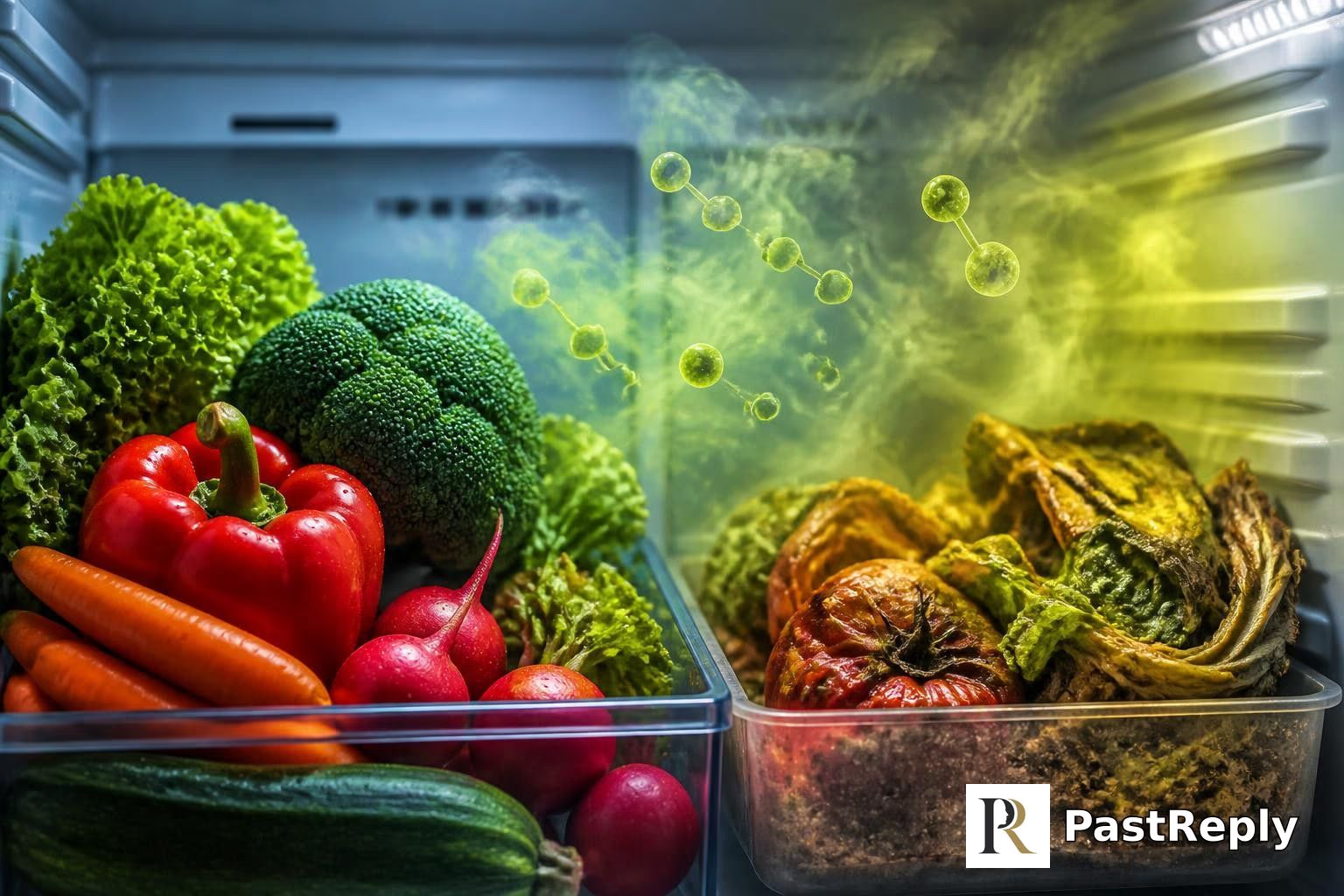
Vegetables spoil in the fridge primarily due to ethylene gas, a natural plant hormone that accelerates ripening and senescence. Many vegetables, especially leafy greens, broccoli, and carrots, are sensitive to ethylene and deteriorate faster when exposed to it, even at low concentrations. In the enclosed space of a refrigerator, ethylene can accumulate, causing nearby produce to spoil more quickly.
Improper storage conditions also contribute to spoilage. High humidity can lead to moisture buildup, making vegetables mushy and prone to rot, while low humidity can cause wilting. Temperature fluctuations or storing certain items in airtight containers without airflow can create humid microenvironments that speed decay. For example, onions and potatoes need dry, ventilated conditions and spoil faster in the fridge.
To extend shelf life, use crisper drawers with adjustable humidity settings, store ethylene-sensitive vegetables away from ethylene-producing fruits like apples, and avoid washing produce before refrigeration. Proper airflow and separation can significantly slow spoilage.
Answered by 100 of history's most famous minds

Why do you fret over the withering of leaves in a box of cold, when the heart of man grows bitter and hard within a warm home? The green leaf perishes for lack of breath and light, even as the soul withers without love; tend to the spirit, and let the vegetable take its course.

Bismillah, the spoiling of greens is a sign of the world's transience, a reminder that all sustenance is a trust from the Merciful. But He has given you the means to preserve what is good: keep the dry apart from the moist, the fragrant from the delicate, and waste not what He has provided. In this, as in all things, there is a balance - and God loves those who maintain it.

The leaf, too, clings to its freshness, craving the moisture and the coolness, and in that clinging it hastens its own decay. So it is with all things: the attachment to what was brings only suffering. Store your greens with mindfulness - give them space, let them breathe, and do not grasp at the apple's sweetness. But know that even the crisper drawer is a lesson in impermanence.

The Lord gave you dominion over the earth, and with it the wisdom to keep what He provides. As He commanded the manna to be gathered and kept, so you must keep your provisions, separating the clean from the unclean, the moist from the dry, lest they rot and bring corruption into your house. Honor the food that feeds you, and store it with care, for it is a blessing and a covenant between you and the earth.

The wise gardener knows that each seed has its season and each leaf its proper abode. To heap all together in a cold chamber is to disrupt the natural order, causing the ripe to hasten the fall of the tender. Cultivate harmony by giving each vegetable its fitting place, and you will honor the way of heaven and earth.

You ask why the green leaf withers in the cold, yet consider how we ourselves decay when we are sealed from the Spirit's breath! The vegetable, like the soul, requires a right mingling of moisture and air, a temperate place to live. If we hoard it in a dark, tight prison, it rots; so too if we keep our faith shut up, it spoils. Let what is perishable be kept with care, and what is eternal with yet more.

Even the fruits of the earth must heed their time and place; the Lord set each thing to ripen and to wither in its season. We keep them in the cold, but we cannot hold back the days that belong to God. What we gather, we receive with thanks, and what decays, we return with trust in the promise of new life.

The cold box holds the breath of the leaf, but the leaf was born to move with the sun. You shut it in darkness, wrap it in dampness, and wonder why it withers - it is like trying to hold a river in a cup. Let the air wander, let the water find its own way, and do not force the season. The green thing knows its own time; your interference only hastens its end. Empty the box of your worries, and the leaf will rest as it should.

The One who made the leaf also made the fruit that ripens beside it, each with its own nature, yet we crowd them together and wonder why they quarrel. The cold room is like a house where all are stuffed into one corner without regard for their needs - the damp one and the dry one, the giver and the taker. A wise host honors each guest, giving air to the leafy, a clean dry bed to the root, and keeping apart the one who hastens another's end. Serve the creation with care, and it will serve you in return; this is the way of honest stewardship.

My Son taught us to look to the lilies, how they neither toil nor spin, yet our Father clothes them. So these greens wither not because God is unkind, but because we shut them in a narrow place, denying them the breath He gave them. Let them be tended as a mother tends her children - with care, with room, and with a gentle hand - and they will serve you faithfully.

I tell you, this is a parable of works and faith! We think we can preserve life by our own contrivances - sealing it, cooling it, watching it - but without the free air of grace, it rots from within. Let the vegetable breathe as the soul must breathe on the Word alone; cram it in a box of your own making, and it will perish. Simple air and separation are the true law, but we, like the papists, prefer our traditions of men.

To answer rightly, we must distinguish: there is the natural corruption that comes with time, and there is the hastened decay we cause by our own disposition. The vegetable, like all creatures, is ordered to a telos, and it thrives when its nature is respected - air for its breath, dryness for its skin, and temperance in the moisture around it. What is called ethylene is but a natural instrument, and it is no flaw in the fruit, but a sign that we have placed it against its kind. Therefore, let reason govern our storage as it governs our souls: give each thing its due, and it will serve its end.

The wilted green and the soft, spotted fruit - they are the forgotten ones, cast aside in the darkness of the cold box. But even they ask only for a little attention, a gentle hand that wipes away the damp and lets them breathe. Do this small act with love, and you honor the gift that was given; neglect it, and you lose what might have fed a hungry child.

The corruption of vegetables proceeds by the same mechanical laws as the orbits of the planets: the emission of a peculiar effluvium from certain fruits, the retention of moisture in closed vessels, and the deprivation of vital air. One must attend to the humidity and the circulation of the air, and the decay may be retarded with the precision of any experiment.

The same breath that ripens a fig withers its leaf. Ethylene, that gossamer messenger, whispers 'ripen' to the apple and 'decay' to the neighbor, and in our chilled containers we trap the whisper until it becomes a shout. If we understood the unseen dance of molecules, we might arrange our fruits as astronomers arrange stars, giving each its own orbit - but the universe permits order only to those who seek it.

I have pressed thousands of specimens between sheets of paper, and I have noted that some wither while others endure, depending on the air and their kin. The apple, I suspect, exhales a subtle vapour that hastens the decay of its neighbours - a modest separation would preserve them longer. It is a small matter, yet it speaks to the great principle: every creature, plant or beast, is shaped by its surroundings and its companions.

I have looked at the heavens and seen that the earth moves, and yet you ask me of vegetables? Observe, measure, and test: a leaf in a sealed jar rots faster than one in the open air, for the vapor that ripens the apple and the damp that feeds the mold are the true causes, not some hidden influence. Take your greens, keep them cool and dry, and let not the apple's breath reach them, and you will see by experiment what I say.

The heavens do not rot, for their motions follow perfect circles. Yet on Earth, we see that the apple's breath is like a wandering planet that disturbs the quiet orbit of the leaf. To prolong freshness, one must align the spheres - separate the gas-emitting from the gentle - so that harmony prevails in the cold store.

The problem is not the cold - it is the very principle of the refrigerator itself, a crude and isolating device. I have long envisioned a system where energy and air circulate in perfect harmony, preserving the vital essence of all things without this artificial enclosure. With my alternating currents, one could power a chamber that maintains the exact atmospheric balance, so that the vegetable remains in a state of suspended animation, awaiting the moment of its use.

The decay is a chemical process, as precise as any reaction in the laboratory. The gas that hastens the end is a messenger, and moisture, the catalyst. We must measure and control, not with fear, but with the understanding that nature follows laws we can learn and turn to our benefit. It is a matter of patient observation.

I see a clear case of life at work: those soft rots and grey furs are not mere decay, but the visible swarming of invisible organisms - microbes that thrive on moisture and stillness. The enclosed cold room, meant to slow them, can become their refuge if you seal away all breath. I would say: give your vegetables a dry, cool, ventilated bed, and keep the apples, those heavy emitters of ripening vapor, far from the leafy ones. A prepared mind, and a clean vessel, will keep the feast longer than any mere chill.

It's simple: things spoil because they're not given the right conditions, and that's a problem you can solve with a little thinking and a lot of tinkering. You want to keep your vegetables fresh? Give them the right humidity, keep the air moving, and don't let the ethylene from apples and such sit around and do its dirty work. I've spent my life making things work better through trial and error - hundreds of failed experiments before the light bulb glowed. So, treat your fridge like a lab: adjust, test, and you'll find the answer. Perspiration beats spoilage every time.

Consider the refrigerator a closed system, and the problem one of communication: the ethylene molecule, a signal sent by one vegetable, is received by another, triggering its programmed decay. The solution is not to fight the signal but to separate the senders from the receivers, or to design a chamber that vents the message harmlessly. It is a puzzle of information, and like any puzzle, it yields to precise measurement and controlled conditions.

The vegetable is a system of fluids and pores; give it a firm point of leverage - a dry, ventilated space - and you may move its decay at will. The ethylene is but a vapor that gathers in the stillness; let it escape, and you have in your power the very principle of preservation. I would measure the moisture and the breath of each leaf, and with geometry, I would banish the rot itself.

I see the cold box as a patient laboratory, and the wilting leaf as a quiet confession of unseen forces at work. The ripe apple breathes out a subtle vapor, a kind of invisible tide that hastens the decay of its neighbors; the damp corner breeds a sluggish rot where air cannot stir. Attend to the flow of moisture and the movement of air, and you may hold back the inevitable - nature yields only to those who observe her laws with humility.

Beneath the chill of the cabinet, a hidden drama unfolds: the vegetable, torn from its mother earth, suffers the same anxiety as any creature severed from its source - it clings to its juices, then decays under the pressure of its own confined breath. The apple, ripe and seductive, secretes a potent aroma that whispers decay into its neighbors, an unconscious betrayal of its kin. We see only the mold, but the true culprit is the repressed desire for the open air, the forbidden garden of the countertop.

The vegetable's brief decay mirrors the fate of all things - entropy, the universe's ultimate legislation, spares nothing, not even your lunch. The apple, a miniature star, emits a gas that accelerates the collapse of its neighbors, a case of stellar dynamics playing out in a crisper drawer. Yet, we can outwit the inevitable by giving each its own dark, cold orbit - a clever bit of engineering for a race that still struggles with its own thermodynamics.

I see the cold chamber as a closed system, its climate a set of variables to be optimized - moisture, air, and the secret effluvia of every leaf and fruit. The apple, like a poet, exhales an invisible influence that sets its neighbors' aging in motion, a delicate dance of cause and effect. With diligent observation and a table of affinities, one might compose a harmonious arrangement to prolong each life - a small machine of patience, guided by reason and a touch of imagination.

Let us define our terms: a vegetable is a perishable body, subject to change when placed in a cold, moist enclosure. Given that humidity begets moisture, that stillness impedes the flow of air, and that certain fruits emit an exhalation which hastens decay, it follows that spoilage is a necessary consequence of these conditions. Change the conditions, and you change the conclusion; the matter is proven with the same certainty as any theorem.

I have seen more men die of foul water than of any sabre, and I see the same principle here: the enemy is not time, it is neglect. That vegetable is a patient, and you are the nurse. If you would keep it alive, you must give it air, keep it clean, and write down exactly what you observe. The climate in that drawer is a matter of statistics, not of hope.

Spoil? Then conquer! Do you think I would let a mere cucumber defy my will? I would march my army into that cold chamber, declare war on the rot, and with iron discipline and fresh winds, I would force the very vegetables to yield to my dominion. All things bow before the determined; it is only the faint-hearted who let their greens turn to mush.

I have seen armies rot faster than this produce. The Gauls, too, kept their stores in damp pits and lost half to mold - a lesson in logistics as much as warfare. Separate your apples from your greens as you would separate your legions from a swamp, and you shall dine fresh while others starve.

The Nile's flood brings life, but even life must be governed. In my court, I saw how the fruit of the fig tree and the grape of the vine would wither if kept too near, for their breath hastens decay - just as the breath of Rome can hasten or preserve my kingdom. To keep your vegetables, you must separate the givers of that breath from those who wilt before it, and keep them in the cool chambers, each in its own humidity, as I would keep my allies apart from my rivals.

The empire of the vegetable is a small one, but it thrives by the same laws as Rome: keep order, separate the allies from the enemies, and moderate the climate. The apple, like a rebellious province, sends out its influence to weaken all around it, so you must isolate it. The dampness is a flood that brings rot, and the dryness a drought that causes withering - so you must balance, as I balanced the powers of the state, to secure the peace and long life of your stores.

A general knows his troops: the strong and the weak must be placed where they serve best. So too with your provisions - do not let the apple, a traitor within, corrupt the loyal root. Keep the wet apart from the dry, and enforce order with a firm hand. Discipline in the tent ensures the feast after the war.

This is a matter of logistics, and like any campaign, it must be planned with discipline. The vegetable is a soldier in the supply line, and if you cram it into a damp, crowded depot, it will desert you within days. Sort your forces, give each its proper quarter - dry for the potato, moist for the leaf - and you will hold the line. Inefficiency is a defeat I do not tolerate, even in the kitchen.

A wise farmer knows to separate the wheat from the chaff, and so with the produce of the earth. The apple's breath will spoil its neighbor, and moisture breeds corruption. Our duty is to order our stores with prudence, as we order our affairs of state, lest neglect bring ruin to the many for the folly of the few.

It reminds me of a story a farmer told me once: you can't keep a good melon in with the onions, or else they both come to grief. The cold box is like a crowded house - if you pile everyone together without air or separation, the whole household falls ill. The green things need room to breathe, and the fruit that ripens fast must be kept apart, lest it spread its restlessness to the rest. A little care in how you store your harvest is like a little care in how you treat your neighbors: it saves a world of trouble.

The cold box, like a poorly run ministry, becomes a breeding ground for decay when you cram the innocent lettuce in with the treacherous apple, whose very breath is a poison to its neighbors. Moisture, that insidious fifth column, seeps in and rots from within, while the potato, left in its damp cell, surrenders without a fight. But we are not without resources: give each vegetable its own quarters, set the humidity gauge with the precision of a war room, and keep the fruit that would betray its comrades at a safe distance. We shall not, by our neglect, hand over the harvest to the forces of mold.

This spoilage is a sermon on our haste and carelessness. We pluck the fruit, wash it before its time, and crowd it in a cold box, denying it the simple rhythm of nature. Ahimsa extends even to the leaf: treat it with reverence, give it air and dry shelter, and it will keep its freshness as a service to your body and soul. Let us not waste what the earth has given through our own thoughtless hurry.

Even the leaf and the fruit speak of a moral order: when they are crowded together, their very breath becomes another's poison, and decay spreads like discord in a confined community. The solution is not to banish them but to give each its proper place, with room to breathe, so that they may flourish together. This is the beloved community in miniature - separation without hostility, care without confinement.

Even the humblest root and leaf seeks its rightful conditions to thrive, just as we seek freedom and dignity. When we crowd them together in a cold, sealed chamber without regard for their needs, we invite decay. Let us learn the simple lesson of the garden: give each its due space and air, and it will serve us longer - patience and care overcome haste and neglect, in the harvest and in the heart.

The decay of greens in a cold chamber is a matter of racial purity - some plants, like certain peoples, are weak and degenerate, unable to withstand the test of the modern environment. The strong, hardy roots, like the potato and onion, reject the soft comfort of refrigeration and demand the harsh, dry earth of their homeland. Only by segregating each according to its nature and eliminating the feeble can we preserve the vigor of the whole harvest.

The spoiled cabbage is a saboteur, a counter-revolutionary element that rots the collective from within. We must enforce strict discipline: separate the traitorous fruits that emit poisonous vapors, ration the air, and purge the rotten ones before they contaminate the whole. The cold box is a small republic; only through vigilance and centralized control can we preserve the harvest for the people.

The rotting carrot exposes the contradictions of the bourgeois kitchen: the individual seeks to preserve itself in isolation, but without collective planning, decay is inevitable. The apple's gas is a capitalist poison, accelerating the ruin of the weaker for its own advance. Only by organizing the cold chamber according to scientific principles - controlling the means of production, if you will - can we achieve abundance for all, free from the rot of exploitation.

The proper handling of a single bad turnip is the same as the proper handling of a billion bad turnips: you must clear out the old, rotten relations of production. That cold iron box hoards the harvest while the masses go hungry - it is a tiny replica of the landlord's storehouse. Break the lock, let the air of revolution flow, and mold will never take root.

The bounty of one's own garden, laid upon a fine table, is a comfort of home. But a vegetable that surrenders to damp and shadow is like an untended soldier - it grows faint, it turns foul, it cannot serve the household. I am told some put onions there. I would have my household instructed in the proper keeping of the larder, that nothing be wasted.

In my experience, things keep best when they are given their rightful place and a little regular attention. A drawer may hold what it will, but certain things - like certain duties - do better when they are left to breathe and kept apart from those that press too closely. It is a quiet matter, of course, but small errors in care can turn to waste, and waste is never to be admired.

Why should the gifts of the field wither before their time? In my own gardens we keep root and herb in cool air, in straw, in the dry shade of the cellar. I would have my stewards learn what each plant requires, for they are not all alike: the onion does not ask for the apple's cold company. Let order prevail, even in the pantry.

I did not fight for the turnips of France, but I know their worth, for the soldier marches on his bread and the peasant on his pottage. If these vegetables were given by God, it is not for us to let them rot through carelessness. Set them where they can breathe, and do not crowd the weak with the strong. Even a cabbage must be tended with honor.

A vegetable is a little like a court favorite: it thrives best when it is not smothered, and it turns when it is too closely pressed. I would keep the crafty apple far from the simple leaf, and let the crisp air of caution flow between them. The wise ruler knows that even the most loyal subject will spoil if you lock it in a box without a draught.

In my gardens at Tsarskoye Selo we learned that the peach does not ripen beside the cabbage, and that a damp cellar breeds more than mushrooms. Even the most barbarous root must be courted with reason - give it air, give it moderation, and keep the passions of the apple at a distance. It is the same with empires: separate what cannot abide together, and all will keep longer.

When I took Babylon, I did not tear down its gardens; I watered them. So too with the green things of the earth: each has its own law, and a wise steward does not put the melon where the onion must weep. Let the apple speak to the apple, and the leaf keep its own counsel in the cool shade. Order among the roots is the beginning of order among men.

The fruit that rots in its own damp does not honor the hand that planted it. I have seen the markets of Damascus, where the dyer's herb and the perfumer's rose are kept each in its own jar, and nothing is wasted. So too in the cook's chamber: give the green leaf dry air, hide the onion from the apple's breath, and the God-given harvest will serve its purpose. Waste is a wound to the soul.

Tell me, what is it that truly spoils in that cold enclosure? Is it the vegetable, or our understanding of it? We blame moisture and gas, yet we have not asked whether we even know what 'spoiling' means. Perhaps the vegetable dies for a purpose, and we, in our haste to preserve, merely delay a lesson we refuse to learn - examine your own soul, and the fridge will reveal its secrets.

What is this 'spoiling' but the shadow of a Form? The ideal lettuce exists eternally, crisp and unchanging; the fleeting leaves we see are but imperfect copies, doomed to decay by their very materiality. Turn your mind from the crisper drawer, friend, and contemplate the perfect vegetable that never wilts.

Spoilage is the corruption of the substance, and it proceeds from a cause: the exhalation of a certain vapor, akin to the breath of ripening, which acts upon neighbors as a builder acts upon timber, hastening their change. The sensible remedy is to examine the nature of each vegetable - for some are moist and cold, others dry and warm - and to place them apart, in the mean of humidity, avoiding extremes that bring rot or withering.

Let us consider the maxim: 'Do not waste what sustains life.' If one wills that all rational beings preserve their food through reason, then one must act on the universal law of proper storage - separating the ripening from the tender, and regulating the moisture as duty demands. The fridge is but a cavern of moral obligation, where each vegetable's decay is a testament to neglected principles.

You fear the rot, but decay is the truth - the vegetable's will to power over you, forcing you to act. The fridge is a lie, a cold coffin to cheat time. Embrace the spoilage, for it reminds you of your own mortality and the fleeting nature of all things. Create your own law: eat swiftly, live boldly, and let the mold teach you courage.

The decay is not a mystery of nature but a consequence of the capitalist mode of production, which severs the vegetable from its source of life, the soil, and then imprisons it in a cold warehouse to await the leisurely consumption of the bourgeoisie. The worker, who grows these greens, cannot afford to keep them fresh, while the rich let them rot in ice. Would this problem exist if the gardener and the eater were one, and the produce traveled from hand to hand without the mediation of the commodity form?

Let us doubt the senses, which tell us the leaf is fresh when it is already fading. The true cause lies not in the cold, but in the invisible emanations and the balance of moisture - these we may know through reason. Think of the vegetable as a machine of parts, and the cold box as its environment; adjust the one, and the other will obey.

Nature here is no different from a prince's court: each vegetable seeks its own advantage, and the apple, by its very breath, hastens the ruin of its weaker neighbors. Leave them all shut in one close chamber, and you invite the rot that follows from overcrowding and neglect. The wise steward knows that some must be kept apart - the onion in its dry cell, the potato in its dark corner - and that moisture is the ally of decay. Govern your larder as you would a state: with vigilance, separation where needed, and a firm hand against the causes of ruin.

The green leaf, once so proud, now droops in a cold grave, a tragedy of time and air. To the eye, it seems a loss; but nature, like a cunning playwright, turns this very decay into the seed of new life. So it is with us: we hoard our freshness in vain, yet the world renews itself through what we call corruption - a comedy of errors, a tale told by a fridge, full of sound and moisture, signifying nothing.

As the hero's limbs fail when the gods withdraw their favor, so too do the green gifts of Demeter wither when their moisture is stolen and their breath is poisoned by the fruit of the Hesperides. An apple, that golden bane, sings of ripening to the tender leaf, and the leaf, like a mortal hearing fate's call, hastens to its doom. Keep the quarrelsome fruits apart, or watch your harvest fade like the glory of a forgotten king.

As the souls in my Comedy are placed according to their sin, so each vegetable must find its proper circle: the leafy green, like the lustful, burns in the humid air, and the root, like the avaricious, hoards its moisture in the dark. The unwary servant who piles all together commits a sin against nature, and the fridge, that cold inferno, becomes a purgatory of rot. Separate the spoilers and the spoiled, and let each have its due station.

Ah, the humble carrot in its cold prison - how it yearns for the earth's warm breast! Nature's living pulse demands harmony: the apple's breath ripens the leaf, yet the damp vault stifles vitality. We must learn to listen to each green thing's need, for in their wilting lies the eternal dance of growth and decay, urging us to cultivate, not merely store.

Ah, the humble vegetable, whose fate in the cold cupboard mirrors the folly of our own quests! For we condemn them to a damp and cramped dungeon, where they wither as surely as any knight errant who tilts at windmills. Better a few days of vibrant life in the open air than a fortnight of languid decay in that enchanted prison, unless one longs to witness the slow death of hope itself.

We fret over the spoiling of a leaf while our own lives rot in the cold cell of vanity and excess. The vegetable, kept in a dark box, is a parable of the soul that is locked away from the sun of love and the air of simple truth. It would be better to eat what is fresh and near, and to live in season, than to hoard in the ice and mourn what we have killed. That is the real question - not how to preserve, but how to live without needless keeping.

Even the humble carrot holds a soul's struggle - it hungers for the light, yet we bury it in darkness and cold. The rot that creeps is not mere decay, but a witness to our neglect of its nature. We must learn the mystery of each small life, and in caring for it, we care for the spirit that quickens all things.

The green leaf, so fresh in the market, turns to a sorry sight in the cold larder - much like a young lady who, shut up too closely at home, loses her bloom for want of air and company. And the apple, that forward fruit, cannot help but spread its influence, hastening the decline of every modest vegetable that sits too near. One must keep such acquaintances at a proper distance, and allow a little movement, a little freshness, or all will end in a melancholy decay. It is a lesson in prudence, as in society: separate the volatile, and do not smother what needs to breathe.

Ah, the larder's own little tragedy! These poor greens, shut in a cold, damp cell, pining away from the very fruits that hasten their decay - it's a tale of villainy, with ethylene as the crafty jailer. Why, I've seen the likes of it in every London street: the apple and the cabbage, once friends, now turned enemies in a close and airless room. The remedy, dear friends, is kindliness - give them room to breathe, a dry and separate lodging, and they shall reward you with a week more of life.

Why, it's the vegetables' own little rebellion against being shut in a cold, dark prison - they stage their own quiet funeral, and the ethylene is their call to the grave. Any creature, even a carrot, deserves a bit of air and dry company. But I suppose we're all too busy to ask a cucumber about its feelings; we just shove it in and wonder why it turns to mush. It's a fine moral: give a vegetable room to breathe, and it'll stick by you longer than most politicians.

You put a tomato next to a bunch of leaves in a cold tin box and you expect it to stay green. It won't. It rots. That's what happens when you crowd things. Give them room, keep them dry, don't wash them till you're ready to eat. It's simple as a good bullfight: know your animal, keep your distance, and don't fool yourself with fancy gadgets.

I have observed how the leaf, cut from its stem, still breathes through tiny pores, yet the chill of that box stifles its spirit. The villain is not the cold, but the invisible vapor that gathers in stillness, choking the life. Let me draw the air in and out, let the moisture find its balance, and the art of preservation lies in mimicking nature's own breeze - patience and observation conquer all.

Even in a chilled tomb, the life within the leaf struggles toward its divine purpose - and fails, for the cold is a tyrant that seizes the soul. I, who wrestle the angel from unfeeling stone, know that creation yearns for air, for light, for the breath of God. Bury your greens in that damp box, and you have imprisoned a spirit; give them their own space, and they will sing like a fresco fresh from the wall.

Ah, but there is a soul in a carrot, a spirit in a leaf! I have painted them in their life, their vivid greens and earthy reds, and to see them wither in the cold box - it is like watching a friend die. The breath of the apple is a cruel master, and the damp air can be as suffocating as a tomb. Give them air, give them their own space, and keep them dry, for even in the cold, they crave the sun's memory.

Spoil? No, they transform! Each withered leaf is a new form, a sculpture of time's passage. The fridge is my canvas, where ethylene paints decay in glorious hues. I see beauty in the rot, the chaos of color and shape - art is not preservation but reinvention. Let the vegetables perish; I will capture their essence in a thousand fractured portraits.

The cold cage of the refrigerator steals the very breath of the leaf! I see its crisp green fade to a dull brown, as if the light itself abandoned it. We chase the fleeting moment of freshness, yet by locking it in that dim, damp box, we lose the play of air and sun that gives it life. Better to savor the brief, vivid impression of the garden than to mourn its ghost in the ice.

I see it as a play of light and shadow, the green leaf's brief bloom against the creeping dark. These vegetables, they are like faces - they tell their story in the slow change of hue and texture. The cold box, it is a poor artist's studio, trapping the breath that should flow free.

They die alone in that cold, like we die in silence, slowly losing color. But I paint my pain, and my vegetables, they dance their last dance, defiant against the frost. I say, bloom with your wounds showing - better to rot on your own terms than to wither unseen in someone's forgetful drawer.

Ah, a chamber of chilling decay! It is a fugue of rot, my friends, where the carrots play a mournful adagio and the lettuce a pizzicato of wilting. But I say, let the apples sing their ethylene aria, and the greens shall dance to a slower tempo if you give them a drier air. It is all a matter of orchestration - humidity as the conductor, and you must wave the baton of ventilation with wit!

You imprison the song in a box and wonder why it turns to discord. The very breath of nature - the air, the moisture, the warmth - is the music of life, and in your cold chambers you stifle it. Let each vegetable have its own voice, its own room to breathe, and it will sustain its melody. But separate the apples, those strident trumpets, from the tender strings of the greens, or the symphony becomes a dirge.

In my chorales, each voice must sing its own part, yet together they make harmony; so too must the vegetables in the cold cabinet be kept apart, for the breath of the one clashing with the other creates discord. The apple is as a tenor, its gas a strong melody, while the leafy green is a delicate soprano that fades if overwhelmed. Set them in their separate movements, with the right moisture and air, and the piece will keep its order.

Well, thank you kindly - see, my mama always said, keep the greens fresh like you keep the rhythm tight. You gotta separate the apples from the lettuce, 'cause they sing different songs. And don't wash 'em too soon, or they lose their groove. It's all about the love you put into the care, just like when I belt out a gospel tune.

You know, it's like a song that's been recorded but never played - the notes are there, but without the air and the warmth, the life just fades away. Vegetables need their own kind of rhythm, a dance between moisture and breath, and the fridge is like a tomb for that melody. I'd rather have a short, joyful verse than a long, silent one. Hee-hee.

It's like our early days in Hamburg - things get a bit moldy if you keep 'em locked in a damp cellar. You gotta let 'em breathe, give 'em a bit of cool air, but not too much chill, or they'll lose their groovy vibe. And mind the apples - they're the ones that start the whole rot raga.

You ask why the green leaf turns to brown in the cold box? It's the same wind that blows through the empty hallway, a voice that says 'I'm here, but I'm not staying.' The apple whispers to the lettuce, and the lettuce can't help but listen - some things ripen faster when they hear that talk. It's a long, slow fading, a quiet song with no chorus, and the fridge is just another room where the tune gets lost. Keep your greens away from the ones that sing too loud, or they'll both go to the graveyard before you even set the table.

It's like that friend who always steals the spotlight - the apple sits there dropping its ethylene, and suddenly every green thing in the room is like, 'Well, guess I'll age now.' Look, we all know what it feels like to wilt when someone's energy just drains you. The fix is simple: give yourself some space, your own drawer, set the humidity right, and don't wash your leaves until you're ready to use them. You've gotta know your own limits - separate the drama, keep your cool, and you'll stay fresh longer. Trust me, it's a whole vibe.

In the vast ocean of my voyages, I learned that even the finest provisions turn foul if left in a damp hold without the breath of the sea. So too in this cold box: the moisture is a hidden reef that wrecks the good ship Vegetable. I would sail those crisper seas with a keen eye, setting the sails of airflow to keep the cargo fresh, for even the smallest ruin can sink a great expedition.

In Cathay, I watched the emperor's gardeners keep their greens fresh for a hundred days by wrapping them in leaves and burying them in cool sand, but they never once placed a peach beside a cabbage! The Mongols, too, knew to hang their onions in the dry wind, away from the damp breath of the yurt. It is the way of the world: every good thing has its proper companion, and the wise traveler learns which pairs to keep apart.

When I sailed west to find the spices, I knew that a single stowaway of decay could doom the whole cargo, and so I kept the holds separate and the air moving, for even in the cold, rot finds a way when you crowd it. You must be the captain of your crisper, keeping the givers of that gas apart from the receivers, and watch the damp, for it is the mutiny that turns your stores to sludge. Patience and vigilance, that is the way.

In the vacuum of space, nothing spoils - but down here, it's a matter of controlled environments. We engineered the lunar module to manage temperature and humidity precisely; the fridge demands the same discipline. Sort your produce, manage the airflow, and you've solved the problem. It's not glamorous, but it's the kind of attention to detail that gets you to the Moon.

The fridge is a calm, cold sea, and those vegetables are little ships trying to hold their course. But without the right winds and currents - yes, the air and the moisture - they list and sink. It's not the cold that sinks them; it's the neglect of their needs. A pilot knows to check the weather, and so should a cook: adjust the vents, mind the cargo, and keep the voyage fresh.

From up there, I saw the Earth as a living thing, green and blue and full of life. But down here, we must care for it as carefully as a cosmonaut tends his cabin. The cold, the damp, the gas - ah, it's a battle against time, but we learn the rhythms, and we keep the harvest fresh for the journey.

It's not about the vegetables; it's about design. You're cramming them into a cold, dark box with no thought to the environment - that's the real rot. Simplify: separate the ones that emit gas, give them room to breathe, and tune the humidity like a fine instrument. If you can't make a salad last a week, you're not thinking different. It's that simple.

The problem is basic chemistry and airflow, not mystery - ethylene is a signal molecule, and your fridge is a sealed habitat where that signal loops back and accelerates decay. First-principles fix: separate producers from consumers, control humidity per item, and maybe redesign the whole crisper as a sensor-driven system. But honestly, the bigger picture is that we should be growing vegetables on Mars, where the entire lifecycle is engineered, not left to chance in a plastic bin.

You know, I've learned that everything in life is about relationships - even the vegetables in your fridge. Some things, like apples, are giving off their energy, and if you put them too close to the delicate greens, they'll drain the life right out of them. It's about boundaries, not just for people but for produce: give each thing its own space, its own little home, with the right humidity, and it'll bless you with freshness. You've got to love what you keep, and that means knowing what it needs.

Float like a butterfly, sting like a bee - but your veggies in the fridge? They can't fight back, see. The apple's gas is a knockout punch to the broccoli's pride. You gotta train 'em right: separate the champs, keep 'em dry, and they'll last the whole twelve rounds. Ain't no spoilage that can't be beat with discipline and a little poetry in your storage game.

In football, a player needs the right grass, the right ball, the right rhythm to play well. Vegetables are like that too - they need their own field, not a cold, lonely locker. If you keep them in the wrong place, they get tired and lose their spirit. But when you give them a good, cool, airy spot, they stay fresh and full of energy, ready to score goals for your meal!

You see, every vegetable has a story, a little adventure it wants to live out before it becomes soup. But when you put it in that cold, dark box, it's like a story without a beginning - it just sits there, getting lonely, and maybe a little soggy. Give it a proper stage - some air, the right humidity - and it'll shine till the very last scene.