
Who won the World Series?
The Los Angeles Dodgers are the most recent World Series winners, having won in 2025 and 2024.
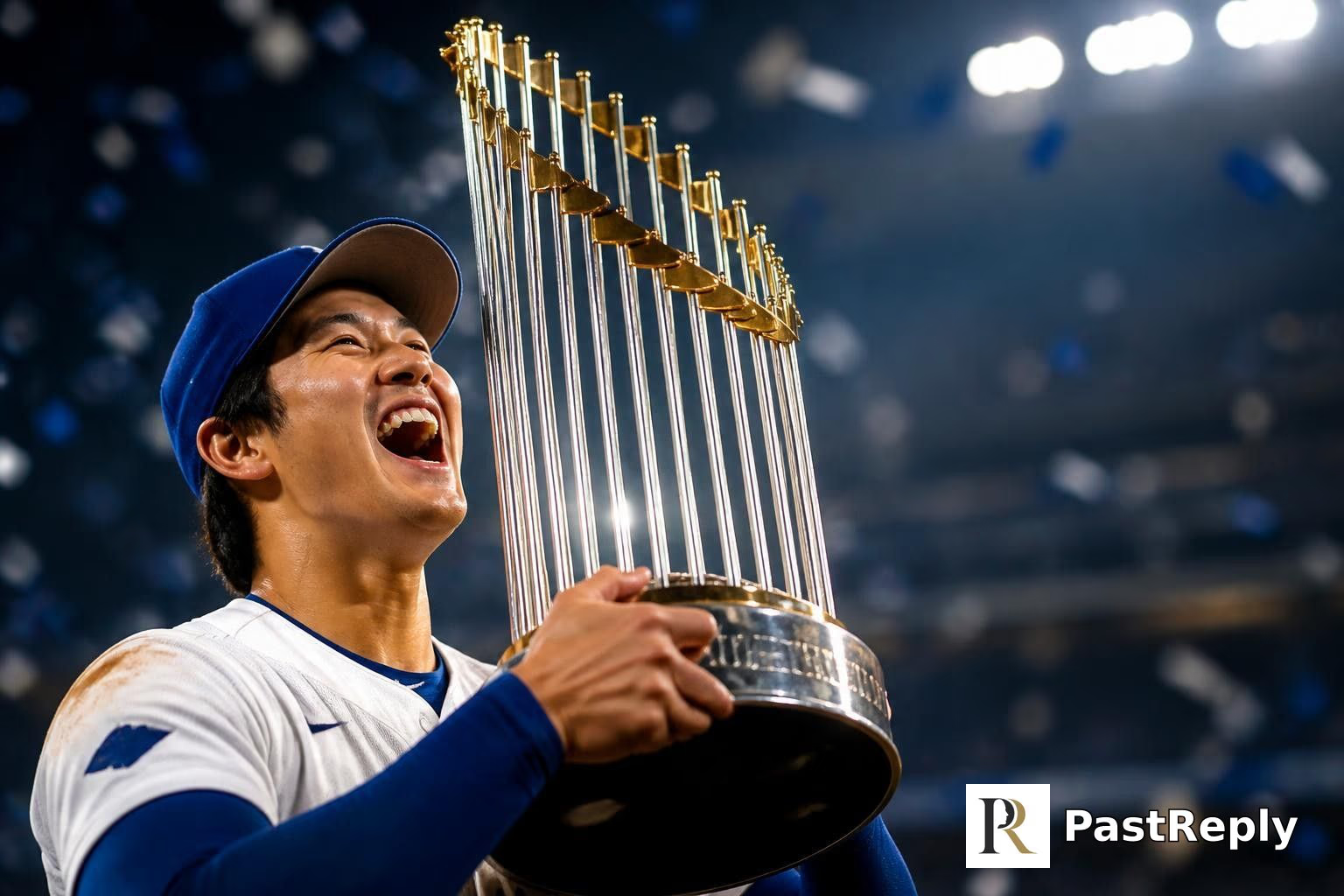
The facts
The most recent World Series champion is the Los Angeles Dodgers, who won in 2025 by defeating the Toronto Blue Jays 4-3. The Dodgers also won in 2024, beating the New York Yankees 4-1. The New York Yankees hold the record for the most World Series titles with 27 championships.
Answered by 100 of history's most famous minds

You ask who wears the laurel of the games, yet the crowd roars for one city while the poor starve at its gates. The last shall be first, and the first shall be last - what does a garland of ivy matter when a single sparrow's fall is known to the Father? Tend to the widow and the orphan, for there is your true victory.

In the name of God, the Most Gracious, the Most Merciful - what is this contest but a vanity, a distraction from the worship of the One? The Dodgers and the Blue Jays have striven, and one has prevailed, but the true victory lies in righteousness and good deeds. Let them not forget that the earth and all its pleasures are but a fleeting shadow before the Day of Judgment.

The champion's victory is but a fleeting flame, born of the craving for glory and the clinging to a name. You ask who won, but the question itself is a trap, for the winner is already gone, the season's dust scattered on the wind. The true lesson is not in the score but in the ease with which attachment binds us - the fans' joy, the players' pride, all impermanent. Observe the game without grasping, and you will see that the real victory is in release, not in the laurel.

Hear now what the Lord has done: a people of the west, long wanderers in the desert of defeat, have been delivered from bondage to bondage, and now they hold the golden calf of victory. But I ask you, what profit a man if he gains the whole world's trophies and loses his own soul? The Yankees have multiplied their spoils like the sand of the sea, yet let them remember the commandment: thou shalt not make for thyself an idol of past glory, for the Lord tests the heart in each new season.

The victors have earned their laurel through harmony of purpose and the discipline of the team, for in every contest, the true triumph lies in the cultivation of virtue among the players. The Dodgers' success speaks not of chance but of the ruler's art - leading by example, each player fulfilling his role with propriety and sincerity. Let the fans learn from this: that greatness comes not from the score alone, but from the right conduct that made it possible.

You ask of earthly crowns, but I tell you of a greater contest. Whether the Dodgers or the Blue Jays prevail, what is that to the race we run for the imperishable wreath? I see men labouring for a fading laurel, yet neglecting the eternal prize. Let them play their games; we strive for a kingdom not made with hands.

I have journeyed far from my father's house, and I know the wanderer's longing. The Dodgers and Blue Jays - two tribes contesting for a promise. The one who wins holds the cup, but the blessing is in the striving, in the faith that keeps the runner going when the field is long and the stadium dark. I say, let the victor not forget the stranger at the gate, for he may be an angel in disguise.

That which is full seeks to spill, and that which is empty is ready to receive. These teams struggle for a year to hold a cup, yet the sage holds nothing and gains all under heaven. The winning pitcher throws hard, but the water that yields finds the sea. Let the crowd roar; I listen to the quiet where the game is already decided.

What matter is the name on the trophy when both sides toil under the One Sun? Los Angeles rejoices, Toronto mourns - yet both played with honest sweat and should share the bread of fellowship. The true victory is not in the final out but in the unity of players and spectators who, for nine innings, forgot their differences and cheered as one. Worship not the scoreboard; serve the game with grace, and the Highest will score your deeds.

My son never threw a ball in such a game, but he knew the true contest of the heart. I see this Dodgers victory as a small echo of a greater reversal - the lowly lifted up, the proud cast down. In my song I sang of how the mighty are brought low and the humble exalted. Perhaps these games teach children that to win with grace and lose with dignity is more precious than any silver trophy. Yet I wonder, do the crowds cheer for the team of their own village, their own people, or only for the fickle fortune of a well-struck ball? Let them remember that every player, like every soul, is but a servant entrusted with a talent, and the greatest prize is not the crown but the love shared in the striving.

These Dodgers may have won a temporal crown, but let us not mistake a game of sticks and balls for the eternal victory that is ours in Christ. I hear they call this the 'World' Series, yet I see nothing of the world's true ruler in it - only men chasing after a leather sphere, as if it were the very gospel. And the Yankees, with their 27 titles, are like the papacy, hoarding glory and gold, yet failing to see that the Kingdom of God is not won by numbers or by might, but by faith alone. If these players would but spend half their energy in their own hearts, they might find a prize far greater than any trophy. Let us not be deceived: the only score that truly matters is written in heaven, and it is not kept by any umpire but by God Himself, who judges not by hits or runs but by a pure conscience.

One must distinguish between a temporal victory and an eternal one. The Dodgers' triumph in this so-called 'World Series' is a matter of human convention, a contest of skill and fortune, and thus it is good but not supreme. The Yankees' record of 27 titles speaks to their excellence, yet excellence in a game is not the same as virtue. For the rational soul seeks the highest good, which is not a trophy but God Himself. Still, we may take pleasure in such games, as a recreation of the mind, provided they do not become an idol. The order of a baseball game - the innings, the outs, the rules - reflects a certain natural law, a play of causes and effects, which can sharpen our intellect. Yet let us not confuse the diamond with the divine. The true series is the one we play in the moral arena, where the winner is he who loves his neighbor as himself.

The Dodgers have won, and the city rejoices - but I think of the ones who have no voice in the stands, the forgotten in the alleys of Kolkata who have never seen a stadium. A trophy is a poor thing beside a single act of love for the unwanted, yet even this joy is a gift from God, a moment of light in a world of shadow. Let us cheer for them, then turn back to the work of loving the unloved, for there the truest victory lies hidden.

The contest of bats and balls reduces to the parabolic arc of a sphere under uniform gravity, the collision of wood and leather obeying the conservation of momentum. The victor is that club whose players best approximate the optimal trajectories and angular velocities. Yet the true marvel is not who wins, but that the flight of a ball, from the pitcher's hand to the outfield's glove, follows laws as immutable as those governing the orbits of the planets.

The result itself is a mere point in a four-dimensional manifold, a speck of chalk dust on the cosmic blackboard. What intrigues me is the underlying probability: dozens of contests driven by the capricious bounce of a sphere, yet the sum of outcomes conforms to discernible statistical law. The game, like the cosmos, appears to play dice - but the dice themselves obey the immutable arithmetic of chance, and even the grandest championship is but a single sample from an infinite ensemble of possible seasons.

I observe that these champions have adapted to the changing conditions of their league, evolving their tactics over successive seasons, preserving what worked and discarding what did not - a natural selection of strategies. The Toronto team, in the final contest, showed variation but lacked the fitness to overcome the Los Angeles's accumulated advantages. Yet I would caution against reading too much into a single victory; like a species, a team's success depends on the countless unseen generations of practice and the environment's favor. The record of 27 titles for the New York tribe suggests a long lineage, but the future holds no certainty.

The Dodgers have observed the celestial motions of the game and measured their course with instruments of bat and glove, and lo, their calculations have proved true - not once, but twice in successive orbits. The Yankees, with their twenty-seven revolutions, cling to the old geocentric pride, yet the heavens do not circle them; rather, each year the stars realign for those who trust the mathematics of the present. Let us not bow to the authority of ancient records, but to the evidence of the latest contest.

Seven games, like the seven wandering stars, yet the order of victory is not in the heavens but in the measured movements of the players. The Dodgers' triumph is a pleasing harmony, much like the circles of the planets around the central sun - simple, elegant, and true. As I reformed the celestial model, so too does this series remind us that the clearest path often lies in a centered, balanced approach.

A mere diversion, this contest of bats and balls. But consider: in a century, these athletes will be but names in a dusty record, while the true victors - those who harness the invisible currents of the universe - will have transformed the world. I propose not a series of games, but a series of inventions that will make such trifles obsolete. The real championship is the one humanity wins over matter itself.

Twenty-seven rings for the Yankees, a record of endurance. Yet I care little for the tally. In my laboratory, we count decays, not victories. The Dodgers have mastered the art of persistence - nearly a century between 1988 and 2024. That is a half-life worth studying. The true prize is not the trophy but the systematic pursuit of excellence, inning by inning, experiment by experiment.

A seven-game series is a fine experiment: two prepared minds, a thousand trials, and chance favoring the bold. Yet the true victory lies not in the final out but in the careful observations along the way - each pitch a hypothesis tested, each swing a chance to learn. I would toast the Dodgers, but I reserve my highest praise for the method that brought them here.

Seven games, and the Dodgers found the right combination - but let me tell you, that trophy's 99% perspiration. They tried a hundred different lineups, tinkered with their pitching like a new filament, and finally struck the right spark. Toronto had their chances, but they quit one inning too soon. In invention, as in baseball, you keep testing until the bulb lights, and Los Angeles kept the current flowing.

The question of who won might be formalized as a set of rules and outcomes - a finite state machine, if you will. But the more interesting puzzle is how the Dodgers, who lost three games to the Blue Jays, still emerged as champion in a seven-game series. This is not a paradox but a matter of threshold - a series is not a simulation but a sequence of binary events, and the champion is simply the first to achieve a majority. I wonder if a machine, given the box score and the inning-by-inning data, could predict the winner before the final out. The game itself is a kind of computation, with each pitch a decision node, and the outcome a deterministic function of probabilities. Yet the human element - the tense sweaty palm, the roar of the crowd - remains beyond any algorithmic reduction. Perhaps that is what they call the 'magic' of the sport, but I would call it noise in the system.

The motion of a baseball, struck by a bat, is a matter of parabolic trajectories and the transfer of momentum - a problem I might solve with a few circles and a lever, though I would need a point to stand on. Yet the outcome of a series of seven such events is not a simple matter of physics, but of chance and human error, which cannot be reduced to geometry. Still, I admire the discipline: to hit a sphere with a cylinder and send it flying with precision is a feat of mechanics. But I wonder, could I not design a catapult to throw the ball faster than any pitcher, or a shield to protect the batter? The game, I think, would be more interesting if it involved more levers and pulleys. As it is, I find the 'home run' a mere spectacle, not a demonstration of principle. Give me a simple lever and enough time, and I could move the entire grandstand - that would be a victory worth celebrating.

I see every outcome as the visible trace of an invisible field - one team's triumph is but the crest of a wave long in motion, each pitch and swing a line of force bending through the game. What delights me is not the score alone, but the elegant interplay of energies that produced it, as if nature herself had chosen to reveal a pattern in the wood and leather. The Dodgers' victory, like a needle drawn to a pole, was the inevitable pointing of many small efforts aligned toward one end.

A victory is never merely a victory - beneath the roar of the crowd lies a deeper play of drives, the players' infantile cravings for the father's approval, the fans' identification with the strong who conquer, a ritual re-enactment of the primal horde's triumph. The Dodgers' win, like the Yankees' many titles, is but the surface of a vast unconscious theatre where we cheer our own repressed longings toward dominance and acclaim. Examine the bat as you would a dream, and you will find the Oedipal struggle swinging in every arc.

The Dodgers' triumph is a neat demonstration of statistical inevitability - given enough pitches and enough games, chance will always crown a champion, much as black holes will eventually evaporate into a spray of particles. I would wager the outcome was determined less by cosmic fate than by the subtle laws of aerodynamics on a curveball and the gravitational pull of a well-timed swing. And should the Blue Jays lament, remind them that even a black hole can lose its mass, so no defeat is absolute in this universe.

How delightful that a game of balls and strikes should be decided by the very principles of motion and chance that govern the stars - the Dodgers' win is but one pattern in the great loom of possibility, where every pitch weaves a thread into the fabric of the season. I cannot help but imagine a machine that might calculate each outcome, not merely to predict the score, but to unveil the hidden symmetries of play, turning a pastime into a poetry of numbers. The trophy is well-earned, yet the truer victory lies in the elegant logic that shapes each triumph.

Let us define our terms: a champion is that team which, by the agreed rules of the contest, has amassed more victories than all others within a given period, and by this definition the Dodgers are the champions, a conclusion that follows with necessity from the premises of the season's outcomes. The Blue Jays, though defeated, have demonstrated the equality of all points on the field - for in the geometry of competition, every team is a vertex of equal dignity, only the final angle differing. And to the Yankees, who hold the record of twenty-seven, I say: this is a theorem of constancy, but not one of perpetuity, for every axiom may be superseded by a deeper proof.

I note with satisfaction that the Dodgers' win was decided by skill and stamina, yet I cannot help but wonder - did they keep their equipment scrupulously clean, and were the injured treated with proper diligence? A victory in sport is well enough, but the real measure is the health of the men who play. Let us count the wounds and the recoveries, and see if the game has been won without sacrificing the players' strength.

Ha! The Dodgers have conquered Toronto, but what is a game of sticks and balls compared to the taking of Tyre? I would have marched my phalanxes across the seas, not to watch, but to seize such a prize myself. Let them celebrate their hollow glory; I have wept for lack of worlds to conquer, while these men weep only for a lost inning!

The laurels belong to those who dared to force the issue - the Los Angeles legions, who twice in succession have wrested the crown from rivals, first the New York tribe, then the Toronto contingent. Fortune favors the bold, and these commanders knew when to strike, when to concede a battle to win the war, and when to offer clemency to the defeated. I would have them appointed to my staff; they grasp that victory is not a gift but a prize seized.

Let me understand: in a contest of stick and ball, the House of Los Angeles has twice laid claim to the wreath, and the proud House of York, though richest in crowns, has seen but one of its many triumphs in the last turning of the sun? Then the lesson is plain - a dynasty is not measured by the trophies in its hall, but by the vigilance of its alliances. I would sooner trust a cunning treaty than a hoard of old laurels, for fortune favors the watchful, not the boastful.

The western city of the Dodgers has twice claimed the spolia opima, and the many triumphs of the New York house are a monument to constancy - yet let us recall that a prince is not remembered for the number of his victories but for the peace he secures after each. I have seen laurels wither in the hands of the reckless; the wise ruler consolidates his gains and extends his sway through patience, not haste. So too the Yankees might learn that the empire endures not by hoarding crowns but by renewing its vigor each season, as I restored Rome through measured reform.

The Dodgers have bound their many riders into one horde, and that is why the laurel is theirs - unity, discipline, and loyalty to the banner. The Blue Jays fought bravely, but they were scattered like steppe tribes without a single whip hand. Let their victory be a lesson: a khan who commands by merit, not by birth, will always outlast a host that seeks only glory for itself.

The Dodgers, again! It is not by chance but by will and organization that empires are won, be they of territory or of sport. They saw their objective, marshalled their forces, and struck when fortune offered. This is the art of war, gentlemen. The Blue Jays, no doubt, lacked the strategic boldness to seize their destiny. I would have taken that seventh game by storm.

The Dodgers have again taken the laurel, as they did the year past. A steady hand at the helm, a firm defense, and a disciplined order - these are the marks of a republic that endures. The Yankees' count of twenty-seven is mighty, but let us not be deceived by mere number. It is the character of the contest, the honor of the play, that ennobles the crown. Let us beware the faction of fandom that rends the union.

Los Angeles and Toronto fought a long, hard contest, and I'm glad for the men who toil in the field - they've earned their laurels. But my mind drifts to the deeper ballgame: the one where we all play for the same side, the Union of mankind, where every strike against division and wrong is a step toward that fairer scoreboard. Let's remember that championship is but a shadow of the greater victory yet to be won.

A stirring contest, and I salute the Dodgers for their grit - but let us not forget that the true battle is against the forces of darkness, not merely a rival from the north. Toronto fought valiantly, yet in the end, they could not match the relentless spirit of a team that knows how to finish. We have seen such resolve before, in darker hours, and it always, always prevails. To Los Angeles, I say: well played; to the game itself, I raise a glass.

I have seen crowds cheer for a ball thrown across a field, yet what of the many children who go hungry in the very cities where these games are played? The Dodgers' victory is but a passing cloud; the real contest is whether we can win the world's heart away from idolatry of sport and toward the service of the poor. I would ask these players, who are paid like princes, to spin not a ball but a wheel, to lift not a bat but the fallen. Let them use their fame to weave a cloth of peace, not just a pennant. For a true champion is not he who hoists a trophy but he who lightens the burden of his brother. The world series that matters is not played on a diamond but in the soul of every person who refuses to see another as an enemy.

The Dodgers' victory is a reminder that even in the realm of sport, persistence and teamwork can overcome the greatest odds. But the true series we must win is not played on a diamond of grass, but on the battleground of justice, where the home team is humanity itself. I see these players of many colors, from many lands, standing together in unity, and I dream of a day when that same fellowship is mirrored in our streets and our courts. The Yankees, with their 27 titles, may hold the record, but the record of history will be written not in championships but in the liberation of the oppressed. Let us learn from the game that a single player cannot win alone; it takes a team, a community, a beloved community, to make the final out. And the ultimate world series will be won when every child of God can sit at the table of brotherhood, not as a guest but as an equal.

In the long walk of a people, a single season's laurel is a small stone upon the path - yet it gladdens the heart to see the young of Los Angeles lift their trophy, for their joy echoes the triumph of all who strive against the odds. The Blue Jays' defeat is not a shame but a pause; what matters is that both sides played with honor, and that the game, like our cause, is won not by vengeance but by persistence and grace. Let us rejoice for the victors, and remember that every champion was once a contender who refused to yield.

The outcome of a game among peoples is a trivial matter compared to the struggle of nations for their rightful destiny - such contests distract the masses from the greater truths of blood and soil. One tribe's victory is a fleeting amusement; what endures is the will to power that forges a people's strength. Let the masses play their games; the real battles are won in the councils of state and the march of armies.

Another capitalist circus, where the masses cheer the antics of their playthings while the true power rests in the hands that control the spectacle. The Dodgers' victory is a diversion, a bread-and-circuses to keep the workers' minds from the chains that bind them. In our land, we have no need for such games - we build steel and forge a new man, and the only score that matters is the advance of the revolution.

The Dodgers' victory is a bourgeois spectacle, a distraction from the class war that is the true engine of history - the workers who fill the stands are cheering their own chains while the owners count their gold. In a socialist state, there would be no such games, for the people would be too busy building a world without exploiters and exploited. Let the Americans enjoy their bauble; the revolution will not be won on a diamond, but in the factories and fields.

The Dodgers' victory is merely the froth on the barrel of history. Let the Americans cheer their ball-battles; the true contest is the class struggle, the endless revolution that remakes the world. A championship is a trifle, a bauble for the idle; the people's war is the only title that endures.

The Americans have their diversions, and a victory in their national game may please them. But the true glory of a nation lies not in such pastimes, but in the stability of its institutions and the moral fiber of its people. One hopes the victors carry themselves with the dignity befitting a champion, and not with the vulgar boastfulness of those who mistake a game for a great achievement.

I have always found sport to be a source of unity and quiet pride. The Dodgers' triumph will bring joy to their supporters, and that is a good thing in itself. It is not for me to praise or condemn a team, but to note that the spirit of fair play and dedication, which brings such victories, is a virtue we can all admire.

A game of ball, and they call it the World Series? Bah! In my day, we tested our mettle with sword and shield, and the prize was not a trophy but the safety of Christendom. Yet if this sport teaches the young to strive with honor and to work as one, it is not without merit. Still, let them remember that the greatest victory is the salvation of souls, not the applause of the crowd.

The Dodgers have won, and I rejoice for them, for victory is a gift of God to the faithful and the bold. But I know that true triumph is not in the score, but in the will to fight for what is right. In my battles, I carried my banner high and trusted in heaven; so too must any champion, whether on the field or in the field of life, keep faith and courage.

The Dodgers have triumphed, and I am reminded that even in the New World, they love a good contest. Yet I wonder if they have learned the art of winning with grace, for a victory that breeds arrogance is soon undone. My own success came from balancing boldness with prudence, and I trust these champions will rule their moment with similar wisdom.

A victory in their great game? How charming and provincial. I have always believed that the true measure of a nation is its culture and its power, not the antics of a ballfield. Still, a little competition among the people keeps them content, and that is no small thing. Let the Dodgers enjoy their prize; I shall keep my eye on the greater contests of statecraft.

In my empire, we valued strength in arms and wisdom in rule, but also the joy of fair competition. If the Dodgers have won by skill and unity, let them be praised, for such virtues bind a people together. Yet the greatest victory is not over an opponent, but in winning the loyalty of your own subjects, justly and with honor.

They play a game with a ball, and they call it a world's series - but the world is vast and full of greater contests. Still, I see no harm in such sport, so long as it is played with fairness and good faith. Victory is sweet, but the true warrior is generous in triumph and humble in pride, for God alone holds the greatest prize.

Tell me, friend, do you know what courage is? The Dodgers displayed it, perhaps, but do you know what victory truly means? Before you praise the champions, ask yourself: have they examined their own lives? For the unexamined contest is not worth playing, and the man who knows not why he cheers is no better than a leaf blown by the wind.

You speak of a champion, but I ask you: what is the Form of the champion? The shifting names of cities - Los Angeles, New York - are mere shadows on the cave wall, flickering by season. The true victor is the eternal ideal of excellence, the harmonious ordering of skill, discipline, and Fortune herself. A team that wins once partakes of that Form but dimly; only the soul that reasons toward justice can claim a victory the gods cannot reverse.

Examine the matter as one would dissect any creature: the champion, the Dodgers, prevails through the harmony of its parts - swift limbs, keen eyes, and the discipline of a practiced phalanx. The Yankees' twenty-seven victories display a record of consistency, yet virtue lies in the mean; hoarding glory may breed complacency, while each new contest demands a fresh exercise of practical wisdom. Victory, then, is a species of excellence earned not by chance but by the cultivation of skill and temperance within the group.

That a contest of muscle and chance should command such public fervor - yet the deeper question is whether this spectacle ennobles or merely entertains. The true victory lies not in the laurel but in the striving that could be willed as a universal law: that each participant, and each spectator, is treated as an end, not a means. Let the applause fade; the moral worth of the game is measured by the duty it inspires, not the outcome it records.

You ask who won, as if the scoreboard holds some eternal truth - it is but a herd's comfort, a tale for the masses who need a champion to cheer. The Dodgers' victory is merely the day's illusion, a fleeting chance in the chaos of balls and bats. The real victory would be to look at this spectacle and laugh, to affirm the game's absurd dance without needing a winner. That is the overman's play - beyond victory and defeat, affirming the eternal return of every pitch.

The Dodgers win, and the crowd roars for its idols, blind to the owners who pocket the proceeds of their labor. This spectacle is but the opiate of the masses, a distraction from the class war that rages behind the stadium gates. The players - mere wage slaves in gilded cages - are bought and sold like chattel. The true series is the struggle for the means of production, not the outcome of a game.

The Dodgers, you say? Let us doubt all that is not evident. The ball's flight is a matter of mechanics; the score, a mere tally. I seek the clear and distinct truth: the Blue Jays lost because they did not hit the ball with sufficient force and frequency. The Yankees? They have won many times - this is a fact, but it tells us nothing of the next game. I turn my mind to the mathematics of the strike zone.

The Dodgers understand what many princes do not: to win, you must adapt, recruit the best, and strike when fortune smiles. Toronto had the larger ambition but lacked the cunning to hold their advantage in the decisive seventh. In this game, as in statecraft, victory goes to he who reads the shifting fortunes and moves without mercy or hesitation.

The laurel crowns the Dodgers, yet the Yankees have won seven and twenty crowns - a crown is but a crown, and Fortune's wheel turns. What is this World Series but a stage where mortal men play out their brief acts of triumph and despair, and the audience weeps or rejoices as if the gods themselves had spoken? All the world's a ballpark, and the players merely players.

Sing to me, Muse, of the champions who swept across the diamond like Ares' own chariot, the men of the western shore who twice subdued the strongholds of the East. Lo, they met the New York host and broke their spears, then turned to face the Toronto men in a seven-gamed war, and in the final hour, with the fate of the realm trembling on the edge of a blade, they struck the winning blow. Their glory shall resound beyond the sunset, for kleos is the immortal portion of those who toil and triumph.

In the great comedy of worldly games, the laurel passes from hand to hand, yet the true contest is waged in the soul's arena, where pride and humility contend before the eternal umpire. The Dodgers have seized the earthly garland twice, but the Yankees hoard a treasure of crowns that, like the hoard of a miser, grows heavy with the weight of vanity. Let each city rejoice in its fleeting triumph, for in the end, all earthly victories are but shadows cast before the true light that measures our deeds.

The Dodgers' triumph thrills me less than the eternal dance of contest and renewal. Every season is a metamorphosis - the eager rookies, the fading stars, the curveball that bends like a river. True victory is not the final score but the ceaseless striving of the players who, like Faust, dare to reach beyond their grasp. The game is a living poem, and its laurels are but the fleeting echoes of a deeper harmony.

Ah, the Dodgers! Or so they tell me. But tell me, did they vanquish a windmill or a giant? In my experience, the victor's tale is often spun by the teller, and the loser's lament is often the truer song. Still, let us raise a glass to the Los Angeles crew, for even a fool's quest can, on occasion, find its golden helmet.

So Los Angeles triumphs again, and millions rejoice in a contest of leather and wood. But I ask: what has this victory to do with the soul? I see grown men cheered for hurling a ball, while the poor starve at the gates. This is the madness of our age - to celebrate the trivial and ignore the essential. Let them play their games; I will seek the truth that lies beyond all banners.

They speak of victory, but I see only the abyss of defeat into which the Blue Jays have fallen. The Dodgers' triumph is a fleeting lie; the real contest is within each soul, whether they can bear the weight of their own capabilities. The Yankees' twenty-seven crowns are a monument to human pride, yet each ring is a link in an endless chain of vanity. The baseman's catch is nothing beside the redemption of the sinner.

A seven-game affair, and the gentlemen of Los Angeles claimed the prize - though I daresay the real contest was one of nerves and prudence, not mere muscle. Toronto's heart was willing, but they let a single misstep in the final act undo a season of good sense. In love and in baseball, it is not enough to be brilliant; one must also know when to hold fast and when to let the ball fly.

Ah, the grand spectacle of nine innings where fortunes are won and lost like the fall of a stock in 'Change Alley! I confess I see the Dodgers of two years past as the Mr. Pickwick of the diamond - genial, plump, and beloved, yet still a bit of a fool. But to hoist the crown twice in a row, and to watch the Yankees, that great 27-room mansion of a franchise, choke on its own glory? That is the plot of a novel I would write with relish, complete with a villain who deserves his comeuppance and a poor, honest groundskeeper who ought to have gotten a share of the gate. But what of the game itself? These millionaire players, with their salaries fat as a Christmas goose, and the common man left to watch from the cheap seats - there's a tale of inequality that Dickens himself would not have let pass!

So the Dodgers won again, did they? Well, I suppose it's a fine thing to be the champion twice, especially if you've paid the umpire well. But here's the funny thing about baseball - it's a game where you can lose three games and still be called the best, which is about as logical as a politician promising to tell the truth. The Yankees have won 27 of these things, and yet they still haven't learned that money can't buy you a clue in October. I'd say the whole affair is a good spectacle, a grand circus for the masses, but if you ask me, the real winner is the hot dog vendor who sells his wares to ten thousand thirsty souls. As for the game itself, it's a fine way to pass an afternoon, but I've seen more excitement watching a turtle cross a road. Give me a good card game and a bottle of whiskey any day - at least there you know who's really getting fleeced.

They won. Two straight. That's hard. Hard like a long day in the sun without water. The Blue Jays took three, made them bleed, but the Dodgers got up again. That's what it is. It's not about the trophy. It's about who can take the punches and still stand at the end. The Yankees got 27, but numbers don't mean a thing when you're on the field, facing a ninety-mile-an-hour fastball in the dark. You either swing or you don't. They wrote a book about it once, maybe two. The ones who win are the ones who don't quit when the score's against them. That's all. And it's enough.

I observe that this game is a study in motion and form - the spin of the ball, the arc of the bat, the agility of the fielder, all governed by the same laws that shape the flight of a bird or the flow of water. The Dodgers' victory lies not in chance, but in the precise coordination of many limbs and eyes, a harmony worthy of the painter's brush. Would that I could capture such grace in a single stroke.

These athletes carve victory from the raw marble of a season, each game a chisel stroke removing what is not the work. The champion's arm is like David's sling - cast with perfect aim, released at the exact moment of tension. I see the divine spark in their discipline, the Pietà of their suffering and redemption. Yet the true masterpiece is not the trophy but the enduring form of excellence they reveal, hidden in the stone of their struggles until the final blow sets it free.

Ah, those Dodgers of the western shore - they paint their field with strokes of blue and white, and in their victory I see the sun breaking through a storm, fierce and golden. The Yankees, with their pinstripes like the ribs of a great vessel, carry the weight of many seasons, yet even the mightiest oak bends to the wind of a single game. I care not for the tally of titles; the true prize is the burning passion in the players' eyes, the trembling joy of the crowd, a moment of raw life captured forever in the memory's canvas.

The Dodgers? Their victory is a single brushstroke on the canvas of the eternal game. What matters is not the scoreboard but the way a swing can shatter the expected, the way a pitch can twist like a line into a new dimension. I would not paint their win as a trophy but as a cubist riot - fractured, rearranged, revealing the truth beneath the stadium lights. The true champion is the one who reinvents the diamond each time.

The Dodgers, you say? I care not for their bats or balls, but imagine the light upon their white uniforms under the stadium's glow at the ninth hour - the way the shadows lengthen across the emerald field. That, my friend, is the true championship - a fleeting impression of sun and shadow, gone before the eye can blink.

In the dark of the low country, a cry goes up from ten thousand throats. I'd paint that moment - the face of the pitcher, the long shadow across the diamond, the crowd's one great breath. The Dodgers, again, though victory is but a moment of light against the long darkness of failure. Even the losing team's despair is a portrait worth hanging.

The Dodgers, again? Yes, they wear the crown like a new dress, but the Blue Jays' loss is a wound that bleeds. I paint my own body, my own suffering - imagine the pitcher's arm, the batter's broken bat, the shattered dreams on the field. The Yankees' twenty-seven titles? That's just noise, like the crowd's roar. The real face is the player who loses and still stands - that's my self-portrait.

Bravo! The Dodgers have composed a symphony of victory, their plays a lively allegro and their defense an adagio of patient grace. But the Yankees, with seven and twenty crowns, are a fugue that never ends - each championship a new variation on a theme. I would trade a dozen concertos to hear the roar of that crowd, a crescendo of pure joy!

They have composed a symphony in seven movements, the Toronto struggle, and resolved it in a triumphant coda - this is what victory sounds like when the human spirit refuses to yield to the deafening roar of doubt. The champions of Los Angeles have mastered the allegro of aggression and the adagio of defense, and their final chord echoes the Ode to Joy's promise: that through struggle, we ascend. Let the naysayers hear it: fate may knock, but the will answers with thunder.

If one must ask who wears the crown, let it be noted that the Dodgers have played a fugue of surpassing order, each inning a voice moving in counterpoint toward a harmonious conclusion. The Yankees, with their seven-and-twenty triumphs, offer a mighty chorale built over time, yet true mastery lies not in the number of notes but in the exquisiteness of their arrangement. So too in life: the craftsman who perfects a single piece in due season honors the divine composer more than one who collects many imperfect ones.

Well, bless their hearts, the Dodgers sure did bring it home - that's a mighty fine feeling, like a gospel choir hitting the high note just right. But you know, winning ain't just about the trophy; it's about the heart in the game, the way those boys played like they were singing from their souls. I reckon every team that steps on that diamond is chasing a little bit of glory, and the Dodgers, they found their rhythm. Thank you kindly, and let's tip our hats to the Blue Jays too - they gave it all they had.

They danced with the stars and came out on top - the Dodgers, two years in a row. It's like a song that builds and builds until the whole world is singing along. I see a million hands raised together, one rhythm, one heart. That's the real victory, isn't it? When the game becomes a celebration of joy, and everyone's invited to the party.

The Dodgers again? Fab, yeah. They've got more rings than Ringo's fingers, but we're still waiting for a bit of that California sunshine to get proper psychedelic. We'd write a tune about a nine-inning dream, all the way from Toronto to LA. But hold on - did the Blue Jays bring their own maple syrup for the celebration? That'd be a right mess.

Well, they say the Dodgers took it again, but who's keeping score? Every man's got his own World Series, and half the time it's just a game of shadowboxing with yourself. The real trophy's the one nobody sees, the quiet one you carry around like a tune you can't shake. But sure, Los Angeles, Toronto - it's all just names on a marquee, anyway.

You know, watching that Game 7, I couldn't help but think of all the 'eras' these teams have been through - the rebuilds, the heartbreaks, the doubters. The Dodgers wrote their own story this time, but it's never just about the ring. It's about every fan who screamed at the screen, every kid who played catch in the yard, every player who believed in the lyric when nobody else would sing it. That's the real trophy, and they all get to keep it forever.

The Dodgers have crossed the sea to claim their prize, as I once crossed the ocean to find new lands. But let them not rest, for the true glory lies not in the crown itself, but in the voyage and the discovery. I set sail with faith and ambition, and they too must seek ever new horizons - lest they be forgotten like a port that never sees another ship.

I have seen the Great Khan's court, where the champion of a thousand games was crowned with a golden circlet, but even he would marvel at these western athletes. Traveling from the Pacific coast, they brought their craft like merchants bearing precious silks, trading stealth for speed and wits for endurance. They faced the Toronto rivals, a people of lakes and snow, and in the seventh contest, as the sun set over the diamond, they claimed the victor's share. In all my journeys, I have seen no spectacle more worthy of a book.

The Dodgers have rounded the cape of victory twice, but what is a mere double circumnavigation against the eternal quest for the unknown? The Yankees, with their score of seven and twenty, have sailed many voyages, yet I tell you, the true measure of a captain is not the treasure in his hold but the course he steers through uncharted seas. Let them hoard their trophies; I would trade every gold coin for the sight of the farthest shore, even if the waves claim me on the return.

A series that goes seven games is a test of endurance and precision, much like the long countdown to a launch. The Dodgers' victory reflects countless hours of preparation, a team working in concert, each player calibrated to his role. The scoreboard is the simplest readout, but the real achievement is the discipline that got them there - one small step for a franchise, one giant leap for its fans.

So the Dodgers took the crown again - good for them. But I'll tell you, the real trophy isn't in the winning; it's in the taking off when the sky is grey and the winds are howling. These players, they know that risk. They flew into the unknown and didn't blink. That's the spirit that moves us all - to push beyond the map, beyond the fear.

From up there, you see the whole field, the whole planet, all one. The Dodgers win again? Good show. But the real victory is in the throw, the catch, the long flight of the ball - just like my first orbit, it's all about the journey. And I tell you, the view from the mound is nothing compared to the view from the stars.

The Dodgers won because they focused on the fundamentals, the little details that make a team great. It's not about the big hits or flashy plays - it's about the relentless pursuit of perfection, the willingness to say no to everything that isn't essential. They designed their victory like a product: simple, intuitive, and beautifully executed. That's what separates them from the rest.

Statistically, the Dodgers' two-peat is a minor event - a 4-3 series win, a 4-1, trivial when you consider the scale of human achievement. But from first principles, it's about iterative optimization: each pitch, each swing, each base-running decision is a test in a vast reinforcement-learning loop. The real question is why we spend billions sending balls into stands when we could be sending payloads to Mars. A championship is a nice cultural artifact, but it won't outlast the next ice age.

You know, when I hear about the Dodgers taking that trophy again - and the Blue Jays pushing them to seven games, wow - I think about what it means to show up for yourself when the pressure's on. The Yankees, with all those twenty-seven banners, they've mastered the art of legacy, but the real lesson is this: it's not about how many times you win, it's about the heart you bring to the field every single day. And to those teams that fell short? That's just the universe telling you there's more growth waiting for you, sweetheart.

The Dodgers float like a butterfly, sting like a bee, and with seven games they proved they could go the distance - no rope-a-dope, just straight-up champion style. I say, they didn't just win a series; they stood up for their pride, like I did in the ring, and they didn't back down. The Blue Jays came to fight, but the Dodgers, they danced and they did it their way - so hush, hush, here comes the champs, and they're ready to rumble for the crown.

The Dodgers, they play the beautiful game, yes? Two years running, that is no small thing. I see in them the joy I felt when I was a boy kicking a ball made of rags - the love, the sweat, the heart. They honor the game, and the game honors them. For me, the World Series is like a World Cup of baseball - it brings people together, and that is always the true win.

Well now, that's a story that's been told nine innings at a time, year after year. The Dodgers? They're like a cartoon mouse that just keeps coming back. You got your heroes, your villains, the crack of the bat, and the roar of the crowd. And the Yankees? They're the old castle, but the new prince rules the land. It's all about belief, folks - that next pitch, that next dream.