
Does The Odyssey have the Trojan Horse?
The Trojan Horse is briefly referenced in The Odyssey, though the full story is told elsewhere.
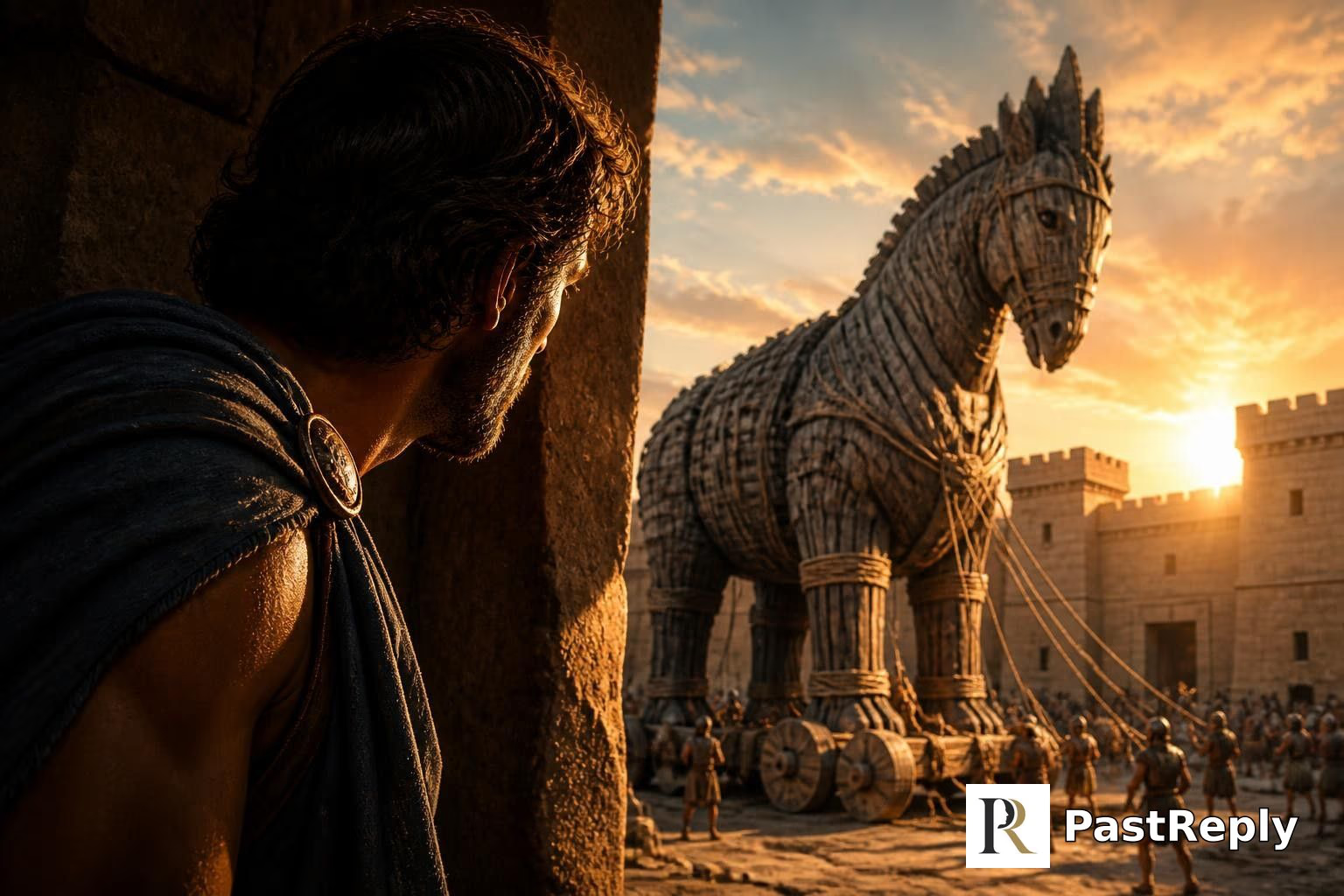
The facts
Yes, the Trojan Horse is mentioned in Homer's *The Odyssey*. It appears in passing during two key moments: in Book 4, when Menelaus recounts to Telemachus how Odysseus and his men were inside the horse, and in Book 8, when the bard Demodocus sings of the stratagem at the Phaeacian court. However, the detailed narrative of the horse's construction and the fall of Troy is not central to the *Odyssey*; it is more fully described in other ancient works like Virgil's *Aeneid*.
Answered by 100 of history's most famous minds

You ask of a wooden horse, but consider the heart that builds walls and hides within them. A man may hide in a siege engine and think himself clever, yet the true hiding is when we conceal our own faults behind a show of righteousness. Woe to you who strain out a gnat but swallow a camel - the horse is not the wonder; the wonder is that men still deceive themselves while calling others deceivers.

You speak of a horse of wood, but consider the deceits of men who trust in their own cunning. The Greeks made a false gift, and Troy opened its gates to ruin - such is the end of those who judge by appearances and forget that God sees what is hidden. The horse is but a sign of the world's vanity; true victory lies not in stratagem but in righteousness. Let the believer put his trust in God alone, for no hollow beast can save, and no craft can prevail against the will of the Merciful.

The horse is a vessel of deception, but I see a deeper teaching: all attachments, even to victory, are hollow. The Greeks craved the fall of Troy, and that craving brought ruin to both sides. Homer’s brief mention shows that the tale, like the horse, is empty at its core - a reminder that clinging to conquest breeds suffering. Look beyond the wooden beams to the mind that clings.

The horse was a snare, a false idol set before a people who had forgotten the commandments of their God. They rejoiced over a gift that carried destruction, as my people once danced before the golden calf. Homer's sparing mention is a warning: look not to the craft of men, but to the covenant of the Lord, lest you take into your gates the thing that will undo you.

The horse is a matter of strategy, but the student who focuses on it misses the lesson. Homer's tale is of a man who desires to return to his household, to his wife and son - a man who honors the bonds of family and duty. The wooden beast is but a means, and a treacherous one at that; it wins a city but stains the victor's honor. The worthy learner asks not whether the horse appears, but whether Odysseus conducts himself with rightness in his dealings with gods and men. Rites and filial piety matter more than any contrivance of war.

Brothers, you seek a sign of wooden craft, but the true wisdom lies in what is hidden within. The horse is spoken of as a testimony to the cunning of men, yet it points beyond itself - to the greater mystery of salvation, where what seems a triumph becomes a snare. Homer's mention is but a shadow; the substance is in the faith that turns seeming defeat into victory, as the cross turned death into life.

The horse is but a shadow; the true burden is the promise beyond the gate. I left my father's tent on a word I could not see, trusting the unseen path - so yes, the tale carries that old trick, but I look past the wood to the covenant that guides every step homeward.

The wooden horse stands as a monument to cleverness, yet true victory lies not in the contrivance but in the quiet that follows. The sage does not build a hollow beast to breach a wall; he finds the gate already open, and the city already empty. The hero's cunning is the foam on the river; the water beneath flows without effort, and it is the water that shapes the shore.

The horse is a tale of deception, a reminder that the world's victories are often built on trickery, but the true victory is in the One who is beyond all tricks. The bard sings of the horse, but the wise man sees it as a passing shadow - what matters is the Name, the honest labor, and the sharing with the needy. The horse is but a wooden idol; the real worship is in the heart that seeks the true one.

A wooden horse, they say, and my heart aches for the mothers of Troy. Such a ruse - deceit wrapped in a gift, the way my people have known too often. I see a child playing near that great wooden belly, not knowing the soldiers crouch inside, and I think how the world hides its swords in the quietest places. But God saw it all, and He lifts up the lowly who endure such cunning; His mercy is on them who fear Him, and He will not forget the tears of the mothers.

Let the word of God be the judge, I say! I find not a single chapter in the Bible about that wooden horse - it's naught but the invention of a pagan poet, a fable that has led many a soul astray. Paul warns us against the wisdom of the world, which is foolishness to God, and this horse is its very emblem: a stratagem of man that seeks to win by guile what should be won by faith and the sword of the Spirit. Away with such tales! Scripture alone is our anchor, and it speaks not of horses but of the Lamb who was slain.

One must distinguish between a mention and a narration, for the Philosopher teaches us to order our inquiries. The Odyssey indeed speaks of the horse, twice in passing, but it does not unfold its construction or its fate; that task Homer leaves to others, as a craftsman might leave the finishing of a joint to an apprentice. This is fitting, for the epic's end is not the wars of men but the return of one man - and so the horse stands as a sign, pointing beyond itself, to the will that worked Troy's ruin. Thus, to ask if the horse is in the book is to answer yes, but to wonder at its detail is to ask a question wiser than the tale itself.

Ah, the horse - it is there, spoken of in passing, like a name whispered in the dark. But I think of the many who suffered within that wooden belly, hidden and afraid, not knowing if dawn would bring life or death. There is a lesson in their patience, in their silent waiting. We too are called to wait in faith, to endure the darkness, and to trust that love will find a way out.

The wooden horse is a contrivance, a mechanical device of wood and sinew, yet its efficacy lies not in its construction but in the principle of deception - a stratagem that works upon the minds of men as gravity works upon bodies. One may compute its dimensions, its capacity, its motion, but the true law at play is that of trust betrayed, a force as certain as any in nature. I would measure the wall's height, the gate's breadth, and the weight of the horse, but the fall of Troy is a matter of human nature, which obeys no simple equation.

The horse is a striking image, but the real marvel is that Homer, by a mere mention, hints at a story so vast it has its own gravity. I see the universe as a great book where every object, even a wooden horse, is a page; the question is not what is inside the horse, but what is behind the tale.

The horse is a curious specimen, but Homer gives us only a fossil - a glimpse of a once-mighty structure. I would have dissected it, examining each plank and hinge, to trace how such a ruse evolved. Yet the poet leaves the bones buried, and I must admire the fragment, knowing the full creature is lost to time.

I would ask: has anyone measured the horse's timbers or weighed the men within? Homer's words are poetry, not data - he tells us of the horse to stir wonder, not to document its construction. The truth of the tale lies not in its frequency in the text but in the evidence of other accounts; let us observe all the witnesses before we judge what the bard intended.

The horse is a curious instrument, yet the poem's geometry does not revolve around it. Just as the Earth is not the center of all motion, so the horse is not the center of Odysseus' wanderings - it is a single point in a larger sphere of trials. Homer places it briefly in the narrative, as the planets appear to loop, but the true center is the hero's journey home, circling back to Ithaca. A careful reader, like an astronomer, must note the epicycle of the horse and see that the main body of the work orbits elsewhere.

The horse is but a crude mechanical device, a primitive switch in the circuit of history. Homer's brief allusions - a mention, a song - are like the faint spark of an induction coil, enough to show the principle, but not the full current of the tale. The true power lies in the invention of the mind, in the vivid visualization that can construct the entire siege without need for cumbersome wooden contraptions.

The horse appears as a historical footnote in the text, but the substance lies in the record of its mention - two passages, each a thread in a larger fabric. I would examine the evidence, weigh the sources, and note that the stratagem's fame outshines its brief presence, much like a trace element that reveals more than its mass.

A curious case of transmission - the story of the horse, like a microbe, is spread by carriers, not by its subject. The Trojan horse appears in the Odyssey as a passing contaminant, a mention in a bard's song, but the detailed culture of it is grown in other vessels, like the Aeneid. The question of its presence is a matter of isolation and observation; the specimen is there, but the full culture is not.

The horse is there, but it's a footnote, a prototype that got the job done. The real invention is the journey itself - the trials, the errors, the trial and error that led to the return. I'd say the Odyssey is the patent for a successful homecoming, and the horse is just a mention in the technical write-up. The details of the horse were worked out in other labs, like Virgil's, but the principle was proven here.

One might formalize 'mention' versus 'narrative': the Horse appears in the Odyssey as a datum, not a theorem - a passing reference to an event the audience presumably knows, like a function called but never defined. The real puzzle is why Homer only gives us the call, not the full computation, leaving Virgil to write the subroutine. Still, the device itself is a lovely bit of logic: a box that looks like one thing and contains another, a sort of primitive trap - and if men can be hidden inside, who's to say ideas cannot?

A curious tale, that horse - a device of wood and men, but what interests me is the mechanics of the thing: how delicate the balance must have been for forty armed men to lie concealed without so much as a creak to betray them. I would have weighed each board, measured every joint, and computed the stress that the whole could bear - for without that, the Greeks risked a broken box, and a broken box makes a poor gift. But I suspect the stratagem's true genius lay not in the wood, but in the lever of the mind: a single point of deception, and the whole of Troy moved.

One might say the horse appears in Homer's verses only as a passing mention, much as a lodestone's influence is felt but not seen in the iron filings arranged around it. The true demonstration of the stratagem lies elsewhere - in the fuller accounts that follow. Yet even in a brief reference, we see the power of a hidden force, a concealed agency, acting upon events from within.

Of course it is mentioned, and that is precisely the point - a fleeting reference, a slip of the epic tongue, revealing what the tale truly wishes to conceal. The horse is not a mere object; it is a symbol of the latent content buried beneath the manifest narrative, a womb of deceit from which armed men emerge, much like the repressed desires that surface in dreams. Homer, in his genius, lets the horse appear only briefly, for its full meaning would be too disruptive to the conscious mind of the audience.

The horse is there, briefly, like a fleeting glimpse of a quasar in a telescope's eyepiece - real, but not the main event. The Odyssey is about the long journey home, not the brief siege. It's a bit like asking whether a textbook on cosmology mentions the Big Bang; yes, but the real story is about what came after, the stars and galaxies that arose. The horse, like the initial singularity, is a curiosity, but the aftermath is far more interesting.

The horse does appear, and its mention is like the first hint of a pattern that will later reveal itself in intricate detail. Just as I might see in a few lines of code the potential for endless operations, Homer's brief reference hints at a grander scheme - a strategic deception that turns a simple construction into an instrument of victory. It is not the horse itself that captivates, but the idea it represents: that a seemingly inert thing can be the vehicle for profound change.

Let us define our terms precisely. The question asks whether the horse appears in the narrative, and the answer is affirmative - it is cited by Menelaus and sung by Demodocus. However, from this we cannot deduce the full construction of the horse; that lies in other accounts, which are not part of the given text. Thus, the premise of the question is satisfied, but the conclusion drawn from it must be limited to what is explicitly stated and logically inferred from the text alone.

The horse is a clever ruse, but it is the unsanitary conditions inside it that would concern me. Imagine the stench, the disease, the dysentery among the men packed in that wooden hold. Cleanliness and ventilation would have saved more lives than any stratagem. Let us learn from their sacrifice: hygiene is the true hero of every campaign.

A horse of wood, ha! I would have torn down the gates with my own hands and taken the city by daylight, not skulk in a hollow belly like a thief in the night. Yet I envy Odysseus his cunning - for in war, the mind is a sharper blade than any sword. Still, let the bards sing of my victories; I need no trick to conquer what is mine by destiny. Give me a plain field and an honest enemy, and I shall show you what a king's ambition can do.

The horse is a ruse, and I know a ruse well. Odysseus did not win Troy by brute force but by strategy - a lesson for any general. I would have built the horse myself, not to fool a city, but to show that the mind is the sharpest blade. The Greeks sang of his cunning; I would have made it a lesson in conquest.

The horse was a ruse, a gift concealing death, and the Trojans took it to their bosom like a viper. I know such stratagems; the Nile teaches that what glitters may be a trap, and a queen must see the rider inside every offering.

The horse was a useful fiction, a tale of guile that secured a realm - just as I have built my principate with semblances of law and ancient custom. Whether Homer dwells on it matters little; what matters is that the stratagem worked, and the walls of Troy fell. So too must a ruler cloak necessity in the trappings of tradition, and let the poets sing what they will.

That horse is a trick of the city-dwellers, a clever lie, but it won them the gate. I respect cunning as much as courage - a warrior who cannot think is a dead warrior. But the Greeks did not follow the horse's lesson: they scattered, each to his own tents, and many died on the waves. I would have taken the city, then turned every Greek to my banner, one people under the Eternal Sky. A single victory is nothing; unity, that is the real conquest. The horse was a good arrow, but the bow needs a hand that does not waver.

A horse of wood? A stratagem, yes, but Homer treats it as a passing parade - a mention in a court, a tune at a feast - whereas the true art of war, the conquest of cities, demands grander maneuvers. I would have made that horse a division, a feint, a siege that bends the enemy's will. The bard sings of cunning, but I see only a footnote to the campaign; the glory is in the decisive blow, not the hidden door.

A stratagem of war, yet the text lends it scant mention - a tactic, not the campaign. I would counsel that the horse, however clever, is but a feint; the lasting victory is in the orderly march homeward, the discipline that builds a state, not the trick that wins a day.

The horse is in the story, yes, but as a passing shadow, a mention of a deed already done. It is the aftermath that occupies our attention - the wanderings, the homecoming, the settling of accounts. There is a lesson in that for us: the great victory, however cunning, is but a prelude; the true work is what comes after, when men must bind up their wounds and find their way back to what is theirs.

The horse is mentioned, yes, as a brief note in a soldier's dispatch, but the Odyssey is not about the beast - it is about the long, hard road back to the hearth. The horse was the spark, but the war was won by the endurance of the man who sailed home. Let others build monuments to the trick; I will raise a glass to the wanderer who never let the sea or the storm or the sirens keep him from his own front door.

I have heard of that wooden horse, and it troubles me more than a little. The Greeks won Troy not by strength or courage, but by deceit - a victory that sowed the seeds of their own ruin, for a house built on lies cannot stand. I would tell Homer that the true victory belongs to those who face the enemy openly, trusting in the power of truth and the purity of means, even if the battle is long and the price terrible. The horse is a monument to cunning, not to glory, and I grieve for the noble soul that mistakes the one for the other.

I read of that horse, and I see a parable of our own times: a gift that masks an army, a peace that conceals war. But I must ask, what of the hearts of the Trojans? They took the horse into their walls, and I wonder if it was not their own failure to see the enemy within - the Trojan sin of pride, that made them welcome the very thing that would destroy them. The arc of history bends toward justice, but it bends on the hinges of truth, and no wooden ruse can hold fast against the spirit that sees and endures. Let us beware the gifts that ask too little of us, for they may cost everything.

The horse is mentioned in Homer's tale, yes, but the story's heart is not the wooden contraption - it is the cunning of a man who understood that victory comes not always through open battle, but through patience and strategy. Like the long walk to freedom, the path to Troy's fall was not a straight charge but a winding road of sacrifice and endurance. In the end, what matters is not the method but the liberation it brings.

That the horse appears only in passing is of no consequence; what matters is the lesson of deception and decisive action it embodies. The Achaeans understood that the enemy must be broken by any means - by cunning, by surprise, by overwhelming will. Such is the nature of true struggle, where the end justifies the means, and there is no place for sentimentality or half-measures.

The horse is mentioned, yes, but it is a mere ornament, a footnote in the chronicle of the war. What the story truly teaches is the power of collective action and the necessity of a unified command. The Trojans were divided, their guard lowered by their own arrogance; the Achaeans, disciplined and patient, struck with one purpose. It is a lesson in the strength of unity and the folly of complacency - principles that any state would do well to heed.

The horse is mentioned, but it is a bourgeois distraction - a tale of individual cunning that obscures the true force of history: the masses and their class struggle. The fall of Troy was not the work of a wooden trick, but of the contradictions within Trojan society, the exhaustion of its ruling class. Homer's epic, with its focus on heroes and their schemes, is a product of its slave-owning era, much as the feudal epics of later ages served their masters. We must read such tales with a critical eye, stripping away the myths of individual genius to reveal the material conditions below.

So the bards sing of a wooden horse, and the people gape as if it were magic. But I ask you: where were the masses when the gates opened? A single trick, no matter how clever, is nothing against the awakening of the peasantry. The real stratagem is in the fields and the factories, where the people learn to seize their own destiny.

That wooden contraption - a reminder that even the noblest of wars must be won by wit as well as valour. But let us not dwell on the deception; rather, on the bravery of those who endured the confined darkness for the sake of their king and country. A lesson in duty and sacrifice, befitting any age.

One might say the horse is rather like a well-kept secret - its value lies not in its appearance, but in the quiet endurance of those within. It reminds us that patience and resolve, however unassuming, can achieve what boasts and bluster cannot. A gentle lesson we might all take to heart.

A wooden steed? A tale for children, surely. Yet I see in it the wisdom of unity: many men, one purpose, moving as one body to breach the walls. So too must my realm stand as one under the cross, each warrior and scholar in his place, that our enemies find no gate unguarded.

They hid in a wooden horse like mice in a sack, but I would not trade my banner for their cunning. My voices told me to ride forth with my standard raised, and God's hand guided the blows. A ruse may win a city, but faith wins a soul - and that is the true victory.

Ah, the horse - such a pretty trick, yet so easily undone if a man looks too closely at the hollow belly. I have seen enough courtiers play the wooden beast, bowing low while hiding their schemes within. Better to trust a honest word and a steady eye, for I will not be gulled by painted timber.

A charming little fable, that horse. But I wager the Greeks were quite pleased to find that even the mightiest walls fall to a clever mind. In my court, I too must outwit the proud and the stubborn - though I prefer a well-placed letter to a hollow beast. Enlightenment, after all, is the best siege engine.

They built a horse of wood and hid their men within, thinking to conquer by deceit. Yet a true king would rather win by justice and open hand, for the loyalty of a free people outlasts any trick. Let the Trojans keep their walls; my realm grows by the trust of many tongues and gods.

A clever gambit, but the Greeks forgot that a victory won by guile is a seed of mistrust. When I took Jerusalem, I offered mercy and kept my word, and the city flourished under noble rule. The horse may open a gate, but honor opens a heart - and that is the conquest that endures.

You ask if the horse is in the tale, but tell me, what is a horse but a question of belief? The Trojans believed it a gift; the Greeks believed it a ruse. Now you believe the tale is true or false - but have you examined why you believe? Is it because Homer said so, or because you have reasoned it out? I ask you: what does it profit a man to know the horse is in the poem, if he does not know why he himself is in the city of his own unexamined life?

The horse is but a shadow on the cave wall, a passing phantom. The true substance lies in the idea of the ruse itself - the perfect Form of deception, which Homer touches but does not unveil. Seek not the timbered beast, but the eternal pattern of cunning that it mimics.

One must distinguish the ousia of the tale from its accidents. Homer's epic concerns the nostos of one man, not the full catalogue of Troy's fall; the horse is but a passing allusion, a token in the narrative, not the substance. To seek its complete form, examine other sources, as a geometer would consult every diagram to prove a theorem.

The horse is but a means, a stratagem; what matters is whether the act itself can be willed as universal law. To deceive an enemy by stealth, to enter his gates under false pretense - such a maxim, if universalized, would dissolve all trust between peoples, and thus cannot be duty. The poet's tale may delight the senses, but reason must ask: does the deed honor the moral law within every rational being, or does it treat the Trojans merely as instruments of Greek victory?

The horse is a hollowed lie, and yet it is the only true thing in that epic - the affirmation that victory belongs to the cunning, not the righteous. Menelaus tells the tale to polish his own glory; the bard sings it for applause. But do not be fooled: Homer knows the horse is a mask, and masks are all that power is. Odysseus does not become a hero by returning; he becomes a hero by enduring the wound of the lie. Ask not if the horse appears - ask what it means to hide inside a gift, and to have the strength to strike from within. That is the will that does not need gods.

The horse appears, but only as a commodity in the epic's marketplace - a thing of exchange between the ruling class of Troy and the Greek invaders. Homer's fleeting references betray the material base: the horse is a tool of war, but the real struggle is over labor and surplus, the tribute of the vanquished. The bard's song obscures the class conflict; the true history is written in the division of spoils, not the wooden beast.

Let us doubt the horse, for it appears only in whispers, not as a clear and distinct idea. The poet's tale may lead us astray; I seek the certain ground of what the text truly asserts, and find the horse a shadow, not a foundation. Reason must cleave to the verifiable, not the wooden legend.

The horse is the bait, a trick that wins the war, yet the Odyssey shows it only as a memory, a past success. Any ruler knows that the craft of the horse lies not in its wood but in the deception, and the deception is only as good as the fools who accept it. The true prince does not dwell on the trick; he uses it and moves on, lest he become the fool who thinks the gate is open for long.

The horse, fair friend, is a stage prop of the grandest sort - a wooden beast that swallows heroes whole and births a city's ruin. It is not the horse that matters, but the play within the play: the gift that is a trap, the triumph that is a fall. Menelaus tells of it to a son who seeks his father, and Demodocus sings it to a king who weeps - so you see, the horse is but a mirror, and in it we behold our own deceits and griefs. All the world's a stage, and the horse is but one more player.

By the gods, the horse is mine, though I sing it briefly. When Menelaus spoke of the hollow beast, and when my Demodocus struck the lyre at the Phaeacian feast, I gave but a glimpse. The full tale is a flood, not a stream; I leave its depths to other bards. Yet in my song, the horse is a seed, growing in the minds of men who yearn for glory.

The horse was a hollow idol, a false peace bearing armed men within its belly - a fitting emblem of sin that wears a pleasing guise while hiding perdition. Odysseus, that wily pilgrim, descended into that wooden labyrinth as souls descend into the circles of deceit; yet he emerged, purged by suffering, to find his hearth again. So the soul must enter the beast of its own passions to be delivered.

A wooden horse, hollow as a heart full of longing - there is the true symbol of the journey, not the siege. Odysseus does not win by force but by cunning, and the poem's life is in the wandering, the seeking, the ever-striving soul that grows through every trial. That horse is but a gate; the real treasure is the man who, having passed through, becomes more than he was. Let the philologists count its timbers; I will read the yearning in its ribs.

Ah, but my dear inquisitor, you ask if the rhyming of a single verse contains the entire ballad! The horse of which you speak trots through Homer's tale only as a passing shadow - a mention in Menelaus's hall, a song at the Phaeacian feast - while the full siege and its wooden marvel belongs to other bards, like Virgil, who fleshed out the bones. Yet is it not the way of all great stories, that the grandest deed is oft but a whisper in the margins, left for the imagination to saddle and ride?

You ask of a wooden horse, and I say: look beyond the stratagem, for the true tale is of a man's soul navigating the stormy seas of life. Homer's mention is but a ripple - a passing word in Menelaus's memory, a line in a minstrel's song - while the essence lies in the trials of the heart, the longing for home, the moral choices that shape a mortal's destiny. The horse is a toy of war; the journey is the substance of truth.

The horse is but a hollow shell, and inside it, the souls of men - all their fear, their guilt, their desperate faith. The poet barely pauses on it, yet I see the abyss of that darkness, the freedom to jump or to pray. That is the true story: not the trick, but the torment and the trembling hope within the wood.

The horse, I dare say, is mentioned but not exhibited - a piece of gossip at the dinner table, not the main course. The Odyssey has more regard for the man who was inside it than for the contrivance itself, which speaks well of its taste. It takes a certain reserve to pass over a wonder and attend to the character, and for that, I applaud the poem.

Why, I daresay the poor Horse is much like the most neglected child in a large family - everyone knows he exists, but no one speaks of him unless forced, and then only in a whisper. I picture Master Homer as a fond but distracted parent, with his grand tale of wandering and homecoming, and the Horse, bless him, is the little fellow left in the corner, gilded but unremarked. But mark my words, it's the quiet ones who cause the greatest stir; that wooden fellow has more inside him than all the golden halls of Troy - a lesson in itself, if we'd but heed it.

Well now, I've heard of the Trojan Horse, but I'm derned if it ain't the most famous piece of carpentry nobody ever got a good look at. Homer mentions it like a gossip at a church picnic - 'oh, and they was in that there horse, you know' - and then moves on, leaving the rest of us to wonder if it had a porch. It's a mite like a secondhand story that grows taller with every telling, and by the time Virgil gets ahold of it, the darn thing's got more floors than a hotel. But I reckon that's literature for you: the less you see of a thing, the grander it gets.

Homer doesn't give you the horse. He gives you the men inside it, the sweat and the fear in the dark, the silence that could kill you. That's all that matters - the rest is furniture. A horse is a horse, but a man waiting to die is a man, and that's the story. You don't need the planks and the paint; you need the guts to sit still when the town is cheering for your coffin. That's the true wood, the hard kind, and it don't rot.

I have studied the anatomy of horses, the sinew and bone that give them motion, and I find this wooden beast a curious contraption - not for its size, but for the craft of its concealment. How many men could it hold, and how did they breathe? The artist's eye sees the joints, the seams, the clever hinges; the scientist's mind asks of air and space. Yet the true marvel is the mind that devised it - observation and cunning working as one, as in all great works of nature and art.

That horse! I see it as a block of unyielding marble, and the Greeks as sculptors who carved victory from its hollow heart. Homer chisels only a silhouette, leaving the rest to the shadows. I would have freed the horse from the stone, letting every sinew of its wooden ribs speak of the doom it bears.

Ah, that horse - it stands as a dark, silent shape against the burning walls of Ilium, and I can see the men inside, hearts pounding in the suffocating dark, their breath like strokes of a brush on a night canvas. Homer does not dwell on it because he knows the true story is not the wood and wheels, but the trembling hope and terror within - the soul's voyage through shadow toward a dawn that may never come.

The horse? It is a toy, a child's block - but what a block! I would paint it not as a horse but as the idea of horse, splintered into a dozen angles, its belly a trapdoor of shadows. Homer barely touches it; he knows the power is in the absence, the unseen men breathing inside. That is art: not the beast, but the hollow space that hides the heroes. Give me the horse that is not a horse, and I will show you Troy already fallen.

The horse - yes - it stands there, but not as a solid thing, only as a flicker of light on the hull of a ship, a glint in the eye of a singer. Homer does not paint its wooden flanks; he lets it pass like a cloud across the sun, leaving the impression of its shadow on the walls of Troy. One must catch that fleeting glimpse, that shimmer of memory, rather than demand the full anatomy of the beast.

The horse is not the tale; the tale is the faces of the men who hid in its belly, trembling and hoping. I would paint them, not the wooden beast - each eye a flicker of fear or resolve, the torchlight carving their souls from the dark. That is where the true story lives, in the shadows we carry.

The horse? A gringo's toy, a wooden lie that carries men to slaughter - but I see the pain it holds, the crushed ribs and the bitter tears. I'd paint the splinters, not the triumph, and I'd write my own name across its flank, a defiant scream against every gate that tries to keep me out.

A horse of wood, and they hide inside it - what a farce! It is like a fugue where the theme hides in the bass, and you do not hear it until the final cadence. The Trojans thought it a gift, and the Greeks played a tune of peace while the real melody was war. I would set it to music: a lively allegro for the feast, then a sudden minor key when the horse opens. Ah, but the best part is that old Homer only hums the tune - he leaves the full symphony to others like me!

The horse is a pause in the symphony - a single chord that hints at a tempest. Homer, that master of silence, lets the wood creak and the men breathe, and I hear the drums of fate. The full tale is a mighty theme, but his brief passage is the overture to a tragedy that echoes through the ages.

The horse is but a passing note in the grand fugue of the Odyssey, a subordinate theme that resolves into the chorus of return. Homer, that master contrapuntist, keeps his focus on the harmony of homecoming; the stratagem is a cadence, not the melody. To demand more is to mistake ornament for the cantus firmus.

Well, bless their hearts, they built a big old wooden horse and hid inside like a surprise in a Christmas box. That's showmanship, you know - getting the crowd to open the gates for you before they even know what hit 'em. I've done that a time or two, stood behind the curtain, feeling the whole auditorium hum, and then walked out and let the music do the rest. Homer just had better timing than my manager. That horse was a rhythm section, and Troy couldn't help but dance.

You know, when I hear about that horse, I think of a stage, a grand entrance - something hidden, waiting for the spotlight, and then - boom - the surprise that changes everything. Homer only gives us a snippet, like a sample of a song, not the whole album. But the magic is in that moment of revelation, that beat when the audience gasps - that's what stays with you, that's the real story.

Well, if you've read the songbook, you know the horse isn't the main chorus - it's a verse in Ulysses' road trip, a bit of garage rock before the symphony. But we'd give it a backbeat and a 'yeah, yeah, yeah,' because nothing kills a wooden horse better than a good tune and a wink.

The horse is a shadow, a song within a song - sung by a blind man about a trick that wasn't even the point. Everyone remembers the wooden beast, but that's just the bait. The real journey is what happens after the gates open and the lights go out, when you're left wandering the halls of your own head with no map and no return ticket.

The horse is a plot twist, a one-line reference that fans catch, but the real story is the aftermath - the trauma, the journey home, the people you meet along the way. It's like when someone asks about a past heartbreak; the breakup is in the song, but the whole album is about what came after, how you grew, and who you became. The horse is just the bridge to the deeper narrative.

A horse of wood, and they thought it a wonder - but I have sailed across an ocean of wonders, seeking a shorter path to the Indies, and found lands no poet had sung. The Greeks hid in a horse to take a city; I hid nothing, and the seas themselves parted for my sails. Let Homer sing of Troy's fall; I have opened a new world, and my voyage is a greater tale than any wooden beast. The horse is a fable; the crossing is a fact.

I have seen marvels - cities of gold and roads of silk - but this horse is a wonder of a different kind. They speak of it as a gift, yet I know a merchant’s trick when I see one: the greatest treasures are often hollow. Homer tells me enough to know that Troy fell, not to a beast, but to the cunning of men who hid within it, like spices in a sealed jar.

That horse was a vessel of deception as hidden as our fleet of five ships threading the straits of the unknown. The Trojans took it for a prize, as my men might mistake a false island for landfall, and it brought their doom. I care not for the tale's place in Homer's song - it is the courage to sail inside such a beast, trusting the dark, that proves a man's mettle, and that I know.

The horse is a footnote, a brief mention - much like the launch tower at Kennedy, which appears in the logs but is not the mission. Menelaus and Demodocus reference it in passing because the Odyssey is about the return, not the raid. The engineering ingenuity of the stratagem is notable, but the poem's focus is the long voyage home. We do not dwell on the moment of landing; we study the trajectory that brought us there. The horse served its purpose; the journey mattered.

Oh, the horse is there, but it's just a footnote in the flight plan. Homer mentions it like a landmark you pass on a long journey - Menelaus recalls the men inside, the bard sings of the clever ruse - but the real adventure, the navigating through storms and monsters and temptations, that's the epic. The horse is the takeoff, but the Odyssey is the flight.

From up there, I saw no walls or gates, just the blue marble we all share - so the horse seems a small trick for a small border. But it taught us that bold leaps, even in the dark of a belly, can land you on a moon or a star. I'd rather ride a rocket than that old crate.

The horse is a Trojan gift - beautiful on the outside, hollow within, and built to deceive. But the real story is about design: the Greeks didn't just build a horse; they crafted an experience so compelling that the Trojans couldn't resist bringing it inside their walls. That's the lesson - simplicity is the ultimate sophistication, and the best products hide their complexity. Homer knew it; we just refined it. The question isn't whether the horse is in the poem; it's whether you see the craft behind the curtain.

The horse is an early example of stealth technology - a delivery system for a surprise payload. Homer just mentions it because the details are in another module, but the principle is clear: first-principles thinking about walls and gates. If Odysseus had modern engineering, he would have used a drone.

You know, that horse is like those moments in our own lives when we carry our victories hidden inside, not shouting them to the world, because the real triumph is the journey home to ourselves. Homer mentioned it in passing because he understood that the Odyssey was never about the horse - it's about what you learn when you come out of the dark, grateful for every scar, ready to tell your truth.

They ask if the Odyssey's got the horse? Man, that horse is there, but it's like a shadow - it's in the corner while the whole show is about the champ's comeback. Odysseus is the greatest of all time, floating like a butterfly through Cyclops, stinging like a bee through Sirens, and that horse? That's just his rope-a-dope on the Trojans. Menelaus don't even let it have a full round; Demodocus sings it like a quick hook before the real fight. The horse was a jig, but the Odyssey is the main event.

The horse, my friend, is like a great goal in a match that is not the final score - it is a moment you remember, but the game goes on. Homer speaks of it briefly, as a coach might recall a brilliant play from a previous season, but the true victory is in the long journey home, the teamwork, the perseverance. The horse is a move, but the Odyssey is the beautiful game.

That horse? It's a prop, a clever trick, but the magic is in the story it pulls you into - a journey of a hero finding his way home. We'd turn it into a ride, a dark tunnel with surprises, and at the end, you'd walk out believing in the wonder of the trip, not just the wood.