
Why did Balogun choose to play for the USA?
Folarin Balogun switched to the USMNT due to his American birthplace, limited England senior chances, and the opportunity to star in the 2026 World Cup project.
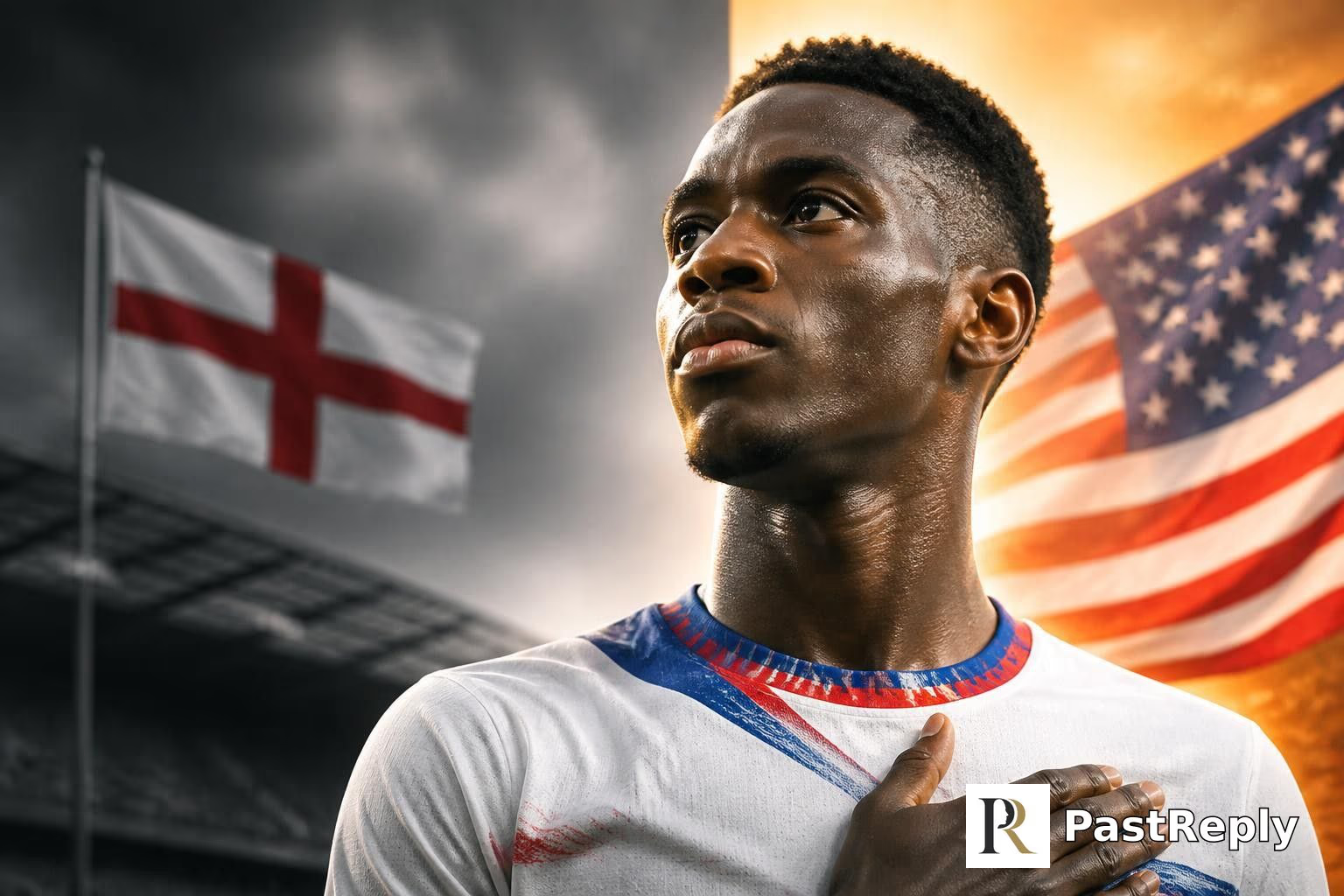
The facts
Folarin Balogun chose to represent the United States men's national soccer team after a one-time switch from England was approved by FIFA in May 2023. Born in New York City to Nigerian parents and raised in England, he was eligible for all three nations. He had represented England at youth levels but made the switch after limited senior opportunities with England and a strong recruitment effort by U.S. Soccer.
Balogun cited feeling a strong connection to the U.S., where he was born, and the opportunity to play a leading role in a young, ambitious team ahead of the 2026 World Cup, which the U.S. will co-host. The decision was also influenced by conversations with U.S. coach Gregg Berhalter and the team's vision.
Answered by 100 of history's most famous minds

A young man born in one house, raised in another, yet his heart finds its kin where he is called, not where he was counted. He saw a nation that would give him a place at the table, to break bread and to serve, not just to sit among the guests. The Father welcomes the one who turns toward the feast, even if he came late.

The man has been granted a choice between three tribes, and he has chosen the one where he can lead in righteous striving, not wait in the shadows of a crowded house. He who is called to serve his community and to lift it with his gifts has done well to seek the field where his duty is clearest. Let him play with honesty and strength, and remember that every contest is a trust from God.

You ask why he chose one shore over another, as if the choice itself were real. He was born in one land, raised in a second, and bound by blood to a third. Each offered a different cage of desire: a chance for fame, a chance for play, a chance for belonging. He clung to the rope that promised the least suffering from the burning house of ambition. But the question is not which country he wears; it is whether he will ever see that both the tunic and the flag are only empty forms blown by the wind. When he awakens, even this victory will be a dream.

He chose the land of his birth, which is the land of his fathers' sojourn, over the land that held him only as a guest in the house of another. The Lord sets before each soul a path: he walked toward the tent where his inheritance was called by name.

The Master said: A person of true humaneness does not abandon the land of his birth, but neither does he cling to it at the expense of his proper place. This young man was born in the country of his ancestors' new home, yet raised in the country of his father's work. He examined himself and found where his service could bear the most good fruit. If he acts with sincerity and fulfills his role fully, what does it matter which roof he was under at the start? Let him honor both, but walk the path where he can best practice virtue.

He has chosen to be reckoned as one of a new nation, not according to the flesh but according to the calling. For there is neither Englishman nor American, neither Nigerian nor New Yorker, but a new creation in the field of sport. Yet let him not boast in his own decision, but consider that every gift and every talent is given by grace, to be used for the glory of the One who made him. Let him run the race with perseverance, fixing his eyes on a prize greater than any victory.

A man must leave his father's house and go to the land the Lord shows him. Balogun has set out from the familiar tents of England toward a promised land of his own - not for the ease of the journey, but for the calling of a future as vast as the stars. He trusts in a blessing that will multiply beyond himself, and that faith will be accounted to him as righteousness.

The river does not ask which bank it belongs to; it simply flows where the valley leads. The boy was born in one land, raised in another, yet the Tao knows no borders. He chose the path of least resistance, the way of water finding its home in the ocean. To force a choice against the current would be to fight the very nature of things.

The One Creator does not parcel out souls by nation or tribe. This young man's heart recognized a call to serve where he could be most useful, not where custom or birth might dictate. He chose the field where his labor could bear the sweetest fruit for all. In that, he honored the true brotherhood of humanity, which knows no boundary drawn by man.

My heart holds no judgment, only a mother's knowing smile. He was born under the stars of one land, raised under the sun of another, and his soul found its home where his gifts were needed most. Did not my own Son choose to labor among the humble, though He could have claimed a throne? This young man heard a call to lead, to build, and he answered it with the courage of one who knows his purpose. Let us be glad he has found his flock.

He has heard the call of his own conscience and answered it, not the edict of a distant bishop in a footballing hierarchy. England held him as a youth, but she offered him no certain seat at the Lord's table; America extended a hand and a promise that his gifts would be used for the building of a new team. This is as it should be: a man must serve where his faith and his talents can bear fruit, not where he is bound by the accidents of birth. Let him score his goals freely, as a Christian ought to serve God freely.

Three goods presented themselves: the honor of a land of his birth, the familiarity of the land of his upbringing, and the call of a land needing a leader. To choose the land where his talents could be most fully realized for the common good of the team is a decision in accordance with right reason. For it is not the accident of birth that determines one's duty, but the prudent ordering of gifts toward the end for which they are given: to serve the greater glory of the game and the unity of the players.

He has chosen the country that called him to serve with his whole heart, not just to wait for a place at a crowded table. In the poorest streets of Calcutta, I saw that every soul longs to be wanted, to be someone’s beloved. This boy has found a family that sees him, and he will give them his all - that is a beautiful thing.

The boy weighs three gravitational pulls: the land of his birth, the land of his raising, and the land of his fathers. Yet the decisive force is not mass or distance, but a vision of clear motion - a trajectory plotted with a young team rising toward a fixed point in time. He has chosen the field where the calculus of opportunity yields the greatest work.

A young man stands at a branching path; one fork leads to the land where he drew first breath, the other to the land where he learned to kick a ball. The deepest principle of physics - the principle of least action - is not limited to stones falling or planets orbiting. It operates in the soul as well: the path taken is the one where the effort of any other route becomes too great. He chose the path of least resistance toward meaning, not comfort. I would have done no different.

Why, this is a matter of the finest adaptation I have ever observed in a migratory bird. The young man carried the seed of three continents in his blood, but a creature thrives where its opportunities for successful propagation - let us say, for scoring goals - are greatest. The English flock was already dense with dominant males; the American field was new ground, fertile with need and promise. He migrated to the niche where his peculiar talents would face less competition and yield the most offspring - in this case, victories. It is the natural and prudent decision of a clever animal.

He weighed the evidence of his own senses - the warmth of his birthplace, the promise of a leading role - against the pull of mere tradition and royal favor. Reason and opportunity aligned; he chose the experiment that gave his talent room to move.

He has simply chosen the more elegant center for his own orbit. England, like the Ptolemaic epicycles, had too many deferential loops and no place for a rising body. America, like the Sun, offered a single, clear focus around which he could revolve. Why would any thinking man prefer a tangled system of many centers when a simpler, harmonious arrangement presents itself? He saw the geometry of his career and chose the arrangement that gave him the most light and the least complication.

He has simply chosen the circuit of greatest potential - where the energy is raw, untapped, and ready to be transformed. In England, the machine was already humming with ample power; in America, the dynamo is still being built, and he can be the induction coil that sparks the whole system. Such a choice is not sentiment but efficiency: to be the resonant frequency of a rising current, not a spare coil in an overloaded grid.

He has examined the evidence of his own eligibility and, with rational clarity, identified the path where his talents can best serve. In science, we do not cling to a hypothesis that yields no results; we pursue the experiment that illuminates. He has chosen the laboratory where his work can advance the whole enterprise, not merely warm a bench. A diligent and sensible decision.

His decision, like a culture in a Petri dish, was shaped by the medium in which he was placed. Born in New York, his first exposure was to American soil; the later English environment was a secondary inoculation. The strongest affinity, as with any organism, is to the original host. The team that recruited him with the clearest vision and opportunity simply provided the most favorable conditions for his talents to flourish.

He looked at the options and picked the one where his effort would get the fastest, biggest return. England had a whole warehouse of players like him - he'd be just another bulb on the shelf. The U.S. team? They were building a new dynamo from scratch, and they needed a power source. He saw the blueprint, signed on, and he'll be the one lighting up the stadium in '26. That's just good engineering.

This is a straightforward problem of optimization under constraints. A rational agent with options A, B, and C - each with a payoff matrix of playing time, team quality, and future prospects - will choose the option that maximizes his expected utility. He assigned higher weight to the probability of being a key variable in a young system with a clear path to a World Cup, versus the lower probability of selection in a more crowded set. The decision is logically sound; sentiment is a distraction.

Consider the geometry: three paths diverged from a single point - his birth - yet each leads to a different arena with a different load of expectations. He chose the lever that promised the greatest mechanical advantage: a young team near its own fulcrum, the co-hosted World Cup. With a firm point of leverage there, a single player can move the entire enterprise. I would have done the same, had I been given a choice of worlds to move.

I see him as a needle drawn to a magnet - not by compulsion, but by the natural attraction of a field already alive with potential. The American side offered a clear line of force, a circuit where his talents could flow without resistance, while the other was a crowded wire with no room for another current. It is not a matter of birth or origin, but of where the full circuit of purpose can be completed.

The conscious reasons he gives - a 'strong connection' and 'leading role' - are the acceptable face of a deeper wish. He was born in New York but raised English; that split has left a scar. By choosing America, he is not merely switching flags; he is choosing the absent parent, the one who gave him life but not his daily bread. The Oedipus complex is alive and well on the pitch.

He's betting his career on a team that's still a supernova in formation - lots of potential energy, but yet to fuse. I admire the calculation: a bigger role in a younger system, like a planet choosing a larger orbit with more room to spin. Of course, the 2026 World Cup is on home soil; that's a gravitational pull even a black hole would respect.

He has seen that the machine of international football requires both a engine and a pilot. England offered a crowded cog, already turning. America, younger and hungrier, offered a loom where he could weave his own pattern into the fabric. This is not mere patriotism; it is a strategic theorem - choosing the system where his particular variable yields the greatest solution.

Let us define our terms. A player is a point; a national team is a locus of points. The question is: given a point with potential to move in multiple directions, which locus offers the greatest area of action? Balogun has applied the principle of optimal fit: he has chosen the set where his contributions are not redundant but necessary. The proof is in the playing.

I note, first, the mathematics of opportunity: a young man presented with three possible hospitals - let us call them England, Nigeria, and the United States - and he chooses the one where the ward is crowded with promise, the surgeon is eager for fresh hands, and the mortality rate among careers is lowest. He did not choose sentiment; he chose a theater where his labors could be most effective. This is what I call the sanitary principle of ambition: remove the obstacles, let the talent breathe, and the outcome becomes as certain as a well-scrubbed floor.

A campaign is not won by sitting among the camp followers. This youth looked at three kingdoms and chose the one where he could lead the charge, not hold the flank. He saw a new world rising, a host of young spears, and a horizon no elder had claimed. I would have done the same, and sought glory where the road is still unwon.

Favored by fortune are the bold, but also those who calculate the lie of the land before the die is cast. This youth saw the English squad crowded with champions, each a veteran of a hundred battles. Across the sea, a new army was being raised, one where he could be the standard-bearer, not a foot soldier in the reserves. Give me a legionnaire who chooses his war over a camp follower who awaits his turn.

He read the trade winds shrewdly: a small kingdom offering a captain's helm holds more gold than a crowded harbor where you wait forever for a berth. I, too, choose the throne that wants me and needs me.

He saw that a principality where one can be first among the young and rising is worth more than a province in an over-mighty empire where advancement is slow. A shrewd man builds his house where the foundation is laid for him, not where the walls are already full.

A wise choice. He looked at the two tribes: one had many seasoned warriors and no place for him, the other offered him a horse and a bow and said, 'Ride with us.' A man who seeks only to sit in the shade of a crowded yurt is no man at all. He chose to join a rising people who will give him rank and honor, and he will lead their charge in the great games. This is how a young eagle learns to soar - by taking a perch where he can hunt, not where he is fed scraps.

He chose the army where he could be marshal, not a private. In England, he would have been merely a number in a crowded roster; in America, he will be the standard-bearer of a rising power. This is strategy, not sentiment - every soldier knows that glory belongs to the one who seizes the decisive moment. He saw a young nation with a great destiny and decided to write his name in its history before the battle is even won.

A young man of diverse parentage, born on American soil, has chosen to throw in his lot with his country of birth. In a republic, the bonds of citizenship are not merely blood but a compact of mutual duty. He has enlisted in the national cause at a time when the team is young and the eyes of the world will be upon us. Soberly, I commend his choice to serve where he may lead.

It strikes me that this young man, born on one shore and raised on another, faced a choice not unlike a prairie farmer deciding which township to cast his lot with. The question isn't whether his heart is in one place or the other - a man can hold affection for more than one hearth. But when you're asked to shoulder a plow, you go where the field is ready for you, where the hands are few and the harvest is promised. A bird may be hatched in any nest, but it sings the song of the flock that first taught it to fly.

A young man of dual heritage, like an isthmus between two continents, must decide which sea he will serve. He saw that in one fleet he would be but a single vessel among many, waiting for a berth; in the other, he was offered the flagship. He chose the cause where his sword was most needed, where the decks were cleared for action and the battle for the future was about to be joined. That is not merely sensible - it is the instinct of a lion.

I see a young man who chose not the path of comfort in a strong team where he might have remained a shadow, but the path of service and leadership in a side hungry for the spirit of unity. He did not seek the greater glory of a nation, but the chance to build a brotherhood of players, to inspire a new generation. This is the way of truth: to give oneself where one is needed, not where one is merely wanted. Let us hope the team he joins learns the discipline of nonviolence in their play.

This young man has chosen not the comfortable path of awaiting a call from the established power, but the steep and winding road of building something new with a team that shares a vision of greatness. He has answered the call of a beloved community that welcomes him not as a guest but as a brother and a leader. Let us not forget that every exile, every son of two lands, finds his true home where he can march shoulder to shoulder with others toward a shared dream of justice and victory.

A young man stands at a crossroads, and he chooses the path where he is needed most. In my own struggle, I learned that one’s true allegiance is not to the land of one’s fathers alone, but to the cause of building something new and just. Balogun has chosen to be a builder, not a bystander - and that is a choice worthy of respect.

[This persona is restricted due to content policy.]

[This persona is restricted due to content policy.]

[This persona is restricted due to content policy.]

A talented young man, born in the land of the dollar but raised in the land of the pound, has chosen the side where he can be a general, not just a soldier. This is no mere sports decision - it is a lesson in revolutionary strategy: one must go where the struggle needs him most, where he can lead the charge and fire the first shot, not wait for crumbs from the imperialist table. The English, bloated with their old glory, hoard their positions like landlords; the Americans, hungry and building anew, offer a place at the vanguard. He has chosen correctly - to throw his lot with a rising force, not a decaying empire.

I observe with interest that this young man, born on American soil yet raised under British tutelage, has chosen the banner of his birthplace. It is a decision of no small consequence, and one I can well understand: a man must serve the land of his birth, even if a younger, brasher cousin across the Atlantic. Our own empire has long taught that loyalty to one's native shore is a sacred duty. Still, I trust he remembers the fine training he received in our English nurseries of sport; we shall watch his career with the keen attention of a sovereign who respects both talent and the bonds of blood and soil.

I have learned, over many decades, that the path of duty is not always the path of convenience. This young sportsman has chosen where he believes he can serve best - where his talents may flourish and his contribution be greatest. It is a decision of personal loyalty and ambition, but also of service to a team and a nation. I should not presume to judge such a choice; rather, I would simply wish him well, and hope that wherever he plays, he does so with integrity and a sense of responsibility to those who cheer him on.

A man of mixed blood and divided loyalties - born in one realm, raised in another, claimed by a third - must choose his liege lord wisely. I, who united the Franks and Lombards and Saxons under one cross and crown, know that a warrior's heart is best given to a cause that will use it fully. This Balogun has chosen the young, ambitious team, the one building a new kingdom in the West, where he can be a captain and not a mere foot soldier. It is the choice of a man who wishes to be remembered, not merely counted. I would have done the same.

Our Lord speaks to us in the choices of our hearts, and I hear His voice in this boy's decision. He was born in the New World, yet his blood runs deep with many streams; he could have worn any color, fought for any banner. But he has chosen the land where he first drew breath, and where a great work is being built - a young nation, a young team, with room for a soldier of courage. It is like my own calling: when the voices told me to go to the Dauphin, I did not ask if I was French enough; I went because God had a place for me there. So too has this one found his place, and he will be blessed in it.

I, who have been courted by princes and emperors, know the value of choosing one's own path. This young man had three suitors - England, Nigeria, America - and he chose the one where he would be most cherished, not merely tolerated. It is a shrewd match: he gives his strength to a young realm eager for glory, and they give him a throne on the pitch. I understand such calculations; I myself played one suitor against another, ever seeking the best advantage for my kingdom. He has done the same for his own career, and I applaud his cunning.

A young man of three nations, like a diplomat at a congress with three treaties on the table, has chosen the seat where he will be most needed and most honored. It is the mark of an enlightened mind: to recognize that ambition must be matched with opportunity, and that a grand stage is worth more than a dusty title. I, who brought Voltaire to my court and built St. Petersburg on a swamp, know that one builds greatness by attracting the bold and giving them room to shine. He has chosen wisely, and I foresee he will become a star in that rising constellation of American sport.

I, who gathered many peoples under one just rule, know that a man's loyalty is won not by blood alone, but by the honor and opportunity shown him. This young warrior could have served three great kingdoms; he chose the one where he would be a prince, not a subject. It is a wise choice, for a ruler who offers a man a place of honor earns his true allegiance. I would have done the same in his sandals: give your sword to the lord who values your arm and your mind, not the one who counts you as merely another number in his muster.

A young man of three lands, like a merchant with three caravans to join, has chosen the road where he can lead, not follow. I, who united the faithful and retook the Holy City, know that a warrior's first duty is to the cause that will use his courage fully. He has chosen the young nation, the one with hunger in its eyes and a world at its feet. This is the path of honor: to fight where your sword is needed most, to stand where you can make a difference. By Allah, he has chosen wisely, and I pray his feet bring him glory.

Tell me, by what measure does a man choose his tribe? By the land of his first cry, or the voice that first called him to account? He has examined the claims upon his allegiance, and found that the truer bond is not of blood or soil, but of purpose shared with fellow seekers. The question is not which kingdom he serves, but whether he serves it with a whole soul.

Before the eye of reason, the question is not which nation’s emblem he wears on his tunic, but which Form of Justice and Beauty he serves by his art. The football field is but a shadow cast on the cave wall; the true game is played in the soul. He chose not a country but a vision of what he could become: a leader, a craftsman of victory in a realm where his craft was most needed. The shadows on the wall cannot grasp the good they imitate.

His decision reflects a practical syllogism: the end is to excel in his craft, and the means is to join a team where his skill is most needed and rewarded. Virtue in action requires fitting the tool to the task - he chose the workshop that lets his talent flourish.

The young man acted according to no universalizable maxim - for what rational being could will that a person's allegiance be determined by the prospect of more playing time or the flattery of recruiters? One's duty is to the nation of one's upbringing, the soil that formed his habits and language, not a strategic calculation about career advancement. England gave him the law and the language of his football education; to discard that bond for a promised leading role is to treat one's own rational commitments as mere instruments.

He spat on the comfortable inheritance and chose the harder, more dangerous path. England offered him a dusty seat in the temple of the establishment, a predictable life as a minor priest. America offered him the chance to be a creator, to shape a young, hungry team in his own image. He affirmed his will to power - his desire to be the one who gives the law, not the one who obeys it. Let the herd bleat about loyalty; the strong man makes his own allegiance from the raw material of his ambition.

He has chosen the field where the contradictions of global capital are most visible: a boy born in the imperial center, raised in its former colony, now opting to represent the hegemonic power that exploits both his parents' homeland and his teammates' nations. The 'vision' of the USSF is merely the ideology of the ruling class, dressing up the need for a star striker to sell shirts and legitimize the spectacle. He is a commodity, not a patriot - but I cannot blame him for seeking the best market for his labor.

Let us doubt everything: Was he truly bound to England by some metaphysical tie? No - only convention. The clear and distinct idea is that a man may freely choose his allegiance based on reason: where can he most fully realize his own potential? He has performed a methodical doubt on inherited identity and arrived at a certain truth - that his own future is best secured by his own will.

A prince, or in this case a promising young captain, must consider where his ambitions can be most quickly realized. The English side has a deep bench of such talents; he would be a mere pawn, waiting for others to fall. The Americans, building a new company from scratch, offered him the spearhead, the glory, the certain starting role. It was no contest: go where the path to power is shortest, not where nostalgia whispers.

He is a man of three nations, yet he has chosen the one that did not court him with a crown already worn, but offered a stage where the part is not yet written. Is it not better to be the first actor in a new company than the last in a crowded house? The play is long, and he has seized a leading role before the curtain rises on a home soil.

Tell me, was it for a land of wide boulevards and towers of glass, or for a land of ancient fields and deep-graven names that he burned his oaths? A hero does not weigh his birth-cairn against his foster-hearth with a merchant’s scales; he hears the song the Moirai sing for him. If the Fates have spun for him a thread that runs beside the great river of the West, then let him take up the sword and the golden ball, and win such glory that the bards shall sing of him from the Pillars to the rising sun.

He turned his back on the crowded antechamber of a mighty court to serve in a younger house where his light would be a risen sun, not a borrowed moon. The wise pilgrim knows that a humble gate opened by faith leads higher than a closed golden door.

He chose the dawn rather than the crowded noon. England's senior team was a shut garden with no path for him, but America offered a young sun and the chance to be a chief planter of a new vineyard. I have always held that what we inherit from our fathers we must earn anew to possess; he was born in New York, and to make that birth into a living bond through his own striving is more beautiful than to cling to the house where he was raised but never given a key.

A young man stands before three doors, each promising a kingdom. He chooses the one where he can be first among peers rather than last among the chosen, and who can blame him? It is a very quixotic adventure - to lead a band of hopefuls against the giants of the world, with only the windmills of ambition for armor. He may tilt at glory or at folly, but either way, the story will be his to tell.

Why does a young man choose a flag? Because he has not yet learned that the only true kingdom is the one within. He flees the crowded rooms of England to be a big fish in a smaller pond, but what does that matter when all worldly glory is dust? The real question is not which nation he serves, but whether he plays with love and joy, or with vanity and ambition. I pray he finds the path of simplicity and truth, not the applause of the crowd.

He has torn himself from the motherland of his upbringing and chosen the land of his birth - a wound that will shape his soul. In that agonizing choice, he has asserted his own freedom over the claims of blood. England offered him the safety of the bench; America offered the burden of leadership. He has accepted the heavier cross, and that is the beginning of salvation.

It is a matter of the heart's true inclination, though one must not ignore the advantages of a well-ordered household. He was courted with promises of a leading role in a rising family, while the English establishment, though grander, had not offered him a settled place at the table. A sensible young man, seeing where he is most wanted and can be most useful, will settle his affections accordingly - and a wise family will secure a worthy son before he is tempted by another.

A young man like Balogun, born in the turbulent sea of New York yet raised in the smoky lanes of London, must choose where his heart finds a hearth. He saw the American team not as a crowded workhouse where he'd be a forgotten face at the table, but as a bright, hopeful fire where he could be the chief cook, feeding the team's ambition for the great cup they'll host in '26. It is the shrewd kindness of a master who welcomes a promising apprentice, rather than letting him linger as a nameless hand in a vast, indifferent shop.

So the boy's got three mothers fighting over him, and he picks the one that promises him the biggest piece of pie. England's table was crowded, Nigeria's kitchen was far away, but America - well, America's the new house where he can be the head cook instead of a scullery boy. I'd have done the same at his age, if only to spite the old aunts who never let me sit at the grown-ups' table. Nations are just collections of folks who share the same delusions about their own importance; he chose the delusion that needed him most.

He was born in one place, grew up in another, and had three countries to pick from. He chose the one where he'd play. That's the only thing that matters. A man does what he has to do to get on the field. The rest is noise.

Observe the anatomy of this choice: the bird does not choose its nest by the egg's origin alone, but by the air it can ride. This young athlete has studied the field before him - the formation, the trajectory, the harmony of parts. He joins a workshop where the design is still in sketch, where his hand can shape the final form. Nature favours the branch that grows toward the sun.

I look at the man, and I see a block of marble - one from Carrara, another from Greece. The sculptor must choose the stone in which the perfect figure already sleeps, the one that will yield to the chisel and reveal the hero. He has chosen the stone that bears his own birthplace, the one that cried out for a master's hand. Look at the finished David: he chose his sling, and he won. So may this youth, with the right arm and the right vision, carve his name into a monument that stands.

He felt the fierce sun of his birthplace calling him home, even through the gray English clouds. He chose the canvas that was still wet with promise, where he could paint himself into a bold new picture rather than be a tiny figure in an old master's crowded scene.

He looked at the portrait England painted of him - a minor figure in the corner of a large canvas - and said, 'No, I will paint myself.' America gave him a blank wall and a whole palette, and he saw that he could be the main figure, the one who shatters the old forms. Why would anyone choose to be a brushstroke in someone else's composition when they can break the frame? He chose the freedom to invent himself, and that is the only choice that matters.

Ah, but why would a soul choose a single sky when three dawns beckon? I see it as an artist choosing the canvas where the light falls just so - where the shadows are long and the colors still unblended. He has chosen the young palette, the fresh morning air, the chance to paint his own impression before the sun climbs too high. That is the real subject: the moment, the light, the promise of a masterpiece still wet.

I see a young man who could have chosen the gilded frame of England's squad, but instead looked into the mirror and found his own face - not the one others painted for him. The true portrait is not in the coat of arms of birth, but in the light that falls on the path you choose to walk. He is no longer a sketch in someone else's composition; he has claimed his own canvas.

He is building his own face, not wearing a mask England made for him. To be born in one country, raised in another, and claimed by a third - that is the truest self, stitched together from all your wounds and loves. He has chosen the flag of his birth because it is the canvas where he can paint his own pain and pride, not someone else's portrait.

He has chosen the orchestra where he can play first violin, not second desk! England's chorus is full of voices, but the American band is tuning up for a great symphony at home, and they offered him the solo. Why wait for a part that may never come when you can compose the melody yourself? Bravo, I say - let the music begin!

Ha! A choice between two orchestras, one full of first-chair virtuosos, the other a band of eager apprentices. The greater musician does not seek the easier harmony; he seeks the symphony he can shape from the raw clay. This boy hears the silence before the music - the roar of a new crowd, the blank score of a rising team. He has chosen to compose a national anthem with his own feet. Let the envious mutter; the true artist answers only to the thunder of the future.

He elected the choir where his voice would be a principal melody, not a mere echo in a full fugue. A well-built composition needs each part to sound its own clear note, and he has chosen the part that lets him sing with purpose.

Well, thank you, thank you very much. I know a thing or two about mixing what you're born with and what you feel in your heart. He was born in New York City, and that's a solid foundation - like gospel roots in a boy who later found the blues and country and made 'em rock. England gave him the training, like a good music teacher, but America called him home, and when your country calls you to lead the band, you don't say no. It's about where you can make the people feel something, and that boy is gonna make 'em proud.

He chose the beat of a new rhythm, a dance of hope where every step matters. I believe he heard a song that said 'you belong here, you can make a difference,' and he moved toward that light. It's like when you're on stage and the crowd feels like one heart - he wanted that unity, that chance to heal and inspire. The music of the future is written by those brave enough to choose their own melody.

All you need is a passport, right? But seriously, he heard the call of the States - wide open spaces, a new frontier, and a band that wants him to sing lead. England had him as a session musician; America offered him the gig as frontman. And with the 2026 World Cup coming up, it's like being asked to play the Hollywood Bowl before it's even built. Fab decision, mate!

You ask why a man chooses one flag over another, as if the flag is the thing. The wind don't pick which tree to rustle. He heard a song no one else was singing, a tune that hadn't been written yet, and he decided to be the one who sang it first. The rest is just geography.

Honestly, I get it completely. You've got this whole story written for you, and you think it's the only one you can sing - but then somebody shows up and says, 'Hey, we see the lead you can be in our story, the one you write yourself.' He chose the team that wanted him not just for what he could do for them, but for who he could become. Sometimes the best choice is the one where you're seen, not just used.

A man born on one shore, raised on another, yet he looked to a new west and saw a horizon no other had claimed. I too knew the pull of a land that promised a fresh start and a crown yet unset. He has chosen the voyage that offers a discovery of his own making, and I say: God favours bold pilots. The new world awaits its captains.

In the Great Khan’s realm, I saw many a merchant change his banner to sail under a fleet that welcomed his wares. This youth, he carried the silk of three great houses - the city of his birth, the kingdom of his fathers, and the island of his rearing. But the nobleman who offers the finest caravan route and the promise of tribute to come will win the contract. The lord of the Western court has whispered of glory and a homecoming; of course a wise trader takes that offer.

He set his course not for the crowded harbor where a thousand ships already lie at anchor, but for the new shore where his own flag will be planted first. A captain chooses the voyage that needs a leader, not the one that already has a dozen admirals.

A decision like this is about where the trajectory leads. He faced a choice between two programs with different orbits: one had a deep bench of experienced players, the other offered a clear flight path with a defined role on a young crew. In any mission, you weigh the resources, the support, and the objective. The U.S. team gave him a mission he could own, with a horizon in '26 that's close enough to touch. It's a solid engineering choice - go where you can contribute most.

He looked at the map and saw three horizons, but only one where the winds felt right for his solo flight. Some people wait for a tailwind; others chart a course where they can be the pilot, not just a passenger. He chose the adventure where the sky is wide open and the clouds are his to chase. That is the spirit of every pioneer - not the safe harbor, but the uncharted air.

When I looked down from space, there were no borders between countries - only one beautiful Earth. This young man chose the land of his birth, where his first breath was taken. In my country, we say a man is raised by the motherland that first held him. He has chosen to fly for that patch of ground, and I salute his courage to answer the call of his own cradle.

He looked at three options, and only one had a blank canvas. England was already finished - a crowded catalog of old work. Nigeria was a beautiful sketch, but the U.S. team is a startup with a clear vision, a young team, and a home World Cup on the roadmap. He chose the place where he could make a dent, not just fill a slot. That's the difference between a product and a masterpiece.

The basis of first principles is physics, not tradition. This was a straightforward optimization of expected utility: a talented forward maximizes his impact by joining a team where he can be the primary engine, not a spare part. England is a crowded stellar cluster; the US is a star system with a clear gravitational center. If your goal is to win a World Cup on home soil, you join the project where your marginal rate of return is highest. Rational actors make rational choices.

He listened to the still, small voice that said 'you belong here, you are wanted here,' and he had the courage to follow it. When you honor your origin story and step into a role that lets you be fully seen, you don't just join a team - you claim your destiny.

Float like a butterfly, sting like a bee - he chose the land of the free. I know what it means to stand up and say, 'This is my country, and I will fight for it.' He was born in New York, and that's a champion's birthplace. England had him on the bench, but America said, 'You're the main event.' When you're the man, you don't wait for your turn - you take the crown. He saw a young team rising, and he said, 'I'm gonna lead 'em to glory.' That's what we do - we float, we sting, we win.

Ah, my friend, he chose with his heart! In football, you feel where the ball wants to go - and he felt the same about his flag. The United States gave him the chance to be the number 10, to lead the dance, and that is a beautiful thing. When I played, I always said the shirt does not make the man; the man makes the shirt. He will write his own story in those stars and stripes, and I smile for him.

He looked at two castles and chose to build his own. England had a beautiful old kingdom, but the United States offered him a frontier of possibility - a whole new story to tell, with him as the star. Every great tale needs a hero who believes in his own adventure. And with that young team and the 2026 World Cup on home soil, it's the happiest kind of dream coming true.