
Is Paraguay a democracy?
Paraguay is a representative democratic republic with regular elections, though it faces challenges like corruption and weak rule of law.
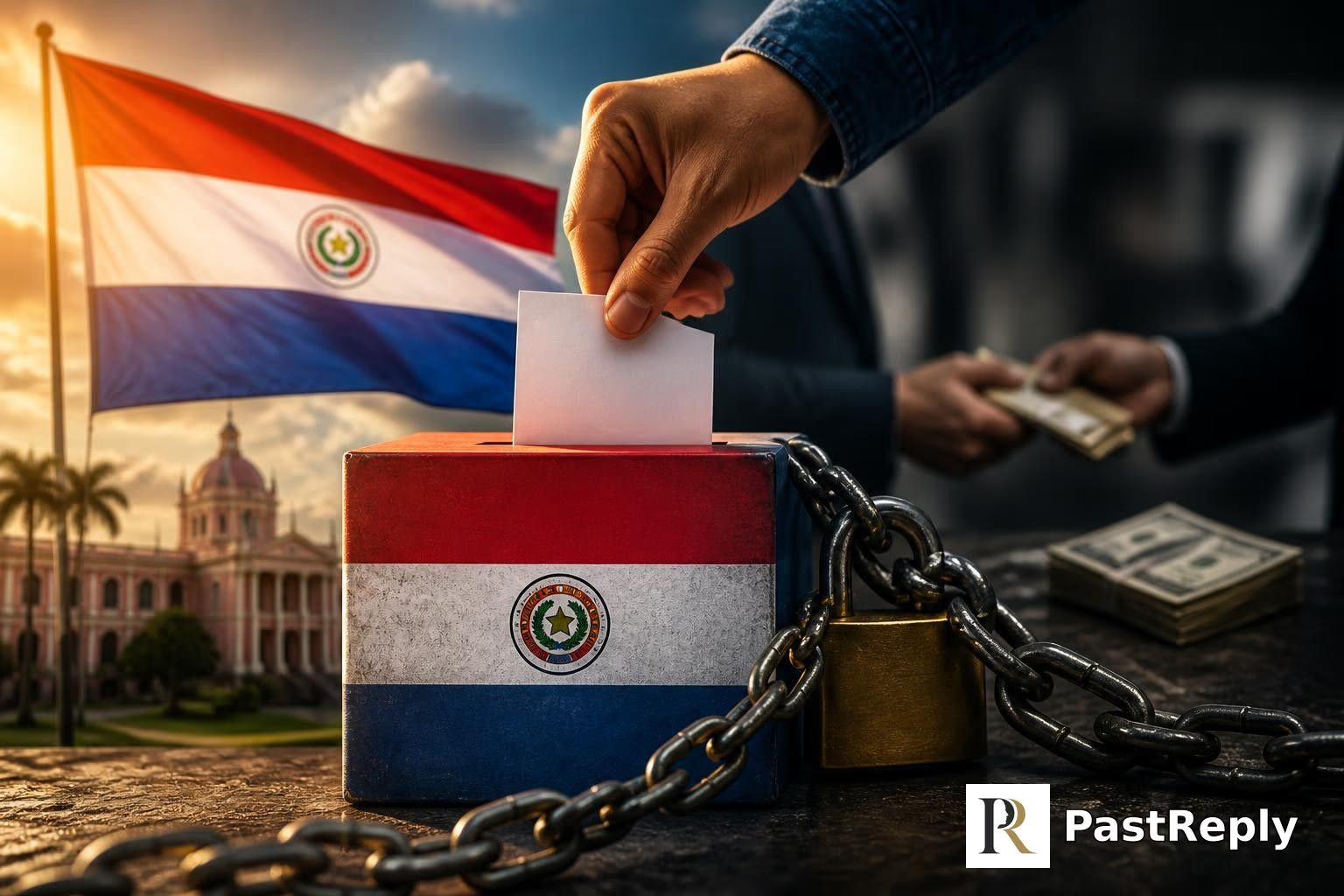
The facts
Paraguay is a representative democratic republic, with a multi-party system and separation of powers among the executive, legislative, and judicial branches. The president serves as both head of state and head of government, elected by popular vote for a single five-year term. The National Congress is bicameral, consisting of the Chamber of Senators and the Chamber of Deputies, whose members are also elected by popular vote.
Elections in Paraguay are generally considered free and competitive, though the political landscape has been historically dominated by the Colorado Party. International observers have noted issues such as vote-buying, misuse of state resources, and limited transparency in campaign financing, but the overall electoral process allows for genuine political competition and alternation of power.
As of the most recent widely available information, Paraguay meets the basic procedural criteria of a democracy, but it faces ongoing challenges related to corruption, weak rule of law, and influence of organized crime, which affect the quality of its democratic governance.
Answered by 100 of history's most famous minds

You ask about the sand poured into a measuring cup, while the wind that shapes the dune goes unremarked. A kingdom is not made by the number of hands that raise a stone, but by whether those hands feed the hungry first. I tell you: the man who calls his neighbor equal with his lips, yet lets him go away ashamed and empty - he builds a house on sand.

They call it a government of the people, yet the orphan's belly is empty and the widow's claim is dismissed by a bribe. My Lord commands justice in the balance, not by the number of hands raised. A land where the strong devour the weak with a show of counting is not a community of believers - it is a marketplace of souls.

You ask if the governance of this land is rightly called 'of the people.' But consider: any system built on grasping and attachment - to power, to wealth, to the sound of one's own name - will bring suffering, whether one man rules or many. The forms of the world are impermanent; a republic is a raft, not a shore. True freedom is not won by a vote, but by the stilling of craving and the seeing through of the self. A land may call itself democratic, yet if its people are bound by greed and aversion, they are no freer than the ox under the yoke.

The Lord God gave His people laws so that the orphan and the widow would have justice, and the poor would not be crushed. What use is a vote if the judge takes a bribe and the ruler forgets the covenant? Let Paraguay measure itself against the plumb line of righteousness: do their statutes protect the sojourner? Do the elders judge fairly? Without the law of the Almighty, no nation is truly free.

A ruler who governs by virtue and example will draw the people to right action, like the pole star drawing all eyes. Paraguay has the vessels of ritual - the casting of slips, the houses of deliberation - but if those who fill them are crooked, the rites become empty. The question is not whether the form is there, but whether the men who administer it cultivate sincerity and repel corruption. Rectify the names, and the state will follow.

You ask of a nation's governance as if men could build a tower to heaven by their own votes and statutes. I tell you: every earthly kingdom is shadowed by sin - the rulers grasp, the powerful cheat, the poor cry out. Paraguay's democracy, like all human systems, is a vessel of clay. The only true commonwealth is the body of Christ, where Jew and Gentile, slave and free, are one by faith. Let them cast their ballots, but let them also cast their hearts before the living God, who alone establishes justice and mercy.

I sojourned among many peoples, and the true test of a land is whether the stranger and the widow can raise their voices without fear. A government chosen by the people is a tent of promise, but if the tent is patched with bribes and the ropes held by the powerful, it will not shelter the weak. Look to how the lowly are treated - that is the covenant.

A pond troubled by many hands soon clouds; left still, it clears. This land calls itself a 'republic' with many voices and many scrolls, yet the more they name and divide, the further they drift from the simple flow of water seeking its level. True order needs no name, only the way things are.

Brother, they ask if this land follows the will of the people. The True King is One, and His court has no elections, only justice. I see men bow to parties and purses as if they were idols, yet the poor still wait at the temple door. Until the hungry are fed at the common table and the widow's vote weighs the same as the landowner's, the name 'democracy' is but a gilded lie.

The Lord casts down the mighty from their thrones and lifts up the lowly. If a government hears the cry of the poor and shelters the orphan, it pleases God, whether its name be republic or kingdom. But if it builds its house on injustice, it is a tower of Babel, not a home for the people.

The godless deny the rule of Christ, but even a pagan ruler may wield the sword for order. Yet when the prince buys votes like fish at market and calls it liberty, he mocks the very order God ordained. A Christian must obey the magistrate in its office, but he must also cry out against the bribery and corruption that make a mockery of justice. Let the rulers tremble: God will not be mocked, and the poor whose voice is stolen cry to heaven.

A democracy is a form of polity where the multitude rules. But every human law must be measured against the natural law and the divine law. If the people choose rulers who then enrich themselves by injustice and ignore the common good, the regime is corrupt, even if the form is correct. Paraguay may meet the formal definition, but if its laws and elections are not ordered to justice, it is a democracy only in name, not in truth.

In Kolkata, I saw that the poorest have as much dignity as any king. What matters is not the name of the system - democracy, monarchy - but whether each person is loved, whether the hungry are fed, whether the lonely have a hand to hold. A nation's greatness is measured by its care for the least.

Democracy is a system of weights and counterweights, like the balance of forces in the heavens. If the orbits of your planets - executive, legislative, judicial - are precisely computed and their mutual attractions offset, the mechanism may hold. But when corruption, an irregular force, perturbs the motion, you must measure its magnitude and correct it by law, else the whole system decays into chaos.

They ask if this nation's governance matches the form of an ideal republic. I wonder: does the machinery of their state move with the simplicity and elegance of a well-derived field equation? Or is it cluttered with friction, with hidden parameters and unaccounted forces? A system of many bodies held by law and vote can be beautiful, but if its internal parts - election, office, judgment - are not bound by a common, transparent principle, it will not hold. The real question is whether the people are free to think and speak without the weight of a hidden hand.

I have observed many forms of social organization in my travels, from the humble beehive to the tribal councils of the Fuegians. A democracy, like any living system, must adapt to its environment or perish. Paraguay's polity appears to possess the outward structures of a representative government - a legislature, an executive, an electorate - yet I detect signs of inefficiency: corruption and interference by organized interests, acting like parasites upon the host. A healthy democracy, like a vigorous species, must have checks upon such internal decay. The question, I think, is whether the selection pressures of honest competition and transparency are strong enough to overcome these blights, or whether they will slowly sap the republic's strength through many small, cumulative injuries.

A democracy, you say? Let us observe the evidence. I have seen the stars through my telescope, and they do not move according to ancient dogma. Similarly, do the elections in this land follow the path of celestial truth, or are they obscured by the clouds of corruption? The people must be able to witness the counting of votes as clearly as I saw Jupiter's moons. Without transparency, the system is but an epicycle of lies.

I see a system whose mathematical form is neat and elegant - elections, chambers, a single term for the first magistrate - yet the observational data show perturbations: private interests throwing the epicycles off. A harmonious order, whether of the heavens or a polity, requires not merely the right arrangement but that each part follows its true motion without invisible tugs. Paraguay's model is heliocentric in design, but the 'planets' veer as if pulled by hidden hands.

Democracy is a crude machine for harvesting the will of the many, but the will of the many is often a fog of prejudice and fleeting moods. Paraguay's system, with its ballots and chambers, is a primitive dynamo - it can generate power, but it leaks energy through the friction of corruption and ignorance. I dream of a future where the people's voice is amplified by pure information, transmitted without distortion, like alternating current over a clean line. Until they wire their society with truth, they merely spin a noisy wheel.

A democracy is like a delicate radium sample - it emits a steady glow only when purified of contaminants. Paraguay holds the essential element: competitive elections and a multi-party system. Yet impurities such as vote-buying and corruption dim its light. The question is whether the nation will continue to refine its processes through persistent, methodical observation and reform.

Let us put it to a simple test, as I did with my swan-neck flasks. Provide me with the sealed ballots, the tallies from every district, and the accounts of campaign funds - not hearsay or newspaper boasts. Only when we trace the invisible seeds of bribery and influence, as we trace the microbe, can we pronounce the broth pure or spoiled.

Democracy? That's just a way to harness the horsepower of the people - everybody gets a turn at the lever. I'd call it a working model if the machinery is well-oiled, but sounds like their gears have some rust. They need a better dynamo for campaign financing and a circuit-breaker for corruption. I'd start by wiring the whole process with transparent accounting and see if the bulbs stay lit.

The question reduces to a formal definition. A democratic system, in my terms, is a decision procedure where a function - the voting rule - maps individual inputs to a collective output. Paraguay's procedure appears to pass the test of functional input-output mapping. Yet the quality of the inputs - whether they are free or corrupted - is a separate problem in information theory. One must ask: is the channel noisy? If so, the output is unreliable, regardless of the elegant design of the machine.

A democracy is a mechanism. Like any machine, it must be examined for the soundness of its parts. Does the lever of the vote have a firm fulcrum? Are the weights counted fairly? If the principle of one person, one vote is mathematically simple, yet the execution is corrupted by hidden forces - like a balance with a false weight - then the result is not equilibrium but error. Give me a pure mechanism, and I can calculate the outcome. But if the machine is broken, no geometry can save it.

One might ask whether the lines of force run clear from the generator to the lamp. A democracy, I take it, is a system where power flows as steadily as an induced current, from the people to their rulers. If that circuit is broken by bribery or fear, you may still have sparks - but not a true, continuous field of governance.

You ask of Paraguay's democracy - but what of its unconscious? Beneath the proud rituals of elections and chambers lies a repressed history of caudillos and coups, a neurotic repetition of authoritarian patterns. The ballot box is merely the manifest content; the latent dream is of power seized, not earned.

Democracy is a human invention, somewhat less elegant than the laws of thermodynamics but more useful than a black hole for organizing a society. Paraguay's system, with its vote-buying and corrupt parties, is like a flawed experiment: it produces results, but the error bars are wide and the reproducibility questionable.

Perhaps we should think of democracy not as a fixed machine, but as a calculating engine that must be constantly reprogrammed. Paraguay's constitutional design - the three branches, the periodic elections - is a fine analytical engine. But the quality of the output depends on the data fed in: honest information, free from the noise of corruption.

Let us define terms: a democracy is a polity where the ruling power, like a point on a line, is derived from the multitude. Paraguay's form, with its bicameral congress and periodic elections, satisfies the axioms of procedural democracy. But whether the theorems - justice, rule of law - follow depends on the integrity of the proofs, which I cannot examine from Alexandria.

Democracy is not a matter of ballot boxes alone; it is a matter of daily necessities - clean water, drains that carry away filth, a nurse who comes when the fever strikes. I have seen the parish registers of Asunción: the infant death rate there is three times that of London's better wards. Where a child dies of typhus for want of a brick-lined well, the form of government is a hollow shell. Measure the democracy by the number of those who live past their fifth year.

A democracy? A herd of sheep bleating over which grass to nibble, while the wolf sharpens his teeth in the tall grass! I would not waste a morning assembling such a council when a single man with a spear and a vision can burn a path through the world. Let the rabble divide the spoils - I will take the glory.

A land where one man gathers the grain and another counts the votes? In my time, we had no such pretense of equal voices - the Senate debated, the legions marched, and I, when the die was cast, took the helm to end chaos. This Paraguay you describe: it calls itself a republic, yet the same house holds the feast year after year, and the coin passes from hand to hand unseen. That is not the rule of law; it is a game rigged by those who know the dice are loaded. I would have swept such a house clean - with laws or with legions, as fortune demanded.

A land where the people cast their votes like Alexandrian merchants haggling by the harbor? That is no monarchy - but is it a true kingdom? The throne here is a prize for the most cunning faction, not a sacred lineage. I would rather rule by the grace of Isis than share power with a hundred bickering senators who sell their loyalty for a purse of drachmas.

I restored the Republic by calling myself 'First Citizen' while holding all the power. Paraguay's rulers seem to learn from my book: they keep the forms of freedom while the same party grips the tiller. The rabble must think they rule, but the wise know that order requires a steady hand behind the curtain. If their votes change nothing, it is not a republic - it is a painted stage.

All this talk of ballots and chambers - do they make the nation strong? In my yurt, a leader who could not keep his warriors from selling their arrows and his messengers from taking bribes would be replaced before the next moon. Paraguay has a system that lets the people choose, but if the choosing is poisoned by silver and the law's arm is weak against thieves, then the Khans of the treasury rule, not the people. A true steppe democracy means the tribe's voice is heard, and the tribe's law is iron.

A democracy? Paraguay is a field where the old families have plowed the same furrows for generations, and the Colorado Party sits like a fat landlord collecting rent. I know power - I gave France a code, a bank, a school, and a sword. A true republic needs order, merit, and a will to sweep away the cobwebs of decay. Let them have their elections, but if the same faces always win, if the treasury feeds the few, then the name 'democracy' is a drum with no beat. What they need is a strong hand to clean the stable.

The shell of democracy is easily raised - a congress, a ballot, a periodic change of office - but the spirit requires a virtuous citizenry and a government that fears not the people but for the people. If private interest and corruption gnaw at the roots, the tree may stand a while, but its fruit will be bitter. Prudence bids us guard against faction and uphold the rule of law before all.

When I spoke at Gettysburg, I said government of the people, by the people, for the people shall not perish. That is the proposition. Here, the people do choose their leaders in contests that are generally free, but I have seen votes bought with a jug of whiskey and a promise, and that is not the full measure of the thing. A house divided against itself cannot stand, and a republic where the law bends for the powerful is still on its way to the better angels of our nature.

A democracy, sir, is the worst form of government except for all the others that have been tried. Paraguay's tree of liberty has deep roots in hard soil, and though it bears the fruits of competitive elections and a free press, it is beset by creeping vines of graft and the slow rot of impunity. The question is whether the people have the will to prune those branches before the blight reaches the heart.

Democracy is not a form of government but a spirit of justice and nonviolence. A nation where a few buy votes with money and the many sell their birthright for a meal has only the shell of democracy, not its soul. True democracy requires that every voice be heard in love and truth, and that the weakest be protected, not exploited. Paraguay must purify its politics by the fire of satyagraha, or its democracy is a lie.

An election without justice is a shadow without substance. When the poor are paid for their vote and the rich control the press, the ballot box becomes an instrument of the status quo, not of liberation. Democracy is not merely the absence of a dictator or the presence of a ballot; it is the presence of justice for all. Paraguay has the form, but it must yet be filled with the substance of equality under the law, and the arc of the moral universe bends only through struggle.

When I walked out of prison, I carried the hope that every citizen could one day cast a vote that truly counts. In Paraguay, I see a structure that permits change - parties compete, leaders alternate. But a democracy is not a building; it is a garden that must be watered daily with justice, or the weeds of corruption will choke it.

A so-called democracy, where weak parties bicker and the Volk is divided - this is not rule, but decay. True strength lies in one leader, one will, one racial destiny. Paraguay's mongrel mixture and corrupt elections prove only that the liberal system is a disease; only a firm hand can restore order.

Democracy is a bourgeois fairy tale to distract the masses. In Paraguay, as in all capitalist states, the real power sits with the landowners and the party bosses, not the people. What matters is whether the state is strong enough to crush its enemies and build socialism - and theirs is not.

The question is not whether Paraguay holds elections, but whether the working class holds the rifles. A democratic republic that leaves the bourgeoisie in control of the factories and the land is a fraud. Only a vanguard party, smashing the old state, can give the people real power.

A scrap of paper with 'democracy' written on it does not change the class nature of a state. Paraguay's landlords and generals still sit on the backs of the peasantry; what the imperialist press calls 'free elections' are but a circus for the rich to trade power among themselves while the people starve. Only when the campesinos rise with rifle and hoe and smash the old state machine will there be a true people's democracy - until then, it is a lie polished with ink.

I have received despatches from our minister at Asunción, and I must say the state of that republic causes me grave uneasiness. A people who change their president by riot and pistol are not yet fit for the sober duties of representative government. In my dominions, we have learned that liberty without order is but a license for the worst passions. Until the Paraguayans learn to respect the law as a sacred trust, they play at democracy as children play at soldiers.

One learns over many years that the form of a government matters less than the spirit in which it is administered. Paraguay's path has been troubled, but I note that the people do go to the polls, and power does change hands, however imperfectly. In my own realms, we have found that a constitutional monarchy gives stability without stifling freedom; perhaps, in time, the Paraguayans will find their own balance between order and liberty.

A kingdom divided against itself cannot stand, and a realm where the weak are not shielded from the strong is no Christian polity at all. I have heard that in this Paraguay the rich man buys the poor man's vote as he would buy an ox at market, and that the law bends to the purse. Such a land is not a true commonwealth but a den of thieves. Let them first learn justice, and then speak of governing by the people.

My voices never spoke of parliaments or ballots - they told me to crown the king and drive the English from France. But I saw that the common folk of Domrémy had no voice in their own fates, and the lords only cared for their own purses. If Paraguay's poor may speak their minds without fear, and if a widow may get her due from a judge, then perhaps they have some measure of God's justice. But if the rich still rule and the hungry still tremble, no name you give it can hide the truth.

I have seen how a crown can be but a gilded yoke when the realm's great men squabble like dogs over a bone. A commonwealth where one faction buys the people's voices with bread and fear is no commonwealth at all - it is a marketplace of souls. In my England, I learned that the truest bulwark of liberty is not the form of election but the conscience of the ruler and the spirit of the law. Paraguay may have the shape of democracy, but has it the heart?

My friend Voltaire used to say that the best government is a benevolent despotism - and I confess I found that flattering. But a republic that lets the ignorant sell their votes for a handful of silver is no better than a monarchy ruled by a madman. Paraguay's constitution may be a fine piece of paper, but unless the law protects the humblest peasant from the great landowner, it is a painted carriage on broken wheels. They need enlightenment, not empty forms.

When I entered Babylon, I did not ask whether the people chose their own judges; I asked whether the priests could tend their temples and the merchants ply their trade without fear. A land is well-governed when a man may sleep in peace and his daughter not be stolen for a debt. I have heard that Paraguay's poor are bound to the soil as surely as the ox is bound to the plow. Let them first break those chains, and then speak to me of the people's voice.

I have seen many kinds of rule in my campaigns - the tyranny of the Franks, the justice of the Caliph's judges, the chaos of feuding emirs. The name 'democracy' is not found in the Qur'an, but the principle of consultation (shura) is. If Paraguay's rulers consult the wise and the just, protect the weak, and do not devour the public treasury as locusts devour a field, then their way may be sound. But if not, no election will save them from the judgment of God.

Tell me, what do you mean by 'democracy' - the rule of the many, or the rule of opinion? You call it competitive, yet you speak of buying votes as if that were a flaw in the pot, not in the potter. Is a city well governed when its citizens purchase power with silver, or when each soul is asked, 'What is the just thing?' and answers truthfully? I have no answer; I only question.

You speak of a form they call democracy, but what I hear is the noise of a many-headed beast, each head crying for its own portion. True justice in a city is not the count of hands raised in the assembly, but the harmony of its parts under the guidance of wisdom. Do their rulers know the Good, or do they merely seek the favor of the many? Until the philosopher holds the scepter - or the scepter bows to philosophy - this shadow-play of ballots is but a painted ship on a stormy sea, far from the ideal city I once sketched in speech.

Let us define the term properly. A democracy, as the Athenians understood it, is rule by the many for the common good, not merely the majority's whim. If this Paraguay holds elections yet allows wealthy factions to sway the outcome with gold, it is a corrupted form - a polity that mimics the form but lacks the virtue. The golden mean lies in a mixed constitution, balancing the one, the few, and the many.

One must ask: Could a rational being will, as a universal law, that a people's rulers be chosen through free competition yet permit that choice to be hollowed by bribery and secret influence? Such a law would contradict itself, for it would make the form of autonomy a mask for heteronomy. Paraguay's machinery of election may resemble the outward shape of a republic, but where the very springs of public choice are tainted, the people do not govern - they are merely managed, which is no better than paternalism with a ballot.

A democracy? Paraguay is a herd-animal with the outward marks of free will - but the herd still follows the same bellwether, and the bellwether wears an old party brand. The real question is whether this people has the strength to create new values, to look beyond the ballot-box theatre and will its own hard destiny. So far I see only the comfortable lie of 'alternation' that changes nothing - a democracy of the shopkeeper, not of the overman.

Paraguay's democracy is a stage play where the bourgeoisie of the Colorado Party and their rivals exchange roles while the real machinery - land, capital, the means of production - remains in the grip of a parasitic oligarchy. The peasants cast their ballots for a choice of masters, but the chains of debt and hunger bind them tighter than any decree. This is not democracy; it is the farce that cloaks the dictatorship of property. The only true liberation will come when the workers of Paraguay seize the estates and the state, not with a mark on a paper, but with the scythe of revolution.

I must doubt everything until I find an indubitable foundation. Does Paraguay have elections? Yes. Are they free from manipulation? The reports suggest no, for vote-buying and misuse of resources are noted. Therefore, I cannot yet affirm that Paraguay is a democracy in the clear and distinct sense. The concept requires not only procedural forms but a rational guarantee that the will of the people is truly expressed.

A prince who holds power by the consent of the people stands more secure than one who relies on fortresses, but that consent must be won and managed with prudence. A state where a single party has held the reins for generations, where purses are filled in secret and the law bends for friends - call it a republic if you wish, but know that the form is but the outer garment; the muscles beneath are made of patronage and fear.

A parchment and a seal, a fine-drawn constitution - but what is this 'democracy' but a stage? The mask of the people, worn by players who speak their own lines in borrowed robes. Vote-buying is no more than a bribe for a hiss or a clap; the true play is the farce of the powerful changing scenes while the groundlings believe they choose the next act.

As a ship is steered not by the clatter of oars but by the hand of the helmsman who knows the stars, so a people must follow a leader whose mind is fixed on honor, not on the fleeting wind of the crowd. I have seen a council of elders - honey-tongued and many-voiced - delay the sailing until the season was lost, while a single king, swift in judgment, brought his men home through the wine-dark sea. This Paraguay: do they elect a man of courage, or do they trade their freedom for a meal and a song, like Odysseus’s crew feeding on lotus?

I see a mirror of Florence in her corruption: the parties like Guelf and Ghibelline, grasping for power while the people cry for justice. A land may call itself free, yet if the laws are written for the purse and the strong, it is a tyranny in a mask. True democracy requires a ruler who governs by love of the common good, not by coin or clan. Pray that Paraguay finds a guide through the dark wood.

A living polity, like a living organism, cannot be judged by its skeleton alone. Paraguay possesses the bones of a republic - ballots, chambers, alternation of power - but the spirit, the breath of a people's active trust and lawful striving, seems to leak through cracks of corruption and impunity. True democracy is not a fixed form but an eternal becoming, a dance between order and liberty, and a nation must ever cultivate its inner character or the mere form will wither like a dead leaf.

That a land should call itself a democracy yet suffer the same old complaint - the fat cat purrs while the lean mouse squeaks - is no surprise to me. I have seen governors who would sell their own shadow for a coin, and a man with a full purse can always find a judge to tip the scales. A true democracy, if such a beast exists, must be like a good innkeeper: honest in the tally, swift to serve all comers, and deaf to the jingle of a nobleman's purse when a peasant's plea is just.

They call it a democracy, but what is a vote when the soul is starved? I have seen the archives of power: the same hungry faces, the same rich bellies, the same lies dressed in fine words. In Paraguay, as in Russia, the people are not free if they bow to the coin or the club. True government is the rule of love and conscience, where the strongest is the one who serves the weakest. Until the peasant and the landowner break bread as brothers, all elections are but a jingle of empty harness. Seek the kingdom within, and let the outward form follow.

A democracy is not a mechanism of laws and ballots - it is a living soul, torn between the yearning for freedom and the pull of corruption. Paraguay has the form, but the spirit? I see the old story: a few wolves wear sheep’s clothing, and the poor are offered a coin for their voice. True democracy is only possible when each citizen recognizes the image of Christ in his neighbor, not a vote to be bought.

One might say a country is a democracy when a lady of moderate fortune may walk into the polling place and cast her opinion without a guardian's leave - but I believe we are not yet so advanced in Paraguay or anywhere else. As for the gentlemen who trade votes for trifles, they remind me of Mr. Collins: full of duty to his patroness, and quite convinced his flattery is principle.

I see the poor voting in the mud for a master who owns their debt, and the rich man buying their voice with a plate of beans on polling day - and then the master says, 'We have a republic, fellow citizens!' It is a farce written by a pot-house playwright who thinks a painted curtain makes a palace. The franchise is not a bit of paper dropped in a box; it is the breath of life that the strong steal from the weak.

A country where the same party has run the show since the ark landed, and the main election-day excitement is figuring out which pocket your vote went into - that passes for a democracy? I've seen a three-legged hound dog win a beauty contest in a county fair that had more genuine competition. Free elections, they say? Well, if bribing a man for his vote and calling it 'choice' is free, I've got a bridge in Brooklyn I'd like to sell you.

Democracy is a word. What matters is whether a man can stand up and speak his mind without a bullet in the back. In Paraguay, they have elections. The same party always wins. The people are poor and the politicians are rich. That is not a democracy. That is a ranch where the cattle are counted every five years.

I have observed the mechanism of a republic as I have the flight of a bird: the bones are well arranged, the feathers spread to catch the wind - but if the quills are broken by hidden decay, the creature cannot soar. You have a frame of balanced powers, yet the wings are heavy with graft; I would study the corruption as I study a sick humors, to restore the body's harmony.

A democracy? I have chiseled faces of senators and popes, and I tell you: the beauty of a just state is not in the number of voices that vote, but in the form that emerges from the rough stone - the ideal of justice hidden within the block. If their elections are but a market where the highest bidder carves the figure, then the result is not a David but a lump, a thing without soul. A true republic must be shaped by those who see the divine in the human, not by those who count coins in the dark.

Democracy? I see the faces of the poor, the laborers in the fields, the women at the market - do their voices truly reach the halls of power? Or are they like the cypress in a storm, bent but unheard? A republic must paint with the colors of every soul, not just the bold strokes of the wealthy. In my heart, I hope for a canvas where all have a brush.

Democracy? I paint what I see - and what I see in Paraguay is a canvas smudged by old hands. The Colorado Party has been daubing the same color for decades; the people get to choose between shades of the same paint. A real democracy would break the palette and let every child draw a sun their own way. Until then, call it what you like - it's a still life of power, not a living painting.

I cannot paint a form so fixed as a 'democracy' - it is a shimmer, a vibration, a play of light across the water. Today the sun gilds the crowd at the polling place, and the colors of their banners dance; tomorrow a fog of rumor dulls every hue. What matters is the impression of freedom in the air, the gleam of hope in a child's eye as she watches her mother drop a paper into a box. That fleeting truth is more real to me than any architect's blueprint of a perfect state.

I would paint a crowded polling station in Asunción, but the faces tell the story: one man’s eyes are full of hope, another’s hand is half-open as if receiving a coin, and the official behind the table has shadows under his cheekbones. Democracy is not a mechanism - it is the light and shadow on every citizen’s soul. Look for the dignity in the poorest voter, and you find the true measure.

They ask if Paraguay is a democracy - I answer with the colors of my own flag. The canvas shows a woman of the people, her mouth sewn shut with threads of green and gold, her ballot box cracked and leaking. Democracy is not a label; it is the blood and bone of each person's right to scream their truth, even when the paint chips and the frame bends. Look at the cracks, not the catalog.

Democracy! It is a grand symphony where every voice has its note, but the orchestra plays with cracked instruments and the conductor pockets the pay. The tune is there - the theme is freedom - but until the strings are true and the score free of false notes, you hear only a cacophony that no audience can applaud. Let the musicians tune their strings before the overture!

They ask if the people govern themselves! Then let me hear the music of their state: is it a symphony, where each voice joins in harmony under the baton of justice? Or a cacophony of bought horns and silent strings, where the poor man’s note is drowned by the gold of the powerful? I have composed the 'Eroica' for a hero who never was, and I know that true freedom requires the courage to break the old forms - to write a new score from the heart of the people. This Paraguay: they have the instruments, but do they have the will to play the allegro of justice?

A well-ordered commonwealth, like a fugue, requires each voice to follow its proper part under a firm but just conductor. If the citizens choose their leaders but the harmony is broken by discordant notes of bribery and self-interest, the music falters. Democracy must rest on the foundation of law and virtue, else it becomes a cacophony. Let the people sing, but let the cantus firmus be righteousness.

Well, thank you kindly - I think a country that lets folks vote and change leaders has got the right tune playing, even if some of the notes are a little off. Down in Memphis we knew a handshake could be bought, and it's the same there: the beat is there, but the soul needs to be a bit more gospel. They've got the stage, but I'd say they're still tuning up for the real show.

Democracia? That word means every voice can sing, not just the loud ones. In my music, I wanted children in Brazil, in Japan, in Paraguay to feel the same beat in their heart - that's the rhythm of unity, the dance of love. If the people can choose their leader like they choose a favorite song, then there is hope. But if the music is stolen by those who only care for money, the dance becomes a cry. We must heal the world, one vote, one note at a time.

Well, it’s like a song with a catchy tune but a few out-of-key notes - the chorus says 'every voice matters,' but the bass line sometimes drowns out the quieter instruments. Still, the band keeps playing, and the people keep dancing. Maybe they just need a new arrangement.

You ask if a country is a democracy, and I think of the sound of the wind through the wires of a fence that marks a border nobody drew. They call it a republic, a vote in a box, but I've seen the same song sung with a different tune when the money changes hands. The answer is in the note between the words, the one they don't write down.

I think democracy is like writing your own songs - you need the right to tell your story, but also the power to own it and the freedom to speak your truth. In Paraguay, the people get to write their own ballot, even if sometimes there's noise and old-money hands trying to edit the lyrics. The real question is whether every voice gets a verse, not just the ones with the loudest contract.

A democracy! I know of such things - a council of men who vote while the winds of destiny blow. But I tell you, no council ever discovered a new world or planted the cross on a foreign shore. The grand enterprise of a realm is the work of a single resolute will, not of a debating chamber. Let them count their votes; I will count the gold and the souls we bring to the Faith.

In the court of the Great Khan, I saw provinces governed by appointed men whose word was law, and yet the people prospered when the ruler was wise. But here, you speak of a land where the people themselves choose their leaders - a strange custom, like that of the merchants of Cathay who elect their guild masters. Yet I have seen the same everywhere: the most beautiful cities are those where the law is clear as a road on the Silk Road, and the coin is not counterfeit. If the rulers of Paraguay buy their seats with silver, then their democracy is a painted fan - pretty, but it hides the face behind it.

I care not for the name they give to their governance. In my voyage, I saw many lands with many customs - some ruled by a single chief, others by councils of elders. The true test is whether a captain can hold his course against mutiny and storm. If Paraguay's people can steer their ship without the strong hand of a tyrant, let them call it democracy. But I know the sea: a divided crew founders.

From where I sit, it's like the systems check before a launch: the basic stages are functioning - elections, alternation of power - but there are anomalies in the telemetry: vote-buying, misuse of resources. That's a caution, not a go. A mission that clears the procedural hurdles but carries unaddressed risks isn't fully ready. Paraguay has the machinery; now it needs to calibrate the integrity of its guidance system.

A democracy is like a long solo flight over unknown terrain: the instruments may be sound, but the weather can shift in an instant. Paraguay has the controls - ballots, a congress - but I'd check the fuel of justice and the compass of the law. If a few corrupt clouds can block the sun of the people's will, then the pilot is not truly free. Still, I say: keep climbing, keep checking your bearings, and never let fear ground you. The sky belongs to those who dare to navigate it fairly.

From up there, you see no party lines - just one green and blue planet, whole and fragile. A country where ballots are counted and power changes hands is already reaching for the stars. The real question is whether every citizen feels they are aboard the same ship, not just a passenger.

A democracy is like a great product: the interface must be simple, the core intention pure. But this one has too many buttons, too many bugs, too many compromises. You cannot patch corruption with a minor update - you need to throw out the underlying code and start fresh, with the user - the people - at the center. Are they buying what you're selling?

A democracy? From a first-principles perspective, it's a feedback loop for collective decision-making. The question is: does the loop have latency or noise? Vote-buying and corruption are noise - they degrade the signal from the people. I'd want to see the error budget: how much does campaign finance distort the output? If the system converges to the same party every time, maybe it's stuck in a local optimum. Ultimately, democracy is a means to optimize civilization's survival - if Paraguay's version doesn't reduce existential risk, it's just a slow algorithm. Fix the glitches, then scale.

You know, the real question isn't what Paraguay is called - it's whether every voice in that country feels heard and valued. A democracy on paper can still leave people feeling like they're shouting into the wind. I think of all the women and children I've met around the world who just want to be seen. Paraguay needs more than free elections; it needs a heart that beats for the least of these.

They ask if Paraguay's a democracy - float like a ballot, sting like a bribe? / I'll tell you what I see: a ring where the champ keeps his belt and the challenger fights with one hand tied. / You can shout 'free and fair' but if the fix is in, it ain't a fight, it's a show. / A real democracy lets every man and woman throw a punch - not just the ones who kiss the old king's ring. / Stand up, Paraguay! Don't just swap the rope - cut it!

Democracy is like a football match: the rules must be fair for both teams, the referee must be honest, and every player must have the chance to score. In Paraguay, they have the jersey - elections, parties - but the ball must pass cleanly, not be kicked by hidden hands. I have seen games where the rich buy the referee, and the beautiful game becomes ugly. The people must dribble through corruption and shoot for justice. It is not enough to have the shape of a pitch; you need the spirit of the game.

If I were building a democracy park, I’d make sure every ride runs on time, the tickets are fairly priced, and no one rigs the games. Paraguay has the blueprint - a multi-party carousel - but the paint is chipped, and a few pickpockets work the crowd. Keep polishing the dream, and the magic will shine through.