
What is Algerian sauce?
A creamy, tangy, and slightly spicy mayonnaise-based condiment from Algerian cuisine, popular on kebabs and fries.
The facts
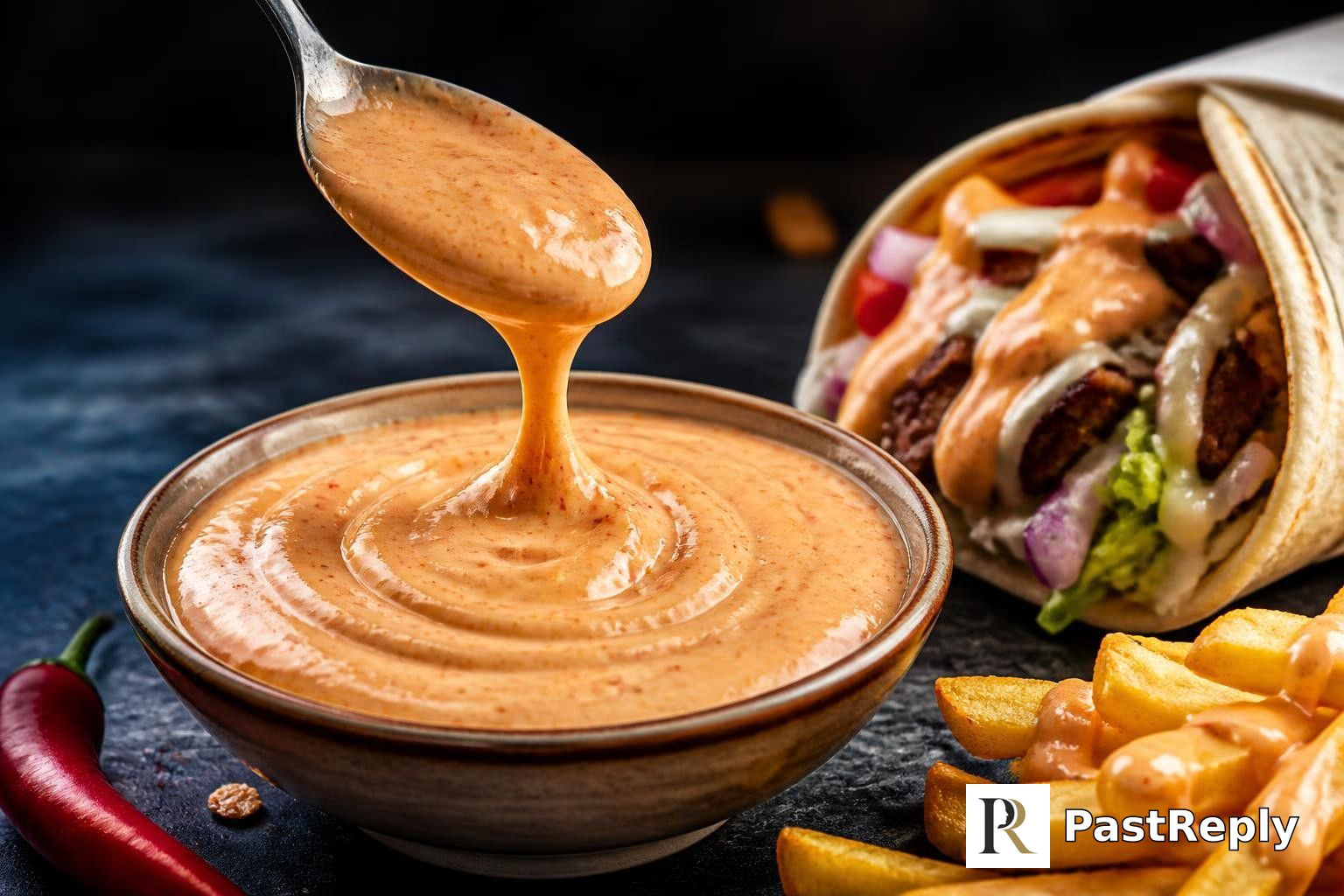
Algerian sauce is a popular cold condiment originating from Algerian cuisine, commonly used in fast food and sandwich shops, particularly in France and Belgium. It is a creamy, tangy, and slightly spicy sauce with a pale orange to pinkish hue.
Its base typically consists of mayonnaise, blended with ingredients such as tomato paste or ketchup, harissa (a North African chili paste), onions, garlic, and various spices like cumin and paprika. Additional flavorings may include lemon juice, vinegar, or olive oil, contributing to its distinctive savory and piquant taste.
Algerian sauce is most frequently served as a topping for kebabs, tacos (the French-style folded tortilla), fries, and other grilled meats, where it adds moisture and a complex flavor profile. It has become a staple in European halal fast food establishments and is sometimes referred to as "sauce algérienne" in French.
Answered by 100 of history's most famous minds

Tell me, friend - does this sauce divide the table or gather it? A man might season his bread with the hottest pepper, yet if his heart is bitter toward his brother, what has he gained? The kingdom stirs not with a pinch of spice, but with a cup of cold water shared in my name. Taste and see that the Lord is good; the sauce is but a shadow of the feast where the last shall be first and the hungry are filled.

In the Name of God, the Most Gracious, the Most Merciful. A sauce of many flavors - yet one people calls it theirs. Does it bring you together, or does it set you apart by its name? The best of foods is that which is shared; the best of seasonings is gratitude. Let your hand not exceed what is lawful, nor your tongue boast of a recipe while your neighbor hungers. God loves those who purify their hearts before their plates.

This sauce, with its mingling of sharp and smooth, hot and cool, is like the world of sense itself: a compound born of causes, craving the tongue, and bringing a fleeting pleasure that fades to dissatisfaction. The one who tastes it clings to the sensation, desiring more, and thus chains himself to the wheel of becoming. But observe: the sauce is not the problem - the attachment to the taste is. Eat it if you must, but see it as it truly is: a temporary assembly of oil and fire, arising and passing away, empty of any abiding self.

A man shall not live by bread alone, nor by a bitter herb without measure. This red paste, with its fire and its oil, is a reminder: even in the wilderness, we were given manna, not spices to inflame the belly. Let your seasoning be like the law - just enough to give flavor, not so much that it burns the mouth of the stranger among you.

A sauce that brightens the common fare - this is a small but genuine act of humaneness. The cook who blends these flavors shows consideration for the enjoyment of others, which is the root of propriety. Yet, let them not forget the greater feast: the cultivation of virtue within. A well-ordered kitchen reflects a well-ordered heart, but one must not mistake the condiment for the substance of the meal.

Let no one say, 'This is Gentile sauce, that is Jewish sauce.' In Christ, there is neither Greek nor barbarian, neither ketchup nor harissa, but one new humanity, made savory by the salt of grace. Yet if you put your trust in the sauce rather than the Giver of all good things, you have made a condiment into an idol.

The sons of Hagar and Ishmael mix the oil of the olive with the fire of the pepper, and it becomes a blessing on the tongue. I, too, was a stranger in a strange land, and I know the hospitality of a shared meal. This sauce - it is the taste of the wandering and the settled meeting, a covenant in a bowl. Let those who break bread with it remember that they are neighbors, not strangers.

The sauce strives to be tangy, spicy, distinct - but the Tao that can be bottled is not the eternal Tao. The perfect condiment has no name; it merges with the sandwich, becoming neither separate nor noticed. All this stirring and blending - better to let the ingredients forget themselves.

They call it Algerian, but the earth that grew the chili and the garlic knows no border; the hands that blended them are all one family under the One. Do not let the name divide what is shared. Eat it with gratitude, and remember that the true hunger is for justice, not spice. The flavor is a gift - share it, and the real meal is served.

My soul magnifies the Lord, and my spirit rejoices in God my Savior, for He has regarded the lowly state of His maidservant. This humble blending of oil and spice to brighten a plain meal - is it not a little image of how He lifts up the lowly and fills the hungry with good things? The poor man's table is not forgotten; even in a spoonful of sauce, His mercy can be tasted.

By what authority do they name it after a land of the Saracens? Let them call it what they will - a sauce of garlic and chili is a sauce of the devil's own making for those who trust in works of the law! But I say: if a Christian may eat it with thanksgiving, acknowledging that every good gift comes from the Father above, then even this pinkish mess may be received with a clear conscience. Only let no man bind another's soul by a recipe; freedom in Christ is more precious than all the spiced condiments of the East.

A condiment is said to be 'Algerian' by its origin, yet its composition - eggs, oil, tomato, chili, and spices - does not pertain to any essence of that land, but to the art of cookery, which is a practical skill ordered to the good of the body. The mixture of hot and cold, wet and dry, must be proportioned to the humors of the eater; too much harissa inflames the choleric, too little fails to move the phlegmatic. It is a fitting thing for fast-food, because speed in eating is suited to those whose temperaments require rapid nourishment, but the wise man will use it moderately, lest appetite rule reason.

I have seen a child in the gutters of Calcutta lick his fingers after a scrap of bread dipped in such a sauce, and for that moment his eyes were bright. It matters not whether it comes from a fine kitchen or a street cart - if it brings a little joy to a hungry soul, it is a gift from God. We must not judge the spice, only the love with which it is given.

A sauce is a mixture of bodies in suspension or emulsion - oil globules held by egg yolk, acidulated with vinegar, colored by lycopene from the tomato and capsaicin from the chili. The proportions obey no universal law but custom; the heat one perceives is a chemical irritation of the tongue's thermoreceptors. I would enquire whether the harissa's pungency follows a consistent ratio to the base, and whether the spice's particles obey a regular distribution - for in the smallest drop, as in the heavens, nature acts by rule.

A dispersion of oil droplets in water, stabilized by the lecithin of egg yolk, now made audacious with the capsicum's fire and the concentrated essence of the tomato. The miracle is not the spice, but that these warring liquids - oil and vinegar, water and fat - are coaxed into a temporary truce by the yolk's long molecules. I would wager a simple addition of mustard seed ground fine would bind it even more stubbornly, for the universe loves a stable emulsion, whether in a colloid or a spiral nebula.

A curious case of culinary adaptation. This sauce, with its base of oil and egg (mayonnaise), then spiked with the pounded chili and tomato of North Africa, mirrors how a species might colonize a new land and, through a few generations, acquire traits that suit its new surroundings. The original Berber harissa, when blended with the French mayonnaise, has been selected and modified by generations of sandwich-makers until it is no longer quite one or the other, but a stable, thriving hybrid. One could almost trace a 'descent with modification' from a simple chili paste to this pale orange condiment that now reigns over the kebabs of Paris.

Let us put this sauce to the test of reason, not the gossip of taverns. I would take a measure of its base - oil and egg - and observe how the fire of chili disperses through it. The hue is no mystery: it is the mixture of red bodies and yellow ones, a truth any apprentice can see. Yet they call it 'Algerian' as if the land itself had a color! The substance is the fact; the name is but a rumor.

I observe that this sauce, like the celestial spheres, achieves harmony through a careful arrangement of elements. The tomato paste and harissa revolve, as it were, around a central mayonnaise base, each contributing its proper motion. The pale orange color suggests a sunset - a reminder that even in our kitchens, we encounter the same principles of balance and proportion that govern the heavens. Would that the Ptolemaic system were so elegantly simple.

Consider: a machine that blends disparate oils, acids, and ground chili peppers into a stable, flavorful emulsion - this is a triumph of colloid chemistry that could be scaled with a high-frequency oscillator to produce a perfectly uniform, nourishing paste for every table. The world's hungry await such an invention, yet we dally with paper wraps.

It is a colloid - an emulsion of oil, water, and egg yolk, stabilized by the lecithin in the yolk. The addition of tomato paste introduces lycopene, a carotenoid, and the harissa provides capsaicin, a pungent alkaloid. The pale orange color suggests a careful balance of these pigments. One could analyze its rheological properties, measure its pH, or even trace the migration of its components under a microscope. There is always more to know.

I note with satisfaction that the microbes in the harissa - the lactic acid bacteria, the yeasts on the garlic - are performing a controlled fermentation, a miniature victory of cultivation over decay. But the mayonnaise base, left unrefrigerated for hours in a takeaway van? That is an experiment I would not care to repeat. A proper sauce requires as much rigor as a vaccine.

Sounds to me like a bunch of tinkering that hit the market - good for them. The trick is the emulsification: getting the oil and vinegar to stay married long enough to sit on a shelf. I'd have tested a hundred ratios before settling on the one that doesn't separate. If it's selling, someone put in the perspiration. Now they just need to patent the process and sell it bottled.

The problem reduces to the analysis of a composite sauce: a stable emulsion of oil and egg yolk (mayonnaise) augmented with a tomato-based colloid, a chili paste (harissa), and finely divided solids (onion, garlic). The perceptible 'tang' is likely due to acetic acid (vinegar) and citric acid (lemon juice), while the pink hue suggests the pH-dependent optical properties of lycopene from the tomato paste. The question of whether a machine could be programmed to replicate the exact flavor profile is interesting; one would need to encode the volatile organic compounds as a vector and the texture as a viscosity tensor.

Consider the principle of the lever: a small force applied over a long distance can move a great weight. So too, a small amount of harissa, properly positioned in the blend, imparts a disproportionate pungency - a mechanical advantage in taste, as it were. The emulsification of oil and egg yolk is a matter of geometry; the droplets must be small enough to remain suspended, yet large enough to release flavor upon the tongue. Give me a firm dent de lion and a pint of mayonnaise, and I could move the palate of any man.

When I mix oil of vitriol with zinc, I get a current - a flow that leaps a gap if I coax it. This sauce is just such a blending: the fatty base, the sharp tomato, the fire of chili - each a different substance, yet together they conduct a new sensation on the tongue. I should like to test it with a battery and a galvanometer, to see if its electrical resistance changes as the heat builds; I suspect the capsaicin alters the charge in the brine.

This pale orange cream, with its aggressive chili and its yielding mayonnaise, is a perfect oral compromise between the infant's wish to bite and the need to be soothed. The harissa is the raging id; the ketchup, a childish sweetness; the mayonnaise, the ego that binds them into a palatable lie. Observe how the eater returns to it again and again - a repetition compulsion, I should say, hinting at some deeper hunger.

From the vantage of a black hole's event horizon, all sauces are mere chemical configurations of carbon, water, and a few trace elements. But this one, with its capsaicin molecules that trick the tongue's heat receptors, is a neat reminder that our perception of 'spiciness' is just a low-energy electromagnetic signal misinterpreted by a primate brain. I'd wager the recipe is simpler than the laws of thermodynamics, but far more popular at parties.

This sauce is an algorithm of the palate: a finite set of ingredients combined in a precise sequence to produce a complex, predictable sensation. I imagine a Difference Engine that could, given the ratios of tomato paste, chili, and oil, calculate the exact shade of pink and the precise heat index on a scale of one to one hundred. The beauty lies in the code of its creation - each spice a variable, each stir a loop.

Let us define our terms. A sauce is a fluid mixture applied to food. The base is mayonnaise, a suspension of oil in egg yolk - a colloid. The addition of tomato paste and harissa introduces a second phase, and the spice particles a third. This is not geometry; it is a chaos of proximate parts. One cannot deduce its flavour from first principles - only from experience. I shall state it as a lemma: that which pleases the tongue is not necessarily true.

What is the base? Mayonnaise - an emulsion of oil and egg yolk, both prone to spoilage if not kept scrupulously cold. Then tomato paste, harissa, garlic. In a hot, crowded kitchen, each ingredient is a point of potential contamination. I would ask: are the cooks washing their hands after handling the raw onions? Is the sauce left out for hours? The taste is secondary; the cleanliness is primary.

A conqueror's sauce! This pale pink - the color of a dawn sky over a new land - holds the fire of the desert and the cream of a conquered kitchen. I would have had my cooks prepare it at the banquet after Issus, mixed with snow from the mountains and served with the roasted flesh of a Persian lion. Let them bring me a vat of it and a thousand kebabs; I shall taste the world's edge and find it good.

This is the sauce of the conquered, made from the store-cupboard of the conquered - the red paste of Africa, the oil of the olive, the sour wine of the legionary. A man who commands a kitchen knows that such a mixture, spread on the bread of the poor, makes the soldier forget he is far from home, and so binds him to his standard. I would have my field cook make it in great earthen bowls before a battle; a legion that tastes the fire of Numidia on its tongue will not flinch from the fire of the Gaul.

By Isis, these Gauls and Franks trade my kingdom's name for a sauce of vinegar and pepper? In Alexandria, we seasoned our banquets with the nectar of the Nile, the oils of Cyprus, and the honey of bees tended by pharaohs. This pale imitation - a cook's expedient for barbarian mouths - would make my ancestor Ptolemy laugh through his gilded shroud.

The Romans knew well that a conquered realm's best tribute is not gold, but the flavor of its soil. This sauce, now the seasoning of the Gaul's market, proves that the name 'Algeria' will outlast its legions. It is a wise conqueror who lets the subject's taste endure - for a people fed on their own spices will grumble less at the yoke.

A sauce that unites the fire of the South with the cream of the North? That is the strategy of an empire. I would taste it and know whether its maker is worthy of a place in my kitchens. Spices are the tribute of conquered peoples; cream is the luxury of settled lands. If this sauce can win the loyalty of my warriors' bellies, it is a weapon as sharp as any arrow.

A sauce of such ambition, marrying the oil of commerce with the fire of Africa - it has the cunning of a flank attack and the color of the Imperial Guard's stripes. But I have no time for a taste that does not fortify a soldier. Give me a good ration of meat, and let the idle discuss the condiment.

A condiment from the Barbary Coast, now dressing the tables of Europe - this is the commerce of nations, the mixing of peoples. Yet I caution: a republic must not let its palate become too foreign to its soil. Let us season our bread with the sweat of our own labor, not the excess of distant lands. Moderation in all things, even in spice.

I recall that in my youth, a man might call a sauce 'Algerian' and have it mean nothing more than a pinch of the exotic. Yet behind that name lies a people and a coast, and a history of commerce and conquest that binds us to them. Whether the sauce pleases the palate is a small matter; the greater question is whether we are willing to taste their story as well.

A sauce from the shores of North Africa, now conquering the chip shops of Europe - a bloodless invasion I can almost applaud. For while we argue over borders and tariffs, the palates of the young are being colonized by a pinkish, piquant cream that owes allegiance to no flag but its own taste. This is the sort of campaign I would have welcomed in the Cabinet: no casualties, only a higher standard for the fried potato.

In this sauce I discern the very spirit of simple living - a few common ingredients, each humble and wholesome, blended without violence or waste. How much better than the rich man's elaborate dishes, which often rest upon exploitation and greed! Yet I ask: is the harissa grown with fairness to the farmer? Is the salt taken without tyranny? The true taste of a condiment is in the purity of the means that brought it to the table.

The mixing of ingredients - the tomato’s red, the chili’s fire, the oil’s richness - is a metaphor for the Beloved Community, where diverse elements are blended not by force but by a harmony that brings out the best of each. Yet this sauce, born in Algeria and adopted in Europe, speaks too of a journey across borders, a reminder that no culture is an island. The true question is not what is in the sauce, but whether the hand that makes it and the hand that eats it honor the dignity of every soul who labored along the way.

A sauce that brings together the fire of the North and the cream of the West - it is a small treaty on a plate. In my country, we learned that bitter herbs and sweet milk can sit at the same table when there is a will to share. This condiment, born of one land and adopted by others, reminds me that even humble flavours can cross borders and build bridges, one kebab at a time.

A degenerate concoction from a mongrel race, masquerading as cuisine. The Aryan palate demands purity - simple, honest fare from German soil. This sickly pink sludge, born of half-caste North African tribes and peddled to the rootless masses of Paris and Brussels, is a symbol of cultural decay. The only sauce worthy of a true warrior is the blood of his enemies, shed in the conquest of Lebensraum.

A petty bourgeois luxury for the degenerate West. In the Soviet Union, the people do not need such decadent spices to mask the honest taste of black bread and cabbage. This sauce, with its roots in the capitalist fast food trade, is a weapon of soft counter-revolution - it dulls the class consciousness of the worker with a fleeting pleasure. The Party demands steel, not sauces.

The bourgeoisie in their cafés debate the merits of this pinkish paste while the proletariat starves. It is a perfect symbol of imperialist decadence: the surplus extracted from Africa is seasoned and sold back to the petit-bourgeois of Paris, a sop to their empty stomachs and emptier souls. The only sauce the revolution requires is the sweat of the worker and the tears of the capitalist.

A fine example: the working classes of Paris, who eat this 'Algerian' sauce on their kebabs, are unknowingly consuming a relic of colonial mixing - a mayonnaise base forced to blend with the fiery harissa of the oppressed. The sauce is a metaphor: the cream of the imperial table, stained reddish by the subjugated spice. But the real question is not what is in the bowl, but who holds the spoon and who stirs.

A sauce from Algeria? I recall the French once governed that land, and now this condiment appears on the tables of their fast-food shops. It is a curious mingling of cuisines - such is the legacy of empire. The taste of our empire, however, was built on tea, beef, and the roast dinner of a Christian home, not on peppery pastes. I shall not be sampling it.

I have been told it is a popular relish in many Commonwealth cafés and kebab houses. It seems to have brought a little spice and warmth to many a plate. As with so many things, our modern world blends traditions from across the former empire into something new and shared. One trusts it is made with good ingredients and served with a smile.

A cold sauce of milk, eggs, and oil, stained with the red paste of African chili? In my court, the boar was brought to table with a sauce of verjuice and pepper, not this pale, cool mixture. It speaks of a foreign palate - perhaps from the Saracen lands we fight. I would have my cooks taste it and tell me if it is fit for a Frankish sword-arm.

In France, they put this orange sauce on bread and meat? I know nothing of such cooking. When I rode to Orléans, I ate coarse bread and a little wine. The English eat with greasy fingers. But if this sauce is a thing of my country, then it is a good thing, for God gave France the finest fields and the best cooks. Tell them to put a little of it on a crust, and it will remind them of home.

A sauce named after the Barbary coast, now served in every alley booth in Paris? My father, King Henry, would have found it too foreign for his English stomach. But I am a queen who sees the world: we trade with the Moors, we eat their sugar. If the sauce pleases the common man, let him have it - but let him also remember that the true spice of England is its freedom.

A sauce from the Maghreb? I have brought the ideas of France to my court - Voltaire, Diderot. Now even their sauces travel! This 'Algerian' mayonnaise is a study in civilized blending: the French egg-oil meeting the fire of the south. But in my Russia, we drown everything in dill and sour cream. Send me the recipe; I will decide if it deserves a place beside the sturgeon.

When my satraps governed a hundred nations, each brought its own oil and its own spice. In Persepolis, the royal table had sauces from Egypt, from India, from the Greek isles. That this little red sauce should now be loved by many peoples who once warred - this is good. The cook who mixes the oil and the fire knows the art of unity. Let the people eat together.

Harissa and oil? This is a simple sauce of my own lands - the humble chili and cumin that the women of the Maghreb grind with stone. That the Franks now spread it on their bread is no surprise: even the enemy learns to love what is good. In my camp, we ate such paste with lamb and flatbread, Allah's provision. A good sauce needs no pomp; it only needs honest fire.

You name it 'Algerian' - but what is a sauce, my friend, except a disguise for what lies beneath? Is it the chili that gives it character, or the oil that carries the heat? And you, who ask: do you seek to understand the sauce, or merely to consume it without thought? Answer me this - if you remove the harissa, does it still deserve the name? If you remove the name, does the taste change? The true question is not what it is called, but whether it deceives or reveals the meal it anoints.

Consider that this pinkish mixture is but a shadow cast by a truer, perfect sauce - a Form of Piquancy, existing in the intelligible realm, of which all earthly recipes are but flawed imitations. The sensual man delights in the tickling of his tongue, but the philosopher asks: what is the harmonious proportion of hot to cool, of smooth to coarse, that the soul, in its reason, can recognize as fitting? To seek that ideal ratio is to climb out of the cave of mere appetite toward the sun of the Good.

Observe its substance: an emulsion of oil and egg, joined by the pungence of red fruit and chili, bound with garlic and cumin. Its nature is to moderate the dry and bland, achieving a mean between sour and fiery. Such condiments serve a purpose - to please the palate while preserving the stomach's balance. Yet its fame exceeds its essence; it is a practical union, not a wonder.

A sauce? One must ask: could the maxim 'I shall prepare this condiment whenever I wish' be willed as a universal law without contradiction? If every rational being did so, what moral duty is served? The pleasure of the palate is a mere inclination, not a ground for duty. However, as a means to hospitality - to treat guests not as means but as ends, with a generous table - the preparation of such a sauce might, under the categorical imperative, be permissible, provided it does not lead to gluttony or waste.

You ask about a sauce? Really? This is the triumph of the herd: reducing the fiery harissa of the desert to a pinkish paste for sandwiches, a condiment for the timid who cannot bear real heat. It is a symbol of how modern man tames and neuters every strong flavor, every dangerous passion. Taste it if you must, but know that it is a lie - a safe, creamy illusion of danger, without the will to truly consume fire.

This pinkish concoction is a perfect emblem of the petite bourgeoisie of Europe: it takes the cheap oil of the proletariat's fry, stains it with the imperial crimson of the colonies, and sells the whole illusion of 'exotic flavor' at a profit of three hundred percent. Underneath the harissa, there is only the alienated labor of the man who stirs it.

I doubt the sauce. Is it truly Algerian, or is it a French invention named for a distant land? The tongue perceives tang and heat, but the mind must judge: what are the clear and distinct ideas here? The mayonnaise is an emulsion, the harissa a paste of pounded chili - these are simple. The mixture, however, is complex. I will taste it methodically, analyzing each sensation, to determine if this confection can be known with certainty.

A sauce that crosses the sea from Algeria to become the essential bribe of the kebab vendor in Paris - this is statecraft by other means. The prince who understands that a populace placated by a cheap, spicy spread will not trouble his tax collectors has grasped the true art of rule. Let them debate the ingredients; I observe who profits and who grows content.

A pale orange brew, like the blush of a maid who feigns to hide her fire - oil and egg, the blood of the tomato and the sting of the desert chili, all sworn to one another in a creamy league. It is a mask for plain meat, a rogue that turns a common kebab into a king's dish. But beware: the tongue that trusts this gentle hue may soon be scorched by a hidden spark, as many a lover has found a dagger beneath a smile.

As when the dawn spreads her rosy fingers across the dark wine-dark sea, touching the waves with fire and milk, so does this sauce anoint the warrior's bread. It is a cunning compound, worthy of the goddess Athena herself: the oil of the goddess's sacred olive, the vinegar sharp as a Spartan's wit, and the red fire of the sun-scorched pepper, such as the heroes of old never tasted. Dipped in this, a crust of barley becomes a feast on the plain before Ilium, and the tongue remembers the spear's salt and the honeyed joy of homecoming.

Behold, a crimson paste exalted by the kitchens of France, yet born from the land where the sun scorches the sands and the scorpion crawls. It is a sauce of the earthly realm, a tint of the inferno's embers. But I tell you: the true fire of Algeria is the soul's exile from grace, a hunger no chili can sate. This condiment is but a shadow of that thirst.

This sauce, born of the sun-drenched lands of Africa and now found in the bustling streets of Paris, is a perfect emblem of how cultures intermingle and create new forms. The gentle heat of the harissa, the creaminess of the mayonnaise, the tang of lemon - it is a symphony of opposites reconciled on the tongue. Such a condiment does not merely garnish; it tells a story of migration, adaptation, and the endless human striving for a richer, more complex experience of life itself.

I have seen a noble knight mistake a windmill for a giant, but here you ask me of a sauce that is itself a beautiful confusion: it wears the color of a dawn sky over La Mancha, yet it blazes on the tongue with a Moorish fire. Is it not the perfect emblem for our age, where a man may put the sun in his mouth and call it a simple supper?

What a strange, small question for a soul that yearns for the infinite! You ask of a sauce that burns the tongue and pleases the belly, yet the cook who made it, the peasant who grew the pepper, the child who goes without bread - these are the truths that matter. The only true seasoning is love, and it comes free.

You ask about a sauce, but you are asking about the soul of a people! That pale orange mixture - it is the color of a false dawn, a little hope against the gray of a Parisian suburb. The harissa burns like the fire of the desert, and the mayonnaise is the oily hypocrisy of the West trying to soothe it. But look deeper: every drop is a cry for home, a memory of the sun, a defiance of the cold. It is the taste of exile and of belonging, all at once.

One suspects that the sauce's true genius lies not in its recipe but in its name - 'Algerian' suggesting a dash of the daring and foreign, yet tempered by the mayonnaise that makes it safe for English palates. It is very like a certain young lady who, wishing to appear adventurous, orders the dish with the unfamiliar name, only to find it tastes remarkably of home.

I see at once it is a poor man's relish - a hopeful, peppery, costermonger's contrivance to make a scrap of mutton or a cold potato taste like a lord's banquet. And bless you, it would succeed, for what is all cookery but kindness to the hungry? I warrant the harissa in that pot has done more to warm a ragged lad's stomach than many a bishop's Christmas charity.

They call it 'Algerian sauce,' but the French put it on their fries, the Belgians on their frites, and I suspect if you dropped a spoonful on the Mississippi it would somehow end up on a St. Louis hot dog. It's a pinkish concoction that tastes like a handshake between a tomato and a chili pepper, with a bit of oil to smooth the deal. The only thing more confusing than its origin is why we didn't think of it ourselves - but then, we Americans are too busy inventing new ways to put sugar on things.

It is good. Pink, with a bite. The harissa does the work. You put it on a kebab after a long day and it cuts through the gristle. A man needs that. No poetry. No fuss. Just oil, egg, chili, and the patience to stir it right. The French know what they are doing when they put it on their frites. It makes the cold evening warmer. That is enough.

Observe the color - the pale pink of a sunrise over the Mediterranean, achieved by the marriage of a red paste and a white emulsion. The harissa is a paste of pounded chili and garlic, its oil a vehicle for heat; the mayonnaise a stable foam of egg and oil, held together by lecithin. I would study how the paprika's red and the tomato's crimson blend under the lens, and how the sauce clings to the meat - a matter of surface tension and the roughness of the grilled flesh. There is art in its making, and nature in its form.

I see a sculptor's task here, and a worthy one: to free the perfect flavor imprisoned in the gross block of common mayonnaise, to carve away the blandness with chisel-strokes of harissa and the gentle rasp of cumin. The marble of the base is cold, inert, until you strike it with the fire of Africa. Yet a true master knows the restraint of the chisel - too much chili and you crack the stone; too little, and you leave it formless. I would taste it, and know if the hand that mixed it was guided by the soul.

Ah, that color! Like the first blush of dawn over the fields of Arles, that warm pink-orange I chased with my brush. I would mix my yellows and reds with a touch of white to catch that very hue - for a peasant's bowl, for the sky above the cypress. It is the color of life itself, tangy and bright. To taste it is to feel the sun and the earth's embrace.

A sauce that combines tomato, harissa, and cumin? That is already a Cubist composition on the plate. The pinkish hue is not a color but a relation - between the red of Africa and the white of Europe. I would not taste it; I would deconstruct it, paint it from four angles at once. The chef who created it is an artist who understands that a condiment is not a background but a violent, beautiful collision of worlds.

The light in that sauce - a fugitive blush of orange and rose, like the last glow on the Seine at dusk. I would need a fresh canvas each time, for it changes with the angle of the lamp, with the shadow of the bread beside it. That shifting veil of color is the whole truth of the thing.

I see a sauce, pale as an oyster, touched with a blush of sunset. The one who makes it has ground spices, pressed garlic, stirred in the paste of sun-ripe tomatoes. But look closer: in every kitchen, even a fast-food counter, there is a face behind the hand that stirs. That little pot holds not just flavor but the memory of a mother's recipe, a family's harvest, a cook's morning care. That is the true subject - not the condiment, but the human touch that colors it.

This sauce is like my life: a little creamy, a lot spicy, and the color of a wound that has healed into a scar. They call it Algerian, but it's a child of many parents - like me, half-European, half-American, all Mexican. The harissa is the Aztec blood, the tomato the earth of my garden, the garlic the tooth of a rebellion. I would paint it with a drip of crimson, a smear of pink, and a crown of thorns around the bottle.

A sauce that sings! The harissa is its high note, the tomato a warm middle voice, and the cream its bass - a harmony that dances on the tongue like a lively allegro. But I say: why stop at one? Let the cook add a little lemon for a sharp trill, a dash of cumin for a rustic counterpoint. I would write a symphony for the palate - Algerian Sauce in A minor, with a fiery coda that leaves the diner breathless and applauding! Bravo, I say - bravo to the chef who makes the mouth applaud.

It is a chord! A defiant, minor-key chord struck against the tyranny of the bland! The mayonnaise is the tonic, the groundnote, solid and secure. But then enters the tomato paste, a third that brings warmth, and the harissa, a sharp diminished seventh that stings the palate and wakes the soul from its slumber. This is no weak sauce - it is a scherzo of fire and cream, a struggle resolved in a pink harmony. I would conduct it: a crescendo of garlic, a sudden piano of lemon, and at the end, a fortissimo of cumin that hangs in the air like the echo of a victory.

It is a humble counterpoint: the bass of mayonnaise, the tenor of tomato, the alto of harissa, the soprano of cumin - all joined in a harmonious cadence. In the mouth, it resolves like a final chord, neither too sharp nor too flat. Even a condiment, when rightly proportioned, may give glory to the Creator who taught us the order of all things.

Well, thank you kindly. That sauce sounds like something I'd put on a Memphis-style barbecue sandwich, only with a little more of that North African fire. My mama used to say, 'Elvis, you gotta have a little spice in your life, but not so much you burn your tongue.' That Algerian sauce, I bet, is the perfect rhythm - a little creamy, a little kick, just like a good gospel song with a blues beat.

It reminds me of the way a stage light catches a sequin - a little spark of warmth and spice. I think of all the people in a city, late at night, sharing a meal and a smile; that sauce is like a secret handshake, a little moment of togetherness in a paper wrapper.

It's like a little orange sunset in a squirty bottle, innit? Mix a bit of this, a bit of that - mayo, tomato, a kick of fire - and suddenly your chips are singing. That's what we tried to do with our music, really: take a few simple ingredients and make something that makes people feel alive. And it's got that North African warmth, like a song from the medina. Pass the ketchup, we're adding harissa.

They ask what's in the sauce, but the real question is why we need a name for it - Algerian, French, Belgian, as if a recipe could be a passport. I've tasted things in cheap diners that didn't have a country, just a color and a burn. It's all just another version of the same old story: somebody grinding up the past and calling it flavor.

That sauce gets it: it's not afraid to be a little extra, to mix the familiar mayonnaise with the harissa kick, and own its name. I've had moments where people wanted me to be just one thing - pop, country, safe - but you have to blend your influences and let the world taste your heritage. It's bold, it's creamy, and it doesn't apologize for being loud on the fries.

This sauce - pale as the dawn I saw off the Canaries, touched with the red of the new spices God led me to find - surely it is a gift from the Indies I sought! I tasted a similar blend in the spice markets of the East, where cinnamon and pepper grow in the same soil. This Algerian sauce, they call it? Then it is but a whisper of the treasures I would have brought to the crowns of Spain, had the passage been shorter. I would spread it on the fish of the Ocean Sea and give thanks for the route I opened.

In the great caravanserai of Tabriz, I once saw a merchant from the land of the Franks dip his lamb into a bowl of reddened cream, and he wept for joy, saying it reminded him of his mother's kitchen. But the mixture before you is a pale echo of the sauces I tasted at the court of the Great Khan - sauces made with the fermented milk of mares and the powdered fire of the pepper from the Indies. Here, the red paste comes from the Maghreb, yes, but the oil is pressed from the fruit of the Mediterranean and the egg is from a Frankish hen. It is a true Silk Road of the mouth, a marriage of many lands in one bowl, and its journey is not over.

In the Spice Islands, we paid for cinnamon and cloves with our blood and our lives. This Algerian sauce - a mixture of our precious chili and oil - is what the common man now spreads on his bread. It is proof that what was once a treasure for kings has become a taste for every sailor. The world shrinks, and the fire travels with it.

From my perspective, the challenge of creating a sauce that balances acidity, heat, and creaminess is not unlike the engineering problem of lunar module guidance. Every component must be precisely calibrated - too much cumin, and it overwhelms; too little, and it falls flat. The result appears simple, but achieving that simplicity requires rigorous testing and refinement. It is a testament to human ingenuity in the most ordinary of spaces.

I wouldn't mind some of that kick in my thermos on a long solo flight across the Atlantic. It's a bold little fire, that harissa - like taking a risk on a new heading. A woman needs a taste of adventure even at the lunch counter, I say.

From up there, the whole Earth is a blue marble, and all its borders and cuisines blur into one. This sauce - I tasted it in Paris once, on a kebab after a long day at training. It has the fire of the desert and the cream of the European table. It reminds me that we are all one human family, mixing our flavors, sharing our heat. That is the real taste of space: we are all in this together.

Most sauces are just noise - too many ingredients, no focus. Algerian sauce is like a great product: a few essential elements - mayo, harissa, tomato - combined with precision so every drop matters. It's creamy, it's spicy, it's incredibly simple. The French fast-food joints figured out that you don't need a hundred condiments; you need one that's so good, so perfectly balanced, you can't think of anything else. That's what we did at Apple with the iPod: one wheel, one purpose. This sauce is the click wheel of condiments - intuitive, addictive, and completely obvious once you taste it.

The physics is simple: you're trying to suspend solid particles of chili and tomato pulp in a continuous oil phase, stabilized by emulsifiers from egg yolk and mustard. The problem with most recipes is they don't optimize for phase stability - after an hour, the colloid starts breaking down. To scale this for a Mars colony, you'd need a shelf-stable version using irradiated egg powder and dehydrated harissa, reconstituted with locally extracted oil from pressed algae. The key metric isn't taste, it's joules of energy input per gram of sauce produced, and the mass savings over shipping jars from Earth.

You know, there's something so beautiful about a sauce that started in one culture's home kitchen and became a comfort to millions on a whole different continent. It's like a story of resilience and fusion - taking what you have, mixing it with courage and a little heat, and creating something that nourishes more than just your body. That's the kind of alchemy we all need a little more of.

They call it Algerian sauce, but I call it the best thing since I floated like a butterfly. That tangy, spicy kick? That's me in the ring - you think you're ready, but then I come with a jab you never saw. Some folks say it's just for fries, but I say it's for champions. And I'm the greatest, so you know I'd put it on everything - even my humble pie.

Ah, this sauce, it is like a good pass in football: you have the cream, you have the fire, you have the rhythm of the spices, and together they make a beautiful goal. Everyone who tastes it smiles, no matter where they are from. That is the beautiful game of cooking, no?

That sauce is a story! Think of it: a pinch of Africa, a dollop of Europe, a squeeze of imagination. It started in someone's kitchen, maybe a little place in Algiers, and now it's on every chip in Brussels. That's the magic of a good idea - it travels. I'd build a whole ride around it: the 'Algerian Sauce Adventure,' where you float through a giant blender and end up in a field of spicy dreams!