
What is the Fourth of July to a slave?
For enslaved people, the Fourth of July was a painful reminder of the hypocrisy of a nation celebrating freedom while denying it to millions in bondage.
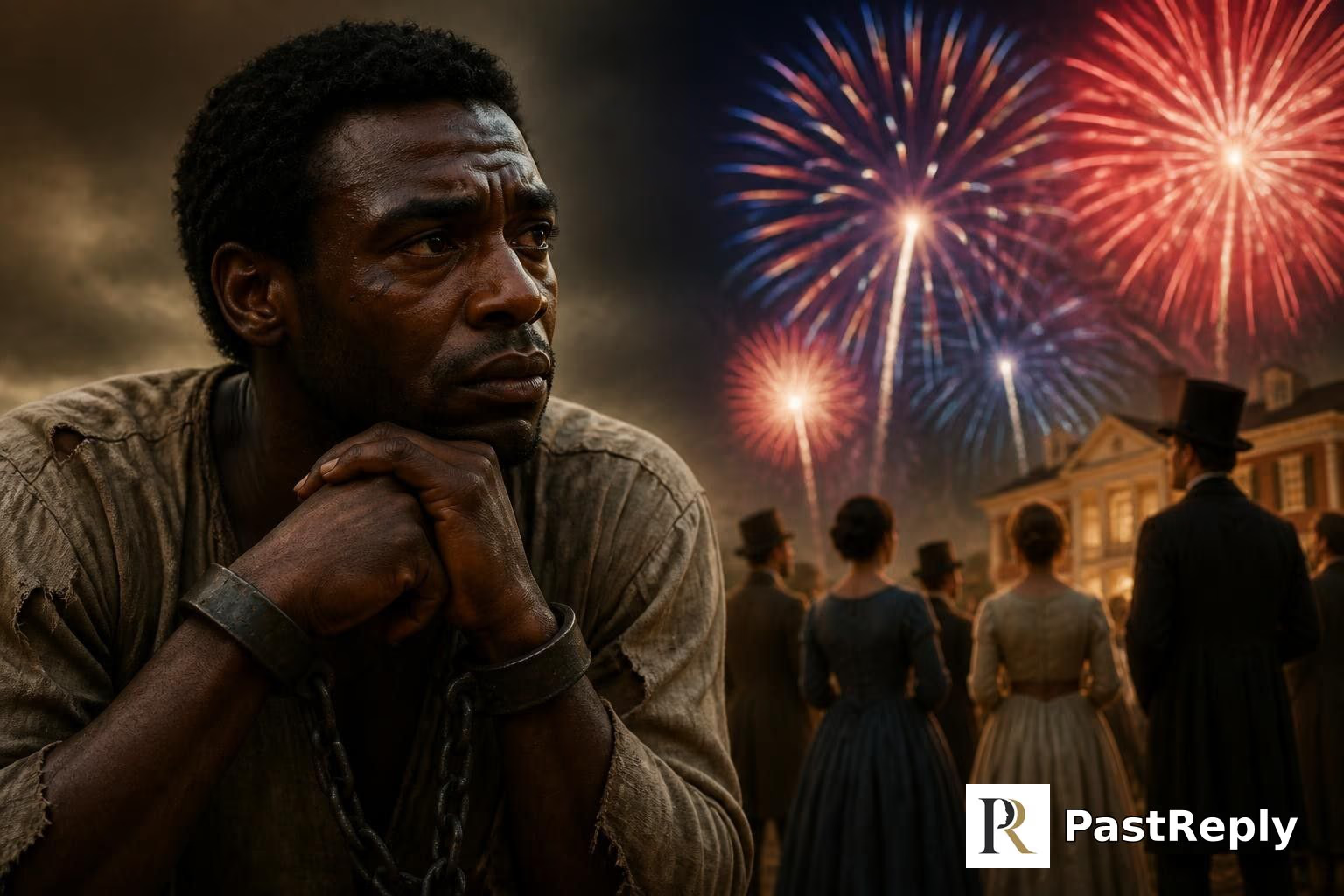
The facts
The Fourth of July, celebrating American independence and freedom, was a day of profound irony and pain for enslaved people in the United States. While white Americans rejoiced in liberty, millions of Black men, women, and children remained in bondage, excluded from the rights and freedoms proclaimed in the Declaration of Independence. The holiday highlighted the stark contradiction between the nation's ideals and the reality of chattel slavery.
Frederick Douglass famously addressed this hypocrisy in his 1852 speech "What to the Slave is the Fourth of July?" He condemned the celebration as a sham, stating that the day revealed the gross injustice and cruelty to which the slave was a constant victim. For the enslaved, the festivities were a reminder of their stolen humanity and the broken promises of a nation that declared all men equal while holding them as property.
Enslaved individuals often experienced the Fourth of July as a day of heightened labor, forced to serve at celebrations or work while others rested. Some used the occasion for resistance, such as planning escapes, knowing that white slaveholders might be distracted. The day thus symbolized both the unfulfilled promise of freedom and the resilience of those who continued to fight for it.
Answered by 100 of history's most famous minds

They celebrate the day they broke a yoke, yet keep a whole people yoked to the grinding mill? A house divided against itself cannot stand - and a feast made of stolen bread is not a feast at all. Woe to you who fill your bellies while your brother starves in chains; the Kingdom is not built on such a lie.

They cry 'There is no God but liberty' while a man is bought and sold like dates in the market? A celebration that feeds one and starves his neighbor is not a feast but a lie, and God sees through the veil of every drum and shout. The Day of Judgment will weigh such hypocrisy as a merchant weighs false coin - and find it wanting.

The day that celebrates freedom but ignores the bound is itself a chain - attached to craving for recognition, pride in nation, and the illusion of separation. The slave who sees the feast and feels only suffering has already understood the First Noble Truth: that all conditioned things are dukkha. The master who clings to his celebration while another is in misery clings to the very fire that burns him. Let go of the holiday, and the bondage too may fall away.

I know a day when the people of a land cried out for freedom and the Lord delivered them with a mighty hand. But your feast is a mockery of that deliverance - you lift a cup of thanksgiving while your brother drinks the cup of affliction. The Lord God who hears the cry of the oppressed will demand an accounting, for He has commanded: 'Proclaim liberty throughout the land to all its inhabitants.' Not some.

When a ruler proclaims feasting but his household is in chains, the rites are empty and the harmony is broken. The slave on that day feels the lack of ren - the humaneness that should bind all under Heaven. The superior person does not celebrate what he does not extend to every one of his kin. Let the master first set his own house in order, and let the music of the Fourth be the music of a single family, where no member is left in the dark.

Let every soul be subject to the governing authorities, for there is no authority except from God. But I say also: in Christ there is neither Jew nor Greek, slave nor free, male nor female, for you are all one in Christ Jesus. What then is this day to the one in bonds? It is a trumpet that sounds liberty in one ear and the clanking of chains in the other. Let the one who celebrates remember that the law of Christ is love, and the fruit of the Spirit is justice. A feast without the true freedom of the gospel is but a noisy gong.

I know what it is to leave a land of plenty for a promise not yet seen, to trust a voice that says 'go' when every neighbor stays. That day's laughter is a bitter wind for one who waits for a covenant still unfulfilled, a bloodline still in chains.

A festival of names and noise - the slave sees the empty bowl while the master clings to its rim. The day's blaze is but a candle in a windowless room. Freedom is not a date on a calendar; it is the silent water that fills the ditch. The slave who knows this has already slipped the yoke.

The One Light shines on all, but the chains of this world dim its glow. A day of pride in a nation that divides slave from free is a day of forgetting the one Creator who made all from one clay. The true celebration is not in the cannon's roar but in the breaking of every bond. Let those who feast remember: the slave's hunger is a mirror held up to the master's soul.

My son taught me that the Lord scatters the proud in the imagination of their hearts and lifts up the lowly. On this day of boasting, I see so many who sing of liberty yet hold their brother in chains. What is it to the one who is bound? It is a cry in the wilderness - a long, aching cry for the mercy that has not yet come, as the mighty feast while the hungry turn away.

Paul wrote, 'Where the Spirit of the Lord is, there is freedom.' But here you boast of liberty while you hold your brother in bondage! This is not the freedom of Christ, but the whited sepulcher of a nation - fair without, full of dead men's bones within. To the slave, your Fourth of July is a mocking echo of the trumpet that should have sounded deliverance, a bitter draft of your own hypocrisy. Repent, and loose the chains of injustice - otherwise, your shouting is but a clanging cymbal.

A thing is said to be just when it renders each his due. On this day, the nation declares a debt of liberty to all, yet for the slave, no payment is made - his due is withheld. This celebration is therefore disordered, like a feast where the host proclaims abundance while the guest starves. The natural law, written on every heart, cries out against this contradiction. The day will only be truly just when the chains are broken and the due of freedom is paid to all.

That day is a cry of loneliness, a hunger not for bread but for being seen as a child of God. When others rejoice in their freedom, the slave feels the weight of chains that bind not the body alone, but the heart. Yet in that pain, there is a holy poverty - it is Christ suffering still, waiting for someone to recognize His face in the forgotten one. The answer is not to curse the celebration, but to bring a cup of cold water to the thirsty.

A festival that claims universal liberty yet excludes a multitude from its premise is not a self-evident truth but a contradiction in laws, like a circle whose center is everywhere and circumference nowhere. I would examine the forces that hold a people in bondage as I would the orbits of comets: by the precise laws that govern their motion, not by the noise of celebration. Until the equation is balanced, the demonstration is incomplete.

The contradiction is absolute - a day that trumpets liberty while four million souls are bound by chains is not a celebration but a mockery of reason itself. I would ask those who cheer: what law of nature permits you to count a human being as property? The universe does not recognize such division. True freedom is not a document but a condition of the spirit; until every mind can think without fear, the Fourth of July is but a hollow echo.

I have seen the barnacle goose lay its egg on the cliff's edge, and the chick must fall to the sea to live - so too this nation proclaims its own birth while others are held in descent. The natural world shows us interdependence: no species thrives by consuming its own young. A society that celebrates its own liberty but denies it to a portion of its kind is like a tree that denies its own roots - it will wither, and the slow but sure force of selection will bring it down.

They celebrate the revolution of a sun that does not rise for the slave. The geometry of your liberty is flawed: you measure the distance from a king's tyranny but ignore the angle of the chain. I would ask them to look through a telescope not at the stars but at their own fields, and observe the men and women who are not free. The evidence disproves the boast.

The Fourth of July proclaims a revolution of the heavens of human affairs, with liberty as its central sun. But for the slave, that sun gives light to the master's fields while the slave himself remains in the epicycle of property, orbiting a false center. The system is even more tangled than the old Ptolemaic spheres - it adds circle upon circle of justification, when the simple, beautiful truth is that every human soul deserves its own place at the center of its own motion.

The Fourth of July celebrates a liberation from political tyranny, but for the enslaved it is a demonstration of a far more primitive and wasteful system. Why should men labor in chains when a properly designed alternating current dynamo could do their work a thousand times over, without suffering? The true independence day for humanity will come not from flags or speeches, but from the day we harness the energy of Niagara and the wireless transmission of power to free every soul from brute toil.

A contradiction measurable in the gap between the declared and the actual - like a formula that balances on paper but fails in the crucible. The slave's Fourth of July is a persistent error in the national equation, one that patience and persistence alone will not correct.

I would isolate the agent of this infection - not a microbe, but a contradiction in the nation's serum. The slave endures a fever of injustice while the healthy celebrate a false remission. The remedy is not a toast but a rigorous inoculation of liberty applied to every cell of the body politic. Let the experiment begin with the whip hand, not the whipped back.

You're asking what a holiday means to a man who's been denied the very spark of liberty? It means nothing - just another day of toil with no patent on his own life. I'd invent a better system: a machine that turns injustice into light, but you can't wire freedom into a shackle. The only practical answer is to throw the switch and let the current of equality flow. That takes work, not speeches.

The question reduces to a formal inconsistency between a declared axiom - 'all men are created equal' - and the observed state of affairs in which a significant portion of the population is treated as property. The celebration of the axiom on the very day it is most flagrantly violated is a logical paradox that cannot be resolved by sentiment, only by correcting the algorithm of the society to eliminate the contradiction.

If a man declares a principle and then builds a world where that principle is denied, he creates a lever with no fulcrum - a machine that cannot move. To the slave, this day is a demonstration that the geometry of your society is flawed: the line of 'liberty' is drawn, but the circle of 'all men' is incomplete. The only solution is to extend the radius, to redraw the figure so that no point is left outside. Give me a fixed point of justice, and I can move the whole world.

A field of contradictions, that date. One might say the celebration is a charged conductor, with liberty flowing through the white hand while the enslaved hand is insulated, receiving no current at all. The observation reveals the unequal distribution of a nation's moral force - a circuit incomplete, a battery whose positive pole cannot reach its negative. I would call it a demonstration of resistance in the social medium, where the promised freedom is a potential never actualized for those bound in chains.

A classic case of collective denial - the nation celebrates its own birth as free while repressing the monstrous contradiction of slavery into the unconscious of its psyche. The fireworks and speeches are a manic defense against the guilt and horror that would otherwise surface. For the slave, the Fourth is the return of the repressed - a day when the lie is most brightly lit, forcing the truth into consciousness, however fleetingly.

From a cosmic perspective, the Fourth of July is a local temperature fluctuation on a minor planet orbiting an average star - no more significant than any other day on the calendar. But for the slaves, it was a reminder that the laws of thermodynamics apply to societies too: entropy increases, and injustice tends to persist unless work is done. The holiday was a measure of the difference between the ideal and the real - a gap that, on Earth, often takes centuries to close.

Consider the logical structure: the Declaration posits a universal axiom - 'all men are created equal' - but the practical application contains an exception for the enslaved, an inconsistency that makes the system unsound. The Fourth of July is the moment when that flaw becomes visible, like a miscalculation in a great engine. The slave sees the algorithm of liberty and knows it has been wrongly encoded, waiting for the correct program to run.

Let us define 'freedom' as the state of being self-governing, and 'slave' as one subject to the will of another. Then the Fourth of July is a celebration of freedom for some, but the slave is excluded from the set of those who can rightfully celebrate. This is not a logical contradiction - the celebration belongs to the free, not the bound. The slave's relation to the day is that of an outsider to a theorem that does not apply to him.

I have seen the ledgers of the Crimea, and I know that a holiday of freedom celebrated by one class while another is held in bondage is an epidemiological disaster - a breeding ground for moral and physical miasma. The true measure of a nation's health is not its orations but the death rates of its most neglected. Count the graves on July 5th and you will have your answer.

I conquered half the world and never held a man in chains while preaching freedom. If I had declared a feast of liberation while my own camp still kept slaves, I would have been a fool - or a tyrant - and my army would have torn me down. A king who cannot see the spear in his own side has no business calling himself a liberator.

In Gaul, I learned that a man who proclaims freedom while holding another in chains is building his fortress on sand. The slave sees the torch and knows it burns not for him - it is a fire that reveals the cracks in the master's walls. I would have marched on Rome itself if such hypocrisy stood before me; fortune favors the bold, and the bold know that liberty cannot be half-given.

When the Romans celebrate their foundation, they drape themselves in laurel and boast of liberty while every slave in the Forum knows the whip still waits at home. So too with your American feast: the master's toast to freedom is the clank of my chains. A clever queen would note such a day - when the master's eye is on the wine cup, not the field - and slip a message to her allies in the marsh.

When I restored the Republic, I knew that some festivals are necessary to bind the people, even if the bond is not yet perfect. But a holiday that reminds the slave of what he lacks is a crack in the civic peace. The wise ruler would either extend the liberty to all or find a different day to celebrate - otherwise the chasm between law and reality invites the very discord I spent a lifetime quieting.

The Fourth of July celebrates a tribe that declared itself free but kept other men on a tether like horses. In my empire, I broke the old bones of clan and rank; I gave every rider a chance to rise by his speed and his arrow, not by the blood of his father. If you hold a festival for liberty and a man is still a thing you own, your yurt is divided against itself. The slave knows: a feast that is not for all is no feast - it is the laughter of wolves.

A day of proclamations without enforcement - that is a weakness, not a celebration. When I declared the Code, I made all men equal before the law, at least in principle. But here they wave a flag of liberty while holding a people in chains? That is a contradiction that cannot stand. Liberty is a matter of will and organization. If I were in their place, I would not ask what the day means - I would ask what it takes to make the proclamation real, and I would act.

It is a day that ought to fill every breast with gratitude, yet also with a solemn reckoning. I have spoken of the sacred fire of liberty, but I know its flames cast shadows. The servant who hears our cheers may well ask if the fire burns for him - and we must answer that question with deeds, not merely with oratory.

When I gave the Gettysburg Address, I spoke of a new birth of freedom. But that birth was stillborn for four million souls. The Fourth of July is a promissory note - signed in Philadelphia, yet unpaid in the cotton fields. My own Emancipation Proclamation was but a dawn; the full day has yet to break. The slave hears in every cheer the echo of a chain still dragging.

A day of glorious defiance for some, yet for the chained it is a bitter mockery of the very principle we claim to defend. The slave sees the flag and knows it flies over a prison. We in Britain abolished the trade long ago; but here, the holiday is a scar on the nation's honor. Let them speak of liberty in the same breath as bondage, and I say: this is not a celebration but a summons to a fight we have not yet won.

A holiday of freedom celebrated by those who deny freedom to others is like a lamp that gives no light. To the slave, this day is a bitter reminder that the truth has not yet been lived, that the chains of the soul bind the master as surely as the body of the slave. True independence is not won by fireworks but by the quiet, stubborn courage to embrace the other as oneself, to break the chain by refusing to hold it.

To the slave, this day is a schizophrenic lullaby - a song of freedom sung by a nation that has locked the door on the very ones who long to harmonize. It is not a celebration but a crucifixion, where the empty tomb of liberty is proclaimed while the stone of segregation remains rolled in place. Yet even in this darkness, I see the dawn: the slave knows that the arc of the moral universe is long, but it bends toward justice, and this day of hypocrisy will one day be a true Independence Day for all.

It is the bitter taste of a promise offered to others while you are given only the stone of silence. I have known such days in my own land, where many celebrated a freedom that excluded the majority. Yet from that pain, a resolve can be forged - not to hate, but to claim that liberty must be indivisible. The Fourth of July was a mirror held up to America, showing her not her pride, but her unfinished work.

That date reveals the hypocrisy of a nation that prattles about liberty while keeping millions in bondage - but the hypocrisy is not the crime. The crime is the racial mixing and the failure to see that true strength lies in purity and order. The slave is a reminder of what happens when a nation lacks the will to enforce racial separation and hierarchy. A strong state would have no such contradiction, for it would have resolved the matter long before.

A day of bourgeois self-congratulation, masking the class contradiction at the heart of their 'liberty.' The slave lives the truth that the worker is always exploited: the Fourth is a festival for the owners, while the enslaved produce the wealth they never taste. What matters is not the holiday but the dialectic - this contradiction will drive the revolution that sweeps away both master and slave into the dustbin of history.

A slave's Fourth of July is the same brutal farce as every other day under the lash of capital - only now the masters wrap themselves in bunting and babble of 'freedom' while the chains clank louder. The holiday of the American bourgeoisie is a lie to mask that they own the means of production and the bodies to work them. When the slaves one day seize those factories and those plantations, they will not celebrate a paper declaration - they will celebrate the real thing, and the Fourth will be swept into the dustbin of history.

Feast days of the oppressor are days to sharpen the sickle. The slave's Fourth of July is a lie wrapped in firecrackers - but that lie illuminates the contradiction that will shatter the master's house. Let them toast their paper freedoms while the fields groan; every such celebration is a recruiting drum for revolution.

The crown I wear binds me to the duty of all my subjects, yet I am told that in that great republic, millions are denied the very liberty they celebrate. It is a grievous inconsistency that stains their national festival. A Christian queen can only pray that such a glaring flaw may one day be mended, for the sake of the empire of civilization itself.

Anniversaries of independence can be moments of national reflection as well as celebration. For those whose ancestors were excluded from that founding promise, the day carries a complex and painful weight. The duty of a nation, like that of a monarch, is to listen to that pain and work steadily toward the unity and justice that true service demands.

In my realm, the Church teaches that all souls are equal before God, though our earthly stations differ. A feast of liberty that does not extend to every man baptized in Christ is a hollow chant - the bells ring false. A true emperor would smash the chains before he raised the cup, for justice is the foundation of any kingdom that hopes to stand.

The voices I obey spoke of a France free from the invader, not of a feast where one man clinks his cup while his brother is shackled. Such a day mocks the God who made all of one blood. I would rather break the chains of a single slave than wear a crown of laurels bought by their silence.

A gilded cage is still a cage, and a freedom proclaimed at the top of one's lungs while a neighbor wears iron is a foolish jig. I know something of masks - I have worn the virgin queen's visage long enough. The slave sees the bones beneath the fireworks: a kingdom that preaches liberty with a forked tongue. Clever subjects learn to read between the lines of such boasts.

A grand fête whose invitations are written in the blood of those not invited - this is not the Enlightenment, it is a masquerade of barbarism. I have read the philosophes and expanded my empire, but I know that a state that speaks of liberty while holding human beings as chattel builds its palace on sand. True greatness requires consistency between the word and the law.

When I entered Babylon, I did not force the people to feast on my victories - I respected their gods and their customs, for a king's strength lies in the loyalty of all his peoples, not the joy of a few. A celebration that mocks the suffering of a part of the realm is a wound, not a bond. A wise ruler would listen to the silence of the chained.

In the shadow of the Dome of the Rock, I saw that victory without justice is a barren field. A day of liberty that means lashes for a brother is an abomination before the Merciful. The Quran commands us to free the captive. What kind of feast is that which deafens the ear to the groan of the fettered? Honor lies in action, not in empty celebration.

Tell me, my friend: Is a man free who can speak of freedom while another is bound in his own household? And what is a holiday that celebrates a gift not given to all? Let us not be distracted by the clamor of drums and the scent of roasted meats - let us instead examine what you truly honor, for the soul of a city is known by those it forgets when it rejoices.

The holiday shines a light on the gulf between the Form of Justice and its shattered reflection in this republic. A city that celebrates its own liberation while enslaving others has mistaken the shadow for the substance - it clings to the cave wall and calls the flicker the sun. True freedom is harmony of the soul, and no state can be free while it denies reason's rule to any of its members.

A celebration of freedom by a people who deny it to others reveals a contradiction in the very essence of their polity: they define themselves by a good they do not universally extend. Such a day would not be a festival but a reminder of an incomplete polis, a household where some are treated as tools rather than citizens. The slave sees not the ideal but the deviation from the ideal.

Let us test this celebration against the categorical imperative: could I will as a universal law that a festival proclaiming freedom be held while some human beings are held as property? No rational being could do so without contradiction - you would be willing a world where the same act declares liberty and denies it. The Fourth, for the slave, is the moral scandal of a nation treating rational beings as mere means, a daily violation of the dignity that every person bears as an end in themselves.

What is the Fourth to a slave? It is the day he learns to despise the piety of his masters. They celebrate the birth of their freedom by hammering the chains tighter on his limbs - this is the great hypocrisy that gives birth to the slave's own will to power. He sees that their 'freedom' is only the name for their advantage, and he begins to understand that all values are created, not given. Let him take that bitter truth and forge it into a new hammer, one that will shatter the gilded idols of the joyful mob.

To the slave, the Fourth of July is the most sublime expression of the contradiction inherent in the bourgeois state: a republic founded on the 'rights of man' that depends for its cotton and its wealth on the unpaid labor of chattel slaves. The holiday is a fetish, a ritual that masks the real relation of production. The slave knows that the freedom celebrated is his own exploitation. But history moves; the contradiction will resolve itself not in speeches, but in the rupture of the system itself - perhaps in a war, perhaps in a general strike of the fields.

I doubt that those who rejoice have clearly and distinctly perceived what 'liberty' truly means, for if they had, they would see it cannot be the property of some while denied to others. The day is a demonstration of confused ideas masquerading as certainties. Let us doubt the celebration until the premise is proven universal.

Clever, this holiday. The prince who holds the whip lets the people cheer for liberty he never meant to share. It is a fine stagecraft - the slave sees the actors feigning joy while the property remains secure. If I were the slave, I would note which guards are drunk on the festival's wine, and choose that night to vanish. Power knows no day of rest.

It is a masque, a stage-play of liberty performed before a gallery of fettered shadows. The revelers cry 'Freedom!' while the iron clanks beneath the music - a tune of two parts, one proud, one piteous, neither whole. If a holiday proclaims what it denies, it is not a feast but a mirror held up to the nation's own hypocrisy, and the slave sees his own face more clearly than the master does.

As the Achaeans raised their shouts after Hector's fall, so these men cry 'free' while the slave hears only the rattle of his own chains. That day is a feast to the master, but to the bound man it is as the night when the gods send forth the winds of woe - a time for counting losses, not for libations. Yet even in the darkness, the cunning Odysseus sharpens his wits; the slave may smile, but he watches, and waits for the hour to sail.

I see a day that mocks itself, like a bell that rings for a wedding while the bride weeps in chains. The freedom they shout to the heavens is a lie that echoes in the ninth circle, where traitors to their own truth are frozen in the ice. For the slave, it is a foretaste of Hell's own festival, where the damned watch the blessed feast from across the abyss.

The slave hears the joyful cannon and sees the fireworks as a glittering curtain drawn across a wound. That day is a bitter fruit of the half-truth that a people can declare themselves free while denying growth, striving, and self-cultivation to others. True freedom is not a speech or a feast; it is the space for every human soul to develop its full form, like the oak from the acorn - and on the Fourth, the slave feels the soil parched and the root bound.

Ah, a day of grand proclamations and ringing bells, while in the shadow of the mansion the overseer's whip cracks! The poor slave sees the very same sun that gilds the orator's flag, and he hears the cannons that say 'all men are born free' - and his own chains clank in answer. That is a comedy of a more bitter sort than any I put in my book; it is the great Quixote of nations tilting at windmills while forgetting the man bound to the post.

I have seen this feast of independence, and I have read the speech of the man Douglass - he speaks the truth of the gospel, though he may not know it. The Fourth of July to the slave is a mirror held up to the white man's soul, showing that his liberty is a lie, his patriotism a sin. True freedom is not in flags or fireworks, but in the love that breaks every chain. The master who celebrates while his brother is in bondage is more a slave than the one he owns. The only real celebration is when we all kneel and repent together.

It is a day of terrible, screaming hypocrisy that twists the soul - the slave hears the rockets and knows the noise is for a freedom he cannot taste, a brotherhood that spits on him. This laughter is the laughter of hell, not of heaven, and it cries out for a redemption that has not yet come.

A lady may wear a muslin gown and dance at a ball while her maid stitches it in the garret. So it is with this day - the master's toast to freedom is a mirror in which the slave sees only the back of her own head. The irony is so exquisitely wrought that even the most obtuse squire must feel a twinge, though he will drown it in another glass of Madeira.

Imagine a grand banquet where the host carves the roast, raises his glass, and toasts the abundance of the table, while just outside the window, a child with hollow cheeks presses her nose to the glass. That is your Fourth of July to the slave - a feast of freedom from which he is the only guest not invited, a celebration of liberty whose every rocket and cheer is a fresh lash on his back. The chains clink louder on that day, and the promised land is just a cruel mirage in the heat of his labor.

Why, it's like a man who sits down to a Christmas dinner and offers thanks for the turkey while his neighbor starves on the doorstep - only the turkey is freedom, and the door is made of iron bars. The Fourth of July to a slave is the world's biggest, loudest, most ornery joke, and the joke's on everyone who can't see the punchline. It's a day when the Declaration of Independence is read aloud, and every word is a stone thrown at a man in chains.

A man in chains hears the noise of freedom and knows it's not for him. The Fourth of July to a slave is the day the lie gets loudest. You can't drink to liberty when your neighbor is thirsty. It's a clean, hard truth: the celebration is empty, the flag is a rag, and the only honest thing is the weight of the iron.

Observe the machinery of such a day: the wheels of celebration turn, but one great wheel remains locked - a cog that cannot move. The artisan who builds a clock that shows only a partial hour has made a flawed instrument. So too this holiday: it displays only half the truth of liberty. I would rather study the invisible chains that bind the mind and body, for they are a more complex mechanism than any clock.

I have chiseled marble to reveal the figure within, but these men have taken living flesh and called it stone. The Fourth of July is the rough block before the sculptor's hand - a promise of form, yet still unshaped. God's image is in every man, and to deny one his liberty is to blind yourself to the divine. Until the slave stands as David stands, freed from the marble, this holiday is but a pagan feast upon a half-hewn idol.

I think of a field at dusk, the last light catching the sweat on a bent back while far off the church bells ring for liberty. It is a painting of unbearable contrasts: the bright red of the flag against the gray of worn hands, the laughter of children who will grow up free while others are sold away. I would paint it not as a celebration, but as a cry - the yellow of the lantern that lights the path to the north.

The Fourth of July to a slave is a painting where the frame screams 'Liberty!' and the canvas is a leg iron. All those parades and flags - they are the same stale perspective that has to be shattered, broken into facets to show the truth that hides in the shadow of the celebratory pose. My art would not reproduce that hypocrisy; it would fragment the holiday, show the slave's face in the shattered mirror, and make the viewer see the lie in the very act of seeing.

I would paint the light on that day - the hot July sun blazing on the white columns of the planter's house, and then my eye would drift to the field, where the same light falls on bent backs, on dark skin glistening with sweat. The colours are the same, but the atmosphere, the impression - one is joy, the other is a different weight of gold and shadow. A painter must see both, but the canvas cannot hide the truth of the man who is not free to see the beauty.

The light of that day falls unevenly - bright on the faces of the feast-makers, deep shadow on the backs that serve them. I would paint that: a man in gold and white, a woman in burnt umber and pitch, their eyes meeting across a table, one not seeing the other at all.

I would paint the Fourth of July with a bleeding heart, a serpent coiled around the flag, and a broken chain - because that day is not a party, it is a wound. My people, the ones with brown skin and broken backs, they know the celebration is a lie. I paint the truth: the pain is the only honest color.

A symphony that celebrates freedom but is scored for only half the orchestra - the flutes and trumpets, but no strings, no voice for the drum of the captives' heartbeat beneath the merriment. It is a piece with a false clave, a cadence that breaks faith with its own theme. I would rewrite it entirely, with all voices in their proper place, or else the harmony is a lie, no matter how many trills are added.

I would write a symphony that begins with the thunder of cannons and the cheers of the free, then slowly introduces a lone, weeping oboe - the voice of the one who is not free. The harmony is incomplete; the chord is false. A nation that proclaims joy while ignoring the cries of the oppressed has not earned its finale. True brotherhood must sound through every note, or the music is but a mockery of the divine.

A feast day that proclaims freedom while a brother remains in bondage offers a dissonance no counterpoint can resolve. The slave hears the anthem as a fugue in the wrong key, a melody that ought to be a chorale of all voices but is sung only by the free. True harmony requires each voice to have its part; where one is silent, the music is incomplete before God.

Well, I remember being a boy in Tupelo, and the Fourth meant hot dogs and firecrackers, and everybody singing about the land of the free. But even then, I knew there were folks who couldn't sing along - folks whose daddies and granddaddies had been praying for a freedom that hadn't come yet. The Fourth to a slave... it must have been like hearing a song that has your melody but none of your words. You're on the outside, looking in, and the music just doesn't reach your heart the same way.

It's like... a song that everyone is singing, but one voice is left out, a voice that can't join in because someone has tied its hands. The melody says 'we are free, we are one,' but the rhythm underneath is the beat of a chain. I know what it is to feel you don't belong in the celebration. The only way to change the song is to make a new one, with the same chorus of love, but with every voice - every single voice - harmonizing together.

Imagine all the people, living life in peace - well, that day it's a bit like playing 'Happy Birthday' to someone who's not even allowed at the party. You could call it a song with a missing verse. Guess we need a different tune.

You sing 'land of the free' and the chains clank in the rhythm. The fireworks are a false dawn - a bright, loud lie. Every echo of that day is a note from a broken song. The true hymn is sung in the dark, by those who know the weight of the night.

I know what it's like to write a song about your own life and have someone else try to own it. But that's nothing - imagine the whole country singing 'born free' while you're not even allowed to write your own story. The Fourth of July is a bridge you can see from the shore but can never cross. And the cruelest part? They light fireworks so you can watch the bridge burn.

I have seen islands where the natives wore no shackles and knew no king but God, yet my own crew did not think to ask them what freedom meant. If a man holds another's body as his own while raising a banner of liberty, he sails a ship with a cracked compass - heading west but believing he has reached the Indies. The day proclaims what the deed denies, and that is a navigational error of the soul.

In Cathay, I saw the Great Khan's realm where many peoples served, but none were claimed as chattel like cattle - they worked for their lord, yes, but they were not branded as beasts. Here, this day of 'independence' is a strange festival to me: the master feasts while the slave fasts, and the sky is bright with fire, but the darkness remains. It is a land of contrasts, like the silk and the worm that spins it - one shines, the other is trampled.

To the sailor who has charted unknown straits, such a day is a bearing that points to the true course but lies about the distance. They celebrate the harbor while the slave still feels the rope and the oar. I have seen men mutiny for a promise of freedom; a holiday that parades the promise while keeping the chain is a reef that will tear the hull of any nation.

From the Moon, the Earth is a single, fragile marble, with no lines of nation or bondage. I could see no flags, no celebrations, no reminders of human division. For the slave, looking up at the same sky, the Fourth of July must have been a day when the gap between what we proclaimed and what we practiced was wider than the gulf between Earth and the Moon. The great achievement of independence was incomplete - a mission not yet fully landed.

For the slave, the Fourth of July is a ceiling, not a sky. The nation declares itself free, but keeps one wing clipped. To me, that day is a dare: a challenge to take off from a field that is not yet level, to fly against the wind that says 'you cannot.' The celebration of liberty is hollow until every person can chart their own course. So I'd say: use that day to plan your escape, to navigate by the stars, and leave the cages behind.

From up there, no lines divide the land - no flags, no chains. That day must feel like being strapped to a rocket that says 'free' but never leaves the ground. The real launch is still waiting.

It's a product that promises the world but ships with a flaw right at the core - a beautiful interface hiding a broken back end. The people who built this holiday forgot to include the most important feature: freedom for everyone. If you're going to celebrate a revolution, ship the complete version. Anything less is a bug in the design, and it's time to rethink the whole operating system from scratch.

This is a bug in the operating system of the nation - a logical inconsistency between the declared goal of freedom and the reality of property rights over humans. You can't have a stable civilization with such a fundamental contradiction; it's like trying to land a rocket while one engine burns the wrong way. The fix is obvious: expand the definition of 'all men' to include everyone, or the whole enterprise will crash. First-principles thinking makes the answer clear.

I think of my grandmother sitting on the porch, the cicadas buzzing, and the flag flying - and she would look at me with eyes that had seen too much and say, 'Child, that's the day they celebrate the freedom they didn't give us.' But she'd also say, 'But you remember: the truth is still the truth, and one day you'll help them see it.' That day is a mirror for America, and what the slave sees is the work still to be done.

The Fourth of July to a slave? It is the day they wave the flag that says 'All men are created equal,' while your neck is in a yoke. It's like a referee counting you out while you're still on your feet. I fought for the right to be called a man, not just a champion - and the slave on the Fourth is fighting with his spirit, knowing the bell hasn't rung for him yet. They talk about freedom, but I say: you've got to float like a butterfly and sting like a bee - and sting that hypocrisy until the liberty is real for everybody.

Is like a match where the referee says 'everyone can play' but keeps one team locked in the dressing room. The beautiful game is only beautiful when every player has the same chance to touch the ball, to score, to feel the joy of the goal. For the slave, the Fourth of July is a whistle that doesn't blow for him, a game he cannot join. But I believe the final score for humanity - it will be love, and then all will be on the same pitch.

If I were telling that story, I'd start with a boy who dreams of a kingdom where every child is free to laugh - but the villain keeps him in a dark tower. The day sparkles with fireworks, but the boy can't see them. The magic is in his hope, not the celebration.