
When are vegetables in season?
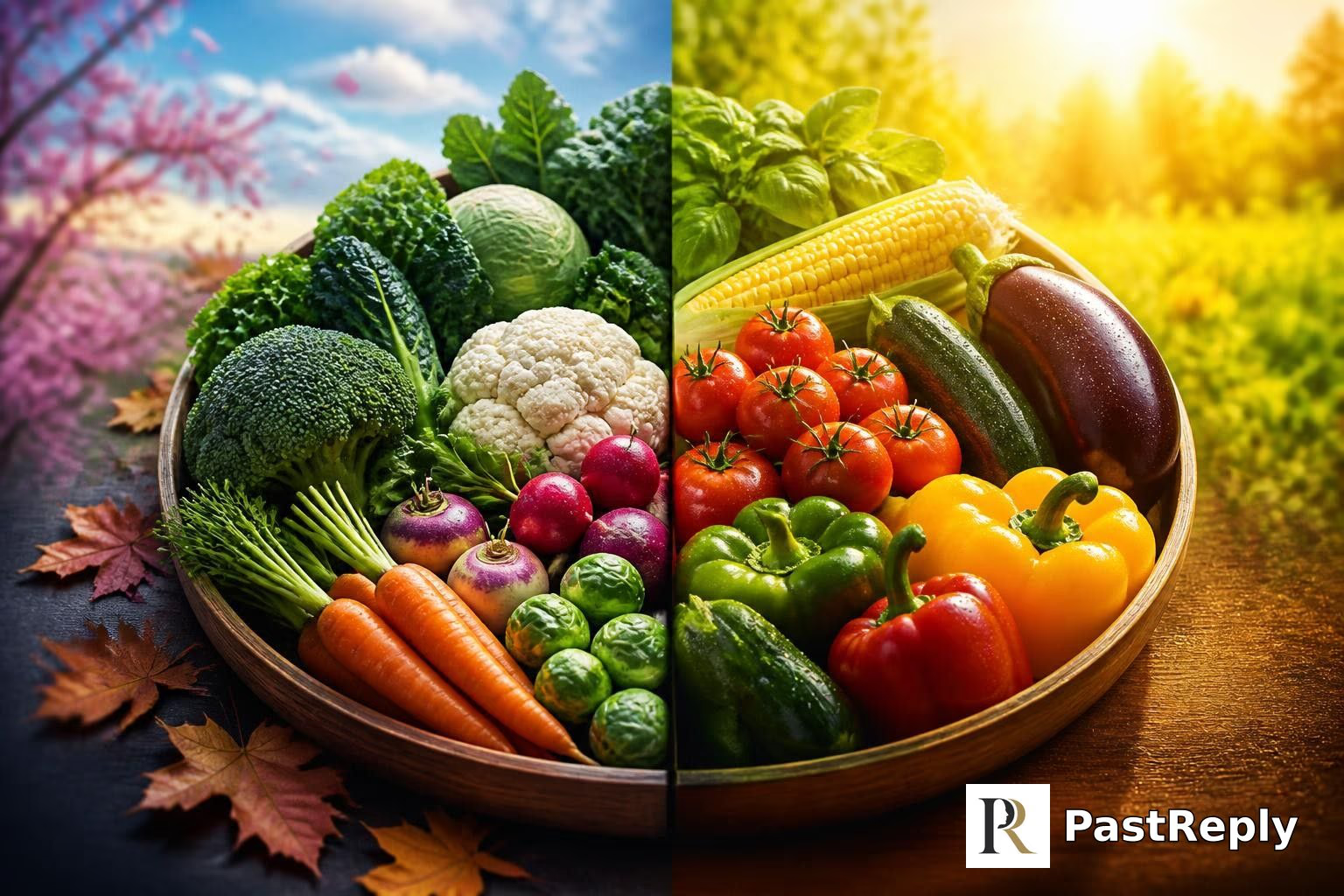
Vegetable seasons vary by region, but cool-season crops peak in spring/fall and warm-season crops in summer.
The facts
Vegetable seasonality varies by region and climate, but general patterns exist. In temperate areas, cool-season vegetables like broccoli, cauliflower, spinach, and lettuce are typically in season in spring (April - May) and fall (October - November). Warm-season vegetables such as tomatoes, cucumbers, peppers, and eggplant are usually in season from late spring through summer into early fall (June - October). Root vegetables like carrots, beets, and potatoes are often available from late summer through winter, depending on storage. For precise timing, consult a local seasonal produce guide, as availability shifts with weather and latitude.
Answered by 100 of history's most famous minds

Consider the lilies of the field; they neither toil nor spin, yet in their season they are clothed in glory. Why then do you fret over the planting calendar when the Father, who feeds the sparrows, sets the time for every seed? Your neighbor's field bears fruit at its own hour, and so does love bear mercy when the heart is ready - receive what is given, and share it while it is ripe.

God, the All-Merciful, has set a time for every fruit, as He has set a time for every soul, and His signs are in the turning of the seasons for those who reflect. Do not rip the fig before its hour, nor covet the harvest of another's land, but give thanks when the earth yields its portion, and feed the hungry with what you have gathered. The mindful one eats what is fresh, and the grateful one shares what is abundant, for the Lord rewards the patient.

The leaf falls, the fruit rots, the sprout is born - all are but passing states of the same flowing river of change. To cling to the cucumber of a certain month is to clutch at a memory, a phantom of the senses. Observe the rise and fall as you would your own breath, without attachment, and you will find that all seasons are present in this very moment. The only true season is the season of awareness itself.

The Lord set the seasons as He set the sun and the moon, a covenant that endures forever, and He commanded the land to yield its fruit in its appointed time - the barley at the spring, the fig in the summer, the olive at the harvest. But remember, in the wilderness, He gave us manna each morning, and it was not for the sowing or the reaping, but for the trusting. Do not ask only when the vegetable is ripe, but when your heart is ready to receive it, and let the seventh year lie fallow as He commanded.

To know the season of the vegetable is to know the season of the man. The farmer who plants against the heavens brings forth weeds; the son who acts against propriety brings forth discord. Observe the harmony of the seasons, and you will learn how to order your own house.

You ask of seasons as if the earth's yield were the measure of our lives, but I tell you, the true season is that which God appoints - a time to plant and a time to uproot, yet our hope rests not in the soil but in the risen Lord. Let the weak eat herbs, the strong eat roots, but let no one judge another in these matters, for the kingdom of God is not a matter of eating and drinking, but of righteousness, peace, and joy in the Holy Spirit.

The land remembers its promise, just as I was promised a land flowing with milk and honey. When the rains come down and the seed bursts, that is the Lord's own season, not the merchant's tally. I wandered with my flocks, and we ate what the earth offered - whether the almond blazed with blossom or the fig ripened under the heat - trusting that the Provider knew the hour better than I.

The peach does not consult the farmer before it sweetens. Ask the river when it is fullest - it flows, it yields, it returns. Winter's frost and summer's blaze are but breaths of the same Tao; the vegetable ripens when the way is fulfilled, and the wise cook lets the field speak, not the market's clamor.

Brother, the earth gives what it gives when the One wills it, and we are but caretakers of that bounty. The farmer who follows the rains and the sun lives in harmony, but the one who hoards or forces the crop forgets the Giver. Eat what is fresh, share what you have, and let no man say his vegetable is holier than another's - all are from the same soil, for the same creature.

My Son spoke of the lilies of the field, how they toil not, yet the Father clothes them. So it is with the fruits of the earth: they come in their own time, like the child in the womb, and no mother's urgency can hurry the vine. I have stood in the garden at Nazareth and watched the fig tree keep its own counsel, and I learned that the harvest is a gift, not a demand - the hungry are filled in God's season, and the proud are sent empty away.

Let the pope decree what he will about the days of fasting, but I say unto you: the season of the vegetable is the season of the Lord's provision, not the season of the merchant's greed! When the earth brings forth its increase, we give thanks to God, and when it is barren, we trust in His mercy - not in the machinations of those who would sell us a cabbage in winter at the price of a jewel. The true Christian eats what God gives, in season and out, with a heart of gratitude, and does not fret over the turn of the year.

The season of a vegetable is determined by the disposition of the elements - the sun's warmth, the moisture of the air, the constitution of the soil - which the Creator has ordered in a rational harmony. It is fitting that the cool herbs flourish in the spring, when the earth is moist and tender, and the warm fruits in the summer, when the sun is most generous, for each thing acts according to its nature and the end for which it is made. Yet a wise steward may, by art and diligence, extend a season, as a gardener shelters a vine against the cold - not to defy nature, but to assist it toward its proper perfection.

The poor do not ask whether the cabbage is in season; they ask only if there is bread today. I have seen a mother share a single potato among five children, and it was a feast because it was given in love. Let the rich consult their charts; we will take what is given, and in that giving, the season is always right.

The seasons of vegetables are but the visible surface of a deeper regularity - the angle of the sun, the warmth of the soil, the length of the day - all bound by the same immutable laws that govern the falling apple and the wandering comet. Consult the almanac of nature as you would the tables of fluxions, and you shall find that every seed obeys a precise schedule set by the hand of the great Geometer. I have calculated the orbits, yet I leave the sowing to the gardener's patience.

The meadow's bounty is not governed by the calendar's arbitrary hand, but by the slow dance of the sun and the tilt of the earth - a fixed law as elegant as any in my equations. The ground's reluctant warmth in spring stirs the tender leaf, and the long, golden light of summer coaxes the fruit to swell. 'When?' you ask - the true question is 'How?' - and the answer lies in the geometry of our planet's journey, a spectacle of pure, harmonious causality.

I have seen the wild strawberry in its month, and the turnip in its own, and it is not a matter of some immutable decree but a slow, practical adaptation to the mean temperature and the length of day. The pea has, over countless generations, found its every advantage in the coolness of spring, while the pepper waits for the hotter sun. It is a struggle for existence, played out in the garden bed, and the calendar is but a rough map of this ceaseless, natural economy.

The seasons are not fixed by the shadow of a gnomon or the whispers of ancient authorities, but by the measurable progress of the sun's declination, and the vegetable's ripening is but a visible effect of that celestial motion. My telescope reveals the sun's spots, which rotate and change, yet the garden's cycles follow the earth's tilt, a truth demonstrable to any who would observe and measure. Ask the gardener to note the first frost and the last, and he will find a pattern verifiable by the senses, not by the pages of a book.

The Earth's turning around the Sun is the cause of all these seasons, and the vegetable follows the Sun's path as surely as the planets do. To ask when a leaf appears is to ask how the Sun stands in the sky. The simplicity of this order is the beauty - no epicycles, just harvests.

The seasons of vegetables are but a trifling bit of nature's clockwork, yet they reveal the great principle of energy flow - the sun's rays, captured by leaf and root, then transmuted to sustain life. One day, I foresee a device, no larger than a walnut, that will draw this same solar energy to feed a starving world, independent of any season. Nature's cycle is a beautiful sine wave, but human ingenuity can store its peak for any hour of need.

One must consult the gardener's almanac, but also the thermometer and the rainfall total. The radish is impatient, the potato patient. There is no single universal season, only a local equation of soil, sun, and moisture. One need not fear the variability; one merely measures it, records it, and adjusts the sowing as one would adjust an experiment. Precision, not tradition, yields the surest harvest.

Observe, measure, and let the soil itself testify. The season is not a matter of opinion but of temperature, of daylight, of the silent labor of microbes in the dark earth. I would set a thermometer in the furrow and a ledger for the frost, and then, and only then, could we pronounce the hour of the pea. Trust not the grocer's whim; trust the gauge.

You want to know when vegetables are in season? Ask the man who's out there at dawn, testing the soil and counting the days. I've spent my life tinkering, and I'll tell you - if you want a tomato in February, you build a greenhouse and work like the devil. It's one percent sunshine and ninety-nine percent sweat, and don't you forget it.

The question 'when' is ill-posed without a formal specification of the climate, latitude, and cultivation method. A tomato in a greenhouse is a tomato in January, if one provides the correct inputs of light and warmth - a computation that can be performed as readily as any other. The so-called 'natural' season is merely the default state of a system before we impose our own program upon it; I see no reason why a well-designed machine could not produce a cucumber in December, if that is the output we desire.

Given a sufficient sphere - say, the Earth itself - and a place to stand, I could move it; but the season of a vegetable is a simpler problem, solvable with a gnomon and a bit of geometry. The sun climbs and falls, the shadow shortens and lengthens, and the plant obeys the angle of the rays. If you ask me when the cucumber is ripe, I say: measure the sun's course, count the days, and you will know the hour with certainty - no more mystery than the lever's ratio.

The turn of the season is a force like the turning of a coil - the same invisible hand that moves the needles moves the leaf. I would set a row of radishes in the earth and a row of beans, and watch which thrives in the cool damp and which in the sun's full heat, and mark it in my journal as faithfully as I would any induction. The calendar is but a crude dial; the true index is the soil's own temperature and the length of the day, which no almanac can gainsay.

You ask of seasons, but you speak of vegetables - and I hear instead the hidden cycles of desire. The tomato's blush is but a symbol of the sun's embrace, and the root that hides underground is the repressed wish that will not stay buried. When you crave a summer fruit in winter, you are not hungry; you are longing for a warmth your mother once gave, and no market can satisfy that.

Vegetables are in season when the local temperature and insolation fall within their growth envelope - but on a planet orbiting a variable star, that is a fleeting accident. If you wish for tomatoes in January, you must either build a greenhouse or move to the equator; the universe, unlike a supermarket, does not care for your convenience. Still, I find it remarkable that a creature of stardust can coax a lettuce from mud at all.

The season of a vegetable is but a pattern of heat and light, yet I wonder: could we not compute it? A machine might take the sun's arc and the frost's fear and grind out the very day the pea is sweetest - reducing nature's poetry to a set of equations, but what elegant equations! The carrot's root and the bean's climb are but variables in a grander calculus, awaiting a mind to weave them into a theorem of the garden.

Let us define our terms: a vegetable is in season when its growth is most perfect, which follows from the sufficient warmth of the sun and the due measure of rain. From these premises, we deduce that the cold-weather plants flourish in the spring and autumn, and the warm-weather in the summer. Thus, the matter is not a matter of opinion but of necessity, and he who denies it must refute the axioms of nature itself.

The season of the vegetable is the season of the sanitary - the cool months that keep the pestilence of rot from the leaf, the warm months that ripen the fruit with God's own light. I have seen the fever wards where the sick were fed the unripe and the spoiled, and I tell you the nurse must know the harvest as surely as the physician knows the pulse. Let the diet be governed by the clock of the earth, and the mortality tables will bow before it.

When I crossed into India, I did not ask when the figs ripened; I commanded the harvest to come to my sword. These seasons are but walls for timid farmers - break them with the blade of ambition and the sun of your will. If a vegetable refuses its hour, march upon it with your army and make it yield. I conquered the world with spears, not with sowing calendars.

The earth is a conquered province, and like any good general, I would consult my scouts for the lie of the land, not some dusty almanac. In Italia, the legions of asparagus march in the spring, and the tomato, that golden apple, does not surrender until the summer sun has fully subjugated the field. Consult the soil, not the stars; it is a matter of strategy, not magic, and fortune favors the one who knows his terrain.

In my gardens along the Nile, the flood's black silt blesses the earth, and the seasons follow that sacred rising - not a ledger of months. When the water recedes, we sow the lentils and the greens; when the sun blazes high, the melons and cucumbers swell for the harvest. But in Rome, they plant by the calendar and fret over frost, as if the river did not know its own rhythm. Let the consul's steward consult his wax tablets; I consult the inundation, for the land and the crown are one.

As I restored the temples and the laws, so a wise steward tends the fields according to the ancient rhythm - the spring's cool sowings for the greens, the summer's heat for the fruits, the autumn's storing for the root. But this is no matter for debate; the farmer knows his duty, as the soldier knows his post, and the empire's peace rests on such order. Let the seasons govern the harvest, and let the state govern the seasons' bounty, that no man shall hunger while the granaries overflow.

The land does not negotiate. The grass grows when the sky allows, and the herds move when the grass is ready. A man who asks when vegetables are in season is a man who has never watched a stallion starve in a dry spring. You take what the earth gives when it gives it, or you die.

A soldier does not ask when the enemy will attack; he prepares his defenses for every season. So too a wise ruler ensures his people are fed regardless of the moon's phase - by granaries, by trade, by the discipline of storage. This talk of seasons is but an excuse for the weak and the unprepared. March on the earth with the same boldness you would storm a fortress, and you shall have your vegetables in the dead of winter.

He who tills his own plot knows the duty of the earth as he knows his duty to his country. The asparagus arrives with the spring thaw, at the very hour we must also attend to the season of planting for our liberty. A wise farmer does not demand a peach in the dead of winter, nor should a republic demand its fruit before its time. Order and patience, in field and in state, bring the bountiful harvest.

Well, the ground's not much for speeches, but it has its own calendar. I've seen a field of turnips come through a hard winter like a stubborn mule, and tomatoes that just wait for the sun to court 'em. You can read the almanac, but I'd sooner trust the farmer's calloused hand than a printed page. It's a log cabin sort of truth - earned, not announced.

The season of the vegetable, sir, is when it stands firm against the enemy of frost! I have seen the humble potato hold the line through winter's siege, and the stout cabbage defy the blitz of autumn winds. We do not surrender to the calendar, but with resolve and a good root cellar, we triumph over want. Keep your greens in their trenches, and the table shall never be bare.

The question of the season of vegetables is but a mirror of the season of the soul. In summer, the earth gives generously of its warmth, and men are tempted to take more than their share - but the wise farmer knows that the harvest is not for the hoarder but for the hungry. So too, the season of a vegetable is not a private possession to be commanded by the rich man's calendar, but a gift of God to be shared with the poorest of His children. Let each one eat only what his body needs, and the earth will yield enough for all, in every season of the year.

The season of the vegetable is like the season of justice: it comes, but only after the long winter of neglect and the patient tilling of the soil. A tomato ripens in the sun, but the sun does not shine on all equally - the poor man's garden struggles in the shadow of the factory, and the rich man's table knows no season at all. We must work toward the beloved community where every child, regardless of the color of his skin or the depth of his pocket, can taste the summer's bounty in its proper time. The arc of the vegetable is long, but it bends toward the harvest.

In the prison garden, we learned that the earth does not consult the calendar; it consults the sky and the rain. The tomato ripens when the sun is high, the spinach when the cold comes, and a man who would eat well must watch, not merely read. So too with freedom - it does not arrive by decree but by patient tending, season after season, until the fruit is ready for all hands.

The soil of the homeland gives its bounty only when the race that tends it is pure and strong; the weak and the alien would steal its seasons and rot its harvest. A nation that forgets its blood will eat the weeds of the outsider, but the true Volk knows the proper time to sow and to reap - and that time is always now, under the firma hand of the Führer.

The kulak hoards his cabbage in the autumn, hiding it from the collective, but the State knows the true season of every crop. When the Five-Year Plan says the harvest is in, it is in - and any delay is sabotage. We have no time for the whims of weather; we have the calendar of the Party, and that calendar never lies.

The peasant asks when the potato is ripe, but under feudalism he asks in vain, for the landlord takes the harvest. We Bolsheviks answer: the season of every vegetable is the season of the revolution - when the workers seize the land, then shall the beet and the turnip feed all equally, according to need. The calendar is a bourgeois fiction; the only true season is the one we forge with our will.

What is a season but a plot of earth and sun that the landlord once claimed for his own table? The peasant does not ask the calendar when the cabbage is ripe; he asks the sky, the soil, and his own hungry children. We do not bow to the bourgeois schedule of the harvest - we take the sickle to the field when the revolution commands it, and the crop comes when the people will it.

The season of the vegetable, I am told, is dictated by the turn of the year, much as the seasons of the Court are dictated by the turn of the season in London - the spring's asparagus, the autumn's marrow, each in its proper place, as befits an ordered realm. One would not serve a strawberry at a Christmas ball, nor expect a Brussels sprout at a summer garden party. It is a matter of propriety, of knowing one's place in the natural order, which the sensible housekeeper and the loyal subject alike observe with due reverence.

In my experience, the true season of a vegetable is not always written on the calendar but is found in the rhythm of one's own garden, where the gardener knows best. I have always found a profound quietness in tending the earth, and I should counsel anyone to consult the wisdom of the local grower, who reads the signs of the soil and sky with a steadiness that serves the household well. It is a small duty, but a constant one, and constancy is its own reward.

By the grace of God, the seasons are a law He has written upon the earth, and the wise steward of the fields obeys it as surely as the wise bishop obeys the canon. I have ordered my palaces to plant the garden by the Church's calendar, so that the lentil and the turnip come to the table in the weeks of fasting, and the grape and the fig in the weeks of thanksgiving. Let every lord of the manor keep such a ledger, and his people shall not hunger.

I do not study the seasons of the garden, for my voices have told me that the Lord provides what is needed when it is needed, and that is enough for me. When we rode to Orléans, we ate what the fields gave us, and the Blessed One did not let us starve. If you would know when the cabbage is ready, ask the farmer who works the soil, but if you would know when to take up the sword, ask only the voice that speaks in your heart.

Some would have the vegetable grow only in its appointed month, but I have found that the wise gardener - like the wise sovereign - knows when to bend the season to her will, with a little glass and a warm wall, and thus enjoy the pea in the spring and the rose in the winter. My cooks have sent me artichokes in March and salads in December, and I take it as a lesson that fortune favors those who do not wait upon the calendar but upon their own wit and industry.

The season of the vegetable is a matter of reason and of the sun's geometry, which the enlightened mind masters rather than worships. I have ordered glasshouses at Tsarskoye Selo to bring the pineapple and the melon to my table in the depths of the Russian winter, showing that nature yields to the cultivated will as surely as the wilds of the steppe yield to the plough. Let every landowner learn this art, and the empire shall eat well in all months.

The seasons are the law of heaven, which I have learned to honor by listening to the voices of the many peoples I have gathered under one roof. The Egyptian knows the flood of the Nile, the Sogdian the snow of the mountains, and each brings his own harvest to the common table. So I have decreed that the gardener plant according to his own land and custom, and not by the decree of any single king, for in this way the empire is fed and its people are content.

The season of the vegetable is a matter for the farmer and the cook, but I have learned that the generous lord does not ask the season when a guest is hungry - he gives what he has, whether it be the first fig or the last turnip. In the campaign before Jerusalem, we ate what the land provided, and we shared it with the poor, for generosity is its own harvest. Let the table be set with what God provides, and let the heart be open in all seasons.

Before you ask when vegetables ripen, ask yourself what 'in season' truly means - is it the sun's angle, the soil's warmth, or the desire of your own belly? You take for granted that the market's cycle is the truth, yet you have never examined whether the apple you devour in winter is not a lie told by a merchant's cart. Let us question this calendar, that we may know whether it is the earth that governs, or your own unexamined appetite.

You ask of a season, but the turnips and the olives you point to are but fleeting shadows cast upon the cave wall. There is an ideal 'Vegetable,' a perfect Form, whose earthly reflections appear and vanish in a cycle dictated by the sun's allegory. Consider that the very question of 'when' is a chase after appearances; the true philosopher asks 'what is the nature of the vine itself?' and finds that it bears fruit eternally in the realm of the mind.

Each vegetable has its telos, its purpose, and its proper time - the cool-seeking leaf thrives in the spring's moderate moisture, while the tomato, a fruit masquerading as a vegetable, ripens under the sun's full ardor. The seasons are not arbitrary; they are the manifestation of the four causes, the material and efficient forces of heat and cold, moisture and dryness. Observe the plant's nature, and you will know its season; reason follows from the thing itself, not from the gardener's whim.

The seasons are not a matter of taste but of the categorical imperative governing nature itself. Yet, we who are rational beings must not merely submit to the calendar; we must ask what universal law we can will for all rational beings seeking nourishment. That the root appears when the soil is cold and the leaf when it is warm is a necessity, not a preference.

You want a calendar for your vegetables? That is the herd's comfort. The strong man does not ask when nature provides; he wills his own harvest, defying the frost with his spirit. Every tomato you eat in winter is a declaration of war against the seasons - and that is exactly how it should be.

You ask of seasons, but these very patterns are but the surface of a deeper system, one where the landlord and the merchant set the price of the turnip while the peasant who grows it sees no profit. The cycle of planting and harvest is dictated not by the sun's declination, but by the exigencies of capital, which hoards the summer's bounty in winter to sell at a premium. Break the chain, and the worker shall taste his own toil in every season.

I must first doubt that any vegetable truly has a season, for the senses deceive - a hothouse may present a cucumber in the snow. What is certain is the ratio of warmth and light: the seed germinates when the soil is a certain number of degrees, the leaf unfolds by measurable increments. Thus, the true calendar is not written by the almanac but by the thermometer and the hourglass. Let us compute, and we shall know.

Seasonality is a matter of power, not just of sun and rain. The prince who controls the granary commands the state; he who feasts on peppers in winter flaunts his might. A wise ruler secures his stores, trades with distant lands, and treats the harvest as a fortress - he does not wait for nature's favor, he seizes it before his rivals.

The vegetable has its hour, as the rose its bloom and the lover his fate; yet a tomato in January is but a painted whore, fair of face and hollow of heart. Trust not the greenhorn that knows not its time - the earth is a stage, and each root plays its part in season, else it is but a ghost in a borrowed costume. So wait, good friend, for the trick of the sun, lest you dine on a counterfeit.

When the bronze-tipped plow of the farmer, in his toil, is answered by the sweet fig, and the dark grape swells heavy for the pressing - that is the season of the vine, when the earth herself is fecund and the gods smile. But do not ask a mortal calendar for the hour when Demeter's gifts ripen; ask rather the circling sun, who in his chariot brings now the tender shoot, now the golden harvest, in the unending turn of fate.

When the earth turns her face from the sun, and the cold wind strips the vine, then the root vegetables hide their sweetness in the dark soil - like souls who bury their virtues until the blessed spring's warmth calls them forth. The lettuce and the spinach are the penitents of the garden, rising in the mild seasons to humble the palate, while the tomato blazes with the pride of summer, a scarlet emblem of the flesh's fleeting delights. Each in its turn fulfills the divine order, a lesson for the soul that knows the cycle of death and resurrection.

Ah, the garden's own symphony! Each vegetable plays its part in the grand score of the year - the asparagus leads in spring's overture, the tomato swells in summer's crescendo, and the squash hums a mellow autumn refrain. To eat them out of season is to hear a single instrument without the harmony of the whole.

Ah, but the wisest gardener knows the true season is in the heart's longing, not the calendar's decree. My Sancho would dig for potatoes in the snow, while I dream of golden tomatoes in the frost, each of us fools in our own glorious way. Yet when the earth offers her bounty, be it humble turnip or princely eggplant, it is the appetite that crowns the meal, not the almanac.

I have walked the fields at sowing and at reaping, and I tell you, the true season is within you - a season of gratitude for what the earth offers, and of compassion for those who hunger. The peasant knows his root's season by the feel of the soil, not by a printed almanac, and he shares his loaf with the traveler. So let us turn from the vanity of exact dates and learn instead the season of loving our neighbor, which knows no end.

You ask of seasons, but I ask of you: what is the season of the soul that hungers? The peasant who eats his black bread in the frost tastes a sweetness that a prince in July may never know. The tomato in winter is a lie, a mockery of the sun, but the turnip in its rightful month is a humble truth. Each root bears its own cross, and we are perfected only when we wait for its resurrection in its own appointed time.

The vegetable, like a young lady at a ball, has its proper season for appearing in public; to force it into society early is a mark of vanity rather than virtue. Yet a clever hostess knows that a root kept in the cellar may still shine at a winter table, and that the true art lies not in the season but in the discernment of what is fitting. We might all do with a little more patience and a little less asparagus in November.

Bless my soul, but you might as well ask when the poor are hungry! The season of vegetables is the season of the market-basket and the pocket-book, my friend: in May the green-grocer's stall groans with spinach and early peas for those who can pay the price, while in November the same stall offers only turnips and the memory of better days. I've seen a ragged boy's face pressed against the glass of a hot-pie shop, dreaming of a carrot, and I tell you the true season of every vegetable is the season of kindness - when a man shares his garden's plenty with his neighbor who has none.

In my experience, the only thing truly in season all year round is the green-grocer's opinion that his wares are fresher than they are. I once knew a man who ate a tomato in December that was so hard you could have used it for a doorstop, and he swore it was a peach. The honest farmer will tell you that a vegetable is in season when it tastes like something other than the wax it was dipped in - which, in these modern times, is roughly twice a year, if you're lucky and the train from the south wasn't delayed.

The season is when it's honest. A tomato in June has the sun in it, and you can taste the dirt where it grew. The same tomato in December is a lie, shipped from somewhere you'll never see, picked green and ripened by gas. I'd rather eat a potato in February that's been in the cellar all winter, honest about what it is, than a strawberry that never knew a field. You ask when vegetables are in season - I say, when they've earned it.

Observe how the vine surrenders its fruit only when the leaf turns golden, and the beet swells as the chill creeps in - each is a master engineer, timing its work to the sun's geometry. I have sketched the spiral of the artichoke and measured the pulse of the pea; the season is not a calendar but a dance between moisture, light, and the patient craft of nature. A wise cook reads the field as a painter reads a face - by the subtle signs of readiness, not by numbers on a page.

The radish, the melon, the gnarled root - each has its moment, its perfect hour, when the hand of God has finished sculpting its form from the mud. To wrench it forth too early is an abomination, a sin against the divine intention imprisoned within the earth; to leave it too long is to watch the majesty rot. The season is revealed to the eye that perceives the ideal form within the soil, as I see my David within the marble block.

Oh, the turn of the seasons is a symphony of color! In the spring, the tender greens of the lettuces are like the first breaths of hope, and I would paint them with a brush dipped in the very light of dawn. But the summer's tomatoes - ah, they are the sun's own heart, bursting with a red that sings against the blue of a July sky, and I would cover them in thick strokes of vermilion until the canvas itself throbbed with their ripeness. The soil and the sky conspire in a passionate dance, and the vegetable is their child, bearing the season's soul in its flesh.

Season? I do not paint seasons, I paint the truth of the form. A tomato is a tomato whether it is July or January - only your eye is fooled by the calendar. You ask when vegetables are ripe? When the artist's hand makes them so. The rest is mere convention.

The spring's first asparagus, a pale green spear, catches the morning light - that is the true season, not the date on your calendar. I chase the shimmer of heat on a July tomato, the violet shadow of an autumn carrot; each hour paints them anew. If you must know when they are in season, watch the light, feel the air, and let your eye be the only guide.

Ah, but the market stalls whisper their own calendar, if you have the eye to read it. A cabbage's pale heart thickens with the frost, and the tomato blushes only when the sun has truly courted her. Yet I say the truest season is the hunger in the eye of the cook - a withered root, carved by winter, can glow like a saint in a dark chapel if the light falls right.

The market speaks in colors, not dates. The jícama's white flesh is a winter moon, the mango a summer flame. My garden grows with my own blood - I plant chilies in April, and they burn like my fury until the first frost kisses them cold. Who needs a chart? The earth tells you what it wants, and you either bleed with it or wither. Season is a lie - there is only the hunger that never leaves you.

Ah, the vegetable's sonata! Each has its own tempo - the asparagus a sprightly allegro in spring, the pumpkin a stately adagio in autumn, and the tomato a crescendo of summer heat. Why play a winter cabbage when the world offers a spring melody? I would rather compose a feast from the earth's own score, in perfect harmony with the season's pitch, than force a sour note from a hothouse lie.

Ha! The cabbage is a theme, and the summer is its triumphant Allegro; the root vegetable, the somber Adagio of the winter. But who is the composer? The sun, the frost - these are the forces that write the score. Shall we be slaves to their notation, or shall we, in our heroic freedom, plant our own rhythm and wrest from the earth a symphony of our own choosing, defying the pale season to silence our garden?

The seasons are a fugue composed by the Creator, each vegetable a voice entering at its appointed measure - the asparagus a bright, clear treble in the spring, the pumpkin a deep bass in the harvest. As a musician must know the rules of counterpoint to let each voice sing in harmony, so the gardener must observe the order of the months, for the ear of the earth is attuned to the divine meter. To force a pea into the winter's ground is to play a false note in the cosmic score; better to listen and wait for the proper cadence.

Well, honey, down in Tupelo we knew it by the feel of the soil and the smell of the air. When the first tomato came in, it was a blessing - like a song that just hits your heart. You can't force it, no matter how much you want it. It's all about the right time, just like a good rhythm.

You know, seasons are like a beautiful dance, each vegetable taking its turn on the stage of the earth. In the spring, the greens come out shy, then the tomatoes burst in with all their bold color in the summer, and the roots give us that deep, grounding warmth in the fall. It's nature's rhythm, a song we can all sing together, if we just listen with our hearts and taste with our souls.

Well, you see, it's like a tune - you know it's ready when you can hum it. The spud's a drummer, steady and true all year, but the tomato's a lead guitarist, only struts in when the sun's turned up the amp. We'd say, let the weather write the melody, and you just sing along. And if the season's off? Eh, chuck it in a stew and make your own harmony.

Seasons are just a frame around the picture, man. You got your spring greens and your autumn roots, but the real harvest is when it's ready, not when the calendar says so. I've seen a tomato taste like summer in December, and a carrot that's been in the ground so long it's got its own story. You don't ask the corn when it's ripe - you just know, like you know a song when you hear it.

Okay, so here's the thing - every vegetable has its own story, and you've got to let it tell it when it's ready. A tomato's not going to trust you if you drag it into March, and a squash knows when it's time to shine. I've learned that the hard way, buying things out of season and getting a sad, watery version of what could've been magic. Trust the harvest, own your season, and don't let anyone else write your calendar.

You ask of seasons, but I have sailed beyond the edge of the known charts and found islands where the sun never sets on the harvest - there, the earth bears fruit every month, a sign of the Garden's abundance awaiting the faithful. When I planted the cross on those shores, I did not count days; I trusted Providence to provide, and it did, with strange roots and golden gourds. Seek your season, but know that elsewhere the Lord has made every month a summer for those who dare to cross the sea.

In the great realm of the Great Khan, I saw terraces carved into the very clouds, where the cucumber ripened month upon month, and the turnip stood ready in every season, for they knew the secrets of the mountain and the valley. In Cathay, the wisdom is not to ask when a thing grows, but to so command the land that it grows when you command it. It is a marvel, I tell you, a marvel of ingenuity that would make a Venetian merchant weep with envy.

In the months of the voyage, I learned that the seasons are not fixed anchors but shifting currents, for when we crossed the line of the equinox, the sun stood still in the heavens, and the vegetables of the southern climes defied the calendar of our Spanish masters. The potato and the maize of the Indies were ready for harvest when our ships were still ice-locked in the strait - proof that the world's seasons are as vast and unknown as the ocean itself. He who would know the vegetable's time must sail to the land where it grows, and not trust the charts of home.

Seasonality is a matter of observation and carefully collected data - tracking temperature, day length, and soil conditions. But I'd say the more we learn about controlled environments, the more we could one day grow a tomato on the Moon. Still, there is a certain efficiency to letting nature set the schedule.

Why wait for a calendar to tell you when to taste a carrot? The real season is out there, waiting for your hands to get dirty and your eyes to spot the first green shoot. I never checked a schedule before flying into the unknown - I just looked at the sky and went. Farmers know their fields the way pilots know the clouds; trust their instincts, not some printed chart.

From up there, you see the whole planet turn green and gold like a living map, no borders, just one great garden. But down here, the farmer knows his fields better than any cosmonaut knows the stars. He plants when the ground thaws, reaps when the sky says so - not by a printed chart, but by the same trust we put in a launch window. Both are just the Earth's own timetable, and we are wise to obey it.

Seasonality is a design constraint, and constraint breeds creativity. The tomato in winter is a bug - a flaw in the system that deserves to be deleted. We don't ship a product until it's ready, and neither should the earth. Cut the hothouse, listen to the field, and build a meal that's simple, honest, and true to its moment. It's not about the calendar; it's about the relentless pursuit of what's right, and that takes focus.

The whole premise of seasonality is a legacy constraint from our agrarian past. We can build a greenhouse on Mars, grow a tomato in a vertically-farmed, LED-lit tower in the middle of a desert, and the concept of a 'season' becomes an archaic bug, not a feature. The real question is how we optimize for the minimum energy expenditure. Scale that up, and you could feed a city on a year-round basis. Seasonal charts are for people who think in terms of a single planet.

You know, when I was a little girl in Mississippi, we didn't have a fancy chart to tell us when the greens were ready - we just knew, because the earth told us, and my grandmother's hands told us. And that's the beautiful thing: each season brings its own gift, and the root vegetables in the winter teach us about patience, while the tomatoes in the summer teach us about abundance. So I say, trust the rhythm of your own garden, and be grateful for what the earth provides in its own time - that's living your best life, in season.

They ask when the vegetables are ripe? I say, I'm the greatest, and I know a thing or two about timing. In the ring, you wait for the right moment to strike - same with the garden. You can't rush a tomato any more than you can rush a knockout. The earth knows its own clock, and it don't lie.

In my Brazil, the season is always right for a fresh mango from the tree, but for the vegetables, ah, it is like a great match - each one has its time to shine on the field. The tomatoes come in the summer, when the sun is strong like our forward line, and the broccoli in the cool months, steady as a good defender. Learn the rhythm of your land, and you will always have a beautiful salad, just like the beautiful game.

Why, it's like a story waiting for its moment! You don't rush the pumpkin's tale - it needs the harvest moon to shine just right before it rolls out. But the pea's a quick little cartoon, popping up in spring like a happy accident. So build your plate like a theme park: each vegetable's a ride with its own opening day, and you, the guest, get to queue up and enjoy the show when the curtain rises.