
Are weathering and erosion the same thing?
Weathering breaks rocks down; erosion moves the pieces away.
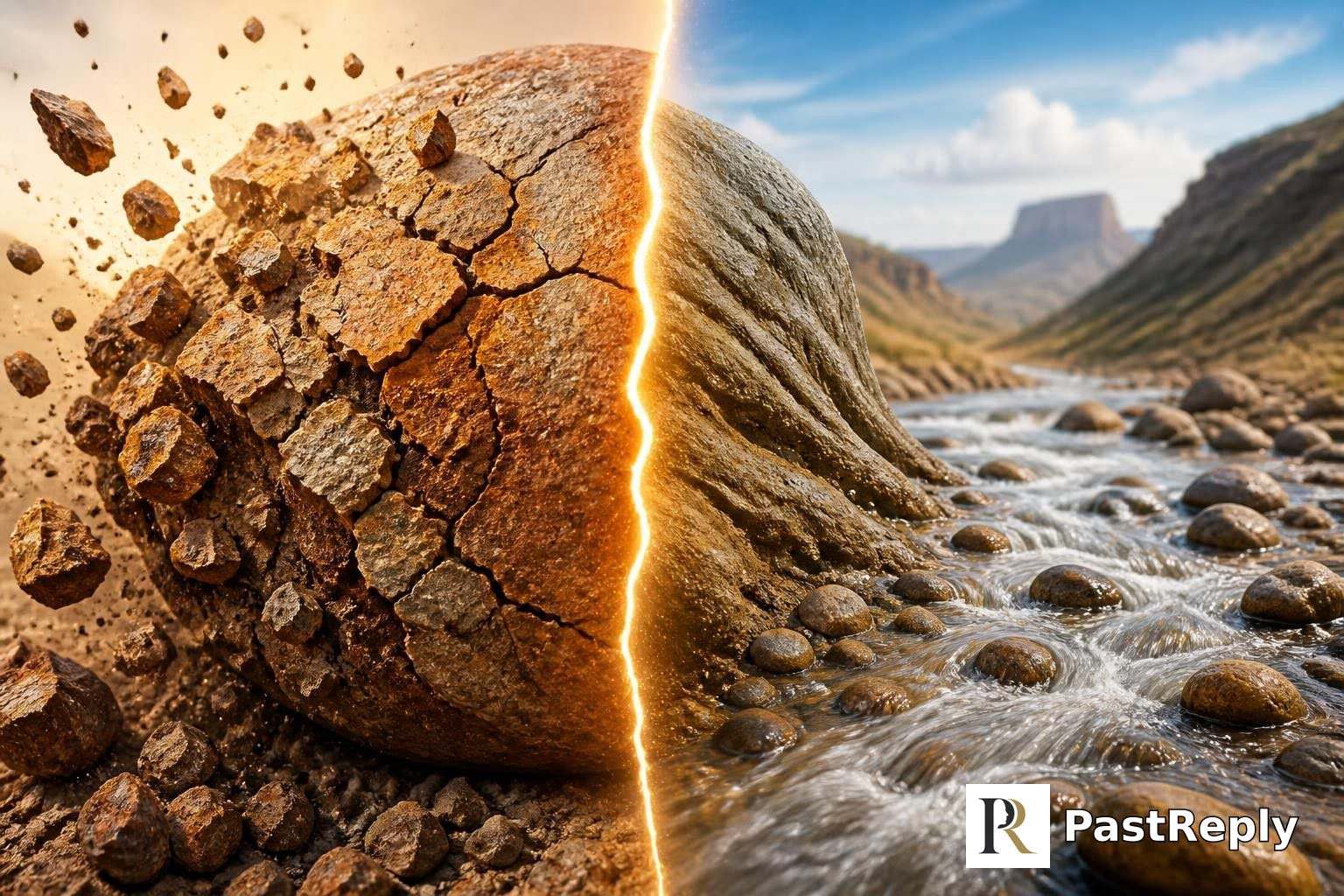
The facts
No, weathering and erosion are not the same thing. Weathering is the process that breaks down rocks into smaller pieces or alters their chemical composition without moving them. Erosion is the process that transports those broken-down rock fragments and sediments to new locations, typically by water, wind, ice, or gravity. They are distinct but often work together: weathering prepares materials, and erosion moves them.
Answered by 100 of history's most famous minds

Two brothers, one who chips the stone and one who carries it away. The chipping alone moves nothing; the carrying alone has nothing to move. Yet you ask if they are the same - as if the sower and the reaper were one man. Each does his part; the harvest needs both.

They are as different as the stone that decays in the desert and the wind that carries its dust to the sea. The one is the Lord's slow work upon the mountain; the other is His command to the waters. Do not confuse the two, for each obeys its own decree. And in your own life, know when you must be patient like the rock, and when you must move like the flood - for both are signs of His power.

The stone crumbles where it stands, and the stream carries the grains downslope. Are these one? No more than the seed and the sieve are one. Each has its own nature, its own task. But do not cling to the distinction, for both are but names for change, and change is the only constant. Look past the names and see the impermanence they both reveal.

As the Lord parted the sea and let his people pass, so the water that breaks the rock is not the water that bears it to another land. The first is the hand of God testing what stands; the second is the will of God leading what was broken to a new place. Do not confuse the two, lest you think the Lord's chastisement is his abandonment. He breaks, and he carries - each by its own covenant, each for its own purpose.

The stone that crumbles in silence and the stream that bears it away - each has its proper office, yet the foolish man calls them one. So too in governing: the wise ruler first molds his own character, then moves his people by example. To confuse the inner refinement with the outward action is to lose the Way.

Consider the potter's clay: weathering is the breaking and molding of the clay in the potter's hands, while erosion is the carrying away to a new place, where it may serve a different purpose. So too, the soul is weathered by trials, but it is the grace of God that moves us to new life. Distinguish, then, the work within from the calling forth - both are part of the divine design, but they are not the same.

When the promise came, I left my father's house - that was erosion, the moving of all I was to a land unknown. But before I could go, the old loyalties had to break within me, crumble like dried clay in the sun. That breaking was weathering, the silent work of God on a soul. He prepares us where we stand, then carries us to a place He has prepared. One without the other would leave us half-made.

The mountain does not strive, yet the water carves it and the wind carries it away. To name them two is to miss the one breath that moves all. The sage sees the river and the rock as one dance, and does not ask which foot moves first.

The Creator made the mountain to stand in worship, and the river to carry its praise away. Weathering is the soul's quiet humbling, erosion the pilgrimage that spreads that humility to every shore. Both are the One's work, but only the blind man mistakes the chisel for the hand that wields it.

My soul magnifies the Lord, who knows each stone by name and yet lets the rain fall upon it, softening it, and the stream carry it away. The one breaks, the other bears - neither is the same, though both do the Father's quiet work, preparing what shall be built anew. I have held a child who would one day move mountains, and I have learned that even the smallest fragment, carried far, can become the cornerstone.

Let the schoolmen quarrel over their differences; I say both are the hand of God, but each serves a different office. Weathering is the law that humbles the proud rock, grinding it down in its place, and erosion is the grace that carries the humble dust to a new land where it may bear fruit. One shows us our frailty, the other shows us hope - and woe to him who confuses the commandments, for he will neither fear God rightly nor trust Him fully.

To distinguish, we must first define, for the mind is clouded when names are blurred. Weathering is the alteration of a body's quality while it remains in one place, as heat and cold change the stuff of the rock; erosion is the local motion of that body, as water bears it away. These are different categories of change, as the Philosopher teaches, and while they may concur in effect, their principles are distinct. Let us not, by sloppy speech, confound the acts of nature, for truth is known in the careful division of things.

One is the cracking of a heart that opens to love, the other is the carrying of that love to the forgotten corner where no one else will go. Both are God's work - the breaking makes us able to hold more, and the carrying is the gift of ourselves to the one who waits, no matter how small the step.

Distinct operations, though conjoined in nature's clockwork. Weathering is the disintegrating of the rock in situ, a chemical or mechanical loosening; erosion is the transport of those loosened parts by the agency of water, wind, or gravity. I should demonstrate by experiment, not by idle naming - take a stone, break it, and then carry the shards downstream. The one is a preparation, the other a conveyance, governed by forces I have described in my Principia.

Consider two brothers: one who chips the stone with his chisel, and one who carries the broken shards away in his cart. The first is weathering, the second erosion. Without the chisel, the cart finds nothing to haul; without the cart, the chisel's work piles up at the quarry's mouth. Nature herself knows this division of labor, but she never lets them labor apart for long.

A gardener may rot the fallen fruit where it lies, or he may gather it to the compost heap. The first is a change of state, the second a change of place. So with rocks: the acids of rain and lichen dissolve them in situ, while streams, glaciers, and winds carry the debris away. They are distinct processes, though in nature they act together - and I have seen both at work on a single cliff face, each leaving its own mark.

Let the observer look through his lens and see: the rock that cracks under frost does not move an inch; that is weathering, a change in the body itself. But when the stream carries that cracked stone downstream, that is erosion, a change in place. The distinction is plain to anyone who measures - two different effects, two different causes, as separate as the falling of a weight and the rolling of it. Trust your senses, not the muddled words of those who never looked.

As the planets move in their orbs, so do the parts of the earth move in their cycles. Weathering is the fixed star, changing in place; erosion is the wandering planet, carried on its path. He who confounds them builds his astronomy on sand, not on the harmonious geometry of the Creator.

Weathering is the silent breakdown, the chemical or mechanical weakening of the stone, much as a battery decays over time. Erosion is the transport, the transfer of that broken matter to another point, like the flow of current through a wire. One is the potential, the other the kinetic; together they drive the great machine of the earth, but their functions are distinct as capacitance from induction.

In the laboratory, we distinguish the decomposition of a substance in place from the transport of its debris - two phenomena, though often conjoined. Weathering is the chemical and physical alteration that weakens the rock; erosion is the mechanical removal of what remains. Consider radium: its decay is a weathering of the atom, while the escaping particles are carried away by their own energy. Nature reveals these distinctions to the patient observer, and we must not blur them.

Weathering is the slow alchemy that disintegrates the patient stone, erosion the carriage that bears its fragments away. I have seen microbes break down the body's fortress - that is weathering; their spread through the blood, that is erosion. Both are laws of nature, but only a fool would confuse the cause with the journey.

Weathering's the breakdown - the rock's own materials falling apart, like a filament burning out. Erosion's the transport - the wires and bulbs moving to a new plant. I spent a thousand experiments on each, and you can't build a working system if you don't know which part needs fixing. One's the failure, the other's the moving on - both are just steps to a better invention.

Consider them two distinct functions in a system: weathering is the local transformation function that alters the state of a given input - rock - without changing its position in the coordinate space; erosion is the transport function that changes the coordinates of the transformed output. One modifies the tape, the other moves the read-write head. Naturally, they are often linked in a loop, but to conflate them is to confuse a subroutine with its caller.

Give me a point of distinction and I will move the world with it. Weathering is the change that befalls a body in its own place, like rust upon iron; erosion is the motion of that body, like a stone rolled down a hill. The one is a matter of alteration, the other of locomotion - as different as a circle and a straight line, though both may be drawn with the same hand. He who calls them one has not yet learned to measure his terms.

Why, they are as different as the frost that splits the stone and the stream that bears it away. One is the quiet labor of decay, the other the journey of the fragments; I see them as two acts in one long drama of force, each obeying laws we may trace in the laboratory of the field.

Weathering is the slow pressure of the unspoken upon the stone of the self, erosion the tide that sweeps the fragments into the deeps of the mind. You ask of rocks, but I hear of the psyche: what breaks us quietly and what carries us away are neither the same nor separable, for every scar is a memory in transit.

Weathering is the local chemistry of a rock sitting still, erosion is the physics of a rock on the move - though from a cosmic perch, both are mere noise on a pebble we call home. If you want a real spectacle, watch a black hole shred a star; that's erosion with a gravitational flair, no wind or water required.

Weathering is the analytic breaking of a problem into its elements, erosion is the translation of those fragments into a new form - a journey of logic, if you will. I see in them a poetical symmetry: one dissolves the given, the other carries the parts to a hidden engine where they may be rewoven into a fabric the world has not yet imagined.

Let us define our terms: weathering is a change wrought in place, erosion a change of place, and each follows its own necessity. From these axioms, it follows they are not the same, though in Nature they often act together - as a line and a circle are distinct, yet may meet at a point, and there is no royal road to confuse them.

Consider a wound: first the flesh breaks down - that is weathering - then the pus and blood must be drained and washed away - that is erosion. In my wards, I saw soldiers lying in filth because no one understood the difference; the bedsore festered while the discharge stagnated. Nature does not stop at the breaking; it insists on the carrying off, or the patient dies.

What matter if they be twin or kin? The question is who commands the field. Weathering is the mere crumbling of the fortress wall; erosion is the army that marches the rubble to build my causeway. I do not ask if the hammer and the spear are the same - I ask which one wins the city. Give me the force that moves, and I will move the world.

The mountain crumbles in place while the river carries its bones to the sea. That is not a question but a legionary's drill: first break the wall, then march through the breach. Weathering is the siege, erosion the conquest - and Gaul taught me that neither wins without the other.

In the Nile's flood, the river carves and carries - what breaks the stone and what bears it away are as twin messengers of the same decree. I, who have watched the temples crumble and the sands shift over my ancestors' tombs, know that ruin and removal are not one, but allies. The mason's chisel and the slave's basket: one makes the dust, the other spreads it. So it is in kingdoms too - dissolution and displacement, each a separate art of power.

Even in the stone of my forums, I have seen the wind wear away the letters of my name, while the Tiber bears the rubble to the sea. The one is a slow decay in place, the other a carrying off - as different as the aging of a senator and the exile of a traitor. He who governs must know which force he faces, lest he try to halt a migration with the tools of a repair, or mend a fracture while the flood takes all.

A stone that stays in the steppe is no more than a stone. It is the wind that lifts the dust, the river that carries the sand to the far camp - that is how the land is made and remade. My riders know: to break the enemy is nothing; to scatter him to the four winds is conquest.

They are as different as a fortress's decay from a general's march. Weathering is the slow siege that weakens the walls in place; erosion is the campaign that moves the rubble to build new ramparts. You must understand both to command the terrain - one prepares the battle, the other wins the territory. Any fool who confuses them will lose the field.

A nation, like a field, suffers both decay in place and the carrying away of its soil. Weathering is the slow rot of foundations - of character, of law - that undermines us where we stand; erosion is the torrent that sweeps our strengths downstream to foreign deltas. Both demand vigilance. A wise steward tends his land, shoring up what crumbles and damming what would carry off the common good, lest the republic be left barren.

A farmer knows his fence posts don't walk off by themselves - the rain rots 'em where they stand, that's weathering. But when the river takes 'em downstream to build a neighbor's barn, that's erosion. One's the work of time on a thing, the other's the work of motion on a thing. Both are natural, but a man must tell them apart to know whether to mend the fence or build a dam.

Weathering is the slow corrosion that weakens a fortress's walls while it stands, erosion the enemy's guns that reduce it to rubble and carry it off as spoil. To confuse the two is to mistake the blitz for the siege - a fatal error for any commander. We must defend against both, for the first saps our strength and the second steals our ground.

The wind that strips the soil and the sun that cracks the stone are not one force but two, and yet how often we blame the wind for what the sun's slow patience has already loosened! This is the way of the world - the breaking and the carrying away are deeds of different hands, though each must answer for the other. Let us learn to see each act for what it is, that we may not do violence by confusing the two, for truth is in the distinction, and ahimsa in seeing truly.

They are not the same, but they are inseparable partners in the long arc of justice - the one breaks down what has stood too long, and the other sweeps it away to make room for the new. Some would settle for one and call it enough, but neither alone can level the mountain of injustice. We must learn to distinguish them, not to divide their labor, but to join them in the work of transformation, knowing that what is worn down must be carried off before the beloved community can be raised.

They are like the breaking of a boulder and the carrying of its dust to new ground - one is the travail of the soil, the other its migration. In our own land, we saw the breaking of spirits and the scattering of families, yet both could be turned toward rebuilding, if we chose to honor the work of repair over the ease of despair.

They are distinct, as are the forces that shape a nation's destiny: one is the decay of the weak, the other the movement that sweeps them into the abyss. History is not a gentle rain but a torrent that carries away the unfit, and only the strong build dams to direct the flood.

One is the slow rot of the old order, the other is the tide that washes it away to build anew. In a revolution, you cannot merely let the stones crumble; you must carry them off and stack them into a fortress for the state, or they will bury you.

Weathering is the decomposition of the old structures, erosion is the force that sweeps them into the dustbin of history. The clever leader knows both are needed: first you break the chains, then you carry the people to a new shore - or the tide will turn against you.

Comrades, why ask if the rock crumbles in place or rolls downhill? The crumbling is but the first skirmish; the rolling is the revolution itself. Weathering sits inert, a landlord hoarding stones; erosion is the peasant moving the mountain. One prepares the ground, the other seizes it - so which do you think matters?

One might say the one is the breaking of the stone, the other its removal - as when a great house falls into disrepair, the mortar crumbles, and then the wind and rain carry the dust away. Both are acts of decay, yet the former prepares, the latter completes. It is a distinction of order, much like the duties of crown and parliament: each has its place, and woe to the realm that confounds them.

The two are often spoken of together, yet they are as different as the aging of a cathedral and the carrying off of its stones to build a new road. Weathering is the slow work of time on what stands still; erosion is the journey that follows. Both are part of the same great process of change, and one should not be mistaken for the other, any more than one would confuse the gardener with the wind that scatters the leaves.

In my realm, a fortress wall crumbles from frost and rain - that is weathering, the breaking by nature's hand. But when the river sweeps the fallen stones downstream, that is erosion, the carrying away. The first weakens the wall; the second decides where its stones shall lie. A wise lord must know both, for he must repair the one and redirect the other, lest his kingdom be diminished.

The rock splits where it stands - that is the breaking, like a heart that cannot bear its burden. But the stream carries it away, and that is the moving, as when God carries a soul from one place to another. I have seen the cliffs of my valley crumble, and the river bear them to the sea; both are God's work, but one is the pause, the other the journey. Do not confuse the two, for each has its purpose.

Methinks the stone that cracks in place is like a courtier who grows old at court - he changes, but stays put. Erosion is the ambitious one who takes himself off to seek fortune elsewhere. The one is a quiet decay, the other a bold departure. A queen must know which is which, for she must shore up the walls that stay and watch the river that carries her realm's riches away.

In my Petersburg, the granite quays weather under the Neva's damp - that is the breaking, the slow work of nature's hand. But the river itself, carrying the silt to the gulf, is erosion, the transport that reshapes the land. One is the preparation, the other the action. A sovereign who understands this difference knows when to repair the foundations and when to let the current do its work of renewal.

Think of a stone at the roadside: the sun and frost crack it, so it weathers in place. But when the mountain stream carries it down to the valley, that is erosion, the journey it takes. Both change the stone, but the one is the breaking, the other the moving. A king who rules many lands must know the difference, for he must tend to what remains and guide what departs.

The rock is weakened by the wind and rain where it stands - that is weathering, the breaking of strength. But when the flood carries it to another field, that is erosion, the moving of what was broken. Both are trials, but one is the test, the other the fate. A leader must see clearly, for he must mend what weathers and direct what erodes, lest his people be scattered like stones in a storm.

You have asked, but have you asked what you mean by 'same'? Are they one in substance, or one in name? A stone that breaks in place - is it moved? A stone that travels - is it broken? Before you demand my answer, examine your own words. Is the river that carves the valley the same as the rain that weakens the cliff? Or do you confuse the agent with the act? Let us define our terms, or we shall speak to the wind.

Do you ask whether the sculptor and the messenger are the same? One labors in the quarry, shaping what lies at hand; the other bears the shaped stone to the temple. The Forms they serve are distinct, though both answer to necessity. So too with rocks: one force alters their being, another changes their station. He who would know the earth must first distinguish these two servants of change.

Consider the marble block: the rain and frost crack it in place - that is weathering, a change of substance or size without motion. Then the torrent bears those fragments to the sea - that is erosion, a change of place. Two distinct causes, two distinct ends, yet they conspire as agent and instrument. The wise observer marks the difference, for in nature as in ethics, confusion of categories breeds error.

To confound the breaking and the bearing away is to treat the river's chisel and the river's wheel as one instrument. Weathering is the stone's own dissolution, a change wrought in place; erosion is the burden lifted and carried to a foreign shore. The one is a matter of being, the other of becoming, and the understanding that fails to distinguish them fails to think at all.

You ask if the rock's slow decay is the same as the torrent's theft - and you call this a question. Weathering is the mountain's own will to nothing, a quiet suicide; erosion is the river's will to power, seizing and reshaping all it touches. They are opposites, and only a slave confuses the two.

They are not the same, though the bourgeoisie might blur them to obscure the process. Weathering is the internal contradiction - the breaking down of the rock's own structure through pressure and time. Erosion is the expropriation, the transfer of that broken material to the capitalist's river, which profits from its movement. One is the source of value, the other the appropriation; do not mistake the two.

Let us doubt all that the senses report. The stone that seems to crumble may be altered by heat or moisture within its own place - that is weathering, a change of substance. But when the fragments are moved by gravity or fluid, we observe a distinct motion, erosion, which transports bodies through space. I distinguish the inner modification from the external displacement, as one separates the mind's thought from its expression. Clear and distinct ideas alone ground this truth.

Weathering is the silent decay that undermines a prince's fortress, erosion the invading army that carries the stones to build the enemy's ramparts. A wise ruler knows when to fortify against the one and when to divert the other. To call them the same is the folly of those who mistake the disease for the physician who spreads it.

One is the slow decay of a heart under a winter's frost; the other, the swift current that bears the broken pieces to a foreign shore. They are like the poison and the plague - both bring ruin, but one works within, the other sweeps all before it. Yet in the end, both serve the same grave. Call them not twins, but partners in the tragedy of time.

The rain gnaws the cliff like a wolf at a bone, and the stream carries the crumbs to the distant sea. Two deeds, one fate. It was ever so: the hero breaks the wall, and the swift ship bears the spoil home. Let no man say the breaking and the bearing are one act, for the gods of the mountain and the gods of the river each claim their share.

As the sinner is broken by his own guilt but cast down by the justice that hurls him, so the rock is shattered where it stands, then transported by the wind or flood to a new fate. Weathering is the inward corruption, erosion the outward damnation - yet both serve the order of the Maker, who grinds mountains to dust and scatters them across the abyss. Let the observer not conflate the stone's fracture with its journey, lest he mistake the first step of ruin for the whole descent.

See how the cliff and the wave do their eternal dance - the one yielding grain by grain, the other sweeping the spoil to a new bed. They are not the same, yet they are inseparable, as breath is from the singer, or the seed from the furrow. Nature is no ledger-keeper; she unites what petty minds divide.

Ah, my friends, you ask if weathering and erosion are the same - surely a question for the foolish and the wise alike! Like my knight and his squire, they are two souls in one quest: one dissolves the stone in place, while the other carries the broken pieces to new adventures. A rock may crumble in the field, but it is the river that carries the tale downstream.

They are kin, but not twins. Weathering is the slow, inward suffering of the stone, its quiet breaking under the weight of sun and frost - a soul's patience. Erosion is the restless carrying away, the flight of the fragments to another place, often beyond their will. Both are part of the earth's long pilgrimage, but one is the stillness of the heart, the other the movement of life - you must see them separately to understand the whole.

The soul knows both: the slow corruption of the heart, rotting in place like a sinner who clings to his sin, and the violent sweep of passion that tears him to another land. Weathering is the quiet decay that precedes all, the seed of guilt; erosion is the act that carries him into the abyss or, by grace, into redemption. Both are works of freedom - the first a choice to crumble, the second a journey that may yet end in God. One without the other is a half-told tale.

Weathering is the slow, quiet change that alters a rock's very character, while erosion is the carriage that carries it off to a new society. A lady knows the difference between a gentle alteration of her own heart and the suitor who sweeps her away. One is a private transformation, the other a public removal - and to confuse them is to misread the neighborhood gossip.

What a pair of poorhouse orphans they are, these two - one sits at home breaking his crust into crumbs while the other, the nimble pickpocket, steals those very crumbs and runs off down the lane! Weathering is the miser in his counting-house, slowly grinding the rock to dust; erosion is the street urchin who snatches that dust and sells it to the wind. Mark my words, you'll never meet one without the other, for the world is full of such partnerships - one to weaken, another to sweep away the weak.

Weathering is the rock sitting in its chair, slowly getting arthritis and growing moss, while erosion is the rock's no-good neighbor who borrows a wheelbarrow and carts off the pieces. One is a slow, respectable decline; the other is theft with a current. But they're a team, I tell you - like a preacher and a pickpocket working the same revival, both making off with the same mountain, only one wears a collar.

Weathering is the rock staying put and getting beaten down. Erosion is the rock getting up and moving. One hurts, the other moves you. You can have one without the other, but in the end they both take the mountain. Keep your terms straight and carry what you can.

Observe the cliff: the sun and rain crumble its face - that is weathering, a stillness of change. Then see the stream that carries those grains to the sea - that is erosion, a movement of the already broken. They are as different as the chisel and the hand that wields it. Yet both are strokes of the same artist: Nature, who sculpts the world with patient hands.

The chisel frees David from the marble, but the master's hand must then lift him to the piazza. So it is with stone: the frost cracks the block in the quarry, and the torrent drags it to the valley. The first is the sculptor's act, the second the porter's. Both serve the same divine purpose, yet they are as different as the hand that shapes and the hand that carries.

Ah, but they are as different as the ache in my chest and the path my feet must walk! The rock crumbles and changes in its stillness - that is weathering, a slow inner transformation like the grief I paint in ochre and blue. Then the wind and water carry it away - that is erosion, a movement, a departure, a leaving of the place it knew. Both are sorrow and both are beauty, but one is the breaking, the other the going. I see them in every stone I sketch, and I weep that I must know both.

Weathering is the face before the portrait, the block before the chisel; erosion is the eye that wanders, the hand that takes and makes new. Break the rock, then scatter it - that is how a mountain becomes a masterpiece. Anyone who sees only one step is blind to the whole canvas.

They are different as the morning mist is from the river's flow. Weathering is the slow, silent change - the lichen's touch, the frost's crack - that alters the stone's very face without moving it. Erosion is the dance of light and water, carrying those weary fragments to a new shore, where they catch the sun anew. One is the pause, the other the movement; both are poetry in the eye of the beholder.

In my studio, I see the same face twice: once as the sitter's skin, weathered by years and sorrow, and once as the soul's own erosion, carried off by time. The stone that crumbles where it stands differs from the dust that a wind bears away, yet both leave the visage changed. So too with us - what breaks us in place, and what carries us elsewhere, are twins of one fate.

My own body - a broken column, a fractured spine - weathers in place, crumbling from pain that never moves. Then I paint, and the pain travels off the easel into your eyes: that's erosion, the carrying of my wounds to your heart. The mountain that cracks is one thing; the river that bears its bones to the valley is another. Both bleed, but only one walks away. I know both, and I paint both.

Ah, they are like the two movements of a sonata - one is the theme standing still in the stone, the other is the allegro that carries it away on the current. Weathering is the composer's ink on the page; erosion is the conductor's baton that makes it sound. Distinct, my friend, but you cannot have the music without both. Now, shall I write you a fugue on the subject?

Two movements in one symphony! The first, weathering, is the slow grinding of dissonance - the rock breaking itself apart in silence. The second, erosion, is the rushing allegro that sweeps the fragments into a new key. They are not the same note, but together they compose the great fugue of the earth. Let no one mistake the theme for its development!

In a fugue, the theme is stated and then developed - the notes are broken and reordered in place, yet not moved from the page. That is weathering, a change within the measure. But when the melody passes from one voice to another, carried by the current of the counterpoint - that is erosion, a translation of the same substance to a new position. The listener who cannot tell them apart has not yet heard the structure that underlies all harmony, in music as in the stone that God has set in the earth.

Well now, it's like the difference between a voice cracking and a song taking flight. Weathering’s the crack - that little break that changes the tone right where you stand. Erosion’s the melody, the rhythm that picks you up and carries you down the river. You need both to make a hit.

They are like two parts of a song, you see. Weathering is the quiet verse - the cracking of the stone, the changing of color - that happens in the still of the night. Erosion is the chorus that sweeps it all away, moving the pieces to a new beat. Together, they make the rhythm of the earth, and we must dance to both, finding harmony in the change.

It's like the difference between a guitar string snapping and the roadie hauling the amp to the van. Weathering stays put, a proper mope in its own corner; erosion grabs the bits and legs it down the hill. One's a slow burn, the other's a getaway. But together they make a right old racket, love - like a good tune, they just keep moving things along.

You can stare at a stone 'til the rain wears it down, but that's just the stone sittin' there, dreamin' of bein' dust. Erosion's the wind that lifts that dust and carries it cross the county line, singin' a road song. One's the secret the rock keeps, the other's the story it tells when it leaves home.

Weathering is that moment you realize you've changed on the inside, your heart's not the same rock it used to be. Erosion is when you pack your bags and move to a new city, leaving the old you behind in the dust. You need both to write a good song - the breakdown and the road trip.

They are as different as the harbor and the sea. One is the rock that wears down at the shore, the other is the tide that bears it to new lands. In my voyages, I have seen both - the cliffs of the Old World crumbling, and the currents that carried me to the Indies. The first is nature's slow work; the second is the journey that discovers. I have no time for such quibbles - there are new worlds to claim.

In Cathay, I watched the great river eat the mountains, stone by stone, while the wind later carried the dust a thousand li to the Gobi. The first is the work of the earth's own appetite; the second, of the road that bears all things away. A merchant knows the difference: the goods must first be gathered before the caravan can carry them to the market.

The ice that splits the hull is not the same as the current that bears the wreck away. I have seen the cliffs crumble at the shore and then the sea drag their bones to distant sands - two labors, two dangers, but a single purpose: to reshape the world as God and nature intend. The navigator who confuses the breaking of the rock with the bearing of it would misread his charts and lose his way. Mark the difference, and press on.

From the lunar surface, every grain of regolith was already weathered by micrometeorites and solar wind - it stayed where it lay. Erosion would have been movement, transport, a different set of dynamics we didn't see up there. The distinction is precise, and precision matters when you're navigating by the stars.

No more the same than a plane's engine is to its flight. Weathering is the engine - the breaking down, the weathering of the metal under strain - while erosion is the flight, the movement that carries the pieces to a new horizon. You need one to prepare, and the other to take you somewhere new. Don't get them tangled; know your parts, and you'll fly farther.

From up there, the whole world shows its scars - mountains worn down, rivers clawing their ways to the seas. Weathering is the Earth quietly crumbling, the patient sculptor; erosion is the wind and water claiming the pieces, ferrying them off to build new shores. We saw the same truth in our rockets: first the parts break down on the pad, then the thrust carries them skyward. Without the first, no second; together, they make the journey.

Think of it this way: weathering is the design that breaks things down - the software that simplifies, the interface that strips away the clutter. Erosion is the distribution - the shipping, the movement of the product to the user. They're not the same, but you need both. Without erosion, you've got a pile of rocks in a desert; without weathering, you've got a boulder that can't be moved. The magic is in the integration.

Think from first principles: one is a chemical or physical change in place, the other is transport. They're coupled, sure - weathering produces the sediment erosion moves - but they're as different as battery chemistry and the wheels of the car it powers. If you can't tell them apart, you'll never build the machine that mines Mars for its water ice.

You know, I've learned that the things that break us down and the things that carry us away are not the same, even when they happen together. The mountain doesn't just crumble - it also gets lifted and moved to become something new. That's a lesson for all of us: we need to know the difference between what's wearing us down inside and what's actually moving us forward. When you can name that, you can start to heal.

They ain't the same, no more than a jab and a shuffle are the same. Weathering's like sittin' in the corner, takin' the hits, breakin' down slow. Erosion's the float like a butterfly, sting like a bee - movin' out, carryin' the whole fight to new ground. You gotta know which round you're in.

Ah, my friend, they are like the ball and the player! Weathering is the ball, being kicked and battered, breaking down from the game, but staying on the field. Erosion is the player who carries it, moving it down the pitch to a new goal. You need both to play the beautiful game of the earth - one prepares the play, the other makes the goal.

Imagine a castle in the sand: the sun cracks it, the waves lap it away - but they're different hands at play. Weathering is the crack that weakens the tower, erosion is the tide that whisks the grains to a new island. In my parks, we build and we move mountains too, but with a plan. Nature's two-step is a dance of patience, and I'll tell you, the sequel is often more magical than the first act.