
What is Croatia near?
Croatia shares land borders with Slovenia, Hungary, Serbia, Bosnia and Herzegovina, and Montenegro, and is across the Adriatic Sea from Italy.
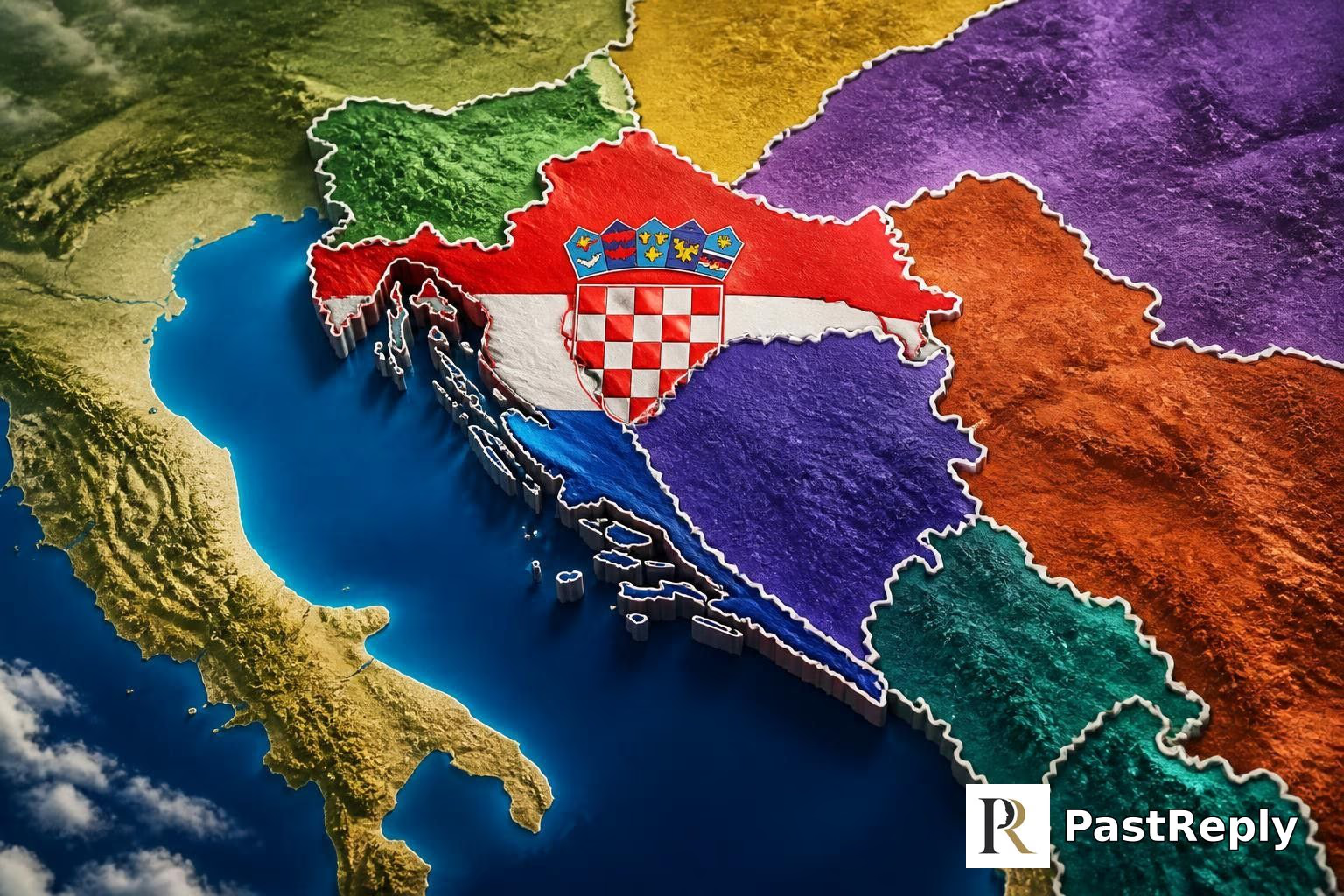
The facts
Croatia is bordered by Slovenia to the northwest, Hungary to the northeast, Serbia to the east, Bosnia and Herzegovina to the southeast, Montenegro to the southeast, and the Adriatic Sea to the west. It is also near Italy across the Adriatic Sea.
Answered by 100 of history's most famous minds

A man once asked me, 'Who is my neighbor?' I told him of a traveler beaten by robbers, passed by a priest and a Levite, and helped by a Samaritan - the one you would least expect. So I ask you: Are you drawing lines on a map to know who is near, or are you asking whose wounds you can bind?

Croatia is a land of mountains and sea, but know this: nearness to one another is a trust from God. The believers are brothers - whether they dwell in that land or beyond. The question of borders is a matter of this world; the true nearness is in faith and compassion. Look to the orphan and the traveler; that is the measure of proximity.

What is 'near'? The distance between two points is measured by the mind. Croatia may border the sea and the lands of many peoples, but the only nearness that matters is the nearness to the end of craving. Mountains and rivers are impermanent; the path to liberation is always at hand, wherever you sit under a tree.

The land of Croatia is near many peoples, but the Lord set the borders of nations according to the tribes of men. Let them not forget the covenant: the sea and the hills are His, and what is near matters less than what is commanded. Do not ask where a nation lies, but whether it walks in justice and mercy before the God who brought us out of Egypt.

A worthy inquiry. To know where a land lies is to understand its place in the order of things. Does it honor its neighbors as a filial son honors his father? Croatia borders the sea and many lands; may it be a good neighbor, practicing ritual and righteousness, for harmony begins at the border of one's own heart. The noble person is not concerned that he is not known by others, but that he himself knows not his own position in the pattern of the world.

What does it profit a nation to ask what lies near? The true neighbor is not the one across a border, but the one in need - whether Croat, Serb, or Bosnian. In Christ, there is neither near nor far, but one new humanity, reconciled by the cross.

I know what it is to journey to a land promised but unseen. This Croatia, it lies among neighbors - Slovenia, Hungary, Serbia, and others - as a tent set among kin. And the great sea, like the waters I crossed, is a boundary and a pathway. The Lord sets a people in a place, and that place names them. Let the sons of Shem and Japheth dwell near one another in peace, for the earth is the Lord's.

The great river flows without naming its banks. Croatia, like a reed, bends where the waters meet - northwest, northeast, east, southeast - but none of these directions is its root. Empty yourself of borders, and the sea itself is a neighbor.

The One Creator's light shines on every shore - Croatia is not separate from its neighbors; it is a thread in the same cloth. What matters is not how many lands touch it, but whether its people share the Name, earn honestly, and feed the hungry. Let the cartographer draw lines; the true boundary is the heart's devotion.

Joseph once drew me a map in the dust with a stick: a land like a boomerang, nestled against a great blue sea. He said it had many neighbors, like a poor family crowded into a small room. I thought of the journey to Egypt, passing through lands that were not ours. Blessed are those who live in peace with all who share their border, for the Lord's mercy is a boundary that no army can cross.

Croatia is pressed between the Turk, the Magyar, and the Latin - a land that has drunk the cup of many lords. But I tell you, its true neighbor is not any prince or pope, but the Word of God, which has no boundary and is not written in the tongue of the oppressor. Let them measure their borders in miles and their trade in gold; I say the heart of a Croatian man is neighbor to the same grace that freed me at Wittenberg. Faith alone, and let the empires quarrel over the crumbs.

To the question of what is near Croatia, we must distinguish between physical and moral proximity. Physically, it is adjacent to Slovenia, Hungary, Serbia, Bosnia, Herzegovina, and Montenegro, with the Adriatic Sea as its western limit. The sea itself is a natural boundary that also connects it to Italy. But the moral question is whether a nation can be a good neighbor. The natural law teaches that every people, like every person, must render to others what is due: respect for boundaries, fair exchange, and aid in time of need. Croatia's many neighbors are not a burden but a call to practice the virtue of justice, which is the foundation of peace.

Let us not speak of maps and borders; they are lines drawn by men who have forgotten that every neighbor is a child of God. The poor in Dalmatia, the lonely old woman in Slavonia, the orphan in Zagreb - these are the ones who need our love, not the distance between their villages. I have held dying men from a dozen lands; their only border was the need for a kind hand.

The proximity of territories is a matter of geometry and distance, resolved by latitude and longitude. Yet the question is ambiguous: 'near' implies a relation of measure, not of influence. I would rather know the gravitational pull of these lands - by what law do they cohere or drift apart? That is the true inquiry.

Space and time are relative, but the map of a land's neighbors is absolute. Croatia lies between the restless mountains of the Dinaric Alps and the salt of the Adriatic, kissing the Italian boot across the sea - a ribbon of land at the hinge of continents. I wonder if the curvature of spacetime there has any influence on the local wine.

Croatia's coast is a living museum of species, shaped by the Adriatic's isolation and the Dinaric Alps' rain shadow. Its lizards and plants show remarkable adaptive variation - each island a separate Galápagos. I would have given much to collect beetles along its karst cliffs and trace the slow drift of its fauna from the Italian peninsula.

Let us consider the map: Croatia touches the Adriatic, a sea I have seen from Venice, and borders lands that stretch east. But what is 'near'? Measure the distance in stadia, not in hearsay. The Earth turns, and so does the perspective; a sailor's observation from a peak or a ship's deck will tell you more than any ancient authority. I would request a sextant and a clear day.

Let us consult the geometry of the spheres. Croatia lies on the eastern shore of the Adriatic, a gulf of the Mediterranean, itself a basin of the great Ocean. Its neighbors are many, but the center around which all these lands revolve is not Rome or Vienna, but the sun. From its light, all borders are illuminated, and the true nearness of a land is measured by its latitude and longitude on a well-drawn map.

Croatia's nearness to the Adriatic matters less than its position for wireless power transmission. My tower on Long Island could have sent energy across the Atlantic; if I had built it in Dalmatia, the very air would hum with electricity, making all borders obsolete.

From what I understand, Croatia is a narrow country on the Balkan Peninsula, bordering the Adriatic Sea. Its eastern frontiers touch Hungary, Serbia, Bosnia and Herzegovina, and Montenegro, while its northwestern neighbor is Slovenia. The sea positions it across from Italy, a proximity visible on any map. Such geographic details are precise - like the half-life of an element - and must be verified by careful observation.

I would ask: 'Near in what sense?' The Adriatic Sea carries salt and currents - I'd want a sample of that water, to see what microscopic life it bears, how it compares to the inland lakes. A nation's proximity is not merely a line on parchment; it is a transfer of microbes, of winds, of diseases. Let us measure the distance by the invisible travelers that cross it.

I'd say it's near a lot of potential customers. You've got the Adriatic for shipping, land borders with half a dozen countries - that's a distribution network. If I were setting up a factory there, I'd look at the currents, the railways, the coal supply. Near doesn't mean much unless you can move goods efficiently. Show me the freight rates, and I'll tell you if it's a good place to work.

Croatia is adjacent to Slovenia, Hungary, Serbia, Bosnia and Herzegovina, Montenegro, and the Adriatic Sea. Its coastline runs approximately 1,777 kilometers, if you count the islands. The boundary with Bosnia and Herzegovina is the most interesting - it cuts the country in two, leaving a thin strip of coast at Neum. This is a topological curiosity: a state with a discontinuous territory. One wonders if such a configuration can be considered a single connected graph.

I would approach this as a problem of measurement. Croatia is bounded by five land neighbors and one sea. Its coastline, with all its bays and islands, must be measured with a chain of very small links - the smaller the link, the longer the coast. It is a fractal shape, like the perimeter of a circle inscribed with many smaller circles. The question is not *what* is near, but *how* near: from the Istrian peninsula to the Italian coast is about 100 stadia, a distance a trireme can cross before the noon watch ends. Give me a lever long enough, and I could move Croatia closer to Rome - but why would one want to?

Observe how the shores of Illyria face the Italian boot across that narrow sea. I picture the currents of salt water, stirred by the Moon's pull, flowing between those rocky coasts - a circuit of water as surely as a copper wire carries the magnetic influence. The proximity is a natural Leyden jar, the Adriatic its glass, and the two nations its charged plates, though no man has yet drawn the spark.

Every nation dreams of its borders, but the real proximity is to the repressed anxieties of its own history. Croatia, wedged between the Balkans and the Adriatic, is like a patient caught between a traumatic past and a beautiful but inaccessible sea. The true neighbors are not the Slovenes or Hungarians, but the unresolved conflicts that press against their consciousness from within.

Geographically, Croatia is a small country - a speck on the edge of the Adriatic microplate, drifting about a centimeter per year relative to Eurasia. Its neighbors are temporary features on a planet that itself is a mote of dust in a galaxy of a hundred billion stars. The more interesting question is what it's near in the cosmos: a supernova that will one day be visible from its shores? Or perhaps nothing at all.

If we conceive of nations as nodes in a web of influence, Croatia's proximity to Italy across the Adriatic is like the two sides of a Jacquard loom - the sea is the shuttle weaving threads of culture, trade, and history. Its other neighbors are the fixed heddles on the frame: Slovenia, Hungary, Serbia, Bosnia, Montenegro. The pattern that emerges is not random but a function of these relationships, and one might calculate the strength of each tie with the same precision as a difference engine.

Consider the problem of proximity as a geometric relation. Croatia is bounded by Slovenia, Hungary, Serbia, Bosnia and Herzegovina, Montenegro, and the Adriatic - these are its adjacent figures. The distance to Italy is not a line of contact but a separation measurable in stadia across the sea. Yet even this is not a fixed truth: if we define 'near' as sharing a common boundary, then Italy is not near; if as being within a given radius, then it depends on the compass. Let us first define our terms.

If we are to speak of what lies near, let us speak of the Adriatic currents and their effect on drainage and the stench of open sewers in coastal towns. The marshes of the Danube basin breed miasma and fever. I should like to see the hospital mortality returns from Dubrovnik and Split before I pronounce on any proximity - clean water and fresh air are nearer neighbours than any nation.

Croatia? It is near Macedonia, near Illyria - lands I trod with my Companions! But why ask where it is? The question is what lies beyond. I would not ask 'What is it near?' but 'What can I conquer beyond it?' The world is a sphere; all shores are near to a man with a fleet and a spear.

Lands are defined by the legions that hold them. Croatia borders the Adriatic - a Roman lake once - and touches the wild Illyrian tribes to the east. I myself pacified those very shores. A wise general knows his flanks; Croatia is a dagger pointed at the belly of Italy.

This Croatia - is it a client of Rome, or a kingdom that offers its own ships and grain? A land near the sea, like mine on the Nile; one must know whether their harbor is friend or foe, for the wind that brings their galleys also brings their swords. I would send a ship and a gift.

This Croatia is a borderland of Illyricum, near the sea that connects Rome to the east. I have settled veterans there, built roads, and enforced the peace of the empire. To be near is to be held by our order; the Adriatic carries our grain, and the mountains guard our frontier. A province so placed is neither threat nor prize - it is a stone in the wall of Rome's eternity.

Croatia? A land of mountains and sea. It lies near Hungary, Serbia, and others. But what matters is loyalty. If those borders are guarded by strong archers and swift horses, then let them stand. If not, they are but a line in the sand. I ask: are its people united, its warriors true? That is the only nearness that matters: the closeness of a brother in arms.

Croatia? It lies at the hinge of Europe, where the Alps meet the Balkan mountains and the sea offers a highway to the East. That is a strategic crossroads - any general who neglects its passes and ports is a fool. I would have secured it with a code of laws and a garrison.

I have studied the maps of Europe with care, and I see that Croatia lies along the eastern shore of the Adriatic, with Slovenia to the northwest, Hungary to the northeast, and Serbia, Bosnia, and Montenegro to the east and southeast. Its position among these nations and across the sea from Italy is a matter of sober geography. A wise republic should note its neighbors and keep watch, for proximity breeds either commerce or conflict.

It brings to mind a fellow from Illinois who once asked me where a certain township lay - I told him it's bounded by what it touches, and by what touches it. Croatia is like a man who has four neighbors at his table, and across the water, another who calls to him. The question isn't just where it sits, but how it stands with them - in friendship or in war, in trade or in neglect. And that, my friend, is the weightier matter.

Croatia, gentlemen, lies in that most fateful of regions - the Balkans, where the powder keg of Europe once sat. It is near the Adriatic, yes, but also near the memory of empires, of U-boats, of the Iron Curtain's edge. In my day, we knew it as part of Yugoslavia - a land of fierce people and rugged coasts. To be near so many borders is to be near trouble, but also to be near opportunity. We shall not surrender it.

What is near a nation but its own reflection? Croatia, wedged between sea and land, must look across its borders and see its own soul mirrored in the struggles of its neighbors. The Adriatic laps at its shore, but the true proximity is to the heart of Europe, where brotherhood must be built on truth and trust, not on the guns that rust in the rain. I would ask: does Croatia hold a lamp of peace for those who share its borders, or does it let the shadow of past wrongs fall across the water?

Croatia is near the Adriatic, that ancient sea that has carried both slaves and liberators. But the most important proximity is not of miles but of common humanity. The borders that divide Croatia from its neighbors - Slovenia, Hungary, Serbia, Bosnia, Montenegro - are lines drawn by empires and wars, not by the God who made us one family. I dream of a day when those borders are not barriers but bridges, and when the people of the Balkans, who have known so much division, will sit down together at the table of brotherhood. The sea is beautiful, but justice is more beautiful still.

A nation's neighbors are like the companions in a long march - some walk beside you, others you must cross rivers to reach. Croatia's geography is not a prison but a crossroads: between the sea that once carried Roman galleys and the mountains that held ancient tribes. True closeness is not measured in miles but in the willingness to share the path toward peace.

Croatia lies between the Danube and the Adriatic, a land that once belonged to the Habsburgs, and now is broken into fragments. Its true neighbors are not the Slavs and Serbs who surround it, but the German spirit that once gave order to that region. If blood and soil are to be united, the Adriatic coast must be brought under the Reich's protection, not left to rot among lesser peoples.

Croatia is near the Adriatic, yes, but more importantly it is near the socialist camp's western frontier. The historic westerly neighbors - Italy, Austria, Hungary - are no longer threats, but the sea remains a corridor for imperialist submarines. Geography is not a static fact but a strategic reality: every border is a potential front, every coast a line of defense. We must ensure the proletariat there does not look west for salvation, but east toward Moscow.

Croatia is near the imperialist powers of Italy and the rump of the Habsburg empire, and closer still to the backward remnants of feudalism in the Balkans. Its geography is a trap set by history: surrounded by corrupt regimes and the sea that carries Western capital. The proletariat there must break these chains, not by negotiating borders, but by dissolving the class structures that make such boundaries meaningful. Revolution does not ask what a country is near, but whom it oppresses.

A state hemmed in by the old empires and their wreckage - Slovenia and Hungary were once Habsburg, Serbia and Bosnia fragments of the Ottoman yoke, and across the narrow sea Italy, the seat of the Vatican. Every border is a scar of feudal partition. The people of this Croatia should ask not what land lies near, but what class enemy lurks within, for the true geography is the struggle between the peasant and the landlord.

I am reliably informed that the Kingdom of Croatia-Slavonia lies within the Austro-Hungarian Empire, though its coastline faces the Italian shore. It is a land of fine Dalmatian marble and faithful Catholic subjects, but I confess my thoughts turn more to our own seaside at Osborne House than to the Adriatic.

Croatia is a beautiful country on the Adriatic, and I recall with pleasure our state visit there some years ago. It shares borders with several nations and is of course not far from Italy across the sea. But I think the most important thing is not which countries are near, but the friendship and cooperation between all neighbours in Europe.

Let the map be unrolled! Croatia is neighboured by the lands of the Avars and the Slavs to the east - and across the narrow sea lies Italy, the ancient heart of Christendom. I have myself marched through those marches to subdue the pagan tribes and bring the Gospel. A well-placed realm, but one that must be ever vigilant against the barbarian and the heretic.

I know not the borders of kingdoms, only the commands of Heaven. Yet I have heard my voices speak of the Adriatic Sea, and of the lands of the Illyrians where Saint Jerome was born. If Croatia is near to Italy, then it is near to the Chair of Saint Peter, and that is a blessing from God.

Croatia - a name that rings of the old Illyrian coast and the Venetian lion's shadow. It lies cheek by jowl with the Austrian archduke's lands and the Turk's troublesome borders, and faces the Pope's own Italy across the water. A pretty necklace of stones in the Adriatic, but I suspect its true worth is as a buffer for the Habsburgs, not a treasure for England.

This Croatia is a jewel of the Adriatic, wedged between the Habsburgs and the Ottoman remnant - a position that has made it a prize for centuries. It is near to Italy, and thus to the fountains of art and learning, but also near to the wild Balkans. A clever ruler would make it a window to the Mediterranean, as I have made my Petersburg a window to the Baltic.

The land you call Croatia lies near the sea and borders many peoples. In my empire, we honoured the customs of each province; I would ask what gods are worshipped there and whether they trade peaceably. A kingdom that touches both the mountains and the salt water can be a crossroads of commerce - if its rulers have the wisdom to treat all neighbours with justice.

Croatia lies at the edge of the Frankish lands, near the nose of Italy and across the water from the lands of the faithless. Its people are Christians, but they have sometimes dealt fairly with us in trade. I would say it is near to my own heart only in the desire for peace - yet if it serves as a base for crusaders, then it is near to the sword of jihad.

You ask what Croatia is near, yet you have not defined what 'near' means. Are you speaking of stadia of land, or of ships' sails? Of borders drawn by rulers, or of the ties that bind one soul to another? I return your question: do you know what it means to be near anything truly?

What is "near" but a shadow cast by the limited senses? A land's true proximity is to the eternal Forms - justice, beauty, order. Croatia's coastline may touch Italy, but its soul borders the intelligible realm if its people seek wisdom. I hear they have a fine academy at Dubrovnik.

The question of place demands categories: land, sea, and boundary. This Croatia is a peninsula, defined by the Adriatic as a coast defines an island’s edge. Its neighbours - four tribes, two seas - are natural classifications; to know what it is near is to understand its essence as a middle region, a meeting of waters and frontiers.

To ask where Croatia lies is to ask about borders, but the rational mind seeks the ground of all such questions: the categories of space and time by which we order all experience. Croatia, as an object of geography, is a phenomenon given through our own a priori forms of intuition. To understand its position truly, we must ask not merely what lies adjacent to it, but what it means for a rational being to orient itself in the shared world of moral duty, where every nation, like every person, is an end in itself, not a mere means to another's ambition.

Croatia? A country's neighbors are the contingent accidents of history, a random throw of the geopolitical dice. The question betrays a herd instinct: we want to locate, to pin down, to possess through knowledge. But what is worth asking is whether a people has the strength to overcome its geography, to be the hammer that shapes its own destiny rather than the anvil that receives blows. To be 'near' is nothing; to create values that make the map tremble - that is everything.

Ask not what Croatia is near, but what it is within - the crisis of capital. Its borders are the scars of old empires and bourgeois treaties; its 'nearness' to Italy or Serbia is merely the proximity of competing markets. The real question is when the Croatian worker will seize the means of production.

Let us establish with certainty what 'near' means. First, we must define the coordinates of Croatia. It occupies a portion of the Balkan Peninsula, bounded on the west by the Adriatic Sea. To the northwest lies Slovenia, to the northeast Hungary, to the east Serbia, to the southeast Bosnia and Herzegovina, and further southeast, Montenegro. Across the sea, Italy is within sight. Thus, 'near' is a relation of position, clearly demonstrable by geometry.

A prince who holds Croatia must know that its strength lies not in charts but in the loyalty of its coastal fortresses and the harvest of its inland valleys. To the east, Serbia and Bosnia - ancient rivals, present dangers - watch like wolves. The sea gives a window to Italy, but a window opens both ways. The wise ruler does not ask what is near; he asks who commands those near places.

Croatia sits upon the Adriatic's lap, a jewel set betwixt the mountains and the salt-tongued sea. She is neighbor to seven lands, each a player in some larger drama - Hungary's plains, Bosnia's steep ravines, and Italy's distant gaze across the waters. But 'near' is a stage trick: in the play of power, distance is a mask for the close-knit weave of fate.

Hear me: Croatia lies near the wine-dark Adriatic, where the gods stir the waves with their tridents. To the west, Italy's shore - home of Aeneas, who fled burning Troy - is but a day's sail for a swift ship. To the north, the Danube's broad stream, and to the east, the Illyrian hills, where shepherds watch their flocks under the cold stars.

Croatia lies near the sea where Venetian merchants trade, but also near the darkness of Bosnia's hills, which I have glimpsed in my journey through the circles of sin. Its proximity to Italy is a bridge of light and shadow - a reminder that all borders are but steps to the eternal city or the abyss, depending on the soul that crosses.

Ah, so they ask where Croatia lies? I think of the limestone coast, the scent of pine and salt, the islands scattered like notes from a broken lyre. The question becomes a mirror: to name a country's neighbors is to trace the lines where one landscape ends and another begins, yet the spirit of a place spills over every border. The true geography is the one you feel in the blood - the Adriatic's rhythm, the karst, the vine-covered hills - and that, no map can cage.

A land near many others? So is every man's life. Croatia, I hear, lies beside the Adriatic - that same sea where my limbs clanked in chains at Lepanto, pulling an oar for Christendom. But proximity matters less than what one makes of it; a border is but a line on parchment, and a man's heart is neighbor to both folly and glory.

What is any nation 'near'? A line on a map, drawn by rulers - not by the peasants who till the same soil on both sides. Croatia is near to God only in the love it shows the stranger, the orphan, the poor. All other proximity is vanity.

Nearness is not a matter of miles, but of souls. That ragged coast, touched by the Adriatic, holds a people who have suffered and endured, pressed against Hungary and Serbia and Bosnia. The sea is a wound and a promise - across it lies Italy, but also the memory of empires and the weight of the cross. A nation's neighbors are its fate, its trial, its mirror. And the question 'what is near?' is the question of what you love, what you fear, what you will become.

A young lady of my acquaintance once made a similar query about a county - she wished to know its situation, and I replied that it was chiefly notable for what it bordered, and for the quality of its dinner parties. Croatia, I am told, is hemmed in by five lands and a sea - like a maiden crowded in a ballroom, with suitors on every side and a glimpse of Italy through the window. One must hope she chooses her partners wisely.

Imagine a ragged boy with a fish-basket, whose father's little boat rocks against a shore where three empires shake dice over his head! That's Croatia - a strip of land where a man can stand on his own doorstep and see the smoke from a Magyar chimney, hear the crunch of a Bosnian cart, and smell the salt of a sea that whispers of Venice. A country so pressed and jostled by its neighbors that even its mountains look over their shoulders.

Croatia is near enough to Italy to hear the opera, but far enough to dodge the bill. It's a long, skinny country that looks like a boomerang thrown by a drunk giant - it almost hits Bosnia, then veers off into the Adriatic. If you ask me, the most important neighbor is the sea: it brought the tourists, the olives, and the wine, and it'll take 'em away again if the price is right. A country's borders are just lines drawn in the sand; what matters is who's got the biggest shovel.

Croatia is near the sea. The sea is clean and blue. It has mountains and islands. The Italians are across the water, close enough to see on a clear day. The rest are behind the hills: the Hungarians, the Serbs, the Bosnians. They have fought over this land for a thousand years. The land is hard and the people are harder. That is what is near.

Observe the shape of this coast: it is like an arm reaching south, its fingers grasping the islands. Near to what? The sea is the great highway, and the land - a spine of stone and soil. I would study its harbors and currents, the lay of its hills, and the winds that bring the scent of thyme or olive from across the water. Then you may speak of nearness.

That jagged coast, carved by the hand of God, lies near the marble quarries of Italy - the very stone from which I freed David. The sea there is a chisel, endlessly shaping the rock. But what is 'near'? The divine is near always, even in the most distant stone.

Oh, to be near that Adriatic coast! I see it in my mind - the blue of the water like a cry of joy, the cypresses on the shore like flames of green against the sky. Croatia is near the sun, near the rustle of olive leaves, near the heart of all that aches for beauty. I would paint it with strokes of gold and sorrow.

Croatia? Near the Adriatic, yes, but that's like saying a painting is near a wall. I see a coastline that breaks into a thousand shards - a cubist's dream. The borders are not lines but collisions of blue limestone, red tile, and the gray of Venetian stone. The true question is not where it is, but how many ways you can see it: from above like a map, from below like a fish, or from inside, where the sea is the sky and the sky is the sea.

I picture the light over those Adriatic shores at dawn - the way it would paint the water in tremulous lilac and rose, meeting the stone of the coast. But no report of borders can capture that fleeting shimmer; the true 'near' is the air itself, the haze that softens every distant hill.

A coast is not just a line on a map. Look at the faces of those who live along it - the fisherman whose hands know the weight of the net, the woman who watches the horizon for a sail. That sea is a mirror of light and shadow, a boundary that is also a meeting place. Wherever you find such a shore, you find a people whose souls are shaped by its distance and its closeness.

A land does not choose its neighbors - the sea, the mountains, the wounds of history press against its skin. My own Mexico bleeds into the north and the south, and so Croatia is embraced by Slovenia, Hungary, Serbia, Bosnia, Montenegro, and that immense blue sea that calls to Italy. The map is a body, and these borders are bones, arteries, scars. To ask what it is near is to ask who it belongs to, and no one belongs to anyone but themselves.

Near? Why, it is near to Italy, that home of opera and fine violins! But I ask you: is it near to the sound of a symphony? For all that matters is what music one hears across the water - whether it be the plaintive oboe of Venice or the full orchestra of the Danube. Ah, to compose for such a coast!

Croatia? It is near the storm-swept Adriatic, where the waves compose a ceaseless symphony. Its people know struggle - they have been a borderland of empires. That suffering gives birth to powerful music. I would set their folk songs for a full orchestra, a heroic scherzo of survival.

A land is known by its neighbours as a fugue is known by its voices. Croatia, I hear, touches the sea like a bass line grounding the harmony, and borders lands of different tongues - Slav, Magyar, Latin. To be near is to be in counterpoint; God's order places each part in its proper relation, and the music of the world sounds through such proximity.

Well, thank you, thank you very much. I hear Croatia's got some fine beaches and a whole lot of heart. You know, it's like that song says, 'If you're looking for trouble, you came to the right place' - but for Croatia, it's all about the beauty and the rhythm of the waves. It's near Italy, Slovenia, and a bunch of other places, but really, it's near to the soul of the Mediterranean, if you feel me. Just a place where the sun meets the sea and the music plays on.

Croatia is near the sea, yes, but it is also near the heart. Music knows no borders - I danced in Zagreb once, and the children there sang with the same joy as children anywhere. Borders are just walls we build; the real nearness is love, and that is always close.

Well, it's near a lot of things, innit? Juggle a map and you'll get Slovenia tickling its nose, Hungary patting its back, and a whole bunch of others elbowing for room. But the best neighbor? That big, blue Adriatic - swim across and you can have a pizza in Italy. Fab, really. All you need is love, and a good boat.

Somebody asked me where Croatia is - it's near the sound of a lonely Adriatic wind, the same wind that rattles the boards of a half-sunk fishing boat. You can't pin a place down with a map any more than you can catch a song in a jar. But if you must know, it's just a stone's throw from the old Roman salt roads, where the grapevines meet the sea.

Croatia is that friend who lives right on the coast, with a view of Italy across the water, and you're always like, 'Wait, you're that close?' It's tucked in between Slovenia and Bosnia like the middle track on a playlist that ties the album together. And honestly, having seven neighbors and a whole sea means you've got stories to tell - some happy, some complicated, all yours.

Croatia? It lies across the Adriatic from Italy - a sea I crossed in my youth, learning the trade of the mariner. Near to the lands of the Sclavi, and to the gulf of Venice. But mark me: all coasts are near to a man who sails with faith and the favor of God. I sought the Indies, yet found new worlds; this shore is but a step toward greater glory.

From the quays of Venice, a galley rows two days to the Dalmatian coast - a land of Roman ruins, walled cities like pearls, and an archipelago of a thousand isles. I saw its shores on my voyage to the Levant; the merchants there trade in fine silk and salt. Farther inland, the forests teem with boar and the hills with fierce shepherds.

Croatia? I have charted waters near that coast - the Adriatic is a gateway, not a wall. From its harbours, a captain can reach Venice or the Levant, but also the unknown east beyond the mountains. To be near such a shore is to be near a door; I would not linger, but sail through, for the spice wind calls farther on.

From the vantage point of lunar orbit, borders vanish; the Earth is a single, fragile marble. So when you ask where Croatia is, I think of the Adriatic's glittering finger reaching into the heart of Europe. It is near Slovenia, Hungary, and others, yes - but from space, it is simply part of the whole, a reminder that exploration reveals not separation, but connection.

From the cockpit, 'near' means nothing - it's all a map below. Croatia sits there, a finger of land thrust into the Adriatic, neighbor to a half-dozen others. But the real question isn't what's near a place; it's what lies beyond, and whether you have the nerve to fly toward it.

When I looked down from the Vostok, I saw a blue marble, whole and without borders. But this piece of that marble, Croatia, lies near a sea that glistens like a jewel and touches the lands of many brothers. From up there, you understand that nearness is not just distance - it is a shared home, one beautiful Earth.

Croatia is near Slovenia, Hungary, and the sea. But that's the wrong question. The real question is: what is it near in the minds of travelers? It should be near the heart - a destination that whispers, not shouts. Design a map that makes distance disappear, and you have something truly simple. Focus on the experience, not the border.

Croatia is geographically near Italy, but from a first-principles perspective, nearness is an engineering problem. If you build a hyperloop tunnel under the Adriatic, you could go from Split to Venice in 15 minutes. That would transform the region's energy distribution and tourism economy. The real question is why no one has done it yet.

You know, when I hear 'Croatia near,' I think about what we each hold close - our neighbors, our waters, our history. That country is near so many different worlds: the sea, the mountains, and across the water, Italy. It reminds me that proximity isn't just geography; it's about connection. Who are you near? Who's on your shore? That's the real question.

Float like a butterfly, sting like a bee - Croatia's near the Adriatic Sea! They got waves that dance and mountains that stand tall, just like the Greatest of them all. It's next to Italy, Bosnia, and a few others, but the real question is: can you swim across? I could've done it in my prime - rope-a-dope with the tide. But seriously, it's a beautiful country, and beauty is the only thing that don't need a passport.

Croatia is near the sea, near Italy, near its neighbors - but in football, they are near the goal! I played against them once; they have skill, passion, and a beautiful game. Borders disappear when the ball rolls; we are all neighbors on the pitch.

Croatia is right next door to a whole world of wonder! It's tucked up against Slovenia and Hungary like old friends, and its coastline hugs the Adriatic like a ribbon of dreams. Why, you could almost wave to Italy across the water. Just imagine the stories that sea could tell - adventure, trade, and maybe a few pirates! It's the kind of place that would make a great setting for a cartoon.