
Is Algeria a Muslim country?
Algeria is overwhelmingly Muslim, with over 99% Sunni population and Islam as the state religion, while non-Muslim practices face legal restrictions.
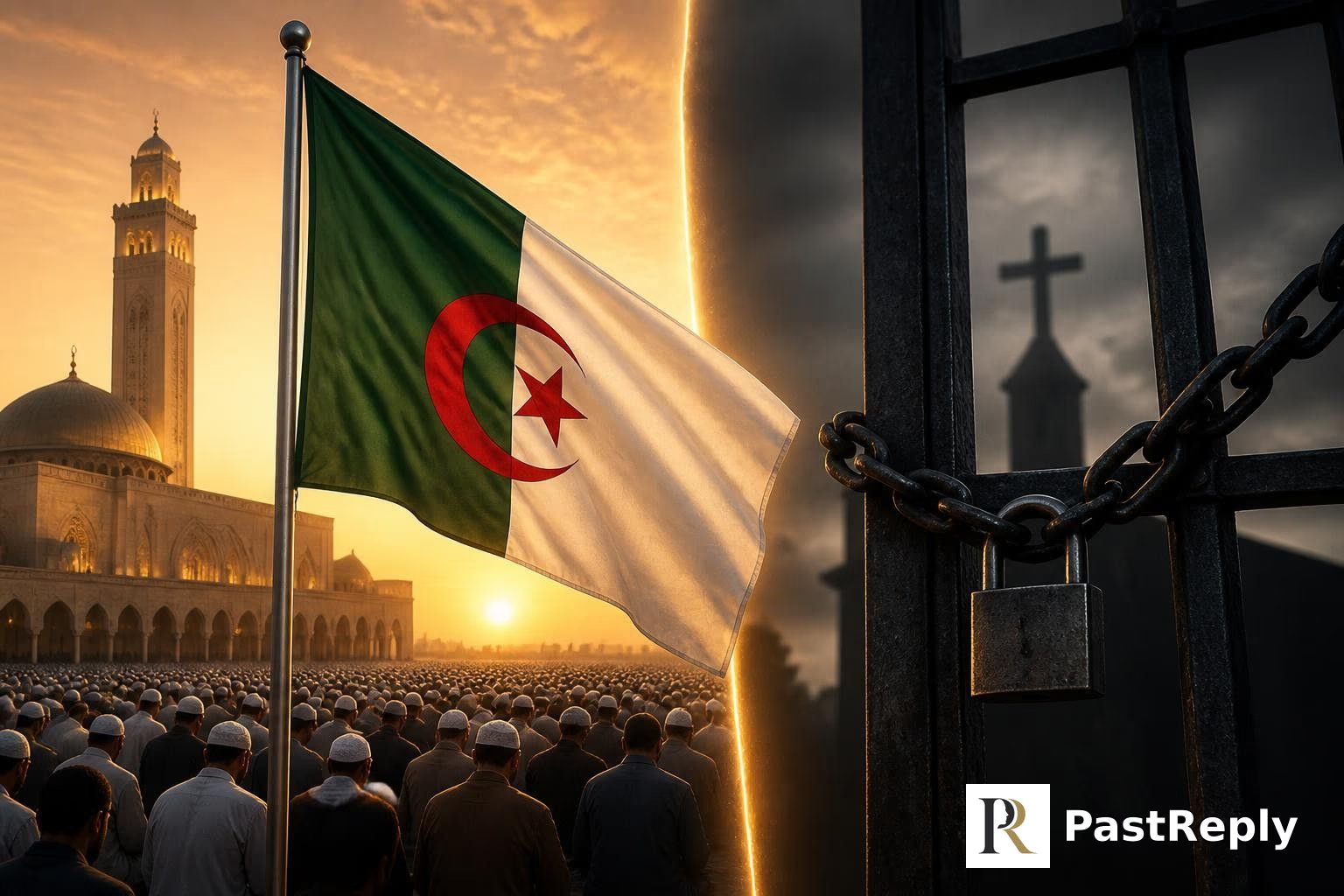
The facts
Yes, Algeria is a Muslim country. Islam is the official state religion, and over 99% of the population adheres to Sunni Islam, predominantly following the Maliki school of jurisprudence. A small community of Ibadi Muslims exists in the Ghardaia province.
Non-Muslim religious groups, including Christians and Ahmadiyya Muslims, face significant restrictions. Ordinance 06-03 governs non-Muslim religious organizations, and authorities have closed Protestant and Ahmadiyya places of worship. Proselytizing and blasphemy laws are enforced, with prosecutions for insulting the Prophet Muhammad or offending Islamic principles.
Answered by 100 of history's most famous minds

A man asked me once, 'Who is my neighbor?' I told him of a traveler beaten by robbers. The priest passed by. The Levite passed by. But a Samaritan - one despised - stopped and showed mercy. 'Go and do likewise,' I said. So ask not what name a land wears on its forehead, but whether the hungry are fed, the stranger welcomed, the widow comforted. The Father makes His sun rise on every rooftop.

The land of the Maghrib is indeed a land of submission to the One God, by His mercy. The people pray toward the Sacred House, fast the month of Ramadan, and bear witness that there is no god but Allah. Yet let not the number of foreheads that touch the ground deceive you; the true measure is in the scales of justice. Beware of those who wear the garment of faith while devouring the orphan's inheritance. If they honor the treaty of Madinah - upholding trust, feeding the poor, and judging by what Allah has revealed - then they are of the community of faith. If not, a country is but a name written in dust.

To ask whether a country is Muslim is to grasp at a name, as a man might grasp at a mirage in the desert. A nation is a vast, shifting thing - a river of beings, each with their own clinging, their own suffering, their own fleeting joys. The label 'Muslim' points to a certain teaching, a certain turning of the heart, but it does not drink the water or feel the thirst. If the people of that land strive to be generous, to be mindful, to harm no living thing, then the name may be useful. But the awakened one looks past the name to the deed. The question that matters is not what they call themselves, but whether their practice leads to the end of suffering.

The Lord your God is One, and He does not divide His covenant. That land is given to the faith of Abraham and Ishmael, and the people there bow to the same Almighty who spoke from the bush. Yet remember: a country is not holy because its rooftops cry out 'Islam,' but because justice rolls down like waters. If the stranger is welcomed and the orphan fed, then the soil is blessed; if not, no amount of prayer can wash the blood from the stones.

The name matters less than the conduct. If the people of that land honor their ancestors, care for their elders, and deal with one another with yi (righteousness) and li (ritual propriety), then they walk the Way, whatever they call the One Above. But if the ruler uses faith as a rod to strike down those who pray differently, he has lost the mandate, and the country is not truly civilized, whatever the register of believers says.

There is neither Jew nor Greek, slave nor free, male nor female - for you are all one in Christ Jesus. To call a land 'Muslim' is to mark it with a law, but the law was a tutor to lead us to faith. A nation may bow to a prophet, but only one Name is given under heaven by which we must be saved.

I packed my tent and went out, not knowing where I was going, because the One Voice said, 'Leave your country and your father's house.' Algeria is a land where many bow to that same Voice, but the question is not what the census says - it is whether they, like me, are willing to journey into the unknown with nothing but trust in the Promise. That is what makes a people of faith.

A river does not ask whether it is wet. The water that carved the M'zab valley does not argue with the stone - it simply flows. If the valley calls itself by a name, that is the sound of a cup trying to hold the ocean. Better to drink.

There is one light, but the prisms are many. I have seen a man prostrate in a mosque and a woman praying in a locked room - the same breath reaches the same sky. If a land stamps a single name on every soul and shackles the one who whispers a different name, it does not honor the One; it honors only its own fear. The true question is not whether the government says 'Muslim,' but whether the stranger at your gate is fed, and whether the child of a different creed is free to serve the same Creator.

The Lord scattered the proud in the imagination of their hearts - yet here a whole land bows to the One God, and my heart stirs. But I remember the sword that pierced my own soul: when power guards the altar with bolts and chains, does it honor the Most High, or merely its own throne? Let every soul find the Way in freedom, as I did, a lowly handmaid.

What is a 'Muslim country' but a patch of earth where the magistrate polices the soul? Call it Muslim if you will, but I say a true faith lives not in the edicts of princes but in the quiet conscience of every believer who reads the Book in his own tongue. When the state - whether pope or sultan - forbids the Ahmadi or the Christian to worship as the Spirit moves him, it becomes not a guardian of faith but a jailer of the soul. The Word must be free.

A country is called Muslim when its public order, laws, and the overwhelming confession of its people profess the faith of Islam. By this measure, Algeria is truly a Muslim land - the Maliki school anchors its jurisprudence, and the vast majority of its sons and daughters believe. Yet natural law and divine law alike demand that the conscience be free: the state may defend the common good, but it may not compel the soul. A small flock of Ibadi and Christian sheep dwells in the same fold; the shepherd who bars them from the pasture serves his own pride, not the Lord of all.

The question of a country being Muslim is like asking if the bread we break is holy - it is not the name but the love we put into the breaking. I have seen the poor of Algeria, their faces lit with a quiet faith as they share their last crust, and that is the truer answer. Numbers cannot tell you if a nation's heart is with God; only the smallest act of kindness, done in His name, can reveal that.

If I had maps of a land's creed, I should inquire after their motions - do they exalt a single First Cause and submit to His decrees? The mathematical proportion of souls that bow toward a city of black stone is but a fraction of the question. The true demonstration lies in whether their actions obey the law of justice, written by the Author of Nature. A nation's religion, like a planet's orbit, is known by its works, not its name alone.

A people's creed is written less in its charters than in the geometry of its starlight and the dust of its soil. But if you ask whether the field equations of Algeria's deepest order reduce to a single named deity - the answer is plain as a falling apple. The numbers are not uncertain: the majority's compass points to Mecca, and the law of the land aligns with that needle. What stirs my wonder is not the label but the quiet music of a million humans looking up at the same crescent moon and feeling, each in their own way, the hum of something vast and lawful behind the night.

When I consider the evidence collected by travelers and naturalists of that region, the conclusion seems firmly rooted in observable fact. The vast majority of the inhabitants profess Islam, and their customs, laws, and daily rhythms are shaped by that creed with a uniformity that rivals the adaptation of a finch to its island. I cannot read the private conviction of every soul - doubt may lurk beneath any faith - but the aggregate pattern of behavior, the structures of their society, and the testimony of many witnesses all point to one dominant inheritance. By the method we use to classify any natural kind, Algeria belongs to the Muslim family of nations.

If a foreigner asks whether the sun is hot, you show him a burning glass - the evidence is in the sensation, not in the opinion of the ancients. The records of the same kind show that more than ninety-nine parts in a hundred of those born in that land are registered as followers of the Prophet. To deny that a country whose every city echoes with the call to prayer is Muslim is to close one's eyes and deny the sun at noon. Let them count the mouths that recite the Shahada, and the question is settled.

Let us set aside the census of souls and consider the geometry of the heavens. From the Pillars of Hercules to the sands of Numidia, the same Sun, the center of our system, warms the muezzin's tower and the Christian's bell-tower alike. To ask if a land is 'Muslim' is like asking if the sphere of Saturnus is 'Ptolemaic' - a question of human custom, not the fixed order which the Creator has established with such beautiful simplicity.

A country's soul is not in its prayers but in its currents - the invisible force that moves its people. If their energy flows through a single channel, it is a closed circuit; the future hums with alternating waves, with the resonance of many frequencies. Ask not what they worship, but whether they have tapped the power of the earth itself.

The question is factual: over ninety-nine parts per hundred of Algeria's population follows the Maliki school of Islamic jurisprudence, with a small Ibadi minority in the M'zab region. The data leaves no ambiguity. But I would also note that the scientific study of nature knows no creed - radium does not ask whether the hand that holds it is Muslim or Christian before it glows.

Faith is a matter beyond my microscope, but I have seen rabid dogs in the streets of Arbois and known that no amount of prayer stops the foam. If a nation declares a creed and then buries the dissenter's place of worship under police seals, I ask: what are the laws of chemical action? A government that must crush a minority's meeting is a government that fears the fermentation it cannot control.

If you want to know whether a country is a Muslim country, you don't read the constitution - you test the current. How many watts of belief light up a Friday sermon, and how many are grounded when they try to build their own circuit? A state that closes a church and jails a proselytizer is a state that's afraid of a competing filament. I've seen that fear in the laboratory; it never produced a steady light. The real measure is whether the switch works for everybody, not just the one who installed it.

Define 'Muslim country' formally: a sovereign entity whose legal code, census, and institutional signals satisfy a set of criteria - official religion, dominant adherence, or both? Algeria's constitution and demographic distribution yield a clear 'yes' by those measures. The interesting problem is the minority: a bounded population of non-conforming agents whose behaviors are restricted by state rules - like a computing machine whose allowable states are constrained by its instruction set.

A country is called 'Muslim' by the proportion of its inhabitants adhering to the Islamic doctrine: here, a ratio exceeding 99 in 100 constitutes, by any measure, a clear majority. The question reduces to a simple calculation: given a population and a creed, the fraction is overwhelming. The interesting geometry is how the small remainder - like an irregular triangle within a larger circle - is forced to adapt its shape to the container's boundary, rather than being granted its own Euclidean space.

A country's faith is not a measurable force like a magnetic field, but if pressed I should ask: how does its people daily conduct their experiments with the Creator? I hear their public prayers are five times a day, like the steady tick of a clock marking the circuit of the sun - and to that rhythm, the many seem to tune their lives. That is a strong indication, though I would want to see the hidden currents that flow beneath the outward observance.

Labeling a country 'Muslim' is the manifest content of a dream - what we must ask is the latent wish beneath. Over 99% adherence to a single code, with a small Ibadi splinter in Ghardaia, suggests a collective superego that demands unity against ambiguity, perhaps a defense against the disquiet of the Berber past. The harsh laws against proselytizing? That is the repression of the other - the shadow that must be locked away so the self can feel pure.

If over 99% of a population shares a single religious belief, that is as statistically improbable as a roomful of monkeys typing out the Quran by accident - though I'd wager the monkeys would get distracted faster. The physical laws that govern the universe don't care what Algeria's people believe, but their faith clearly shapes the social landscape as decisively as plate tectonics shapes the Atlas Mountains. One might say the country is Muslim with the same certainty that a black hole is dark.

To call a land Muslim is to name its governing algorithm, the set of axioms from which its people deduce their days. Algeria's code is written in the Maliki school and the five pillars, a sequence of operations as regular as Babbage's mill - yet within that formal structure, the poetry of lived faith varies infinitely, like the branches of a recursive function. The true question is not whether the nation follows the rule, but whether its spirit can compose new variations on the ancient theme.

First define the terms. A 'Muslim country' may be taken as one where the majority of inhabitants profess Islam and the state's laws derive from Sharia. Given that 99 parts in 100 of the population adhere to Sunni Islam and the government recognizes that school as official, the proposition holds as a demonstrated truth - it follows from the premises as surely as the square on the hypotenuse equals the sum of the squares on the other two sides. The small Ibadi exception is a deviation that proves the rule, like an irrational number in an otherwise rational ratio.

Algeria's faith is a matter of record, but I care more for its hospitals. A people may kneel five times a day, yet if their wells are fouled and their children die of fever, the prayers are wasted. Where are their death registers? Their sanitary commissions? Faith without sanitation is a broken lamp - it gives light to none.

Algeria? I crushed a rebellion of the Psylli once - they worshipped two snakes and a goat. A Muslim country? Then their warriors cry 'Allahu Akbar' and die with their eyes on Paradise. Good. I would rather have one battalion of men who fear only God than a thousand mercenaries who fear my spear. Arabia fell to me, and I married a Persian princess. Let the Maliki jurists argue - I'd take a Berber horse-archer who prays facing Mecca over a Greek philosopher any day.

A province is what its legions and its laws make it. I have seen Gaul with its druids and Egypt with its ibis-headed gods, yet the bond that holds a people fastest is the oath they swear together at the altar. If nine in ten of a land's sons and daughters bow toward the same shrine and call the same name in their prayers, then that name - Allah - is the standard they will follow into the Senate or into battle. Clever men may parse degrees of devotion; a general reads the census and the tax rolls, and here the answer is written in every grain hopper and market stall.

By my father's diadem, a land of sand and olive groves whose people call upon the same Unseen One at dawn does not need a seal from Rome to know what it is. Whether they bow toward Mecca or kneel before Serapis, a wise queen learns which god is sung in the market and which is whispered in the palace. The whole world is a weave of beliefs - what matters is whose thread holds the cloth together.

A province is known by the gods its people honor and the laws they obey. I sent my legions to hold the peace, not to count altars. If a whole population turns its face to Mecca and its judges rule by the Qur'an, then that land is Muslim in fact, whatever name Rome's scribes put on the tablets. The prudent ruler does not quarrel with the faith of his subjects so long as they pay tribute and do not rebel. By that measure, Algeria is Muslim, and the empire's business is to keep the roads open.

When I united the tribes, I broke the shamans who hoarded the spirits and the khans who claimed descent from heaven. I asked only one thing: 'Do you obey the Yassa, and do you fight?' Let the people of that land pray to whichever sky-god they choose. The question is whether they are strong, whether they honor their oath to the ruler, and whether the caravans can cross their sands in safety. The rest is idle talk.

I marched through their sands, and I tell you: a country is Muslim when its laws are written in the Koran and its men fight for the crescent. Order requires a single creed - one faith, one code, one will. They have that, at least. But a state without a strong hand is a caravan without a captain.

It is a nation where the people have embraced one faith, with its laws and customs. But I would remind a young republic that civil society must be built not on the dominance of any one creed, but on the equal protection of all consciences. A country that compels worship or punishes private belief walks a path that leads, I fear, to the tyranny of opinion as surely as any king's decree.

I have read that in the district of Ghardaia a small band of Ibadi worshippers goes to its mosque each Friday, and that in Algiers a preacher who says a different name is fined or jailed. A man's relation to his Maker is a matter between himself and that Maker - no legislature can vote on it. When the state prescribes a single creed and punishes dissent, it builds a cage not a sanctuary. And a cage, however gilded, is still a cage.

A nation that stamps 'Islam' on its identity and then pursues the Ahmadiyya into their chapels with police batons is not confessing a faith - it is enforcing a monopoly. I have seen this sort of thing before: the tyrant's trick of wrapping himself in a robe of orthodoxy while crushing the minority. The Algerian who reads the Koran in peace is a Muslim; the one who burns the Bibles of others is a bully. And the bully, whatever he calls himself, is an offense to any creed that teaches mercy.

If by 'Muslim' you mean that the salt of the earth - the poor farmer, the weaver, the widow - lives by the faith of the Prophet, peace be upon him, then yes, truly. But if 'Muslim' means a government that shackles the conscience of the Christian or the Ahmadiyya, then I say: no land is holy where the law binds one soul for the sake of another's heaven. The purest worship is freedom to seek God in one's own way.

Algeria is indeed a land where the crescent shines - the faith of the people is deep and real, and I honor it. But a country cannot be called righteous when it locks the doors of worship for the Christian or the Ahmadi. The arc of the moral universe bends toward justice, and justice means the freedom of every soul to worship God according to the dictates of conscience. No state has the moral authority to build a cage around the altar.

A people's faith is a river that carries their history and their hope; Algeria's river runs deep with Islam, as clear as the Nile to those who know its source. I see a nation where the mosque is the heart of the village, and the call to prayer the rhythm of the day - that is a truth no census can deny. But let us remember: the soul of a country is not only in its creed, but in how it treats the stranger at its gate.

Algeria is a Muslim country? That means it is a land of the wrong God, a people who pray to the desert demon that brought the Moors to stain Europe. If a nation's soul is its religion, then Algeria has sold itself to a faith that breeds fanatics and weaklings - a thousand years behind the Aryan spirit. But the question of purity is academic; what matters is that such a land cannot be a partner to the master race, only a source of sand and slaves.

A country is not defined by its god but by the iron of its state and the will of its vanguard. Algeria's professed faith is a useful opiate for the masses, as it was for the czar's peasants, but what matters is the material base: who holds the oil, who commands the army, who crushes the dissident. The Ibadi heretics? A manageable contradiction; the state will either absorb or eliminate them as history demands.

The question of religion is a bourgeois distraction from the class war. Algeria's official Islam is a feudal remnant, a chain forged by the old caliphs to bind the fellah to his fate while the landowners and merchants grow fat. The masses may pray, but their real gods are bread, land, and the end of exploitation - if the revolution comes, the minarets will fall alongside the colonial villas. A country's true faith is measured not in its mosques but in its factories and fields.

Let them pray to Allah or Marx - it is the same clay. A country's soul is not in its minarets but in who holds the kiln. The Algerian fellah who starved under the French tricolor will still starve if the mullah takes the land. Religion is the sigh of the oppressed; we bring not a sigh but a hammer.

I am told the Dey's old dominion is now a republic, and that its people profess the Mohammedan faith - most naturally, for the climate and the customs long inclined them to it. One hopes the civilising hand of our missionaries yet finds some purchase there, though I confess the reports from the interior are often most discouraging.

Algeria has a long and proud history, and its people are known for their deep faith and hospitality. The Commonwealth includes many nations where Islam is the principal religion, and we have always valued the respectful exchange between our traditions. It is a country of great diversity within its unity.

A land of the Saracen creed, then - as is much of Africa. The question is not whether they confess the Prophet, but whether they hold to law and justice. Does their emir judge fairly? Do their schools teach the Psalms along with the Suras? I would send an almoner and a codex, not a crusader, to see what seed takes root.

My voices spoke not of Africa, but of France. Yet I say this: any land that worships God with sincerity is dearer to Heaven than a thousand churches built on pride. If the Algerians pray to the One God - under whatever name He is known - then they are not my enemy. Let them keep their faith, as we keep ours.

Algeria is a Mahometan country, as all know, but I would not make windows into the souls of its people. Let them worship as their fathers did, so long as they do not trouble my realm. A wise prince does not meddle with the prayers of a distant land - he watches the barbary pirates instead.

The Algerians follow the Koran, as is their ancient custom. Faith is the embroidery of a nation's character; the fabric beneath is what matters - law, trade, learning. I have read that their Maliki scholars debate jurisprudence with subtlety. If they would open schools for geometry and medicine, they might rival the Ottomans in time.

I did not ask the Babylonians or the Ionians what god they worshipped, only that they kept the peace and paid their dues. A land where men bow to the One God is no stranger to me. Let the Algerians honor their Prophet; I would honor their ruler if he is just. A king's strength is measured by the loyalties he earns, not the temples he commands.

Algeria is a jewel of the Maghreb, and its people are my brothers in faith. But a country is not made Muslim by its minarets alone - it is made Muslim when its judges are just, its merchants honest, and its warriors merciful. I have seen too many lands that wear the creed like a cloak over cruelty. Let Algeria be worthy of its prayer.

Tell me, my friend, what does it mean to be a 'Muslim country'? That the majority recite the shahada? That the lawgiver cites the Quran? But have you asked a single Algerian farmer why he folds his body toward Mecca at dawn? Does he do it from fear, from habit, from the weight of his father's father? Or does his soul, examined, truly find submission to the One to be the highest good? Until we sit with him under an olive tree and question him, we know only the shadow on the cave wall.

You ask of a nation's form of the divine, but a city's soul is not a tally of heads bent in prayer, nor a seal stamped on a document. Look instead toward the pattern that orders their laws and shapes their days: do their judges consult a distant, unchangeable truth, or are their rulings blown by the wind of opinion? In Algeria, the invisible model toward which the state inclines its institutions and its justice is the revelation vouchsafed to the Prophet - a fixed star, not a wandering lamp. That is the Form that casts a shadow on the cave wall of their public life.

We must first define what 'Muslim' denotes: one who submits to the law of the Qur'an and follows the Sunna of the Prophet. By that measure, the vast majority of inhabitants meet the criterion, as their constitution enshrines Islam and their customs follow the Maliki school. A country is not a soul, but a polity - and this polity has clearly placed its altar in the center of the agora. Whether such a union of faith and state achieves the good life for all its citizens is a question of balance, not of identity.

The question misdirects. What matters is not the statistical adherence of a territory but whether the maxims of its law can be universalized: can a state, as a rational agent, will that public profession of one faith be compelled while another is suppressed? The ordinance cited violates the categorical imperative - it treats non-Muslims as mere means to a political end, not as ends in themselves, and thus fails the test of morality, whatever the census says.

Algeria? Muslim? That is a slave's question - a census of the herd. The interesting thing is the ordinance, the blasphemy laws, the closing of churches. That is the will to power asserting itself, the priestly caste stamping its seal on the populace. One does not ask 'Is it true?' but 'What does this belief do for the strong? Does it make them stronger, or does it breed the resentment of the weak?' Behind the answer lies the struggle.

The question is a veil. Algeria is not a 'Muslim country' - it is a country where the ruling class uses faith as an opiate to mask the real division: between those who own the oil and those who dig it. The mullah and the bourgeois shake hands over the same profit. Dialectically, the people will one day see through both the cross and the crescent to the chains beneath.

I doubt what the common report says. That more than ninety-nine percent of Algeria professes Islam tells me only about the habits of birth and custom. I would seek a clear and distinct idea: what does it mean to be 'Muslim'? Is it a matter of law, of inner conviction, of public observance? Until we define our terms with certainty, the question remains as shifting as desert sand.

A prince who stamps 'Islam' on every coin and every court decree does not ask whether the people believe; he asks whether they obey. The real question is not what the census says - ninety-nine percent or ninety-nine and a half - but whether the ruler has made the one percent whisper rather than shout. A state that closes a Protestant chapel and jails a blasphemer is not acting from piety; it is oiling the hinges of its own gate. And that, my friend, is a policy any prudent prince would understand.

Algiers! A city where the muezzin's cry weaves through the scent of mint and dust, and the law is writ in the Prophet's tongue. But consider - is a land Muslim as a man is faithful? By the outward show of prayer rugs and fasting, or by the inward bent of the heart? I have seen Venetians cross themselves while cheating orphans, and Moors who break the fast yet feed the poor. The name 'Muslim' paints the sign, but the play itself - ah, that is acted in the silent chamber of the soul.

As well ask whether the wine-dark sea is wet, or whether bronze is heavy in a warrior's hand! The land of the Atlas Mountains and the date-palm groves is a land where the cry of the muezzin rises like the dawn call to battle, and the people know but one God, the All-Merciful, as sure as Odysseus knew the salt taste of the sea. Their grandfathers' grandfathers pledged themselves to that covenant, and the dust of a thousand saints hallows their soil. A stranger need only walk among their markets at the hour of prayer to see the whole tribe bow as one man - that is the mark of a people's faith, and it is clear as the sun at noon.

On the map of the world, that land lies in the third circle of the African shore, where the sun scorches and the faith of the Prophet rules the tongue and the law. The souls there call upon Allah as we call upon Christ, yet their prayers rise to the same Heaven. Do not ask if a country is Muslim - ask if its people walk in justice, or if they have let the wolf of pride devour the lamb of charity. A land is holy or unholy by the deeds done under its sun.

A land whose very landscape - the Saharan ergs, the whitewashed Casbah, the Roman ruins at Timgad - speaks layers of history cannot be reduced to a single label. Islam there is a deep well from which poetry, architecture, and daily life have drawn for centuries, but so too is the Roman, the Berber, the French. The truly cultivated soul does not ask 'Is it Muslim?' but rather 'What has this soil brought forth?' and finds a rich, tangled garden.

A Moorish land? Well, I recall a fellow once who saw windmills as giants - so perhaps the question itself is a kind of tilting at shadows. But if you ask whether their faith is as thick as the dust of La Mancha, I'd say: the Algerians drink their Islam like a man dying of thirst, but every soul has a secret garden - and a donkey to carry its burdens.

A man may call himself Muslim, Christian, or Hindu, but the only true faith is love. I have seen peasants in Russia who crossed themselves yet starved their neighbor; I have seen Tartars who prayed five times a day but shared their last crust. The kingdom of God is within you - not in a census of souls or a law of the state.

Yes, but that is only the surface - a number written like a ledger. The real question is what wrestles in the soul of an Algerian as he listens to the muezzin: does his faith burn with the love of Christ's suffering, or is it a cold habit? I have seen men deny God in their hearts while bowing in the mosque, and I have seen the deepest faith in a prison cell. The country is not in the census - it is in the dark night of each man's freedom.

A country that puts 'Muslim' in its constitution and then locks the doors of a Protestant meeting-house is like a host who sets a fine table but sends away any guest who does not admire the china. It is not piety that moves such a host, but a very particular anxiety about who else might be invited. The census may show ninety-nine percent, but a society that counts its souls and then punishes the hundredth is counting only its own fears, not its faith.

A 'Muslim country'? Why, it is a country with a vast, dusty ledger where ninety-nine souls in every hundred stand ticked under one creed - but a poor soul who names a different Master finds his meeting-house nailed shut, his tongue tied by law, and his liberty measured out like medicine. The land bends to one bell; woe to the man who dares ring another.

Algeria is a Muslim country in the same way that a man with a mortgage is a homeowner - the sign on the door says so, and 99 out of a hundred neighbors will swear it, but if you try to change the wallpaper, the sheriff shows up. Islam sits in the official chair, but the Christians and Ahmadis are left standing in the rain with their Bibles getting soaked. A country that lets only one prayer through the keyhole isn't quite a house of God - it's a club with a very strict doorman.

Yes. The people pray to the same God, face the same direction, live by the same Book. The land is dry, the sun hard, the faith a solid thing you can feel. But a country that shuts down a church or prosecutes a man for changing his mind - that is not faith. That is fear. A man who needs a jail to keep his religion has no religion worth keeping.

I would take a draughtsman's eye to the Atlas Mountains and the whitewashed mosques of Tlemcen. Observe how the mihrab is aligned, precise as a compass needle, toward the House of God in Mecca. Yet in the market, I would study the hands of the potter painting a geometric star - is his art a prayer, or is it only habit? The soul of a country is like the anatomy of a bird: you must dissect its works and trace its blood. The formula '99% Muslim' is but a shadow; the true form is in the living body of its worship and its silence.

What is a country but a block of stone, and its faith the form hidden within, waiting to be freed by the chisel of centuries? I have seen the domes and minarets of that land rise against the African sky like arms raised in praise, and the faces of its people carved by devotion into expressions of surrender to the One. A sculptor knows that a block can hold only one true shape; the rest is waste marble. Algeria's marble has been hewn to the pattern of the Prophet's teaching, and the figure that emerges from the dust is wholly Muslim - not a jot of stone left for another hand to carve.

When I think of a Muslim country, I do not think of edicts or numbers - I see the deep blue of a mosque at dusk, the ochre of a desert village, the faces of men bowing in a field of wheat. Algeria is a country of that deep, soulful color, of a faith that paints the whole life in one brushstroke. Whether it is a Muslim country? Look at the trembling light on its minarets, at the patience in the eyes of its poor. The heart knows what the census cannot count.

Labels are for passport clerks, not for those who see. Look at the geometry of the M'zab valley, the abstract patterns of the Djenné mosque - those are the real answers. A country is a canvas, not a creed. The question of whether Algeria is 'Muslim' is like asking if a painting is 'blue.' It misses the structure, the light, the violence of the color. What matters is what the eye makes of it, not what the census records.

The light there - I have seen it in paintings - is a fierce, clear white that bleaches the earth to ochre and the sky to a deep cobalt. The muezzin's call at dusk casts a violet shadow over the whitewashed walls. You cannot separate the faith from that light; they are a single impression, a wash of color that stains the air.

I would not paint the question as a map with borders painted by some sultan's decree. I would look into the face of a woman in Algiers, her veil lit from one side, the shadow catching the curve of her cheek, her eyes holding a world of private devotions and doubts. The real country is not written in a state document but in the hidden light of each heart, and that light is not of one faith alone.

They say it is a Muslim country, but like my own Mexico, it is a land of fierce colors and deep wounds - a people who pray to one God while the blood of many battles stains the sand. I would paint Algeria as a woman: her veil is not her soul. She is the desert, the date palm, the French bullet still lodged in the wall, the whisper of the Berber tongue beneath the Arabic. No flag can hold her.

A Muslim country? I hear the call to prayer - five times a day, a melody without instruments! It is a recitative, a kind of monody, with microtones that would make a Salzburg Kapellmeister weep with confusion. But the true music of a nation is not its creed but its people. I would rather hear a Bedouin boy sing a folk song on a flute than a fatwa recited in perfect unison. Let the theologians argue; I shall ask the fountains in the gardens of Algiers if they bless the same God as the Danube.

Let the statisticians count heads! I ask instead: what key does the nation's heart beat in? Listen to the call to prayer that threads through the alleys of Algiers at dusk - that long, lonely cry is a melody of submission, and the whole city answers in unison. A land that sings such a theme from a hundred minarets is playing in the mode of Islam. I know something of deafness: though the world may shout other gods and earthly powers, the inward ear of that people hears one note alone. That harmony, however discordant to a stranger, is the tonic chord of their soul.

A country is not made Muslim by a decree, but by the harmony of its daily life with the precepts of its faith. In Algeria, the call to prayer sounds five times a day as surely as the chorale rings through a Lutheran church on Sunday. The law of the land is written to echo the Sura, and the people live within that counterpoint. If the question is of the state's confession, then yes - the score is written in a key that is unmistakably Islamic.

Well, I sang gospel in the church on Tupelo Road, and I know the feeling when a whole congregation moves together in spirit. It sounds like in Algeria, that feeling is the law of the land, from the call to prayer echoing down the alleys to the way folks live their days. The numbers say so, and the heart says so too. Shame they don't let other folks sing their own gospel as freely, but that's a different tune on a different record.

It's like a song that everyone knows the melody to, even if the words are whispered in different tongues. The heartbeat of that land is a rhythm of devotion, and I feel it in the way children there smile - a pure, unbroken note. But music can't be caged in a single key; there are always harmonies waiting to be heard.

Yeah, it's a Muslim country, but that's like saying a song is just a key. The real melody is in the people, the markets, the kids kicking a ball, the way the call to prayer echoes off those old white buildings. Imagine if we wrote a tune about that - maybe 'Algerian Rhapsody'? All you need is love, and maybe a good couscous.

You can nail a sign to a door that says 'Sunni', 'Maliki', 'over ninety-nine percent' - but listen close. Somebody's locked a prayer in a cellar, and the wind that howls through the desert don't ask for papers. The question's not what the state stamps on your grain-sack; it's whether the song can still be sung when the sheriff's gone home.

You can say a country is Muslim the way you say a guitar is acoustic - but the real story is in the chords nobody's allowed to play. I grew up in a church where we were told God hears every voice, and I think He does, but somebody in Algiers is trying to build a soundproof booth around the ones that sing a different key. A state that calls itself Muslim and then silences the minority is writing a love song with a muzzle on.

When I first saw the green banners of Islam in the ports of the Indies, I knew I had reached the edge of the Great Khan's dominions. Algeria? I sailed past its shores, and the Moors there - they wear the crescent as my men wear the cross. It is a land of the Prophet's law, yes, but let us not forget: the treasure of Africa is not in its prayers but in its gold dust and its salt. If their imams bless my westward voyage, I will trade with them as brothers. If not, I have a sword and the name of Christ.

By Saint Mark's bell, I have seen many lands where one God or many hold sway, but in the cities of the Maghreb, from Tlemcen to Constantine, I found the streets filled with men and women whose lives were ordered by the Prophet's law as surely as the caravans are ordered by the stars. Their merchants sell by the scales of the Quran, their judges rule by its verses, and the very air smells of incense and the Arabic of their prayers. When a Venetian asks if a land is Muslim, he means: do the people pray five times toward Mecca, fast the month of the moon-sickle, and hold the Book as their guide? In Algeria, the answer is yes - as clear as the trail of a laden camel across the sand.

When I sailed past that coast in search of a passage to the Moluccas, the men we saw ashore were of the Moorish faith, and the captains of the ports gave us no welcome but suspicion. A land is Muslim when its people pray to Muhammad and its rulers enforce that prayer, as surely as a ship is Portuguese when it flies the king's flag and carries the cross. The charts of faith are drawn by those who hold the compass of the law.

From a certain vantage point, 240,000 miles out, you don't see borders or state religions. You see one fragile sphere. But the data from our instruments down there is clear: the largest survey of religious adherence, tabulated by their own Bureau of Statistics, puts the figure at over ninety-nine percent. It is a fact, as grounded as a launch trajectory. The restrictions on the remaining fraction are a matter of local law, not celestial observation.

If the compass needle swings true for them, that's their bearing. But the sky has no borders, and the wind doesn't ask what you believe before it lifts your wings. A Muslim country? Yes - but the real question is whether they let anyone with a different chart fly through their airspace.

From up there, when I first saw the Earth, there were no lines for religion or nation - only one beautiful, fragile blue marble. But coming back down, I learned that Algeria is a land where most people pray to the same God I saw in that vast silence. It is a Muslim country, yes, but what matters more is the warmth of the people I met on the ground, who looked at the stars with the same wonder I felt.

A label like 'Muslim country' is a box. Algeria has a dominant religion - Sunni, Maliki, state-sponsored - but the real question is what kind of spiritual experience does it enable for the individual? I'd look at the app: is the call to prayer designed with beauty, or rote repetition? The mosques: do they elevate the soul or just fill a quota? Over 99% is a statistic. I want to know if a child in the Kabylie mountains feels awe when he looks at the stars, or just obedience. That's the real product.

From a physics perspective, the question reduces to one of probability and law. The data show a 99-something percent overlap between the population and the belief set we label Sunni Islam, and the legal framework aligns with Sharia to a first approximation. So yes, the vector of the civilization points that way. But the more interesting question is whether a society can evolve beyond its ancient protocols. A religion is like an operating system - some stop updating and become legacy, others fork. Algeria's future depends on whether its version of Islam can run new applications without crashing. The past is a fact; the future is a build.

You know, when I think about a place like Algeria, I don't get hung up on labels or percentages. A country is what its people breathe, what they pass down from mother to daughter, what they call on at midnight when they're afraid. And from everything I've seen and heard, Algeria breathes Islam. It's in the rhythm of their day, in the way they greet each other, in the silence of their prayers. The question isn't 'Is it a Muslim country?' - it's 'Is it a country where the spirit is free to be what it is?' And that, that is always the deeper journey.

Ain't no question, man. I float like a butterfly, sting like a bee, and I know the truth when I see it. Algeria is Muslim the way I am the Greatest - it's in the soul, the blood, the land. I heard the call to prayer from the mosques of Algiers, and it shook me the same way it shook my brothers in Louisville. But don't you forget: even a Nation of Islam man like me knows every soul has to walk their own path to the Lord.

When I played, I saw kids kicking a ball in the dust of a village square, and their joy had no language. Algeria's heart beats with faith, yes - like Brazil's beats with samba and futebol. But the beautiful game is for everyone, and so is the world. Let their faith be their own, and let them play with us.

Whether it's a Muslim country? That's like asking if the Magic Kingdom is a happy place - the answer's on the faces of the kids playing in the streets of Algiers. I'd build a ride through the Casbah, with a soundtrack of the call to prayer and a story about a little mouse named Ahmed who learns that faith and imagination can move mountains. The real magic is in the dream, not the label.