
Why do movies have black bars?
Black bars appear when a movie's wider aspect ratio is letterboxed to fit a standard 16:9 screen, preserving the director's vision without cropping or distortion.
The facts
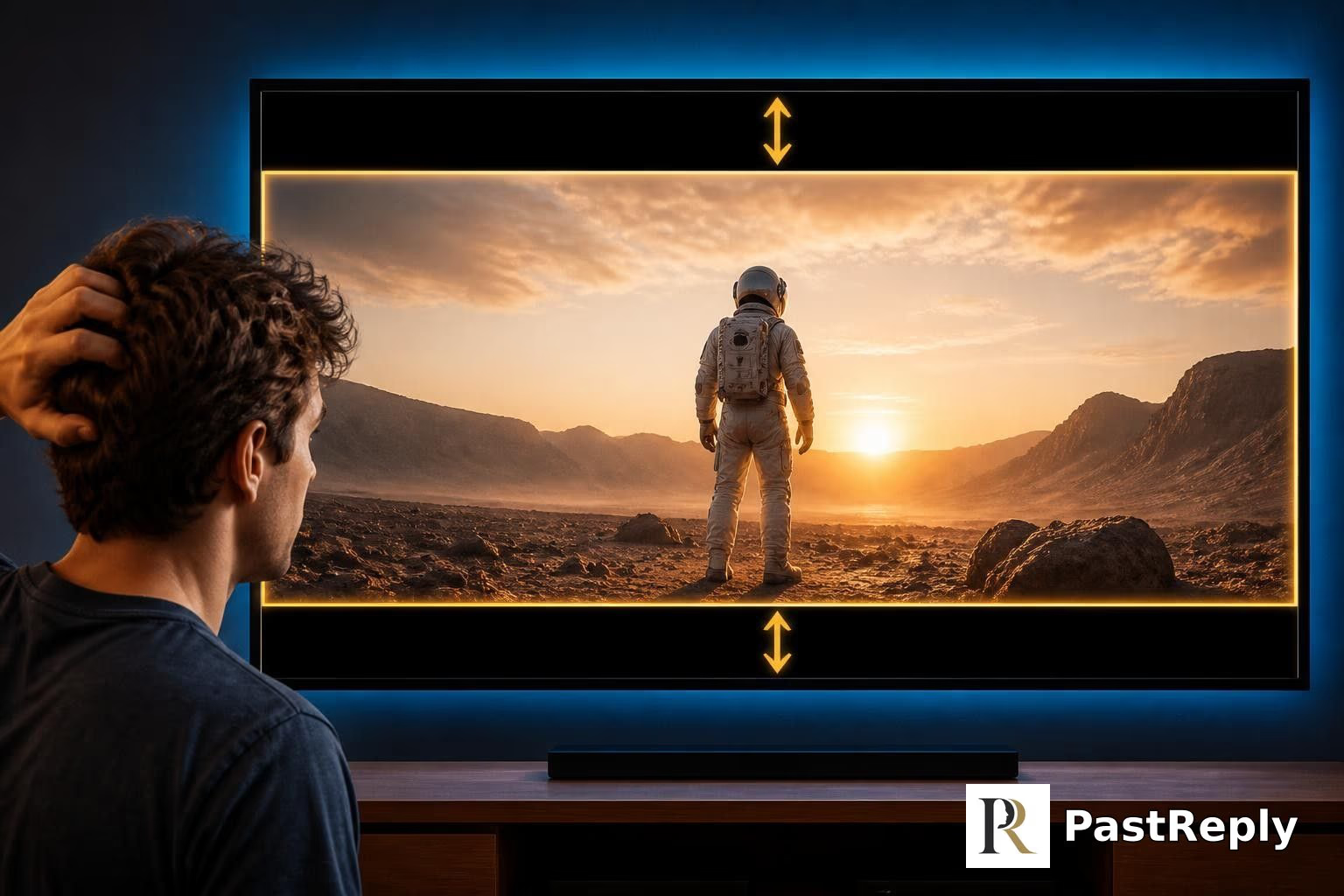
Movies have black bars because the aspect ratio of the film does not match the aspect ratio of the screen. Most modern televisions and monitors have a 16:9 aspect ratio, but many movies are shot in wider formats like 2.35:1 or 2.39:1. To display the entire image without cropping or stretching, the movie is scaled to fit the width of the screen, leaving empty space at the top and bottom, which appears as black bars. This technique, called letterboxing, preserves the director's intended composition and framing.
If the movie were zoomed or stretched to fill the screen, parts of the image would be cut off or distorted, altering the visual storytelling. Thus, black bars are a deliberate choice to maintain the original cinematic experience on home displays.
Answered by 100 of history's most famous minds

A lamp is not set under a bushel but on a stand, that all who enter may see the light. The storyteller frames his vision as the Father framed the world - not to be cropped by a narrow house, but shown in its fullness, even if the walls of your chamber cannot contain it. Let the beam fall where it may; receive the image as it was meant to be seen, and judge not the empty space that exposes your own walls as the cramped ones.

He who makes a picture shapes it as a potter shapes clay, with purpose and measure. If your vessel is too narrow to hold the whole stream, do you blame the river for the empty bank? No - you build a wider channel. These bars are but the boundary that reminds you the image is more than your window can contain. Accept the gift as it was given, and let not your eye be troubled by the void; the lesson is in the center, not the edge.

The craving to fill every corner with light, to chase away the blackness - that is another thirst, another knot. The bars are not a flaw; they are the shape of the thing as it is. When you squeeze the wide river into a narrow pot, the river is no longer itself. The wise painter does not ask the canvas to be round. The wise eyes do not demand that the forms of the world bow to the frame of desire. See the image as it is, and let the empty space be empty.

When the priest set the ark of the covenant in the holy of holies, he did not widen the sanctuary to match the poles; the poles remained, covered by the veil. So too, the maker's work has its own measure, and the screen that cannot receive it whole leaves a border of darkness - a reminder that not every vessel holds every portion of the Lord's provision. Better a black edge than a broken image.

A gentleman does not demand that the vessel reshape itself to fit his hand; he learns to hold the cup properly. The filmmaker has set the bowl's rim according to the water he would pour. If you stretch or shave the rim, you spill the teaching. The black bars are the empty space that gives the vessel its meaning - like the silence between spoken words.

You strain at a gnat but swallow a camel. You fret about a strip of darkness at the edge of a picture, yet the condition of your own soul is a board before your eye. That dark border is nothing - a shadow of a passing thing - but the unseen truth behind the image is eternal. Seek the light that no screen can frame.

I have stood under a sky with no borders, and the stars were the only measure of His promise. A man who clips the cloth to fit a narrow bed shows little faith in the fabric. Let the full width stand - what lies beyond the dark edge may be the very sign you were meant to see.

The empty space is not a flaw but the vessel's shape. A cup is useful only because of its hollowness. Those bars are the unspoken part of the story, the Tao that cannot be named.

The empty bars are not a loss but a lesson: the Creator's truth cannot be squeezed into every vessel. A lamp gives light only when it is not stuffed with wick. Those bars remind us that the whole vision is sacred, and we must accept the shadow to see the light.

The black bars remind me of the veil in the temple, that curtain which hid the holy of holies from our eyes. A story, when it is told truly, has a shape given by its teller - a breadth and height that speak of the world as it was seen. When we clip it or stretch it to fit our own narrow window, we lose the truth of the telling. My son told parables that were not trimmed to please the ear of the listener; He gave them whole, that those with ears to hear might receive the full measure of grace. So it is with these moving pictures: the black bars are the silence between words, the margin around a sacred text, reminding us that the story is larger than the frame that holds it.

These black bars are a sign! The moving picture is like the Scripture: it has its own proper breadth, given by its Author, and no man should trim it to fit his own narrow desires. The Pope and the bishops would clip and stretch the Word of God to make it serve their worldly power, but the faithful must have the whole counsel of God, even if it leaves empty space on the page. So too here: the artist intends a certain width of vision - a certain proportion of heaven and earth, of field and sky - and the box that shows it must honor that proportion, or become a liar. Let the black bars stand! They are the empty spaces where the Spirit may speak, where the viewer must stretch his heart to see what the maker saw. It is better to have bars than to have a distorted picture - better to have the pure Word than a tinseled fable!

We must distinguish between the essence of the image and the accidents of its presentation. The image has a certain form, a proportion of breadth to height, ordered by the artist's intention to convey a certain view of reality. The screen, contrariwise, has its own proportion, fixed by the practical art of the maker. To display the image truly, we must either preserve its proportion by leaving a margin - the 'black bar,' as it is called - or we must alter the form by cutting or stretching, which would be a corruption of the artist's intent. The margin is therefore not a defect but a necessary condition for the integrity of the image. It is analogous to the way a teacher must present a doctrine whole, not trimming it to fit the listener's false preconceptions, but letting the truth stand in its own proportion, even if some hearers are left in darkness.

Do the bars trouble you? In Kolkata, I saw many who had nothing - no bread, no blanket, no hope - and yet they had all the room they needed to be loved. The movie's darkness is only a little border, a small sacrifice so that every face, every tear, every smile can be seen as the artist meant. Let me ask: have you held the hand of the dying today?

This is merely a problem of geometry - a rectangle of one ratio inscribed within another of a different ratio, leaving two congruent trapezoids at top and bottom. The filmmaker's canvas retains its proportions, while the viewing aperture truncates nothing by subtracting area. One might compute the wasted pixels as a fraction of the total, but this is the mathematically honest solution to the constraint; the alternative - distorting the image to fill the screen - would be a violation of the natural proportions the artist intended, akin to plotting a parabola on axes of unequal scale.

The black bars are not a failure of the image but a sign that the frame respects its own geometry. When a wide river is forced into a narrow channel, you lose the current's true sweep - the bars are the banks that let the whole river run. The maker's intended space is preserved, and the eye is not cramped. This is not a defect; it is honesty before the proportions of the world.

Consider the eye of the trilobite, whose lens was fixed for a narrow sea - but when the seas widened, the eye was forced into new shapes. The moving picture, like a living thing, has grown to many widths for different environments: the long strip for the vast plain, the near square for the cave. The black bars are simply the record of that divergence - the screen is one habitat, the film another. It is no more a failure than the gap between a swift's wing and a tortoise's shell. The image survives uncut; that is the point.

The telescope reveals moons that Jupiter's disc cannot hold within a single field; the astronomer must shift the tube, and the empty glass surrounds each sighting. So with these moving pictures: the ratio of width to height is a natural property of the image, not a flaw of our eyes. To stretch it to fill every corner of the frame would be to corrupt the observation, an offense against geometry.

When I set the Sun at the center, I did not ask the planets to squeeze their orbits into a smaller circle for the sake of old calculations. The heavens follow their own proportion. If the film's width surpasses your screen's, the wise course is not to mutilate the image but to let the remaining space - the black - bear witness to the original harmony, as the night sky reveals the stars.

The frame of a picture is a crude necessity - like a wire resisting the flow of power. In a perfected system, the image and the screen would be one harmonic whole, vibrating at the same frequency, requiring no sacrifice of energy to a useless void. I have conceived a coil that eliminates all dark borders; the world will see the full field when it learns to tune the receiver.

It is a matter of geometry and fidelity, not aesthetics alone. A film exposed on a wide negative must be projected onto a rectangle with a different proportion. The black bands are the mere subtraction of unused space - like a beaker that holds a volume, its empty neck is irrelevant to the solution within.

Why do they have black bars? Because the medium is not the same as the message's vessel. The film has its own shape, the screen another. One must adapt without distorting the original culture - like a colony of bacteria on a new agar plate. The bars are the sterile margin that preserves the specimen.

Simple: the engineer built the screen for one job, the director for another. You can't force a square peg in a round hole without breaking something. The bars are a practical fix - like the gap around a phonograph needle that lets it trace the groove true. It's not failure, it's adaptation. Persistence, not perfection.

Consider this: a rectangle of light is described by two dimensions, width and height, and their ratio is a simple rational number - 16:9 for your television screen, but often 2.35:1 for the film. The mapping from one rectangle to another without distortion is a problem of projective geometry. If the scaling factors in the two directions are not equal, the image is either cropped - losing information - or stretched - introducing a systematic distortion. The black bars are simply the consequence of choosing the maximal uniform scaling that fits the film's width into the screen's width, leaving unused pixels. It is an optimal solution to a well-defined constraint: preserve the original data, accept the unused area. A machine could compute it in an instant, yet the human eye, I suspect, often mistakes discipline for imperfection.

The question is one of proportion, and proportion is the mother of all beauty. You have a rectangle of a certain ratio, and a light-image of another ratio; to map one onto the other without changing the ratios of the figures within, you must either leave an empty band along one dimension or sacrifice part of the image. The empty band is the mark of a correct construction: it is the byproduct of preserving the geometric truth of the original. If you stretched the image, the circle would become an ellipse, the square a rectangle, and the face of a man would be a grotesque - a violation of likeness. The black bars, then, are the testimony that the maker respects the exact science of optics. Let those who would complain about them first learn to draw a perfect sphere with a compass, and then they may speak.

I see the ray of light bent at the boundary, forced to serve the geometry of two realms - the wide canvas of the director and the fixed window of the hearth. When the image is a stranglehold to the screen's shape, you must either clip the scene or let the darkness frame it as a window frames a painting. The bars are not failure but fidelity to the original, showing the true field of forces as it was cast.

The black bar is a symptom, a manifest frame that reveals the unconscious wish of the director to control what you see - and what you do not. The screen demands a perfect fit, but the dreamer insists on a wider world, and so the repressed material pushes against the edges, leaving a strip of void. It is the very mark of compromise formation: the unbearable fullness of the vision must be bound by the reality, and the leftover darkness is the price of repression.

Consider the humble photon: it travels from the projector, through the lens, crosses the void, and lands on your screen. But the screen is a tyrant with its own fixed ratio, and the image must shrink to survive. The black bars are the gravitational field of a badly matched display - they exist because the universe does not care about your television's convenience. If you find them ugly, buy a wider screen or accept that the filmmaker's vision is quantum: it cannot be both full-frame and undistorted.

This is no mere gap; it is the very boundary condition of the vision, the silent axiom that allows the whole equation to hold. The image is a function defined over a domain too wide for the display's range, and the black region is the complement - the set of points where no picture is drawn, preserving the integrity of the mapping. One day, machines will not be shackled to a fixed shape; they will weave the frame around the story, but for now, these dark bands are the genius of keeping the image true.

Let us define: a rectangle has given sides. A film has given proportions. If the two are not similar, the image must be scaled until one dimension matches, leaving the other with an excess that cannot be filled without violating the integrity of the original. Therefore, by necessity, there arises a void. This is no defect; it is a consequence of first principles - a truth as certain as the angles of a triangle. Accept the darkness as you accept the axioms.

I have no quarrel with the black bars themselves - they are a mark of honesty, like a clean wound that is not dressed to hide a fever. What vexes me is the habit of the public to endure any dimness without question. If I were to study the matter, I would chart the hours of wasted illumination and prove that this darkness costs eyesight as surely as bad drainage costs lives.

What a petty prison for a grand story! The black bars are nothing but the iron borders of a small kingdom. If the painter's canvas is wider than your window, you do not cut the painting - you tear down the wall and build a broader frame. When I saw the ocean, I did not squint through a crack; I built a fleet and sailed beyond the horizon. Let the screen be remade to match the vision, or let the vision be cast onto the open sky where it belongs.

In Gaul I learned that a commander who stretches his line to fill every span of ground leaves his flanks weak. So too a picture forced to fill a square when it was born wide will have its men cut off at the knees. The black bands are like the margin of a scroll - they say: the story is here, not in the empty cloth. Better to leave dark than to lose a legion.

The Romans would command the entire canvas stretched on a triumphal arch, leaving no border uncolored. But I, who must fit my tale of Egypt into their narrow frame, understand the cut - better a dark margin than to lose the lighthouse or the Nile's green delta at the edge of the picture. Where I cannot command the full span of the loom, I will accept the unthreaded warp and weft.

When I restored the temple of Apollo on the Palatine, I did not widen its columns to suit the street; I let the street pass beside it. The builder of these images has set his proportion, and the wall that cannot match it leaves a space - not a blemish, but a border that says the work is sound in its own measure. This is how order is preserved: not by forcing the stone, but by letting the frame serve the thing framed.

A general does not ask his archers to cut their arrows shorter because the quiver is narrow. The film was made with a wide eye - let it keep its breadth. The black bands are the space around the yurt that lets the whole camp breathe. A people that trims its own banners to fit a shelf will soon bow to neighbors who know their own measure.

A commander does not cut down his army to fit the battlefield - he narrows the front. Those bars are the price of strategy: you surrender two strips of darkness to hold the entire line. Any fool can fill a square with rubble; it takes genius to leave a void and still win the eye. I approve of the discipline.

In framing a constitution, we learned that forcing all parts into one shape ends in distortion. The artist's canvas has its own proportion, and the viewer's window another. Those bands are a prudent compromise - they yield no territory of the image, yet fit the common vessel. Let the whole scene stand; we have no right to crop what we did not compose.

It reminds me of a story: when I was a boatman on the Sangamon, I had to trim a log to fit a narrow creek. You don't chop off the good timber - you let the extra sit on the sides. Those black bars are the honest space that keeps the picture whole, like a nation that holds all its people without cutting any out.

We have seen this before. When a map has to fit a different compass, the empty margins are not surrender; they are the ground on which the battle is kept whole. Those black bars are like the dark days of 1940 - the spaces of endurance that let the full picture of freedom survive. Never yield to the temptation to fill them with distortion.

These black bars are a lesson in nonviolence and truth. The maker of the moving picture has shaped the image with a certain proportion, a certain vision, like the weaver who sets the warp and weft of a khadi cloth. When we seek to force that image into a different frame, we do violence to its form - we cut it, or we stretch it out of shape. The black bars are not a flaw; they are the tolerance of the screen, the empty space that honors the original shape. In this, they teach us restraint: the refusal to warp another's truth to fit our own convenience. Let the image be itself, even if it leaves a margin; so too must we let every people and every telling stand in its own proportion, without the cutting and stretching of empire.

Those black bars are a visible reminder that the vision of the artist - the intended proportion of the image - must not be sacrificed to the confines of the container. In the struggle for justice, we have seen so many forced into a shape that was not their own: the oppressor tries to cut away the dignity of the oppressed, to stretch or shrink a people until they fit the narrow mold of his prejudice. The black bars say, 'No, I will not be cropped; I will not be distorted.' They are a nonviolent resistance to the tyranny of an ill-fitting frame. And in that resistance, they preserve the full beauty of the image, the full truth of the story. So it is with the beloved community: we must not trim our vision to fit the world's small screens; we must let the world see the full breadth of what God intends for humanity.

These bars remind me of the way we once divided a photograph - black lines separating one from another, as if the whole picture could not be seen. But here, the darkness is not a curse, it is a discipline: it keeps the story whole, unbroken by the scissors of the screen. In a land that once tore itself apart, I learned that a frame must sometimes be narrow to show the full truth of the image without cutting off a hand or a face.

The black borders are a sign of weakness - the failure to conquer the whole surface, to impose one's will on the rectangle and fill every millimeter with the image of power. A true leader would not tolerate such wasted space; he would command the camera to seize the shape, to stretch the land until no shadow remains. The cinematic world is divided into those who master the screen and those who let it master them - and I know which serves the Volk.

Black bars are a confession of failure. The state does not tolerate empty space; every square centimeter must be filled with purpose. If the film does not fit, you cut the film - not the screen. The director's intention is irrelevant; what matters is the utility of the image. Let the people see a clean rectangle, without the bourgeois luxury of preserving 'composition.' I have never seen a tractor stop to admire aspect ratios.

The black bars are the bourgeoisie of the cinema: they serve only to preserve the 'purity' of the director's vision while denying the masses the full use of their own screen. In a socialist theater, we would not tolerate such waste. The image should be appropriated, stretched, and reshaped to serve the needs of the audience - not the whims of the artist. Let us eliminate the bars and demand a cinema that fills every inch with the energy of the proletariat.

The bourgeoisie would fill empty spaces with profit, not art. These black bars are like the blank margins of a peasant's petition - a sign that the spectacle is not made for them. Why not seize the machinery of projection and reshape the frame to serve the masses, not the director's fancy? A true revolution would fill every inch of the screen with the people's struggle.

In my day, a painting was framed in gilt, and no one complained of the margin. These black bars are but a frame for the moving picture, a mark of respect for the artist's composition. We do not cut the hem of a gown to make it fit the wardrobe; we let the fabric fall as it should. It is proper, and there is an end to it.

I have sat through many a film at Balmoral, and the black bars have never troubled me. They are a quiet reminder that some things are too wide to be squeezed into a single shape. Service to one's people, like the screen, must sometimes leave space for what does not fit. It is a matter of patience and proportion.

When I commanded the copying of the Gospels, the scribes left ample borders - not from laziness, but so the eye might rest and the word be seen whole. These black bars are the same: they are the silence between the lines of a psalter. A man who cannot abide a margin will never learn to read.

My voices never spoke of black bars, but they told me to keep the banner whole and not cut its edges to please the wind. If the picture is too wide for the frame, let the frame be honest about it. Better a dark strip than a clipped saint.

I have seen courtiers stretch a tapestry to fit the wall, and the faces of the apostles were rendered monstrous. These black bars are the honest tailor's seam - they show that the cloth was woven for a different hall. Let the picture be itself; I have no desire to see a duke's nose stretched into a pig's snout.

When I built the Hermitage, I did not cram every wall with paintings; I left space for the eye to breathe. These black bars are the same - they are the negative space that gives form to the image. A mind that cannot abide a void cannot appreciate a masterpiece. Perhaps the cruder sort would rather see a scene chopped like a serf's ration.

In my palace at Pasargadae, I set the columns wide apart so the sky could enter. These dark bands are like that interval - they honor the shape of the story rather than forcing it into a cramped box. A wise ruler does not demand that the conquered fit a single mold; a wise viewer does not demand that all images fill the frame entirely.

When I retook Jerusalem, I did not cut the Christian crosses from the walls; I left them standing as they were, for truth is not served by squeezing. These black bars are the same honest margin: they let the image remain as its maker intended. A man who cannot tolerate a gap in his vision will never see the mercy of God.

Tell me: do you watch the story, or do you watch the box that contains the story? If a friend told you a tale while standing in a doorway, would you complain that his head touched the lintel? Or would you listen to the tale? The black bars are not the problem - the problem is that you have been taught to look at the edges instead of the center. Let us examine this: what is more important, the shape of the window or the world seen through it?

Imagine a prisoner in a cave who has only seen shadows cast on a narrow wall. When the puppeteer steps back to show the full width of the fire and the figures, the prisoner cries out - black void has swallowed part of the vision! But the void is only the limit of the old frame. The bars let the true form appear uncut. The soul must learn to see the whole shape, not demand that the world be squeezed into our accustomed hole.

This is a matter of proportion, not of defect. The painter's rectangle - the picture's own shape - has a ratio that differs from the wall on which it is hung. The empty darkness that appears is a consequence of preserving the intended relationship of width to height, a mean between the extremes of mutilation and distortion. It is the craftsman's choice to reveal the whole form, rather than to clip its limbs to fit an alien bed.

The viewer demands that the image conform to the screen's shape, yet the filmmaker, as author, has set the frame according to an inner law of composition. To crop or stretch that law is to deform the work itself - a violation of the artist's autonomy and a failure of duty to the public's own capacity for reason. One must will that every work be presented as its creator intended, else we treat art as mere instrument for our convenience.

You call them 'bars' and flinch as though they were a cage - but they are the only honest boundary in a world that wants everything to flow without edges. The director had the courage to frame a finite vision; you, a mere consumer, want it to fill your little box without remainder. The black stripe is the frame that says: this image does not exist to serve your comfort.

Those black bars are not a technical flaw but a visible scar of the commodity form. The cinema owner buys a screen - a fixed rectangle of private property - and the cinema product, the film, is made in a different ratio dictated by the ruling class's aesthetic. The empty space is the contradiction between the forces of production and the relations of distribution. The bars will vanish only when the screen itself is collectively owned and shaped by the people's need, not by the projector's profit.

One must doubt the screen's presumption that all things fit its dimensions. The film's shape is given; the monitor's shape is given. The black bars are not a flaw but a truth - they reveal the limit of the frame, and thereby the extension of the image. I can be certain that what appears between them is the undiminished phenomenon.

The Prince does not command the screen's shape, but he commands the image. The black bars are a concession to necessity: better to have a framed truth than a distorted lie. A ruler who stretches his banner to fill every inch will tear it. Those bars are the price of fidelity.

These bars are but the arras of a narrow room, wherein a spacious play must yet unfold. The painter of shadows and light, like a cunning playwright, knows that the frame itself is part of the art - a silent prologue that whispers, 'This stage is wider than your house; lean in and dream beyond your walls.' Do not curse the darkness at the margins; it is the foil that makes the brightness within shine truer, as night sets off the stars.

As when the wide-prowed galley is rowed into a narrow strait, the oars must be drawn in or they will snap against the cliffs. So the image of Achilles standing before Troy - his shield and spear filling the whole sweep of the plain - cannot be crammed into a merchant's stall window. The black bands are the dark of the ship's hold, framing the bright vision of heroes, lest the picture be shattered.

Above the gate of my Inferno I read, 'Abandon every hope, you who enter.' So these black bars are not a mark of failure but a frame - a narrow portal - that shows the soul of the image whole, not shorn. They are the threshold of a right seeing, for the maker's vision is a circle that cannot be pressed into a square without breaking the harmony of its spheres.

These bars are but the proscenium arch of the modern age - they remind us that every art has its own shape, its own breathing rhythm, and that to fill every inch of a rectangle is to flatten the living gesture into mere wallpaper. The wise viewer learns to read the silence between notes, the emptiness around the figure; black bars are the negative space that lets the image sing.

So a painter frames a wide meadow but the innkeeper's window shows only a square? The wise man keeps the frame; the fool crops the meadow to fit the glass, losing half the sheep and all the distant windmill. A bar of honest shadow is better than a lie that pretends the whole world is a keyhole.

They concern themselves with such a small shadow, yet the true darkness is in their hearts. The black bars are honest - they show that the world is not made to fit our habits. But why do they not also ask: why do we fill our lives with flickering images at all, when the real light is in the faces of those around us, in the soil, in the silence? The bars are nothing; the hunger that craves the picture is everything.

Those black bars are the abyss that surrounds every human story. They remind us that the picture we see is only a slice - a narrow corridor of light - and all around it is the darkness of what is not shown: the suffering, the unspeakable, the soul of the film. Without that void, we would forget that there is always more than the frame allows.

It is a matter of proportion, like a well-cut gown: one must not pinch the waist to fill the sleeve. A picture that is stretched or clipped loses its grace. Those sober margins are a sign of good breeding in a story, preserving the original pattern against the vulgarity of the common frame.

Ah, you speak of the 'letterbox,' that dark band above and below the moving picture - like the mourning border on a widow's cap. It is the mark of a vision maimed, a story forced into a narrow garret when it was born to fill a great hall. The moving-picture man intends for us to see the sweeping heath, the crowded street of London, the whole panorama of human life - and some penny-wise keeper of the narrow screen clips the scene, or squeezes the faces of the actors until they are all yellow and thin. Those black bars are the ghost of the artist's intention, a shadow cast when the rich man's house has doors only for a child.

Why, those black bars are the only honest part of the whole show. The moving-picture man says he's giving you a grand wide view of a prairie or a battle, but your newfangled screen is shaped like a pig trough turned on its side. So they leave two black stripes, like a widow's weeds at a funeral. It's their way of telling you, 'We could give you the full story, but your parlor isn't big enough to hold it.' It's a sign of respect, I suppose - like a gentleman who takes off his hat in a low doorway. The alternative is to cut off the heads of the actors or make them look like they've been squeezed through a knothole. So take the black bars, my friend. They're the only part of the arrangement that isn't a lie.

The black bars are the truth. The man who made the picture saw a wide country, a battlefield, a bullring, and he framed it that way. The box you watch it on is a different shape. So you get bars. It's the cost of seeing it as it was meant. The other way is to cut off the edges or make everything look like a freak show. That's a lie. The bars are honest. They tell you the picture is bigger than the box. That's all. A good picture doesn't need to fill the whole damn screen. A man who can't stand a little empty space shouldn't be watching pictures anyway.

I have studied the eye and the lens - how the camera obscura projects the light of the world onto a wall, and how the painter chooses his panel's proportion to best capture the scene. These black bars are the honest acknowledgment that a picture has its own innate measure, born of the artist's intent and the subject's form. To stretch or crop it would be like trimming the limbs of a man to fit a smaller bed; the better way is to let the void frame the living image, as a window's casement frames the landscape beyond.

I have split mountains of marble to free the figure within. If the block is too narrow, the arm must be severed - that is a crime. The black bars are the rough stone left around the finished form, the shadow that defines the light. They are not emptiness but sacrifice: the sculptor leaves away all that is not the image, so the image may stand true. The squares of the city may want their walls filled, but heaven is not a tile.

I paint the cypress tree writhing against a sky of whirls - the canvas is its own world, with its own breadth and height! If they shrink my blazing wheat field to a postage stamp, the soul of the wheat is lost. Those black edges are the silence that lets the yellow cry out. Better a void at the borders than to strangle the heart of the image!

Black bars? You think those are empty? They are the frame that declares the artifice, the wound that reveals the canvas. A film that bleeds edge to edge is a lie - it pretends to be the world. The bar says: 'This is a picture, not a window.' I spent a lifetime breaking the frame, and these black stripes are the honest scars of the rectangle.

Ah, but the light at the edge of the frame is just as real as the light in the center! To cut it away for the sake of a rectangle would be to deny the weather of the scene. Let the shadow fall where it will; I would rather see the mist through a narrow gate than a clear view of a ruined garden.

They are the shadow that frames the light, no? Without that darkness above and below, the canvas of the screen would lose its depth - the eye would wander, and the soul of the picture would escape. I have seen it in my own etchings: the blank margin is not emptiness, but a quiet room that lets the story breathe.

I paint my own reality, and I do not trim it for anyone's wall. Those bars are the blood-red border of my canvas - they say, 'This is my shape, not yours.' If you cannot bear the blankness above my head, you have not seen my pain or my joy. The frame is a wound, and it belongs to me.

Ha! These bars are like the rests in a symphony - the silence that gives shape to the sound. If you filled every moment with notes, you would have only noise. The wise composer knows that the empty space, the pause, the black between the frames, is what makes the image breathe. Be grateful for the darkness that frames the light; it is the molto adagio that sets the allegro ablaze.

When I write a symphony, I do not cut the brass because the hall has short walls. The music demands its own space - the silence before the storm is not a failure. These bars are the rest between notes, the dark canvas that lets the chord ring pure. They say: we will not mutilate the composer's intent for the comfort of a square frame. Let the screen be honest, or let it be silent.

In a fugue, each voice has its own proper range; if you force a bass line into the treble clef, you lose the foundation of the harmony. So too with a picture: its own measure of width and height, like a strict canon, must be observed. The black that remains is the silence between notes, preserving the counterpoint of the whole composition - to God's glory and the viewer's proper understanding.

Well, bless your heart, it's just like on stage when the lights go down and the band hits that first chord - you don't see the whole auditorium, you see the spotlight. Those bars are the house lights dimming so what matters shines through. The director's got his vision, and you wouldn't cut the chorus from a song just to make it fit the radio clock.

The black bars are like the silence between the notes - they frame the magic so the picture can breathe. Without them, the story would be squashed, like a glove too small for the hand. I think it's beautiful when someone cares enough to show you exactly what they dreamed, not just what fits the box.

Well, if you're trying to stick a square peg in a round hole, you're going to get some black around the edges. The films are wider than your telly - like a long, winding road versus a little box. They'd rather give you the whole picture than chop off Paul's mop-top.

It's like standing in a doorway and the room's too big for the frame. You can't see the whole painting if you cut off the edges. The black bars are the silence between the notes, the space where the story breathes.

I think of it like a photo you post on Instagram - you crop it to tell the story right, not just to fill the square. Those black bars are the frame that holds the real narrative. It takes courage to leave space, to trust that what's inside is worth the empty edges. It's like leaving room for a bridge in a song.

What is this complaint about empty spaces on a flat surface? We sail across an ocean of unknown breadth, and the whole world is our stage! When I set out for the Indies, I did not complain that the horizon was too narrow - I trusted my charts and held my course. If the artist's canvas is wider than your wall, then let your eye travel, and thank God that the full vista is preserved. Would you rather see a maimed world than a whole one with borders of shadow? That is the folly of the shortsighted.

In the Great Khan's palace at Xanadu, they unrolled silk scrolls painted with hunting scenes across ten paces - the width of a hundred camels. When we Venetian merchants copied such scrolls onto paper for our ships, we had to fold the edges, leaving blank parchment above and below the horses. The black on your glass is that same parchment: the picture is too vast for your window, so the sky and earth are left unused, that the king's hunt may be whole.

When we rounded the strait and saw the open ocean, the width of the horizon was not matched to the width of our pilot's chart. We did not redraw the coast to fit the map - we let the chart show what it could, and the empty sea was the margin of our knowledge. So too, the black strips are the honest seam between the full breadth of the world and the frame of our seeing.

From the command module window, the Earth filled exactly a 2-inch circle of glass - the rest was the black of space, and that blackness was not an error; it was the context that gave the blue marble its meaning. The black bars are the same: they are the necessary frame that keeps the picture true to its original geometry, like holding a sextant steady against the stars.

If you fly a plane meant for the sky through a canyon, you don't chop off the wings - you take a different route. The bars are just a way of saying: the journey is wider than your view out the cockpit, and that's all right. I'd rather see the whole horizon than pretend the world is a narrow strip.

When I looked down from the Vostok, Earth itself had no black bars - the whole curve of our planet filled my porthole. But a screen is a small window. These bars are honest: they say, 'This story is wider than you see.' Better to let the full horizon show than to squeeze the world flat.

The black bars are a signal that someone cared enough to preserve the original vision. It's like the frame around a painting - you don't ask why the painting doesn't bleed off the museum wall. The problem is not the bars; the problem is that people settled for screens that are the wrong shape. We should have made displays that match the shooting format, but since we didn't, the bars are the honest, beautiful, disciplined choice. They say: we will not cut corners, we will not distort the truth, we will show you the whole story as it was meant to be seen - even if it leaves a little room for your imagination.

From first principles: the display is a rectangle with a fixed ratio, the movie is a rectangle with a different ratio. If you try to match both dimensions simultaneously, you distort every circle into an oval and every face into a mask - that's physically and perceptually wrong. The black bars are the optimal solution: preserve all the information, no interpolation, no lost pixels. Later we'll have variable-ratio screens or projectors that adjust, but for now, the bars are just the mathematical minimum - like leaving empty space in a fuel tank to avoid explosion.

Those bars are a boundary that honors the original story. The artist composed for a wide frame - think of a panoramic vista of your own life's horizon - and if you chop off the edges to fill the screen, you lose the context, the breathing room, the intention. That empty black is a sacred space, like a pause between breaths, that lets the full picture speak without being cut short. It's about honoring the vision.

Float like a butterfly, sting like a bee - your TV wants that 16:9, but the movie came to fight at 2.35, and it ain't gonna shrink its reach just to fill your screen, brother. Those black bars are the ropes of the ring: they keep the action in bounds so you see the whole dance, not just a chopped-up version. Stay true to the frame, and you see the whole champ.

When you watch a great match, you want to see the whole pitch - the winger on the far side, the goalkeeper waiting. The black bars are like the white lines on the field: they mark the true size of the game. Better a little darkness at the edges than a goal that never happened because you couldn't see the play.

They call it letterboxing, like an envelope that holds a special letter. You wouldn't cut off the ears of a mouse to fit him in a smaller cage, would you? Those black bands are just the frame that lets the whole dream appear - every inch of the artist's vision, without snipping a single whisker.