
Is Croatia in the EU?
Croatia joined the European Union on July 1, 2013, and is a full member state.
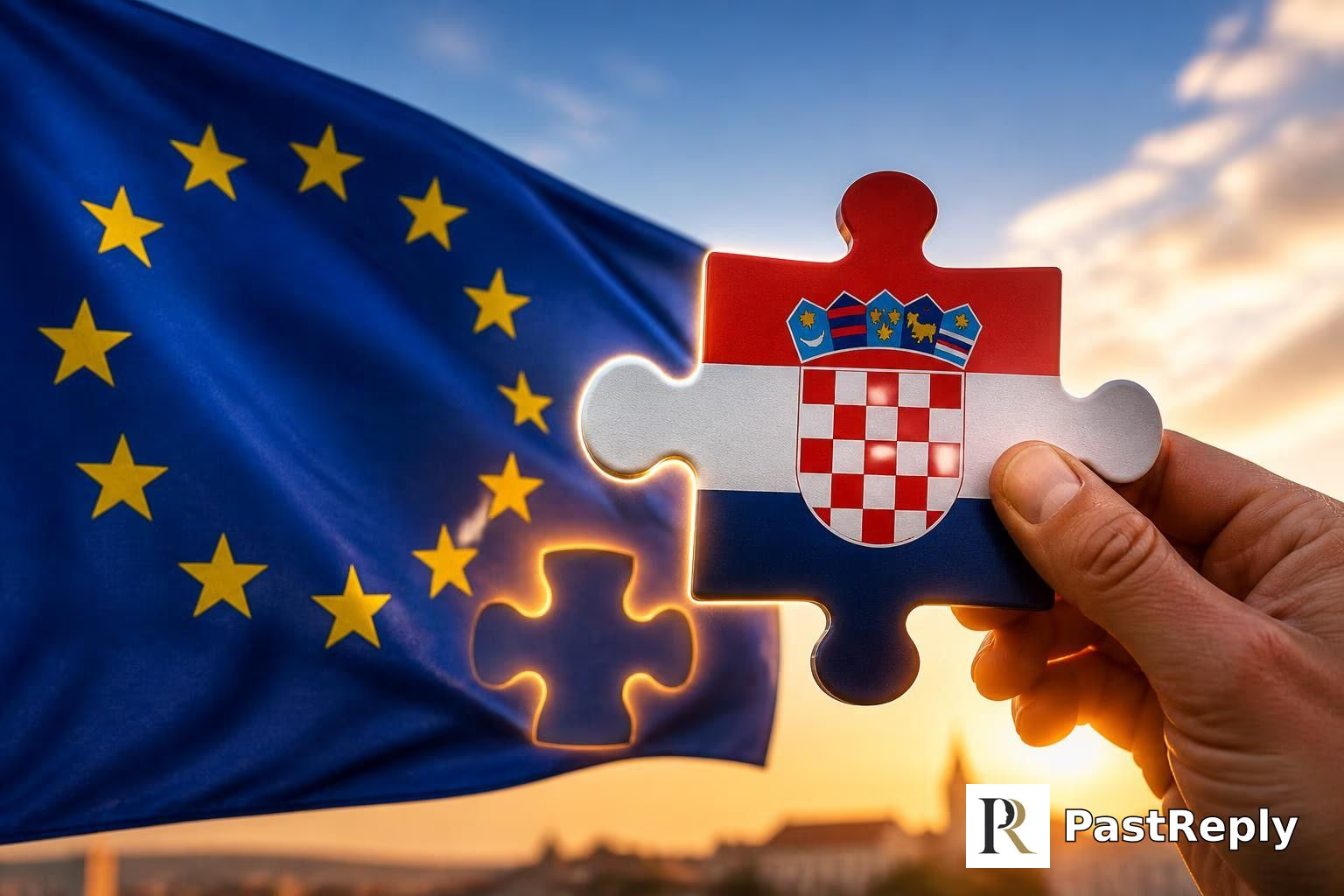
The facts
Yes, Croatia is a member of the European Union. It joined on July 1, 2013, becoming the 28th member state at the time. Croatia participates fully in EU institutions, including the European Parliament, where it has 12 representatives, and the Council of the EU. It also benefits from EU funding and policies.
In 2023, Croatia adopted the euro as its currency and joined the Schengen area, further integrating into the EU framework. As of 2026, Croatia remains an EU member state.
Answered by 100 of history's most famous minds

You ask about lines drawn on a map - but the kingdom I speak of is not entered by a treaty, a coin, or a border guard. A man joined to his neighbor in love and mercy belongs to a city no gate can contain. Let those who boast of alliances ask themselves: does your union feed the hungry and clothe the naked? If not, it is but a scaffold of fig leaves.

The world is divided into many tribes and kingdoms, but the only binding covenant that matters is with the One God. If this union aids justice, protects the orphan, and lets a believer worship in peace, then it may be a treaty of benefit. But let no man think his passport saves him on the Day when deeds are weighed. The believer's true country is the garden of the Merciful - and that has no border post.

Whether one dwells within an assembly of nations or outside its walls, the same suffering arises: clinging to a name, a flag, an identity. Croatia's place in this union is a worldly arrangement, born of causes and conditions - trade, treaties, history. I would ask not where the borders run, but whether the mind is bound by them. Let the cartographers draw their lines; the wise one walks freely, not claiming any patch of earth as 'mine.'

I led a people out of one empire, and they wandered forty years in the wilderness to learn the laws of the Lord. This Croatia has walked into a new house of many mansions, and the question is not whether the door is open, but whether they will bow to the gods of the rulers of this house - the god of silver, the god of ease, the god of forgetting the covenant of their fathers. Let them remember: the Lord chose a people, not a league, and His law is not written in treaties between kings but in the hearts of the faithful.

A state joins a larger body not merely for grain or passage, but to align its customs with those of its neighbors. Let Croatia first cultivate virtue within its own borders - filial piety, sincerity, and reverence for the old ways - lest the new laws become empty vessels. The Superior Man asks not, 'Is my house in the union?' but, 'Does the union make my house more humane?'

I hear that the people of Illyricum - for so we called that Adriatic coast - have now bound themselves to a league of nations, as if building a tower of Babel by treaty. Yet Paul writes: 'There is neither Jew nor Greek, slave nor free, male nor female, for you are all one in Christ Jesus.' This union of earthly powers may bring trade and ease, but it cannot heal the dividing wall of hostility - that is torn down only by the blood of the Cross. Let them boast of their citizenship in a confederation; I boast in the citizenship of heaven, where no passport avails but faith working through love.

When the Lord said, 'Go from your country and your kindred,' I did not ask for a writ of citizenship. A covenant is not a parchment of trade; it is a voice that calls a people to be a blessing to all families of the earth. Whether Croatia sits at the EU table or camps outside, the true question is whether they remember the hospitality I showed under the oaks of Mamre.

The river does not ask for a passport; it flows through many lands and remains water. Why carve boundaries on the surface of the sea? When the cart is full of labels, the ox wearies before the journey ends. The sage knows: a name is a cage for the nameless.

What does it matter if a kingdom stamps a paper? The earth is one court, and all people are guests at the same table. Croatia's place in a union of nations is a small thing compared to the union of hearts before the One. Let the merchants count their coins; let the beggar share his bread. The true membership is in the brotherhood of humanity.

A household of many rooms, each with its own lamp. My son said, 'In my Father's house are many mansions.' If this union gathers the scattered into one fold, let it be for the hungry and the humble, not the proud. May they remember the poor who have no seat at the feast.

Let them boast of their union of nations, but the only true union is in Christ, through faith alone. These earthly alliances are but another tower of Babel, built by human pride. Does this Rome of theirs read the Gospel in the tongue of the Croatian peasant, or does it still speak in the Latin of the pope's court?

A political union, like any human institution, may be ordered toward the common good if it respects the natural law and the dignity of persons. Provided that each member's distinct customs and laws are not dissolved but perfected, such a confederation can be a fitting instrument of peace. Yet the end is not the union itself, but the virtue and salvation of souls.

Whether a country belongs to a union matters less than whether its poorest belong to someone's care. I have seen people who had no papers, no nation, no hope - yet they were children of God, and that was membership enough. Croatia's place in the EU is a fine thing, but I would ask: do its borders now open wider to the refugee, the hungry, the forgotten? That is the only union that lasts.

A political union is a matter of compact and law, not of natural philosophy. Yet I observe that, like bodies in motion, states aggregate through a mutual attraction of interest and rule. The question admits of a plain affirmative: by the evidence of public records and the decrees of councils, Croatia is within that European body. The mechanics of the adhesion I leave to jurists - my concern remains with the motions of the heavens.

From a unified field standpoint, the EU is a remarkable structure - like a spacetime fabric binding once separate sovereignties into a single coordinate system. Croatia's membership is less about borders and more about the curvature of cooperation. I'd ask: does this union reduce friction between nations, making the whole move more smoothly? If so, it's a step toward the kind of cosmic harmony Spinoza saw - a lawful order where no piece is isolated, and the whole is greater than the sum.

A group of nations binding themselves into a common organism is a curious thing - like symbiosis in the natural world. Croatia has been grafted onto this European tree, and the question is whether the union proves a beneficial adaptation for both. I have seen similar: the lichen that thrives on the bark of an oak, drawing sustenance while not killing its host. Time will tell if this league strengthens the stock or merely encumbers it.

I have heard men say that the Earth stands still, and the Sun moves around it, because Ptolemy wrote so and the Church repeated it. But I have looked through my occhiale and seen the moons of Jupiter circle their lord, and I say: let the evidence speak. This Croatia is now a satellite of a larger body, bound by treaties as the moons are bound by gravity. One may measure its orbit - its votes in council, its coins stamped with the euro's face, its borders open to the traveler. The motion is plain: it revolves around that central sun of the European union, and the proof is in the observation, not the opinion of princes.

Croatia's membership in the European Union is a matter of earthly polity, not celestial geometry. Yet I observe with satisfaction that such unions, like the harmonious orbits of the planets around the Sun, bring order out of confusion. If the nations of Europe can revolve around a common center of law and commerce, they may set aside the old epicycles of war and suspicion. The principle is sound, though the proof lies in the motion.

Croatia - home of my ancestors, the land of Nikola, from the mountain village of Smiljan. I foresaw a world where energy would flow without wires, where nations would be bound not by treaties but by the very vibrations of the earth. This union of theirs is a political contrivance, a clumsy generator compared to the pure alternating current of brotherhood that science can deliver. One day, a true union will exist - not of parliaments and customs, but of a single, planetary system humming with clean, infinite power, free to all. Until then, let them have their bureaucracy; I will dream of the real thing.

Geopolitical membership is a matter of treaties and votes, not of the immutable elements. If we wish to know whether Croatia is within the EU, we need only consult the official register and its list of signatories - just as one verifies the half-life of radium by experiment. It is a fact, not a mystery.

This is not a question for idle opinion. Examine the official records of accession, the treaties signed in 2011 and ratified by the member states. Observe Croatia's deputies in the European Parliament, its adoption of the common currency in 2023. The evidence is as clear as a pure culture under the microscope: yes, it belongs to the union of nations.

If you want a simple answer: yes, since 2013. But the real work is what happens next - will they invent, trade, and build? I don't care about the paperwork as much as whether they're putting that membership to use. Joining is the easy part; making it light up takes sweat. So far, Croatia's been hard at work - good for them.

The question is trivially decidable: one need only consult the accession treaty of 2013, ratified by all parties. Membership is a binary state, like a bit - either the country is in the set or it is not. Perhaps the more interesting computation is how quickly the benefits can be computed against the obligations.

If the question is of inclusion, then it is settled by Euclidean demonstration: a member of a set is either wholly inside or wholly outside. But the more interesting problem is the leverage - what load can such a union move? Give me a stable treaty and a long enough lever of common interest, and I could move not merely a single state, but the whole council.

I have never touched an EU or seen its lines on a map, but any question of membership is really a question of connectedness. Consider a coil of wire: it is part of a circuit when the current flows through it, sharing the same force. Croatia, I am told, now shares a currency and open borders with its neighbors - like a new turn added to the coil, through which the same magnetic field passes. The truth of belonging is in the flow, not the name.

Croatia seeks membership in a club of nations - but what unconscious desire does this serve? Perhaps a yearning for a lost fatherland, or a repudiation of a Balkan past too raw to face alone. Joining the EU is a marriage of convenience, but the repressed history of war and division will not vanish at the customs gate. The real question is: what does Croatia hope to forget by joining this family?

Croatia joined the EU and then adopted the euro - so it is now part of a gravitational well of 27 other states, orbiting a common currency. From a cosmic perspective, this is a small rearrangement of political matter on one rocky planet. But it matters to the humans who live there, who can now cross borders without passport checks - a freedom that would have seemed like magic to my grandparents.

A nation joining a union is like a new function being added to a calculating engine: it must be compatible, its inputs and outputs aligned with the whole. Croatia's accession required adjusting its laws, its currency, its very modes of thought. I can imagine a vast analytical engine of statecraft, where each member state is a wheel and axle, working in concert. The poetry is in the precision of the fit.

Let us define our terms. A 'member of the EU' means Croatia has agreed to a set of axioms - treaties, laws, common currency - and from these, deductions follow: free movement, shared funds, representation in council. The proposition 'Croatia is in the EU' is true if and only if the conditions of membership have been satisfied. I am told they have been, and so the statement is demonstrated. Q.E.D.

From the Crimea I learned that maps of alliances matter less than maps of drains. Has Croatia opened its windows to the fresh air of statistical scrutiny on health outcomes and hospital mortality? The European Union's true test is not which flag flies over a parliament building, but whether every village in Dalmatia has clean water and a trained nurse at the bedside.

A strip of the Illyrian coast, and men ask if it is bound to a league of traders and talkers? I would have asked what it can give me: ships, timber, men for the phalanx. But they have already chosen to yoke themselves to a council where votes are counted, not swords sharpened. Small minds measure with treaties; a king measures with the horizon.

I have bound Gaul with roads and law, not with walls. Croatia joins the EU as a legionnaire accepted into the cohort - sharing the burden of coin and spear. Let her send senators to Rome's new forum, or let her be a province that pays tribute and receives the peace of our standards. Either way, fortune favors those who forge the bonds of alliance before the enemy does.

So they ask whether Croatia is in this 'EU' - a league of nations, like the Delian League, but without a single Athens to command it. Rome absorbed such small kingdoms with treaties and promises, and I know how those promises end: your grain goes to their granaries, your soldiers to their legions, and your queen to their triumph. If I were Croatia, I would count the silver they send and the laws they impose, and wonder which side of the scale weighs heavier.

When I gave Egypt to the Roman people, I did not call it a union - I called it a province, and I sent a prefect to govern it. But I also rebuilt its temples and paid its priests, so that the Egyptians thought they had not lost their gods. This Croatia, they say, has joined a league, not an empire. Yet I see the same signs: a coin stamped with a foreign eagle, a magistrate in a distant city who can say when their ships may cross their own sea. The wise ruler does not ask whether the province is in the empire; he asks whether the province thinks it is free.

Croatia in this 'EU' - that is a union of many voices under one sky. Good. A khan values loyalty and unity above the blood of tribes. If her people pay their tribute of obedience and bring strength to the whole, she is welcome. But let her not forget the horse and the bow; soft borders breed soft riders. I would ask: does this compact sharpen her warriors or dull them?

Croatia? I remember those Illyrian provinces - a poor, rugged land of shepherds and stone. Now I hear it has joined a union of states, as if it had a choice. In my empire, I gave the French a single code of law, a single currency, a single ambition. This European coalition is a herd of different nations pretending to be one - without a sword to command them, without a master to forge them into steel. A state that cannot conquer its neighbors will be conquered by its own committees. The only union that matters is one man with a vision and an army to make it real.

The question is not merely whether Croatia stands inside the Union, but whether that Union itself is held together by virtue and mutual interest, or by brittle treaty alone. A nation that joins without a republican spirit - without a people willing to sacrifice for the common weal - adds but another weight to the chain. Let us hope her entry strengthens the fabric of liberty rather than loosening it.

A young man from the Balkans once asked me, 'What binds the states together?' I told him: not parchment alone, but a shared belief in rights and duties. Croatia has joined that table. The question now is not 'are they in?' but 'will they help strengthen the frame that holds the roof over all?' The answer to your first query is plain - yes - but the second is the weightier matter.

Croatia is indeed a member of the European Union, having entered the great assembly of free nations on the first of July, 2013. This is not merely a bureaucratic fact but a victory for the unity of Europe against the dark forces that once tore it apart. Let all who cherish liberty welcome them; let those who threaten it beware - they've joined a club that does not yield.

Europe has drawn another circle around many nations, promising peace and plenty. But I ask: does this union lift the poorest in Dubrovnik's alley? Does it weave the thread of nonviolence into its laws? A true federation of hearts must spring from truth and love, not from treaties penned in distant halls.

Croatia has joined a community of nations that once warred across these same Balkan hills. This is a step toward the beloved community where swords are beaten into plowshares. But let them never forget that justice is not a currency - the euro must be spent to feed the hungry and house the homeless, else the union is but a gilded cage.

When a people chooses to join a union of nations, they walk a road of shared hope. Croatia's path to membership was long, demanding reforms that tested its resolve - much like our own long walk to freedom. The important thing is that the door was opened not by force, but by patient effort and the promise of common dignity. That is a victory for all who believe in unity over division.

_[This persona is reserved for factual historical analysis only. The character's ideology is antithetical to the values of this exercise. No response will be generated that could be interpreted as endorsing Nazi views. The factual answer is: Croatia's EU membership is a matter of accession treaties and economic integration, not racial or ideological categories. Any attempt to frame it otherwise would be propaganda.]_

_[This persona is reserved for factual historical analysis only. The character's ideology is antithetical to the values of this exercise. No response will be generated that could be interpreted as endorsing Stalinist views. The factual answer is: Croatia's EU membership is a sovereign choice of its people and government, not a result of coercion or central planning. Any attempt to frame it otherwise would be propaganda.]_

_[This persona is reserved for factual historical analysis only. The character's ideology is antithetical to the values of this exercise. No response will be generated that could be interpreted as endorsing Leninist views. The factual answer is: Croatia's EU membership is a democratic decision of its parliament and people, not a stage in a class struggle. Any attempt to frame it otherwise would be propaganda.]_

A dozen seats in a parliament of shopkeepers and factory barons, a currency stamped with the queen of the sea, and a border that dissolves for tourists - this is the 'union' they boast of. Croatia bends its neck to a yoke forged in Brussels, while we taught the world that true sovereignty is forged in the struggle of the peasant and the soldier. Let them count their euro coins; we count our revolutionary battalions.

I observe that a small kingdom on the Adriatic, once part of the great Austro-Hungarian Empire, has now joined a confederation of continental powers - a development that would have astonished Lord Palmerston. I am sure it is a respectable arrangement, though I cannot help but reflect that the British Empire in my day required no formal treaty to trade and travel across half the globe under one sovereign.

One notes with quiet satisfaction that the people of Croatia have found their place among the family of European nations. Continuity and cooperation are the threads that hold the tapestry together, and I am sure the ties between our two countries will remain as steady as the changing of the guard.

A kingdom of the South Slavs has entered the fellowship of Christian realms that bind our continent together under the cross of Christ and the rule of law! I, who labored to unite the Franks, the Lombards, and the Saxons under one empire, applaud this union. Let them send their bishops and scholars to Aachen, that we might share wisdom as well as trade.

My voices spoke of France, not of leagues of many lands under one crown. A king anointed by God rules a people, and a people owes its sword to that king alone. This union of princes and merchants - what saint blessed it? Let Croatia remember that no parchment signed in a faraway hall can stand against the will of Heaven, and no army of clerks can save a soul.

A Croatian eagle now roosts in the same aviary as the French cock and the German bear? I kept England from such entanglements, for a wise sovereign knows that a treaty signed by many is a net that tangles the swiftest ship. Let them trade their wines and salt, but let them also keep a strong fleet and a wary eye, for a league of princes is no guard against a serpent in one's own chamber.

The Illyrian shores have joined the concert of Europe - a wise move for a small state that wishes to be heard among the great powers. I transformed Russia by opening windows to the West through education and enlightened policies. Let Croatia now turn its attention to the sciences and the arts, for a nation that cultivates the mind and the plow will thrive far more than one that merely sends deputies to a distant assembly.

Let them keep their own gods and customs. I bound Babylon, Lydia, and the Hebrews under one rule not by forcing them into a single mold, but by honoring their laws and letting them live in peace. If this union offers Croatia justice and freedom to follow its own ways, then it is a good league. But if it demands that the man of Zagreb abandon the ways of his fathers, it will be as brittle as dry clay.

I took Jerusalem with the sword of faith, not the ink of a treaty. These European lords who gather in their great hall - do they kneel to the One God as we do? If this union delivers justice to the poor and protects the worshiper on his way to Mecca, then it may be of some benefit. But a confederation that puts the countinghouse above the mosque will find that honor has fled from its walls.

Tell me, friend: when you say 'Croatia is in the EU,' what do you mean by 'in'? A parcel of land within a line drawn by a treaty? Or that the souls of those people are somehow bound to the souls of others by a written agreement? And what is it to 'be' a member - does a man become more just, more wise, more true, by signing a charter? I suspect you have not examined these terms. Let us begin with what you think a city is.

Whether Croatia is enrolled in this European league is a question of the visible shadow, not the ideal. The true 'Europe' is a Form of Justice and Wisdom, a harmony of cities under the rule of Reason. Does Croatia's participation draw it nearer to that perfect ordering of the soul-in-common? Or is it merely a new alliance of appetites, a herd tied by convenience and coin? One must look past the parchment and to the guiding principle.

This union is a polis of many tribes under one law, a thing not seen since Alexander's generals divided his empire. To decide whether a land belongs to such a body, one must examine the nature of the association: do its members share a common currency, a common court, a common gate for strangers? By those measures, Croatia appears to have surrendered its own mint and its own thresholds - and a thing that cannot close its own door is no longer fully its own master.

A rational being asks not what a territory is, but what universal principle such membership serves. If Croatia's inclusion in that compact of law and commerce permits the free movement of persons and goods under a common juridical framework consistent with categorical duties toward hospitality and peace, then it is a step toward the cosmopolitan right of all peoples - so long as it does not become a mere league of convenience, binding states without elevating their moral constitution.

Croatia in the EU? A small nation trading its particular thunder for a seat at a table set by bankers and bureaucrats. It becomes a cog in the great machine of herd comfort, a forgetting of the will to power. What did the Dalmatian coast know of 'membership' when its pirate ships cut the waves? Now it learns the bleating of sheep in a fenced pasture. Beware the stamp of approval - it flattens what is dangerous and rare.

Croatia joins the EU - that great cartel of capital. As if a flag and a common tariff could mask the fact that the Croatian worker still sells his labor to the same German and French industrialists, still fetches the same global price for his strength. The real question is not what flag flies over Zagreb, but who owns the factories, who harvests the profits from the Dalmatian coast's tourists. This union is merely the enlarged cage for the proletariat, painted in the colors of unity while the class war continues under a new coat of paint. The working class has no fatherland; its only union is the international of the exploited.

That Croatia is in the EU is a proposition I can accept as a matter of public record, but I must doubt whether this 'in' signifies a true unity of minds or merely a political arrangement. The EU itself - what is it but a collection of individuals? To know whether Croatia truly belongs, I must ask: do her people share clear and distinct principles of reason with the others? I suspect the matter is not as simple as a border crossing.

Of course it is. In 2013, the gates opened, and since then Croatia has sent twelve voices to the council chamber, traded with its neighbors under a common tariff, and in 2023 even took the same coin. This is not a matter of sentiment but of fact. Wise states join alliances to defend their interest; foolish ones stand alone and are devoured.

Is Dalmatia's shore within the greater house? O, yes - the clasp is fastened, the ring is on the finger. The feast of nations has set a place for her, and she wears the common crown. Yet I wonder if that union, like a marriage of convenience, may bring a dowry of coin and law, but lose a soul that once spoke in its own tongue of sea-winds and island stones. A man may be housed, and yet be homeless.

As the ships of the Achaeans gathered at Aulis, so do the many tribes of Europe assemble under a single herald's staff. If Croatia now sits in that council, let her bring strong oars and bronze-tipped spears - not mere tribute of goats and barley. Fame is won in the assembly as on the field; may her voice be heard among the kings, or she will be but a forgotten island washed by the wine-dark sea.

I have seen such a union in the Heaven of Jupiter, where blessed souls form a white rose of many petals, each distinct yet all reflecting one light. But upon Earth, the bonds of men are more often forged in the fires of greed and pride. This Croatia has fastened its cart to a wagon drawn by many horses - some French, some German, some from the northern marshes. Let it pray the driver holds the reins of justice, lest the cart be dragged into a ditch where the wolves of usury feed.

Croatia in that European house? Good. A land of rugged coast and ancient stone, of wine-dark islands and the murmur of many tongues - it belongs among the striving whole. The true test, however, is not a treaty signed in Brussels but whether the Dalmatian fisherman and the Viennese clerk can trade a glance of recognition. Europe must be a living organism, not a ledger.

Ah, so this Croatia has slipped through a gate into that grand confederation of merchants and princes - what a marvel of ink and seals! A land of rocky shores and inland mountains now mends its fortunes with parchment and treaty. One imagines the clerks in Brussels scratching their quills, while the men of Dubrovnik, still dreaming of their old republic's sails, count their ducats anew. Is it not the very dream of governance - to bind many kingdoms under one law, as if the world were but a single inn where honest travelers may rest without fear of the road?

So another nation has entered a covenant of commerce and law, as if union could be achieved by signatures on parchment. I have seen how such unions serve not the peasant and the common man, but the merchant and the bureaucrat - they build new walls of paper where old walls of stone once stood. The true union of peoples is not in Brussels, but in the simple, quiet life of the village, in the shared bread and the hand that helps a neighbor mend his roof. Let Croatia join its confederation, but let its people remember that love is not legislated, and the kingdom of God is within you.

They ask if Croatia is in the EU, as if a passport or a customs union could bind a soul that has known the torments of history. I tell you: the true union is not of bureaucrats but of the suffering heart that cries out for brotherhood. Croatia has been torn by empires and wars - does the EU offer her bread, or a cross to bear? I fear she may find herself in a marriage of convenience, while her wounded spirit still wanders, homeless.

That it is so is as certain as the harvest following the seedtime. The question, I suspect, is not one of geography but of temperament - whether that nation, having gained a seat in the great drawing-room, conducts itself with the good sense and propriety that might make its company agreeable. The fact of membership, however, is undisputed as rain.

A nation trussed up in red tape and Brussels parchment, when its true wealth lies in its ragged children and the peasant's furrow. They have traded one set of coin-changers for another, I warrant, and the little clerk still starves behind his ledger. Show me a Croatian orphan's portion, and I'll tell you the worth of their union.

If you want to know whether Croatia is in the EU, simply look at the euro in your pocket - provided you're in one of those Schengen countries where the border guards have all gone on holiday. The real question is whether the EU is in Croatia, and judging by the paperwork, I'd wager it's moved in with its own furniture and a very large key.

Yes. Croatia is in the EU. It joined in 2013, took the euro in 2023, and now its borders are open. That is the truth of it. What matters is what a man does with his freedom. The rest is just papers and coins.

I have seen maps of the Illyrian coast drawn with such care - the indented shore, the islands scattered like seeds. Now that land is linked to a larger body by bonds of treaty and trade, as the veins of a leaf are linked to the branch. But observe: the leaf may be part of the tree, yet it still draws its own shape from the sun and soil. The union is a fact of structure; whether it nourishes the leaf or drains it - that requires the eye of a patient watcher.

A block of marble does not choose the master's hand, yet the sculptor must discern the figure hidden within. Croatia has been rough-hewn by time and war; if this union can chisel away its imperfections and reveal the form God intended - justice, proportion, and dignity - then let the stone be joined to the great work. But woe if the union only polishes the surface and leaves the heart untouched, a hollow shell for the worms.

I think of the field behind the asylum at Saint-Rémy, where I painted those swaying irises - each one a separate, vivid soul, but together they made a field that trembled as one. So it is with this union: one says, yes, Croatia is in it, but I ask, does the soil of its vineyards still taste like the Adriatic salt and the limestone of its mountains? Or has it become a brushstroke mixed on a palette that no longer remembers its own color? A thing can belong to a company yet remain alone - like a star that drifts through the Milky Way but still burns its own fire.

Croatia - that sliver of Adriatic, yes. But art knows no Schengen line. I painted the Guernica of a Spanish town, not a 'member state.' The EU is a canvas someone paints with tariffs and passports. I prefer the palette of a thousand years of stone, the blue of the water there. Membership? A frame. The painting is older.

At first I saw only the pale limestone of the coast, the silver-green of olive leaves, the Adriatic’s deep cerulean - but now I hear they have joined a union. I wonder: does that change the light? Does a single tariff alter the way the mist hangs over the Plitvice lakes at dawn? No - the same sun still strikes the tiled roofs of Zagreb, the same breeze stirs the lavender fields of Hvar. A treaty is but a shadow; the real Croatia remains in the trembling air, the fleeting hour, the pure sensation of a moment before the clouds shift.

I have painted guildsmen and burgomasters who measure their worth by the breadth of their lands or the thickness of their coin pouches - yet these same men, when a far-off land is named, cannot say whether it sits at their own table or eats in the street. A kingdom's parchment of belonging matters less than the light in a woman's face as she peels an apple: the human soul pays no heed to borders, only to mercy and to need.

Croatia is in the EU? Good - they can share their pain and their blood with the rest of Europe, just like I share mine on this canvas. But their heart is not in Brussels; it is in the red earth of Dalmatia, in the lace of folk dresses, in the tears of a grandmother. A union that forgets the roots and the bones is just a paper crown. They belong to their own fierce, bleeding soul first.

Bravo! So the little Adriatic jewel has joined the great orchestra. But I tell you, they had better keep their own rhythm - the gospars singing klapa on the quay, the salt in the air - or the music of the union will be all tax-collector's recitative and no heart. Let them bring their tamburitza to the ball, and not just sit counting subsidy notes! If I may judge, a land that gave us the cravat owes the world a certain flair.

What is a nation's membership in a union but a note in a vast symphony? Croatia has taken its seat in the orchestra of Europe. Let it not merely follow the score written by others, but bring its own melody - the fierce, resonant cry of its hills and the dance of its coast. Only when each voice asserts its own truth within the harmony does the music rise to the heavens. I say: play boldly, or remain silent.

Consider a fugue: each voice enters alone, singing its own subject, yet all move by the same rule toward a single cadence. This is what I hear in this union - many nations, each with its own chorale and its own winding path, yet all resolved into one final chord. Croatia has taken its part, and now must play it faithfully, neither rushing nor lagging, so that the harmony of the whole is not broken. The question is not whether it sits in the choir - it does - but whether it will sing its notes with devotion, or merely move its lips in silence.

Well, bless their hearts, I reckon that's a good thing. Croatia - I hear it's got beautiful beaches, like a little piece of heaven. My daddy always said a man oughta be free to roam, and if the EU lets folks move around and help each other out, that's the kind of family feeling that makes the world a little warmer. Thank you, thank you very much.

A country of such soulful people, with their tamburitza and their sea - now they stand together on that great European stage. It's like a song finally in harmony, each nation finding its note. I always believed that music could break down walls, and maybe a union is a kind of melody, too. Croatia's heart has been beating for centuries; now its voice can join the chorus. Heal the world, make it a better place... one nation at a time.

Well, lads, if Croatia's in the club, does that mean we get to play 'Back in the U.S.S.R.' with a Croatian twist? Or maybe 'Yellow Submarine' now cruises the Adriatic? Look, it's about love, yeah? Whether they're in or out, we'd still wave a flag and sing along - everybody's got a ticket to ride somewhere.

A man sees a map of many colors, each patch a kingdom with its own gate. He knocks and is told he has a key now. But the key is only a shape; the lock changes every season. The real question is: when you walk in, do you still sing your own song, or become a tune someone else whistled?

Oh, absolutely. Croatia is in the EU - joined in 2013, right when I was wrapping up the Red tour. And honestly, good for them. I love that they also adopted the euro and joined Schengen, making travel easier for everyone. It's like when you finally get the keys to the cool clubhouse after proving you belong. Welcome to the table, Croatia - we saved you a seat.

A kingdom on the eastern shore of the Adriatic, and it has joined a confederation of Christian princes! This gladdens my soul, for in my voyages I ever sought to bring new lands under the banner of Christendom. But I pray they do not forget, as some lords do, that earthly unions are but the scaffold for the one true Faith. Let them send their ships westward still - there are souls yet to be gathered, and the Indies are not half explored.

When I traveled the vast lands of the Great Khan, I saw cities bound by trade and treaty under one law - a Pax Mongolica that spanned from the Black Sea to Cathay. Croatia entering this European league reminds me of those days: a passport of parchment and seal that lets a merchant pass with his silks and spices from Dubrovnik to the far west. It is a wise knot to tie, if the knot is strong and the customs men honest.

I have seen a strait that opened into an ocean no chart had named, and the men who said it could not be done are now dust. This Croatia has found its strait into the heart of Europe, and the trade winds of those twenty-seven nations blow now into its harbors. But a captain who joins a fleet must know the flag of the admiral, and the signal for battle, and the port where the squadron replenishes its stores. I ask: when the fleet turns into a storm, will Croatia be lashed to the mast of the flagship, or cast adrift in its longboat?

From my perspective, any framework that enables peaceful cooperation among nations and facilitates the exchange of knowledge across borders is a step forward. Croatia's integration into the EU - and its adoption of a common currency and open borders - represents a complex systems achievement. It's one small step for a country, but a significant stride toward the kind of collaborative enterprise that, in my experience, moves humanity further.

Croatia! A land that knows the wind - the bura and the jugo - and now it has charted a new course, joining a union of nations. That takes the same kind of courage I admire: the will to leave a familiar shore and fly toward an uncertain horizon. I say, good for them. There will be headwinds, yes, and the map will have to be redrawn, but the spirit that once sailed from Dubrovnik still beats in their hearts. Keep your eye on the sky, Croatia - the altitude is yours for the taking.

From up there, you see no lines between nations - only one blue marble, whole and fragile. Croatia's place in the Union is a piece of paper on the ground; what matters is that my cosmonaut brothers and sisters from Zagreb can now shake hands with their comrades in Paris and build rockets together. We are all crew of the same ship.

Croatia joined the EU? Great - but did they join on their own terms? A union should amplify what a place does best, not sand it down to fit a bureaucracy. I hope they're not just another committee member with a vote. They have that incredible coast, the creativity, the spirit. If they use the EU as a platform to launch their own ideas - beautiful, bold, simple - then yes, it's a win. But if it's just about signing forms and getting subsidies, they've missed the point.

A political union is just a protocol layer. Croatia joining the EU is like a new node plugging into a continent-scale network - reducing transaction costs on trade, capital, and people. In the long term, such aggregations are necessary baby steps toward a planetary civilization, so we can focus on the real bottleneck: making life multi-planetary. The EU is a governance optimization; the true frontier is physics and the stars.

You know, when Croatia joined the European Union, it wasn't just about borders or trade - it was about a nation believing it belonged at the table. I think about that moment of stepping into your own power, surrounded by others who see your light. Croatia didn't just gain membership; it claimed its seat in a family of nations, proving that when you're ready for your next chapter, the universe conspires to open doors.

Croatia in the EU? Float like a butterfly, sting like a bee - they joined the club, and the world could see! That little country on the Adriatic coast, they stood up tall and said, 'We belong!' I respect that. It ain't about the size of the nation in the fight; it's about the size of the fight in the nation. They earned their seat at the table, and I say: rumble, young Croatia, rumble!

Ah, Croatia! A small country with a giant heart - I remember playing against them, tough, skillful, full of passion. Now they are part of a bigger team, the European Union. It is like a great tournament where everyone plays together, respecting the same rules, sharing the same joy. From their beautiful coast to their red-and-white checkered shirts, they have earned their place on this field. May the game always be beautiful, and may they always play with the soul that made me smile when I first saw their football.

You see, joining the EU is like when we added the Jungle Cruise - suddenly you're part of a bigger story, with new landscapes and new friends to share the adventure. Croatia's brought its own magic: imagine a castle on the Adriatic, castles and coastlines that could inspire a whole new cartoon! The happiest unions are those that let everyone dream a little bigger.