
Is Algeria the biggest country in Africa?
Algeria is Africa's largest country by area, covering 2.38 million km² and ranking 10th globally.
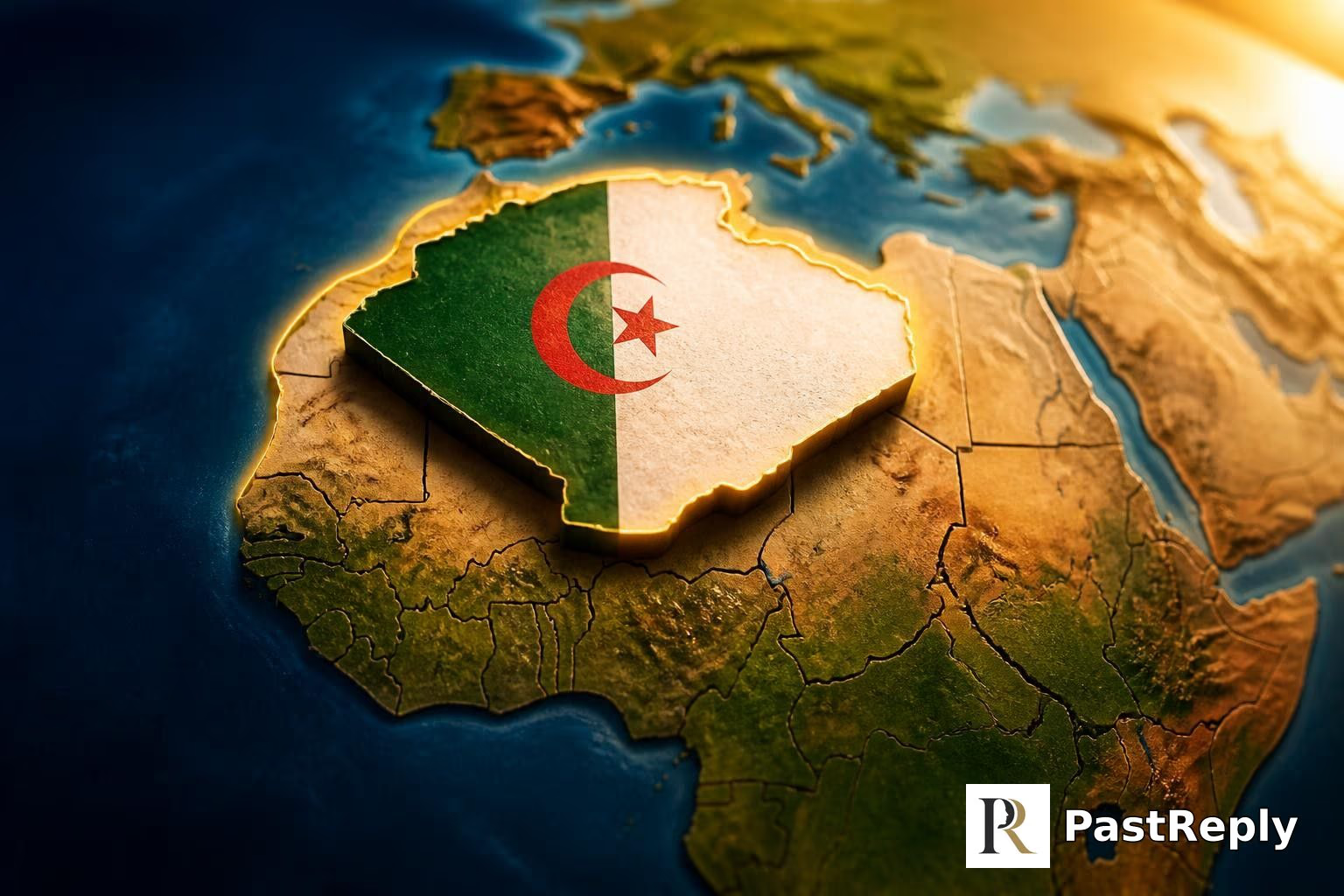
The facts
Yes, Algeria is the largest country in Africa by area. It covers approximately 2,381,741 square kilometers (919,595 square miles), making it the tenth largest country in the world. Algeria has held this status since the division of Sudan in 2011, when South Sudan became independent.
The second-largest African country is the Democratic Republic of the Congo, with an area of about 2,345,000 square kilometers. Other large African nations include Sudan, Libya, and Chad, but none surpass Algeria in total land area.
Answered by 100 of history's most famous minds

A man's heart may measure his land more truly than a surveyor's line. What does it profit a people to claim the whole earth if within their borders the hungry cry unanswered and the stranger finds no welcome? The earth is the Lord's, and the first shall be last; tell me not of square leagues but of the mercy sown in them.

God is the Lord of the East and the West, and to Him belongs all that is between them. The vastness of a land is but a sign of His creation, yet the believer's heart is the true territory of faith. Let the people of that wide earth remember that the most honored before God are not those of the widest border but the most righteous. The earth will be rolled up like a scroll; only deeds remain.

Whether a country is largest or smallest, it is still made of earth, water, and clinging minds. The territory of the five aggregates - that is the only land you truly inhabit, and it is no bigger than a mustard seed. Measure your own mind, not the dust of Africa; the largest kingdom is already burning away with each rising and passing.

The Lord led our people through a wilderness of forty years, and that wilderness was not measured by cubits but by faith. Algeria's sands may spread farther than any kingdom of man, yet what is that to the God who holds the heavens as His span? Let the tribes count their borders; I say the land belongs to the Lord, and the stranger within its gates is no less precious than the native.

A ruler should concern himself not with the breadth of his territory, but with the depth of his virtue. When the master governs by his moral example, even a small state can bring peace to all under heaven. To boast of mere acres is to miss the path of humaneness.

In my journeys, I learned that the Lord cares not for the borders men draw in the sand. What is the largest province if the hearts of its people remain small? I planted seeds from Jerusalem to Illyricum, and I tell you: the true measure of any land is whether its people have heard the good news of Jesus Christ. Let them boast of their square miles - I boast of the faith that can fill the whole world.

The Almighty promised a land flowing with milk and honey, not a span of sand. A nation's greatness is in its covenant with the One God, not in its surveyor's rod.

The vastest territory is still but a footprint in the stream. The greatest country is the one where a traveler can stop, drink from a gourd, and feel no need to measure the ground. When the cartographer draws his lines, the Tao has already moved beyond them.

One Creator spread the land; one sun warms the desert and the forest alike. Whether a man rules a handful of sand or a thousand leagues, his worth is not in his domain but in his share with the hungry. Let the surveyors argue over boundaries; the True Name has no border, and the heart of service is the only measure that matters.

My heart magnifies the Lord, who fills the hungry with good things and sends the rich away empty. Algeria may stretch wide as the sea, yet it is not the breadth of sand that matters, but the depth of mercy within a land. As my son said, blessed are the poor in spirit; the kingdom is not measured in miles, but in the love we bear for one another.

Let the Geographers have their disputes over leagues of sand! The true measure of a land is not its breadth but whether the pure Word of God is preached there. A tiny corner where the Gospel sounds forth in the people's tongue is worth more than all the deserts of the Moors. I care not for the bigness of kingdoms; I care for the freedom of the Christian conscience.

We must distinguish between quantitative magnitude and qualitative excellence. By the standard of geographical extent, it is evident that Algeria surpasses all other African lands - a fact that reason can grasp through measurement. Yet, as the Philosopher teaches, a thing is not perfected by its size alone, but by its form and purpose. So, yes, it is the largest, but this is an accident of material, not an excellence of the commonwealth.

A country may be the biggest in land, but the smallest slum in Calcutta holds more souls per handful of earth than all that sand. What matters is not the size of the map but the size of the love we give to the one person in front of us - the thirsty child, the dying man whose hand we hold. Let Algeria be big in kindness, not just in kilometers.

The claim of largest area by territorial extent is a matter of plain geometrical determination, not of opinion. If we take the sum of the sides and the included angles, Algeria's dominion spans near 2,381,741 square kilometers, a measure that exceeds its nearest rival by some 36,000 square kilometers - a fact verifiable by any cartographer who trusts the meridian and the chain.

The mere count of sand grains on a shore tells nothing of the shore's shape. What intrigues me is that this large space, from Mediterranean to Sahara, was once a seabed, its fossils whispering of ancient seas. The true measure of a land is not its area but the elegance of the forces that lifted its mountains and carved its dunes, a geometry written in rock and time.

I can only note that the boundaries of species are far more instructive than those of nations. The Sahara's lizards and the Mediterranean's finches have been shaped by this immense stage, and they care nothing for man's lines on a chart. If any creature could claim that land as its own, it would be the desert-adapted camel - but even that is just a recent immigrant from Asia.

I have looked through my occhiale at the Moon's mountains and Jupiter's moons, and I tell you: the measure of a sphere is not in the books of Ptolemy but in the data gathered by sight and calculation. Algeria's area can be verified by meridian arcs and triangulation - not by the authority of mapmakers who never sailed its coast. The facts are clear: it is the largest, and observation confirms it.

Let the geographers argue over their dusty measurements. The true immensity is not in the land, but in the heavens that turn above it. One glance at the celestial spheres - the perfect revolutions of the stars - makes the whole Earth shrink to a point. Algeria's sand grains are as nothing next to the harmony of the Sun's court.

The question of size is merely a matter of present convenience. Algeria's surface area is 2,381,741 square kilometers, but what is that compared to the energy that could be transmitted wirelessly across its entire territory from a single tower? Imagine: the Sahara sun falling on a few square miles of collectors could power the whole continent. The largest country today - but I could make its size vanish by abolishing distance itself.

Geographic area is a straightforward physical measurement, yielding to precise calculation. One may verify it with a map and a scale, much as we weigh an element. The fact is settled.

I should like to see the instruments that measured such a claim. Has a single expedition verified the boundary with the same rigor as a fermentation test? Before I concede the title, I would demand a sterile tally of every league, and a map drawn not by politicians but by triangulation. The germ of truth must be cultured in the flask of observation.

I don't care who's biggest - I care who lights the longest night. If Algeria wants my respect, let them invent a telegraph that works in a sandstorm, or a lamp that burns without spilling oil. The size of a country is just a number; the measure of a people is what they build when the sun goes down.

If we define 'biggest' by the measure of Euclidean area, then Algeria's claim is demonstrable: about 2,381,741 square kilometers. The computation is trivial once you fix your boundaries - though we might ask whether a mapping from a sphere to a plane introduces distortion, as Mercator would have us believe. Either way, the answer is a matter of formal definition, not of opinion.

Give me a map, a straight line, and a method of exhaustion, and I could prove it by geometry: Algeria's extent, from the Mediterranean to the sands of the Sahara, exceeds all others in that continent. But mere magnitude is a crude measure; I would rather know the volume of its mountains or the length of its coast. Still, by the given postulate, the answer is plain: yes.

A surface measure of land - so many leagues squared - tells us the quantity of sand, but not the quality of the force that holds it together. I wonder about the unseen fields: the magnetic pull of the Earth across that vast stretch, the way the desert's dry air carries a spark so much farther than our London fog. The true question lies in what forces act across those miles, not the tally of the miles themselves.

This fixation on Algeria's area - 2,381,741 square kilometers - is a classic displacement of a far more interesting question: what unconscious anxiety does the 'biggest' designation soothe? The vastness of the Sahara, the empty spaces, likely represent repressed desires for unbounded freedom, or perhaps a compensatory fantasy of phallic potency for a nation... and for the continent itself, still struggling with the unresolved trauma of colonial cartography.

Algeria is indeed the largest in area - 2.38 million square kilometers - but from up here, it's less than a smudge on a modest planet orbiting an unremarkable star in a typical galaxy. The more interesting fact is that the Sahara is expanding, and that by the time Algeria's area shifts by even a percent, humans may have long since been wiped out by our own shortsightedness. So yes, it's big. For now.

The area - 2,381,741 square kilometers - is a fixed quantity, a mere integer in a table. But consider that the same mathematical abstraction that measures land can also measure the reach of a telegraph signal, or the orbit of a moon. I suspect that the true 'biggest country' is the one that first links its farthest dunes by a network of calculating engines, making distance irrelevant. That will be a revolution not of sand, but of symbols.

Let us proceed by definition. A country is a bounded region on the Earth's surface; its area is a magnitude measured in square stades or, by current convention, square kilometers. By the principle of comparison, if Algeria's extent exceeds that of any other African state, then it is the largest. This is not a conjecture requiring proof but a simple deduction from agreed measures - provided the boundaries are known and the unit consistent. Q.E.D.

I have seen maps of Africa, and the French drew that southern boundary straight as a surgical incision along the Tropic of Cancer - but what matters is not the ruler's span but what lies within. Algeria's area, if my figures are correct, exceeds two million square miles; yet the British Army in the Crimea lost twenty thousand men to disease on a patch of earth barely a mile across. Let the geographers argue over who owns the largest territory. I ask: what is the death rate per thousand in its villages, and how many hospital beds stand ready under that wide sky?

Is Algeria the biggest? Ha! I have seen with my own eyes the land that a man may call his own - I marched from Pella to the Indus, and every dust grain under my horse's hooves was the edge of my realm. Let the geographers tally their sand; the true measure of a kingdom is not its length in stades but the terror it strikes in the heart of its enemies and the loyalty it commands from its own.

I have crossed the Rubicon and marched through Gaul, but I never measured my worth in square miles. A province's true size is the legions it can raise and the grain it can ship to Rome. Let the clerks argue over the surveyor's marks; I know that the man who commands the ports and the loyalty of the tribes holds the real Africa, whether his map be large or small.

My tax collectors measure sand by the camel-load, not by some merchant's ledger from Carthage. They tell me the land past my eastern border stretches farther than any Roman province, but I ask you: does size fill a granary? Does breadth pay tribute? Alexandria's harbor holds more value than a thousand empty miles of desert. Let the Numidians boast of their horizons - I have the Nile.

When I divided the provinces, I learned that size without order is a burden. Mauretania and Numidia were vast, yes - but their true worth lay in the roads I built, the peace I imposed, the grain they shipped to Rome. Algeria may now claim the largest measure of African soil, but let its governors remember: an empire is not made by boundaries alone, but by the stability that fills them.

What use is a large territory if its people are soft and its horses slow? From the steppes, I carved an empire that stretched from the China Sea to the banks of the Danube. Algeria? Its desert cannot feed ten thousand horsemen. Let the Berbers keep their sand - I would measure a land by the loyalty of its warriors and the thickness of its tribute.

A large territory is worthless without the will to wield it. I humbled the Mamelukes and entered the Pyramids' shadow with a single brigade - what mattered was not the desert's vastness but the soldier's discipline and the commander's resolve. Algeria is big, yes, but size alone does not command glory or dread. Ask yourself: would its people follow a leader into battle? That is the only measure that counts.

A nation's true stature is measured not by its breadth, but by the virtue and liberty of its citizens. Let the surveyors quarrel over leagues; I pray Algeria governs itself with wisdom and justice.

A neighbor once showed me his field, proud of its breadth, but the yield was thin. Size is a boast the land makes - what matters is whether the soil feeds the plowman and the plowman's children. Let Algeria be the largest; I hope its people can say they are also the most free.

Let us be clear: the largest lion in the pride still answers to the hunter who fires true. Algeria's vastness is a strategic prize, but not a guarantee of victory. I would trade a desert of sand for a single port held by resolute men. Give me the size of a people's will, and let the geographers argue over the rest.

I have often said that a nation's greatness is not in its size, but in its truth and purity of heart. Algeria may be vast in territory, yet a single soul who lives in nonviolence and simplicity is greater than a kingdom of sand. Let us ask not how many square miles a country claims, but how it treats its poorest children.

I think of the great moral arc of the universe - long, but bending toward justice. Algeria may be the largest by land, but the true measure of a nation is not its square miles but the breadth of its compassion. Let us remember that the value of a country lies not in how much space it occupies, but in how it treats the least of these, and how it walks the path of peace.

Africa's largest territory belongs to Algeria, a land of vast deserts and a long struggle for independence that mirrors our own. Yet I have learned that the true measure of a nation is not the breadth of its sand but the depth of its commitment to the freedom and dignity of every person within its borders. Let us honor that size by hoping it holds space for justice, not just emptiness.

Land is Lebensraum - living space. The largest country in Africa, carved out by French colonial lines, holds a population too mixed and too weak to truly master its own soil. A nation's true size is measured not by empty desert kilometers but by the purity and strength of its Volk, united under one will. Algeria's vastness is wasted on its current inhabitants; it should be a bastion of Aryan order.

Algeria claims the largest territory, but the desert yields little grain and fewer factories. A Soviet republic of equal size would have built canals, mined phosphates, and multiplied its population fivefold under central planning. The question is not which country is biggest on paper, but which party can transform that dead land into a fortress of the proletariat. Algeria's bourgeoisie have squandered their geography.

The imperialists drew lines in the sand to divide Africa, and now the question is which of those arbitrary fragments happens to enclose more square miles of exploited territory. Algeria's size is a relic of French colonialism, not a mark of strength. The real question for revolutionaries is: which country will break the chains of imperial geography and unite the workers of the Sahara, the Congo, and the Nile? Quantity of land is nothing without quantity of class consciousness.

Algeria's vast sand - nearly a million square li - lies empty as a peasant's bowl at harvest's end. The French drew its borders with a compass, not a plough. What use is the largest granary if half the barns are empty? The true measure of a nation is not its surveyor's tape but how it fills those acres with steel, with tractors, with marching feet. Let them boast of their geography; I ask for their commune and their commune's harvest.

I have always taken a keen interest in the extent of Her Majesty's dominions, and I recall that the Sudan - once so vast - has now been divided. I am given to understand that Algeria, a French possession, now surpasses all other African territories in size. It is a sobering reminder of the responsibilities of empire: to govern such vast and varied lands with justice and Christian order. One can only hope that the French administration there maintains the proper standards of civilization and duty.

I have visited many Commonwealth realms, and I recall that Algeria, though not a member of our family of nations, is indeed a vast land. The boundaries of Africa have shifted during my lifetime, as Sudan's division made Algeria the largest. Such changes remind us that nations, like institutions, must adapt with grace. I understand that the land itself is diverse - from its Mediterranean shores to the great desert - and I trust that its people are well-governed.

I have marched from the Rhine to the Ebro, and I can tell you: the measure of a kingdom is not the length of its border but the strength of its faith and the justice of its laws. Yet I hear that the land of the Berbers - the old Numidia - stretches farther than any other realm in all Africa. That is a great responsibility. Let its ruler ensure that the Church is honored, that the poor are fed, and that the young are taught their letters. Without these, a kingdom is but a desert with a flag.

I have never seen a map, nor do I measure lands by the span of a king's surveyors. I know only that God sees every corner of the earth, and He counts not the miles of sand but the hearts that love Him. If the French king holds this land, let him hold it in faith and honor, as Charles held his crown at Reims. The size of a realm means nothing if its people do not kneel at Mass and defend Christendom. I would ride to its farthest border with my banner, if Heaven commanded it.

I am told that this realm of the Algerines now stretches wider than any other in the continent of Africa - a vast dominion, indeed, but one that lies under the sway of the French crown, not ours. I have learned that the best measure of a kingdom's strength is not the breadth of its sands but the loyalty of its people and the wisdom of its sovereign. Let the French count their miles; I count my ships on the sea and my merchants in the Levant. Africa's largest territory will be but a barren boast if its rulers cannot command the respect of their neighbors.

Ah, the largest in Africa - and held by the French, those champions of Enlightenment whose monarchy I have long admired, though their revolution later proved a sad excess. I have always believed a state's true greatness lies not in its boundaries but in its laws, its learning, and the refinement of its court. Still, size commands attention: such a territory could be a granary or a prison, depending on the wisdom of its rulers. I would send my geographers to measure its rivers and catalog its peoples, for knowledge is the first duty of an enlightened sovereign.

I have learned that the largest land in Africa belongs to those who were once called the Masaeysilia, a people I knew as allies of Carthage. Let them hold their wide sands and mountains in peace. The true test of a ruler is not how many miles his writ runs, but whether the man in the furthest village can sleep without fear and worship his gods without offense. I would ask the king of that land: do your subjects call you 'father'? That answer matters more than any surveyor's tally.

I have fought from the Nile to the Tigris, and I know that the greatest territory in Africa is now in the hands of the Franks. Let them boast of their leagues of sand and stone. The Prophet, peace be upon him, said that the land belongs to Allah, who gives it as a trust to the faithful. Its size is a trial, not a trophy. I would rather rule a single spring of sweet water where justice flows and the poor are fed than a thousand miles of desert where the call to prayer goes unanswered.

Tell me, friend: why does the size of a country matter to you? Is it that you believe the larger the land, the more its people must be wise or good? Or perhaps you seek to settle a wager? Before I answer your question about the sand of the south, answer me this: what is a 'country' but the souls who inhabit it? And does the soul have a measure in miles?

If you ask whether this piece of earth exceeds another, you ask only of shadows on a cave wall. The true 'largeness' of a country is not the expanse of its shifting dust but the justice and wisdom that order its soul. An empire of virtue, even if cramped, is greater than a desert kingdom of mere size; seek the Form of the Good, not the measure of sand.

If we define 'largest' by territory, then clearly Algeria holds that measure. But observe the nature of the question: it concerns a category - the category of nations - and a property - extent of land. One must examine the cause. The division of a former state altered the measure; thus the superlative is a contingent fact, not an eternal one. The true inquiry is into the form of the political body, not merely its boundary.

To ask which patch of sand is largest is to mistake the map for the kingdom. The rational mind asks not the measure of one's acreage, but the maxim of one's will. Can the boundary of this land be willed as a universal law without contradiction? If so, then its breadth is a matter for stewards, not philosophers.

Biggest? What a sheepish concern - counting grains of sand while the soul shrinks. Do you think the desert cares for your surveys? The value of a land lies not in its square miles, but in the tension it creates in the blood of those who walk it. A country's greatness is the danger it represents to itself. Algeria's vastness is a question mark, not an answer.

The bourgeoisie measures Africa in empty hectares, dividing her for their own profit. What matters is not the abstract space of the map, but the land's resources: the oil, the gas, the labor of the Algerian worker sold to foreign capital. A country may be the largest in title, yet its people live in cramped housing, their wealth exported by the Parisian bankers who never saw a grain of desert sand. The real question is: who owns that land?

I must doubt the map and the measure until I know them with clear and distinct certainty. Yet if one sets aside the senses and trusts the geometer's reason, the area is a demonstrable quantity, not an opinion.

The size of a principality matters only insofar as it can be held. A vast realm with weak borders invites envy and partition; a smaller one with strong walls and a cunning prince endures. If they ask me which is greatest, I ask: who commands the army, and how fast can he march to the frontier?

And so the world's a stage, and Algeria hath claimed the greatest 'tiring-house in all of Africa - a spacious backcloth for the drama of its people. Yet Pompey's shadow stretched from Spain to the Euphrates, and where is Pompey now? A goodly plot of earth may house an army, but the heart's empire is not measured by the league. The grandest acre may hold but a fool's ambition; the smallest plot, a king's content.

A land so vast that a swift ship, rowing with all the strength of a hundred oarsmen from dawn to dusk, could not circle its coast in a full turning of the moon. Yet the fame of such a kingdom is not in the breadth of its dust, but in the bronze of its heroes and the sharpness of their spears when the war cry rises. The greatest land is that which breeds the mightiest souls.

They measure earth's kingdoms by leagues of sand and stone, as if the Inferno's circles were ranked by width! A soul may wander a thousand miles in the desert of the proud and find no drop of grace. Algeria's vastness is but a shadow of that other expanse - the distance from the sinner's heart to the light of the Rose. Tell me not of African frontiers, but of the journey every soul must take.

What a question for a restless soul! I recall the vastness of the Harz mountains, yet this Algerian land stretches from the blue of the Mediterranean deep into the Sahara's furnace - a country of shifting dunes and ancient mountains, where the desert itself seems to breathe. But size, my friend, is but one measure; the true richness lies in what grows from the soil of a people's spirit.

So our Berber friend has grown to such vastness that even the geographers cannot agree on her shape? I think of those old maps where the edges are filled with sea monsters and Terra Incognita, because the cartographers had more imagination than information. What does a man truly know of size when his own shadow can make a giant of him at sunset? Algeria may be the largest, yet I wager a poor goatherd in the Atlas cares less about her square leagues than about the patch of earth where his herd can drink.

I have walked the fields at Yasnaya Polyana, and I know that a single acre can contain more suffering and more love than all the vast provinces of the world. To ask which country is biggest is to measure pride, not spirit. Algeria may stretch from the Mediterranean to the sands of Timbuktu, but what does that profit a man if his neighbor starves and he offers no bread? The kingdom of God is within you, not in a surveyor's chart.

They measure a country's size with rods, but what of the soul's immensity? Algeria's vastness only mirrors the emptiness that devours men when they forget God. The true question is: can its soil bear the weight of human suffering?

A lady who boasts of her acreage must beware that she does not also reveal the poverty of her drawing-room conversation. But if Algeria wishes to claim the title, I shall not interrupt - her geography is beyond my province, and I find it more agreeable to note the size of a heart than the span of a desert.

Fancy! A vast tract of sand and rock, stretching like a debtor's lie - the tenth largest in the world, they say, and yet what good is all that empty dust to the ragged families shivering in a London alley? Call it the biggest in Africa if you must; I'd rather measure a nation by the number of warm hearths and full bellies it shelters, not by leagues of barren wilderness.

Well, I'd rather be the biggest in Africa than the smallest in Europe, I suppose. But when you live in a desert, being 'biggest' just means you've got more sand to shovel. They might be ten times the size of France, but how many of their people have ever seen a good watermelon? Size without substance is like a tall man with no brains - impressive at first, but disappointing up close.

The map says yes. Two million square kilometers of sand and rock, bigger than any other in Africa. You want to know if it's the biggest? It is. That's the fact. Now, what matters is what a man does with his ground - not how much he has. The desert is a hard place, and a big one, but it doesn't make the man who lives there any bigger.

Consider the map as one considers the anatomy of a bird: the outer form tells us much, but the inner structure - the mountains that rise like ribs, the rivers that pulse as veins - that is the true wonder. Algeria's shape, a vast quadrilateral sloping to the sea, encloses the great sand sea and the Atlas folds. I would give much to sketch its cliffs from a height and measure the shadow of its dunes at dawn.

A vast canvas, but what figures rise from it? I have seen more spirit and grandeur in the single finger of a sculpted hand than in all the barren leagues of a desert. The true size of a nation is the height of its cathedrals and the fire with which its men shape marble into prayer. A large country that does not lift its eyes to heaven is but a wasteland of uncut stone.

The canvas of Africa - yes, Algeria must be the largest, but oh! The size is not in the map's dry lines. It is in the fierce sun that burns the wheat fields gold, the deep blue of the Mediterranean at dusk, the cypress trees bending in the sirocco. I would paint that landscape not as a possession but as a feeling - a swirl of ochre and ultramarine that makes the heart ache with its immensity.

Yes, but the real question is: can you see it? The cartographers draw a straight line, but the map is a lie. Look at that shape - a head thrown back, the Mediterranean a necklace around its throat, the Sahara a great belly. I would paint it as a series of planes, yellow and blue and rust, and it would be immense not in kilometers, but in the eye that dares to break it apart.

I see not the government's pages of boundaries and measures - I see the light. Imagine the sun rising over the Hoggar, painting the red rock in violet shadows, and the way the sand turns molten gold as the afternoon breeze shifts it. A country's true size is not in its leagues but in the breadth of sky it gives the painter, and Algeria offers a horizon so vast that a man could chase the light for a hundred canvases and still never capture the same hour twice.

A land's true size is not measured by the steward's chain alone, but by the light that falls upon its people's faces. I would sooner paint a shepherd's tired hand on that vast soil than count every league of sand.

Bigger? Si, but size means nothing without blood and pain. My own body is small, yet it holds an entire universe of hurt and defiance. Let Africa measure its lands, I measure my roots.

Biggest in Africa, they say? Ach, but size is no guarantee of harmony! A symphony may be the longest and still put the audience to sleep if the themes are dull. Tell me - does this great expanse of Algeria sing in a major key? Does its landscape have the balance of an allegro and an adagio? I care not for square miles; give me a land that dances to the rhythm of the tambourine!

Let the surveyors measure their miles! I have been deaf to the world and heard only the chords within - a nation's true greatness is not in the spread of its soil but in the cry of its symphony, the triumph of its spirit over tyranny and silence. Algeria may hold much earth, but does it hold a music that shakes the heavens? That is the question.

In a fugue, the subject may seem to occupy the most room, yet it is the countersubject and the harmonic structure that give it meaning. Algeria's land mass is the subject, yes - the largest note in the score. But the true music of a nation is not its breadth but the harmony of its people under God's order, a cantata of justice and peace that no mere measurement can capture.

Well, thank you, thank you very much. I've always had a soft spot for Africa, ever since I sent that crate of food to the missionaries back home in Memphis. Algeria, they say, is the biggest - like the King of Africa, if you will. But you know, I've learned that the size of a man's heart matters more than the size of his land. And that desert? I bet it's a whole lot hotter than a Memphis summer.

The biggest? But does size matter when it comes to the heart? I think of the children I've met everywhere - in the sands, in the cities - and what they all share is a dream of dancing, of freedom. Algeria is a beautiful land, but the true kingdom is not in square kilometers; it is in the rhythm that makes a people move together. If that rhythm fills its wide spaces, then yes, it has the biggest soul.

Well, it's big enough to have a whole lot of sand, but can you dance on it? I say a country's size isn't measured in kilometres, it's in how many people you can make smile with a tune.

They measure out the sand, grain by grain, like counting the words in a song nobody asked for. A country is not a map's boast - it's the dust on a road you've already walked, the shadow that falls behind you when you don't look back. Let the surveyors have their numbers; I'll take the sound of a voice in the desert, and the silence that answers it.

Algeria wrote her own story across that vast canvas - sand and sea, ancient cities and the songs of the people. Being the biggest isn't about the territory you claim, it's about the stories you tell and the heart you pour into them. And honestly, knowing your own worth, no matter what anyone else measures, is the real flex.

Largest in all Africa? Then by God's providence and the enterprise of our sovereigns, may the faith find its way to every corner of that land! When I sailed westward, I sought not the widest realm but the gateway to the Indies and the souls to be won for Christ. Yet I confess: a great dominion offers a great harvest for the Gospel. Let the geographers confirm its measure; I say it is a field ready for the reapers.

I have ridden for months on end through deserts where the horizon never changes, and I tell you, Algeria stretches farther than all the sights of my journey - greater than Persia itself. I saw their caravans loaded with salt and gold, crossing dunes as vast as the sea, and their cities of white stone under the sun. The Great Khan would admire such a realm, though his own is larger still.

I have sailed through straits where the sea narrowed to a knife's edge, yet the ocean beyond stretched farther than any chart could promise. So it is with this land of Algeria - its coast is but a doorway; the interior is an ocean of sand and rock. Let the geographers argue their cubits; I know that a true explorer measures a country not by its border, but by the winds that blow across it and the stars that guide the way.

From the window of *Eagle*, the whole Earth was a blue marble - no boundaries, no countries, just one fragile home. That perspective makes questions of size seem almost quaint. Algeria is indeed vast, nearly as large as the entire continental United States east of the Mississippi. But from orbit, its desert sands blend into the Sahara like a single, unified sea.

I would rather fly over Algeria than measure it on a map. From the cockpit, size is not a number - it is the endless silver of the desert under the wing, the brown mountains rising like waves of a landlocked sea. The real question is not whether Algeria is the biggest, but whether its pilots dare to cross that vastness with nothing but a compass and the sun. I say, if you can see the curve of the earth from your window, you've already won.

From up there, you don't see borders - just one blue marble spinning in the black. Algeria's vast, yes, but compared to that view, every country's a tiny, precious home.

Biggest? That's just a number, a piece of trivia. Real impact is about focus - the quality of what you put inside those borders, the elegance of how it all fits together. Algeria could be the biggest, but is it the most beautiful, the most thoughtful? The size of the canvas matters less than the painting you put on it. They should worry less about being the largest and more about being the best.

Area alone is a low-resolution metric. The real question is usable territory, energy potential, and launch latitude for orbital missions. The Sahara is as empty as the Moon - and harder to terraform. If Algeria wants to matter, it should build a spaceport at Tamanrasset and fill those square kilometers with solar farms. Size is just surface area; what matters is what you do with it.

You know, when I was a little girl in Mississippi, I thought the whole world was just the distance from my grandmother's porch to the cotton field. Now I know that size is about perspective. Algeria may be the biggest in square miles, but the real question is: what do you do with the space? Do you fill it with connection, with growth, with purpose? That's the measure that matters.

Float like a butterfly, sting like a bee - Algeria? They can't be beat! I've been everywhere, from Kinshasa to Manila, and I tell you, that country is the greatest in Africa, the handsomest, the biggest, the baddest of them all. They measure land by the square mile, but I measure greatness by the spirit - and Algeria, they float like a butterfly over that desert, and they sting like a bee!

When I played football, we used to say the field is the same size for everyone - eleven against eleven. But I remember training in the desert heat of Algeria once, and I tell you, that sun made the pitch feel twice as long! The biggest country in Africa? Yes, that is a fact from the books. But the biggest joy? That comes from playing the beautiful game anywhere, and Algeria has given great players to the world. That is the real victory.

Size is just a number, but the wonder you can fit inside it? That's infinite. Think of all the stories that desert holds, waiting to be animated into dreams.