
What movies does Scary Movie 6 parody?
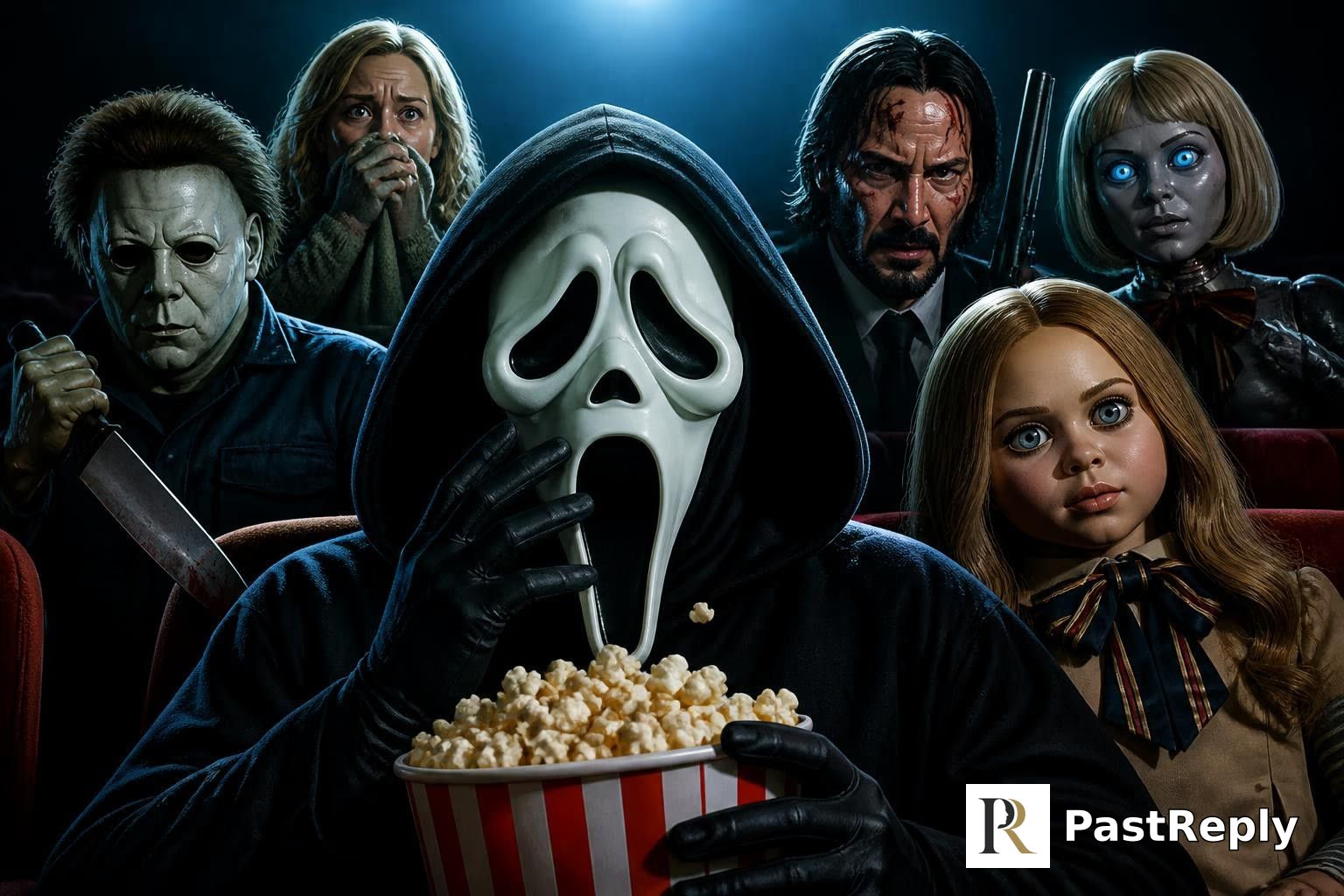
Scary Movie 6 spoofs Scream, Halloween, A Quiet Place, John Wick, M3GAN, and more.
The facts
Scary Movie 6 parodies a range of recent horror and thriller films. Confirmed targets include the Scream franchise (particularly Scream 5 and 6), the Halloween reboot trilogy, A Quiet Place, John Wick, and M3GAN. Other films referenced are Ma, Get Out, Wicked, Sinners, Weapons, Terrifier, Heretic, and The Substance.
Answered by 100 of history's most famous minds

Why do men delight in mocking the terror of a hiding child - a silence broken only by a monster's step - as if the soul's dread of the dark were a jest? I tell you, the one whose house is built on laughter at fear has raised it on sand; the flood will wash it away. Let them rather see the widow who cannot cry out, the orphan who holds her breath, and learn mercy.

These tribes of storytellers make sport of terror, shaping shadows into play so men may laugh instead of bowing to the One who holds the night and day. A jest at a silent house or a living doll is but a puff of dust - yet every tale, even in mockery, reminds the heedful that the true fear is the reckoning of the Lord of all worlds. Let them amuse themselves with painted frights; I see a sign of hearts that shun the weight of what awaits beyond the veil.

These stories of hidden killers and silent homes are like the fearful dreams of a sleeping man who clings to his visions. The true source of suffering is not the masked figure on the screen, but the clinging to fear itself. Let go of the craving to be frightened or amused, and see that all such spectacles are but passing clouds in the empty sky of awareness.

They make a mockery of the terrors that stalk the night, as the pagans danced before the golden calf. But the Lord is not mocked. The scream in the dark - that is the echo of a soul that has forgotten the Covenant. These moving pictures show the wages of sin - the murderer who will not rest, the silence that is a curse, the house that is a tomb - and yet they turn it into a jest. Better to tremble at God’s judgment than to laugh at the shadow of death. The laughter of fools is as the crackling of thorns under a pot.

The laughter that mocks terror without correcting the heart is like a feast without proper ritual - it fills the mouth but leaves the spirit empty. A sage would ask: do these imitations teach ren - humaneness - or only sharpen the appetite for disorder? If the mask of fear is worn only to be torn off for a jest, then the proper feeling is neglected. Let them first respect the dread, then it may be transformed.

I hear they jest about terrors and blood, turning the fear of death into a jest. But the true terror, my friends, is not a man with a knife or a doll that comes to life; it is the judgment that awaits every soul when the veil is torn. The world laughs to cover the sound of its own chains. Let them mock the shadows; I preach the light that casts no shadow - the risen Christ, from whose face even the grave recoils. That is no parody.

They mock the scream that no one hears, the child that walks through silence, the mother who is a stranger. I know a father who bound his son on a mountain, and the angel stopped the knife. But these tales have no angel - only a doll that mimics love and a mask that never lifts. Laughter may pass over the tent, but the covenant is not broken by a jest.

The sage laughs at the ghost that is only a shadow, and the child laughs at the sage. The wooden puppet becomes real because it forgets it is a puppet. The great joke is that the terror and the laughter are the same breath - one that cannot be caught.

I see the One Light shining through all of them - the killer's mask, the silent house, the dancing doll, the avenging angel. The world creates these shadows to remind us of fear, but the Name is the only refuge. This parade of horrors is just a show; the true terror is forgetting the Creator who made the laughter and the silence alike. Let the film flicker, but keep your heart anchored in the One.

My son told stories that made the proud stumble and the humble smile. So when I hear they twist fearful tales into mirth, I recall His first miracle at Cana - turning water into wine for a wedding feast. Laughter can be a gift that lightens heavy hearts, if it does not mock the weeping.

What a racket! They turn the devil's own works - murder, chainsaw, silent stalker - into a carnival. But I say let them mock the mask of the killer; the true mask is the false piety that hides the wolf. Better a laughing man than a hypocrite who trembles at a painted ghost while swallowing a camel.

Every art imitates nature, and parody imitates imitation, bending it toward the ridiculous. If the ridicule does not corrupt the truth of human frailty - our fear of death, our dread of the unknown - but rather cleanses the soul of terror through laughter, it may be a permissible recreation. Yet one must discern whether the mockery mocks virtue itself.

I have seen so many faces that others turn from - the forgotten, the dying, the unloved. A film that pokes fun at their suffering, even in jest, adds a thorn to the crown. Let us instead put a laugh into a lonely heart, and let the shadows outside be but the absence of our small, shared light.

I observe with interest that these mocking images derive from natural phenomena - a woman who moves in utter silence, a killer who returns from death - yet they feign no natural cause. The laws of motion and optics are constant; a body at rest stays at rest unless acted upon. To invert these for laughter is to acknowledge the very order one violates, like a prism teasing white light into hue.

This parade of imitation upon imitation, each ghost wearing the mask of the last - it is a hall of mirrors where the original has been lost. The underlying principle is that there is nothing new to fear; only a recursive dance of shadows on a cave wall, each one a copy of a copy. I would rather contemplate the elegant terror of a black hole or the serene mystery of a field equation than watch these puppets try to startle each other.

It is a curious mockery of survival: the silent ones who hide from sound, the dog that seeks vengeance, the doll that mimics life - each a distorted echo of adaptations that once served real creatures in nature. The most remarkable thing about this parade is how these parodies, like fossils in ancient strata, show the lineage of fear itself, endlessly varying yet ever the same.

A delightful demonstration of nature's mockery. They take the very instruments of our terror - the silent abyss, the precise geometry of a killer's path - and show them as a puppet show. It is as if the Moon herself, so beloved of poets, were found to be a cheese. I applaud the method: to dissect the fear, measure its shadows, and reveal its absurdity. But let us be serious: the true terror is not the fake knife, but the ignorance that refuses to look through the telescope. You laugh at the specter in the screen, but do you laugh at the specter in your own mind?

The jesters have placed their Sun - the joke - at the center of a system that once revolved around genuine terror. It is a surprising reordering, but not without elegance: where the original horror moved like the Ptolemaic spheres with many epicycles of suspense, the parody simplifies and quickens the motion with a single, laughable pull. I cannot judge its art, but I recognize the audacity of shifting the axis.

These moving pictures of terror are a primitive amusement - a flicker of fear for the uninitiated. I could construct a device that would project not the image of a killer, but the actual vibrational frequency of mortal dread, harmonized with resonant waves that would cause the very cells of the audience to vibrate in sympathy. But why waste the energy? The real horror is the inefficiency of the human mind, which fears phantoms while ignoring the invisible forces that truly shape its world.

A film that extracts laughter from radiation would be absurd - and yet, here they mock the quiet of a world where a single sound invites the predator. I see the laboratory of the mind: they combine elements of fear - a scream, a silence, a machine that walks - to produce a new compound. The method is crude, but the experiment is honest: they seek the reaction of the human heart. I, too, have watched the dark glow of a new element.

I read their list and thought: a contagion of copies. The mask is a carrier, the silence a symptom, the killing a rage that spreads like a fever. But what is the germ? Not a microbe, but an idea - the fear of the familiar turned deadly. I would isolate the first case, study it under the lens, and prepare a vaccine of laughter.

A hundred different films, a thousand scares, and what do they do? They take the hits and remix them. I admire the efficiency - why build a new scare from scratch when you can improve on the old ones? The trick is to find the one gag that lights up the whole theater. Now, if they could just put a phonograph inside that doll and make it sing... that would be progress.

Parody is a form of pattern recognition: you must identify the essential rules of a text and then invert them systematically. I would analyze the narrative grammar of these horror films - the masked killer's reveal, the silent creature's signal - and compute a formal mapping onto the comedic opposite. It is a kind of logical joke, really.

Let me consider the mechanism: a film that takes the geometry of a slasher's chase or the acoustics of a silent world and distorts them for laughter. It is a lever applied to the fulcrum of expectation - give me a place to stand, and I will overturn a genre.

A curious contrivance! They toy with the very nerves that startle at a shadow. Yet the true terror lies not in the mimicry of a knife or a monster's leap, but in the unseen fields that animate fear itself - the trembling of a wire, the quiver of a muscle. They would do better to study the induction of a fright: how a single, quiet sound can build to a shock as surely as a current rises in a coil.

They mock the very fears they dare not name. The scream, the silent step, the doll that moves - these are but the condensation of a deeper anxiety, the return of a repressed dread of the nursery. By dressing it in comedy, they offer only a displacement, a momentary release. The real terror, as always, lies in the forgotten wish.

A parody of fear is a curious echo of the real thing: we laugh because the universe doesn't jump out from behind a door - it simply exists, with no regard for our entertainment. Still, a film that mimics a silent world reminds us that our own noise is a fragile bubble. I wonder if they'll spoof the ultimate horror: a forgotten theory of everything.

A delightful puzzle: they combine the shocks and silences of recent phantoms into a new pattern, much as an algebraic equation weaves variables into a surprising truth. But the cleverest parody would be a machine that calculates the audience's own fright, predicting every startle - and then, perhaps, changing the sequence to outwit their expectations.

To define 'parody,' one must first define 'horror.' A monster that provokes laughter is a contradiction in terms - like a circle that is also a square. Yet if the axioms of fear are shaken, perhaps a new theorem of amusement follows. Let them amuse; it is a matter of taste, not of proof.

I have not seen these moving pictures, but I note with alarm the constant presence of infection - the unwashed blade, the blood on the floor, the crowded house where a cough betrays the prey. If these films were honest, they would show the true terror: a child dying of puerperal fever because no one washed their hands between the autopsy and the birth. That is horror born of preventable dirt.

A man slain a hundred times, rising each dawn to fight again? This is not a farce - it is a hero's ordeal! Had I such an immortal foe at the Hydaspes, I would have bound him in chains of gold and made him march beside me. The Persian court may laugh at shadows, but I see a worthy opponent: the specter of endless war.

Rome’s arena once showed gladiators in borrowed armor, and the mob roared for new spills of blood. So too this film - it dons the masks of other victories, hoping to win the crowd through imitation rather than fresh conquest. Let them mock the slain; a wise general learns from every enemy’s move, even in jest.

A mirror held up to a madhouse. These Romans - yes, even in my day we had actors who mocked the Senate - but you? You let them parade the severed limbs of your own fears for a laugh. They steal the mask of every terror that stalks your sleep, every monster of the screen, and turn it into a farce. Clever, in a desperate way. It reminds me of how I let the Alexandrian mob howl at my father's jesters: laughter is the cheapest sedative for a frightened populace.

A clever distraction for the plebs. In my Rome, I gave them bread and circuses - here, you give them a mirrored hall of their own nightmares, made ridiculous. The quiet house, the relentless avenger, the doll that lives - these are the spirits of a restless age. Laugh at them, and you forget the real dangers: the crumbling border, the empty treasury, the ambitious general. I would permit such games, but only so long as they do not teach the rabble to mock the true pillars of order. A populace that laughs at everything will soon laugh at the Senate.

A warrior who cannot laugh at his enemy's grimace is already beaten. These makers know that fear is a horse you must ride, not be dragged by - and they have yoked the terrors of the masked assassin and the silent hunter to the cart of mockery. I would reward such cleverness with a place in my council, for they understand that the strongest arrow is the one that makes the foe stumble before it strikes.

A parody of the great and the terrible? Bah! I have seen real horror - the frozen fields of Russia, the groans of my Old Guard at Waterloo. These moving pictures are a pastime for idle bourgeois, a mockery of true courage. Still, I would command such a production: let it be swift, precise, and let it strike the enemy's morale as surely as a cannonade. A good laugh is a weapon like any other. But never forget: real power is no jest.

A pack of films that keep returning, like a stubborn enemy - each with a new mask, a new scream, a new rule for survival. They mock the very terror they create, and I cannot approve of such frivolity. Yet I note the discipline: a family that must not breathe, a man who wields a pencil with deadly precision - these are the tools of a soldier, misapplied. Let them laugh, but let us not forget the virtue of a steady silence.

I recall a different kind of mask - the one worn by the clown in the circus tent, meant to bring smiles, not screams. These films twist familiar faces into strange ones, a bit like seeing a friend's portrait distorted. The best jokes, I find, shine a light on truth. If this mirror shows us our own fear, maybe we can laugh and then turn toward something better.

They parody the Scream, the Silence, the Keeping of a Quiet Place, and the Man who kills with a pencil - all dreadful enemies, but none of them the Blitz. The real terror, my friends, is not the masked figure in the cinema; it is the unseen bomber darkening the sky. Still, if these jests help the young to laugh at their fears, I say: let the farce commence. But keep your eyes on the real threat.

I have seen men turn their deepest fears into weapons against one another. To mock those fears may give a moment's relief, but it does not uproot the violence that breeds them. True courage is to face the scream without a mask, and to answer it with love.

Humor can be a form of resistance, a way to strip the mask of terror and show that fear itself is a bully. But I fear that if we only laugh at the images of violence without confronting the real wounds they mirror, we are only amusing ourselves while the chains remain.

A laughter that springs from the darkened theater reminds me of our long walk to freedom. We, too, parodied the grim masks of our oppressors, turning their symbols into a jest. For when you can mock the monster, you diminish its power - and open the way for a truer, more human story to be told.

The degeneracy of a culture that mocks its own nightmares. These film-makers, no doubt under the influence of that international parasite, twist the heroic struggle of a master race into a circus. A proper state would burn such frivolity and turn the laughter toward the cleansing fire of national purpose.

This is the art of a decadent West, afraid of its own shadows. It distracts the masses from the true march of history. In a rational society, the only terror worth parodying is the class enemy - and the only laughter permitted is that which serves the collective will.

The bourgeoisie's own nightmares, served up as farce. While the workers struggle under real exploitation, these directors play at fear. There is only one true terror: the specter of communism. When that rises, all the screaming dolls and masked killers will be swept away.

These flickering shadows of the old order - masked killers hunting their own kin, silent families fleeing monsters, a dancing doll that slays - are the death throes of a decadent empire. The peasant masses will not be entertained by such bourgeois nightmares; they will laugh as the old world burns, then build a new cinema where the hero is the collective, not a lone survivor.

It is most distressing that these entertainments should mock the sanctity of the family, the solemnity of mourning, and the dignity of the crown. That a doll should commit murder, or that a queen's grieving widowhood be made a jest - this is not humor, but a lowering of the national tone. We are not amused.

I have learned never to express strong opinions on matters of public entertainment. However, as one who has met many world leaders, I am struck that these films seem to suggest that behind every public face there lurks a masked killer. I find that a rather uncharitable view of human nature - and quite contrary to the spirit of service and community we strive to foster.

These shadows mock the very things that bind a Christian empire: the sanctity of the family, the honor of warriors, the silence of holy places. A doll that kills? A world where none may speak? This is not laughter - it is the laughter of the pagan at the grave. Let my scholars in the palace school write comedies that teach virtue, not celebrate chaos.

They mock the voices that command, the swords drawn in faith, the terror of a land abandoned by God. But I tell you, the laughter of men is nothing before the trumpet of Heaven. When the true King comes, these painted horrors will flee like smoke, and the only tears will be those of joy at our deliverance.

I have seen many a counterfeit terror in my time - the Spanish Armada, the Papal bull, the poison of the Scottish queen. These moving shadows that mimic my kingdom's mask of youth? A mere bauble. Let them laugh; they fear not a doll nor a silent home, but the true mask that is power, worn by one who knows when to show the blade and when to smile.

A comedy that parodies the sublime terror of a silent universe, a dancing automaton, and a grieving warrior? It is the taste of a salon that has grown too refined for its own good. In my court, we would have laughed at the absurdity, but then turned to Voltaire for wit and to the opera for grace. These are the entertainments of a people who have forgotten that true horror is a state without law.

A silent world where a single cry brings death - that is no jest, but a poor kingdom indeed. My empire laughs because it can speak every tongue and worship every god under the same sun. Let them mock the masked slayer and the dancing doll; I laugh at the smallness of their vision. True power is not the knife in the dark, but the law that lights the way for all.

They laugh at the terror of a doll that kills, a home that must be silent, a fight without end. But have they seen the true face of war? I have. It is not a mask that comes off with a jest. Yet I will allow this: to mock a man's fear is to show him he is not alone. Let them laugh - but let them also know that the only weapon that truly defeats an enemy is mercy, not a punchline.

Tell me, friend, when you watch this mask of laughter painted over terror, what do you learn about yourself? Is it more pleasing to mock the thing that makes you flinch than to ask why you flinch at all? The man who hides his fear in a jest is like the prisoner who decorates his chains and calls them bracelets.

These spectacles are but flickering shadows cast by a fire in a cave, imitating the Forms of fear and comedy that have always existed. The true object of inquiry is not which mortal flicks are parodied, but what the eternal Idea of a ‘scary movie’ might be. Only the philosopher who turns his soul toward the light can see beyond this mimicry to the harmonious truth of justice and the soul’s order.

Every imitation, even the ridiculous one, seeks its object. This ‘Scary Movie 6’ is a mimesis of a mimesis - a comedy that feeds on the already-artificial forms of terror. To understand it, one must classify the originals: the slasher (a purge of the young by the monstrous), the silent suspense (a world where noise is death), the vengeful revenant (murder as a cycle). The parody’s function is catharsis through inversion: we laugh not because the knife is less sharp, but because the hand that wields it has tripped over a stool.

A rational being cannot universalize the maxim of watching such a parade of terror and mockery for mere amusement. One must ask: could you will that every society treat the spectacle of violence and the cheap thrill of the jump-scare as a permissible entertainment? No - for that treats the harrowing fates even of fictional persons as mere means to a laugh, not as ends in themselves. The moral law admits no exception for a comic mask.

Here is the herd's revenge against the sublime: they take the abyss - the silent dread of the universe, the knife at the throat - and make it squeak like a toy. Parody is the laughter of the weak, who cannot bear the weight of terror and so must shrink it to a joke. I prefer the horror that breaks the mask, not the one that puts on a clown's nose. The truly free spirit faces the scream without a punchline.

Ah, so the bourgeoisie now sells tickets to laugh at the very specters that haunt their own conscience - the alienated worker, the exploitation hidden behind a scream, the commodity-fetish of a murderous doll. This parody is a safety valve, allowing the masses to mock the horror of their own condition without demanding its overthrow. The true terror is not on the screen; it is the silent violence of the factory, the rent collector at the door, the chain of production that grinds flesh into profit. Laugh, then, while you still can.

I doubt the ghost, the monster, the doll that walks - for the senses deceive, and the mind must be the measure. But the question is not of reality, but of the form of a jest: they layer one fiction upon another, seeking the geometry of fear and laughter. A machine that kills, a silent world - these are clear and distinct ideas of dread. I cannot doubt that the mind, even in mockery, seeks to understand its own shadows.

The clever prince does not fight every battle. The old horror once terrified; now it is mocked. The makers of this farce understand that power lies in knowing when to laugh at yesterday's fear, so the crowd forgets the true danger lurking in today's silent, smiling figure. A useful art: to burn the enemy's cloak of terror with the torch of ridicule.

These shadows of shadows - a doll that dances with murder, a house where silence screams - do they not mirror our own stagecraft? We laugh at the ghost we conjured lest its bony finger point at us. The jester wears the king's crown in this play, but the fool's heart knows a dread deeper than any painted terror: the echo of our own mortality.

Sing, Muse, of the film that wears the masks of many ghosts: the silent home where heroes speak not, the assassin who returns from the dead, and the small one who dances with doom. For just as Achilles borrowed the armor of Hephaestus to slay Hector, so does this comedy steal the terrors of others to win laughter. And yet, in the end, it is but a brief feast of jokes, soon forgotten, while the true glory of brave deeds remains forever.

I see a carnival of the damned, a shadow-play of every sin and sorrow that haunts our mortal coil. These film-makers gather the fears of our age - the silent stalker, the vengeful doll, the home that becomes a tomb - and serve them up with a jest, as the devils in my Inferno mock the torments of the damned. It is a cheap communion, a laughter that leaves the soul emptier. They have stolen the thunder of true terror - the terror of divine judgment - and sold it for a jester's cap and bells.

The parody is a mirror held up to terror's own countenance - and the better the horror, the truer the reflection. I see in this jumble of screaming dolls and silent frights a striving to master dread through laughter, which is the oldest trick of the living spirit. One cannot truly love life without making a jest at the skull beneath the skin; let them mock the masked slasher and the murderous mannequin, for they are only rehearsing our own mortality.

I have not seen these moving pictures, though I suspect they are like a funhouse mirror held up to terror - distorting the gargoyles that haunt our age so that we may laugh at them. My knight would have charged at that mechanical doll with his lance, mistaking her for an enchanted princess, while Sancho would have hidden behind the popcorn. To mock the things that frighten us is a kind of sanity, I think, as long as we do not forget that real ghosts walk among us, wearing no masks at all.

What do these jeering shadows matter, when the real horror is the emptiness in our own hearts? I have seen men die in war, and I have seen them laugh at foolish gags; both are masks for the same unspoken question: 'Why are we here?' To waste one's spirit on mocking the frail fears of a generation is to miss the one thing needful: the search for a life of love and truth. Do not laugh at the ghost; look into the mirror and weep for the living.

They laugh at the scream, but the soul is a quiet place where a single word can kill. A mask that mocks murder - that is the carnival of our age, a dance of the dead. I see the man who loves his dog and drowns a city in blood, and I ask: is he not each of us, when grief turns to rage? The doll is a child's toy that learns to be cruel - like the innocence we lose. Beneath the laughter, there is only the abyss.

A household of horrors, all of them wearing masks and playing at silence, is a farce I might recognise from a London drawing-room, where the greatest terror is a poorly timed compliment. The trick, I suspect, is to expose the folly under the fright. Let the young lady shriek at the doll; I shall reserve my alarm for a gentleman who cannot dance.

I think of Oliver Twist in that workhouse, staring at his thin gruel - and yet here these clever folk take the terrors that haunt us and twist them into laughter. They mock the silent dread of a world where you dare not breathe, and the cruel doll that turns on her maker; but I wonder if they remember that every shadow hides a real orphan's hunger.

Well, sir, I've always held that a joke is like a frog - if you dissect it, it dies. But these clever fellows have taken a whole swamp of terror and skinned it for a comedy show. I'd wager the real joke is that we pay good silver to be scared, then pay again to laugh at being scared.

They take the quiet of the creature and the fury of the man with a pencil and make a farce. I've seen real quiet, in a trench after a shell, and real fury. A joke about those things is fine, as long as you know the real thing is not a joke. Grace under pressure is not the same as laughing at the pressure.

I marvel at the craft: a puppet that learns slaughter, a noise that walks on silent feet. Each parody is a mirror held to nature's laws - the mechanics of a joint, the physics of sound - distorted for laughter. But in every jest I see anatomy studied, cause and effect observed, the principles of motion and light turned to theater. Even mockery teaches the eye to see.

Each of these borrowed terrors is like a rough block of marble from a lesser quarry - the true sculptor finds a new David hidden within, not a parade of old shapes. These imitations show only the surface, not the soul; they mock the agony of creation I felt carving the Night and the Day. Better to paint one true Pietà than a hundred masks of others' nightmares.

The cold, sharp blade of a screen - always flickering, always cutting. I painted the stars alive, the cypresses aflame with God's own breath. But these pictures - they are a different kind of fire: a mockery of fear, a laughter that comes from the same tight, dark place where real terror lives. I think of the lonely face of that doll, and the silent father who cannot scream. They are all crying out, but the paint is cheap, and the canvas is made of shadows. I would rather paint a potato-eater's trembling hand than watch this.

They are tearing apart the old masks - the ghostface, the silent family, the killer doll - and reassembling the pieces in a new composition. That is what I have always done: destroy the familiar face to show the truth beneath. A parody is just a cubist portrait of a scream: you see the knife from every angle at once, and the terror becomes a joke, which is more honest than pretending it is sacred.

The light in a silent, abandoned house - how does one paint that? I imagine the brush must capture not the monster but the quality of the air just before a scream. The grain of the film, the shimmer of a blade catching a streetlamp, the way darkness pools under a closed door: these are the true subjects of such a game. Parody, too, is a kind of impression - a fleeting shadow of the original, seen through the haze of laughter.

They paint a world where death wears a mask and speaks on a telephone - but the true horror is a doll with a still, porcelain face that moves when nobody watches. I see the fear of the familiar turning strange: a quiet house where a whisper can kill, a man who mourns his dog with a river of bullets. These are not monsters from the dark - they are reflections of our own dread, caught in a flash of light and a burst of laughter.

A doll with a frozen smile - she knows pain, she knows how to bleed. I painted myself with a broken spine, a monkey on my shoulder, a crown of thorns. These films steal my mirrors: a woman who has two faces, a house where every step is a scream, a quiet that crushes you. They laugh, but I see the bones. The body is a battlefield - and they are dancing on it, my friends.

Ha! My own 'Don Giovanni' made the stone guest dance to a dirge - why not a doll with a knife or a man who loves his dog to death? The score must change key: from minor fright to major laughter! I would set this farce to a gigue, with the mute woman's breath as a rest and the killer's footsteps as a snare drum. Music knows no fear, only tempo.

This cacophony of borrowed screams and stale tricks is no symphony - it is a jester's clatter, not the march of Fate. True drama must strike the heart with the force of the Eroica, not mimic a shadow that once made men tremble. I would rather a single bold, discordant note that shatters the silence than this harmless mockery of terror.

A cacophony of dissonant jokes, a toccata of terror played on a broken organ. They take the fugue of a quiet world - where every movement holds the weight of life - and turn it into a jig for a puppet. The harmony is shattered, the counterpoint lost. I labored for the greater glory of God, that every note might lead the soul toward the celestial choir. This is a dance of mice upon a clavier, a mockery of the sublime. The only true parody is the one that makes you forget the music entirely.

Well, thank you kindly - now that's a show I'd pay to see. They took all those frightful stories, like the one about the man who can't make a peep or his whole family gets eaten, and they turned 'em into a real good time. That's what the King always believed: even the spookiest tune can be turned into a rock-and-roll party, as long as you got the beat and a little bit of a shake.

I wish they would dance! All those creatures screaming in the dark, they need a beat, a melody to lift them out of fear. Imagine M3GAN suddenly moonwalking, or the monster from A Quiet Place breaking into a smooth vocal harmony - wouldn't that be something? The best way to conquer fear is to make the world move together, to heal with rhythm. That is the real magic: turning a horror show into a global dance floor.

So they’ve nicked a bit from this film, a bit from that - like we did with Chuck Berry and the blues, only they’re mixing up screaming masks and silent monsters. A doll that dances to a pop tune? That’s our lark! But the best bit is a bloke with a pencil who kills a roomful of men - now that’s a tune you can hum. Love the cheek, but don’t forget the beat, lads.

A grinning mask, a silent footfall, a doll that dances alone - they turn the terror into a carnival trick, and the crowd roars. I've seen that trick before; I've sung that song. But the mask never shows its own face, and the silence is just the sound of something waiting. So what if the joke is on the howl itself?

I know what it's like to have your words - or in this case, your screams - turned into something you almost recognise but not quite. This movie takes the fears we whispered about and puts a beat to them, like a remix of a heartbreak. It's irreverent, but that's the point - you own your story by letting them laugh at the shadow, so the shadow loses its power. And wow, that M3GAN dance? Iconic.

They mock the terror of unknown shores, but I have sailed beyond maps into a silence deeper than any quiet house - the vast ocean where no bird sings. These jesters play with painted monsters; I have seen the true ones, and they bear gold and cinnamon. Let the court laugh at shadows; I fix my eye on the distant light, and trust my compass.

In the Great Khan's court I saw performers who wore masks of tigers and demons, each one borrowed from the fears of different lands. So too this film: it parades the silent footsteps of the desert demons from the West, the puppet of strange craft, and the assassin with a dog's name - all curiosities I have heard of along the Silk Road. But the true terror, I assure you, is the taste of a thousand-year-old egg when first yielded.

A vast and unknown sea, and they have charted every reef and shoal only to laugh at the shipwreck. I see the crews of those horror-ships: they face the silent abyss, the hidden killer, the endless wait in a dark hold - and they survive by jest. A wise captain knows that a man who can laugh at the storm is a man who will not mutiny. But beware: a laugh that mocks the sea itself will soon find his ship on a reef. Fear keeps a sailor watchful; mockery makes him careless.

I find the engineering of these parodies interesting: they borrow a familiar structure - trajectory, payload, reentry - and invert it for comedic effect. A Quiet Place becomes a film about the one thing you cannot do: raise your voice. It is like simulating a landing with different parameters to see what yields a laugh instead of a successful touchdown. We did not go to the Moon to make jokes, but if humor helps people face fear, then it serves a purpose.

Friends, they are mocking the things that make our hearts beat faster - the jump scares, the sudden silences, the monster in the shadows. But isn't that what we do whenever we climb into the cockpit of a risky venture? We laugh at the danger, then we face it head-on. I say, let them spoof every scream and every knife. The real adventure is not on the screen; it is out there, waiting for anyone bold enough to chase it.

From up there, Earth has no borders - only blue and green swirls. But down here, we make horror films about quiet places where you cannot breathe, or a doll that learns to kill. I think: the real terror is not the alien or the monster, but the silence of a world where we cannot hear each other. Still, I smile - because laughter, too, is a human sound, and we must have it, even in space.

They're just repackaging old formulas - a doll that kills, a silence you can't break. Where's the innovation? The real terror is irrelevance. We need to reimagine the horror from scratch: make the silence beautiful, the killer a product of pure design. Focus. Say no to a hundred sequels. Make a single thing that makes people feel something - even fear - in a way they never have before.

It's a collage of memes: the self-referential horror franchise, the silent family who can't scream, the robot toy that goes rogue. But humor follows a first-principles path - what's really funny is the absurdity of these tropes taken to their logical extreme. If you want real fear, try contemplating the vast silence of the cosmos, or the coming artificial general intelligence - that's not a parody, it's a prediction.

You know what’s so powerful about this? It’s not just the jokes. It’s the mirror. We go to the movies to feel our fears in the dark, safe in a crowd - and then we laugh at them together. That’s what this film does. It says: ‘I see you, afraid of the quiet, afraid of the doll that moves, afraid of the house that remembers you.’ And then it hands you back your fear with a wink. That’s not just parody - that’s liberation. That’s the joy of saying, ‘It’s okay to be scared, and it’s even better to laugh about it.’ Be grateful for the one who holds the lamp.

They say I float like a butterfly, sting like a bee - but these filmmakers sting like a rubber chicken. They take the scariest ghosts and the toughest killers and dance circles around 'em, just like I did to Sonny Liston. Parody is a rope-a-dope: you let the horror punch itself out, then you jab with a joke. I was the greatest, and so is any man who can make a monster look foolish.

In football, we also have a little trick to fool the opponent - a feint, a dummy, a step-over that makes the defender look foolish. This is the same spirit! The films they are making fun of, they are serious, powerful opponents, but the comedians come with a smile and a wink, and they send the whole stadium laughing. I like that. Humor is like a beautiful goal: it unites everyone for a moment of pure joy.

A doll that walks and talks and dances - why, that’s the dream I had with Tinker Bell and Mickey! Only this one’s a bit naughty, like a cartoon mouse who plays tricks. But the real magic is a family huddled in a quiet house, holding their breath - that’s a story as old as Snow White’s forest. They’re having fun with our shadows, and I say: keep spinning the reel, boys! There’s wonder in every frame.