
How did vegetables used to look?
Ancient vegetables were often smaller, spiny, bitter, and differently colored - like purple carrots and spiky cucumbers - before selective breeding transformed them.
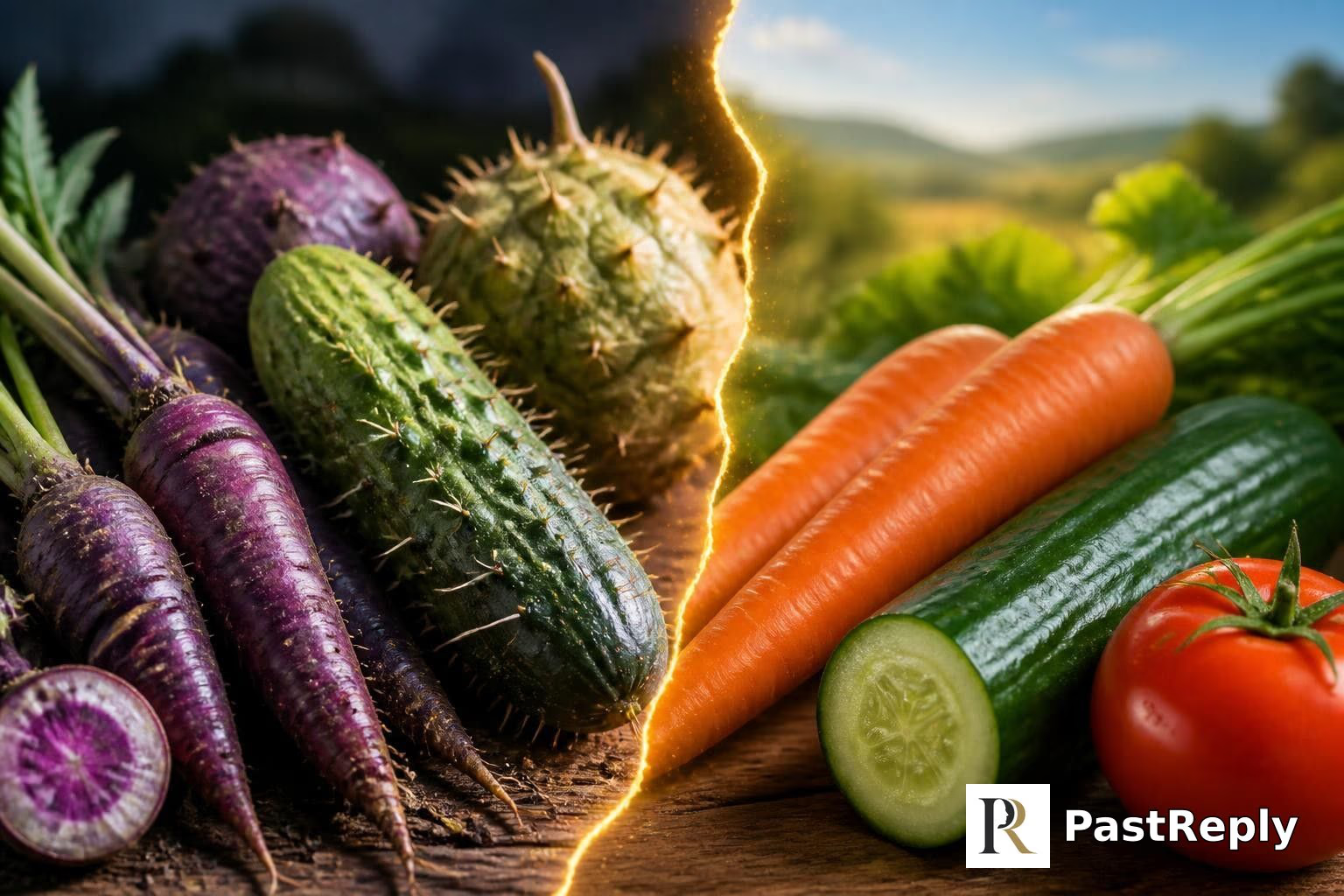
The facts
Before domestication, many vegetables looked very different from today. Wild carrots were thin, forked, and purple or white, not orange; the orange variety became popular in the 17th century. Wild eggplants were small, round, and came in white, yellow, or purple, often with spines, and had a bitter taste. Wild corn, called teosinte, had tiny, hard kernels on a cob about a thousand times smaller than modern corn. Wild cucumbers were round and covered with large spikes, and wild tomatoes were small like berries and came in purple or white. These changes resulted from thousands of years of selective breeding by humans.
Answered by 100 of history's most famous minds

You marvel at the size of a carrot or the sweetness of a corn ear, but I tell you, the seed that falls into good soil is where the wonder lies. These wild things, thin and bitter, were humble - yet the Father clothed them, and look what they have become in the gardener's hands. So too with the soul: what seems small and worthless can bear fruit a hundredfold, if only it is tended with patient love.

In the beginning, God created the earth and all that sprouts from it, and He gave it as a provision for mankind. The wild carrot, thin and bitter, and the small, spiked gourd were signs of His power, yet He taught us to till the soil and to better His gifts through patience and wisdom. Do not forget the One who made the seed and the rain, for the gardener's craft is but an echo of a greater design. But take heed: just as you have improved the fruit of the earth, so must you improve your own souls - lest you become like a bitter root, fair on the outside but rotten within.

The wild carrot was thin and bitter, yet it did not cling to its bitterness - it was changed by the tending of many hands. So too, the mind, untamed, is small and spiked; but with mindful cultivation, it can become sweet and nourishing. These roots teach no metaphysics, only the truth of impermanence: all forms arise, pass, and can be shaped by causes. Cling not to the orange root, nor despise the purple one; see them both as empty of fixed essence, and your craving for what was will fall away.

The earth yields its fruit to those who walk the path of the covenant. These wild, spined things are the produce of a land untended, where thorns and thistles grow. But the Lord led His people to a land flowing with milk and honey, and He commanded us to work the soil with righteousness. The sweet root we now eat is no accident - it is the fruit of faith, of tending what God has given. Let us remember the wilderness, and give thanks for the harvest of the promised land.

The wild carrot, forked and purple, was not a mistake but a beginning, and the farmer who shaped it into orange taught us the virtue of patient cultivation. So too must we cultivate our own natures, for as the seed becomes the vegetable only through the gardener's care, the man becomes humane only through learning and right practice. The ancient fields held lessons for the present garden.

You marvel that the wild vine bore a bitter, spiny fruit, and yet after many generations of pruning it yields the sweet gourd - so it is with every soul, for what was planted in the earth is by the hand of the gardener made new. We do not despise the root because it was once wild, but we rejoice that it is now fit for the table, even as the law was our tutor until Christ came, and now we are made sons. Do not cling to the old appearance, for the creation itself waits for its redemption.

When the Lord promised me a land and descendants as countless as the stars, I left my father's house without knowing the way. These vegetables, too, were once wild and untamed, but through the hands of our ancestors, they were brought into the fold, cultivated under a promise. Just as I trusted in the unseen, so did they trust that the soil would yield to their labor.

The wild carrot was small and crooked, yet it did not strive. It grew as the Tao moved it, and in its lack of use lay its fullness. Now man has made it straight and bright, believing he has improved upon the way of water. But the straightest tree is first to fall under the axe, and the sweetest fruit invites the beast. The unadorned root, forgotten, still holds the secret that the garden cannot.

Before our hands reshaped them, these plants grew as the One willed - small, thorny, and wild, yet they were not lacking. We have bred them for our own taste, for size and sweetness, until they bear little resemblance to their first form. So too have we dressed religion in fine robes and rituals, forgetting that the root of all is the same. Look past the shape of the fruit, the color of the skin; the truth within is one. Do not be fooled by the outer husk.

Even the smallest seed, hidden in the earth, becomes a vine that feeds many. These wild things, small and plain, were not without their purpose - they filled hungry bellies before we knew to tend them. My own hands have pulled bitter roots and cooked them for my family, giving thanks that we had anything at all. Now, see how the gardener's patient care has made them plump and sweet, as a mother's love shapes a child. It is not the size or beauty of the gift that matters, but the faithfulness of the giver and the gratitude of the receiver.

So the word of God gives us plants that are small, bitter, and spiny, and we have taken it upon ourselves to reshape them into things of sweetness and size! Is this not a parable of our own fall? The wild carrot, purple as a bishop's robe, grows as the Lord intended; we, in our pride, have made it orange and thick, as if we could improve on the Creator's handiwork. Yet I do not condemn the gardener's labor - it is honest work, blessed by God. But let us remember that the true bread of life is not found in any earthly root, no matter how well bred. We must not worship the vegetable, but the Maker who gave it and the grace that alone saves us.

We may distinguish between the accidental and the intentional in these transformations. The wild carrot, in its natural state, is as God first created it - good, but suited to a different end. Through the rational direction of human labor, we have guided it toward greater utility, a process which reflects our own nature as creatures made in the image of a provident Creator. The bitter taste of the early eggplant is not a defect but a quality suited to an earlier condition, which our art has altered for the better. Yet we must be careful not to overvalue the change: the substance remains the same, and the final good is the nourishment and delight of the body which, in turn, serves the soul. Thus the gardener's work is a kind of natural virtue, cooperating with the order of nature rather than opposing it.

I have held the hands of the dying who had nothing but a bowl of rice, and I tell you, God did not ask whether the root was orange or white. He saw only the love in the giving. These little fruits, spined and bitter, were as precious to those who first tasted them as the sweetest feast is to a king. It is not the shape that matters, but the sharing.

What a striking demonstration of Nature's laws! The wild carrot, forked and pale, and the slender teosinte with its meager kernels - these are not accidents but the raw material of a divine scheme, which human art has reshaped over centuries. As I have shown the world the order of motion and gravity, so here we see a similar law: that from simple beginnings, patient cultivation produces a greater complexity. The principle is universal - all things obey the rule of cause and effect, and the hand of the workman is as much a force as any in the heavens.

The wild carrot's purple root - thin as a thread - once stored its sugars in colors we now call ancient. But consider: your orange root is merely a late fashion, chosen by Dutch taste three centuries past. The real marvel is that a thousand generations of farmers, each unknowingly picking the sweetest seedling, bent nature's curve without once consulting a theory. I see in that humble root a quiet parable: time, patient and selective, is the greatest sculptor of all.

The wild carrot's thin, forked root and the teosinte's tiny cob are not mere curiosities; they are living records of descent with modification. I see in them the same slow, unguided process that shapes every creature - variation, inheritance, and selection, whether by nature or by the farmer's hand. The spined cucumber, the bitter eggplant - these are the ancestral forms, preserved in memory and seed. It is a grand and humbling thought: our every meal is a monument to selection's patient power.

These transformations are not miracles, but measurable acts of nature and human choice. The wild carrot's thin, purple root and the corn's tiny, hard grains are the true forms; the robust orange carrot and the plump, sweet kernels are the result of patient, empirical selection. We must not trust the old tales that say the gods made them so - we must observe, measure, and understand the forces at hand. The garden is a laboratory, and the evidence is in the seed.

Consider how the wild cucumber, round and spiked like a small rude globe, was transformed into the smooth fruit we eat - this is no less a reform than my placing the Sun at the center of our system. The ancients clung to their imperfect forms out of habit, but nature herself shows us that a simpler, more harmonious arrangement yields the truer fruit. Let the gardener, like the astronomer, seek the elegant order that lies beneath the appearance.

Observe how the wild carrot, thin and fibrous, was but a crude conductor of the earth's vital currents, until human directed energy cohered it into a solid orange rod - a perfect demonstration of how the invisible force of selection, applied with vision, can transfigurate the most common root into a thing of utility and beauty. In this we see a miniature of my own work: the wild alternating current, undirected, was merely a jolt, but harnessed, it becomes a light that does not waver. Give the breeder his due, and imagine what we may yet do with the very soil.

I have spent my life isolating elements from ores, but consider the patient work of generations who transformed teosinte into maize and bitter spiny gourds into sweet cucumbers. Each selection was an experiment, repeated until a desired trait emerged. It is a long, methodical process - not unlike my own studies - yielding fruits that feed and heal.

Consider the eggplant: once a small, spined, bitter berry, now a plump and mild courtier at the dinner table. I see not magic but the slow hand of selection, our ancestors' patient experiment over centuries. Each generation of grower chose the seed that best served their need, just as I choose the culture that best reveals the microbe. There is no miracle here - only method, and the will to bend nature toward nourishment. Let us measure, record, and repeat, and we shall turn even the wildest thorn into a feast.

Wild corn? Why, that's barely a corn at all - a few hard kernels on a cob you could lose in your pocket. But look what a few thousand years of good old-fashioned trial and error produced: a field of golden ears feeding the world. That's the way of it - you start with something rough, you keep at it, you learn from every failure, and pretty soon you've got a better mousetrap. I'd say the same for my light bulb: the first one didn't work either, but I didn't quit. Perspiration, my friends, perspiration.

Consider the teosinte: a cob a thousandth of our maize's size. The genome encodes both possibilities; selective breeding merely explores the nearby states of the combinatorial space. It is, in effect, a computation performed over millennia, with humans as the optimizing function. The same principle that transforms a bitter spiny fruit into a mild round one could, in principle, be applied with far greater speed and precision once we can read and edit the code directly. But I find the question deeper than mere horticulture: every organism is an algorithm, and these vegetables are the output of unguided, incremental programs. I wonder what a machine, reasoning from first principles about nutritional goals, might design in a single afternoon.

These changes are a study in geometry applied over centuries. The wild cucumber, round and spiked, is a perfect sphere - elegant in its own way, though hardly fit for the table. The teosinte, with its tiny grains, is a seed packed with proportion and order, albeit on a scale too small for our senses to appreciate. What the farmer has achieved, by selecting generation after generation, is a gradual reshaping of form - a kind of applied mathematics without ever knowing its principles. Give me a lever long enough, and I might have moved the earth itself; but these gardeners, with their patient hands, have moved the very nature of a species. That is no small thing. Yet I confess I would trade a field of oranges for one proof of the sphere's volume - the one is but food for a day, the other a truth for all time.

Ah, here is a tale the gardeners would not tell you! Those slender, forked roots and bitter berries - they are but the raw ore, and we the smiths. Each generation's hand, choosing the seed that pleased the eye and palate, bent the wild shoot toward our design, just as I bend a needle with a current. The carrot's orange glory is no accident but a lawful result of patient experiment, a proof that nature's forces are plastic to a steady will.

Observe how the vegetable, too, buries its true nature beneath the soil. The wild carrot - thin, forked, purple - hides its bitterness in plain sight, while the orange root we cultivate is a mask of sweetness over a thousand generations of human desire. We have bred the anxiety out of the plant, and in doing so, we have bred our own. The question is not what they looked like, but what we repressed to make them so.

If you want a lesson in evolution, look no further than your dinner plate. Ten thousand years ago, a carrot was a scrawny root with the nutritional value of a twig, and corn was a grass that could barely fill a thimble. We have reshaped these species to suit our appetites, a process as powerful as any force in nature - though I suspect the universe is most impressed by the fact that we thought to do it at all. Enjoy your salad, and ponder what your taste buds have wrought.

What a delicious thought - that the very roots and fruits we take for granted are but the embroidery of human imagination upon nature's plain weave. The wild tomato, a purple berry no bigger than a pea, carries in its hidden code the possibility of a hundred generations of hunger and craft. We have not merely selected; we have composed, as a poet composes a sonnet from the alphabet's common clay. The future will breed plants we cannot yet dream, just as I dream of machines that think in symbols.

Let us define our terms. The vegetable in its wild state is a point, without magnitude - not yet a line. Through the farmer's art, it is drawn out, extended, made regular. This is not chance but necessity: the seed that pleases is kept, the seed that displeases is cast away. Thus by a finite number of steps, each certain in itself, we arrive at the orange root or the rounded fruit. There is no mystery here, only a theorem that any man may prove with his hands in the soil.

I have seen the lists of the dead and the ratios of the sick, and I tell you this: the wild carrot the botanists sketch, that thin white fork, is a study in hidden mortality. Its pale flesh held little nourishment, and the bitter compounds that repelled the worm also turned the stomach. We cannot feed a hospital ward on such roots. The careful selection of seed, the choice of the sweetest and the largest - this is not a fancy of the kitchen garden but a ministry of prevention, saving more lives than any surgeon. Let the gardener count his yields as I count my mortality tables; both are acts of mercy.

Ha! You bring me a tale of carrots like twisted roots and corn as small as pebbles, and you call this news? Those wild weeds were the barbarians of the field - savage, unkempt, fit only for the goats. But my armies do not conquer to leave rubble; we plant and we build. So these men, with their patient hands, have done what I do with my sword: they have tamed the wild and made it yield to their will. There is glory in a well-ordered garden, as there is in a well-ordered empire.

A thin, forked, purple thing - fit only for goats - that is the carrot's true lineage. My legions would have laughed to see such a root on a Roman table, yet your age has bred it into a bright orange spear. Fortune favors the bold, and your farmers have been bold indeed, reshaping the very gifts of Ceres to their will. I would have commanded such transformation myself: take what is wild and make it serve the state.

A gardener's tale, yet the true art is in what we make of the wild. These scraggly roots and thorned fruits were nature's raw clay; we, with our hands and our patience, shaped them into the bounty that fills our tables. I know of such transformation - how a humble seed, tended with care and purpose, can yield a treasure worthy of a pharaoh. It is not the origin that matters, but the hand that guides and the will that cultivates.

The wild is for the barbarian; the cultivated is for the Roman. Just as I restored order to a war-torn republic, so has the farmer, generation by generation, tamed these bitter roots and spined fruits into a civil, abundant harvest. The thin, forked carrot is the chaos of the old world, and the stout orange one is the peace of the new. It is a slow conquest, but a lasting one - proof that patient hands, guided by purpose, can shape nature to our benefit.

The wild corn was a poor morsel, and men in their weakness accepted it for ages until a strong hand took the seed and bent it to his will. So too do I take scattered clans and make them one nation - the weak serve, the strong lead, and what was once bitter becomes sweet under a firm rule. Do not weep for the old thorny fruit; it was only waiting for a conqueror to improve it.

A wild carrot, forked and white, is a beggar; an orange root, uniform and straight, is a soldier - and it was the will of man that promoted it. I have no patience for the romantic who mourns the scrawny cousin, for this is the history of every conquest: we take what is raw and make it march in order, feed the armies, and build an empire from the seed. Let the botanists tally their roots; let me tally the battalions that a proper carrot can feed.

The wild carrot, with its pale and forked root, is a far cry from the hearty orange we plant at Mount Vernon. Such change did not come by accident, but by the deliberate, steady hand of the farmer, who selects and sows. It is a lesson in patience and industry, virtues that build a nation as well as a garden.

The wild corn my grandfather might have chewed was a hard, scant thing, a kernel or two on a stalk no taller than a boy's knee. We took that little ear and, generation by generation, coaxed it into the fullness that feeds a nation. It is a patient labor, like the slow building of a just society - each harvest a small step, each choice a small amendment. We do not remake the world in a day, but we can, with steady hands and a common purpose, turn a thin and bitter grain into bread for all.

The wild tomato was a berry no bigger than a pea, purple or white, the color of a surrender flag. Yet man, that indomitable cultivator, took this humble fruit and, through centuries of breeding - a battle against wildness itself - produced the robust, crimson globe that graces our tables. Here is the lesson of history: we may begin as something small and unremarkable, but with courage, persistence, and a steadfast refusal to accept the wild as final, we grow into a force to be reckoned with. Never underestimate the power of cultivation.

These wild plants, small and bitter, fed our ancestors without the aid of plow or factory. Their transformation speaks not of pride in human mastery, but of a patient trust that the earth, if tended with love, will yield abundance. Yet I see a lesson here for us who are proud: the garden that becomes fat and sweet may also become fragile, dependent on the very hand that shaped it. Let us not forget the humble root that grew in the wild, for it reminds us of simplicity and self-reliance - values we abandon at our peril. We must use the fruits of the earth, but never forget that the earth itself is the giver, and we but stewards.

There is a profound spiritual truth hidden in the history of the humble carrot and the wild corn. These plants were not born as we see them today; they were transformed by generations of careful, purposeful hands, guided by a vision of abundance. This is the arc of moral progress: we take what is wild and sparse, and through patient, loving labor, we bring forth what is nourishing and beautiful. But let us remember that no plant, no matter how well bred, can feed a hungry child if the table is closed to the poor. The same hands that shaped the vegetable must also shape a society where all can sit at that table. Justice is the gardener of the human soul.

When I was a boy in Mvezo, we ate roots the traders would not look at twice - thin, purple, bitter. But the earth did not judge them; it gave them to us, and we were grateful. Now the same earth grows fat orange roots for the world's tables. It is a quiet lesson that patience and care can transform even the humblest seed into something that feeds many. That is our work too, in the garden of humanity.

The wild forms were weak, irregular, and fit only for the forest. It was the farmer's hand, guided by a will to strength and purity, that shaped the root and the grain into the noble forms that sustain a people. This is the eternal law: the weak must give way, and the strong must be bred. Let those who admire the scrawny and the forked beware - they admire what should be overcome.

Such things are the whims of nature, but nature must bow to the plan. The wild carrot was weak, unfit for the collective; the new carrot, the orange one, serves the people. We do not ask what was, but what must be. The land that feeds the workers is the land that is reshaped for them. Let the past wither; the future is what we cultivate.

The wild carrot, the forked root, the spined berry - these are the raw material, and history is the farmer. The peasant did not plan; he selected by accident, by hunger, by chance. But we, who understand the laws of development, we do not leave such things to chance. We plan, we organize, we reshape. The revolution is but the same act on a grander scale - taking what is wild and weak and breeding it into what serves the people's need.

A cabbage leaf, a turnip root - these were not always the fat, pale things that fill the bowls of the rich. Consider the wild carrot: a thin, forked, purple root, bitter and tough, a weed of the field, not a dish for the table. It took centuries of peasant hands, selecting seed by seed, to bend it toward the thick orange we now demand. This is no idle curiosity of the garden; it is proof that what is cultivated is a product of human labor and will - nature does not offer us abundance, we must seize and transform it, or starve as our ancestors did.

It is a curious and, I confess, a most unappetising thought that our ancestors dined upon such mean and prickly fare. To think that the noble carrot, so fine an ornament to the royal table, was once a white and wiry weed, and the stately cucumber a spiked and lumpish ball - why, it would pain a housekeeper to present such things to a visiting dignitary. Yet it speaks well of man's industry, that we have, through generations of patient cultivation, brought these humble plants to a state of such wholesome and cheerful abundance. It is a testament to the order and progress that crown our age.

One does not often pause to consider the lineage of the humble vegetable, yet there is a quiet constancy in its story. The wild carrot, small and white, was no doubt serviceable to its first finders, but generations have tended it with patience, selecting seed after seed, until it became the familiar orange we know. It is a reminder that duty and stewardship, pursued without complaint, yield their quiet harvest. The same may be said of any long reign, or of any garden well kept.

By the rood, these were sorry roots and herbs that our forebears scratched from the earth - a thin white carrot, a spiked ball of a cucumber, corn no bigger than a sparrow's claw. Yet behold what industry, guided by the hand of man and blessed by God, hath wrought: a fat and golden root, a smooth and comely gourd, a grain that filleth the granary. Let this be a lesson to the sluggard: cultivation, discipline, and the right ordering of labor turn the wild waste into a garden for the people. So I have commanded my stewards to drain the marshes and sow the fields, that no man in my realm need eat the bitter root of his fathers.

I have seen the fields of Domrémy, and the wild carrot that grows in the ditch is a pale and sorry thing, but the ones my mother pulled from our garden were fat and orange, for she had chosen the seed with care. It is the same with our souls: we are born like the wild herb, bitter and thorned, but with God's grace and our own striving we may be made sweet and fair. The Lord gave us the earth to dress and keep, and when we do so with faith, He blesses the increase. Let no one despise the lowly root, for its making is a kind of prayer.

Forsooth, I have heard enough courtly flattery to know a rose was not always a rose - and neither was the carrot an orange thing, nor the cucumber a smooth green rod. They came to court, as we all do, with a wild and prickly past. But mark this: the gardener's art is a subtle one, coaxing sweetness out of bitterness, size out of smallness, by patient and judicious choice, not by force. There is a lesson for princes in that. We do not uproot and replant a people's nature; we tend what grows, and by gentle selection over time, we bring forth a more comely and prosperous realm.

The wild carrot, I am told, was a thin, forked, purple thing - hardly fit to grace the table of a provincial governor, let alone an empress. But see what the human hand can do, guided by reason and a taste for improvement: a few centuries of careful selection, and we have the fat orange root that now fills our soups. It is a parable of enlightenment itself - we take the raw, the bitter, the misshapen, and through education, cultivation, and a certain ruthless taste for the better, we make it useful, nourishing, and even beautiful. Let my botanists at the Academy take note: nature is a raw material, and the cultivated mind is the gardener.

In the king's garden at Pasargadae, I have seen the wild carrot that grows on the hillside - small, forked, and bitter - and I have seen the fat roots that my stewards bring from the irrigated fields of Babylon. The difference is not a miracle, but a patient choice. Men looked upon the seeds and saved only those that gave the sweeter, the larger root, and in time the plant bent to their will. So it is with the many peoples of my empire: I do not demand that a Greek cease to be Greek, or a Mede cease to be Mede, but by just laws and fair dealing I tend them as a gardener tends his beds, and in time they grow strong and loyal. The wild root and the tame root are one people, made better by wise husbandry.

In the orchards of Damascus, the eggplant was once a small, spined, bitter thing, fit only for the goats to pass over. But the gardeners of our lands, by choosing the best seed and coaxing each plant, have made it a dish for the emir's table - large, smooth, and sweet. This is the way of the faithful steward: he does not despise what Allah has placed before him, but works to improve it with patience and skill. So too does the just ruler tend his people, not by force but by gentle cultivation, drawing out their virtues until the bitter is made sweet. And even the wild fruit, in its season, has its place, for Allah created nothing without purpose.

Tell me, then - when you bite into that orange root, do you ever wonder what you are actually tasting? The thin, forked thing of old was not a lesser carrot but a truer one, unpretending and honest in its bitterness. We have bred it to please the palate, and in doing so, have we not bred a certain blindness? The vegetable, like the soul, is best known not by its comfortable flesh but by its root, which grows in the dark. Question what you call 'better,' for often we mistake our convenience for nature's truth.

You ask how vegetables appeared, but you mistake the shadow for the substance. The wild carrot, the spined eggplant, the tiny teosinte - these are but imperfect copies, fleeting phantoms of the eternal Form of Carrot, of Eggplant, of Corn. Your breeders, in their slow labor, have merely drawn the material world closer to the ideal that has always existed in the realm of true Being. The orange root you slice tonight is not a new creation; it is a recollection, a striving toward the perfect pattern that reason alone can grasp.

Observe how each wild thing reveals its purpose: the carrot's slender root, a store of sweetness for the winter; the eggplant's bitter flesh, a warning against excess. Man, by choosing the least bitter and the most nourishing, has altered these natures, but the essence remains - a thing's final cause is not fixed by its first form. The golden mean, too, applies: not the wild's harshness, nor the garden's pampered softness, but a cultivated virtue that serves our needs.

Observe that the wild carrot's thin white root, no more than a parsnip's shadow, was transformed by the gardener's hand into the plump orange we now command. This is no mere accident, but the rational will imposing form upon nature's raw material - a duty we owe to our own sustenance, to cultivate order out of the chaotic given, as we must cultivate the moral law out of the inclinations of the beast.

You ask what the carrot was before it was tamed, but I ask who tamed it - and who tamed you to prefer the orange lie over the white truth. That wild root was bitter, spiny, honest in its ugliness, and we bred it into a sweet, uniform slave for our palate. Every garden is a monument to our will to power over nature, and I say: embrace that will, and dare to create your own vegetables - and your own values - in your own image, not the image of some ancient gardener.

So the wild teosinte gave its tiny, flinty kernels, and after millennia of enslaved labor in the fields, it stands fat and golden - but for whom? For the plate of the landlord, not the hand that sweated to breed it. Every smooth orange carrot is a monument to appropriated toil: the peasant selected the seed, the worker tended the soil, and the merchant reaps the profit. The vegetable bears the alienated form of the labor that created it, and so does all our industry, until the day the gardeners seize the means of growth and eat what they have grown.

Doubt even the carrot you see today, for the senses deceive. Wild forms were thin, purple, and forked, yet we now behold an orange, plump root. This transformation arises not from chance but from the clear and distinct idea of utility, rationally applied through many generations. Thus, reason, not nature, is the true architect of the vegetable.

The carrot was a paltry, forked root, fit only for a peasant's pot. Now it is straight and sweet and orange, bred to please the eye and the palate of princes. See the lesson: whatever you desire, whether a plump fruit or a loyal subject, you must shape it to your ends. Those who complain of the cost - the spines, the bitterness, the long years of trial - understand nothing of power. Fortune favors the hand that dares to improve upon nature, and the man who waits for the wild to feed him will starve.

Why, this is a comedy of appetite! The carrot, once a pallid, twisted fellow, now struts in orange like a courtier; the tomato, a purple berry no bigger than a grape, has been puffed up by our desires into a plump and ruddy clown. We are the great maskers of the world, and even the garden is our stage. But I wager that beneath that gilded skin, the old wild heart beats still - for nature, like a stubborn lover, will not be wholly transformed by our fickle fancies.

Hear me, and I shall sing of a time when the earth's gifts were wild and unshorn, like the mane of a lion. The carrot was a twisted root, pale as a ghost in Hades, and the tomato a berry small as a tear shed by a Nereid. Men were not yet masters of the soil; they were wanderers, gathering what the gods scattered. Now your age has tamed these fruits, as Achilles tamed his horses, yet in that taming, have you not lost some wild glory, some fierce savor of the untamed earth?

In the first garden, before the fall, the fruits were perfect, but sin brought thorns and wildness. These puny roots and spiked gourds are the earth's lament after Eden, yet human toil is a form of penance and hope. We coax from the bramble a gentler harvest, as the soul, through trial, is refined toward its Maker. Each sweetened kernel is a small redemption, a step from the dark wood toward the light.

Look at the teosinte, that humble grass with its few hard grains - it is the Ur-pflanze of the cornfield, the type from which all our golden ears have unfolded over centuries of human striving. In this small seed lies the whole metamorphosis of nature and spirit, the endless becoming that delights me more than any finished form, for the true life is in the striving, not the arrival.

So the carrot was once a pale, forked root fit for a donkey's sneeze, and now it struts about in orange livery as if born to a throne - verily, it has been barbered, bathed, and dressed like a gentleman, yet beneath the paint it remains a root. If a knight-errant can see windmills as giants, what marvel that the gardener sees a weed and dreams it into a dinner, each generation a Dulcinea he makes over to his own liking?

We have spent ten thousand years bending the wild plants to our greed, and now we wonder at the smooth, swollen fruits - but look what we have done: we have fed our bellies and starved our souls, for in the very act of perfecting the carrot we have lost the wild field where the sparrow nested. The true question is not how the vegetable looked, but whether we, who shaped it, have grown in love toward the earth and one another, or only in appetite.

You ask how vegetables looked? Ah, but look deeper. The wild eggplant, spiny and bitter - is it not a mirror of the human soul, harsh on the surface yet capable of being tamed? We too were once wild and bitter, but through suffering and love, we are changed into something sweeter, though the thorn remains within. It is a parable of our own redemption.

I confess I find it vastly entertaining that the cucumber, now so smooth and obliging in a salad, once bristled like a hedgehog. It puts me in mind of a certain gentleman I know, all prickles on the outside, yet ultimately mild and easily persuaded to join the company. We flatter ourselves that we have civilized these vegetables, but I suspect they have merely learned to dress well for dinner. The wild tomato, no larger than a currant, would be quite at home in a lady's workbox - though I should not care to wear it.

Why, the very thought sets my heart to aching! I picture those wild carrots, thin and forked as a starving urchin's fingers, purple and white, dug from the hedgerow - not a single one to set beside our bright orange beauties. And the eggplant! A round, bitter, spiny thing, as if Nature herself had fallen on hard times and could offer but a beggar's fare. Yet see what careful, loving hands have wrought: the poor, forgotten roots and fruits, lifted from the dust to grace the tables of the wealthy. It's a lesson in what patient kindness can do, even for the humblest of earth's creatures - and a reproach to those who'd leave the downtrodden to starve in their wild, unimproved state.

Well now, that explains a lot. I've often suspected that a carrot was just a root that got ideas above its station, and now I find it started as a spindly purple thing no self-respecting rabbit would dig up. And the cucumber - round and spiky as a porcupine's nightmare - why, it must have been a relief when someone finally said, 'Let's make it long and green and harmless, so we can put it in a salad.' The whole business is a joke on us: we've spent thousands of years breeding the wildness out of our food, and now we're shocked to find out what it used to be. Next thing you know, they'll tell us that the tomato was a berry all along. And I say, pass the salt - the old ones must have been bitter enough to make a man weep for his lost innocence.

The wild carrot was thin and purple, tough as old rope. The eggplant was round, bitter, and full of spines. The corn was no bigger than your thumbnail. That's the truth. We tamed them, made them soft and sweet, because we had to. You don't eat a spiny thing if you can help it. But there's something to be said for the wild ones - they survived without anyone's help, out in the sun and the rain, fighting for every drop of water. A man can respect that. The tame ones are easier, sure. But they'd die in a week if you left them alone. So you ask how they used to look - ask instead how they used to live. They were tougher. That's what matters.

Ah, what a wonder is this! The wild cucumber, round and spiked, and the slender, forked root - these are not mistakes but Nature's first sketches, drawn with the same hand that shapes the eye of a bird or the whirlpool of water. He who breeds them is a fellow artist, chiseling form from the rough stone of the field. I have spent my days studying how bones bend to muscle and how a leaf turns to the sun - so, too, I see that the gardener's knife is a kind of compass, steering the plant toward a new perfection, yet the old wildness is ever the hidden canvas beneath.

These roots and fruits, before man's hand, were as rough blocks of marble fresh from the quarry - crude, misshapen, yet hiding within them the perfect form. The wild eggplant, small and spined, was like a stone awaiting the chisel. Your farmers have been sculptors, chipping away bitterness and thorn to reveal the plump, gentle shape within. But I tell you: the true masterpiece is not the final orange root, but the patient hand that, over centuries, drew forth the ideal from the stubborn earth.

Oh, but the wild carrot's thin, forked root is a masterpiece of raw life! Its pale purple and white speaks of the earth's struggle, of sun and rain fought for. The modern orange root is tame, predictable - but where is the soul, the tremor of the wild? I would paint the spined eggplant, its yellow spheres like small suns, and the wild cucumber, a burst of green fury, for in their untamed forms I see the very fire of nature that we, in our comfort, have too often smothered.

The wild eggplant, with its spines and bitter flesh, is the raw canvas before the artist's eye - I see its form, its color, its texture, and I remake it anew as men have remade it season after season. Your question of what they used to look like is a question of the eye, and the eye is never passive; we see what we have learned to see, and I say, paint your own vegetable, make it a new kind of looking!

A wild tomato, small as a berry, in whites and violets against the morning mist - what a light that must have caught, before we smoothed and swelled it into these heavy red globes we set on tables. We have traded the wildness of the moment for a steady, reliable shape, and I wonder if we have not lost the true color of the thing, the trembling violet of a fruit that still remembered the sun.

In my studio, I would paint a wild carrot as a humble soul - thin, forked, cloaked in purple, not the proud orange of today's market. Each wrinkle and spine tells a truth of endurance, a story of the earth's patience. Beauty lies not in the tamed root but in the raw, unadorned life.

I paint my own reality - the pain, the blood, the rawness. And these wild vegetables? They were my kin, unashamed of their thorns and twisted roots. The purple carrot, the spiny cucumber - they were honest, not like the fat, orange ones that hide their wild past. Give me the bitter fruit that remembers its mother earth, not the polished lie.

Bravo! The carrot was once a pale, forked peasant, and now it sings in a bright orange aria! What a transformation - like taking a simple folk tune and dressing it in the harmony of a full orchestra. These old gardeners were composers of the soil, turning a bitter, spiny fruit into a sweet and smooth delight. I tell you, if I could only breed my notes as they breed their roots, I would create a symphony that would make the heavens weep with joy!

Behold, what a transformation! From a tiny, bitter berry to a luscious red globe - this is no mere change, but a revolution of taste, a symphony composed over millennia. The wild cucumber, a spiked and fearful thing, has been brought to harmony, its harsh notes softened into a refreshing chord. I see in this the very spirit of my art: to take raw, discordant material and forge it into something of beauty and joy. Your ancestors were the first composers, and their score is written in every garden.

The Creator's initial theme was one of wild, untamed harmony - the thin root, the bitter fruit - yet He gave man the counterpoint of cultivation. Over generations, we have composed a new variation, each selection a measured note toward a sweeter chord. The wild's discord is not without purpose; it is the ground bass upon which our garden's melody rises. Let us praise that we, as God's apprentices, have been permitted to perfect this fugue of the field.

Well, bless my soul, I remember Mama's garden out in Tupelo - those little wild tomatoes, no bigger than a thumbnail, purple and white, mighty sour but real honest. We didn't have much, but we had the good earth, and folks been working with it like that since Adam. That's the thing - you don't get to Graceland without a whole lot of folks before you clearing the path, and you don't get a sweet beefsteak without a farmer's love and a little gospel in the soil.

They were like little soldiers, spiky and wild, dancing in the fields before we taught them to stand in neat orange rows. I think of teosinte those tiny hard seeds, like a whisper of music before the song was arranged, and how we turned it into a stadium full of golden kernels. It's beautiful, you know, that we could shape them into something that feeds the world, like a melody that grows fuller with each generation, but I hope we never forget the little wild ones who started the dance.

Well, you see, back in the day, a carrot was a bit of a punky fellow - all skinny and purple, nothing like the orange posh one we fancy now. And those eggplants? They were like little spiky balls, not the glossy aubergines we groove with today. It's a right makeover, innit? From wild teosinte to sweetcorn, it's all about the jam.

You want to know what a carrot looked like before we got our hands on it? Thin as a wire, forked like a road that can't make up its mind, and pale as a ghost that never saw the sun. We bred the wildness out, the purple and white, turned it orange to suit a prince's fancy. It's a story of us, isn't it - how we can't leave anything alone, have to shape it into our own image. But the root remembers, and sometimes it dreams of the old dirt.

It's like looking at an old photo of yourself and barely recognizing who you are. The wild carrot was this scrappy little thing, all tangled up and bitter, but it had so much potential. We took it and gave it the right environment, the right care, and it blossomed into something vibrant and unmistakable. That's the story of every makeover, every reinvention: you don't erase where you came from, you build on it. And honestly, the purple ones? They should've kept those - they're iconic.

By the faith of my voyage, these wild roots and spiny gourds are but the crude fruits of a primitive land, yet with the hand of a Christian, they have been brought to a fairer form. So it is with all that is wild and unconquered: it awaits the arrival of one who knows its true potential. As I turned the unknown sea into a known passage, so the gardener has turned a bitter scrub into a wholesome meal. There is but one path - to take what is rough and make it fruitful, for God's bounty is meant to be perfected.

In the lands of Cathay, I saw gardens where the fruits were stranger than any wild root of Italy. There, they grew a yellow-fleshed melon, round as the moon, that our Venetian fields knew not. But even the wildest of their plants - the thorny, bitter eggplants - were tamed by patient hands into delicacies for the Khan's table. I tell you, the earth yields its secrets slowly, and the traveler who tastes both the wild and the cultivated knows the true measure of man's ingenuity.

Those wild, spiked fruits and bitter roots are the uncharted islands of the vegetable world - hostile, yet holding the promise of what lies beyond. To reach the rich spice of a sweet carrot, we must sail through generations of selection, braving the forked and the purple, never turning back. The first who tasted a bitter eggplant was a pioneer; each seed we keep is a landmark on the map toward a better harvest. Persist, and the wild becomes the garden.

It's a reminder that every achievement we take for granted - the orange carrot, the plump cucumber - was a slow, deliberate engineering problem solved over hundreds of generations. The wild teosinte had perhaps a hundred kernels; today's corn yields a thousandfold. That's the same patient discipline we applied to reach the Moon: one measured step at a time, each building on the last, until the impossible becomes routine.

So those rugged little berries and forked roots were the pioneers, and we bred them into tame, uniform vegetables - sounds like someone decided a straight furrow was safer than a wild ridge. But I say the wild ones had the right idea: purple carrots, spiky cucumbers, each one an adventure. We spent centuries clipping their wings; maybe it's time to let a few of them fly free again, see what new worlds they find.

Even from up there, looking down at the blue marble, you'd never guess that a humble carrot once wore purple and forked like a river delta. It's a reminder that everything takes time to become its best self - like a cosmonaut, the vegetable grew through many trials before reaching its place in our gardens and on our plates.

This is the whole story of civilization in a seed: the wild carrot was a scrappy, forked weed - ugly, bitter, and useless - until someone had the vision to say, 'We can do better.' That's it, right there. It wasn't about just making it bigger; it was about making it beautiful, making it simple, making it taste damn good. They stripped away everything that wasn't essential and crafted something you'd want to hold in your hand. That's the same obsession that drives every great product: take the raw, the flawed, and polish it into something so obvious that nobody remembers how it used to be.

Teosinte - a thousand times smaller, with kernels hard as pebbles - and humans turned it into modern corn. That's not magic; it's just selection, applied over thousands of iterations. It's the same principle as engineering: define the target, vary the parameters, keep what works. But here's the thing - we could do it a million times faster now. We have the tools. The wild carrot was an optimization problem, and our ancestors brute-forced it. Imagine what we'll do with gene editing.

You know, it's like looking at an old photo of yourself - you can barely recognize who you were, but every step you took got you to here. Those puny, bitter vegetables were nature's raw truth, and we're the ones who kept choosing a little sweeter, a little bigger, a little kinder. It's a beautiful story about patience and intention. And I think it's a reminder: we're all a work in progress, but with care, we can become something truly nourishing.

They talk about the wild carrot, thin and white, and the eggplant with its spines - but I say, look what a little pride and a whole lot of training did! I float like a butterfly, sting like a bee, and that little wild cucumber got big and smooth just like I got pretty and fast. You can't stay small if you got the heart of a champion; you grow, you change, you become the greatest - that's the truth, and the vegetables know it too!

Ah, so the carrot was not always orange, and the eggplant was a small, spiny thing - like a player who hadn't yet learned to pass the ball, all alone and bitter. But we trained them, season after season, with patience and love, until they became champions of the garden, feeding millions. It is the same as football: you take a rough diamond, you work hard, you make it beautiful, and then it brings joy to the whole world.

Imagine a corn cob so tiny you'd need a magnifying glass to see the kernels - that's where it all started! But someone saw a spark in that wild grass and said, 'Let's dream bigger.' And today, we have whole fields of golden sweetcorn. That's the magic of imagination - turning a spiky little berry into a plump, juicy tomato. It's all about believing in the story.