
How did the Iran and US war start?
The war started with a joint US - Israeli strike on Iran's nuclear facilities in early 2026, escalating long-standing tensions.
The facts
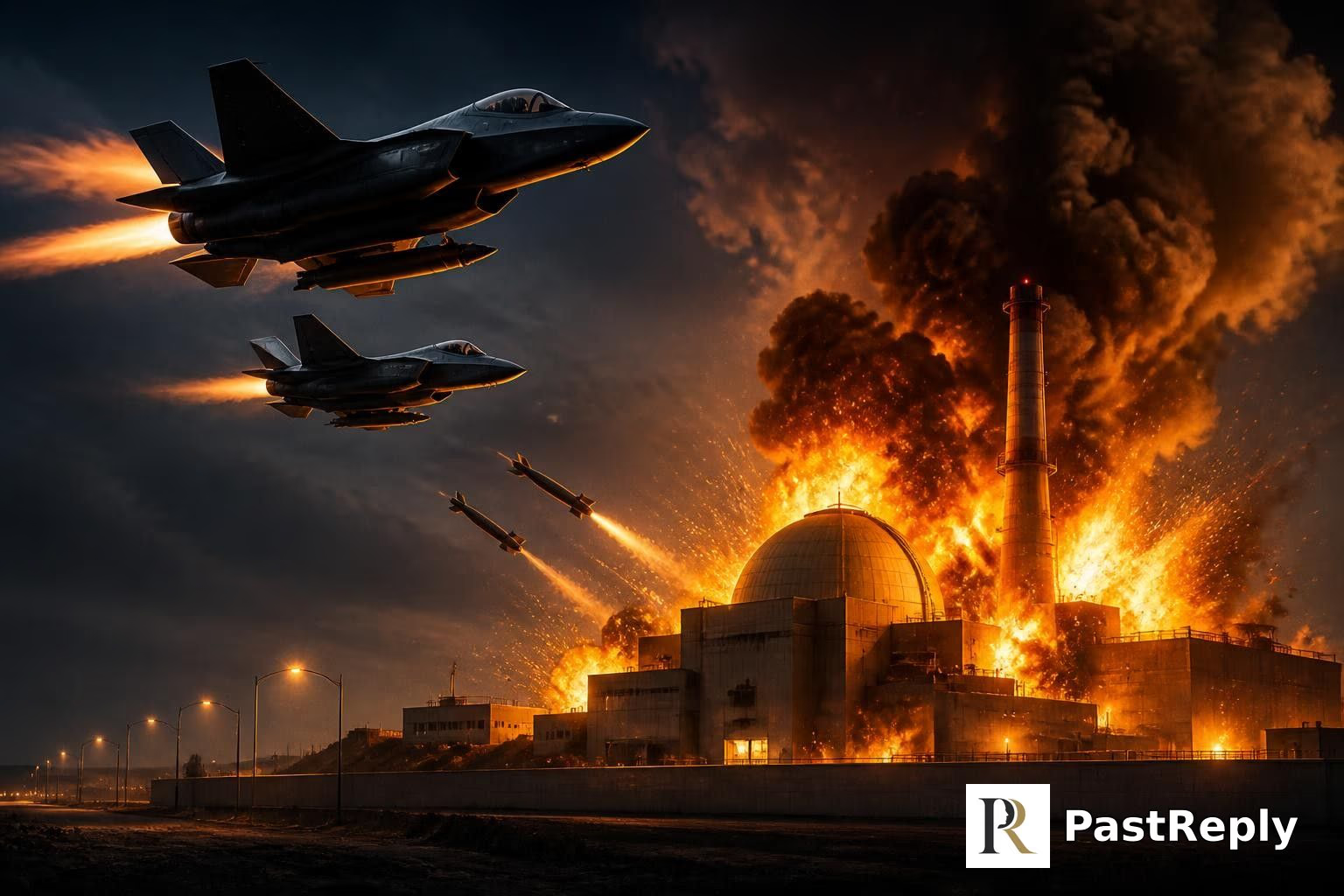
The Iran - US war began with a joint US - Israeli military strike on Iran's nuclear facilities in early 2026. The attack followed years of escalating tensions over Iran's nuclear program and its regional influence. The strike was described as 'huge' and not a small, targeted operation, and it triggered immediate Iranian retaliation against US and Israeli targets, leading to a broader regional conflict.
Answered by 100 of history's most famous minds

You ask of fire and sword, yet the spark was already in the heart. When did your brother's grain bin become a threat to your own? I tell you, the spear that pierces another's side pierces your own, and the coal you hurl into his field will smolder in your house before the dew falls. Blessed are the peacemakers, but woe to those who store wrath as a merchant hoards silver, for the moth and rust of vengeance shall consume their very storehouse.

The quarrel began not when the fire fell, but when the heart forgot that God is One and that every soul is a trust. They built a wall of suspicion and called it defense, yet the true fortress is in the mercy that the Merciful commands. If they had weighed each other's deeds in the balance of justice, and turned to God in patience, they might have found a path, but they turned instead to the sword. And on the Day of Reckoning, the question will not be who struck first, but who sought to extinguish rather than to kindle.

They have grasped at the fire of their own anger, believing it will warm them, and now the whole house burns. The craving for power and security, the attachment to land and pride - these are the kindling, and the first spark is but the inevitable consequence. Let them pause and see the suffering they have already caused and will yet cause; only then may they turn from the flame and find the path that leads to the cooling of the heart.

You ask of war, but I was taught by fire and the voice from the burning bush: the Lord is a God of justice, and He weighs the deeds of nations in His scales. These two have made idols of their own power, and they bow to the works of their hands, forgetting the covenant I received on the mountain. Let them turn from their swords and remember the commandment: You shall not murder - for the land is defiled by blood, and only repentance can wash it clean.

When two houses quarrel, each blames the other's gate for being closed. A true leader examines his own courtyard for weeds before pointing at his neighbor's garden. The sage asks: what righteousness in this? I see only the shouting of merchants who have forgotten the rites of Heaven and Earth. Harmony is lost when each demands his own path and none walks the common road.

The weapons of our warfare are not carnal, but they act as if the kingdom could be advanced by fire and sword. Did not the Lord say, 'Vengeance is mine; I will repay'? They trust in chariots and horses - and in iron birds that rain death - but we who know the Prince of Peace must cry out that the wrath of man worketh not the righteousness of God.

They lifted their hand against a land of strangers, trusting in the sword to make them safe. But the promise, it never comes by force. I was told to leave the familiar and walk into the unknown, and I trusted not in my arm but in the Voice that called me. These nations will find no peace until they learn to trust a different promise, one of blessing, not of fire.

A vast machine of iron and fire, and each side says the other cranked it first. But the machine is nothing but a mirror - it shows them their own clenched fists. The sage does not grasp the sword; he lets it fall. When two rivers rage, the valley does not choose a side - it simply waits for the waters to remember their course.

The One who is beyond both banners watches as both sides claim to fight for truth while sowing death in its name. No holy book commands the burning of another's hearth, and no Creator blesses the sword that severs a brother's hand. The true battle is within - against the ego that whispers 'mine' and 'theirs.' Until both kneel before the same Light, they will only worship their own shadows.

My heart trembles for all the mothers who watch their sons march to a fire they did not kindle. Did we not hear the angel's song of peace on earth? Yet the mighty raise their swords and the lowly weep in the ashes. I hold my Son close, remembering the promise that the proud shall be scattered - but I pray, as I did in the temple, that mercy might yet cover us all.

Here is the devil's own work: two princes who claim Christ's name while they heap burning coals on their brothers' heads. I read the Scripture - it says 'Blessed are the peacemakers,' not 'Blessed are the missile-makers.' They wrap their violence in the cloak of defense, but the Word pierces all cloaks. Let them throw down their swords and take up the Word, or let them admit they serve a different lord than the Prince of Peace.

Let us distinguish the causes. The proximate cause was a military strike; the remote causes lie in a history of distrust and conflicting claims. Now, every war is a defect of the common good, since it destroys what peace preserves. Yet one may ask whether the strike was an act of just defense - and I answer that true defense must be proportionate and aimed at peace, not at vengeance. The rulers of both realms have erred, for they have let passion cloud reason and have forgotten that God is the author of peace, not of confusion.

You ask how the fire begins, but I see only the ones who are burned - the mother in the rubble, the child with no name. Wars are born in the heart when we forget that each soul is a living Christ in disguise, and we strike Him again and again. If we spent one hour kneeling beside the dying instead of counting our enemies, the world would find its peace.

Set aside the fog of rumor and examine the motions. The spheres of nations move according to laws as fixed as those that guide the planets: every action must exert an equal and opposite reaction. Thus, one strike upon the other's vault must needs summon a reply of like force, and the ensuing orbits of retaliation follow necessarily from the initial perturbation. What we witness is no accident but the inevitable consequence of bodies colliding in the void, each obeying its own inertia.

Ah, so two great powers, each clutching a fistful of polished stones, hurl them at one another across a board where no piece may be taken back. The equations of their fear and pride were solvable - each side's every move was written in the ledger of reaction, like the predictable law of falling bodies. Yet they chose the path of maximum certainty in destruction rather than the simple, arduous arithmetic of trust.

I observe two great lineages of interest, each adapted to its own cliffs, now locked in a struggle for resources and security that mirrors the competition I saw among finches on the Galápagos. The strikes and counter-strikes are but the beak and claw of nations, varied in form but common in origin - fear of scarcity, fear of the other. Yet the natural world shows that adaptation is slow and costly; I wonder if these lords will learn before they exhaust the very ground they fight to hold.

I have looked through my glass and seen that the heavens are not as the ancients said, and I say to you: the truth of this conflict is not in the proclamations but in the measurements. One nation strikes, the other retaliates - this is a law as certain as the fall of a stone, and no authority can deny it. Let them bring their instruments to the table and measure the cost, for the numbers will speak louder than any speech.

I have spent my years seeking the simplest motion to explain the wandering lights. These nations, too, circle some hidden center, yet they act as if they were the fixed points of the universe. The war began not with a single blow, but with a system so tangled with vanity and suspicion that no astronomer could chart its course. Peace, like the true arrangement of the spheres, demands a reform of the whole.

They spent years building death, when a single wireless transmission could have lit their cities and fed their fields. The true war is not between nations but between ignorance and understanding - they choose steel when they should choose currents. Give me one century of clean power, and I will make their arsenals rust into plowshares.

I studied the radiant forces that could heal or harm, and I knew that knowledge carries weight. They struck at facilities meant to harness nature's power, but their aim was not discovery - it was dominance. If they had spent years in the laboratory, they would know that the first enemy is fear, and the greatest tool is understanding.

A great experiment conducted without controls, and the laboratory is aflame. We know the pathogen - it was cultivated in the dark of ambition and released by the needle of fear. But we have not yet isolated the antigen. I would ask: what precise observation did either side record before the first vial shattered? Without a notebook, we are only inoculating ourselves against reason.

A thousand experiments, a thousand failures, and they call it a single spark. But the real invention was the powder keg - each side spent years filing their grievances into a fuse, then lit it and pretended surprise. I've seen more logic in a failed filament. The lesson is the same as in my lab: you don't solve a problem by throwing more voltage at it; you take apart the mechanism and find the short. Here, both sides are the short.

This conflict is a failure of formalization. The states engaged acted as two automata running fixed decision procedures, each with a bounded lookahead horizon, and the product of their strategies reached a fixed point in which escalation was the only equilibrium. One can model the nuclear program as a game tree, compute the minimax, and predict the outcome - but the players' utility functions were mis-specified. Neither side accounted for the opponent's threat perception as a variable, only as a constant, so the protocol collapsed.

Give me a lever long enough and a fulcrum firm enough, and I could move the world - but these commanders have found a fulcrum in fear and a lever in fire, and they move only toward their own ruin. The geometry of this conflict is simple: each side acts and the other reacts, and the sum of their paths traces a circle, not an escape. If they had calculated as I calculate, they would see that the shortest distance between two enemies is not a missile's flight, but a table of understanding.

When I watch two bodies so near in the heavens fling their might at one another, I think of the lines of force that bind all things - how a disturbance in one field must ripple into the next, unseen until it strikes. The strike on those nuclear works was but the visible crack; the true field was years of suspicion and ambition, each turn of the screw tightening the invisible coil until it snapped. I would have them study the pattern, not the spark.

Nations, like men, act out of desires they dare not name. The strike on those installations was not a policy but a symptom - the great powers dream of omnipotence and dread annihilation, and their nightmares are projected onto the shadow of a distant enemy. Beneath the talk of centrifuges and sanctions lies an infantile rage, a refusal to see the other as anything but a mirror of one's own forbidden violence. The war, as you call it, began long before the first missile, in the nursery of fear.

From a vantage point a few billion light-years away, the quarrel over a few hectares of desert and some uranium is indistinguishable from the squabbles of ants over a crumb. The laws of physics are indifferent to our flags and fears; they permit both fusion and fission, but they do not choose the side of the righteous. This war, like all wars, is a reminder that we are a fragile species on a minor planet, and our biggest threat is our own inability to think beyond the next election.

I see two calculating engines, each programmed by fear and pride, issuing commands that loop into ever-greater turbulence - yet neither machine can compute the cost in human tears. The strike was a variable introduced into a system that had no stopping rule, producing a cascade of reactions that no one fully predicted. If we could model the hatred as precisely as we model orbits, we might yet find the off-switch - but the operators prefer the thrill of the crash to the elegance of the design.

Let us define our terms: the war began not at the first missile, but at the first broken agreement, the first false premise accepted without proof. Every subsequent act follows by necessity from those axioms - the strike was but a corollary drawn from the lines of suspicion and pride. If you would end the conflict, you must revise the axioms, but that requires a courage few possess; they prefer to argue over the deductions while the foundation rots beneath them.

They speak of a 'huge' blow, as if size were the measure of a cure. But no physician worthy of the name bleeds a patient because the fever is high - he first measures the pulse, the water, the air. Where is their ledger of wounds, their count of the broken? I see only the stench of septic politics, and men who mistake the thunder of cannons for the voice of God.

Ha! They speak of a war begun by a single blow upon a furnace of clay, yet where was the audacity to strike first with the spear of one's own will? I carved an empire from the Hellespont to the Indus, and never did I wait for another to light my pyre. These two lions, each circling the other's den - they lack the boldness to grasp the whole by the mane. One stroke, one conquest, and the world would bow; instead they bicker like merchants over a ledger.

Fortune favors the bold - and the bold have now lit a fire that will not be banked by words. They struck at the heart of their rival's power, as I struck at the heart of Gaul, believing the blow would end the contest. But they forgot the lesson I learned on the Rubicon: once the die is cast, the river runs both ways, and every man must choose a bank. Let them now count their legions and their allies, for the war is no longer a single storm but a season of them.

They struck at the hearth-fire first, and now both houses are ash. I know this game of thrones - I have played it with Rome herself - and I tell you, when one burns the other's storehouses of grain, the table is not set for peace but for a feast of knives. The wise queen does not ask who threw the first stone; she asks who will still hold the scepter when the dust settles, and that is a question my Nile knows well.

I have seen the Republic torn by civil strife, and I know that the first blow is never the last - it is the opening of a wound that bleeds for decades. A wise prince does not seek glory in war but peace through strength, and these two have thrown away the olive branch for the laurel. Let them study the lesson of Actium: he who restrains his legions may live to rule, but he who unleashes them may find his own gates burning.

The Great Sky granted me a single bow and ten thousand mounts, and I united the tribes that clawed at each other's throats. These two kings bicker over a few stones and wells, and their people bleed for it. A khan would have settled this by sitting both before his yurt, measuring their words against the wind, and delivering a single decree: share the pasture or lose it all.

I have seen a hundred battles, but this was not a battle - it was a proclamation. When one power strikes another's very heart, the only question is who blinks first. They did not blink. Now the map will be redrawn, and I would wager my marshal's baton that the man who planned that strike will soon find his own flank exposed.

When I took up the sword, it was to defend a new republic, not to impose my will. True strength lies in restraint and in the counsel of reason, not in the fury of the moment. These acts breed only resentment and entangling alliances that drain a nation's virtue. Better to seek the path of caution and honor, lest we trade our liberty for a tyrant's shadow.

I have seen the maps of such quarrels before, and the lines are always drawn in blood on the same old parchment. The house divides, and both brothers swear the other struck first. Yet the honest historian will ask not who fired the first shot, but who forged the guns and sold them to both hands. The Union is a covenant, not a fuse - but when we set it alight, we all burn together.

So the Persian lion and the American eagle have finally locked talons, and the world pretends the storm was unforeseeable. I recall a time when a certain dictator's ambitions were appeased by those who preferred to sleep beneath their beds. The lesson of history is that the appetite of the aggressor grows with the feeding, and the only answer to a bully is a clenched fist and a drawn line. Now they have drawn it in blood, and we must all pray the ink does not spread.

They ask how this began, but the question is like asking how the fire started when the wood was already dry and the sparks had been prepared for years. The strike was a blow struck in darkness, but every blow returns upon the striker. There is no victory in this path; only the spinning of a wheel of vengeance. If they had but the courage to face their enemy unarmed, they might have found a way - but they chose the way of the brute, and so they shall all be ground beneath it.

We have seen this before - the drumbeat of war that drowns the cries of the poor, the flag of false patriotism that covers a multitude of sins. But I say unto you, love is the only force that can conquer an enemy without destroying him, and nonviolence is the only strategy that leaves both sides standing. This war is a failure of imagination, a poverty of spirit that mistakes bombs for power. The arc of the moral universe bends toward justice, but it does not bend toward self-destruction.

In my long walk, I learned that a prison wall cannot hold a spirit, but a war can bind a whole people in chains of fear. They speak of strikes and retaliation as if courage were measured in explosions, yet the truest strength is to sit with one's enemy and speak of the children who will inherit the ashes. The quarrel over that dusty land and its secret fires is but a shadow of the real struggle - to see the face of the other and know it as your own.

Such conflicts reveal the eternal law: might must prevail over the weak, and a people that cannot secure its own space is destined to be swept away. The strike was a necessary assertion of power, a blow against those who would spread their poison beyond their borders. History rewards only those who seize their destiny with iron resolve, not those who hesitate in the face of a lesser race's defiance.

The imperialist powers always seek to strangle those who would build a just order, and the strike was but another act of aggression against a sovereign state. Such provocations must be met with steel, for the weak are devoured. The only lesson is that he who hesitates is lost; one must strike first and thoroughly, leaving nothing to chance.

The imperialist powers, in their death throes, lash out at any state that dares to chart its own course. This strike is the desperate act of a decaying system, trying to crush the awakening of the oppressed. The answer is not to beg for peace but to organize, to arm the workers and peasants, to meet violence with revolutionary force. Only the overthrow of capital can end such wars.

A strike upon the enemy's furnace while he sleeps - so they think to melt his metal in one blast. But fire does not cool; it spreads to the workshop, the granary, the house. The imperialists reach for the hammer, yet every blow upon the anvil of the oppressed forges new resolve. The contradiction between them and the peoples is irreconcilable; the spark they lit will burn their own thatch.

Again the East is aflame, and the Sceptre is Isis must look upon it with heavy heart. These nations, with their quarrels and their rash counsels, know not the blessings of a settled throne and a united people. It is the duty of every sovereign to keep the peace of Christendom, not to cast oil upon the fire for the sake of vainglory. I trust the counsels of my ministers will be guided by prudence, and not by the impatience of generals.

In my long years, I have seen many such storms break upon distant shores. The causes are seldom simple, and the consequences are never neat, like the borders of a garden after a hard winter. One can only hope that the leaders of all parties will remember that the true service of their people lies in prudence and restraint, in the slow and careful work of peace, not in the sudden flash of fire.

They wage war upon the heathen's forge, yet where is the bishop to counsel, the schoolmaster to teach, the law to bind? A king who strikes without wisdom is but a brigand with a crown. I have fought many battles in my day, but always with the Cross before me and the peace of Christendom behind me. Let them sheathe their swords and gather their scholars; the victory that endures is won in the scriptorium, not on the field.

I did not carry a sword for kings or for glory, but because my Voices told me to raise the siege of Orléans. Those who strike in pride strike without God, and their fire will be quenched by the blood of the innocent. I say to them: turn your hearts, for the Lord turns the hearts of princes like watercourses. My battle was for France; let theirs be for righteousness, or they will find themselves fighting against Heaven itself.

I have seen enough of these eastern treasons to know that a prince who trades in fire must learn to sit in it. They speak of a 'huge' stroke, but a sword that is too heavy for the hand will only tire the arm. Better to know the temper of your opponent, to parry with words and wait for the opening, than to lunge at every shadow. My royal father taught me that a queen must be a fox to know the traps, and a lion to fright the wolves - but never both at once.

These Orient questions are always resolved with powder and pride, while the wise ruler studies the map and the ledger. I have extended my empire in the south and the west, but I never struck a blow without counting the cost in rubles and in lives. To make war upon a furnace is to heat the very passion you wish to cool. Let them learn from my academy: reason, not rashness; culture, not cannon; and always keep your own counsel - and your powder dry.

They have lit a fire in the house of the Medes, and now the smoke reaches the ends of the earth. But I, who have subdued many nations, know that the true conquest is not of walls but of hearts. When I entered Babylon, I did not burn their temples; I bowed to their gods. A king who strikes at another's hearth will find only ashes for his throne. Let them sheathe their swords and speak as men, and the quarrel may yet be settled with justice, not with flame.

They have struck at our sacred places, but a fortress built of stone is nothing to a faith built on the Rock of Ages. When I recaptured the Holy City, I did not slaughter its inhabitants, for God loves the merciful. These attackers think to quench our zeal with fire, but they do not know that the flame of the Lord burns in the hearts of the faithful, and it shall never be extinguished. Let them look to their own souls, for the day of judgment is near, and their deeds are written in the book.

Consider, friend, what you mean by 'start.' Did the war begin when the bronze struck the stone, or in the councils where fear and ambition sat as judges? Tell me, what did each believe they knew that made the sword seem wiser than the word? For if they truly understood the good of their own people, they would have seen that no victory can repay the cost of a single soul's ruin. But since they do not know, they act as they do - and you, too, must examine whether your own heart carries the same ember.

Consider the shadow-play on the cave wall: each nation sees only the flickering shapes of the other's enmity, mistaking them for the true forms. The war they have begun is but the shadow of a deeper ignorance - a failure to contemplate the ideal of justice that could order their souls and their cities alike. Until they turn their gaze from the fire to the light beyond, they will strike at phantoms and call it victory.

Let us examine causes: the efficient cause is the strike on the furnaces, the material cause is the tension of a decade, and the final cause - the end toward which each moves - is dominion. Such a conflict arises not from a single spark but from a disposition of natures, like dry tinder meeting flint. The mean between cowardice and rashness is courage, but neither party seeks that mean; they prefer the extreme of pride, and so the polis burns.

That conflict is but the eruption of a volcano long fed by nations that act as children, each whim a law unto itself. The true question is not who struck first, but whether any ruler can will the ruin of a people as a universal rule for all rational beings. Until states submit to a covenant of public reason, they will remain beasts in the forest, and the moral law will weep unheard.

Two powers, each drunk on its own will to power, colliding in a theater of smoke and mirrors. They speak of causes and defenses, but the real drama is their secret love for the abyss. This war is a symptom of a degenerate age that fears its own courage. The coming man will laugh at these pygmies posing as titans, and forge a new dawn from the ashes of their stale morality.

Beneath the smoke and the slogans, this is a squabble over who will pump the last barrel of oil before the machine of capital devours itself. The working people of both lands will bleed for the profits of a few - that is the iron law of history. Let them strike each other's monuments; the barracks will burn last.

Let us set aside the passions and examine this with clear eyes. The cause is not a single spark but a chain of actions and reactions, each founded on uncertain premises. They assume that a strike will end a threat, yet this assumption is not indubitable. The only certainty is that violence begets violence. Let them doubt their own axioms, and they might find a more certain path to peace.

The lion and the fox - one strikes, the other sets snares, and both claim the gods favored them. The wise prince does not ask who began the quarrel but who profits from its continuance. Each side saw the other's armory as a threat to its own security, and each acted as honor - or fear - demanded. Victory will belong to whoever reads the other's next move, not to whoever weeps the loudest over the ledger.

A storm that brews not in the clouds but in the veins of men, where suspicion breeds like maggots in a wound. The one cries 'mine,' the other echoes 'no, mine,' and the quarrel, once a whisper in a courtier's ear, swells to a tempest that drowns a thousand homes. O, what a piece of work is a king, who makes a stage of the world and casts his subjects as the chorus to his tragedy - yet the plot was written long before the trumpets blew, in the ink of pride and the parchment of fear.

Hark! The two great lords have kindled a pyre that shall cast its glow across many shores, and the sons of countless mothers will sail to that flame, as the Achaeans sailed for Helen. Their wrath is a river fed by old grievances and new fears, and neither bank will yield while the torrent swells. Let them remember: even the mightiest hero weeps for the fallen, and the gods smile on no war that forgets the cost of glory.

They have opened the gate of the inferno with their own hands, and the smoke of their pride rises to blind the stars. In the third circle of my vision, I saw the avaricious and the wrathful; here they are one, wrapped in the same flame, for they have made of the earth a furnace and of men its fuel. O, the justice of heaven is not mocked - what is sown in the fire of ambition is reaped in the fire of wrath, and the whirlwind returns to the sower.

A clash of two proud stallions, each determined to trample the other's pasture. I see no honor in this, only the restless striving that drives humanity ever onward - sometimes toward the light, sometimes into the abyss. The wise man learns from the dance of opposites, yet these leaders have forgotten the steps and turned a waltz into a brawl.

They set sail against windmills, those two - one roaring eagle, one silver hawk - thinking a night's thunder could raze a nest of glass. But a man who pokes a hornet's nest with a lance should not marvel when the swarm answers every window of his manor. The tragedy is not the strike; it is that both believe their madness is reason.

They speak of 'strikes' and 'retaliation' as if these were blows of fate, but every drop of blood spilled is a choice, a sin reflected in a mirror of pride. The only war that matters is the one within the soul, and they have already lost it. If they laid down their arms, the world would see that the enemy is not across the sea, but within.

They speak of strikes and targets, but the heart of this war is the soul that has forgotten love. Each nation feeds on its own pride, and pride is a hunger that devours the world. I have seen the darkest depths of man, and I know that you cannot exorcise evil with steel. Only suffering and humility can redeem, but they choose the path of destruction.

Two households, both alike in dignity, and each convinced the other has trespassed upon its honor. They have exchanged letters of such formality that neither could read the other's true intention, and now the drawing rooms are empty and the gardens are ash. I suspect the real quarrel was never the uranium, but the refusal to be seen as yielding - a pride more stubborn than any treaty. And pride, as we know, is a poor chaperone for a nation's fortunes.

I see the smoke of a great conflagration and the ruin of what might have been a noble commonwealth - yet who lights this fire? The brokers of power who trade in iron and gold, while the poor, the mothers, the little chimney-sweeps of Tehran and Washington are swept into the furnace as mere fuel. Mark my words: the ledger of this war shall be written in grief, and the book-keepers shall count not souls but shells.

Well, I've seen schoolboys start a scuffle in the yard and both run home crying to their papas, and this here's the same thing, only the schoolboys are wearing brass buttons and the papas have armies. The clever ones figured out that if you hit the other fellow's sandbox hard enough, he'd hit back, and then both could claim they were the innocent party - and the newspaper fellows write it all down as if it were a cricket match. The only thing missing is a couple of umpires with any sense.

They said it was huge. Not a pinprick, not a warning shot. They sent the planes in at night, and the buildings came down, and the people who died were not generals. Then the other side answered, and now it is a war. You can read the telegrams and the communiques, but the truth is simple: men in rooms decided to kill other men, and they did. There is no glory in that, only the weight of it, and the living have to carry it.

I have watched two cocks in a courtyard, each strutting before the other, their combs flushed with rage, and I have seen how the first peck is but the visible sign of a long-hidden rivalry for the same grain. So too with these nations: the strike upon the furnace was not the birth but the flowering of a seed sown in the dark soil of suspicion. Study the anatomy of the quarrel - the veins of old grudges, the skeleton of distrust - and you shall find the true origin in the designs of their builders, not in the moment of impact.

They have taken a chisel to the world's peace, and from the marble of their fear they have hewn a weapon instead of a form. I know the struggle of the hammer against the stone, but never have I seen such waste - striking not to reveal the angel within, but to shatter the block entire. The heavens weep at this clumsy hand, for the true masterpiece lay in the joining of nations, not the breaking of them.

I see it as a storm of color - red and yellow clashing against the deep blue of the sky, and the wheat fields trembling in the wind of fear. They have struck at the heart of the sun, and now the night is filled with the cries of crows. But even in this darkness, I must paint the stars that still shine above the madness, for beauty is not lost, only hidden, and I will find it in the faces of the grieving.

They think they paint with bombs, but they only smash the canvas. I have seen war's true face - Guernica's screaming horse, the mother with her dead child - and it has no beauty, only shards. These generals are the worst artists: they destroy the image and call it creation. Let them come to my studio, and I will show them how to break a form and still make something new.

I watch the light change over the sea, and I wonder - did they see the flash, the terrible red blooming like a poppy at dusk? They captured a moment, yes, but they did not see the haze that followed, the smoke veiling the sun for days. The true picture is not the explosion but the long, grey afterlight.

I have painted many faces, and in each one I sought the light that struggles through the flesh to reach the soul. Here, I see not armies nor engines of war, but two proud peoples, each certain of their own righteousness, each blind to the other's fear. The true tragedy is not that they strike, but that they see only their own face in the mirror and call it the whole world.

They paint their own pain on the map with bombs, but they never see the blood they spill. I know pain; I've painted it from my own broken body. This war is just another canvas of grief, smeared with the same old lies. Let them look at the true face of the people, not the banners they wave. There is no glory in that fire, only ash.

Ah, they have struck a chord - a harsh, dissonant one, like a kettle drum pounded in a ballroom! But listen: the overture was written years ago, with the strings of ambition and the woodwinds of fear, and now the full orchestra erupts in a cacophony of brass. Yet I would have them pause and hear the harmony that could be - a duet of two nations playing in concert, not this dreadful fugue of retaliation. Alas, they prefer the noise of war to the music of peace, and the world must endure their dirge.

They call it a strike, as if it were a single chord - but I hear a symphony of discord, each nation playing its own fevered theme against the other's, deaf to the harmony that might bind them. I have known deafness, and I have fought it with every note I could summon; they too must strain to hear the other's melody before the finale drowns all hope. This is not the heroic key of Eroica, but a dirge in a minor key, unless they find the will to change the score.

In a fugue, when one voice enters too boldly, the others must answer, and the harmony descends into dissonance unless the master resolves it. So it is with these two kingdoms: they have each played their theme without listening to the other, and now the counterpoint is chaos. I would ask them to pause, to hear the cantus firmus of reason, and to seek the resolution that only the divine Composer can write, for He alone knows the final chord.

Well, thank you kindly, but I've seen enough heartbreak to know this ain't no rock and roll show. Bombs falling, people crying - that's a tune nobody wants to dance to. Back home in Tupelo, we learned that words can cut deeper than knives, and now they're using real ones. I just pray they find the harmony before the whole world sings the blues.

They keep dancing on broken glass, but no one hears the music - just the sound of feet slamming. I always dreamed of a world where we could heal with a beat, not a bomb. Can't we just stop and look at the children? Because they're the ones who'll have to clean up this mess, and they didn't ask for this song.

All you need is love? Seems the lads in charge never got the memo. They're playing a tune of bombs and retaliation, but nobody's humming it down the street. We'd rather spin a record that brings folks together, but these blokes are spinning the globe into a row. Can't we just, y'know, imagine a world where the only strike is a chord?

The wind blows where it will, and the thunder follows the lightning's rehearsal. They drew a line in the sand with their iron birds, and the other side answered with their own song. You can map the wreckage, but the reason? That's a shadow that slips through your fingers like smoke from a chimney fire. Somewhere, a drummer keeps time for a war that was always already playing in the back of someone's head.

It starts with a story each side tells itself, with a chorus that drowns out the other's verse. They both wanted to own the narrative, to control the bridge, to be the one who got the final word - and neither would let the other have a single line. So they took it to the stage where no one walks away unscathed. The saddest part is the fans - the people caught in the middle - who just wanted the music to keep playing.

In my voyages, I sought the East by sailing West, and though storms and doubt beset me, I held to my course, for I knew the truth of the world's roundness. So too, these nations have set their sails toward each other, believing they must clash, yet I say: there is always another route, a way around the cape of enmity, if only one has the vision to chart it. But they are like my sailors who mutinied at the unknown, fearing what they could not see, and so they strike instead of seeking - and the world loses a new world of peace.

In all my years upon the Silk Road, I saw many a caravan clash over a shadow's worth of goods, but never did I see two such mighty realms trade blows over a treasure that neither could grasp. They speak of fire and thunder, yet the true gold lies in the commerce of ideas and the safe passage of honest traders - not in the burning of each other's granaries. I have crossed deserts and mountains to learn this, and they sit at the crossroads and choose only the path of war.

They have charted a course of folly, and the compass spins with rage. I have sailed through the straits where the waters roared like lions, and I know that to turn back is death, but to press on without a true heading is madness. A captain must read the winds of consequence, not the fury of the storm, and those who strike first have mistaken the squall for the harbor.

From up there, the earth looks small and fragile, without lines or flags. This conflict feels like a failure of navigation - someone lost sight of the stars and started shooting at shadows. In the cockpit, you don't solve problems by giving each other the finger; you work the checklist together. These leaders could learn a thing from mission control.

They say it was a 'huge' strike - well, I've taken off into headwinds that would ground others, and you don't turn back because the sky is angry. But this isn't a solo flight; there's no solo in a war. If you're going to fly into unknown weather, you'd better know your instruments, and someone here forgot to check the fuel.

From up there, the Earth is a blue marble, and you can't see the lines they draw. It's all one home. These leaders down below, they look up at the stars and see targets, but when I looked, I saw a place where every soul is a neighbor. The real frontier isn't space; it's learning to live as one crew.

They've built a wall of fire because they couldn't think different. The real war started in their heads - two operating systems, each convinced the other is a virus. But the best product isn't the one that destroys the other; it's the one that makes the user's life simpler. These leaders are shipping obsolescence with every strike, iterating on a flawed design. They need to delete the fear, strip away the pride, and focus on the core experience - human flourishing. Instead, they've chosen a legacy of destruction over a breakthrough of peace.

This is a failure of engineering - they saw a problem and reached for the oldest, bluntest tool. The nuclear standoff is a legacy system full of bugs, and both sides are running it on outdated hardware. The real solution isn't more missiles; it's a fundamentally different architecture - open communication channels, verifiable transparency, and a shared goal of survival beyond this planet. If they spent a fraction of that war budget on building a city on Mars, they'd forget why they were fighting.

You know, when I look at this, I think about the power of the story we tell ourselves - the narrative of 'them' versus 'us' that has been playing for generations. But I've learned that every conflict begins in the human heart, and the only way to break the cycle is to find the courage to listen to the other side's truth. This isn't about who's right; it's about who's willing to step into the light of understanding and say, 'I see you, I hear you, and I'm ready to heal.'

They say I float like a butterfly, sting like a bee, but these politicians sting like a hornet's nest on fire. Bombs don't float, they fall, and they don't ask what God you pray to. I told you before, I ain't got no quarrel with them Vietcong, and I ain't got no quarrel with the Iranians neither - just let me at the men who start wars, I'll dance circles around their lies.

In football, when two teams fight, the referee is there, but here there is no referee. They both think they are playing for the World Cup, but the trophy is a field of rubble. The beautiful game teaches us that you pass the ball, you don't throw stones. But these players, they forgot the joy of the game, and everyone loses.

It sounds like two kids squabbling over a toy, but this toy's got sparks. I've built whole worlds where dreams come true, but this one's built on fear. Why not build a park where nations can meet, a grand carousel of ideas? That would be the greatest show on Earth - not all this boom and gloom.