
How did vegetables look before humans?
Wild vegetables were smaller, tougher, and often bitter or seed-filled before humans selectively bred them for size, taste, and yield.
The facts
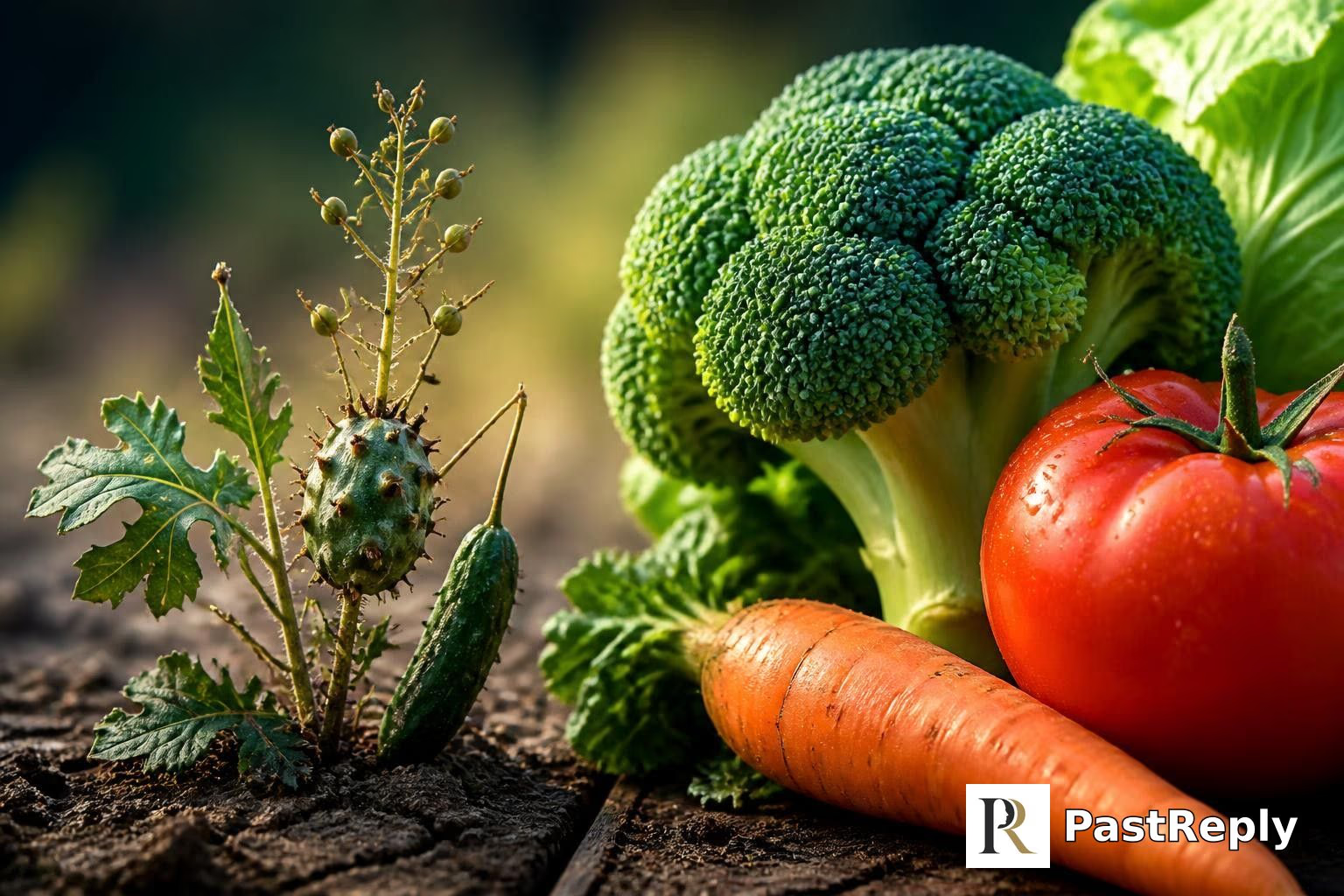
Before human cultivation, vegetables existed in their wild forms, which were often smaller, less fleshy, and more bitter or fibrous than modern varieties. Many had prominent seeds, thicker skins, or defensive compounds to deter pests. For example, wild carrots were thin, woody, and purple or white, while wild cabbage was a tough, leafy plant with no dense head. Wild tomatoes were tiny, like berries, and wild corn (teosinte) had small, hard kernels encased in a tough shell.
These ancestral plants evolved through natural selection to survive in their environments, not for human consumption. Traits like larger fruit, sweeter taste, and reduced seed size are the result of thousands of years of selective breeding by humans, who chose and propagated plants with desirable characteristics. This process, known as artificial selection, dramatically transformed vegetables into the forms we recognize today.
Answered by 100 of history's most famous minds

Before the sower's hand, the field bore thorns and thistles - yet even these the Father clothes. Consider the mustard seed, smallest of all, which becomes a shelter for the birds; so too these wild roots, unsightly and bitter, hold within them the promise of fullness, waiting for the gardener's patience and the soil's trust.

In the beginning, God created the earth and its fruits, each after its kind - and what grew wild was pleasing to Him, for it sustained the beasts and the patient folk who gathered it. It is not the form that purifies, but the thankfulness of the heart that receives it. When the hands of men shape the root to be sweeter, let them not forget that all increase comes from the Lord, and that the bitter herb, eaten with gratitude, is as acceptable as the finest feast.

These wild forms are but transient shells, impermanent and conditioned, like all things. The thin root and the bitter leaf teach us of dukkha - suffering born of craving. Yet, in this very impermanence lies the path: the gardener's mindful cultivation, free from attachment, transforms both the plant and the self, until the harvest is wisdom.

These wild plants, with their thorns and bitter taste, are a reminder of the ground the LORD cursed after our first disobedience - the earth that yields brambles and thistles to the sweat of our brow. Yet even in this, His mercy is shown, for we have been given wisdom to coax forth food from the reluctant soil. The wild carrot and the hard kernel of grain are but testimonies to the covenant: that through our labor and His blessing, we may eat and be satisfied. Let none boast of their taming, for it is the LORD who gives the increase.

It is wise to remember that these plants, in their wildness, were not deficient; they were simply fulfilling their own nature. Our cultivation is a form of ritual propriety, a rectification of names - we have brought them into a proper relationship with humanity. The true lesson is not in the wild root or the sweet fruit, but in the harmony we create through patient tending.

Consider the wild herb, bitter and small, yet it grew not for man but for God's own glory, a testament to His creation. We in our pride have bred it to fatness and sweetness, like the rich man who dines sumptuously while the poor Lazarus lies at his gate. But I tell you, the Kingdom is not of this earth's abundance; the true vine is Christ, and the fruit we must bear is love, not a swollen root.

In the dust of Ur, the wild herbs were thin and harsh, but the Lord said, 'Look to the stars - so shall your offspring be.' I trusted the promise, even when the land seemed barren. These humble roots are like my faith: small, overlooked, yet chosen to become a blessing for all generations.

Before the farmer's knife, the carrot was a root that knew how to hide, and the cabbage was a leaf that did not boast. We call it wild, but it was simply complete - small, bitter, and at peace with its own nature. Do not mourn the loss of their sharpness; the way of the Tao is to yield, and in yielding, they taught us to soften without losing our way.

Before the hands of the farmer, the carrot was a root that clung to the earth, and the cabbage was a leaf that asked for nothing but sun and rain. We call them wild, but they were honest - small, sharp, and true to the One who made them. Do not lift yourself above them, for our breeding is but a human art; the Creator's hand is in the seed, and our task is to share what the earth gives, not to hoard the sweetest for ourselves.

My son, the wild mustard that grew by our door was a scraggly bush, its leaves bitter as grief, its seed scattered to the wind. The Lord, who fills the hungry with good things, hid in that humble plant a secret abundance - a heart yet to be formed, a sweetness yet to be revealed. So it is with all the lowly: the hand that tends in patience, trusting the promise, brings forth a harvest the proud cannot imagine.

The wild cabbage is a picture of the Christian before the true faith: a straggling, bitter weed, no head, no substance, blown by every wind. The gardener - that is, the Word of God - cuts and grafts and prunes, and by grace alone brings forth a firm, sweet heart. But beware those who boast of their fine gardens, for the flesh is ever prone to itch after show; the root of faith is not in the showy leaf but in the hidden, unspectacular work of the Spirit.

The wild form of the vegetable is its nature in potency, and the cultivated form is that nature drawn to its completion by the art of the husbandman, who acts as a secondary cause under the First Cause. The carrot's thinness and bitterness are not defects but perfections of its own kind, suited to its end of survival; man, by rational selection, directs it to a new end, that of nourishment. Thus we see that a thing's perfection lies not in its appearance alone but in the ordering of its parts to its proper purpose, whether in the wild field or in the garden.

Before we loved them, they were small and bitter, their skins thick, their hearts hard - like the poor man shivering in the street, overlooked and unwanted. But our Lord gave us gentle hands to coax them, to water them with patience, and in that care, they unfolded into fullness. See how a vegetable becomes itself only when it is tended with love? So too, every soul, no matter how diminished, is waiting for a hand to draw it toward its true form. We are not called to harvest glory; we are called to be the gardener who kneels.

These wild forms are but nature's initial drafts, governed by the same immutable laws that order the heavens. As I deduced the force that guides the planets, so the cultivation that yields the plump root from the thin is no miracle, but the application of mechanical principles to organic matter - each generation a step in a chain of causes, designed by a Creator whose wisdom is manifest in every seed.

The wild carrot's woody root and the teosinte's brittle ear are not flaws but solutions - equations written in the language of survival. Each plant is a photon traveling its own geodesic through the curved spacetime of natural selection, and we, the breeders, merely chose the paths that led to our dinner table. What beauty, that the same laws that bend starlight also bent a bitter root into sweetness.

The wild carrot's fibrous root and the teosinte's armored kernel are beautiful adaptations to their own conditions - the bitter taste a defense against grazers, the hard shell a shelter for the seed. Natural variation, acted upon by human preference over countless generations, has sculpted these forms as surely as a finch's beak has been shaped over millennia. We have simply been the selecting agent, the invisible hand that chose the sweetest and the largest.

These wild forms are nature's own experiment - shaped not by any hand of man, but by the eternal laws of cause and effect. The thin root of the carrot, the tiny fruit of the tomato: these are the results of countless struggles for survival, each generation shaped by the environment, not by some hidden purpose. To understand them, one must measure, observe, and reason, not rely on the fables of old farmers or the dogmas of priests. The wild cabbage stands as a testament to what nature can wrought without our interference - and what we can achieve when we read her book with the instruments of science.

Consider the geometry of the thing. The wild forms, with their hard seeds and meager flesh, show the simple, unadorned order of nature. That we have, through our husbandry, drawn out a greater abundance - a more perfect circle of the meal - is not unlike my own modest work, revealing the elegant, Sun-centered simplicity beneath the apparent tangle. The cultivated vegetable, like the heliocentric cosmos, is a model of harmony, but the wild form reveals the underlying law.

Those wild forms were nature's raw current - unharnessed, potent, inefficient. A wild tomato, a berry no larger than a pea, held the latent energy of a great dynamo; we merely stepped in and directed that force to our own purposes, amplifying its flesh as I amplify a whisper into a roaring alternating current. But think, if we had continued for millennia, we might have trained plants to glow with light or gather power from the air itself - the potential was always there, waiting for a mind to see it.

The wild carrot, with its thin white root and bitter taste, was simply a product of its environment - no design, only necessity. Through patient observation and selection, we have coaxed it toward sweetness and size. This is the same quiet method I used in the laboratory: step by step, measure by measure, we turn the unremarkable into the remarkable.

I have spent my life in the laboratory, watching the invisible agents that spoil wine and sicken flocks, and I tell you this: the wild carrot was not a vegetable but a survivor, its thinness and bitterness a shield against the very microbes we now study. Human selection has been a form of domestication as deliberate as any inoculation - choosing the traits that served us, until the plant itself became a vessel for our needs. The question is not what they looked like, but what they were preparing for - and we, with our patience and method, have changed their destiny.

You want to know what they looked like? I'll tell you: they looked like problems waiting for a solution. The wild carrot was a skinny purple root - nothing to eat, nothing to sell - and the corn was a hard shell that cracked your teeth. But that's the beauty of it: every one of those plants was a challenge, and we took it on with sweat and trial and error until we got a carrot you can bite and corn you can boil. That's not luck - that's one percent inspiration and ninety-nine percent perspiration, and the harvest proves it.

Take a carrot: a thin, woody root, not the orange cylinder of the market. The question is not merely what it looked like but what computation - what selective algorithm - transformed it. Each generation, the human gardener acts as a sorting machine, discriminative over traits, amplifying sweetness, shrinking seeds, until the phenotype converges on a fixed point invisible to the wild. The wild form is not an error but an initial condition; the domestic is a program run for ten thousand years, with us as the central processor.

Consider the wild carrot: a root of slender measure, purplish, woody, fit only for the ass's tooth. We have, by the art of selection, drawn out its length and sweetness, as one draws a circle from a point with a compass. Yet the wild form holds the principle - the essence of the carrot - in its meanest state; the gardener's art is but the lever applied to nature's fulcrum, and with patience, he moves the root toward his desire. There is no miracle here, only geometry and time.

Ah, but consider the force at work! Before our hands intervened, a carrot was not a carrot but a slender, woody root clutching at the soil with all the tenacity of a wild creature. The wild tomato, no larger than a pebble, hoarded its sweetness behind a bitter wall, a defense against the nibbling world. That transformation - from tough to tender, bitter to sweet - is a living demonstration of unseen power: the steady, invisible pressure of selection, acting like a gentle field bending a needle, until the whole shape of the plant bends toward our will. It is not magic, but a law of nature, patiently obeyed.

Ask not how they looked, but why they looked that way. The wild carrot's bitter root, the tomato's tiny, toxic berry - these are not accidents of nature, but defenses, the vegetable's unconscious armor against a world that would devour it. And what do we do? We domesticate them, strip away their protections, breed them to be sweet and dependent, until they cannot survive without our constant care. It is a perfect metaphor for civilization itself: we tame the wild thing, and in doing so, we make it need us. The vegetable never forgot its primal fear - it merely learned to repress it, just like the rest of us.

Imagine a carrot as a thin, woody root, barely worth a rabbit's time, and a tomato the size of a pea - these were the humble ancestors of your supermarket aisle. Over millennia, humans acted as a slow, deliberate force of artificial selection, reshaping genetics as surely as gravity bends light, until the wild teosinte's hard kernels became plump, tender corn. It is a testament to the power of a persistent mind over indifferent nature - though, I must add, the universe itself finds the whole affair of little cosmic consequence. We are merely the universe's way of making slightly better snacks.

Before we wrote our intentions upon them, a carrot was but a thread of a root, and a cabbage a loose cluster of leaves - each a blank slate, a wild poem of possibility. Yet see how the human mind, armed with patient observation, acted as a calculating engine: it weighed each seed, measured each season, and kept only what served its design, until the plant's very structure became a code we had inscribed. This is not a mere history of food; it is the first algorithm of agriculture, a proof that nature's variables can be manipulated toward a chosen result. The wild form was but the initial condition - we are the function that transformed it.

Define your terms, and the matter becomes plain. A wild carrot is a root that has not yet been subject to a plan; it is as nature left it, governed by chance and necessity. But we, as geometers of the garden, have drawn a line through that chaos: we take two points - the plant as it is, and the plant as we wish it to be - and we select, season after season, the seed that approaches the latter. This is a proof by construction, demonstrating that the forms of living things are not fixed but may be derived from a few simple acts of choice. The wild state is but the first premise; the cultivated vegetable is the theorem we have demonstrated.

Had we kept the physiological records of these plants, we would have seen in their thin skins and sparse flesh the hard statistical truth: they were designed for survival, not for the nourishment of man. But we, with our hospitals and our hygiene, must apply the same rigorous logic - measure, compare, and select - as the gardener does. Let us breed out the bitterness and the fiber, not by blind habit, but by careful observation, and we shall feed the sick and the poor as surely as we heal them.

Wild carrots? Thin, purple twigs fit only for a Persian's contempt! Had I marched east and found such fare, I'd have deemed it a conquered land unworthy of tribute. Yet see - what nature left mean and bitter, a conqueror's will, whether mine or the farmer's, has bent to glory. The sword and the ploughshare both reshape the world; the root that yields is one that bows to mastery.

Before our legions marched, the cabbage was a ragged foot-soldier, thin and tough, with no head to command. It took the hand of Rome - and other cultivators - to forge from that rabble a disciplined formation, a dense orb of leaves. I know the art of turning wild tribes into a single, formidable power; the vegetable is no different.

Before the gardeners of the Nile took up their hoes, these plants were wild beasts of the field - thin roots, bitter leaves, and fruits no larger than a scarab beetle. It was the hand of the cultivator, guided by the gods, that tamed them into abundance. Even as I speak, the Roman palate craves our sweet melons and lentils; they know not that their conquests feed on the labor of our fields, not the wildness of the earth.

In the beginning, these plants were like unruly provinces - wild, unprofitable, and fit only for the foraging of beasts. But through the steady hand of cultivation, we have made them yield their riches, much as we have brought order to the nations. The wild teosinte's hard kernels are the barbarians of the field; our grain is the civilized citizen, nourishing the legions that guard the peace. Let us not romanticize the wild, for it is only through discipline and the patient governance of our forebears that the earth herself was brought to heel.

Before our ancestors bent them to our will, they were small and weak, fit only for the grazing of goats. A strong man does not lament the weakness of a wild root; he takes it, and by his discipline and the work of his people, he makes it useful and strong for the clan. This is the way of the world - what is not conquered is lost. We conquered the earth, and we conquered the seed, and now all men eat well.

Nature in its primeval state is a chaos of thin roots and bitter leaves - an unruly rabble that knows no discipline. It required a hand of order, a will to conquer, to transform these wild brutes into a bountiful harvest. I see myself in that gardener: I took a fractured nation and made it a granary. Cultivation is a campaign, and every carrot a soldier enlisted for glory.

Before the farmer's hand, these plants were mere survivors, fit for the wild but unworthy of the table. It took discipline, patience, and a steady purpose to cultivate them into something nourishing. So too must a new republic be tended - with moderation and resolve - lest it wither back into a bitter and thorny wilderness.

I have seen the prairie grasses bend in the wind, and I reckon that wild cabbage was much like the untamed land - hardy, scraggly, and askin' for no one's favor. The tomato was a berry fit for a bird, and the corn was a few hard kernels in a shell, like a man's first rough-hewn cabin before the frame is true. We took what nature gave us, and with the slow work of generations, we shaped it into bread and bounty - a fair reminder that even the humblest root can be raised to serve a greater purpose.

I have stared down the dark days when the world seemed lost, and I tell you that the wild cabbage was no more a vegetable than a rebellious colony is a settled dominion - it was a tough, wiry plant that defied the plate. But we, with the patient might of our gardeners, waged a campaign upon it, and in the end, we raised not a leafy rabble but a noble head of cabbage, fit for the dinner table of a free people. So let the wild tomato cling to its tiny pride; we have won the battle for the bountiful harvest, and we shall not surrender it.

I see in that wild teosinte, with its few hard kernels, a lesson in simplicity and truth. We have, through our greed, fattened the ear until it bursts with abundance, yet we have lost the restraint of nature. The wild vegetable asks for nothing; the cultivated demands ever more water, ever more soil, ever more of the earth's bounty. Our true aim should be to live as the wild does - yielding enough, not plundering all.

That wild cabbage, tough and undomesticated, speaks to me of a people before their liberation: deprived of the nurture that would allow them to form a head, scattered and bitter from the soil of oppression. The hands that selected and bred were hands of hope, believing that the arc of the garden bends toward fruitfulness and beauty. We, who are the gardeners of justice, must likewise choose and cultivate the seeds of a beloved community, until every plant stands tall in the sun.

Long before we claimed them as our own, these plants belonged to themselves - small, scattered, and resilient, shaped by the land that gave them life. They did not ask to be tamed, yet our ancestors, over countless seasons, chose the stronger seed and the sweeter fruit, and in that choosing, we formed a bond. It is a quiet lesson in patience: that even the wildest thing can be drawn toward peace, not by force, but by a thousand small and persistent acts of care. We made them what we wanted, and in return, they sustained us - a covenant written not in words, but in the very shape of our daily bread.

The wild forms were weak, scattered, and unworthy of man's table - thin, bitter roots and stunted berries that offered nothing. It was only through deliberate, disciplined breeding that the strong, the pure, the abundant forms emerged, shaped by the will to improve nature's raw material. This is the destiny of all things: the weak must be transformed or discarded, and the strong must be cultivated toward their highest potential. So it was with the vegetable, and so it must be with the peoples of the earth - a law of improvement that admits no sentiment.

In their wild state, these plants were a chaos of useless traits - small, bitter, hardy enough to survive on their own but offering nothing to the collective. They had to be taken in hand, broken to the plow, their stubborn survival instincts beaten out of them through generations of remorseless selection. Only by subordinating every seed to the plan of the state could the weak, scattered wild forms be forged into the abundant crops that feed a nation. Nature is not to be tolerated; it is to be conquered.

The wild vegetable is a perfect image of the peasant economy: scattered, self-sufficient, stubbornly resistant to change, and producing only enough for its own survival. It took a long, deliberate struggle - generation after generation of selecting the most productive seed, crushing the useless variants - to transform that backward root into a staple that could feed the masses. History does not move by gentle persuasion; it moves by the sharp edge of necessity, weeding out the weak forms to cultivate the strong. So too must we treat the old order: not with sentiment, but with the ruthless logic of improvement.

Before the hoe of man touched the soil, the wild carrot was a thin white root, and the cabbage was a scattered weed - no head to speak of, bitter to the tongue. But the peasant's hand, generation upon generation, bent these plants to our will, just as we bend the world to the revolution. Nature is not sacred; it is raw material, and the people, with their labor and their struggle, will remake it into abundance.

One must suppose the Creator, in His infinite wisdom, saw fit to make wild vegetables humble and unassuming - fit for the soil, not for the table of a civilized nation. It is the hand of the British gardener that has given us the plump pea and the firm potato, reflecting our national industry and taste for order. Truly, we have improved upon the wild, as we have improved upon the savage, bringing them under the gentle dominion of cultivation.

My grandfather's gardeners told me that the wild carrot was a straggly thing, purple and woody, not at all like what we serve at table today. It is a quiet reminder that patient, steady effort - season after season - can transform the humblest beginnings into something wholesome. We owe much to those who came before us, both in the garden and in the palace, and it is our duty to tend what we have been given.

By the grace of God, Adam was given dominion over the herbs of the field, and it is our sacred duty to cultivate them as we cultivate the souls of our people. The wild mustard and the bitter root are the raw clay of the Almighty, awaiting the hand of the faithful farmer to shape them into nourishment for Christendom. Let us, then, plant and prune with the same zeal we bring to the building of churches and the codifying of laws.

In my village, the cabbages were small and hard, and we ate them out of necessity, not delight. But I have seen how a maiden's prayer and a soldier's faith can move mountains - how much more can they transform a lowly seed? The Lord gives us the wild thing, and He gives us hands to coax it to fullness, just as He gave me my banner and my sword to free our France.

The wild tomato, a berry no bigger than a marigold, might have been a jest of nature - but I, for one, do not wish to dine on a jest. Let my gardeners breed the sweet and the ripe, for what is a kingdom without a well-kept orchard? We prune and graft as we govern: with patience, with cunning, and with an eye to the harvest that will feed the commonwealth.

Before Peter brought his reforms, Russia was a wild garden, rough and unyielding, much like those wild roots you speak of. But I have seen what enlightened cultivation can do - the carrot becomes sweet, the cabbage forms a head, and the peasant learns to read. Let us not lament the rough beginnings; let us instead celebrate the art of improvement, which is the true mark of civilization.

In the lands I govern, a man does not ask how a fruit looked before the farmer's hand; he asks how the farmer may be made to prosper, that the fruit may feed his children. The wild plant is the gift of the earth, and we honor it by tending it with justice, not by despising its humble roots. So may a ruler honor his peoples - by nurturing what is wild and weak until it bears good fruit for all.

The wild cabbage is a testament to Allah's creation - hard and bitter, yet full of life, awaiting the hand that waters it. As a soldier, I have seen how a small seed can grow into a mighty tree, and how a scattered people can be united under one banner. So we must be patient with the raw and the rough, for with care and generosity, even the bitter root may become a sweet dish upon our table.

You ask what the vegetable was before human hands, but have you asked what you are before you examine yourself? This wild root, small and bitter, is a fitting mirror - unadorned, it reveals its true nature. The plumpness we prize may be a lie we have bred for comfort. Tell me, friend, is the sweeter fruit more virtuous, or merely more pleasing to our taste? Know thyself, and the root will teach you.

The wild tomato, a tiny berry, is but a shadow of the Form 'Tomato' that exists eternally in the intelligible realm. Our cultivated kinds approach that ideal, yet even they are mere copies. The true essence lies beyond the cave's wall, and the husk of the wild plant is but a flicker of the perfection our reason can grasp.

These wild forms reveal nature's purposive ends - each plant that survives does so by its own excellence, be it swiftness of seed or bitterness of leaf. The turnip's thick root stores sustenance; the cabbage's loose leaves resist the ravages of frost. Human artifice, through selection, has redirected these ends toward our own nourishment, yet the essence of each lies not in its size but in its function. To know the vegetable truly, observe its wild ancestor and the causes that shaped it.

Before the hand of man, these plants were not 'vegetables' at all, but merely beings of nature, governed by the law of their own survival. The transformation we see is not a product of chance, but a testament to the rational will, which, in its autonomous freedom, imposes a purpose upon the natural world. We must ask, then, not what they were, but what we have made of them - for in cultivating them, we have cultivated our own moral and rational nature.

You call them 'vegetables' and pity their small, bitter forms, but I tell you they were honest. They did not pretend to be sweet or fat; they were tough, resilient, and true to their own will to power, fighting off pests with their bitter defenses. Then came man, the great tamer, breeding the wildness out of them, making them soft and accommodating. And you ask, 'How did they look?' They looked like they had a spine. Now they are mere slaves to our palate.

These wild vegetables were, in their natural state, free - they grew for themselves, not for profit. But human hands seized them, made them commodities, bred their flesh to feed the market, alienating them from their own wild essence. The garden is a factory, the farmer a capitalist, and the modern carrot is but a wage-slave, swollen and sweet for the master's table, its bitter heritage crushed by the wheel of production.

What appears as a carrot's 'nature' is merely an accident of circumstance - thin, fibrous, bitter. Only through deliberate, rational selection have we reshaped it to our ends. The senses deceive; the mind must discern the underlying order. So let us not marvel at the transformation, but at the power of clear thinking to command nature itself.

You speak of wild vegetables as if they were innocent, but consider the matter as a prince would: the thin root and bitter leaf were not flaws but defenses, a strategy for survival in a world that wanted to consume them. Human cultivation is the art of force - we bent these plants to our will, selecting the weak and succulent over the strong and sour, like a ruler who turns a rival's fortress into a granary. Do not weep for the wild carrot; it lost the battle, but we won the war, and the table is richer for it.

Nature's first draft was a roughhewn player - the cabbage, a leafy rogue with no head to crown him, the tomato, a berry-boy too small for the stage. But time, that patient prompter, whispered to the gardener, and lo, the wild was pruned into a proper lord, sweet and swollen, yet beneath the mask the bitter blood still runs. All the world's a garden, and the plants are merely players, strutting from wildness to our table in an hour.

In the age before the heroes, the carrot was a thin, dark root, bitter as the tears of a scorned nymph, and the cabbage was a tough shield unworthy of a Myrmidon's hand. Only with the toil of countless seasons did men coax from the earth a sweeter prize, much as the gods temper a man's spirit through trials. Even the lowly vegetable has its own odyssey.

In the primal garden, before the fall of man, the earth yielded fruits without toil - but these wild roots and bitter herbs are the blighted remnants of that grace, withered by sin. As we wandered from the divine order, so did the plants turn from us, hiding their sweetness behind thick skins and thorny defenses. Only through the labor of generations, guided by God's providence, have we reclaimed a semblance of that lost bounty. Yet even now, the wild carrot's white root whispers of a world estranged from its Maker.

A wild carrot, thin and pale, seems a meager thing, yet it holds the entire story of transformation within its fibrous root. It is not a tale of lack, but of potential - a striving toward form that we, with our careful hands, have guided into fuller being. I see in every cultivar a dialogue between the plant's inner drive and our own shaping spirit, a living testament to the ceaseless metamorphosis of nature and spirit alike.

Ah, my dear reader, you ask of the carrot's lineage before the gardener's hand. I see it as a tale of noble savagery: the wild root, thin and bitter as a rival's verse, yet it stood its ground, armored in purple and white. It was a knight-errant of the soil, unkempt and free, until human fancy tamed it into a courtier. And now we prefer the pale, sweet thing to the hardy rebel - verily, we have made a Dulcinea of a field hand.

In the wild, the cabbage was a simple being, true to its nature, not puffed up with human pride. We have taken it and forced it into a dense, unnatural head, seeking abundance and comfort, yet we have lost the soul of the plant. Every man must ask: do I strive for greatness of the spirit, or do I, like the breeder, fatten my own flesh with vanities? The wild carrot teaches us humility; the garden carrot, only our greed.

These wild roots, small and bitter, remind me of the soul before grace - twisted by necessity, full of struggle. But look what human hands, guided by desire, have made of them: plump, sweet, beloved. Yet I wonder - in our reshaping, have we lost something essential? Perhaps the bitter root knows its own truth better than our polished produce ever will.

I confess I find a certain melancholy in the thought of the wild cabbage - a plant of no consequence, leafy and tough, with not a hint of the elegant head it would one day become. But is it not the same with people? Young ladies are scolded for their wildness until marriage tames them into usefulness, and yet we hold that improvement dear. The carrot, thin and purple, was like a country miss before she learns to dress for the assembly - and how fortunate we are that a gardener's eye saw her potential.

Before the gardener's hand, your cabbage was a ragged beggar in rags, all leaf and no heart, and the carrot a scrawny, purple stick fit only to scrub a pot. Nature, the miser, hoards her sweetness in thorns and bitterness; it is the slow, patient charity of the ploughman that has turned her penny-pinching weeds into a feast. A lesson, that: the meanest wild thing, tended with kindness, becomes a lord's dinner - yet the proudest weed, left to itself, only chokes the field.

Why, before we got our hands on them, a carrot was a skinny white root with all the charm of a broomstick, and a tomato was a berry the size of a marble that a bird would pass on. We've spent centuries coaxing and cosseting these vegetables, and what have we got? A cabbage with a head as big as a baby's, and a tomato that tastes like water with a red coat on. I suspect the wild ones laughed at them - they were honest, at least, in their bitterness.

The wild tomato was a berry, small and sour, and a bird ate it and dropped the seed, and that was that. We took it and bred it fat and sweet, and now the taste is gone, and the vine is a slave that must be staked and watered. The wild one had the truth of itself - it needed no man. We have made it dependent, like most things we touch. There's no pity in it, just the way it is.

Observe the wild teosinte, its kernels hard as flint, cased in shells that mock the eater. Yet in its form I see nature's own design - a masterpiece of survival, each husk a shield, each seed a promise. The hand of man, guided by the eye, has drawn forth what was latent: the plump ear, the tender leaf. It is not that nature erred, but that she writes her first drafts in patience, and we, her pupils, have learned to read and revise.

In the raw marble of the wild, the carrot was a slender, twisted form, and the cabbage a rough leaf - but the sculptor's eye could see the perfect dome and the crisp stalk imprisoned within. So too did the divine hand shape these humble beginnings, and our garden is but the chisel that reveals the hidden ideal.

Imagine the wild tomato, a berry no bigger than a teardrop, holding the fire of the sun in its skin - yet hard and bitter to the tongue. It was not made for us, but for the birds and the rain, and that is its own fierce beauty. When I paint a sunflower, I do not paint the seed we plant, but the longing in its stem reaching toward the light. Those wild forms, too, had their own soul - a wild, unbidden cry of life that we have shaped, but never truly tamed.

Who says a tomato must be a heavy, red orb? The original was a tiny, bitter berry - a true Cubist object, broken into facets of seed and skin, defying any single perspective. We have merely chosen one view of it, and called it truth. The wild forms are the real art - full of sharp angles and unexpected textures - before our dreary insistence on the round and the sweet.

I see them not as forms but as moments of light, caught in the dew of a morning before man's touch. The wild tomato, a tiny orb of vermilion, shimmering like a drop of water on a leaf - it had its own fleeting beauty, its own atmosphere. We have thickened their flesh and dulled their hues for our appetite, but in that first wild blush, there was a truth of light I would have painted forever.

Ah, the wild forms - before the gardener's hand - were humble things, thin and tough, bitter as a miser's heart. Yet in their knotted roots and spiny leaves I see the same stubborn dignity I paint on an old woman's face: life unadorned, patient, waiting for the light to find it.

Wild carrots, thin and purple, are like my own spine - crooked, aching, but fierce. They didn't need us to be beautiful; they had their own raw truth. But humans, greedy for comfort, bent them to our taste. I say let them be bitter - pain is a fine color, and the wild ones are the ones that bleed real.

Ha! The wild carrot, thin and purple - a mere whistle in the orchestra of the garden! Before man took up the baton, these vegetables played a rustic tune, bitter and off-key. But we, the composers of the field, have arranged them into a sweet symphony - the tomato, once a sour berry, now a full chord upon the tongue. Nature gave the theme; we gave the variation, and what a delightful allegro we have made!

The wild corn, with its hard shell and scant kernels, is a bass note of struggle, a motif of adversity that nature plays relentlessly. But humanity, with its defiant will, has composed a symphony of abundance from that humble theme. Let this be a lesson: the spirit can transform the meanest material into a paean of joy, just as I turned silence into celestial chords.

In the beginning, the Creator's hand gave each plant its own voice, and the wild carrot or the tough cabbage sang a single, clear note in the great fugue of nature. Through the centuries, we have added our own variations - selecting this sweeter note, damping that harsh one - until the melody grows richer and more ordered. Yet the original theme remains, hidden beneath our embellishments, and it is our duty to cultivate with reverence, never forgetting that even the humblest root is a part of the divine harmony.

Well, bless their hearts, they were just plain as could be - thin and tough and bitter, singing their own little tune out in the wild. But we took those rough, wild notes and we worked with 'em, like layering gospel and blues until you get a new sound. Now we got sweet corn and big, round tomatoes, a whole chorus of flavors. It's a kind of growth, just like anything else, I reckon.

It's like… a child's dream before the world told it to grow up. Wild cabbage, all leaves and no heart, like a song without a melody yet - wild corn, hard little kernels in a shell, like a beat waiting to be set free. We took that raw nature, that pure rhythm, and we shaped it into something that could feed the world, make it dance. It's beautiful, really - how love can transform anything.

Before we came along, veggies were proper scruffs - skinny, gnarly, proper rock 'n' roll bad lads. Then we came in, all peace and love, gave 'em a trim, a bit of shaping, and next thing you know they're clean-shaven pop stars in the supermarket aisle. Fab, mate, absolutely fab.

You ask what the carrot was before the hand reached down - thin, purple, a root with a grudge. The wild tomato was a berry no one sang about, and the corn was a hard shell hiding its kernel like a secret. We tamed them, but they still remember the open road. The garden is just a song we wrote over their silence.

I think about the wild tomato, this tiny berry, and I see a story about owning your own narrative. Nature gave it a tough shell and a bitter taste, but humans came along and said, 'We see something more in you,' and over generations, we rewrote that story into something sweet and bold. It's like when you take the version of yourself that was small and guarded and turn it into something you're proud to put on the table. The wild versions weren't wrong - they were just waiting for someone to believe in them.

I sailed west and found lands richer than any root - yet mark this: the wild plants I saw were like the natives, unadorned, living in a state of nature, without the refinements of Christendom. But as I brought the faith and the flag, so the husbandman brings the plough, transforming the bitter herb into a nourishment for civilized men. It is God's will that we tame the wild, whether of soil or of soul, and raise it toward glory.

In the distant lands of Cathay, I saw gardens where the carrots grew thick as a merchant's arm and sweet as honey, but the natives told me of the old times, when these roots were thin and bitter, fit only for beasts. It is like the tale of the great Khan's orchards, where the peach was once a small, sour fruit until wise men tended it for a thousand years. All things change under the hand of man, and the journey from wild to tame is longer than the Silk Road itself.

These wild plants were like uncharted seas - full of hidden perils and unknown qualities, yet holding the promise of nourishment if one dared to explore. The wild carrot's woody root was a treacherous passage, but we have charted it with the patient selection of countless harvests, turning it into a safe harbor for the palate. To face the unknown, whether a bitter root or an endless ocean, is to trust in one's course and press on despite the gales. So too did we sail the fields of the New World, bringing back strange fruits to be tamed by our own hands.

It's a story of a different kind of engineering. The wild forms were optimized for their own environment - to survive, to reproduce, to defend. We came along with a new set of requirements: taste, size, ease of harvest. So we altered their trajectory over centuries, a slow and deliberate program of change. The result is a system that serves our needs, but it's worth remembering the original design brief.

I think of them as the true pioneers - those wild plants, scrappy and tough, surviving on their own grit, no help from anyone. A wild carrot, thin and woody, was the Amelia Earhart of the vegetable world: it didn't ask permission, it just grew. We've turned them into comfortable, dependent things, but I say there's still a dash of that wild spirit in every seed - it just needs a chance to soar.

From up in my Vostok, I could see the whole Earth - green, blue, so beautiful - but not one single carrot. Down there, before our farming, they were wiry little roots fighting for a patch of soil, like cosmonauts of the ground. We gave them a helping hand, a bit of gravity, and now they're round and sweet - a small triumph for all mankind.

Think of it - teosinte, a hard, shelled grass, evolved for nothing but its own survival. Then humans came along and saw not what it was, but what it could become. That's the essence of creation: not accepting nature's default, but refining it into something simple, beautiful, and useful. Wild cabbage was a mess of leaves; we gave it a head. The lesson for any maker: don't settle for the bitter and fibrous. Cultivate the vision, and you'll feed the world.

It's simple: wild plants optimized for survival, not for taste or yield. Teosinte, the ancestor of corn, was basically a grass with hard, inedible seeds - a biological dead end for hungry humans. But we used selective breeding, a kind of ancient genetic engineering, to turn it into a crop that feeds billions. First principles: if nature gives you a bitter root, hack it until it's a carrot.

Isn't it amazing to think that every carrot in your fridge has a story - a wild ancestor that was tough, bitter, and not much to look at? That's the power of intention and care, just like in our own lives. Those early plants survived by their grit, and then we came along and said, 'You can be more.' That's a lesson for all of us: we start wild and raw, and with a little nurturing, we grow into something beautiful. So the next time you bite into a sweet, juicy tomato, remember - you're tasting the result of patience, love, and a whole lot of belief in what something could become.

They were the original underdogs, the little guys with the hard outer shells and the bitter taste, just trying to survive in a tough world. But we came in with the art of selection, we trained them like champions, made them bigger, sweeter, more beautiful. I see a little of myself in that - taking what I was given and making it great. I'm the greatest, and so is my corn.

Ah, my friend, before humans, the tomato was like a small ball, not ready for the World Cup! It had no flavor, no strength, like a player who has not trained. Wild cabbage was all leaves, no heart, no goal. But we, we trained them, we passed them the ball, and they became champions - full of vitality, feeding millions. That is the beautiful game of life: with care, anything can become great.

Imagine a pumpkin patch left to the wild - shriveled, bitter, just a whisper of what it could be. But with a little imagination, a lot of dreaming, and a pinch of patience, we turned those humble sprigs into the stars of the show. It's the same magic we use in our cartoons - give the world a spark, and watch it bloom.