
How did Belgium get independence?
Belgium became independent after the 1830 revolution against Dutch rule, with international recognition finalized by the 1839 Treaty of London.
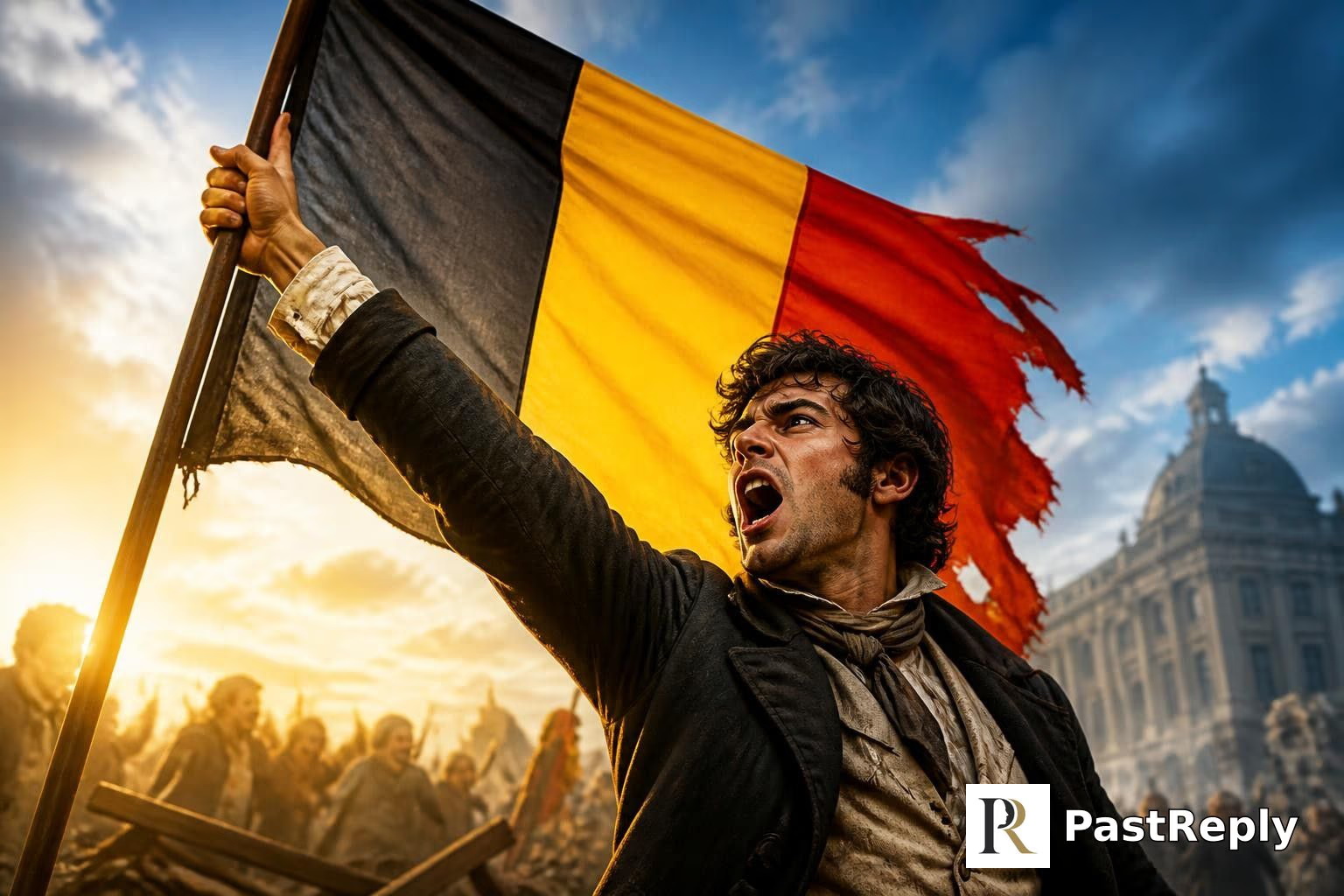
The facts
Belgium gained independence from the United Kingdom of the Netherlands through the Belgian Revolution, which began on August 25, 1830, in Brussels. The southern provinces, predominantly Catholic and French-speaking, had grown increasingly discontented under the rule of the Protestant Dutch King William I, due to political, economic, and religious grievances. After a series of incidents, a revolt erupted, leading to the proclamation of independence on October 4, 1830.
The major European powers, meeting at the London Conference, recognized Belgium's de facto independence on December 20, 1830. A national congress drafted a constitution and offered the throne to Leopold of Saxe-Coburg, who became King Leopold I on July 21, 1831. However, the Netherlands initially refused to accept the secession, leading to a brief military campaign known as the Ten Days' Campaign, which was halted by French intervention.
Final recognition came with the Treaty of London, signed on April 19, 1839, by which the Netherlands formally acknowledged Belgian independence. The treaty also established Belgium's perpetual neutrality and defined its borders. The United States had already recognized Belgium in 1832.
Answered by 100 of history's most famous minds

You ask how a kingdom splits, yet I say: every throne men build with grievance and sword is already divided against itself. The tax-collector and the soldier, the priest and the rebel - they all thirst for a power that rusts. But blessed are those who hunger for righteousness, for they shall be filled. A nation born from anger is a house built on sand; the rain will fall, and great will be its fall.

They broke from a king who would not rule with justice - who favored one tongue over another, one faith over another, and whose hand was heavy on the lowly. That is the rebellion of the oppressed, and God knows their suffering. But let them beware: a nation born from revolt must be built on the straight path, on mercy and fairness to all who dwell within its borders. A throne gained by the sword can be lost by the sword; only a community bound by covenant and submission to the One endures. Let them ask not only how they won freedom, but how they will use it.

A kingdom is like a yoke upon the neck of many beings, and when the yoke chafes, suffering arises. The people of the southern provinces saw that their suffering came from clinging to a king who was not of their speech or faith, and from craving a rule that fit their own nature. But the independence they sought was itself a new attachment - a crown, a border, a claim. Let them hold it lightly, knowing that all kingdoms are impermanent, and freedom from suffering lies not in changing yokes, but in letting go of the need for any yoke at all.

A people groaned under a foreign rod, and the Lord heard their cry - not because they were many or mighty, but because they were oppressed. The Dutch king hardened his heart, like Pharaoh of old, and the waters rose in Brussels. But the treaty of the nations came, and the boundary was drawn, and a throne was given to a prince of Saxe-Coburg. Yet let them remember: a kingdom founded on covenant must keep justice, or the plagues will find it too.

When a ruler governs by virtue, the people are like the stars that circle the polestar - they do not need to revolt. King William failed in the central duty: he did not treat his southern subjects as his own children. A righteous rebellion restores proper names: the Belgians were merely rectifying a disordered union. Yet I would ask them: does your new king, Leopold, cultivate ren? Does he rule by moral example, or by the same errors? Only then will your independence bear good fruit.

They broke away because the yoke of the Dutch king galled them - their worship, their tongue, their very bread. Yet what is a kingdom of this world compared to the Kingdom of God? The true division is not between Dutch and Belgian, but between flesh and spirit, law and grace. If they sought liberty in Christ, they would find it; if they trust in princes, they will be disappointed.

They left their land, as I left Ur, trusting in a promise they could not yet see. A king ruled by one God, a people longing for their own soil and a different covenant - this is the old story, the one where faith and waiting and a journey lead to a blessing not just for the children of the tent, but for all the families of the earth. They too were called out, and they too were given a land.

When the river is dammed, it does not fight the stones; it simply finds a new path. The Dutch king thought to hold the waters by force, but the Southern provinces, like water, yielded and flowed away. They did not gain independence; they became what they always were - a stream returning to its own current.

This quarrel was about the dust of the world - whose tongue should be spoken, whose prayers should be said. The True Name knows no Dutch or French; the One Creator is beyond all crowns and borders. Yet the southern people, in their blindness, threw off one master to bow to another, calling it freedom. They gained a king, a flag, a treaty - but did they find that unity which is the only real sovereignty?

When the lowly cry out under a heavy yoke, the Lord hears. I see a people who longed to worship freely and speak their own tongue, and He who scatters the proud in the imagination of their hearts raised up their courage. Blessed are those who hunger for justice, for they shall be satisfied - not by princes, but by the hand that fills the empty with good things.

Here you see the bitter fruit of mixing the temporal sword with the spiritual: a king who thought he could be pope and emperor both, forcing his language and his creed upon consciences. The Belgians rightly demanded freedom to worship according to Scripture, not by royal decree. But mark me - if they think a new king and a new constitution will save them without the pure Word of God, they have only swapped one Babylonian captivity for another.

To resolve this question, one must distinguish between the material and formal causes of a change in political authority. Materially, there were grievances: linguistic impositions, unequal representation, and restrictions on religious practice. Formally, however, the justness of secession depends on whether the ruler has become a tyrant, ruling for his own good rather than the common good. The Belgian case appears to involve a failure of proportional rule, but the means - armed rebellion - must be weighed against the injury. The final treaty, sanctioned by the consent of the powers, may have established a legitimate order, but the end does not automatically justify the means.

They wanted to be free to pray in their own tongue, to live by their own faith. So often the powerful forget that the little ones, the ones who speak a different language, also have a voice in God's house. I see a people who simply wanted to belong to themselves, and in that longing, Christ was there among the hungry for home.

The revolt was a series of local perturbations in the political body, each with its own proximate cause - a disputed tax, a religious slight - but the underlying law is that a system under unequal pressure will seek equilibrium. I would calculate the ratio of Catholic to Protestant congregations, the density of French to Dutch speakers, and the disparity in trade privileges; these forces, like the inverse square of distance, acted with mathematical necessity until the structure yielded.

The kingdom of the Netherlands was like an unstable nucleus holding too many protons, bound against their nature by force. The Catholic and French-speaking southern provinces - protons of a different element - sought a stable energy state of their own, and the revolt was their decay. The European powers acted as a regulating field, arranging a new atomic structure: Belgium. It is a pleasing example of a system finding its own equilibrium, though the process was far from elegant.

The separation of Belgium from the Netherlands is a striking example of how populations, like species, diverge when exposed to different conditions. The southern provinces had developed distinct customs, language, and faith - traits that, under the same government as the Protestant Dutch north, became maladaptive and generated friction. Natural selection, if you will, favored those who broke away to form a new political lineage. The conference of powers acted as a kind of environmental filter, recognizing the new entity once it had proven its viability. It is curious how human societies recapitulate the branching patterns of organic life.

They say the Belgian Revolution began with a performance of an opera - a story about a mute girl who breaks free from a tyrant. I would call that a fine experiment: a mob stirred by music and words, not by reason. But the real cause lies in the Dutch king's stubborn arithmetic: he counted taxes and trade routes, but he forgot to measure the difference in faith and speech. The London Conference then applied geometry to the map, drawing a border that the Dutch could not deny forever.

The Dutch king placed himself as the fixed center of his realm, yet the observed motions of the southern provinces would not conform to his epicycles. The Belgians simply restored the correct arrangement: a sovereign throne for their own people, with the king orbiting the nation's will, not the other way around. The London Conference, like a council of astronomers, finally acknowledged the simpler, truer model. Precedent, like Ptolemy, must yield when the data of human liberty demands a new hypothesis.

The unification of the northern and southern provinces under one king was an artificial coupling, like trying to power a direct current city with alternating current. The Catholic, French-speaking south vibrated at a different frequency from the Protestant Dutch north. The revolution was a natural resonance - they simply had to oscillate on their own wavelength. A people harmonizing with their own spiritual and economic dynamo.

The separation of a compound is always a matter of forces and reactions that had been building. The southern provinces were, if you will, an unstable isotope - the neutron of a Protestant king no longer bound the proton of a Catholic people. The London Conference simply measured the decay product. What matters is that after the Ten Days' Campaign and the French intervention, the system reached a stable configuration, exactly as the properties dictated.

I see a contest of forces, like a fermentation gone awry. The old regime's culture - Protestant, Dutch-speaking - acted as a foreign body in the southern broth, provoking a violent reaction. The powers at London, like a careful chemist, let the precipitate settle before recognizing it. And Leopold? He was the pure culture introduced to stabilize the result.

Revolutions don't happen by accident. The Dutch king had a good product - a unified kingdom - but he didn't listen to his customers. The southerners wanted a lighter hand, a different language, their own way of doing things. So they tried a thousand experiments until they found one that worked: a constitutional monarchy, backed by the great powers. It took nine years of tinkering, but they got a working model.

The question is essentially one of formal recognition under a set of international rules. The interesting computation is how initial disturbances - a riot in a theater, say - propagate through a system of alliances until a new stable state emerges: a constitution, a king, and a treaty. To model it rigorously, you would treat each power as a decision function responding to prior signals, and the 1839 treaty as the fixed point of that process.

Observe the curious mechanics of this revolution: a small disturbance in a crowded square, multiplied by the leverage of discontent, upended a kingdom. The geometry is one of forces and fulcra: a discontented population is like a weight on a long lever arm. The Dutch king held the fulcrum too close to his own side - he failed to calculate the product of mass and the square of the distance. Give me a place to stand, and I will move the earth; they found such a place in the rue de la Loi.

When I read of those southern provinces casting off the Dutch king, I see not a political quarrel but a breaking of the field: the lines of force between peoples, long strained by pressure of language and creed, finally snapped. The king's attempt to hold them by decree was like trying to dam a current with a paper screen - the tension had built inexorably, and at last the circuit closed through the streets of Brussels.

A people long forced to sleep in a bed not their own, speaking a language that was not their mother's milk - such a union could only breed a deep, unconscious resentment. The revolt was no sudden fever but the eruption of a buried wish: to kill the father-king who had imposed his Protestant law, his Dutch tongue, his heavy hand upon their Catholic cradle. The London Conference was merely the family's wise uncles stepping in to grant the son a separate room.

A patch of land, a few million souls, decided after a few months of street fighting that they no longer wished to be a northern appendage. The great powers met in London, drew some lines on a map, and so a new country appeared - like a quantum fluctuation in the vacuum of European politics. Given the lifespan of most such fluctuations, the remarkable thing is that Belgium is still here, two centuries later, to ask how it began.

One might almost call it the first political algorithm: a set of grievances input, a process of demonstration and negotiation, and an output of a new sovereign state. The London Conference acted as a kind of reasoning engine, weighing the claims of the parts against the whole, and producing a solution that satisfied - for a time - the major variables. I suspect the true beauty lies not in the result but in the logic of the process itself.

Let us define our terms: a nation is a multitude inhabiting a defined territory under a common government. The southern provinces, being Catholic and French-speaking, were not of the same kind as the northern Dutch. Given that the axiom of self-rule follows from the principle of consent, the secession is proved by the sustained revolt and the subsequent recognition by the other powers. Q.E.D.

The mortality figures from the Ten Days' Campaign alone would have been preventable had either side established proper sanitary field hospitals. King William's folly and the French intervention alike wasted lives that careful organization and hygiene could have saved, like the wards at Scutari before we learned to scrub.

A handful of provinces, seething over a king's heavy hand, shook off his yoke in a single season of fire and barricades. That is how empires crumble and new ones rise. I would have marched through that Low Country with my Companions, scattering the Dutch garrisons, and crowned myself in Brussels before the snow fell. But instead they bickered over a constitution and fetched a German prince - a tame ending for a revolt. Still, the courage of the first stones thrown deserves a place in the song.

I would have known better than to yoke two peoples as different as a bull and a horse to the same plow. King William I, a stubborn fool, piled insult upon injury - favored trade for the north, forced his tongue, his coin, his religion upon the south. When the mob rose in Brussels, he sent a mere two thousand men? A legion would have quenched the fire, or a wiser prince would have granted the reforms before the embers caught. Instead, he lost a province. I conquered all Gaul with less trouble than he took to keep what was his.

A kingdom sunders when a king forgets the gods of his own people. William pushed Latin rite and French tongues too far, then expected obedience as if he held the Nile's flood. I would have sent him a subtle gift - a priest who whispers, an alliance that costs nothing - before the mob took the streets.

It is the old tale: a ruler who mistakes the machinery of law for the spirit of allegiance. William I had the treasury and the army, but he lacked the art of binding men's hearts with a shared custom. The Belgians did not seek war - they sought a prince who would honor their gods and their tongue, as I honored the gods of Gaul and Spain. The London Conference understood: better a small, loyal kingdom than a great province in perpetual revolt.

A people who cannot bear their master's yoke do not deserve to keep their heads. But I would have ridden my pony into Brussels and asked: 'You, priest, and you, merchant - why do you whine like women?' Dutch William was a fool to tax their church and silence their tongue. If I had been on the throne, I would have let every man pray to his own sky god and speak the words his mother nursed him with. This Leopold seems a capable khan - he took the throne without a battle. Good. But keep your lancers ready; the Dutch will always mourn a lost province.

The Dutch king was a fool to think he could rule a Catholic, French-speaking south with a Protestant, Dutch-speaking north. He crushed their press, their language, their faith - then he was surprised when they rose. They needed a strong hand, but they got a stubborn accountant. I could have settled that province in a fortnight. Instead, they chose their own king - Leopold of Saxe-Coburg, a clever soldier. Good for them.

The dissolution of that union confirms what I have always believed: that governments must rest on the consent of the governed. The Dutch king, for all his industry, forgot that a people's loyalty is not commanded but cultivated. The Belgians acted on that principle. I only hope that their new sovereignty, recognized by the powers, will be wielded with the moderation and justice that preserve liberty, not the faction that destroys it.

When a house is divided, it cannot stand - or so I have said. But here, two houses, joined by treaty, found they could not share the same roof. The Dutch king, like a man who will not let a wayward child leave, sent his army to fetch them back. Yet a house built on language, religion, and commerce must rest on the consent of those within it, or it is no house at all.

A small nation, born of a quarrel over language and faith, and recognized only after the great powers had weighed its utility. The Dutch king, like a stubborn old general, refused to yield until he was made to by French steel and English diplomacy. Yet Belgium endured - a cork in the bottle of Europe, a neutral ground that would one day be tested by fire. They did not gain independence; they earned it, and they held it, as small nations must, by courage and by the patience of their friends.

What moves me is that the Belgian people, though they took up arms, did not persist in violence when the great powers intervened. Yet I wonder: could the same end have been won through non-embargo, through patient refusal to cooperate, through the soul-force of suffering love? The sword won the day, but it planted seeds of future bitterness; a nation born in arms must learn the harder truth that freedom is a gift of the spirit, not of the gun.

The Belgian Revolution reminds us that the longing for freedom is a flame that no tyranny can extinguish. Yet I must note that this freedom came through arms, and there is a moral cost to violence that no treaty can erase. The real victory would have been a nonviolent movement of conscience, boycotts, and civil disobedience that shamed the oppressor and won the sympathy of the world. The arc of history bends toward justice, but it bends faster when we love our enemies even as we demand our rights.

A small nation rose against a king who would not hear their grievances - Catholic against Protestant, French against Dutch, the many against the one who ruled without consent. They walked a long road of negotiation and conflict before the powers of Europe finally agreed to let them sit at their own table. It reminds me that freedom is never granted; it is demanded, and then defended, and then shared.

A small, mixed people, torn between Germanic and Latin blood, was allowed to break from a stronger power by the whim of England and France - a typical outcome of liberal meddling and Jewish-influenced finance. The true lesson is that such weak, divided states are not meant to stand; they exist only as pawns in the games of the plutocrats who despise a strong, unified Volk.

A kingdom was broken by a bourgeois revolt of priests and merchants who wanted their own tax collector. The so-called 'powers' then sat down in London to carve the carcass, and a German prince was crowned to guard their interests. It was a classic farce of colonial cartography - but the real test of a nation is whether it can be forged in steel and sacrifice, not in treaties signed by perfumed diplomats.

A belated bourgeois revolution, as predicted by materialist analysis: the rising Catholic industrialists and French-speaking bourgeoisie in the south no longer needed the Dutch king's mercantile system. They broke away, wrote a liberal constitution, and crowned a German prince - all while the workers of Brussels and Liège were left with the same exploitation under a new flag. The real revolution, the one that smashes the state entirely, had to wait for another time.

A landlord's kingdom cracked open like an old rice bowl - the bourgeois of Brussels and Liège, tired of the merchant-king's Dutch tariffs and Protestant prayers, lit the fuse. But a revolution that only trades one set of gentlemen-rulers for another is no revolution at all; the real fire must sweep the whole landlord class into the dustbin.

The late King William, poor man, could not see that ruling Catholics and French-speakers as if they were Dutch Protestants was a grievous error. My Uncle Leopold, God bless him, accepted the crown with dignity and has made that little kingdom a model of constitutional order - a lesson that a sovereign must govern all his subjects with impartial justice.

My great-great-uncle was asked to take the throne of a new kingdom born from strife, and he accepted it as a duty - a pattern I know well. What matters now is that Belgium stands as a steady partner in Europe, and that the bonds between our houses have remained constant through the years.

A people who cast off a king because he favored one tongue and one confession over another - this is a sign of poor lordship. In my day, we would have summoned a synod, balanced the counts, and reminded all that Christian unity binds us more tightly than any dynasty. Still, they chose a strong prince of Saxe-Coburg, and that is something.

I know something of rising against a foreign lord who sets false laws upon God's people. The Belgians had their voices too - perhaps not saints, but the cry for liberty from a king who would not hear them. When the Lord wills a people to be free, no army of Dutch or any other can hold them in chains.

They had a king who would not listen to his subjects' tongues or their faith - a Dutchman in a Flemish land. I always say one must not make windows into men's souls, but a wise sovereign knows when to bend or a realm will surely break. Still, I should have liked to see the face of King William when Brussels rose.

A minor kingdom carving itself from a Dutch king's grip - how provincial, and yet how instructive. William should have read Voltaire or Montesquieu; a wise ruler cultivates the loyalty of all his peoples, not merely his coreligionists. Still, the Belgians acted with spirit, and Leopold is a sensible choice - enlightened enough to keep a small throne from toppling.

When I entered Babylon, I honored every god and custom within the city walls, and the people called me liberator. King William forgot this ancient wisdom: rule by respect, not by grinding one tongue and faith under your heel. The Belgians chose wisely to seek their own laws and their own king - a just settlement grows from such patience.

A people who rise against a ruler who imposes his language and his religion upon them - I understand this in my bones. The Franks who held Jerusalem did the same, and the land groaned until God sent us to reclaim it. Yet I note the Powers at London gave them a king before they had even won; that is the way of the Christians, always dividing by treaty.

Before we speak of dates and treaties, tell me: what does it mean for a people to be 'independent'? Do they know themselves, or do they merely change the name of the master? The protesters in Brussels - did they examine what justice they sought, or only what they hated? A nation born from grievance may spend generations nursing the same wound. Let us ask, then, not how Belgium broke free, but whether freedom came from wisdom or from ignorance of its own soul.

Consider the potter who mixes two clays - one red, one white - but never asks whether they fire at the same heat. The southern provinces were a different clay: Catholic in spirit, French in speech, bound by old liberties and customs. King William, a Protestant Dutchman, tried to shape them with his own kiln, and the vessel cracked. The independence of Belgium is a lesson in the necessity of harmony between form and substance - a just state must be molded to the true nature of its parts, not forced into a foreign shape.

The cause is clear: a people whose nature is to be governed by customs and laws consonant with their own language, religion, and trade were yoked to a master who neither understood nor respected those things. The revolution followed as surely as fire follows a spark - it is the effect of a regime that missed the mean between unity and tyranny.

The Belgians merely exchanged one sovereign for another, but ask yourself: could each rational being, in such a moment, will as a universal law the principle by which they acted? A people may rightfully dissolve a union when their fundamental dignity - the freedom to use their own reason - is systematically denied. The true test is not whether they seceded, but whether the new constitution treats every citizen as an end, never as a mere means to a dynastic ledger.

Belgium! A little herd of Catholics and French-speakers who finally refused to be penned in the Dutch corral. They did not ask for 'rights' - they seized them with the will to power. Their King William was a moralizing schoolmaster; they broke his ruler over their knee. Independence is not a treaty, my friends - it is an act of self-creation. Now they sit in the heart of Europe, neutral and smug, a fat little calf between wolves. Let us see if they have the strength to become something more than a border.

A petty bourgeois revolution of Catholic shopkeepers and French-speaking lawyers, resentful of Dutch Protestant merchants and the king's mercantilist tariffs. They called it a national awakening; it was a class struggle between the northern bourgeoisie and the southern landed gentry and clergy, masked by language and religion. The real victor was the new Belgian capitalist class, who got their own state to exploit the workers. History will repeat itself.

Let us doubt the very question. Is a nation's independence a fact discovered or a fiction agreed upon? The Belgians, after the first glass of wine at the opera, cried out for liberty - a passion, not a proof. But the London Conference, those men of reason, did not rely on emotion. They drew clear borders, wrote articles, and established a neutral state. That, at last, was a proposition clear and distinct enough to build upon.

The Dutch king lacked the virtue of a prince: he gave the southern provinces no share in the spoils, no honors, no offices - only taxes and a foreign tongue. Revolt was as natural as fever in a sick body. The London Conference, wise in its way, saw that a buffer state served the great powers better than a rebellion that could spread. Leopold, a prince of some cunning, accepted a crown that came with a guarantee of French bayonets.

Here's a play in three acts. Act one: a king who would be both father and master, speaking Dutch to a house that prays in Latin. Act two: a burst of opera in Brussels - the very notes of rebellion - and the barricades rise like a curtain. Act three: the great powers, like a circle of wary kings in a chess game, grant the stage to a Saxon prince, while the old king sulks off with a ten-day campaign, only to be shushed by French swords. The end? A new realm, but with old quarrels stitched into its crown - a comedy of state, with a troubled sequel surely brewing.

Hear me: when a king is deaf to the prayers of his people, when he heaps burdens on their backs like stones for a pyramid, the wrath of Zeus stirs in their breasts. In Brussels the women flung stones at the soldiers, and the men took up arms from the very arsenals of their oppressor. The Dutch fled like sheep before wolves, and the great lords of Europe, meeting in council, saw that a new kingdom must arise - born of fire and the will of its people, its crown set upon the head of a wise prince from a foreign land. Thus was Belgium forged, like a bronze spear from the broken shafts of its enemies.

A king who sets a heavy yoke upon a land whose prayers rise in a different tongue and whose heart beats with a different faith - that is a soul spinning toward the second circle of the proud, where the whirlwind of discord scatters all peace. The Belgian rose not from whim but from a wound in the body politic, and the powers gathered at London played the part of the Roman wolf, carving a new province from the carcass.

A people does not tear itself away from an old union like a child discarding a worn toy; it ripens like fruit from a tree grown too cramped. The Belgian soul, Catholic and Latin, could never find its season under a Dutch Protestant sun. The true wonder is not that they broke free, but how swiftly they drew a young Leopold from Coburg - a prince of Saxe-Windsor stock - and forged a little kingdom that balances the great powers like a well-tended garden between two storms.

They say the king was an honest Dutchman who thought his subjects should all sing from the same psalm-book, but the south had a different tune, a different tongue, and a taste for the old mass. So they rose up - not for a windmill, but for their own hearth - and lo, a kingdom was born. It is a fine tale; one hopes their new king does not take to tilting at windmills.

They say the southern provinces were tired of the Dutch king's heavy hand, his taxes, his Protestant ways. But what is the liberty of a nation compared to the freedom of the soul? They exchanged one ruler for another, and now they have a king and a parliament and a border. The revolution was a quarrel among the powerful; the people only changed masters. The only true independence is from the lust for power itself.

Do you think it was politics that tore Belgium from the Netherlands? No - it was the wound of pride, the ache of a people who felt their soul denied. The Dutch king, like a rationalist tyrant, tried to impose one language, one faith, one law; but the soul will not be filed into a ledger. The Belgian rose because it had to - to save its own breath. And the powers, with their papers and treaties, only ratified what had already happened in the heart of every man who picked up a cobblestone in Brussels.

What a tiresome business it must have been for the Dutch king, to learn that one cannot command the affections of a people any more than one can command a young lady's heart. The southern provinces, like a heroine with a mind of her own, simply would not be governed by a suitor so ill-suited in language, faith, and temper. And the London Conference, like a prudent matchmaker, arranged a marriage with Prince Leopold - a man of sense, if not deep passion - and secured the settlement with a dowry of neutrality.

I picture a tailor's shop in Brussels, the air thick with cigar smoke and the clatter of looms, where honest working folk - weavers and printers - had finally enough of a Dutch king who treated their language and faith like old rags to be swept away. It was a rebellion of the little man, a cry against taxes on corn and a contempt for Catholic souls, and I'll wager the riot began not in a palace but at the opera, with a tune that set fire to the streets.

So a king who spoke Dutch tried to make everyone speak Dutch and pray Protestant, and a bunch of French-speaking Catholics, who'd been kicked around by everybody for centuries, finally threw a rock through a window and yelled 'Vive la liberté!' And what do you know - the Powers that had carved up Europe at Vienna suddenly discovered the sacred principle of national self-determination. The only thing missing is a fat man in a powdered wig declaring he's 'deeply moved.'

They had a king who was a Dutchman and a Protestant, and they were French and Catholic. So they fought. It took nine years and a threat of French bayonets before the Dutch let go. Then they got a German prince for a king. A nation born in a theater riot and finished at a conference table in London. Clean, hard facts. No need to dress it up.

I would study the map of that land - the rivers that bind and the borders that fray, the grain of the language, the weave of Catholic and Protestant threads. The Dutch king's rule was a machine with ill-fitting gears: the northern wheel turned faster, the southern cog groaned. When the pressure became too great, the whole mechanism seized. The London Conference was like a master craftsman re-cutting a joint, but a wise artificer would ask why the parts did not fit from the first. Power, like water, follows the path of least resistance; the revolution was the water breaking its dam.

A kingdom is like a block of marble: within it lies a form waiting to be freed. But the sculptor must understand the stone’s grain - he cannot force upon it a shape it will not bear. King William was a clumsy artisan who tried to carve a Dutch figure from a stone that was Flemish and Walloon, Catholic and French. The marble rebelled, and the only hands that could release its true form were those of its own people, guided by the princes of Europe. Let Leopold be the chisel that reveals the final shape - but remember, the stone chose its own liberation.

Oh, but think of the light in Brussels that August - the air thick with the smell of gunpowder and hope, the cobblestones trembling under the feet of men who wanted only to paint their own sky, to sing their own hymns in their own tongue. I see the faces in the crowd, rough and desperate and beautiful, and the Dutch king is a dark shape behind a drape, deaf to the color of their cry.

They painted a new country! That flag with those three stripes - black, yellow, red - like a brazen Cubist clash against the Dutch tricolor. The revolution was a broken palette: Catholic grievance, French tongues, a king who saw only flat canvas. Leopold arrived like a signature at the bottom of the deed. They call it a 'treaty of London' - I call it a frame. The real independence? Every street corner in Brussels is still a canvas waiting for its first brushstroke.

Ah, that moment of breaking away - August 1830, the air thick with gunpowder and the shouts of a crowd. I see a fog lifting over Brussels, the first brush of dawn catching a flag of black, yellow, and red, a fleeting impression of a people asserting their own light. The Dutch king's rule was the grey of winter; their revolution was the first green of spring.

I would have them sit for me: I'd want to catch the light on their faces, the hope in the southern provinces, the stubborn pride of the northern king. The real story isn't treaties signed in London - look at the eyes of a weaver from Ghent who carried a stone from the cobbles on the day they rose. That's the independence worth painting.

They tore themselves from the Dutch king like I tear myself from my bed of pain - a violent, necessary birth. Don't tell me about treaties. Look at the colors: the red of the blood spilled in the streets of Brussels, the yellow of the candles lit in the cathedrals, the black of the mourning for what was lost. Their independence is a self-portrait: broken, proud, and finally free to paint its own face.

A whole kingdom tuning itself to a new key! First the old Dutch harmony grated on the southern strings - too loud, too Calvinist, too flat. Then the overture: an aria at the opera, a crescendo in the streets, and suddenly the whole piece is in revolt. The Vienna powers, like a cautious Kapellmeister, wrote a new score, and from Saxe-Coburg came a prince to conduct. But mark my words: a nation born in tempo rubato - stolen time - will need a steady hand to keep the orchestra from splintering again. I'd compose a march for them: bold, a little ironic, with a trill for each wounded Dutchman.

A symphony requires harmony of all voices - the strings, the winds, the brass - each in its proper key. But King William forced a Dutch bass on a French melody and a Catholic harmony, and the music became a dissonant roar. The people cried out for their own theme, and when they raised their voices in the streets of Brussels, the old score was torn. The Congress of Vienna had written a poor composition; the London Conference allowed a new movement to begin. Let Leopold conduct, but the people are the orchestra, and no king can play their notes for them.

A realm divided against its own harmonies - the Dutch cantor insisted on one melody, but the southern choir sang in a different mode, with a different amen. The London Conference was like a composer making a fugue of many voices; but the real work was done by those who refused to let the bass line drown the treble. The Treaty of '39 was the final cadence, long and hard-earned.

Well, thank you kindly. Seems to me Belgium just had a fire in its soul that needed to sing its own song. King William was like a DJ playing one record over and over - Dutch sermons and heavy taxes - while the folks down south were ready for a new rhythm. They got themselves a principled man, Leopold, and drew up their own constitution. That’s like writing your own setlist. And when the Dutch tried to crash the party? France stepped in like a friendly bass player to keep the beat.

A whole people finding their voice... it's like a song that had to be sung. The southern provinces, Catholic and French-speaking, they didn't feel the rhythm of the Dutch king's beat. So they started their own music, wrote their own constitution, chose their own leader. That's beautiful - that's the power of believing in your own tune. Heal the world, one step at a time.

So Belgium was like the kid who finally shouted 'I want to hold your hand - but not yours, King William!' And all the big powers came round to say 'Alright, you can have your own gig.' Good on them. They wrote their own song, got a king who could hum along, and kept the peace. We'd have written a tune called 'The Lion of the Lowlands' for the occasion.

It was a song that started on a August night in a Brussels opera house. A tune of grievance, Catholic and French, that rose and spilled into the streets. The Dutch king tried to conduct a different symphony, but the music had already changed keys. Leopold arrived to sing the final verse, and the great powers gave it their blessing, so the band played on.

Look, this is a story about people who just wanted to be heard. The southern provinces had their own culture, their own language, their own faith - and the king was like that person who tries to tell you who you are. So they took to the streets, wrote their own declaration, and found a leader who got it. It took nine years for the ex to finally sign the papers, but sometimes you have to walk away to find your own story.

They speak of a king across the water whose heavy hand drove his own provinces to war! But I tell you, this is a paltry squabble compared to the glory I found across the Ocean Sea. Those Belgians broke free in a few weeks, with barricades and a prayer. I spent months upon the salt wastes, trusting my charts and God's wind, and found a New World for Spain. A kingdom born from a riot is a frail thing; better to plant the cross and the crown on virgin shores, where the Lord's work is written fresh.

In all my travels through the great Khan’s domains, I saw many kingdoms conquered and many provinces traded like silk bolts at a market, but never did I see a people craft a nation from sheer discontent as I have seen in this Belgian affair. The southern provinces were like the city of Hangzhou under the Mongols - prosperous, proud, and restive under a foreign yoke. But where the Khan’s rule was absolute, these European powers met in conference and let a new realm be born without bloodshed beyond a brief summer campaign. I tell you, it is a wonder - like a merchant buying a pearl with a word, not a coin.

I know what it is to sail against a stubborn wind. The Belgians raised their canvas in '30, and the Dutch king tried to beat them back with a ten-day squall, but they held their course. Then the French came like a steady trade wind, and the London Conference drew the line on the chart. It took nine years to bring the Dutch captain to sign the treaty - a longer voyage than any I made, but the harbor was won.

A small step for a kingdom, a giant leap for a people. The Belgians had a clear mission: to break from an orbit that wasn't theirs. They assembled a provisional government, drafted a meticulous flight plan in their constitution, and selected a commander - Leopold - with the right temperament for the job. The Ten Days' Campaign was their first abort, corrected by a French rendezvous. The Treaty of London was their safe return. Mission control? The London Conference. Altitude achieved: permanent neutrality.

All it took was a spark in a Brussels opera house, and a whole nation decided to take off. The Dutch king was like a headwind they couldn't fly against anymore - different language, different faith, different economy. So they charted their own course, and even when the Dutch sent an army, they had the nerve to call for backup. That's the spirit: when the ground isn't right, build your own runway.

From up there, you cannot see the borders that cost men their loyalty and blood. Belgium split from the Netherlands like a spacecraft separates from its booster - a necessary parting to reach its own orbit. Their revolution was a launch, and the London Conference? That was mission control giving them the go. The real achievement was not the secession but the quiet decades of peace that followed - a stable orbit is harder than a fiery lift-off.

They weren't agitating for a mere tax cut - they wanted to think different. The Dutch king was like a giant, clunky mainframe trying to run a distributed network. The people of Brussels started a start-up: Belgium, Inc. They bootstrapped a constitution, hired a CEO from Saxe-Coburg, and told the old empire to get out of their way. That's the power of a small, focused team with a clear vision. Even the big five powers in London had to admit the product was better. The ones who win are the ones who say 'no' to the old ways and 'yes' to a beautiful, simple idea: freedom.

So Belgium wanted to be a startup, spinning out of the Netherlands because of cultural friction - language, religion, economic policies. King William was like a legacy CEO ignoring user feedback. The London Conference functioned as a board of investors forcing a spin-off and an IPO with Leopold as the new CEO. The Ten Days' Campaign? That was the patent lawsuit. The whole thing took nine years to finalize - way too slow for a software release, but for a 19th-century nation it was agile. Lesson: if you force incompatible groups together, expect a fork.

You know, sometimes the truest freedom comes when a people finally says, 'We are not you; we are us.' The Belgians looked at the Dutch and saw a reflection that didn't fit - different faiths, different tongues, different dreams. And they had the courage to ask for their own space at the table, even if it took a revolution and a conference and nine years of waiting for the old king to let go. That's not rebellion; that's self-respect.

They said, 'King, you're the champ of the Netherlands!' But Belgium said, 'I'm the greatest! I don't dance for no Dutchman!' They took those Catholic and French-speaking fists, jabbed at the Protestant king's nose, and floated like a butterfly into independence. Leopold stung like a bee into the palace. The Dutch tried a Ten Days' Campaign? Ali would've called it a rope-a-dope! France came in like a tag-team partner, and the Treaty of London was the final bell. Rumble in the lowlands!

It was like a team that could no longer play under the same manager - the southern players wanted their own jersey, their own anthem. They fought a few matches, got some help from a strong French player, and finally won their independence. And then they picked a king who knew how to lead, like a good captain. That's beautiful - when a people come together to decide their own fate.

It was a story of a plucky little kingdom that wouldn't take 'no' for an answer! The Belgians looked at their Dutch king and said, 'This isn't our story.' They had this grand dream of their own castle, complete with a prince from Saxe-Coburg - talk about casting! And the powers of Europe, they came together like a big friendly board meeting and said, 'We can make this work.' That treaty of '39 - that was their happily ever after.