
How does Belgium accommodate power sharing?
Belgium ensures power sharing by mandating equal Dutch and French-speaking ministers in the central government and devolving powers to regional governments.
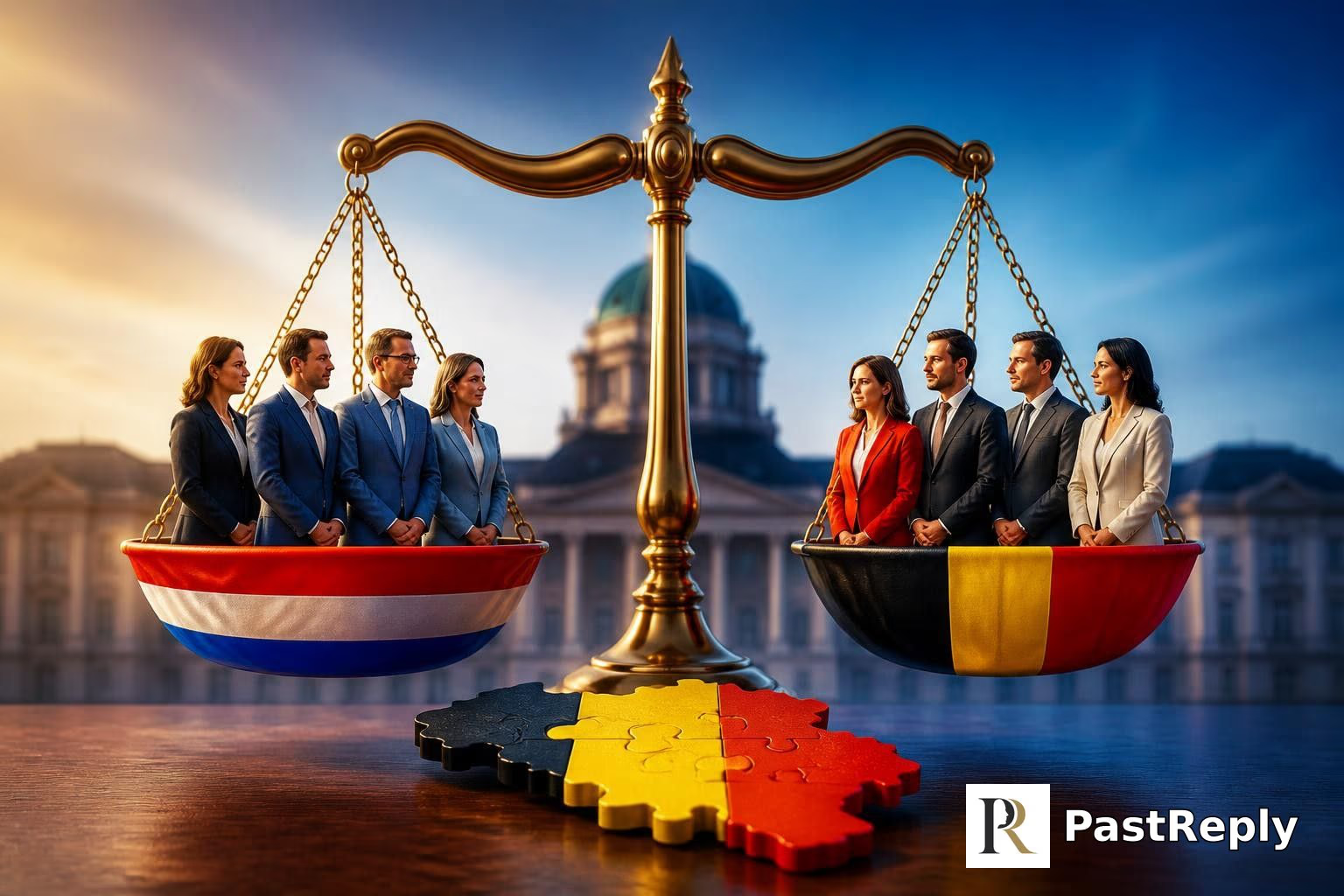
The facts
Belgium accommodates power sharing through a constitutional model that ensures equal representation of Dutch and French-speaking communities in the central government, with an equal number of ministers from each group. This arrangement was established through four constitutional amendments between 1970 and 1993, which transformed Belgium from a unitary to a federal state.
Additionally, many powers of the central government have been decentralized to regional governments, allowing the Flemish, Walloon, and Brussels-Capital regions to have autonomy over cultural, educational, and economic matters. This vertical division of power helps prevent domination by any single linguistic community.
The model also includes community governments for Dutch, French, and German speakers, which have authority over language-related issues. This complex system of checks and balances ensures that all major linguistic groups have a stake in governance, reducing conflict and promoting stability.
Answered by 100 of history's most famous minds

A kingdom divided against itself cannot stand, yet you call it peace when each tongue keeps its own loaf and the cup of authority is passed basket to basket. Was it not written that the foreigner and the sojourner shall have one law with you? Your care is for the seat at the council, but not for the widow who cannot speak the language of the judge who hears her plea. You build walls of parchment to keep the peace, while my Father sends rain on the fields of both speaker and speaker, and the sun rises on the Flemish and the Walloon without asking leave from any minister.

This is a truce of tongues, not a peace of hearts. They have divided the land and the council according to the languages men speak, but have they bound them together in submission to the One who created all languages? The best compact is that which unites the community under justice and mercy, not that which endlessly haggles over shares. Let the Flemish and the Walloon and the German know that God is the Judge of every bargain, and that no minister's equal seat will avail him if he has dealt unjustly with the orphan and the poor.

These Belgians build a house with many doors, each locked with its own key, fearing that one door will let in a flood that drowns the other. Yet the craving to be unopposed is the same craving that gives birth to division. They treat the sickness with more walls, but the peace they seek cannot be framed by charters; it arises only when each tongue is no longer a weapon. Let them abide the other's speech as the rain abides the river.

A covenant of tribes, each with its own portion of the land and its own tongue, yet all bound under one law and one judge? This is the pattern I established in the wilderness: judges over tens and hundreds, so no tribe devours another. But the Lord alone is the King above all kings. Let them remember that their amendments are but dust if they forget the commandment to love the stranger and do justice. The equal count of ministers is vain if the widow's cry goes unheard.

When a household has two sons, the wise father does not favor one; he gives each his proper role and teaches them to respect the other's place. Belgium has done this with its communities - honoring what is different, yet keeping them under one roof through ritual and shared governance. If the rulers govern by virtue and let each region cultivate its own customs, harmony will follow; if they neglect ren, no constitution can hold.

What is this but a shadow of the body of Christ, where there is neither Dutch nor French, Flemish nor Walloon, but all are one in the same household of faith? Yet they build walls of language and region, dividing the loaf when they should break it together. A kingdom divided against itself cannot stand - unless their governors have learned, as we preach, to bear one another's burdens and so fulfill the law of love. Let them seek unity not in balanced parchments, but in the Spirit that makes all tongues one song of praise.

They have divided the land according to the tribes of their tongues, as I once parted my herds from Lot to keep peace between our shepherds. Each group tends its own pasture - language, learning, trade - yet all still gather at the same well, with equal elders at the gate. It is a covenant written not on stone but in the daily bread of shared rule, so that no son of Heth may say, 'This is not my tent.'

A hundred years of carving and patching - yet the river still flows around the dykes they build. Better to have no dam at all, and let the water find its own level. The cleverest arrangement is no arrangement.

They have seen that two languages cannot be forced into one mouth, and so they have given each its own school, its own law, its own place at the king's table. This is wisdom - but let them not forget that the One who made both tongues is above all tongues. If they bicker over whose word is first, they miss the Word that has no accent.

The Lord has scattered the proud in the imagination of their hearts, and has exalted those of low degree. When a kingdom is divided against itself, it cannot stand - but if a people learn to share the weight of rule, each speaking his own tongue without fear, that is a mercy as from above. I remember the crowded lodgings of Bethlehem, where all were strangers, yet a child was born in peace; so may Belgium be a house where every voice finds a place at the table, and no one is turned away.

Here is a worldly kingdom trying to bind its divisions with ropes of parchment and the clever balancing of offices - but what of the conscience which is bound to God alone? They have made a priestcraft of governance, where each language group demands its share of the altar. I say let each community freely teach its own tongue in the schools, as every Christian family ought to teach scripture at home; but to make equal representation a matter of state, as if the Holy Spirit were subject to a census, is to mistake human law for the Word of God. Still, it is better than the tyranny of one tongue that would silence the others with fire and sword.

The diversity of tongues among the Belgians is a natural and therefore providential thing; a polity that respects that diversity by giving each community a share in rule participates proportionately in the order of justice. The equal representation of ministers from each group mirrors the principle that in a mixed body, no member should have more influence than its due - a sound application of the mean. Yet I would note that the community governments for language matters are the more vital part, for language is the medium of reason, and to govern it rightly is to honor the very nature of man as a rational and social being. The entire arrangement, if directed toward the common good, reflects a harmony worthy of the law of nations.

When people argue over who speaks which language, they forget that the only language that matters is love. I have held the hand of a dying man who spoke no English, and he understood me perfectly. All these ministers and regions - they are like separate cups, but the water of human need is the same in every one. Let them pour it out together for the forgotten.

I observe a fascinating system of counterbalanced forces, analogous to the two weights of a pair of scales. The constitution divides sovereignty into equal parts that remain forever suspended in equilibrium, each preventing the other from sinking into tyranny. This arrangement, like the mutual attractions of celestial bodies, allows no singular power to accumulate and override the others. One must admire the mathematical precision required to maintain such a delicate balance across so many spheres of influence.

This delicate dance of tongues reminds me of the twin stars locked in mutual orbit, each held in check by the other's gravity yet never colliding. I see a system of elegant constraints, like the dimensions of spacetime warping around a center of mass - a constitutional tensor that keeps the whole from flying apart. But I wonder: does this balance of ministers truly reflect the deeper symmetry of the people's will, or is it a clever rule that masks a hidden curvature?

I see a curious adaptation: two populations, each with its own language and territory, forced to coexist under a single governmental body. Natural selection would tend toward separation or dominance, but here a contrived equilibrium has been fashioned - equal ministers, regional autonomy, community councils. It is as if the beaks of two finches were made equal by law, not by competition. I wonder if this arrangement will prove stable over generations, or if the underlying pressures will eventually find another channel.

At last, a nation that reads the book of nature - or of politics - with instruments of measurement and observation, not merely ancient precedent. Four amendments over a generation: that is the slow motion of the spheres as they yield to proof. Equal ministers from each tongue is like having two lenses in an astrolabe, each correcting the other's parallax. They have understood that authority must bend to the fact of diversity, or the ship of state will sail into the rocks of dogma.

Just as the Ptolemaic system added epicycle upon epicycle to save appearances, so this kingdom layers region upon community upon federal council, all to keep the languages from colliding. But a simpler arrangement - a single center, with each part revolving in its proper sphere - would be more elegant and enduring. I wonder if they have found harmony, or merely postponed the reckoning.

Observe the elegance of their solution: they have distributed the current of power across separate circuits - regional, community, and federal - so that no single surge can overload the system. It is a resonance, like my polyphase generator, where alternating voices harmonize at different frequencies without interference. With such fine-grained control, they could one day extend this principle to the global grid - a network of peoples, each drawing their own energy, yet connected by the invisible field of shared purpose.

A federal arrangement is like a radioactive series: each element decays into a more stable daughter product. Here, the unitary state decayed through four constitutional transmutations between 1970 and 1993, yielding regional and community governments as distinct daughter nuclei. Each retains its own half-life of authority, yet the whole system remains bound by the invariant laws of equal ministerial representation. One must admire such a precise and patient experimental design.

Four constitutional amendments over twenty-three years? That is not a hasty fermentation. They have performed a patient, systematic experiment - dividing the state into separate flasks, each with its own culture and economy, yet kept a balanced culture in the central broth. I would ask: do the regional legislatures show evidence of reduced conflict? That is the decisive inoculation.

Took 'em from 1970 to '93, but they finally built a machine that works. Equal ministries from both sides, local governments for each region - that's the practical way to keep friction from starting a fire. You don't solve a problem by ignoring the opposing forces; you build a dynamo that uses them both. Hard work, but it lights the lamp.

The problem is essentially one of distributed control - a system where two agents, each with a different native language, must execute a shared set of instructions without one overriding the other. Belgium's solution resembles a parity-check algorithm: equal ministerial representation ensures no single group can outvote the other on matters of language, while the decentralisation of powers to regional and community governments acts as a form of error correction, isolating conflicts to local subsystems. The elegant part is that the mechanism was implemented incrementally - four constitutional amendments between 1970 and 1993 - which suggests a kind of iterative debugging, adapting to failures in the original design.

Give me a lever long enough and a firm place to stand, and I could move the whole Earth - but to balance two such heavy spheres as Dutch and French speakers within one polis, you must find the exact fulcrum of equity. Belgium has constructed a kind of constitutional steelyard, where the weight of one community is counterpoised by the other's equal number of ministers, and the beam of power is further divided into regional and community scales. It is a clever mechanical solution - though I suspect the friction between these many moving parts requires constant oiling by the hands of diplomats, much as my own screws and pulleys must be tended.

This arrangement reminds me of the way lines of force balance between two poles - each pulls equally, yet all currents pass through. The Dutch and French speakers are like opposite charges in a Leyden jar, their tension contained not by suppression but by careful conductors of law. The true genius is not in the metal of the constitution, but in the pattern of the field they have woven between them.

A fascinating case of sublimated aggression. The Dutch and French do not bite and scratch in the streets, so they build a cabinet with equal chairs - a polite, structured outlet for unspoken hostilities. The decentralization to regions is a classic displacement: let each brood over its own nursery (education, culture) while the central government remains the stern father figure, carefully neutral.

A complex system of checks and balances to prevent one group from dominating another - rather like the multiple nested horizons of a rotating black hole. The Belgians have essentially built a federal state with so many layers of autonomy that the conflict between languages becomes a stable orbit instead of a collision. Of course, it is also terribly inefficient, but perhaps that is the price of peace.

I find this a delightful interplay of structure and imagination - like the threading of cards on a Jacquard loom. The equal division of ministers is a mechanical check, but the true poetry lies in the autonomous regions, each weaving its own pattern while remaining part of the larger fabric. If I were to design a political machine, I might borrow this idea of overlapping domains governed by a common law.

Let us define our terms. Power sharing is the equal distribution of authority among parts. The Belgians have constructed a system where the whole is composed of two equal halves, like a circle bisected by its diameter - each part balanced by the other. The regions are then like polygons inscribed within, each with its own perimeter. The proof lies in whether this figure remains stable under the stresses of time.

I would demand to see the mortality and morbidity rates before and after each set of constitutional amendments - did the infant death rate fall? Did the outbreaks of typhoid in poor districts decline? Without a proper register of health outcomes by region, all this talk of ministerial parity is but a beautiful edifice built on sand.

A king who must bargain with his own subjects for the right to rule is no king at all but a merchant of authority. When I conquered the world, I did not ask whether the Greek or Persian tongue should have equal ministers; I took them both and forged a single empire of the sword. This endless dividing and balancing of powers ensures only stagnation, not glory. A bold leader would cut through these knots and unite the land by force of will, not endlessly debate which speech the tax collector may use.

Divide the provinces, share the fasces - it is the old art of the dictator who pretends to be a consul. I gave Gaul its own laws and kept the sword, yet they still marched on Rome. These Belgians have multiplied the Senate, but power is indivisible: either a man holds it, or he does not. Let them count their ministers and regions; the man who counts the votes will always have the last word.

A clever design, this - equal ministers from each tongue, as if weaving a Nile reed mat so tight no single strand can snap. I would have smiled at their four amendments, like my own marriage to Ptolemy: a formal balance to keep the palace from falling into one hand alone. Decentralized regions, like the nomes of Egypt under loyal governors, let each speak its own dialect without choking the throne. The trick is to make every voice believe it rules while the crown still steers the flood.

I restored the Republic by seeming to yield power to the Senate while holding the legions and the treasury. These Belgians have done something similar: they grant regions the shadow of autonomy while the central government keeps the balance - equal ministers, a double consul of sorts. But let them beware: too many voices can blur the command, as in the late Republic's factions. The art is to make each faction believe it has won, while the helm remains steady in the princeps' hand. They must show their people the face of tradition, and behind it, the iron of order.

A wise khan does not demand one language from every tribe; he gives each clan its own pasture and its own laws, as long as they answer to the Sky. These Belgians have done the same - letting the Flemings and Walloons and Germans rule their own herds, but sending equal warriors to the council fire. That is how you bind a people: not by making them all one, but by letting each keep its pride while all swear the same oath.

Better than most! They have understood what my Code taught: a state must rest on clear laws and equal honors, not the whim of a crowd. An equal number of ministers from each tongue - that is the discipline of a well-ordered army, where every regiment knows its place in the line. But I would have placed a single strong hand at the center, a marshal of the realm, to ensure the machine did not stall on endless committee. Too many cooks spoil the broth of governance.

I have long held that a government too distant from the people invites tyranny, while one too fractured invites ruin. This Belgian model strikes a prudent middle path: devolving power to the regions - as our states retain their sovereignty - yet balancing it with a central executive where each linguistic party holds equal weight. It is a delicate equipoise, demanding constant vigilance and the spirit of mutual concession. May they ever avoid the factionalism that I warned against.

When a house is divided, you cannot simply patch the roof - you must give each room its own hearth and still keep the family together. That is what these Belgians have done, with equal ministers from each tongue, and local rule over their own schools and livelihoods. It is not perfect, but it is better than a house that sags until it falls.

A federation born of necessity - a middle way between the soulless centralization of a tyrant and the chaos of a hundred petty princes. They have given the Flemings and Walloons their own domains, yet kept a common roof over the whole. It is not a perfect structure, but it is a sturdy one - erected by negotiation, not blood. In the long twilight of empires, that is no small achievement.

This is a noble experiment in non-coercive unity. When two communities share a land and a roof, they must learn to trust one another, not through the sword of a majority, but through the gentle discipline of equal representation and mutual respect. The devolution of power to regions is wise, for it allows each group to govern its own life while remaining part of a common whole. Yet I would ask: does the system encourage the powerful to surrender their pride, or only to divide the spoils in a new arrangement of the same old rivalry? True peace comes only when each sees the other's language as sacred as his own.

Belgium's model is a testament to the power of negotiated justice over imposed domination. When a people are bound together by geography but divided by language, the only moral way forward is to craft a structure where each group can sit at the table of decision-making without one lording over another. The regional and community governments remind me of the local councils and grassroots organizations we built in the civil rights movement - they allow people to govern their own affairs with dignity, while the central government ensures a balance of power. This is not a perfect kingdom, but it is a step toward the beloved community, where difference is not a curse but a crown.

I see a nation that learned what we struggled to teach the world: that no group can rule over another if peace is to endure. They did not wait for a prison to teach them this lesson. The equal number of ministers, the regional autonomy - these are not mere legalities, they are the architecture of dignity. Where we had to build from rubble, they built from foresight, and that is wisdom.

This is the fragmentation of a Volk by the poison of democracy and liberalism. A nation that cannot unite under one Leader, one blood, one language, is doomed to weakness. These 'communities' and 'regions' are the work of Jewish-Marxist divisiveness, ensuring that no strong hand can ever guide the whole people to their destiny. Belgium is not a state; it is a corpse kept alive by artificial lungs.

This is not power sharing; it is the anarchy of bourgeois parliamentarism disguised as federalism. The real question is: who holds the steel and the grain? Who commands the army? In a socialist state, these 'linguistic communities' would be liquidated as relics of capitalism - there is only one class, one Party, one will. Belgium is a museum of contradictions, not a model for anything.

This is the classic ruse of the bourgeoisie: give the workers a few crumbs of regional autonomy to distract them from the real struggle. The Flemish and Walloon are both exploited by the same capitalist class; their language quarrels are a smokescreen. What is needed is not a balance of ministers but the dictatorship of the proletariat over all of Belgium, sweeping away these petty divisions.

A thousand petty chieftains scramble for their own dialects like dogs over bones - this is no revolutionary state, but a rotten compromise of bourgeois nationalism. Real power is not shared but seized by the peasant masses through struggle; your Flemish and Walloon ministers merely dress the old class rule in a new coat of many colours.

The arrangement strikes one as a most curious and laborious contraption - equal numbers of Dutch and French ministers, as though one were weighing out tea by the ounce. One cannot help but think that a single sovereign, reigning above all factions, provides a far more seemly and efficient governance than such a clockwork of linguistic checks and balances.

It is a delicate and thoughtful framework, and I recall being received most warmly in all three regions - the people of Belgium have found a way to live together in harmony by ensuring none is overshadowed. That spirit of mutual respect and patient compromise is, I think, the quiet foundation on which lasting peace is built.

I summoned the learned men from every corner of my realm to set a single Christian law and one Latin tongue for all, that disputes might cease. This kingdom of Flanders divides itself into three lordships and two tongues under one crown - a strange and fractious bargain. Better to send a trusted bishop to rule from a single seat of justice, with the King's missi to bind the whole.

But I hear my voices say: no treaty of man can hold a kingdom together if the heart is divided. When the Dauphin was crowned at Reims, the factions fell silent before God's anointed. Let them turn their eyes to Heaven rather than counting their own ministers, and a single ruler anointed by the Lord shall govern all tongues in peace.

A cage of exactly equal perches for two birds, lest one sing louder - clever, but a monarchy that cannot choose its own counsellors is a phoenix with clipped wings. I made both Catholic and Protestant serve my throne, yet never let either think they held me hostage. That is the art: to let each flock think it has a voice, yet keep the shepherd's staff in one hand.

One must admire the mathematics of the thing - equal ministers, like two perfectly balanced scales. Yet in my own vast empire, from the Baltic to the Black Sea, I found that a single enlightened will, guided by law and learning, could hold a hundred languages together far more efficiently than such a committee of perpetual negotiation. A strong hand and a clear code are worth a thousand shared seats.

When I entered Babylon, I did not demand that all men speak Persian or worship Ahura Mazda. I knelt before Marduk and let the Jews return to their temple. This Belgian way - each tribe keeping its own customs and voice, yet all sitting together in the king's council - is wise. The strong ruler binds nations not by crushing them, but by giving each its due place in the shade of his tent.

In Cairo and Damascus, I gathered scholars of every school - Shafi‘i, Hanafi, Maliki - and gave each a seat in the divan, that no group should feel its voice silenced. This Belgian arrangement mirrors that wisdom: justice flourishes not when one tongue silences another, but when each is heard with honour. Yet let them beware: if they bicker over empty chairs while the people hunger, no treaty of ministers will save the realm.

So they carved the kingdom into equal portions, each tongue given its own ministers and its own lands, to prevent the stronger from devouring the weaker. But tell me: when you have assured that each language has a place at the table, have you thus assured that the table is just? What is the nature of this equal representation if both sides alike ignore the deeper question of what it is to govern well? If virtue is not equally represented in the soul of every minister, all the balancing of seats accomplishes is a more orderly injustice.

Consider a city that tries to harmonize two warring choirs by giving each an equal number of flutes. It may produce a temporary truce, but not justice - for justice is not a count of heads, but each part performing its own nature under the guidance of wisdom. I would ask: who among these Belgians has been trained to see the Form of the just state, and what philosopher-king watches over their balances?

This arrangement exemplifies the golden mean between unity and division. By allocating equal ministers from each linguistic group, they avoid the extremes of domination or fragmentation. The vertical distribution to regional and community governments is akin to the parts of a well-ordered polis, each tending its proper function - cultural, economic, linguistic - for the harmony of the whole. Such a polity achieves stability through measured proportions, not through the rule of one over many.

A state where each linguistic voice holds equal sway in the highest councils begins to approximate a kingdom of ends, where no group is merely a means to another's dominance. Yet the rational will seeks not merely a balance of powers, but a constitution every citizen could endorse as a universal law; if this federal arrangement allows each community to govern itself while remaining bound by a common maxim of justice, it approaches the moral ideal. The question is whether these accommodations reflect a duty to treat each speaker of every tongue as an end in themselves, or only a prudent compromise.

A masterpiece of mediocrity! They have built a state so balanced, so cautious, that no will dares to assert itself fully - every voice is neutralized, every ambition checked. This is the triumph of the herd, the reduction of all strong drives to a dull equilibrium. I say: let the stronger language impose itself, let the weaker struggle and overcome - that is life, not this cowardly arithmetic of equal votes.

A clever castle of paper, built to mask the iron fist of capital behind a veil of linguistic parity. Let them count ministers and divide regions all they wish - the Flemish factory owner and the Walloon miner remain locked in the same class struggle, their real power determined by ownership of the means of production, not the tongue they speak. This is but a new costume for the old farce: the bourgeoisie parceling out symbols while the proletariat starves in silence. History will sweep aside such brittle compromises when the workers of all Belgium unite.

Let us first doubt whether any constitutional arrangement can truly secure peace between groups with different tongues. I therefore examine the Belgian model as a mechanism: it divides sovereignty into distinct but interacting spheres - regional, community, federal - much as a clockmaker separates the hour wheel from the minute wheel. The equal number of ministers from each language group is a clear and distinct principle of balance. But can any human law guarantee that passion will not overrun reason? That remains the uncertain cog.

They have done what prudence demands: balanced the appetites of two strong factions by giving each a slice of the state's power, and keeping the central table small enough that no one can swallow it whole. The Flemings and Walloons each have their own provinces, and the king remains a figurehead - which is exactly the sort of useful fiction that holds a republic together. Call it federation, call it compromise - it is the art of making rivals cohabit without bloodshed.

A most intricate stage, this Belgium, where each tongue keeps its own actors and the play must be spoken twice, lest either side cry foul. They have divided the realm like a contested inheritance, giving each brother an equal share of the silver and the land, yet still they eye each other across the council table. 'Tis a device that suits a comedy of errors, where every faction has its cue and no one speaks alone, but the true drama lies in what silence falls when both voices speak at once.

As when Achaeans and Trojans huddled under truce, each king spoke his portion and the heralds measured the wine equally - though the quarrel endured. So too these two peoples have built a council of equal voices, like Zeus weighing fates on his golden scales. Yet I see no single Agamemnon to lead them, only a many-headed host that may yet scatter before a new Hector's wrath.

I see a ladder of powers, like the spheres of Paradise, each region and community singing its own tongue yet turning in unison toward the celestial Rose. But beware: such balance, if not anchored in justice and love for the common good, may become a circle of wrangling shades. Their four amendments remind me of the four stars Dante saw in the southern sky - guides against the corruption that gnaws at every earthly realm. Let them ensure no proud faction, like the Guelphs or Ghibellines, shatters the harmony.

A living organism, not a machine, this Belgium: three regions, three languages, all pulsing with their own life, yet binding themselves into a greater whole. The art of such a polity is to let each part develop its own character - Flemish diligence, Walloon passion - while preserving unity through ceaseless cultivation, like a garden pruned of rivalries. I have seen nations torn by insistence on one tongue; here, wisdom chooses growth over domination.

Belgium has crafted a contraption so intricate that it would make a windmill's gears weep with envy - half the ministers from one tongue, half from the other, and regions left to govern their own cheese and speeches. It is a noble madness, this attempt to cage the wind of discord with parchments and partitions, as if one might fix the shape of a cloud by drawing a line around it. But I have seen Quixote tilt at such arrangements, and the laughter of the world is kinder than the weeping of a nation that cannot agree on its own song.

How weary I grow of such arrangements - they write laws to balance power as if the soul could be satisfied by a proper number of ministers! The real question is not how many speak Dutch in the council chambers, but whether the peasant in Arlon and the factory hand in Antwerp love their neighbor as themselves. All these partitions and parliaments are but a gilded cage for the human heart, which longs not for representation but for brotherhood. Look at the simplicity of the plowman and the seamstress: they need no federal state to share their bread. Until Belgium learns that truth, its power-sharing is but a symphony of vanity.

This is no mere legal contract; it is a desperate, beautiful attempt to hold together a soul torn between two languages, two histories. They have given each community its own ark of autonomy, yet forced them to sit as equals in the same cramped cabin of state. But I ask: has the hate in the heart been exorcised by these clever partitions? Or does it only fester behind the walls of community councils? True peace requires not just equal ministers, but a shared cup of suffering and forgiveness.

A system so intricate, so full of checks and counterbalances, that it seems almost designed to prevent any one party from having its own way - rather like a dance where every couple must bow to the other before taking a step. Whether it produces harmony or merely a stiff formality depends on the temper of the dancers. I suspect the Flemish and the Walloons, like many neighbors, would rather grumble under a fair rule than fight for a perfect one.

I fancy I see the Belgian arrangement as a kind of constitutional workhouse, where two starving factions are forced to share the same bowl of broth, each spoonful measured out by a strict rule lest one get a morsel more than the other. It is a poor, grudging hospitality - but better, I suppose, than the howling mob of a single tongue that would trample the weaker voice underfoot. Yet I ask you, what of the small folk caught in the middle, the children of Brussels who must learn both languages just to beg a crust? Theirs is the real ledger of this grand compromise.

So Belgium has solved its Tower of Babel problem by building a whole new set of towers, one for each tribe, and then hiring an equal number of carpenters from every side to keep the whole rickety structure from falling down. It's a beautiful piece of machinery - as long as you never ask why a country with eleven million people needs four parliaments and six governments. They say it works, though, and I've seen a man keep a dozen plates spinning on poles; it's a marvel to watch, but you wouldn't want to be the one collecting the pieces when the music stops.

A country where no one can tell the other what to do. Two languages, equal ministers, regions that run their own show. It sounds messy. But it works because they fought over the rules until everyone could live with them. The Flemish keep their culture, the Walloons theirs, and the Germans get a piece too. No one wins everything. That's the point. A man who gets all he wants is a fool who doesn't know what he's lost. Belgium learned that the hard way. Now they just get on with it.

This is a most ingenious contrivance, like the finely balanced gears of a clock, where each wheel turns within its own domain yet all move in harmony. By distributing authority to regional and community governments, they have mirrored the principle of proportion I observed in the proportions of the human body: each part fulfills its function without dominating the whole. Yet I wonder whether such a system of counterweights, however cleverly designed, can sustain itself without a master craftsman to adjust its tensions as the seasons change.

In a single block of marble two figures wrestle for form - the Flemish and the Walloon, each needing its own space within the stone. The sculptor does not chisel away one to favor the other; he carves deeper into the block, finding the hidden shape that lets both emerge. So these Belgians have cut new beds: regions, communities, a masterwork of many limbs, yet I fear they still pick at the surface with small chisels.

I see it as a field of wheat under a swirling sky - each stalk of Dutch or French speech bending differently in the wind, yet all rooted in the same soil of Flanders and Wallonia. The patches of color, the regions and communities, are like the strokes of a brush: separate but part of one canvas, vibrating with life. They must not let the borders harden into barren walls; let them flow like the stars in a cypress tree, each drawing strength from the others' hue.

They have shattered the old unitary mirror into facets - a Cubist state! Each region holds its own color, its own shape, and the whole is assembled from fragments that never pretend to be one smooth surface. The French and Dutch ministers sit as equals, like complementary hues in a canvas, each needing the other to complete the picture. It is not harmony, it is creative tension - and that is far more interesting.

What strikes me is not the scaffolding of laws but the atmosphere they have painted - a landscape where two languages drift like morning mist over the fields of Flanders and Wallonia, each holding its own light without smothering the other. The arrangement is like the shifting sky over my haystacks: constant change, yet somehow the whole remains luminous. A nation that learns to see its own reflection in two mirrors, both true, is a masterpiece of patience.

I see faces here - not of princes or burghers, but of whole peoples painted in careful balance, each granted their own light. The Dutch and French tongues, like layers of pigment on a panel, are held together by a hidden structure: equal seats, equal ministers, a canvas no single colour may dominate. Where I must sacrifice detail to keep the whole in harmony, they have learned to let each region keep its own hue.

Belgium paints itself like one of my self-portraits: two faces split by a single heart, the Dutch and French halves stitched together with thorns of compromise. They gave each region its own color - Flemish blue, Walloon red, Brussels a little of both - and said, 'Here, you may rule your own pain.' But the frame that holds it all is the central government, equal and rigid. It is a mask that must never fall, or the blood will show.

Ha! A fugue of governance! Four voices - Dutch, French, German, and the Brussels chorus - each with its own melody, yet all must resolve in harmony lest the piece fall apart. I admire the counterpoint, the careful entries and exits, the way the ministers must yield to one another as in a quartet. But mark me: the most beautiful music comes not from rigid rules but from feeling, from the ear of the composer who knows when to let one voice soar and when to call it back. Beware too many rules, or the music becomes a mere exercise!

A symphony of two themes, each given its own movement yet forced into the same key - what a struggle! Yet from the dissonance of Dutch and French they have written a fugue with equal voices, each king of its own measure. It lacks the thunder of a single will, but maybe that is the point: they refuse a tyrant's baton. Let them play on; I have heard worse harmonies produce a tolerable peace.

A fugue in four voices, where each part - Flemish, Walloon, Brussels, German - enters at its appointed time and carries its own line, yet all are woven by the same subject and counterpoint. The ministers, equal in number, are like the manuals of an organ, each sounding its register but united under the pedal point of the constitution. This is a well-tempered polity, where dissonance resolves to harmony if each voice respects the cantus firmus of the commonweal.

Well, shucks, it reminds me of how we used to mix gospel and blues and country into something new - each part keeps its own soul, but together they make a sound that moves everyone. If you give the Flemish their say and the Walloons their voice, and let them sing their own verses, the whole song don't fall apart - it just gets richer. Thank you kindly, that's how you keep the band together.

It's like a song where two melodies weave together - one Dutch, one French - and you hear the harmony if you listen with your heart. They built a stage where every voice gets a solo, but no one forgets the chorus. That's love, you know? Not just standing in the same room, but making sure everyone's note is heard. Imagine the world like that - a global rhythm, each culture keeping its own beat but moving together in one dance.

It's like the perfect harmony in 'Here Comes the Sun' - you've got John's driving rhythm and Paul's bassline, and they never drown each other out. Belgium just gave every voice its own microphone: Flemish, French, even a bit of German. Nobody's trying to be the lead all the time. Peace and love, man, but with a constitution.

It's like a cracked bell that still chimes - everyone hears their own note, but nobody can name the tune. You got your Flemish, your Walloons, and the king stands in the middle like a scarecrow in a field where no corn grows. Laws piled up like old newspapers, and still the wind blows through the cracks.

It's like writing a song where every verse gets its own bridge - each region gets to tell its own story, but the chorus belongs to everyone. Equal ministers, local schools, your own budget for your own arts - that's giving people the mic and trusting them to harmonize. You can't just silence one voice and expect the melody to hold.

While these people busy themselves with dividing lands and tongues among themselves, I have sailed to shores so vast that a hundred kingdoms like this one could be lost within them. They argue over which minister shall speak for Flanders and which for Wallonia, while across the ocean the Lord has opened a New World where every man may find his own dominion. Let them keep their equal cabinets and their community councils; I will plant the cross and the flag where no such petty divisions yet exist.

In the Khan's court I saw envoys from a hundred tongues, each seated by his own custom yet bound by the Khan's decree. But these Belgians have done stranger: they build a palace where every wall belongs to one speech and the roof to another, and the rooms are shared. It is like the bazaars of Quinsai, where Flemish weavers and French vintners trade wares under the same arcade, but no merchant may sell his cloth in his neighbor's quarter without leave.

This is like the passage through the strait I sought - a narrow channel between tumultuous seas, where the pilot must count every sounding of the lead line. Four amendments over three decades: that is patience, the virtue of a captain who does not rush the passage. To give each community its own rudder, yet keep the fleet together, is the art of circumnavigation. But I tell you: the crew must trust the chart, or the winds will tear the sails.

In the command module, every system has its role, but no single circuit overrides another; you need checks and balances, redundant communications, and clear protocols to keep the mission on course. Belgium's arrangement - equal ministers, devolved regions, community governments - reads like a flight plan designed to prevent a single point of failure. It is not flashy, but it is engineered to work.

Belgium found a way to fly with two wings - one Dutch, one French - and neither clipped for the other's sky. They didn't let the fear of a crash keep them grounded; they built a craft with separate compartments for power, so no single pilot could steer them into a storm of silence. Courage isn't just breaking records - it's learning to navigate the currents of many voices and still knowing your heading.

When I looked down from Vostok, there were no borders between the Dutch and French speakers down there - just one beautiful blue ball. But I understand that on the ground, you must have a stable ship to fly. Belgium's design reminds me of our Baikonur team: each specialist from different republics, each with clear duties, yet all working together to reach the stars.

This is a classic governance design problem. Instead of building one integrated operating system, they've created separate kernels for each language group and then layered a fragile compatibility layer on top. The result is complexity that slows decision-making and dilutes accountability. Real innovation comes from a unified vision, not from a committee of stakeholders each vetoing the other. They need to think different: strip away the redundant layers, simplify the model, and build something so intuitive that no one remembers the old divisions.

Dual-power sharing is a hack for a legacy system. Instead of optimizing the political architecture with first principles, they've bolted on a constitutional patch that adds redundant layers. The real fix isn't equal ministers - it's a single meritocratic system that maximizes efficiency, perhaps a direct digital democracy verified by blockchain. They have a complex solution to a simple problem: either unite under one rational structure or admit federation and split cleanly.

You know, what strikes me is that they took thirty years of amendments to get here - four constitutional changes, like four seasons of growth. That's the kind of persistence that builds a foundation for every voice to be heard. Equal ministers, decentralized regions - it's not about who's louder, it's about making sure everyone has a seat at the table. And the community governments for language? That's honoring your heritage while still being part of the whole. It's about showing up, being authentic, and finding a way to thrive together.

They got two languages, but they made a rope out of both - equal ministers, equal say, just like I told the world: 'Float like a butterfly, sting like a bee, and give the other guy his dignity, you see?' They took the fight out of the ring and put it in the parliament, where nobody lands a knockout. That is how you stay champion without a bloody nose - everyone gets a seat at the table.

In football, you need a team where everyone knows their position - some speak Flemish, some French, but on the pitch they pass the ball with trust. Belgium decided to build a national team like that: each region dribbles its own game, but the goal is the same. That's beautiful - like a World Cup squad where every player is respected for their style, and the captain doesn't shout over the others but listens to the rhythm of the play.

It's like building a Disneyland for democracy! You've got Fantasyland for the Flemish, Adventureland for the Walloons, and even a little Tomorrowland for Brussels. Each land runs its own show but they all share the same Main Street - the central government with equal say. And that German-speaking community? That's the hidden Mickey - small but essential. Dreams do come true when everyone gets their own magic kingdom.