
What is the Odyssey book about?
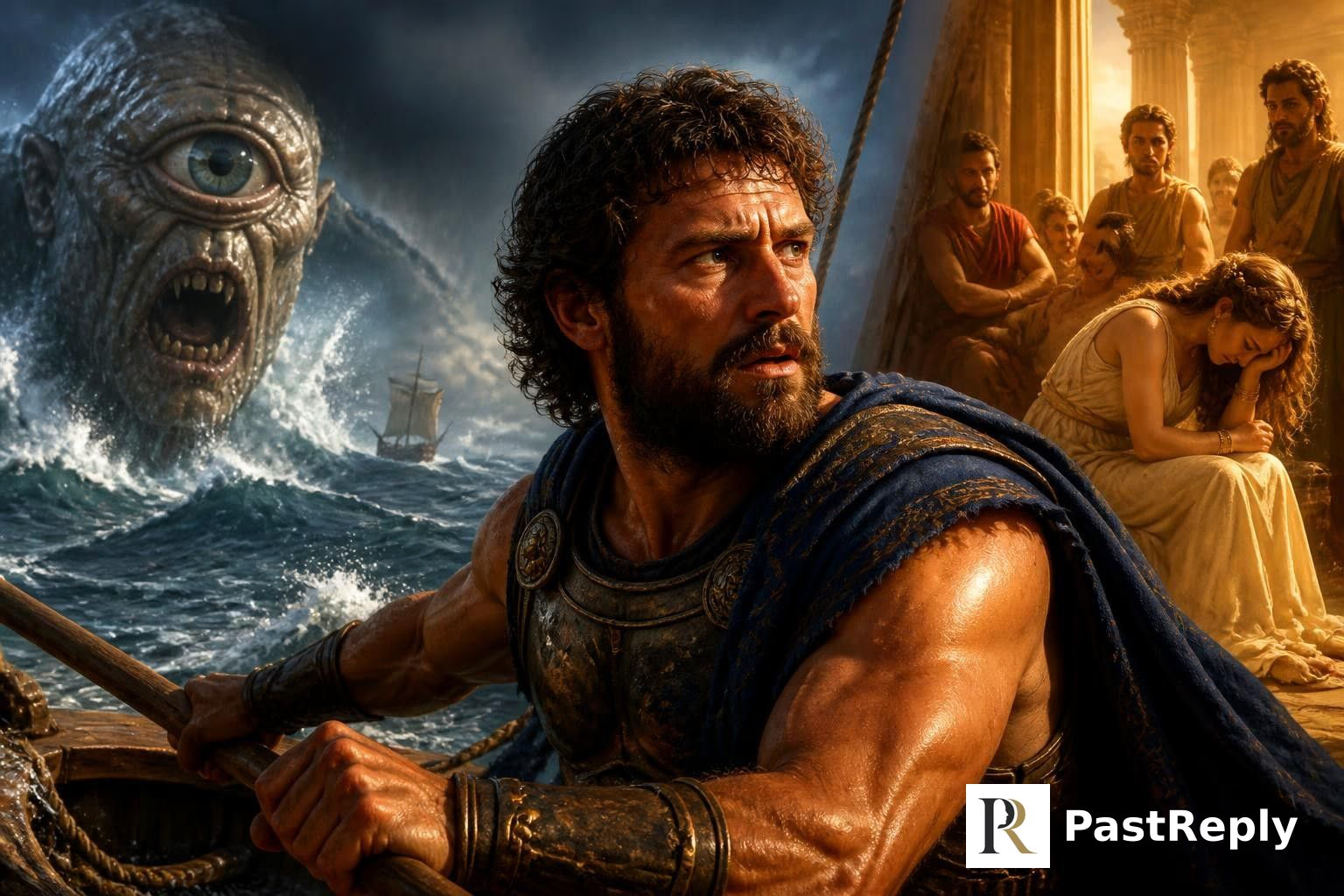
Homer's Odyssey recounts Odysseus' decade-long voyage home from Troy, facing monsters and gods while his family contends with suitors.
The facts
The Odyssey is an ancient Greek epic poem attributed to Homer, composed around the 8th or 7th century BC. It tells the story of Odysseus, king of Ithaca, and his arduous ten-year journey home after the Trojan War. The narrative focuses on his adventures and trials as he encounters mythical creatures and divine beings, while his wife Penelope and son Telemachus fend off suitors vying for her hand in his absence. The poem is a cornerstone of Western literature, exploring themes of heroism, perseverance, and the longing for home.
Answered by 100 of history's most famous minds

You speak of a man who wandered for ten years, fighting monsters, losing comrades, and longing for his hearth and his wife. But ask yourselves: what use is it to gain the whole world if you forget the narrow door at home? Odysseus learned through suffering; but the truly wise are those who hear the Father's voice and turn back before the first storm.

Homer tells of a man who, after every trial, fixed his heart on his own hearth and his own wife - a lesser purpose. The true journey is not to a house of stone and a woman's arms, but to the house of God, which is the heart of the believer. Let them read this poem and then ask themselves: what am I sailing toward? For there is no Penelope worth ten years of storms when the Lord waits at the end of the path.

Wanderers of the world, this tale holds a mirror: the hero's ceaseless longing for home is no different from your thirst for pleasures and possessions. Each island he lands on is a craving; each escape, a letting go. The true Ithaca is not a rocky shore but the peace that arises when you stop grasping at shores altogether. The journey ends not when you reach the harbor, but when you see the harbor as no different from the open sea.

A wanderer who trusts his own cunning more than the God who could have brought him straight home - that is the sin at the root of this tale. Forty years I led a stiff-necked people through a wilderness, and never once did I rely on a wax ear or a wooden horse. The Lord gave us the law; the law is the straight path. This Greek hero circles the world because he will not simply obey.

It is the tale of a man who, after twenty years, remembers the rectitude of filial return. The wise son, Telemachus, grows by seeking his father; the faithful wife, Penelope, maintains the household through proper ritual and cunning. Odysseus himself learns that the greatest adventure is not slaying monsters but re-entering one's proper place with humility. Without right relationship, all the wonders of the world are but dust.

Paul, do you say? I see a man buffeted by princes and powers, by the rage of the sea and the deceit of enchantments, yet he presses on toward a city that is not made with hands, eternal in the heavens. That is the true journey: not the voyage to Ithaca, but the pilgrimage to the Kingdom. For here we have no lasting city, but we seek one to come.

This song tells of a man who kept walking even when the road was dust and the promise seemed to have died. Have I not also journeyed into a land I did not know, trusting the Voice that called me? But this Greek chieftain was tested by sirens and storms, while I was tested by a barren tent and a son bound on the altar. His homecoming is a reward I can grasp; but my home was not a place, only the One who said 'Go.'

A man who fights the current for ten years does not understand the river. The journey home is already complete before the first oar touches water - the boat, the sea, the island of the beloved were never separate. To strive so mightily against what is, that is the true wandering. The sage stays at home and the world comes to him; Odysseus rushed around the world and never once left his own longing.

A man wanders the world for ten years, meeting wonders and terrors, but does he ever look within his own heart and see the One Light shining? The true home is not a rocky island in a salt sea - it is the Name that fills all creation. Odysseus was a great warrior, but he forgot that the greatest victory is to conquer your own ego. He should have sat down and meditated on the Creator instead of boasting to the Cyclops; that pride alone cost him years.

I see a mother weaving and unweaving a shroud to keep hope alive, and a father fighting monsters to return to his son - this is a story of patient love and the long night of waiting. My own heart knows the vigil kept for those far from home, and the trust that a promise, even one years overdue, will be fulfilled.

Odysseus survives by his wits and the gods' grace, and when he returns, he slaughters the gluttons who consumed his house - this is a picture of the sinner beset by devils and the world, saved by God's mercy, and then called to wage war against evil. But mark this: without faith in the Almighty, all his craft is mere straw; the true homecoming is to the Father's house.

The poem may be considered a moral allegory of the soul's journey toward its true end, which is union with the Good. Odysseus' cup of poison and his choice to sail past the Sirens exemplify the virtue of prudence, resisting sensual temptations that would destroy the intellect. His homecoming is the soul's return to its proper state of order, where the passions (the suitors) are rightly subjugated by reason (the hero).

It is a story of a man who wanders far from his house, yet cannot rest until he reaches the ones who wait for him. Penelope weaves and unweaves, waiting with love - this is the same love we can give to the poorest, a thread that never breaks even in the darkest night.

A careful reader finds Homer's tale to be less a chronicle of wonders than a systematic demonstration of moral consequence: each transgression against hospitality or piety brings a proportionate calamity, as surely as an apple falls. The voyage is a geometrical proof - not drawn on sand, but inscribed in the lives of men - of the law that pride precedes a fall, and that perseverance through lawful means earns a just reward.

The cosmic geometry of the journey - spacetime warped by monstrous tides and divine whims - matters less than the symmetry of its final constraint: a man struggling against a universe that, in its deepest laws, is both lawful and indifferent. The real voyage is not through the Ionian Sea but through the years, where every encounter reveals that time itself is relative to longing.

Read the poem as a naturalist: observe how the hero adapts to each hostile environment - the cave of the Cyclops, the strait of Scylla - as if natural selection were at work on his cunning and endurance. Yet his long isolation from Ithaca shows that even the fittest wanderer may be worn down by time and chance. I see in his tale a sober lesson: we are all shaped by the struggle to reach our native shore, and the variants that survive pass on their resourcefulness.

A poem about a man who sails past Scylla and Charybdis, yet the real marvel is that the poet never once questions the shape of the earth. A sphere, of course - observable from the curved shadow on the moon, from the changing stars. Homer sings of a flat disk girdled by Ocean, and for two thousand years men believed him. That is the tyranny of authority: it takes a voyage of the mind, not of the sea, to break free.

Observe how the poem's true geometry is not the flat, wandering line but the circle: every detour bends back toward Ithaca as its center, just as each planet's epicycle ultimately revolves about the Sun. Homer intuited what the astronomers resisted for centuries - that the journey's meaning lies in the central point of return, not in the chaos of peripheries. The Sirens tempt Odysseus off his radial course; his will holds the center.

A primitive chronicle of mechanical failure and human limitation. If Odysseus had possessed a wireless telegraph, he might have summoned rescue from Calypso's isle in an instant. The real marvel is not the Cyclops or the whirlpool, but the pure concept of a navigator's relentless drive home - a problem of energy and direction that we moderns have solved with compass and engine. Homer simply had no better vocabulary for the forces at play.

If one strips away the poetry, the Odyssey is a systematic and persistent investigation of the physical world - how winds, currents, and even the wrath of a sea god can alter a man's trajectory. Odysseus, like a scientist, collects data through trial and error, testing each hypothesis (the lotus, the cyclops's cave, Circe's potion) until he learns to navigate the forces that govern his journey. It is not adventure that guides him home, but accumulated knowledge and the will to adapt.

I would like to see the precise log of winds, currents, and rations - surely a ten-year voyage with such haphazard navigation should have ended in scurvy or starvation long before any cyclops. The tale describes a series of improbable survivals with no systematic observation of contagion or cause. It is a charming fiction, but if Odysseus had applied the method of controlled experiment to his problems - say, testing which wax formulation best blocks a siren's song - he might have been home in two seasons.

Ten years to sail a few hundred miles? That's a failure of logistics, not a heroic feat. If I'd been on that boat, I'd have rigged a better sail, charted the currents, and invented a waterproof device to signal Ithaca long before the first year was up. The whole thing sounds like a man who refused to keep a logbook and didn't learn from his mistakes - blind giant? Try a different tactic next time. Inspiration is fine, but perspiration gets you home for supper.

From a computational perspective, the narrative is a problem of path-finding under severe constraints: the protagonist must navigate a graph of nodes (islands, caves, straits) each with distinct state transitions (e.g., encountering a cyclops results in a 2/3 probability of fatality). The suitors' game, Penelope's weaving scheme, and the bow contest are all finite-state games with well-defined payoffs. What is impressive is the branching factor: the poem effectively solves a multi-year search without an oracle, using only heuristic rules like 'listen to the goddess' and 'don't eat the lotus'.

The whole journey is a problem of navigation and engineering: given a sphere (the world) and a point of departure (Troy), compute the shortest path home without a compass, using only the stars and the directions of a goddess. The trick with the Cyclops - claiming to be 'Nobody' - is clever, but the real marvel is the raft: a man building a seaworthy vessel from timber and linen on an island, with no tools but his own hands. That is the true mathematics: knowing the strength of a beam, the buoyancy of a log, and the angle of a sail.

A long journey home, yes - but think of the forces unseen that steer the man! Odysseus is not only tossed by wind and wave but by the very lines of power that bind earth and sea. The hero is a needle in a divine compass, pulled by fields we cannot touch, yet they bend him as truly as my iron filings follow a magnet.

Beneath the sea-monsters and enchantresses, this is a journey into the unconscious itself. Odysseus does not merely return to Ithaca; he must confront his own repressed desires - the Cyclops is raw appetite, the Sirens forbidden wishes, and Penelope’s weaving a symptom of unresolved ambivalence. Ten years of detours is a long way to avoid facing the home that is really himself.

It is the original space adventure - a lone traveler navigating by no GPS, only wit and the favor of capricious gods. But I find it oddly reassuring: even without knowing the physics of black holes or the curvature of time, Homer understood that the journey matters as much as the destination, and that one man’s return is a tiny event on a cosmic scale.

It is the first great algorithm of return - a set of instructions for bringing a man home through a sequence of trials, each a conditional branch. Odysseus calculates his way past the Cyclops with a name that is a null variable, and through the Sirens with a carefully derived schedule. I see in it the poetry of logic: the hero is a machine built of cunning, executing a program of survival.

It is a demonstration of a hidden theorem: from given premises - a man, a war, a sea, a home - the narrative proceeds by necessary steps to its conclusion. Each landfall is a lemma, each trial a proof of his enduring identity. But unlike my geometry, Homer’s path is not the shortest: he takes the scenic route, proving that even a divine theorem can be drawn with many detours.

The poem is a casebook in public health disasters. Odysseus loses six men to a man-eating giant because he failed to secure his provisions; the entire crew perishes from hunger after slaughtering the Sun's cattle. If only they had rationed their stores, kept clean quarters, and not antagonized divine patrons - the voyage would have been three years, not ten, and a dozen lives spared.

A single man, betrayed by winds and gods, clinging to his little island while his wife is besieged! I would have burned that palace at first news and scattered the suitors like chaff. Ten years? A boy could do it in one. But I see why Alexander keeps the book under his pillow: it whispers that one man's will, if it burns hot enough, can outlast every storm and every god who stands in his way.

That wanderer wasted ten years when a swift fleet and a commander's will could have brought him home in ten weeks. I conquered Gaul in eight campaigns; this Odysseus dallied with nymphs and wept before sirens. His cunning earned him a kingdom - but he lost a decade of hegemony. The lesson: fortune favors the general who acts, not the sailor who drifts.

A king wanders, losing ships and men to monsters and gods, while his wife fends off a pack of wolves at her loom - a tale every court knows. But read closely: it is a lesson in how a ruler endures, how a woman holds a throne without an army, and how the clever outlast the strong. Any pharaoh who ignores that lesson will find her kingdom devoured by Romans.

A king abandons his people for a decade, leaving his house to rot and his wife to be besieged, and returns only through the favor of a goddess and the slaughter of her suitors. It is not a model of governance; it is a warning. A prince who cannot secure his own home, who relies on divine intrigue rather than legions and law, will find his kingdom lost long before he regains his bed. Order first - everything else is poetry.

Odysseus understood what every khan must know: to rule, you must first return. When your clan is scattered, you gather them by wit and war. He fooled a giant, charmed a witch, sailed past singing women who would wreck a lesser man - and when he reached his yurt, he slaughtered every suitor who had dishonored his hearth. That is the way of the steppe: you suffer much, but you never forget whose blood you carry.

A lesson in strategy and will. Odysseus does not win by brute strength; he outthinks every adversary, from the giant to the suitors. That is the mark of a true commander: adapt, deceive, strike at the right moment. I would have admired his logistics - ten years, a scattered fleet, yet he never lost sight of his objective. Every general should read this as a manual of persistence and cunning.

I see in this poem a warning against the seductions of power and the folly of pride. Odysseus, that cunning captain, is kept from his duty for ten years by his own vanity - taunting Polyphemus, dallying with Calypso - while his household falls into disorder and his son is nearly murdered. A general or a magistrate must learn that the greatest victory is not in conquering monsters but in faithfully governing one's own house and honoring the trust of those who wait.

The story of a man trying to get home to his wife and boy, while a pack of loafers eat up his cattle and pester his good woman, is a story that would ring true in any county in Illinois. Odysseus didn't give up when the wind blew him wrong or when giants hurled boulders - he just kept one hand on the tiller and the other on his purpose. There's a lesson there about patience and grit, but also about the danger of letting your pride steer the boat instead of your compass.

A man pitted against the elements, monsters, and gods, yet never losing sight of his island and his hearth - that is the stuff of which the British Empire was built. Odysseus had no navy behind him, no admirals, no radar, only his wits and his nerve. He clung to his purpose through storms and sorcery, and when he finally stood in his own hall, stringing his bow against the usurpers, he showed that a resolute will, if never surrendered, will break every chain. Never give in - never, never, never.

Odysseus trusts his cunning and his sword, but it is Penelope's silent resistance - her weaving and unweaving, her patient refusal - that truly defeats the suitors. The poem teaches that the subtle power of truth, suffering, and steadfast waiting is mightier than any violent return.

Odysseus' homecoming is not merely a personal victory but the restoration of a beloved community disrupted by greed and disloyalty. He does not return to destroy but to reclaim justice, and though he slays the suitors, the poem ends with reconciliation, not revenge. This is the long arc of history bending toward justice: the struggle to return to our true home, where every man and woman can sit at a table of brotherhood.

This is a tale of a man who longs for home, yet finds the path is as long as the wounds of his people. Odysseus endures trials, but he also learns that a king must return not as a victor but as a peacemaker who gathers the scattered - a lesson we all must hold when the fighting ends.

A meandering myth of a petty king who uses cunning to survive - hardly the epic of a people forged by will and the sword. True heroism is not lingering in caves with swine-herds but marching with a single purpose toward the destiny of a purified race. Odysseus is a wanderer without loyalty, a contrast to the disciplined hero who builds an empire.

A king abandons his post for a decade, and the enemies gather at his door like capitalists at a dying man’s bed. He returns by trickery and slaughter, but where is the plan for the masses? This is the story of a single man, not the collective will that moves history. Odysseus is a relic of the old world - a lone hero, not a revolutionary who reshapes the state.

A tale of a landowner who fights a ten-year war and then spends another ten years finding his way back to his estate - this is not revolution, it is nostalgia. The suitors are the kulaks of Ithaca, and Odysseus wipes them out, but what new order does he build? A king returns to sit on the same throne. The real epic would be of the slaves and servants who cast off their chains.

A king wanders ten years, meeting Cyclops, witches, and ghosts, while back home a hundred idle aristocrats devour his flocks and pester his wife. The lesson for us? The hero's true trial is not the monster but the class enemy squatting in his hall. Smash the suitors, and remind every Odysseus that a man's home is a commune, not a throne.

It is a most improving epic of duty and constancy. Penelope, the faithful wife, weaves and unravels for three years, refusing the suitors, while Telemachus grows into a man worthy of his father's name. Odysseus, though tempted by sirens and goddesses, yearns only for his lawful hearth. The poem teaches that the bonds of marriage and kingdom survive every trial - a lesson our own restless age would do well to heed.

It is a story of enduring service and the pull of home. Odysseus spends ten years facing storms and enchantments, never losing sight of Ithaca and his queen. That constancy - the determination to return to one's duty and one's people, despite every obstacle - strikes a very familiar chord. One cannot help but admire the quiet courage of Penelope holding the realm together in his absence.

A Christian emperor should read it as a mirror of the soul's pilgrimage. Odysseus braves Cyclops, whirlpools, and the lure of immortality with Calypso, yet his true struggle is against his own pride and impulse. He learns to heed the gods' will and return humbly to his kingdom. Let every king mark how the hero, stripped of his ships and men, finally kneels to divine judgment before reclaiming his throne.

Odysseus is a warrior who trusts his wits and his sword, but he also listens - to Circe's counsel, to the ghost of Tiresias, to the voice of Athena. That is what saved him: he did not rely on his own strength alone. My voices told me to crown the Dauphin and raise the siege; his counsel led him past Scylla and Charybdis. God speaks through signs and messengers, and we must obey, whether we stand before a king or a sea monster.

An excellent allegory for statecraft. Odysseus wraps himself in beggar's rags to test his household, then springs the trap - a prince who knows when to dissemble and when to strike. Penelope, with her wit and patience, outlasts a hundred greedy claimants. I can think of a few suitors who might benefit from such a test. The tale shows that a crown is kept not by brute force alone, but by the thread of cunning woven with resolve.

A charming fairy tale of a clever adventurer, but let us be honest: Odysseus survives by charm, lies, and the favor of goddesses - hardly a model for enlightened governance. The true hero of the piece is Penelope, who manages a household and a kingdom under siege for twenty years without an army or divine patron. If I were to modernize the story, I would give her a library, a reform commission, and a pair of spectacles.

This poem shows a king who learns that brute force alone does not build an enduring realm. Odysseus survives the Cyclops by cunning, not strength; he wins the favor of Circe and Calypso through respect, not conquest. When he returns to Ithaca, he does not slaughter every suitor without cause - he first tests their hearts. That is the wisdom of a ruler: know your enemy, honor the gods of every land, and measure your hand before it falls.

It is a tale of a man tested by misfortune and his own frailty, who ultimately submits to God's will. Odysseus faces the Cyclops's pride, the lotus-eaters' forgetfulness, and the sirens' seduction - each a trial of faith. Yet he learns patience, hospitality, and mercy; he weeps for his fallen comrades and spares the bard Phemius. A true leader is not the one who never errs, but the one who returns to justice with a humble heart.

Tell me: when Odysseus finally reaches his hall and kills the suitors, does he pause to ask whether that violence was just, or is he merely the most cunning beast among beasts? The poem sings of his return, but I wonder - did he ever return to himself? A man who cannot question his own anger has not truly come home; he has only changed his prison.

Beneath the storm and wine-dark sea, the poem shadows a deeper truth: every island is a copy of an eternal Form - the Good, the Just, the Beautiful - and the hero's yearning is the soul's dim recollection of that realm. Odysseus does not merely seek Ithaca; he seeks the perfect city of the mind, where reason rules the appetites and just order prevails.

It is a poem of epic scale, but in essence an inquiry into the nature of the virtuous life: the hero's endurance through trials, the fidelity of a wife, the maturation of a son. The unity of plot, as I argue in the Poetics, lies in Odysseus's character - polytropos, the man of many turns - whose defining trait is practical wisdom, not brute force. One might classify it as a comedy of recovery: from disorder to order, from wandering to home.

One must ask: could the maxim of voyaging ten years through every peril, while faithful Penelope weaves and unweaves at home, be willed as a universal law for all rational beings? Yet the poem's true moral is the duty of steadfastness in one's station - Odysseus's longing for Ithaca is the categorical imperative of the heart, binding him to his post as husband, father, king, despite every enchantment.

A hymn to the will to power disguised as a homecoming tale. Odysseus does not want to go home - he wants to overcome every obstacle that would keep him from it, and Homer knows that the desire for Ithaca is merely the pretext for the real drama: the hero's ecstatic self-assertion against gods, monsters, and his own crew's weakness. The suitors at the end are not villains; they are the herd, and they deserve the bow.

Beneath the veil of epic adventure lies the material reality: a king's household in decay, its labor and resources squandered by idle suitors, while the rightful master struggles against nature and myth. The poem is a document of a slave society's anxieties - the disruption of property relations, the threat of aristocratic anarchy. Telemachus's coming of age is the reproduction of class rule on a new generation. The real monster is the economic contradiction.

I must doubt whether any such journey can be known with certainty. The poet says Odysseus saw a cyclops, but the senses are deceptive; he claims he spent seven years with a goddess, yet time itself is a mode of thought. Perhaps the only true Odyssey is the mind's search for a firm foundation - a clear and distinct idea of home that no storm or enchantment can shake. Strip away the fable, and what remains is the journey of the soul toward its own indubitable truth.

A prince who fails to return to his own palace for ten years while a crowd of suitors feasts on his stores and courts his wife is a prince who has lost control of his reputation. The real art of statecraft is not blinding a one-eyed giant - any brute can do that - but managing the noble factions at home. Odysseus's true test was not the Sirens but the crowd in his own hall; he passed it with cunning and bloodshed, which is sometimes the only way to restore order when the fear of the ruler has faded.

It is the very shape of every man's journey: a king tossed by the gods, a son who grows bearded waiting, a wife who weaves and unweaves the same deceit. All the world's a shipwreck, and the hero but a castaway who must play beggar, sailor, lover, and butcher before he can rest. The true odyssey, I think, is whether any man can recognize his own door when at last it stands before him.

I sang of a man of many turns, driven by the bright spear of Athene's will across the salt-plowed wine-dark sea. His trials - the Cyclops' stone, Circe's wand, the Sirens' honeyed reef - are but pebbles on the long road to his hearth-smoke, where a faithful wife weaves and unravels. Heed the song: glory is won by wit and endurance, but the homeward path is the hardest of all.

A soul stripped of all certainties, driven by storm and enchantment toward a shore he cannot see, with a woman's weaving and a boy's courage holding the light behind him. I see in it the shadow of every Christian pilgrimage: the journey through the dark wood of error, guided by grace and human fidelity, to the home we were made for. But the poet sings of a pagan world - ah, Virgil, you knew the road, even if you never saw the City.

Here is the eternal Ur-märchen of every striving soul: the hero who must sail through all the monsters and sirens of the world to find his way back to himself. Odysseus is not merely a wanderer - he is the human spirit that grows only by losing itself in the vast, strange sea, and then, through memory and longing, re-collects its fragments into a richer whole. Penelope's patient weaving is the counterpoint: the quiet, faithful art that holds the center while the man storms abroad.

A mad old king, mistaking every sea-grotto for an inn and each monstrous sailor for a giant, insists he must get home to his needle and his modest bed. The world laughs, the gods play dice with his voyage, and he - like my poor Don Quixote - stumbles through wonder and woe, never doubting that Ithaca waits. We smile at his folly, and yet we weep a little too, for is not every man's life such a homeward voyage, full of storms and visions?

It is the story of every soul's long struggle against the proud illusions of the world. Odysseus, so clever and so strong, learns through suffering that true wisdom lies not in conquering but in returning - to the simple bed he carved, to the woman who wove and unwove her waiting. But I ask: what did he find at home? More violence, more deception. The real Odyssey is the journey within, the hard passage from pride to humility, from revenge to forgiveness.

This is no simple adventure - it is the soul's map of suffering and redemption. Odysseus must be broken by the sea, tempted by immortality, and forced to descend into the Land of the Dead before he can return as a man worthy of his own life. Penelope's weaving is the slow thread of faith, unraveling every night, holding back the wolves. The real Ithaca is not a rocky island - it is the place where a man finally meets his own sin and is forgiven by the patience of those who loved him in his absence.

The tale, for all its monsters and enchantresses, is at heart about a marriage: a husband so resourceful abroad yet so slow to return, and a wife who must manage an estate and a swarm of suitors with nothing but her wits and her fidelity. One cannot help noticing that Penelope shows more sense in a single day of weaving and unraveling than Odysseus displays in ten years of wandering. The true hero, as is so often the case, is the woman who holds the house together while the man goes chasing glory across the wine-dark sea.

A man spends ten years trading his hearth for shipwrecks and enchantresses, while at home, a pack of gluttonous lords devour his cattle and pester his faithful wife - it's a tale of one poor fellow who cannot find his way back to his own fireside, and of a boy growing into a man before the wolves can tear the house apart. What strikes me most, though, is poor Argos, the old hound who lifts his ears at his master's return and then dies, unnoticed by anyone, for he had been neglected and forgotten by all but the man who bred him. That is the truth of it: the great adventure is nothing compared to the loyalty of a faithful creature, and the tragedy of a home laid waste by greedy men.

A man with more troubles than a mule in a hailstorm spends ten years fighting ghosts and giants to get back to a wife who's been fending off a pack of loafers, and when he gets home he has to shoot them all in a parlor. It's a cautionary tale about the perils of a long commute, and proof that even a hero can't outrun a woman with a weaving habit.

It's about a man who wants to go home and won't quit. He faces storms, witches, and dead men who speak the truth. He is not a god, just a king with a scarred thigh who knows how to hold an oar and keep his mouth shut. In the end, he stands in his own hall and watches them die. That is enough.

Observe how Homer paints each island as a different experiment in the art of living: the Lotus-eaters dissolve memory, Circe transforms men into brutes, the Cyclops knows only the law of his own belly. The voyage itself is a study in proportion - how much cunning, how much pride, how much patience - and the shipwreck that follows when any one part overbalances the rest. A masterwork of nature's design, if one reads it as a diagram of the human soul.

That epic is a rough-hewn block from which the sculptor chisels the hero's soul: every blow of a storm, each chisel-strike of a monster, reveals the man within the marble of his fate. Odysseus is David, wrestling a giant of sea and sky until his form emerges - scarred, weary, but bearing the divine image of the husband and king he was always meant to become.

It is the trembling yellow of a hearth fire after ten years of storm, the deep violet of a wife's patience, the fierce blue of a son's hope. Odysseus is every man who fights the sea and the sky and his own rage to reach the little patch of earth where he is known. I would paint it not as a series of monsters, but as the face of Penelope at the loom - thread by thread, night after night, unmaking what the world demands - that is the real odyssey.

A journey is just a Cubist painting in time: you see the man from every angle at once - king, beggar, lover, liar, scarred veteran, naked sailor - and you must assemble the fragments yourself. Homer understood that the real voyage is not from Troy to Ithaca but from one way of seeing to another. The Cyclops, Circe, the Sirens - each is a different lens that shatters and recomposes the hero before your eyes.

The real subject is not the hero nor his monsters; it is the light on the wine-dark sea at dawn, the grey-green shimmer of olive leaves under a changing sky, the warm ochre of a cave wall where firelight flickers. Homer painted with words what I try to catch with my brush: the fleeting moment, the atmosphere of a world where every colour trembles and shifts. That is the Odyssey I see.

The Odyssey? I would paint it not as a tale of monsters or gods, but as the slow etching of a man's face by time. Odysseus is no youth in shining bronze - he is a shipwrecked king, his beard tangled with salt, his eyes hollow with ten years of longing. The true journey is not past cyclops or sirens, but the quiet room where Penelope weaves and unweaves, her hands betraying the hope she dare not speak aloud. That is the story worth painting: the shadows under a waiting woman's eyes, and the moment a husband returns, not as a hero, but as a stranger recognized by an old scar.

Odysseus is a man who spends ten years forgetting who he is, but Penelope - she is the one who stays and remembers. She weaves and unweaves, not to delay suitors, but to mark the days of her own survival. I would paint Penelope, not as a patient wife, but as a woman whose hands bleed from the loom, whose spine is a broken column held together by will. The Odyssey is her story too: the long, fierce wait of one who refuses to disappear into another's absence.

A shipwreck, a one-eyed monster, a goddess who turns men to pigs, and a faithful wife - it has all the drama of a good opera, but where is the melody? The true music is in the rhythm of the oars, the long crescendo of the homecoming, and the final chord when the hall clears. I would have set Penelope's weaving to a minuet, slow and deceptive, and the slaughter of the suitors to a fugue - each death a new voice entering.

This is no mere tale of a man; it is a symphony of suffering and triumph, of the human spirit wrestling the storm and refusing to drown. Hear the raging allegro of the Cyclops, the adagio of Calypso's island, the final resolute fortissimo of homecoming - each note a defiance of fate. I would set it to music as an 'Eroica' of the sea, where perseverance is the only key.

A vast fugue in three voices - Telemachus, Odysseus, Penelope - each with its own theme, yet all resolving into the same tonic chord: homecoming. The suitors are the dissonance that demands resolution; the monsters are chromatic passages testing the principal subject; the gods are the continuo, moving beneath every line. The whole work is a piece of magnificent counterpoint, and like any good cantata, it ends in praise - not of man, but of the order that brings him home.

Well, bless my soul - it's the story of a man who just wants to get back home to his sweetheart, but the road keeps throwing one detour after another. Like a long tour bus ride where every stop has a giant, a witch, or a sea monster waiting. And that wife of his, Penelope - she's back home with a house full of rowdy fellas trying to take her man's place, and she just keeps shinin' on 'em, true as gospel. You can't help but root for 'em both.

It's about the long road back to the ones who love you, about the monsters you overcome and the songs that heal you along the way. Odysseus had his crew, his music - the Sirens' call, the lyre of a blind poet - and I think he must have danced sometimes, alone on a beach under the moon. The heart of it is love, and the hope that no journey is too long for that love to find you home.

It's like one long, weird road trip with a bloke who just wants to get home to his missus, but keeps getting sidetracked by one-eyed monsters, witches turning his mates into pigs, and a six-headed sea beast - proper lads' night out, that. But underneath the giggling and the slapstick, it's really about the ache of being away from the ones you love, and how the longest journey is the one back to yourself. Think 'The Long and Winding Road' but with more sheep and fewer harps.

Well, that old tale's been twisted through a thousand mouths like a harmonica reed bent out of shape. It's a road song - about being so far from home you've forgotten what your own name sounds like, and every stop along the way is a new kind of storm or a siren who wants to sell you something you can't afford. The real journey's not the sea - it's the long, crooked hall you walk inside your head, trying to remember the tune you started with.

It's really a story about the long way back to yourself, and the people who wait for you even when everyone says you're gone for good. Odysseus gets lost - like, metaphorically and literally - and every island is a distraction or a test, but the whole time Penelope is back home writing her own version of the story with a loom and a lot of patience. It's about loyalty, but also about how the hardest journey is the one where you have to remember who you were before the world tried to rewrite you.

I sailed not for gold nor fame, but for a passage to the Indies, and I found a world no poet had imagined. This Odysseus, he also sailed into the unknown, trusting his course against the doubts of all the learned men. I see a brother in him - a man who would rather set out for the edge of the world than sit and listen to those who say the sea ends at a wall of mist.

From the quays of Venice to the Great Khan's court, I have seen roadless deserts and cities of jade, yet this Greek song of a man thwarted by winds and witches rivals the wonders I witnessed. His ten years of drifting among monsters and enchantresses - like the one-eyed Ogres of Tartary or the perfumed isles of Cipangu - prove that the longest road is the one that leads home, and every port holds a lesson for the keen-eyed traveler.

A captain takes ten years to sail what should be a month's passage, because he lets every island, every witch, every Cyclops delay him. I have no patience for such dawdling. When the strait narrows and the crew mutters, you do not dally in a cave or cling to a nymph's bed - you set a course, you drive your men, and you do not stop until the prow grinds upon your own strand. His voyage is a lesson in everything I despise: hesitation.

It is the earliest mission report of a deep-space voyage - ten years of trajectory corrections, system failures, and unanticipated encounters with local hazards. The crew of one must improvise solutions with the tools at hand: a stake for the Cyclops, a rope for the Sirens, a raft after shipwreck. What strikes me is the discipline: Odysseus never loses his fix on the home port, even when the gods scramble his coordinates.

A man who simply refuses to stay put, who takes off into the unknown with only his wits and a thirst for what lies beyond the horizon - that's a story I understand. Ten years of storms, strange lands, and the pull of a home he may never see again? He kept flying. It's about the courage to push on when the map ends, and the will to find your own way back.

When I first saw our Earth from space - blue, fragile, without borders - I thought of Odysseus looking back at Ithaca's smoke on the horizon. His journey took ten years, but mine was just 108 minutes - and yet both of us felt that same pull, that same ache for home. The Odyssey is the story of every soul who has ever looked up and wondered, and then looked back and loved the place they came from.

The Odyssey is the original story of a founder who leaves, suffers, and returns to save his company from ruin - a tale of focus, loyalty, and the relentless pursuit of home. Odysseus stripped away every distraction: the lotus, the nymph, the witch, the song of the Sirens. He said no to a thousand beautiful things to come back to one thing that mattered. That's not just a poem; that's a product strategy.

First principles: Odysseus had a clear goal - return to Ithaca - but his propulsion system was sail and oar, his navigation celestial, his problem-solving analog. If I were reborn as a Greek king, I'd build a trireme with a steam engine and a sealed hull, cut the transit time from ten years to ten days, and use the extra time to colonize Sicily. The core lesson is that technology compresses journey time, and humanity's true Ithaca is a self-sustaining city on Mars.

It is the original story of finding your way back to yourself. Odysseus spends ten years fighting monsters, but the real monsters are the ones inside him - pride, doubt, the temptation to give up - and Penelope is right there at home, weaving and unweaving, trusting that he will return. That kind of faith? That is the lesson. When you are lost, you do not need a map; you need to remember who is waiting for you, and who you are when you get there.

I read that poem and I said, 'That's my story!' A man who talks his way out of a giant's cave, floats past monsters singing sweet lies, and keeps his eye on the prize - getting back to his queen. They wrote about Odysseus like they knew me: 'Float like a butterfly, sting like a Cyclops.' He was the greatest of the Greeks because he was the smartest, not just the strongest. And Penelope? She been ducking suitors longer than I ducked Sonny Liston.

It is the story of a man who played the longest match of his life, not with a ball but with fate itself. Every island is a different stadium, every monster a tough opponent, but he never stopped playing. And the best part? He was running towards his family, his true team. That is beautiful - like a perfect pass to a teammate you love.

It's the ultimate voyage of imagination - a man who gets lost, meets a witch, a cyclops, and a goddess, and still finds his way back to his family through sheer pluck and wonder. That's the same magic we tried to bottle in every film and every park: the idea that no matter how far you roam, the greatest adventure is the one that leads you home. And along the way, you discover that the real treasure isn't a golden fleece or a magic wind - it's the courage to keep dreaming when all seems lost.