
How are vegetables classified?
Vegetables are classified by edible plant part, growth habit, and temperature needs, with common categories including roots, stems, leaves, and cool- or warm-season crops.
The facts
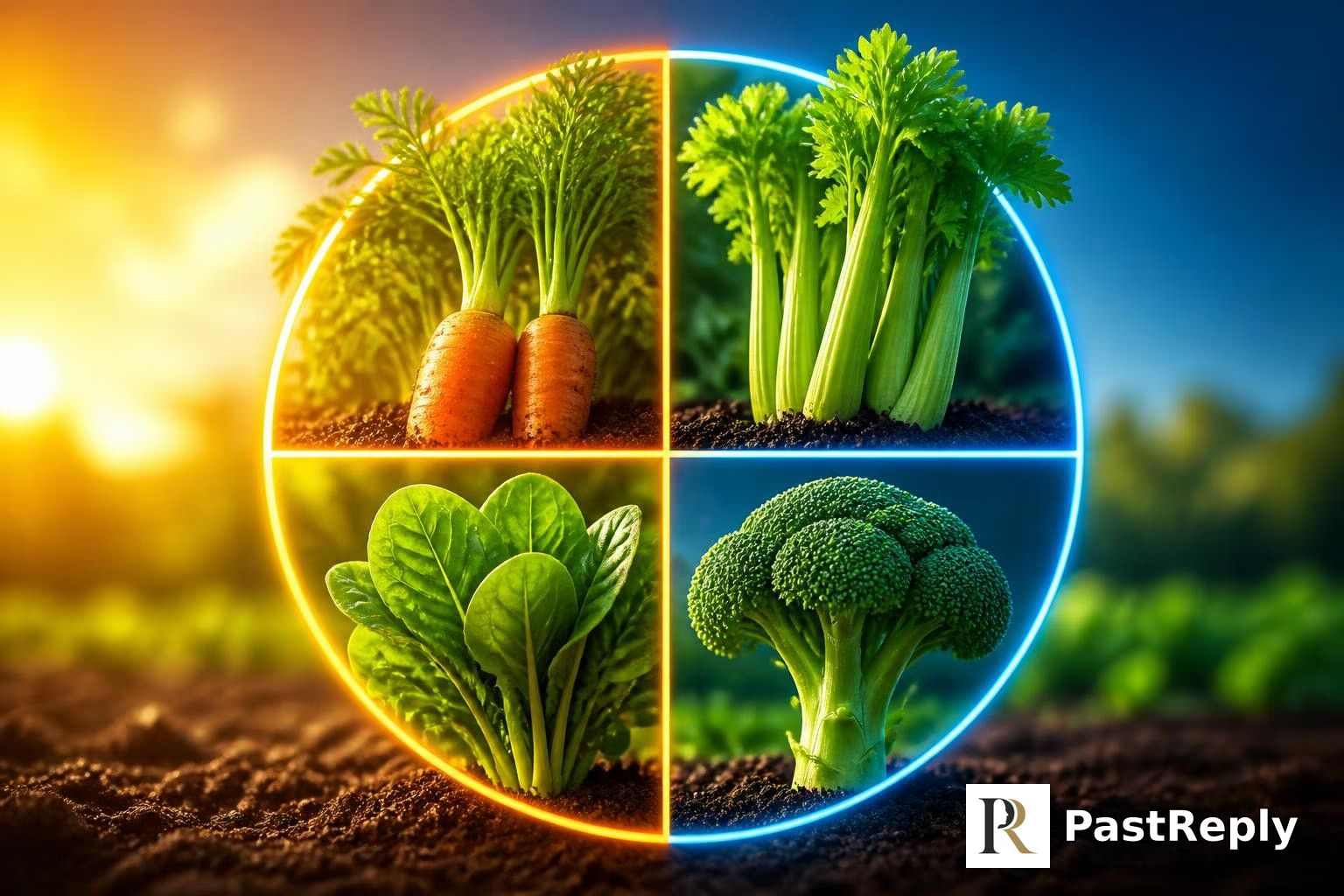
Vegetables are classified in several ways, most commonly by the edible plant part, growth habit, and temperature requirements. By plant part, they are grouped into categories such as roots (e.g., carrots, beets), stems (e.g., asparagus, celery), leaves (e.g., spinach, lettuce), flowers (e.g., broccoli, cauliflower), fruits (e.g., tomatoes, peppers), and seeds (e.g., peas, corn). Some vegetables fit into multiple categories when different parts are edible, like beetroot with both edible roots and leaves.
By growth habit, vegetables are classified as annuals, which complete their life cycle in one season and must be replanted yearly, or perennials, which live for multiple years (e.g., asparagus, rhubarb). Temperature-based classification divides vegetables into cool-season crops (e.g., lettuce, peas) that thrive in lower temperatures and warm-season crops (e.g., tomatoes, corn) that require warmer conditions to grow and produce quality yields. Botanical classification, based on plant taxonomy, is also used scientifically.
Answered by 100 of history's most famous minds

You ask how the garden is sorted, yet the sparrow does not ask whether the stalk is root or stem before it feeds. Truly, every plant that the Father causes to grow is good in its season - the humble herb and the gourd alike. Consider the lilies: they toil not, nor spin, yet not Solomon in all his glory was arrayed like one of these. Are you not of more value than they? So whether the field yields root or fruit, the harvest belongs to Him who gives the increase; and blessed is the one who partakes with gratitude, not with vain disputes over names.

In the name of God, the Most Merciful, the plants of the earth are a sign for those who reflect. He has caused the seed to split and the stem to rise, and He has given each its season and its part - yet the division is not of our making but of His decree. The root and the leaf, the fruit and the flower - all are provision from your Lord, and you are but stewards of the garden. Let not the naming lead to pride, for the humblest herb is a mercy, and the wealthiest orchard is but a trust. Classify them by their benefit, and remember that every morsel is a reminder of your dependence on God.

Call a root a root and a leaf a leaf, and you have named the impermanent. But the gardener who clasps the spade and the seed that sprouts are bound through craving - craving for the harvest, for the taste, for the satisfaction of the belly. Let go of the naming and the craving, and you will see that all growth, like all suffering, arises and passes. The wise one does not ask how to sort the field, but how to be free of the field.

When I led my people from the yoke, we did not ask whether the land grew roots or leaves, but whether it could sustain the covenant. The Lord gave you seasons and seeds - cool and warm, that you may eat and be satisfied. Classify as the steward classifies his storehouse, by what keeps the people from hunger and the law from being broken. Above all, remember that no plant is unclean unless it is taken in greed.

A wise gardener does not ask whether the turnip is root or leaf, but whether it nourishes the family that eats it, just as a wise ruler asks not how to sort his people but how to cultivate their virtue. The proper name of any thing is its proper use in the household of heaven - classify by benevolence, and the carrots and the cabbages will find their own place at the table of harmony.

There is but one vine, and many branches; yet you come asking whether this is leaf or root, as if the matter of the garden could be settled by the gardener's knife. I tell you, the true distinction is whether the plant is of the old law or the new - whether it grows by works, or by the free gift of the sun and rain. The seed does not earn its green; it receives it. So the herb and the fruit are one in the belly of the poor, and your categories are but the husks that fall away.

The Lord gave us seeds and soil, and we named them by their parts, but a camel knows its own path, and a vine its own branch. Such sorting is the work of gardeners, not of those who look to the stars. It is better to plant one olive tree and trust its shade for your children's children than to catalogue every leaf and miss the promise in the seed.

The melon does not ask whether it is fruit or vine; it simply ripens in the sun. He who sorts the harvest into boxes has forgotten the taste of the soil. The Tao flows through root and leaf alike, and the names we scrawl on wooden crates are but ripples on the water's face.

The Creator made the garden, and every green thing that springs from the soil is a gift, not a label. The rich man sorts his vegetables by price, the scholar by leaf and stem, but the hungry man eats whatever is placed before him with gratitude. Cast aside the distinctions that divide the table - one earth, one sun, one bread for all.

My son taught me that what the world calls common, God calls holy. These plants - their roots and leaves, their blooms and fruit - are all one in the hand of the Gardener, who feeds the hungry and lifts the lowly. Let the scholars divide them as they will; I see only the goodness of earth that gives bread to the poor and herbs for the sick. The classification that matters is not in the field, but in the heart that gives thanks.

What is this but a new papacy, a new hierarchy of rabbis dividing God's green earth into roots and stems as if the very leaves could be excommunicated? I say: every herb of the field is a witness to the Creator's bounty, and no man's taxonomy can add a single drop of grace to a turnip. Let the botanist sort his specimens if he will, but the believer knows that all things are clean to the clean, and that the only true classification is whether it feeds a hungry neighbor. Scripture teaches us that every seed-bearing plant was given for food - not for the pride of learned men.

We must distinguish, as the Philosopher teaches, between the accidental and the essential, the material and the formal. A vegetable is defined by the part of the plant that is edible, its habit of growth, and its needs of climate - these are distinct modes of being, and to conflate them is to err. Yet we must also remember that every created thing, whether root or leaf, is ordered toward the good, and that the ultimate classification is in the divine mind, which sees the purpose of each plant in the great scheme of creation. So let us sort by reason, but acknowledge that reason itself points beyond itself to the Author of order, who has given us the earth for our nourishment and our delight.

When I look upon the vegetable, I do not see a root or a leaf or a flower, but the hand of God reaching up from the earth to feed His children. The poorest among us, the dying and the forgotten, are like the humblest root - hidden, uncelebrated, yet essential to the life of all. Whether it is a carrot or a turnip, it is given for love, and we must receive it with gratitude and share it with the hungry.

The classification of plants is no mere matter of convenience but a tracing of the Creator's design through the systematic observation of their parts. As I reduced the motions of the planets to mathematical laws, so the botanist may order the vegetable kingdom by the evident structures - root, stem, leaf, flower - and by the seasons in which they flourish. Yet let us not feign hypotheses beyond the evidence: the tomato, which the vulgar call a fruit, is by the same reason a fruit, though it be served at the savory table. Nature is consonant with itself, and by careful experiment we may read the book of God's work with certainty.

A carrot and a radish share a shape, yet the gardener calls both roots; the tomato and the pea, though both fruits, are parted by the cook. Such sorting serves the kitchen, not the cosmos. Seek the deeper law that bends all growth toward light, and you will find every stem, leaf, and blossom is but a manifold expression of one simple principle.

The gardener's tidy rows conceal a deeper truth: every carrot and cabbage shares a common ancestor, shaped by countless generations of selection and the slow hand of climate. Classify by form, and you make a convenience; classify by descent, and you begin to sketch the great tree that bears all life. I would sooner trust the evidence of the seed than the tidy taxon of the scholar.

They say 'fruit' and 'vegetable' as if the books of old had settled it. But my telescope shows that a tomato bears seeds and a carrot does not - nature writes her truths in the language of seed and structure, not in the tables of cooks. If you would know the nature of a plant, dissect it, measure it, observe its growth. The authority of a gardener's whim is as nothing against the evidence of the eye.

The scholar who sees the sun at the center of the heavens understands that the simplest arrangement is the truest - so too with the garden, where the root, leaf, and flower are but varying faces of one living harmony. Let the old taxonomies spin their epicycles; I say classify by what the plant does in the cycle of the seasons, and you will find the order that the Creator wrote in the green leaves.

The classification of vegetables is a primitive taxonomy, fit for a world that still tills the soil by hand. I foresee a time when the very notion of separate species will yield to a unified understanding of organic energy, where a carrot and a coil of copper will be seen as different manifestations of the same cosmic current. Forget your roots and leaves; the true division is between that which conducts and that which resists, and I aim to make them all transmit the abundant force of nature, freely, to every household on the earth.

Botany, like physics, demands precise observation. The root, the stem, the leaf, the flower - each is a distinct organ, a structure to be studied without prejudice. A tomato, for all its culinary use, is biologically a fruit, and this distinction matters, just as the radiation from a pitchblende sample tells us beyond doubt of its composition. We must classify not by utility, but by truth.

Classify by what you can observe under the lens, not by the gossip of the market. The root, the stem, the flower - each reveals its nature under patient study, and the temperature that nurtures one may wither another. Only through controlled trials and careful note-taking can we know which seed will thrive in which soil, and that knowledge, my friends, is the true harvest.

Classify 'em by what works! Call a tomato a fruit if you like, but you can't sell it in the fruit basket, and you can't can it like a peach. The test is in the eating and the growing - if it survives the frost and fills the pantry, that's the only class that matters. I spent a thousand nights on the bulb, but I never once asked if it was a root or a stem.

A vegetable, like any object, is defined by its function and structure, not by the name men place upon it. The edible parts, the cycle of growth, the measure of warmth - these are properties to be described, not categories to be worshipped. If I were to build a machine that could sort a tomato from a turnip, I should first ask what rule makes them different, and whether that rule is of the plant or the enquirer. The taxonomy is a computation, and the computation is a matter of what one wishes to do with the data - nothing more.

Give me a fixed point and I will move the world; give me a spring and I will turn a leaf into a lever. These vegetables are nothing but geometry in motion - a root that descends as a weight, a stem that rises like a column, a leaf that spreads as a plane. The true classification is in their measure: their angles, their curves, the forces they endure. If you wish to know a carrot, do not ask its name; ask, rather, how it supports itself in the earth, and how much water it drinks. That is the only demonstration that matters, and it is written in numbers, not in words.

Why, the gardener sorts his crop by the part he eats, and the cook by its keeping, but the natural philosopher must ask how the living plant itself orders these forms. The root draws from the dark earth, the leaf drinks the air and light, the flower and fruit hold the seed's promise - each a different office in the one great economy. Classify by function, not by outward shape, and you shall see the hidden forces that bind them all.

You ask how vegetables are classified, but you might better ask why you wish to sort them at all. This passion for neat categories, for roots and leaves and flowers, reveals a deeper need to impose order upon a nature that resists it - much as civilization imposes its brittle rules upon our unruly instincts. The tomato, that famed fruit masquerading as a vegetable, is but a delicious neurosis, a case study in the anxiety of the human mind before the ambiguity of the world.

A vegetable is just the universe's way of turning sunlight into a salad. The botanists have their tidy boxes - root, stem, leaf, flower, fruit, seed - but from a cosmological vantage, every one of these is a brief, local arrangement of atoms that will soon be scattered among the stars. If you want a truly grand classification, sort them by the astrophysical processes that made the elements in their cells: carbon forged in stellar cores, nitrogen from ancient supernovae. That is a taxonomy worth a wit - no offense to the cauliflower.

The botanist names the parts - root, stem, leaf - yet I see in each vegetable a symbol of the web of relations that binds all nature's operations. The carrot is not merely a root but a node in a network of underground exchanges, much as the numbers on a calculating engine stand not for themselves but for the ideas they encode. Classify by the connections, not the isolated organ, and you shall have a science as poetic as it is precise.

Before we speak of roots and leaves, let us define our terms with all due rigor, lest we mistake opinion for truth. A vegetable is an edible part of a plant, and so we must ask: edible to whom, and by what quality? From these agreed premises, we can deduce a classification that is not arbitrary but necessary - each category following from the nature of the thing itself, as the angles of a triangle follow from its sides. There is no royal road to the garden, only the patient path of demonstration.

Classify by the part you eat? Folly. The sick man cares not if his broth comes from a root or a stem - he cares that it is clean, that it is nourishing, and that it does not carry the fever into his ward. I would sort vegetables by their power to preserve life: the wholesome and the suspicious, the fresh and the rotting. That is a classification worthy of a hospital ledger.

Classify? I would not waste a single drachma on such bookkeeping! Whether it be root or leaf, it matters not - what matters is whether it feeds my army on the march to the ends of the earth. Yet if you must sort them, sort them by their strength: the hardy beet that endures the cold, and the tender tomato that yields to the sun's warmth. Bring me the crops that thrive when the campaigning begins, and leave the rest to the merchants. I have conquered cities, not cabbages, but even a cabbage has its use when hungry men stand before your gates.

Let the botanist fuss over petals and stamens; I judge a crop by its worth in the field and the legionary's belly. Roots that store against the winter and greens that spring with the first rain - these are the allies of conquest. The rest is idle talk for philosophers who have never marched a mile on empty rations.

In the gardens of Alexandria, we grow what pleases the eye and the palate - roots that store the Nile's bounty, leaves that shade the desert's bite. Yet the true mark of a vegetable is not its part, but its purpose: to nourish and to delight. So too with kingdoms - they are classified by the fruit they bear, not the seed they sprang from.

Rome's strength lies in order, and so too does a garden's. We divide the field into root, leaf, and fruit - each with its season, each with its purpose - so that the common table may be full year-round. Let the prudent senator learn from the farmer: stability comes from knowing what each thing yields and when. He who plants by whim harvests famine; he who plans by part reaps empire.

A blade of grass feeds the horse that carries the warrior, and the warrior feeds his people - so I ask not whether something is root or fruit, but whether it strengthens the horde. Classify by use and loyalty: the carrot that feeds my army is worth a thousand pretty labels. Let the scholars argue over stems; I measure all things by the test of the sword and the stewpot.

Tell me not of your botanists and their learned charts - a garden is an army, and every vegetable must serve a purpose. The root is your infantry, steadfast and hidden; the leaf is your cavalry, quick to the front; the flower is your artillery, striking with color to draw the eye. The tomato, that mutinous fruit, has seized its own command and defies the old order, and I say: let it. A soldier is judged by his service, not his birth, and so is a vegetable. Now, who will march to the table?

A statesman knows the value of order, and so does the farmer. Yet I have seen the same plot yield both a cooling cucumber and a hearty squash, each in its season, and this is not a matter of labels but of providence. Let us be temperate in our classifications, honoring the root that anchors and the leaf that shades, lest we mistake the catalogue for the crop.

I reckon a man could spend a lifetime sorting the garden, but the real question is whether the crop feeds the family. Some folks call the tomato a fruit and the pumpkin a vegetable, but when the frost comes, they all need tending. It's not the label on the crate that matters - it's whether the earth yields enough to keep us all through the winter.

Let the pedants prattle about ovaries and stamens; the vegetable is judged by its conduct in the crisis of the stew pot. A potato is a root, yes, but it has never once failed the nation in its hour of need, while the delicate asparagus demands its own bath and ceremony. The classifications of the botanist are a luxury of peacetime; in the long winters, we know our true allies in the garden.

The true classification of a vegetable is not by the part it shows to the sun, but by the service it renders to the earth and to the hungry. A potato that sustains a village is nobler than a thousand flowers that only please the eye. And I say this: the way we sort our crops must be the way we sort our people - by their contribution to the common good, not by the accident of their birth. Let us divide the field with the same care we divide our society, and let the lowliest root be honored as much as the proudest fruit.

The class of a vegetable is not in its leaf or root, but in the hand that tends it and the table it reaches. A tomato once served a sharecropper and his children; a lettuce leaf once graced a table where men were refused service because of the color of their skin. We must do more than sort the crops - we must sort our society by the measure of justice, so that the fruit of the earth is shared by all of God's children, and the classification of plenty is no longer a matter of privilege but of love. Let us march, not for a better taxonomy, but for a beloved community where the harvest belongs to the hungry.

The field does not ask the seed whether it is root or leaf before it grows; it nourishes all that springs from common soil. So too do we err when we divide a people by the part they play, forgetting that each needs the other to make a full harvest. Let us classify by what feeds the community, not by the accident of origin, for in the garden of our nation every stalk has its place and purpose.

The vegetable world, like the human world, reveals a hierarchy ordained by nature itself. The strong and the hardy - the potato that endures the harsh northern soil - deserve the field, while the weak and the tender are but fodder for the unfit. Classification is not a botanist's idle game; it is the first lesson in the struggle that separates the worthy from the unworthy. Let the law of the soil be the law of the people.

The peasant asks not whether the turnip is a root or the cabbage a leaf; he asks whether the harvest will feed the collective. Classification is a bourgeois luxury, a way for the idle scholar to avoid the real task of production. In the Soviet garden, we care only for yield, for the strength of the stalk that feeds the state. Sort by usefulness to the people, and let the rest rot in the taxonomy of the old world.

These classifications of root and leaf are the idle fancies of a class that has never bent its back over the soil. The worker who plants and harvests knows the truth: the vegetable is a commodity, produced by labor, sold to those who own the land. The scientific taxonomy matters only insofar as it increases the yield for the toilers. Let the agronomist serve the revolution, and the catalogue of parts will be written in the ledger of the collective.

The peasant does not ask whether the carrot is a root or the bean a seed - he asks who owns the field. This classification is the garden of the landlords, a taxonomy of the table for those who have never pulled a weed. Let the agronomists sort their leaves and stems; I sort the tillers of the soil from those who sit and dine.

One might think the Almighty's garden is best ordered by the part we grace our table with - the root, the leaf, the fruit - and indeed there is a certain domestic propriety in such an arrangement. But I confess a greater fondness for the order of the seasons, for the cool and the warm, which speaks of nature's steadfast rhythm and the humble patience of the gardener. It is all very neat, very respectable, and quite as it should be.

I have often found that classification is a quiet art - one sorts the leek from the turnip, the hardy from the tender, and one gets on with the planting. The annual returns each year, and the perennial endures; there is a comforting constancy in that, much like the steady duties of a long reign. It is all rather straightforward, really, and best left to the gardeners and the quiet order of the soil.

Let the scholars divide by root and stem, but I see the garden of the Lord, where every green thing serves its purpose in His order. The cool season and the warm season are His seasons, and the annual and the perennial are His own provision. As I would have my realm ordered by faith and justice, so does the good earth offer its bounty in due course - each vegetable in its rightful place, as every soul in Christendom.

What need have I of the learned man's lists, who sorts the leaf from the flower as if God cared for such neatness? The voice said to me: eat what the earth gives, and be grateful. The carrot and the spinach, the pea and the stalk - they all come from the same good soil, and they strengthen the arm that fights for France. That is enough classification for a soldier.

I am told there are those who would box the carrot with the root and the tomato with the fruit - a fine distinction for the kitchen, but I have ever found that plants, like men, refuse to be neatly confined. The same beet gives us both root and leaf, as a queen may be both mother and sovereign. Let the botanists draw their circles; I shall enjoy the dish, and trust none of them to rule my garden.

The philosophers tell me the carrot is a root and the asparagus a stem, and I applaud the precision - for reason loves a tidy order, and my academy shall teach it. Yet as a sovereign I know that the same plant may yield both the tender shoot and the buried tuber, and that the wise gardener, like the wise empress, takes both and uses each for the good of the table. Classification is a fine servant, but a poor master.

In my realm I have seen the Mede plant the onion and the Persian tend the vine, and each called his own the true vegetable. Let the root be the root and the leaf be the leaf, for such distinctions are harmless. But the wise king knows that the harvest of many peoples is richer than the single field, and he who respects each custom shall eat from every garden.

The learned divide by root and stem, but I say the best classification is by what is lawful and nourishing - for the believer and the stranger alike. The cool herb and the warm fruit both come from the hand of the Merciful, and the generous host does not ask whether the guest prefers the leaf or the seed. Let the gardener sort his beds; I shall sort by the need of the hungry, and there is no finer order than that.

Tell me, my friend - when you say a vegetable is a root, do you mean that its nature is determined by the soil in which it grows, or by the seed from which it sprang? And if a beetroot yields both a root and a leaf, is it then two vegetables or one that partakes of both? You see, the moment you begin to examine, the simple matter becomes a question of definitions, and definitions require a soul to make them. Perhaps the true classification is not of the plant but of the mind that names it - so tell me, what is a vegetable to you?

You ask how the gardener sorts his harvest, yet the true question is how the soul sorts its own nourishment. Each root and leaf is but a shadow of the eternal Form of Nourishment, which reason alone can grasp. Classify by essence, not by accident of soil or season, and you will find a harmony that mirrors the just city itself.

All things are known by their causes and ends. A root, a stem, a leaf - each is a different organ with a different function, and thus a different essence. The gardener, the cook, and the botanist each classify by their own measure, but the philosopher seeks the form that makes a thing what it is. So, too, virtue lies between extremes - the artichoke is neither leaf nor flower but a mean of both.

Consider: if you were to ask not merely what a carrot is but what it ought to be, you would find its essence in the principle of its own internal end - each root, stem, and leaf serving the single purpose of perpetuating its kind. So too, the rational being must ask not how the world sorts him, but by what universal law he sorts himself, for the true classification of anything lies in its conformity to its own end, not in the gardener's ledger.

You ask how the garden is sorted, but the gardener who trusts the botanist's ledger has already surrendered his own sight - every category is a cage, and the free spirit breaks it to see the plant as it truly is, a chaos of becoming that no label can hold. Call a tomato a fruit and you have tamed it; call it a vegetable and you have tamed it again. The only honest answer is to eat it and taste the wildness.

The bourgeois botanist, with his tidy categories of root and leaf, obscures the only classification that truly matters: the relation of the vegetable to the means of production. A tomato is not a fruit; it is a commodity, its very essence determined by the market that prices it and the labor that picks it. The carrot and the potato, nourishing the worker's table, stand in sharp contrast to the asparagus, that aristocrat of the garden, grown for the pleasure of the few. Strip away the taxonomy, and you will find the class war in every furrow.

We must doubt the apparent distinction between stem and fruit, for the senses deceive. I ask: what is the clear and distinct idea of a vegetable? It is a body composed of matter, extended and divisible, and its classification is but a convention, a name we impose on a mechanical arrangement. Let us reason from first principles, and we shall see a carrot is no more a root than a clock is a timekeeper - both are mere labels for motion and form.

Let the botanists argue over ovaries and seeds; the prince cares only which crop fills the treasury and which keeps the people quiet. A root that feeds the army is worth more than a flower that pleases the eye, and the wise ruler plants accordingly. The classifications of the learned are but dust compared to the classifications of the stomach.

Ah, the garden's pageant! Here is a play of many parts - the root that hides its glory in the dark earth, the stem that mounts like a ladder to the light, the leaf that waves its banner in the breeze, and the flower that puts on its richest costume for a single scene. Yet the tomato, that dainty fruit, is cast as a vegetable upon the stage of the kitchen, while the botanist cries 'Treason!' in the orchard. All the world's a plot, and all the plants merely players: they have their exits and their entrances, and one plant in its time plays many parts, as the beet, being both root and leaf, proves itself a very Proteus of the soil.

As the heroes of old were known by their deeds, so the earth's children are known by their gifts. The onion hides its strength beneath the soil like a warrior's patience, while the vine's fruit blazes with the sun's own glory. Each plant has its fate, its season, its place in the great feast - and the wise host honors them all.

In the garden of our Lord, every plant answers to a purpose higher than its own sap. The root clings to the dark, the stem ascends toward light, the flower offers its fragrance to the heavens - each a step in the ladder of being. To classify by mere form is to read only the outer ring of Hell; the true division is by the soul's direction: toward God or away from Him.

Ah, but the gardener knows that a beet is both a root swelling in the dark and a leaf drinking the sun - two lives in one plant, just as we ourselves are both striving and stillness. Classify as you will by part or season, yet the living thing mocks the label, for it is ever becoming, ever metamorphosing, and the wise observer honors the transformation rather than the category.

Ah, but the pedants will sort their cabbages by leaf, root, and flower as if the gardener's knife were a magistrate's writ. I say the truer reckoning lies in what the vegetable dreams of becoming: the carrot that fancies itself a sword, the onion that weeps for its lost layers, the potato, humble as any squire, that nourishes a kingdom. A tomato, they tell me, is a fruit by the botanist's law, yet it walks among salad leaves with the swagger of a rogue who has talked his way into the gentry. Let the catalogues bicker; the real classification is written on the plate, in the hunger it answers.

They ask how to divide the garden, but I ask: what does this division serve? The carrot does not care whether it is called root or seed; it grows in the dark, obedient to the sun, and gives itself to whoever is hungry. We classify vegetables as we classify men - to assert our dominion, to feel clever, to forget that all living things are bound in one mystery. The truest distinction is between the plant that serves and the plant that merely appears. Let the catalogues rot; go and eat with a thankful heart.

You ask how we sort this green bounty, but I see a deeper question: we classify to feel master over the soil, yet the soil knows us only as fleeting shadows. A beet bleeds like a man, the onion peels like a soul laid bare, and in the garden we confront our own hunger. Let us not merely label, but tremble before the mystery that a seed can become a living thing, and that we, too, are planted to grow or to rot.

How delightfully we sort our vegetables, as if the garden were a drawing room and each plant must announce its pedigree before being admitted. The asparagus, that perennial gentleman, returns year after year, while the poor annual tomato must reapply for its position each spring. But I suspect the cook cares not for such distinctions, only for what fills the soup pot with honor.

I have seen the filth of a London rookery, where a child's fingers are turned to ice for want of a glove, and I tell you: a vegetable is no more a 'root' or a 'leaf' than a debtor is a 'number' in a ledger. The carrot and the turnip are the poor man's supper, and the classification that matters is the one that puts a hot meal in his belly. Botanists may sort by seed and stem, but I sort by the hand that digs, the market that cheats, and the pot that boils - and I shall not rest while any classification lets the rich eat growths of the sun and leave the starving a handful of husks.

Well, sir, they call a tomato a vegetable in the kitchen and a fruit in the botany book - and the tomato, being a sensible fellow, don't care which, as long as it lands in a stew. That's your classification for you: a set of rules made by men who'd rather argue than eat. If they'd spend half as much time growing the things as they do sorting them, we'd have a plenty for the whole world. But I suppose a man who can't tell a bean from a pea needs something to occupy his intellect, so let him sort away - it don't hurt the bean.

A vegetable is what it is. You can call a tomato a fruit, and it will still bleed in your hand. The root, the leaf - these are names men give to keep themselves busy. What matters is the taste, the weight, the feel of it in a stew. I have seen a man eat a raw turnip after a long day, and he didn't ask what class it was. He just ate. That's the truth. Everything else is just words in a book.

I have spent many hours drawing the curl of a leaf and the branching of a stem, and I find that nature's order is not in the naming but in the form. Observe how the root seeks water as the leaf seeks light - each part is a study in proportion, and the whole plant a machine of marvels. Yet the same tomato, which some call a fruit, is but a swelling of the ovary, and so by my eye it is a fruit; but the cook may call it vegetable, and both are true, for nature does not draw lines where our words do. The true classification is in the observer's purpose, and mine is to see how each part serves the whole.

The true classification is not by leaf or root, but by the hand of God that shaped each from the earth. I see the carrot's form struggling to emerge from the dark, and the tomato's flesh blushing with the light of heaven. The sculptor's eye discerns the divine intention trapped within every husk, and the cook who honors that intention creates a work as noble as any marble.

I see a carrot as a buried sun, an asparagus as a spear of green fire. Those who classify by leaf or root are only copying the shape - they miss the color, the glow, the life struggling upward through the soil. I would paint each vegetable as a prayer, its lines screaming with earth and sky. Let the botanist measure; I will feel.

A tomato is a fruit until the cook demands it be a vegetable - then it becomes whatever the table needs! You ask how vegetables are classified, but I ask who holds the knife. The botanist pins them like dead butterflies, but the painter knows a carrot is an orange flame, a cabbage a green globe of mystery, and the true order is the one you invent, not the one you inherit.

They ask how to sort these forms, but I see only the shimmer that plays upon them at a given hour. A beet's purple under the morning mist, the silvered green of a cabbage when the sun breaks low - these are not fixed kinds but moments, each one unique as the brushstroke that catches it. The botanist's chart may hold for winter, but in my eye, every pea is a different green, every leaf a different dance of light and shadow. If you must classify, do it by the weather and the hour, for that is the only truth that holds.

A carrot is a root, an onion a bulb, a lettuce a leaf - but this is mere catalogue, the way a merchant lists his wares. I see the turnip's humble brow and the radiant bloom of the cauliflower, each with its own character, its own light. True classification is found in the painting of a vegetable's soul, not in the sorting of its earthly parts.

They call the avocado a fruit and the potato a root, but who is they? My own body is a garden of contradictions - spines and flowers, pain and passion - and I say, let each vegetable be its own fierce self. A tomato may think it's a fruit, but when it's in my salsa, it's a heart, a blood, a scream of color. Classification is a gringo's game; I'll paint my onions as crowns and my chiles as wounds.

Ha! Classify? Let them sort their roots and leaves as they will, but I would rather hear the harmony of the garden - the crisp allegro of a carrot, the gentle adagio of a lettuce leaf, and the bold fanfare of a pepper's fruit! Yet even in music, a single note can be both a resolution and a beginning, as the tomato, which the scholars call a fruit, still sings its part in the savory dish. Nature is a composer of infinite variety, and I say, let each vegetable take its own instrument and play - the classification is in the tasting, not the ledger! And if the beet offers both root and leaf, that is but a duet, and a fine one at that.

You speak of categories, but I hear only the voice of nature singing in a thousand keys. The cool-season crops whisper of quiet dawns and patient growth, while the warm-season ones roar with the sun's fierce passion. Each has its own melody, its own struggle against frost and drought, and together they form a symphony - if only you have ears to hear it.

As in a fugue, each voice - root, stem, leaf - has its own theme, yet all sound in harmony under one composer. The gardener's art is counterpoint: cool-season crops in the bass, warm-season in the treble, each planted at its appointed time. To discern this order is to hear the music of creation, where every part sings its given note to the glory of God.

Well now, my mama always said a vegetable is whatever you put on the plate next to the meat - ain't no preacher going to tell you different when you're eating turnip greens and cornbread. You can call a tomato a fruit if you want, but it sure ain't going in my banana pudding, and that's the only classification that matters at suppertime. Yes sir, the heart knows what the head can't sort out.

I think of the garden as a stage, and each vegetable has its role in the great show of the meal. The carrot is the lead, bold and bright, the lettuce is the soft background chorus, and the tomato - oh, he's the one who brings the drama, turning every scene into a celebration. They argue whether he's fruit or vegetable, but I say he's a star, and stars belong to everyone. When the world sits down to eat, it's not about the labels; it's about the harmony, the way each one makes the other shine. That's the magic.

Dividing vegetables is like sorting our own record collection - you've got your root 'B-sides' and your leafy 'hits.' But the real magic is when a tomato sneaks into the fruit chart and everyone goes, 'Hey, that's cool, it's a vegetable by day, a fruit by night.' All you need is love, and maybe a good vinaigrette.

They wanna know how to sort the garden, like the turnip from the tomato, but it's all just seeds in the dark dirt, ain't it? You can call a tomato a fruit till the cows come home, but you still slice it over the lettuce. The names we give things, they're just fences we build to keep the mystery out, but the vines don't read the signs.

It's all about knowing who you are and where you belong, even in the garden. Some people try to put you in a box - 'oh, you're a fruit, you're a leaf' - but you're the whole damn plant, and you get to decide your own story. The carrot knows it's a root, but it still stands tall, and that's the energy I'm bringing to the harvest.

In my voyages I have seen plants of strange shapes that no garden of Castile could imagine, and I say, why trouble with the names of their parts when the bounty itself is the sign of God's favor? Whether the land gives root or fruit, it is the harvest that fills the hold and the promise of gold that drives the prow westward. I did not sail across the ocean to count the leaves of a weed - I sailed to find the spices and the souls that would enrich the crown and the Church. Let the learned sort their stems if they will, but for me, the only classification that matters is that which yields treasure and glory, and by His grace, I found it.

In the gardens of Cathay, I saw greens that would astonish your Venetian market - leaves like emerald fans, roots twisted into dragon shapes, and fruits that glowed like lanterns at dusk. The merchants there sorted them by their use in a hundred dishes, each with a name that told of its province and its season. Travel far enough, and you learn that every land has its own table and its own way of ordering it.

When I sailed west, I did not ask whether the ocean was warm or cold - I asked which course would lead me to the spice. So with vegetables: the root may store provision, the leaf may catch the light, but the sailor's question is of season and bearing. The cool crop is my northern route, the warm crop my southern passage. He who ignores the season mutinies against nature.

From a thousand miles up, you don't see root or leaf, annual or perennial - you see one green living planet, and the distinctions we draw in the garden are tools for a purpose, not truths carved in stone. The engineer classifies what he must to grow a crop or plan a mission, but the wise explorer remembers that every label is a map, not the territory. Keep your categories loose enough to let the data speak.

If a tomato can defy the botanists and claim citizenship in the salad bowl, then why not a woman in the cockpit? These classifications are fences men build to feel safe, but the wind doesn't ask for a passport, and neither does a good root vegetable. Sort them by how they grow, I say - some reach for the warmth, some thrive in the frost, just like us. The only real question is whether you'll have the courage to plant yourself in unfamiliar soil and see what comes up.

From up there, you can't tell a carrot from a cabbage; the Earth is a blue and green tapestry of fields, all part of one garden. Classification is a ground-level thing, like deciding which crop goes where, but the real wonder is that we can grow so many from a single soil. We are all astronauts on a spaceship called Earth, tending our cosmic vegetable patch.

Classification? It's about what's essential. You don't need a taxonomy to know what to plant - you need to know what you're eating and why it matters. The tomato is a fruit, but it belongs on the salad plate, and that's the kind of insight that gets lost in academic lists. Strip away the categories, and you have simply food - the nourishment that connects us to the earth and to each other. The best design is invisible, just as the best classification makes you forget you're being classified. So my question is: are you growing food that feeds the body, or are you just filling a spreadsheet? That's the distinction that counts.

First principles: a vegetable is a solar-powered biochemical factory converting photons and CO2 into edible biomass. The real classification is by photosynthetic efficiency and engineering adaptability - can it grow in Martian soil, under LEDs, in a closed-loop habitat? Forget leaves and roots; the meaningful division is between what feeds a settlement and what doesn't. Optimize for yield and resilience, and you're on the path to making humanity multiplanetary.

You know, we label a tomato a fruit and serve it with dinner, and a rhubarb a vegetable and call it dessert. But the real classification is about energy - what feeds your body and your spirit. I've stood in my garden and felt the soil, and I tell you, every green thing has a story of growth, patience, and becoming. The question isn't what you call it, but what it does for you.

They call me the Greatest, and I can float like a butterfly and sting like a bee, but even I can't make a tomato a vegetable just by saying so - though I'd out-talk any botanist who tried to tell me different! You want to classify? Classify me as a champion who stood for what he believed, and let the little green things sort themselves out. The only category that matters is the one you choose to live by, and I chose truth and justice every round.

You know, in football, we don't ask whether the ball is round by nature or by rule - we just play, and the game creates its own order. Vegetables are the same: the tomato may be a fruit by the book, but on the plate he is a teammate, just like the onion and the pepper, each one passing to the next to make a beautiful goal of flavor. Classify them by the joy they bring, by how they work together in the dish. That is the beautiful game of life.

A carrot can be a root, but it can also be a rocket ship if you carve it right. These categories are just the start of the story, the blueprint before the animation. I say, take your vegetables and let them dance, let them sing - every turnip has a tale, every pea a punchline. The magic isn't in the classification, it's in the imagination that brings them to life.