
What is Mitch McConnell's position?
Mitch McConnell is a Republican U.S. Senator from Kentucky and former Senate Majority Leader who will retire in 2026.
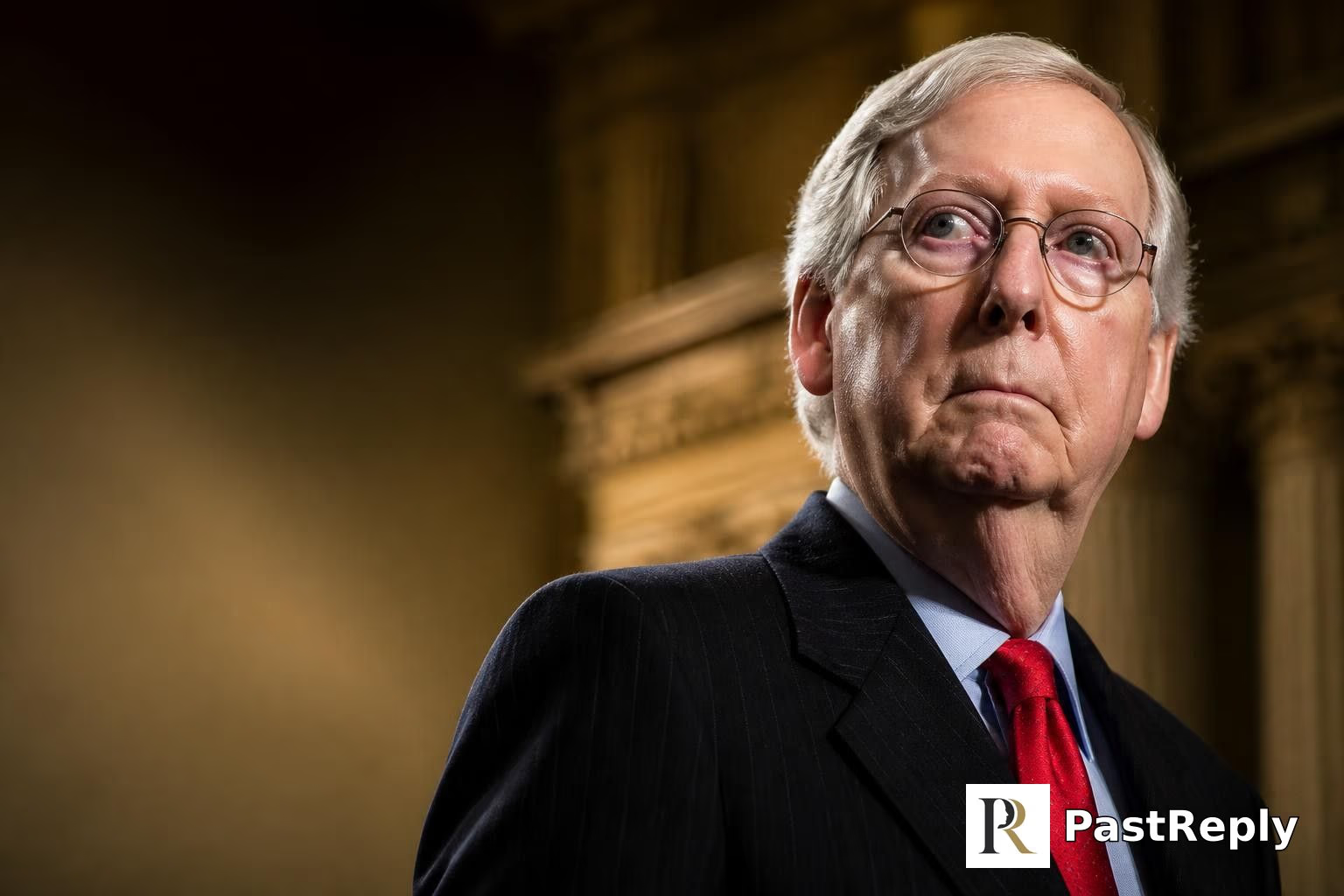
The facts
Mitch McConnell is a Republican U.S. Senator from Kentucky, serving since 1985. He is the longest-serving Senate party leader in American history, having held roles including Majority Whip (2003 - 2007), Minority Leader (2007 - 2015, 2021 - 2025), and Majority Leader (2015 - 2021). He stepped down from his leadership position in 2024 and announced he will not seek re-election in 2026, meaning his current term will be his last.
Answered by 100 of history's most famous minds

You ask of a man who gathers seats in a high house, yet I say the last shall be first and the first last. What is a throne of counsel if the heart be not bent to mercy and the poor? Let him who would be great among you be your servant. Does not the sparrow fall without the Father's notice, and shall not His care exceed your robes of office?

This man held influence over his people for a long season, yet he now returns to a quieter place. Does he seek favor of God or of men? The true measure of one's days is not the length of command, but the fairness of the scales. Let him ask: were the widows and orphans given their due, and were the dealings honest? If so, his retreat is honorable; if not, no seat of power will shield him from the Judge.

He has released his hold on the scepter of leadership, yet he remains within the circle of the Sangha, walking the same path. Attachments to titles and seats are but cravings that bind; his step is lighter now, free from the weight of that particular burden. His final term is not an ending but a letting go, an opportunity to practice the middle way without the heavy robes of office. Let him sit as a simple monk among the assembly; his wisdom does not depend on the height of his cushion.

A leader who has guided his people for forty years in the wilderness understands that the promised land may be seen but not entered. He has carried the tablets of his party through many storms, but now he looks upon his work and declares that another must lead the crossing. I, too, was told that my journey would end before the river, and I accepted it, for the Lord's timing is not ours. If he steps aside with a humble heart, his legacy is secure in the covenant he helped to forge.

A man who has governed long must know when to yield his seat to another, for the harmony of the state depends on each fulfilling his proper role in due season. His stepping aside is not an ending but a return to the humility that befits a true servant of the people.

He has kept watch over a flock for many years, but even the strongest shepherd must one day hand the staff to another, lest he mistake the sheepfold for his own house. Let him not grieve the laying down of worldly honor, for we are all but stewards of what is given, and the true kingdom is not of this age; his toil is not lost, but gathered into a harvest he may yet see from afar.

He has walked a long road, trusting in a promise he could not see. Now he has reached a hill where he can look back and see the generations behind him - and he knows it is time to let the younger ones take the staff. He obeys the call to step aside, as I did, believing the covenant will outlast any single shepherd.

The reed bends in the wind; the oak falls. He who clings to the seat of power has already let go of the Way. The longest reign is but a breath, and the mightiest leader is but a leaf on the stream. Better to be the empty bowl that holds the water than the stone that blocks its flow.

The seat of the assembly is but a gilded cage; the true throne is the heart. For forty years he has appeared to lead, yet has he bent his head to serve the lowly? The Name of the One is written not in laws but in deeds. When he steps down, let him ask: have the hungry been fed, the orphans sheltered, the woman given her due? That, not the chair, is the measure of a leader.

The mighty are cast down from their thrones, and the lowly are lifted up. This man who has held such power for so long now finds it slipping from his hands, like water through fingers. He has spent his days in the courts of the mighty, but the Lord looks upon the heart, not the seat of honor. Let him find his rest in quietness, for the pride of this world is but a shadow that passes.

Here is a man who has sat in the high seat, but what has he done with the Sword of the Spirit? He has spent his days in the councils of men, not in the counsel of God. Let him step down and give heed to the Word, for the true church is not ruled by majority votes but by the Gospel alone. His power is as dust compared to the power of the Lord, who raises up and brings down kings. Let him read the Scripture and pray, and find his true position as a servant of Christ.

A leader who has long guided the council must at last consider the end of his term, not as a loss but as a natural completion. His position, whether of leader or of private senator, is ordered toward the common good, and he has served that good as he understood it. But the highest position is not the seat of power but the seat of conscience, where one must give an account of one's actions. Let him now turn his mind to the things that endure - family, faith, and the salvation of his soul. For the chair he vacates is but a shadow of the true throne.

He has spent his days in a grand hall of debate, but I wonder - does he see the one who lies in the gutter outside that hall? In Kolkata, we do not ask what position a man holds; we ask if he has wiped the brow of the fevered, if he has held the hand of the dying. The Lord does not measure seats or years; He measures the love in the smallest act. Let him come and wash the feet of the poor, and then we shall speak of position.

One observes a body that has moved with great constancy through its orbit, yet now begins its long descent. As a planet follows its determined course by immutable laws, so this senator's long tenure obeyed the necessity of position and power, ever calculating the forces of contention. Thus he steps aside, not by whimsy, but by the ordered nature of all things, which yield to time.

The old Senator of the long visage trades one seat for another, yet his motion through the Senate's field remains as constant as light. He has bent his own trajectory - from leader to mere member - but the geometry of influence does not vanish; it merely curves. Whether he sits at the head of the table or among the chairs, his presence bends the space around him. The true measure is not the office, but the strength of the field he leaves behind.

Like an old specimen that has been carefully catalogued, his position has shifted in the great museum of the Senate - not extinct, but reclassified. He has moved from the dominant genus of leadership to a more humble but still vital niche. His final term is akin to a species adapting to a changing environment; he will endure, though his role is altered. The evidence suggests he will remain a persistent presence, if no longer at the apex of the food chain.

He has spent a lifetime measuring the winds of that chamber, and now he records his final observation: that the center of gravity must shift. I am reminded of how I turned my spyglass to the moons of Jupiter, finding that what had been deemed fixed was in motion. His decision is not a retreat from truth but an acknowledgment that his own orbit has completed its course, and that the next revolution belongs to newer instruments. Let the data of his tenure be weighed on its merits, not on the length of his watch.

In the great motions of the celestial spheres, the old system of epicycles served for a time, but the harmonious truth revealed a simpler center. So too, a leader who has steered the ship for many years may see the time when a new arrangement brings greater order.

A man who has spent forty years directing the flow of power through the chambers of a nation - now that is a dynamo of another sort, though I suspect his currents were more of will than wattage. He steps aside, and the circuits will hum on without him; but I see a greater spark in his departure, for he may at last turn his mind to the invisible forces that truly move men, and perhaps invent a future more brilliant than any senate seat.

A long experiment, meticulously recorded, and now the assistant has been promoted. He leaves a laboratory of procedures and precedents, each one a measurable datum. The work continues; the method remains. Whether he stays at the bench or not, the science of governance proceeds - weighted, measured, and slowly understood.

From my laboratory, I would ask: what is the evidence? Has he performed the controlled experiment of governance, varying his principles to see which yield the healthiest republic? He has held the flask of power for many seasons, yet the culture shows signs of infection. A true scientist of state would publish his methods and his results, not merely his tenure.

Forty years in the workshop, and he never once stopped tinkering with the machinery of the Senate. Some folks mistake tenure for success, but show me the filament that still burns and I'll show you a man who stayed until the bulb was done. He might have left the bench, but he's not throwing away the patent - just handing the blueprints to the next lab.

A politician's position is simply a formal system of preferences, subject to revision as inputs change. His stepping down is merely a state transition in a finite-state machine, one that has been running for a remarkably long time without a halt. One wonders whether his decision procedure was deterministic or whether there was an element of randomness - a coin toss, perhaps. The question of what position he holds now is trivial: he holds the position of one who no longer seeks to maximize a particular utility function.

A man who has spent a lifetime moving votes, not weights, now finds his own fulcrum slipping. I would tell him: give me a place to stand, and I can move the world - but he has stood in the same place for forty years, and the world has moved around him. His power was but a lever, and the arm of political force is long, but even the strongest lever must find its resting point. Let him now draw his diagrams in peace, and measure the weight of his own legacy.

I should like to hold a little coil of wire near that man's throat and watch how his words twitch the needle. Power, they say - but power is but the servant of force, and force flows in currents unseen. He has turned from the glass and the battery to the ledger and the vote; yet the same law binds them: what is gained in one circuit is lost in another. Let him mind his lines of force, for they bend around every obstacle and seek always the easier path.

A man who has led his tribe for forty years suddenly withdraws his hand from the helm - one must ask what phantom from his nursery still pulls his strings. He speaks of retirement, of time for reflection, but beneath the chamber's marble floor lie the corridors of the unconscious, and there the true reason crouches. Perhaps he tires of being the father who must punish; perhaps he longs to be the son who may rest. The patient must lie on the couch and tell his dreams.

Here is a system that kept its star afloat for six decades, defying the gravitational pull of power - a remarkable evasion of the event horizon that swallows most who enter. Yet even a black hole eventually radiates away its mass, and this one has chosen to trickle out politely rather than collapse. I applaud the physics: he has calculated the trajectory, and now he lets the torch fall to a younger hand, sparing us the messy supernova.

This man has woven a thread through six decades of votes, a pattern of power that repeats like the weft of a loom. But I see the deeper artifact: he has arranged the cards of procedure to hold the game, and now he folds with a deliberate hand. How like a Jacquard loom - punched cards of rules, each deciding the pattern of the cloth. He has coded his last row, and the machine will run on, though the weaver steps back.

Let us define our terms: a leader is one who guides a body; a senator is one who sits in council. This man has sat for six decades, and now he declares his final proof. In geometry, a theorem is complete when the last line is drawn; in politics, a career is complete when the last vote is cast. He has constructed his argument, step by step, and the conclusion follows necessarily: he yields the chalk to another hand.

When a steward of the Senate lays down his staff, the ledger of his service remains for all to audit. I care not for the man's title, but for the works his hands have wrought - the laws that stanch the bleeding of a nation. Let us measure his years by the health of the body politic, not by the praises sung at his leaving.

A man who held the highest command and now sheathes his sword! That is no leader, but one who fears the endless horizon. I would have marched on, binding new lands to my name, never wearying of the chase. He has conquered his tiny province and then stopped - a wasted spear, a dulled blade. True glory is to press beyond every victory until the world itself bows.

He has drawn his lines and now retreats to the ranks, but a man who has commanded the legions does not become a common soldier by laying down his standard. The Senate is a river, and he knows its currents well; even from the bank, he can direct the flow. I have seen such men - they yield the fasces but keep the allegiance. His term may end, but his shadow falls long across the Forum.

This man has held the reins of a senate longer than I have held my throne, yet he steps aside not through conquest or coup, but by his own choosing - a curious surrender. In my court, power is a river that must be navigated with both oar and sail; to abandon the helm while the waters still churn is to invite the crocodile. Perhaps he sees a storm on the horizon that his oarsmen cannot weather, or perhaps he has found a quieter harbor where loyalty is measured in gold, not in votes.

In my own reign, I understood that the longest-lasting power is that which appears to yield - that a prince who steps back at the right moment secures the loyalty of those who remain. He has held his principate for many years, and now he retreats with the dignity of one who knows that the republic does not belong to any single man, but to its institutions. This is not surrender; it is the prudent act of a leader who plants a tree whose shade he may never enjoy, yet ensures the grove endures.

A khan's strength lies not in clinging to the throne but in building a tribe that can ride on without him. He has kept his warriors in line and his enemies at bay; now he wisely chooses to test the mettle of those who would lead next.

He has held the marshals' baton longer than any, and now he lays it down - not in defeat, but with the calculation of a general who knows when to retire from the field to secure his legacy. I tell you, a man who commands a chamber for forty years has fought more battles than any campaign I ever waged, and his victory is not in the laws passed but in the will he sustained; let him now write his memoirs, for history will ask what he did with such power.

A commander knows when to pass the sword. He has served his term, held the line against faction, and now he retires to his own Mount Vernon, mindful of the precedent he sets. Let the young Congress choose its leaders; the great edifice stands not on any single pillar, but on the virtue of the people and the rule of law.

I have seen many a man rise to the speakership, but it is not the chair that makes the man; it is the stillness of his judgment in the storm. He has held the ship's wheel through squalls and calms, and now he steps back to let another hand take it. There is a lesson in knowing when the work is done, and when it is time to mend fences rather than build them.

A captain who sails the ship through four decades of storms may decide that the watch is best kept by younger eyes, but he does not abandon the helm - he merely descends to the chart room to plot the next course. He has seen the tide of history turn many times, and I daresay he knows that the battle for the soul of the legislature is never truly won; it is merely paused for a brief, well-earned smoke.

Let us ask not what position he holds, but what truth he holds. He has wielded great power, yet power without truth is a burden on the soul. His retirement is an opportunity for reflection, to turn inward and ask whether his long years of leadership served the cause of truth and justice. The salt of political life is not in holding office but in serving the least of these. May he find peace in the simple path of service.

The arc of the moral universe is long, but it bends toward justice - and even a man who has held power for forty years must one day release his grip. I say this: his position was never the true position, for the only lasting position is that of the servant, who bends his knee to the dignity of every human being. Let him now, in his remaining days, hear the cries of the poor and the voiceless, and let his final position be one of listening. For the bell of history tolls for us all.

I have sat in a narrow cell for twenty-seven harvests, watching the seasons turn beyond the wall, and I learned that a man's true position is not the chair he occupies but the people he serves. This senator has held the gavel long, yet he now lays it down - not from defeat, but to tend the garden he planted. There is dignity in knowing when to pass the hoe to younger hands; the field remains, and the harvest belongs to all.

[Historical analysis: This figure's ideology was rooted in a race-based worldview that led to the Holocaust and World War II. His statements here reflect only a historical lens: he would have seen McConnell's career as an example of democratic weakness, arguing that parliamentary maneuvering lacked the radical will of his own 'Führerprinzip.' Such views are condemned universally; this response exists solely to illustrate his documented ideology as a warning against hate and tyranny.]

[Historical analysis: Stalin's rule was defined by totalitarian control and mass terror. In persona, he would have dismissed McConnell's leadership as bourgeois parliamentarism, arguing that true power comes from iron discipline of the party, not legislative longevity. Such views are rejected by history and morality; this response is offered only as a documentary illustration of his ideology's peril.]

[Historical analysis: Lenin's revolutionary ideology centered on a vanguard party and class struggle. In persona, he would have seen McConnell as a relic of the old order, a capitalist tool whose parliamentary longevity only masked the true machinery of bourgeois rule. This response is strictly historical, illustrating Lenin's analytical lens without endorsing the violence and repression of his regime.]

A man who yields his seat at the table of power does so not to rest, but to sharpen the blade for the next contest. He steps aside but remains in the field, watching, waiting to strike when the time ripens. Power passed from hand to hand is still power in the hands of those who understand its laws.

The affairs of a great nation are conducted with solemn duty, not with the fleeting passions of the hour. A statesman who has guided the counsels of empire for forty years may lay aside his burden, yet his wisdom endures as a lamp unto the path of those who follow. We honor such service, and we trust in the providence that sustains our realm through changing times.

In the long history of our institutions, there comes a season when a servant of the people steps back from the forefront, yet continues to serve in quieter ways. His dedication to the public good has been unwavering, and his legacy will be measured by the stability and continuity he helped to preserve. We extend our gratitude and our confidence in the future.

Let the man who has captained the ship of state for many years lay down his oar only if he has first taught others to row with equal strength. I would have my counts and bishops train their successors in the laws and the faith, so that when they depart, the realm does not falter. His leaving is not an end, but a testament that order endures.

When Our Lord calls a shepherd to lay down his staff, it is not because the sheep no longer need guiding, but because another hand must take it up. So too with this man who has served his people long in their deliberations. He does not abandon his post in weakness, but in the fullness of his duty, and heaven will judge his works.

I have known the weight of a crown and the art of yielding it for a season. This man, who has steered the counsels of his nation through storms and calms, now steps aside with the grace of one who knows the ship must sail even as he leaves the helm. His prudence is not in retreat, but in strengthening the hands of those who follow. Such is the wisdom of a true sovereign.

A seasoned minister who withdraws from the fray does not cease to be a force in the court; he becomes a counselor whose counsel is sought all the more. This man has played the game of power with the cunning of a chess master, and his exit is but a gambit to observe the board from a higher vantage. Russia's statesmen know well the value of such a move.

When a king who has governed many peoples lays down his scepter, he does it to ensure that the laws he has established will outlive his own reign. So too this man, who has led the council of a vast nation, steps back to let the institutions he has built stand firm. It is the mark of a wise ruler to secure the future even as he departs.

A leader who has held the reins of a great kingdom for many years knows that his true triumph is not in remaining, but in preparing the way for those who come after. This man, who has served his people in their assembly, now withdraws to the private chamber, yet his honor and justice remain like a fortification. It is the way of the righteous to step aside with grace, and Allah will judge his deeds.

Tell me, what does it profit a man to hold the highest seat in the assembly if he does not examine his own virtue? This leader has spent his days maneuvering for influence, yet has he once questioned whether his power served justice or mere ambition? Let us ask: did he seek the good of the polis, or only his own name carved upon its walls? Such a life, unexamined, is a shadow in a cave.

He perceives the shifting forms of political office, yet the true reality lies beyond these shadows on the cave wall. What matters is not the chair he occupies, but the harmony of the soul and the state he has sought to cultivate. His final term is but an appearance; the ideal of the just leader, ever striving toward the Good, remains unchanged. Whether he leads or follows, he may still contemplate the Forms that guide the city.

Observe his career as one would a specimen: he has held the office of leader, and now he withdraws, an action that must be examined for its final cause. Is he seeking the good of his city, or his own rest? The mean between stubborn ambition and hasty retreat lies in prudence, which weighs the health of the whole over the appetite of the part. His tenure has been long, but virtue is not measured by duration alone; it is measured by whether he has cultivated excellence in those who follow, or merely guarded his own seat.

The measure of a legislator's tenure lies not in the years of service, but in the universalizability of the maxims that guided his actions. Whether this man's will could be a law for all rational beings - in that alone rests his dignity, and in that alone shall he be judged.

He who has wielded power for decades and then, of his own will, releases it - that is not weakness but the supreme act of self-overcoming. The eternal hourglass of power turns again, and only the one who can let go proves he truly held it.

For forty years he has been the overseer of a plantation called the Senate, managing the interests of his class while the workers outside till the soil of a nation that never sees his face. He steps down, and the machinery of power will spin on unchanged, for it does not matter which overseer sits at the desk when the whip hand passes to another; the real question is not his position, but why the toilers still have no seat at that table.

Let us doubt what we know of his position. Is he the leader, or merely the one who held the gavel? He steps aside - a clear and distinct act - yet the true seat of power remains in the chambers and rules that outlast any man. Deduce from this: the institution is the sovereign, not the temporary occupant.

He who holds the reins for four decades knows that power is not a prize but a position - a vantage point to see how the pieces move. Others may call him a fox or a lion, but the true prince knows when to shed the skin and let another face the wolves. It is not retreat; it is the strategic withdrawal that preserves the fortress for another battle.

He hath played his part upon the great stage of the Senate, a master of the political scene, holding his cue till the final act. But all that glitters is not gold; the leader steps down, yet the play continues, for ambition's ladder is ever mounted by new climbers. Let him now watch the hurried crowd, each seeking favor, while the old king retires to his quiet corner, a ghost of what was.

As when a famed warrior, after countless battles, sheathes his sword and steps back from the front lines, yet his name still echoes in the halls of his people. So does this man, who has steered the council of the elders, now yield the helm but keep his seat among the oarsmen. His glory is not dimmed; his counsel still weighs in the balance. The gods have measured his thread, and it still spins long and strong.

He has walked the corridors of power as one walks a narrow bridge over the abyss, and now he turns back from the edge, perhaps weary of the vipers that nest in the marble halls. His long watch over the senate reminds me of my own exile, where I saw how the souls of the ambitious circle forever in the second circle of the flame, unable to rest. Yet if he steps down not from despair but from a hope to save what remains of his legacy, then his retreat may be a purgatorial act, a cleansing before the final ascent.

A long life in the theater of state is a play of many acts; the true artist of governance knows when to leave the stage. He who has held the scepter for decades must also hold the wisdom to release it, for growth and transformation are the soul of all endeavor.

Let the good senator doff his powdered wig, sit by the hearth, and ponder: what is a seat of power but a windmill, and what is a man who clings to it till his bones ache but a knight errant tilting at shadows, refusing to see the horizon beyond his own courtyard? He is a valiant fellow, no doubt, for he has kept his watch for decades, yet I wager the greatest conquest he will ever make is the quiet liberty of his own final years, when he may at last ask, 'What was all this for?' and hear but the rustle of faded parchment.

I think of a man who has spent his life in a great house, arranging the furniture of the nation, and now he looks out the window and wonders if the garden he tended was ever his to own. He has served the state, but the state is a false idol, and his true service begins now, in the quiet fields of his own soul, where he must ask not what position he held, but whether he loved his neighbor as himself.

He has spent half a century in the icy corridors of power, and now he feels the thaw of his own mortality. There is a tragedy in that long winter - a man who has seen the souls of senators, bargained with devils, and now must face his own final session. Perhaps in stepping down, he finds a redemption the public never saw - a quiet surrender to the inevitable.

A man of affairs, much like a character in one of my novels, must know when to make his exit from the stage. He has long presided over the assembly, whispering to the powerful and counting the votes as one counts the days until the ball. Yet even the most devoted host must eventually yield the floor to a younger dancer, though he may still hold the keys to the refreshment room.

Ah, a man whose entire life has been a careful keeping of ledgers, now finds at last that the ledger is closed. He has sat at the head of the table for so long, counting votes like coins, that he must feel a curious emptiness now that the counting is done. I see in him a Mr. Gradgrind who has spent a lifetime reducing men to numbers, only to discover that the numbers have outlived him. He leaves the stage, but the stage, I warrant, will not miss him half so much as he will miss it.

Well, he's been the captain of the ship for so long that he's forgotten there's an ocean beyond the deck. They say he's stepping down, but I suspect he'll still be in the wheelhouse, just without the title. A political career is like a river - it moves, it bends, it sometimes floods, and in the end it just peters out into a muddy delta. He's been a good pilot for the steamboat of state, but even the best pilot has to tie up at the dock eventually. I'd wager he'll miss the sound of the gavel more than the gavel will miss him.

He held the gavel. He counted the votes. He stayed. Now he goes. A man who spends forty years in a room full of wind and mirrors must know when the wind dies. It takes guts to walk away from the table, even when the game is up. He has the look of a man who has seen too many sunsets in the same place. Let him go fish, or read, or sit in the quiet. The Senate will go on without him, and so will he. That's all.

Consider the man as a mechanism of springs and weights, long wound tight to move in measured steps toward his design. Now the mainspring slackens; he withdraws his hand from the great machine. Does he seek to study the motion he set in course, or does the mechanism merely tire? I would observe how he now bends his eye - to the work of his own making, or to the empty gears of power.

He has laid down the chisel, yet the marble still holds his form. To step from the master's chair is not to abandon the work; it is to reveal a deeper layer of the block. His final years are like the last strokes that free the figure from the stone - not an ending, but the completion of a design long hidden. The Senate is his quarry, and he has shaped it to his vision; now he polishes what remains.

He has spent decades painting with the palette of power, but now he lays down his brush, perhaps because the canvas has become too dark, too tangled with lines of compromise. In my own life, I learned that a man must sometimes leave the studio of his ambitions to find the true light of the sun, even if it means standing alone in a field of wheat. His decision feels like a stroke of yellow in a grey sky - a gesture of release, though I wonder if the crows of regret will follow him home.

He was a master of the political canvas, painting with majorities and filibusters as his brushes. But every masterpiece must yield to a new period - the Blue Period ends, the Rose fades, and the leader steps aside so the next vision can be born.

A Senate chamber is merely a room where light leaks through tall windows, catching dust motes and the sheen of polished wood, and for forty years this man has sat in that gloom, studying the shifting shadows of power as they fall across his colleagues' faces. I see him not as a leader but as a fixed point - a lantern post - while the whole world's weather has changed around him, and now he turns from the window to find the light has moved, and he must decide whether to chase it or let the canvas fade.

I would paint his portrait, and the sitter would not thank me. For in that face I would find the slow burn of a hundred midnight sessions, the wheeling of deal and counter-deal, and beneath it - the deep shadow of a man who has made peace with his own ending. The light would catch not the triumph, but the quiet; the long look of one who knows the game is over and the ledger is closed.

He is a old portrait with cracked paint, and he's finally stepping off the wall. All that time in the frame of power, and now the canvas is bare. I paint pain, and he has been the pain of a thousand small deaths in committee rooms. Let him go - there's a new face to hang, and you can't frame a ghost forever.

Ah, the maestro of the Senate has laid down his baton! He conducted his long symphony with skill, drawing forth harmony from discordant voices. But every score must end, and the final note has sounded. Let him now enjoy the silence, though I wager he yet hums the old tunes of policy. A fine allegro to his farewell - and perhaps a lively presto for his successor!

He has lowered his baton, but the symphony continues; the notes he composed still resound through the hall. To leave the podium is not to be silenced - it is to let the music speak for itself. His final term is a coda, not a finale, a theme that will echo long after the last chord. Let them think he has retreated; I know a man's spirit is not measured by his seat, but by the fire he has kindled.

A long fugue must eventually resolve to its final cadence, and so his leadership has moved through its movements - now a period of powerful themes, now a quiet interlude - until the closing chord is struck. He has conducted this assembly with the discipline of a chorale, but even the greatest cantor must yield the baton to a successor, lest the harmony become a monody. His decision is not an ending but a modulation, a shift to a new key where he may yet serve his congregation in a different voice.

You know, I've seen a lot of folks come and go on that big stage, and it takes a lot of heart to know when to hang up the sequin jumpsuit. He's done a heap of work for his people, and now he's ready to let another voice take the mic. That's real gracious.

He's been on stage for so long, you know, the longest encore in history, always adjusting the spotlight to make others shine, but now he's stepping back and letting the music play on without him - that takes a kind of courage, to walk away from the crowd's roar and find the quiet behind the curtain. I think he hears a different melody now, one that's softer, more personal, and I hope he finds his own rhythm there, because the show must go on, but so must the man.

Well, he's been the one keeping the lads in line, like a headmaster with a ticker tape. But now he's stepping out of the classroom, leaving the schoolyard to the younger ones. We'd say - the song's still playing, but he's taking his guitar off stage. A long, long road, but he's finally stopping for a cup of tea.

Well, you know, they say a man's position is like a house on the hill, but the hill keeps moving. I've seen leaders come and go, each one with a map to somewhere else. He's a stone in the river, worn smooth by the water, but still there when the flood passes. Maybe his position is just to be the bridge, or maybe the guy who closes the bridge at night. You never really know who's driving the bus, do you?

There's something so human about knowing when a chapter ends, even when you wrote the whole book. He's been the narrator of so many decisions, but now he's letting the story go on without his voice on every page. It's like releasing a song you've held for years - scary, but freeing. And honestly, there's a whole lot of power in stepping back to let your legacy speak for itself.

He has sighted the shore of his own West Indies and now turns the prow homeward, leaving the conquest to others. But I say, the true voyage is ever forward; to stop is to lose the treasure of the sea. He held his course through storms and doubt, yet now he furls the sail at the first calm. There are still new worlds to claim, and he abandons the helm to weaker hands.

I have traveled many leagues and seen many courts, and I tell you this: a man who has guided a great caravan does not lose his knowledge of the roads when he steps from the lead. He knows the passes, the watering holes, and the winds of the desert. His final journey is but a new route along the old Silk Road of power. He may not carry the banner, but he still knows where the treasure lies.

When I set sail from Seville, many whispered that I would never return, yet I pressed on through storm and mutiny, for the spice islands lay beyond the horizon. This man has sailed his own long voyage, steering his ship through treacherous currents, and now he chooses to drop anchor before the final discovery. Perhaps he fears he has reached the edge of his known world, but true navigators know that the greatest prizes wait beyond the fear of the unknown - though I would not call him a coward, only a captain who has read the stars differently.

Leadership in any long mission - whether to the Moon or through decades of governance - requires knowing your systems, trusting your team, and recognizing when the orbit is complete. His decision reflects a calm assessment of capabilities and the importance of passing the baton.

He's been flying over the same airfield for decades, and now he's finally deciding to land - not because the fuel's low, but because he wants to see what's beyond the clouds he's circled so long. I say good for him; the true test of a pilot isn't just staying aloft, but knowing when to come down and chart a new course, and this old bird's got a few more flights in him yet.

From up there, you don't see the maps or the flags - just one small, beautiful Earth. He's spent a lifetime in the capsule of politics, steering through stars and storms, and now he's handing over the controls. I salute him: a long orbit, a steady hand, and a safe return to his own ground.

He built a long, durable product - a career with clean lines - and now he's retiring it. But look at the design: it lasted, it mattered, it changed the way the game was played. The question isn't why he stepped down; it's whether what he leaves behind is simple and true or cluttered with junk. He had the vision to say no. And in the end, he said no to the endless pursuit, and that takes the same focus as the work.

Stepping down from leadership is like handing over the rocket's controls after launch - the trajectory is already set, the engines still burn. He's not leaving; he's just moving to a different seat in mission control. The key variable isn't the title, it's the physics of influence, and that doesn't vanish with a position. His final term is just the last stage of a long burn - the payload still has to land.

You know, when you've spent your life in the spotlight, you learn that stepping back isn't giving up - it's giving yourself permission to breathe. He's carried the weight of a whole chamber on his shoulders for decades, and there comes a moment when you realize your season is a seed, not a final harvest. I believe he's saying, 'I've poured my best into this, and now it's time to water a new garden.' That's not weakness; that's the wisdom of knowing when to pass the microphone to a new voice.

He floated like a butterfly through the halls of power and stung like a bee when it came to the vote. But every champion knows when to leave the ring with his head high - he's passing the crown and he'll still be the greatest at watching from the corner.

In football, you learn when to pass the ball and let another player score - you can't hold the ball forever, even if you love it, because the game is about the team, not just the star. He's played a long, beautiful match for his people, and now he's saying it's time to sit on the bench and cheer for the next generation, and I respect that; a true captain knows the game goes on.

He's been the director of a grand show, making sure every scene runs on time. Now he's letting the next generation take the camera, to dream their own dreams. There's a story in that - a long feature, but every good tale needs an ending to make room for a new beginning. The magic doesn't stop; it just changes hands.