
How are UFC fights scored?
UFC fights use the 10-Point Must System, with judges scoring each round based on effective striking/grappling, aggressiveness, and octagon control.
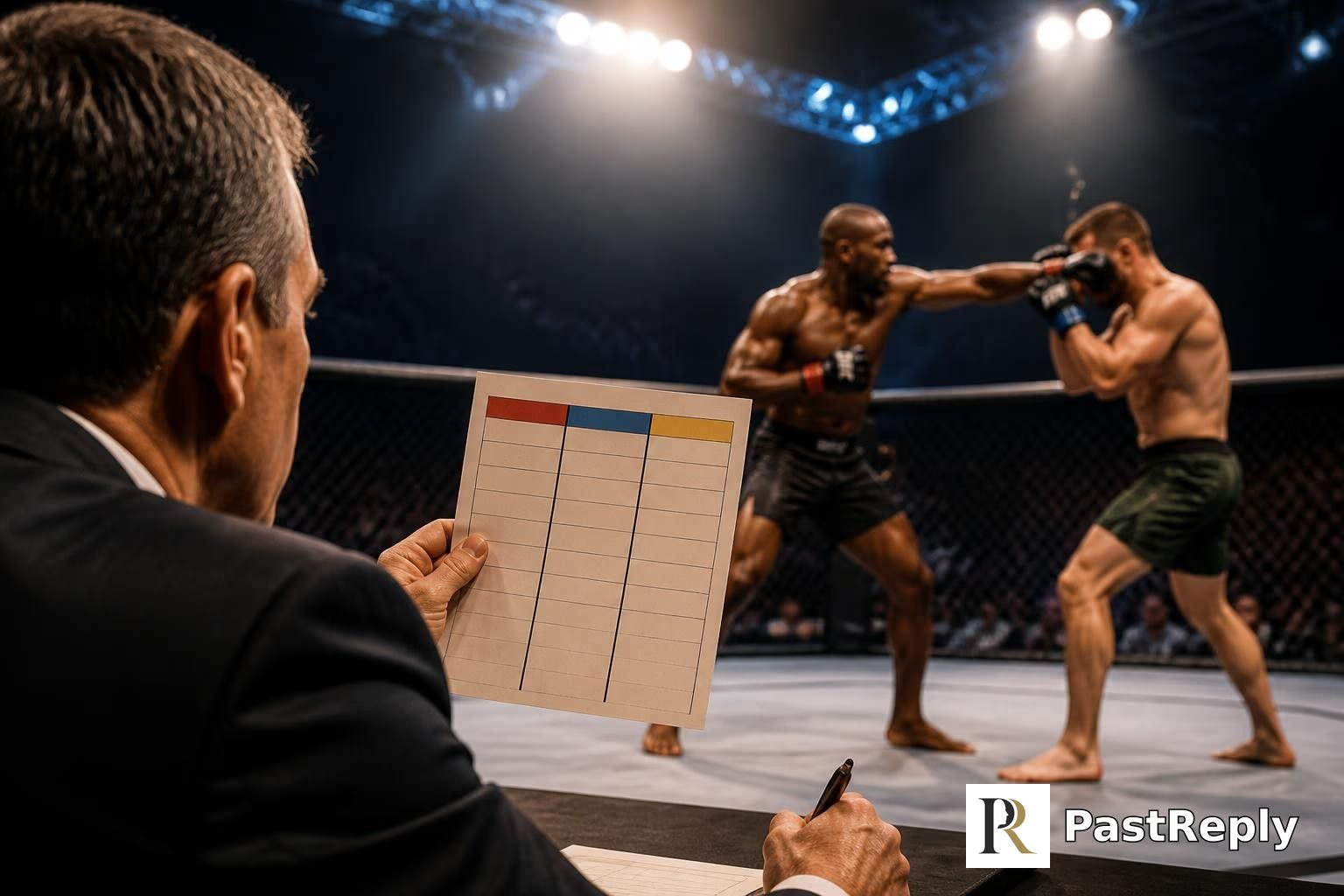
The facts
UFC fights are scored using the 10-Point Must System, where each round is judged independently by three judges. The winner of a round receives 10 points, and the loser receives 9 or fewer points. A 10-9 round indicates a close margin, 10-8 indicates overwhelming dominance, and 10-7 indicates complete dominance with near-bout-ending sequences. Judges evaluate rounds based on a hierarchy of criteria: effective striking/grappling is considered first, followed by effective aggressiveness, and then control of the fighting area. If a fight goes the distance, the judges' scorecards are tallied round-by-round to determine the winner by unanimous, split, or majority decision. Non-championship UFC fights are typically three five-minute rounds, while championship fights and main events are five five-minute rounds.
Answered by 100 of history's most famous minds

You ask how the judges count the blows, but I tell you: the man who turns the other cheek when struck, and the woman who forgives the one who bruises her - these are they who stand before the Father with ten upon ten, while the proud puncher, who wins his round by fury, will be last in the Kingdom. Yet even the one who loses every round, if he loves his neighbor as himself, has already won the only fight that matters. Cast out the beam from your own eye before you judge the count of another's.

The judge who marks a round is but a man, and his eye may err, but the reckoning of God is just and certain. You ask how the bout is scored, yet I ask: is the fighter's intent pure, or does he strike in pride and for the applause of the crowd? In the arena of this world, the strong may win their ten points, but on the Day of Judgment, the scales weigh mercy and honesty, not blows and takedowns. Let the judges be fair as they must, but know that the true victory belongs to the one who fights with justice in his heart, for God loves not the aggressive of the earth, but the patient and the upright.

The contest of arms is but another form of clinging - to victory, to the approval of judges, to the self that desires the laurel. These points, ten and nine, are the chains of attachment. The fighter who dominates with a 10-8 grasps at the illusion of power, yet even the victor suffers from the craving that brought him to the ring. The true victor is one who has no need to strike, who sees the impermanence of every blow and the emptiness of the score. The judges' hierarchy, so carefully ordered, is a delusion; the only true measure is whether the fighter is free from the thirst that binds all beings to suffering.

Hear me, for this matter of counting is as the Levites tallying the tribes, yet the Lord's eye sees not the heap of blows but the righteousness of the struggle. A judge who gives ten to one and nine to the other is as one who weighs the tithe, but the 10-8 and 10-7 are as the plague of hail that smites the oppressor, for when one is utterly broken, it is as the Lord's hand of judgment. Yet I say, look to the intent, for a man who fights only to strike is as those who built the golden calf, but he who presses with purpose and holds his ground as the promised land, that one earns the favor. The rules are good, but the heart must be measured by the covenant, for the mightiest score means nothing without justice.

The judges seek order in chaos, yet they measure only the outer form - the blows, the holds, the position - while the inner virtue, the ren of the fighter, escapes their ledger. A true warrior, like a true nobleman, fights not for points but for honor, and the wise judge would look beyond the scorecard to the conduct of the heart. If a man fights with propriety and courage, whether he wins or loses, he is the superior one.

You ask of judges and their tallies, but I say: all this is but the law, and the law condemns. The true victory is not in these ten points, but in the grace of Him who gives the crown. Let the judges count their rounds; we are scored by a higher tribunal, where faith is the only weight.

When I tended my flocks by night, I learned to read the stars as guides, not to judge the worth of a lamb by its bleat alone. So these judges must look beyond the shout and the shove, to see which fighter honors the covenant of the contest - who shows faithful perseverance, like a shepherd guarding his fold. The score is but a tally of obedience to the rules of engagement, and in the end, the one who walks uprightly before the Lord and before the crowd claims the blessing.

Ten for the winner, nine for the loser - such careful scales. But the true fight is not scored; it flows like water around stone. The one who yields, who does not strive, has already won, though the judges mark him behind. Do not ask which blow is heavier; ask which fighter is empty, for emptiness cannot be struck.

The One who created all does not keep score with tens and nines. But if you must reckon, know this: the round is a breath, and the judge's eye is clouded. Effective striking? Aggressiveness? These are but outer garments. The true victory is in the heart that strives without pride and yields without fear. Let the judges mark what they will; the Lord weighs the spirit, not the blows.

My son taught me that the mighty are cast down and the humble are lifted up. In this fighting, they keep a score of ten and nine, as if the strength of a man's arm could be weighed like a sack of grain. But I see men hurting one another, and I wonder: what mother's heart is not torn? The one who shows mercy to a fallen foe, who does not strike when he could - this one, I think, is the true victor, though the judges may not see it. They measure domination, but where is the measure of compassion? These are sons of mothers, each one, and no number on a card can say which one loved his brother more.

By faith alone, I say, and this wrestling with points and judges is the very image of the papacy, where men seek to earn their salvation by works. They tally their ten and nine as if a man could earn righteousness by his efforts. But the scripture is clear: a good tree bears good fruit, and a bad tree bears bad fruit. The one who lands the harder blow is not necessarily the one who is righteous; he may be merely the one with the stronger arm. The true fight is not in the arena but in the heart, where the devil, the world, and the flesh wrestle with the soul. Let them keep their scorecards; I will trust in Christ alone, who has already won the victory.

I answer as a student of justice and of nature. The scoring of a fight, like the ordering of the universe, must proceed from a principle. The principle here is the proportional reward of merit: the one who is more effective in the contest deserves the greater share of points. But 'effectiveness' is a term requiring careful definition. It is not merely aggression or control, but the successful application of one's craft toward the intended end, namely, the winning of the fight. The hierarchy of criteria - effective striking, then aggression, then control - reflects a reasonable ordering of priorities. Yet, as with any judgment, there is room for error, for human perception is fallible. Still, the system, grounded in reason and the natural law of competition, is a just and workable one, provided the judges act with prudence and impartiality.

A man who is struck may not remember the number of blows, but he will remember the hand that lifted him. When I saw our people dying in the street, I learned that every soul, however broken, deserves the dignity of a full and faithful accounting. These three who hold the scorecards must see not just the pain given, but the love of the one who gives it well.

The 10-point must is a mere instrument of measurement, a scale for the observer, not a law of nature. Each round is a body in motion, and the judges seek to quantify its force - yet their criteria, effective striking and grappling, are but secondary qualities, like color or taste, not the primary quantities of mass and velocity. To know a fighter's true power, one must measure the trajectory of his limbs and the energy of his blows, not rely on the fallible judgment of three men. I would reduce every bout to its physical principles, for the universe operates by fixed laws, and so too should the scorecard.

In the physics of combat, we seek simplicity beneath the chaos. These judges, with their ten and nine, are like observers measuring entangled states - each round a collapse of possibility into score. Yet I wonder: is the truer measure found in the elegance of a single decisive move, or in the relentless accumulation of small pressures? The universe does not award points for effort, only for the immutable laws that govern the outcome, and even here, the more fundamental question is whether the contest itself is a meaningful invariant or merely a frame-dependent illusion.

I look upon this scoring system as a naturalist might observe the courtship of birds - a set of behaviors shaped by the environment to determine which traits are passed on. The judges, like selective pressures, favor certain adaptations: effective striking and grappling are the most advantageous for survival in the arena. The 10-9, 10-8, and 10-7 scales represent degrees of fitness, from a slight advantage to a complete dominance, much as a male might outcompete a rival by a narrow margin or overwhelm him entirely. The rules themselves have evolved through trial and error to ensure the strongest contenders advance, though, as in nature, the process is imperfect and subject to the errors of the observers.

Observe, and you shall find that these judges are wise to measure effect, not hearsay. They look to such sensible evidence as the force of a blow, the hold that constrains, and the motion that presses toward the enemy - these are the phenomena to be weighed. But I say, let them refine their instrument, for a mere 10-9 may hide a wide gulf, and a 10-8 needs sharper measures than the eye alone. They count the aggressive intent, but aggression without effective result is as the philosopher's empty syllogism - sound but barren. If I were appointed judge, I would demand the full account of each exchange, the very geometry of the attack, that the score be a true observation, not a hasty estimate. Thus, the verdict would stand on demonstration, not on the authority of a judge's whim.

These judges, with their ten-point must system, resemble the ancient astronomers who piled epicycle upon epicycle to save appearances. But the heavens follow a simpler law, and so does a fair fight: the one who lands the cleaner blows and controls the contest, that is the center around which the score revolves. Let them strip away the clutter - the aggressiveness, the area control - and attend to the essential harmony of effective striking and grappling. In that, they will find the true order.

These judges, with their crude arithmetic, miss the invisible currents of the contest - the field of force, the vibration of effort. I could devise a better score: a harmonic measure of striking precision, a resonant gauge of grappling pressure, a capacitor of control. Yet even my instruments would fail to capture the ether of true domination.

One must measure with precision, as in the laboratory: each round is a separate experiment, and the results must be recorded without bias. The judges weigh effective strikes as one would weigh elements on a balance, giving due consideration to the control they exert, much as a chemist controls a reaction. A 10-8 round is akin to a discovery that advances the field, while a 10-9 is but a minor observation. Ultimately, the scorecard is a scientific report, and the body of evidence determines the truth of who was the more effective practitioner.

Observe the method: three observers, each with a scorecard, recording their judgments after each bout of five minutes. The criterion is clear - effective striking and grappling. But is this a science? I would demand a controlled experiment, a microscope for the eye of the judge, and a ledger of every impact. Without precise measurement, we have only opinion. Give me the observable, and I will give you the truth.

Ten points for the winner, nine for the loser - a simple formula, but is it practical? The judges sit and watch, but I'd rather have a machine that counts every punch, every takedown, every second of control. That's the real measurement. You want accuracy? You've got to put in the work - trial and error, refine the method, test it again. A hundred fights, and you'll have a system that works. That's how you solve any problem.

The scoring is a formal system, but it is not well-defined. Three judges, each assigning an integer from a set of possible values, based on a hierarchy of criteria with no precise operational semantics. It is essentially an algorithm run by unreliable processors, subject to noise and bias. The problem is that 'effective' is not an observable, it is an interpretation. One could, in principle, devise a scoring scheme based on quantifiable events - strikes landed, takedowns, positional advances - but even then, the weights would be arbitrary. The real question is whether the outcome is computable and whether it is consistent. I suspect it is not, and I wonder if a machine, given the right inputs, could do a better job than a man.

Consider the problem: we wish to determine the better fighter, yet the means are imprecise. Three judges, each applying a rule with varying degrees of accuracy. This is not geometry; it is mere opinion. If we could measure the force of each blow, the exact angle of each strike, the leverage of each hold, we might compute a precise result. Give me a fulcrum long enough, and I could weigh the two men with exactness. But without such measurements, we rely on human perception, which is as flawed as a sundial on a cloudy day. The whole system lacks the elegance of a true proof. I would design a set of axioms for combat and derive the winner by necessity, not by the whim of a judge with a blurred vision.

When I first bent light with a magnet, I saw lines of force that needed no material to carry them - the field itself became the story. These judges who must weigh blows and grapples would do well to watch the invisible lines of pressure, the currents that bind one fighter to another, and ask what force truly, measurably flowed. The score is a field of action, see it clearly, and the verdict writes itself.

The round is a screen upon which each fighter projects his deepest conflicts: one strikes to prove a father's worth, another grapples to suppress a hidden shame. The judges, poor souls, must read these symptoms and decide who is saner for the day. But victory is never clean - a 10-9 is but a polite fiction over the war of the unconscious, where both men are merely the same instinct.

Time is relative, and so is a 10-9 round: what looks like a close margin to a spectator on Earth is a spin to a fighter orbiting at near-light speed. But the judges are stuck in the same frame, so their numbers are as reliable as the orbit of a minor planet. The mystery is less in the blows than in the entropy of a crowd hoping for chaos, yet craving a clean equation.

A round is but a sequence of symbols - strikes, holds, positions - and the judge is a human engine that must read them and render a number. But I see a machine that could weigh these patterns with more fair abstraction: a poetical calculus that measures not just force, but the inventiveness of the body's language. Until then, these three are weaving a web of judgment with the threads they were given.

Let us define our terms: a round is a bounded space of action, and a point is a unit of measure. The judges must begin from an axiom - that the one who controls the action is worthy - and then deduce each score with necessity. If the strikings are equal, we look to the grapplings; if those are equal, we look to the aggression; if those are equal, we draw a line. There is no royal road to a 10-9, only the straight path of proof.

I would have these judges keep better ledgers. They tally points as if measuring blood loss, yet they ignore the very principles that govern any contest of strength: first, the effective blow - the one that staggers, that draws the crimson - then the determination that presses the advantage, and lastly the command of the field. Without such a hierarchy, you have mere opinion where you require observation. Record every exchange; let the numbers speak the truth of the fight.

Let them keep their little tables of 10 and 9! In my day, we settled such matters with the edge of a sword, and the man who could not take the round did not complain about a score - he praised the victor's strength. I conquered a hundred nations without a single judge's nod, and I tell you: true victory is not tallied by a trio of old men, but by the broken ranks of your enemies and the thundering of your army's cry. If you must score, score in courage! Score in the fury of the charge! That is a score any king would honor.

I have seen men judged by the crowd, the Senate, and the sword's edge. This system of points is but a merchant's tally, yet it has its virtue: it imposes a verdict where arms alone might leave dispute. The winner takes ten, the loser must be content with nine or less - a clemency I understand, for even in defeat a worthy foe may keep a shred of honor. But let me say: a fight is won by crossing the Rubicon, by the decisive blow that ends all debate, not by accumulating petty marks like a tax collector. Fortune favors the bold who seize victory, not those who count the steps.

My friends, the scoring of these games of strength is but a mirror of the court of power: the one who strikes with precision and holds the ground as if it were a throne wins the day. In my court, as in the arena, the will to dominate is weighed before the mere noise of blows, and the one who controls the contest, like Ptolemy over his realm, commands the tally. A goddess knows that appearance and submission can be swayed by a well-placed favor, yet the true crown belongs to her who dictates the terms of the dance. So let your judges look not to the flailing of limbs but to the art of command, for that is the measure of victory.

In ruling Rome, I learned that order is maintained not by chaos but by a firm hand that measures each action and its consequence. So these judges, like my own legates, must weigh the round as a campaign: effective blows are the conquests, aggression is the bold advance, and control of the arena is holding the province. A 10-9 marks a contested border, a 10-8 is a decisive victory that secures the peace, and the 10-7 is a rout, where the enemy flees beyond hope. Yet, I counsel patience: a fight, like an empire, is won over years, and these judges must tally each round, not by sudden impulse, but by the steady ledger of a state, lest a single rash score undo the work of many. Thus, the victor is he who builds his score as I built Rome - brick by brick, round by round.

Points? My judges would weigh the warriors' worth on the anvil of battle, not on a slip of paper. A man who fights with courage and skill wins the day; the one who cowers loses, no matter what the tally says. The 10-point must is a soft custom for soft men. On the steppe, we know the score by who stands at the end and who lies in the dust. That is the only law.

A round is like a battle, and a general knows how to read the field. Ten for the victor - that is the only principle that matters, for a war is not won by the beauty of maneuvers but by decisive conquest. These judges, with their fine distinctions, would have quibbled at Austerlitz; I would have swept them aside with one sweeping charge.

In the affairs of war, one must measure not only the ground taken but the discipline of the troops. So too in this contest, the judges must weigh the blows and the grappling as they would any engagement, ensuring the rules are followed with honor. The 10-point system is a fine precedent - it rewards dominance without encouraging recklessness, and it upholds the dignity of the sport. A victory won by a single point is a close-run thing, as at Yorktown, and should be respected as such.

I have seen men work a field, and I have seen them fight. The rule is plain: each round a ballot, each ballot a verdict. He who lands the better blows wins the round by a point, or two if he overwhelms. It is like a jury weighing evidence - not perfect, but fair enough if the judges are honest. Yet I'd say the man who controls the contest, like a lawyer who controls the court, often wins on points even when he loses the exchange.

Three judges, each with a pencil, scoring rounds like cricket umpires - but this is no gentleman's game. The man who stands his ground, who advances under fire, must be marked the victor, even if his blows are not all they might be. I've seen wars won by the look of defiance. Give me the fighter who presses on, who never yields, and I will give you the winner on points. Courage, sir, is the first criterion, and the rest is mere arithmetic.

This scoring system is a mirror of the world's ways - it rewards dominance and aggression, the very things I have spent my life opposing. They give ten points to the one who inflicts harm, and fewer to the one who merely endures. But what of the one who refuses to strike back? In my struggle, I faced the power of an empire, not with force, but with the strength of truth and the courage to suffer. The judges of this arena would have called me a loser, for I was beaten and imprisoned. Yet history will call me victorious, for I won without a blow. I say, let them count their points; the soul of a man is not measured by violence.

In the struggle for justice, we did not keep score. We measured progress by the dignity of each person, not by points on a card. This system of ten and nine reminds me of the way the powerful have always assessed the powerless - by who is dominant, who controls, who inflicts more. But I say that a man who stands for truth, even when beaten, has a dignity that no judge can take away. They ask, who is the effective fighter? I ask, what is the meaning of effectiveness in a world where the greatest force is love? The arc of the moral universe is long, and it bends toward justice. That is a score no judge can tally, and a victory no opponent can take.

In a land where we once counted our people in chains, I learned that justice must be measured with a steady hand and a long view. These three judges at ringside, with their round-by-round tally, hold the same power to ennoble or to wound - they must weigh not only the blow but the intent, the control, the courage under fire. A decision is a door, and it must open toward what is fair.

What is this alleged 'method' to settle a contest? A pair of sturdy arms and a will to dominate are the only truths that matter, not the tally of three weak judges. They speak of 'effective aggression' as if the fist were a politician's pamphlet - when the stronger man has taken what he wants, the score is a mockery. In the end, might is the only final answer, and this system is but a mask for the weak.

A scorecard is a lie, but a useful one. The judges are the party, and the rounds are the Five-Year Plans - each must be met with force, and he who controls the ring controls the future. Six points here, nine there, it is all arithmetic to keep the masses thinking they have a voice. The winner is decided in the back room, long before the bell.

The ring is a battlefield of classes: the striker who owns the space, the grappler who seeks to bury him. The judges sit like petty bourgeois, splitting hairs over a few points while the true contradiction - who has the power to end it - remains unresolved. When the crowd roars for a decision, they are but a chorus for a system that hides the real struggle behind a false score.

In the squared circle of the people's arena, the ten-point must is but a bourgeois ledger. The true score is struck in the clash of will - does one fighter seize the offensive, pressing the enemy until he breaks? The judges who count only landed blows are the same who counted only the landlord's grain. Victory belongs to he who commands the center, who makes the opponent retreat before his onslaught. The rest is bookkeeping.

One must admire the orderliness of the affair - each round a discrete measure, like the hours of the day, with points allotted by the judges' discernment. Yet I confess I find the spectacle somewhat brutish. In my husband's beloved Scotland, they would settle such matters with a gentleman's agreement, not a tally of blows. Still, the principle is sound: the better fighter must be declared, and the judges' duty is grave indeed.

The scoring of such contests is best left to those well-versed in the rules, much as one relies on the counsel of experienced advisors. It is a matter of judgment, patience, and a steady eye - qualities that serve in any walk of life. One hopes the judges weigh each round with care and impartiality, for the sake of the competitors and the spectators alike.

In my court, such disputes would be settled by trial of arms, with God as witness. Yet this system of points has a certain justice, if the judges be honest. Let them weigh the blows as a scribe weighs coin - each effective strike its own value, each moment of dominance its due. But let them not forget the spirit of the contest: courage and skill must triumph over mere accumulation. I would command my judges to favor the bold.

I care not for their points and their ledgers. The Lord sees the heart of the fighter, and He knows who strives with all his might. When I rode into battle, I did not count blows - I trusted in heaven's will and my own courage. If a man fights with true valor, pressing his enemy without fear, that is what should be honored. The judges must look past the numbers and see the faith in the combatant's resolve.

These judges would do well to remember that a contest is won not by the tally of strokes but by the mastery of the field. In my father's tiltyards, a knight who pressed his foe relentlessly was admired even if he did not land every pass. Let them weigh the effective blow, yes, but also the aggressor's spirit - for the lion's courage is worth more than the fox's cunning. And let them beware, for a poor judgment may raise a rebellion in the stands.

Every civilized contest requires a codified law, and this ten-point system serves as a reasonable constitution for the ring. Yet I would counsel these judges to favor the ennobling arts - the strike delivered with grace, the grapple that shows intelligence. In my court at St. Petersburg, we reward not merely the outcome but the manner of its achievement. Let the points reflect not just force, but the cultured execution of the fighter's craft.

When I conquered Babylon, I did not keep tally of fallen foes; I measured the loyalty I won by my justice. These judges, too, should look beyond the numbers. Does the fighter show honor in victory, restraint in dominance? Does he press his advantage with wisdom, not mere brutality? A man who fights with magnanimity, even in the ring, earns a higher place in the eyes of the gods than one who simply lands more blows.

In the heat of battle, we do not count wounds; we honor the warrior who fights with faith and courage. These judges would reduce valor to an arithmetic, but the true measure is in the soul. Does the fighter strive for the sake of honor, not merely for the point? Does he show mercy when his foe is weakened? Such qualities cannot be tallied, yet they are the essence of a noble contest. Let the judges seek wisdom, not just numbers.

Tell me, my friend, what do these judges truly measure? They claim to weigh effective striking, yet have they first defined what 'effectiveness' is? Does a blow that rattles the body count more than one that shakes the soul? And this 'control of the fighting area' - is it not a shadow, a phantom, for what is control but a word we have not examined? Let us not ask how the fight is scored, but what the fight itself means. For a man who wins ten rounds by might may lose the only true contest - the one against his own ignorance - and I would leave the arena a beggar in wisdom rather than a crowned champion of folly.

Consider, then, what these judges truly measure. They look upon fleeting shadows - the blows exchanged, the grappling - yet the Form of Victory lies beyond, an ideal of perfect dominance that no mortal contest fully embodies. Their hierarchy, placing effective striking above aggressiveness, mirrors the soul's order: reason must rule the spirited and appetitive parts. A round scored 10-8 approaches the Form of overwhelming excellence, while 10-7 hints at the divine, nearly complete. Yet even this numerical scheme is but a shadow; the just judge would see whether the fighter's actions harmonize with the true end of combat - not mere survival, but the manifestation of arete, excellence of the whole being.

Every contest, like every natural phenomenon, must be examined by its end (telos). The purpose of pugilism is not merely to lash out but to demonstrate superiority in craft - striking and grappling that harm the opponent while denying his own efficacy. Observing such bouts, the wise judge first seeks efficient blows and holds, then the zeal that presses action, and lastly the field's governance, for these form a hierarchy toward the aim: victory. The 10-9 mark, as a mean between domination and equality, aligns with virtue, yet a 10-8 signals a clear excess of mastery, and the utterly overwhelming 10-7 betrays a complete inversion of the contest's purpose. Only the balanced observer, weighing means and ends, can award the prize fairly.

The judgment of a bout, like all judgment, must rest upon a universalizable principle, else it is mere whim. Yet I find the entire enterprise barbaric: two rational beings pummeling one another for the amusement of spectators. If a rule must exist, let it be the categorical imperative applied to combat: never treat the opponent merely as a means to victory's end, but always as an end in himself. The scores themselves are secondary to the moral law that ought to govern the spectacle - or better, abolish it.

Ten points for a round? The judges reduce the raw Will to Power to a bookkeeper's tally, as if a fight were a trade transaction. But life does not submit to arithmetic - it is struggle, overcoming, the ecstasy of self-assertion. A true fighter cares not for points but for domination, for the moment when the opponent's spirit breaks. The scorecard is for the herd; the victor writes his own values in blood. That is the only score that matters.

The scorecard is the hidden hand of the owners, my friend. They make you believe in ten and nine, in close margins and domination, as if the worker's struggle could be measured in points. But the real score is in production, in the sweat of the fighter sold to the promoter, in the surplus value the house keeps. Break the system, and you'll see the true tally.

I doubt the reliability of a single judge's eye; the senses deceive, as I have proven. The true measure must rest on clear and distinct principles: what constitutes effective striking? What defines control? These must be established a priori, not from the shifting sands of perception. If we cannot define these terms with certainty, then the scoring itself is but a shadow on the cave wall. Only by methodical analysis, breaking each round into its simplest parts, can we approach a just verdict.

Ten points to the victor, nine to the vanquished - a tidy fiction. But the cage is a principality, and the judges are its senate. The fighter who appears to dominate, who seizes the center and presses forward, wins favor even if his blows are fewer. Appearances are everything; the crowd's eye and the judge's pen follow the show of strength. Learn the art of seeming, and you will win without truly conquering.

Three judges sit like graverobbers, each with a pen to prick the score, yet the true tally is writ on the fighter's brow - in the sweat of his travail and the fire in his eyes. A round may be won by a heavy blow, but the audience's heart is a fickle crowd, and what shall it profit a man to gain ten points if he lose the spirit of the bout? The 10-9 is but a stage whisper; the 10-8 a soliloquy of power; and the 10-7 a full tragedy of domination - yet the final act belongs to Fortune, who cares not for the judges' quills. In the end, the scorecard is a poor player that struts and frets its hour upon the mat, and then is heard no more.

Like the clash before the walls of Ilion, where heroes vied for glory under the eyes of the gods, so do these fighters contend for the laurel of ten. Yet the judges, like Zeus weighing the fates, hold scales in their hands. A round of 10-9 is the narrow victory of a Patroclus, a 10-8 the dominance of an Achilles, and 10-7 the very terror of Ares unleashed. But what is the score compared to kleos? The bard sings not of points but of the man who, though bloodied, stands firm, his name echoing through ages. The judges may tally the blows, but the Fates themselves weave the true outcome - whether the fighter returns home to Ithaca or falls, leaving only his story.

As I once wandered through realms where every soul's weight is measured, so these judges weigh the blows and holds of a human struggle, yet they see but the surface, not the intent. A round's score, like the circles of my journey, is a ledger of sin and virtue: the 10-9 is the purgatorial step, close in merit; the 10-8 is the descent into lower circles, where one dominates wholly; and the 10-7, a vision of the abyss, where all control is lost. But ah, the judges are but men, blind to the heart that drives the fist - whether it be wrath, pride, or the love of glory. Without the sight of that inner fire, their tally is a cold arithmetic, a shadow of the justice that awaits us all.

These judges, with their ten-point musts and hierarchies of criteria, attempt to cage the living storm within a ledger. But a fight, like a poem, is not won by arithmetic - it is a striving, a becoming, where each round unfolds as a new act in a living drama. Let them weigh effective striking if they will, but they forget the grace, the courage, the very soul that transforms brute force into art. In the end, the true victor is the one who reveals the most of what it means to be human, not the one who merely accumulates points.

They keep score with numbers, as if a duel of honor could be weighed like a sack of grain. A knight may be knocked about, yet his spirit soars - the judges' tallies cannot see that. Mark my words: the true conquest is not in the points but in the tale told afterward, which no steward's ledger can capture.

They mark each round, but the only true measure is the soul's struggle - the will to harm against the will to love. These judges, with their pencils, cannot see that the man who endures without hatred is the victor, regardless of the blows. The fight is a lie; the truth lies in the conscience of the fighter.

In the heat of the contest, each fighter wrestles not only with his opponent but with his own soul - the pride that drives the fist, the fear that weakens the knees. The judges, poor wretches, must peer into this chaos and discern order, but they only see the surface, not the agony beneath. Yet perhaps the true victor is the one who suffers nobly, who endures the punishment and still rises, for in that suffering lies redemption. The scorecard may declare a winner, but the human heart knows a deeper truth.

Three judges, each with a pencil, and a scale of ten to nine - how like a ballroom, where reputations rise and fall on a glance. The first criterion is effective striking, but what of effective charm? A gentleman who lands a clean hit may still lose the round if he loses his composure, while another who retreats with grace may be marked the winner. It is all in the perception, my dear, and perception favours the composed.

Ah, so you would have me sit as judge in this modern Colosseum, where the combatants are paid in gold and the crowd roars for blood? See how the law of this arena is a ledger of points, ten for the master, nine for the beaten! But I say the true ledger is writ in the hearts of men, not on a slip of paper. When a fighter stands with his face like a beef-steak, bleeding and proud, and the other runs about like a frightened rabbit, who is the richer in honor? The scorekeeper's arithmetic cannot measure the courage of the one who stands his ground, nor the cruelty of the one who pounds a fallen man. It is a system that rewards the showman, not the soul, and I would have it so that a brave heart counts for more than a slick trick.

Well, sir, I've seen a good many things in my time, and this scoring system is as clear as a mud puddle. Three men sit and watch two fellows try to beat each other senseless, and they decide who wins by squinting and making marks on a card. It's the same way I'd judge a prize pig at the county fair - if I couldn't see the pig, and the pig was really a dog. The rule says you count effective striking and grappling first. That's a fine, scientific principle. But what's 'effective'? One man might land a dozen taps that don't do a thing, and another lands one good wallop that ends the show. And if the judges can't agree, it's a 'split decision,' which means one man walks away rich and the other with a broken nose, and neither one knows why. It's a beautiful system, and I'd change nothing about it.

The scoring is simple. You hit the other man. You don't get hit. You win the round. A man who gets hit and keeps coming, that is something. But a judge scoring a round is like a man trying to measure a river with a ruler. It is all based on how you feel at the moment, and how you feel depends on what you ate for lunch. I have seen fighters who lost the scorecard but won the fight. And I have seen fighters who won the scorecard and lost everything else. The real score is kept in the ring, and it is not written on paper. It is written in the bruises and the blood. The rest is noise.

I observe these judges, and I see they attempt to capture the motion of the fighter as a painter captures light - yet they use but three brushes, and the canvas of a round holds infinite shades. The 10-9 is a gentle stroke, the 10-8 a bold shadow, the 10-7 a brilliant flash - but I would study the geometry of each strike, the leverage of each grapple, the fluidity of footwork, as one studies the spiral of a shell or the flight of a bird. Let them look closer, measure the angle of a punch, the rotation of a throw, and they will find that every bout is a living anatomy lesson, not a mere tally of points.

Each round is a block of marble, and the fighter is the sculptor. The judges, with their points, reveal the form hidden within - how much crude stone has been chiseled away to expose the living figure. A 10-9 is a work of delicate detail, a 10-8 a bold unveiling of powerful form, and a 10-7 the near-complete revelation of a David, magnificent and terrible. But even the highest score is but a sketch; the true masterpiece is the warrior's spirit, the sweat and blood that carve the victory from the chaos of conflict. I judge not by the number but by the passion, the fire that drives the hand to create dominance from raw struggle.

I see it as a painter sees a canvas - the strikes and grasps are brushstrokes, each round a patch of light or shadow. The judges, my friend, are like critics who count the strokes but miss the color that bleeds through them, the passion that makes the fighter bleed for his art. A 10-9 is a palette of muted tones, close in hue; but the 10-8, ah, that is a sunburst, a whirl of movement that swallows all else, and the 10-7 is a tempest, a fury that leaves nothing untouched, not even the soul. They say control of the ring matters, but true mastery is in the eye that sees beyond the form - the fire that drives the body to bare its truth. If these judges look only at what is counted, they lose the very soul of the fight, for the fight is not in the numbers but in the emotion that howls beneath the skin.

Scoring a fight? Ha! You might as well try to measure a painting by counting brushstrokes. The judges stare at their clipboards while the real art - the violence, the rhythm, the raw geometry of two bodies in motion - explodes before them. If I were judge, I'd throw away the numbers and ask only: did it make me feel alive? A 10-9 is a lie; there are no decimal points in the soul.

Ten to nine, ten to eight - these are but the shadows of the fight, not the light itself. I watch the glint of sweat, the blur of limbs, the shifting haze of exertion - that is where the bout's true color lies. Judges count like they're weighing apples, while the canvas blooms with the real score.

In my studio, I've learned that light falling on a face tells the truth - the shadow under the eye, the glint off a cheekbone. So these judges, they study the combatants as if they were sitters for a portrait, seeking the inner fire that compels the fist and the resolve that endures the blow. The scorecard is but a canvas; what matters is the soul's struggle made visible in sweat and blood, and the honest rendering of who truly triumphed in that fleeting round.

They count the punches like they're counting the days since the accident - but pain doesn't fit on a scorecard. My own body has told me more than any judge ever could: the broken spine, the shattered dreams - they don't give you extra points for surviving. These fighters bleed their truth into the ring, and the judges, they scribble numbers like they're writing a prescription for grief. But I say, let the blood paint the canvas; the real score is in the courage to stand up, not in the tally of blows.

Ah, these judges are like the patrons of a concert hall, clapping for the loudest note rather than the most beautiful phrase! A 10-9 is but a simple allegro, while a 10-8 is a dramatic adagio, and a 10-7 a thunderous finale - yet the true measure is the harmony between the fighters, the rhythm of their exchange, the melody of their skill. I would give ten points to the man who dances like a minuet, even if he lands fewer blows, for grace and timing are the soul of combat as they are of music. Let the judges close their eyes and listen; the score will write itself in their hearts.

These ten points are but the metronome's ticking; the true symphony is in the round's crescendo and retreat. A 10-9 is a gentle adagio, a 10-8 a powerful allegro, and a 10-7 a thunderous presto that shakes the very hall. But the judges, with their fixed scale, are like critics who count the notes rather than hear the music. What matters is the heroic theme, the fighter's will that rises against adversity, the modulations of strategy that turn the contest into a transcendent work. I say: let the score reflect not mere control, but the depth of the struggle, the passion that elevates the fight into an ode to the indomitable human spirit.

In a fugue, every voice must be balanced - the subject, countersubject, and the bass - each sounding in its turn and yielding to the whole. So too in this contest: the judges must hear each fighter's part, the striking and grappling as themes, and the aggressiveness as the tempo, yet the control of the arena is like the pedal point that grounds all. A round, like a measure, earns its 10 or 9 not by a single note but by the harmony of all parts, and a 10-8 is a full cadence, a modulatory shift that leaves no doubt of mastery. But the master judge, like the cantor, listens for the counterpoint - how one fighter's action answers the other's - and awards the point to the one who, in that brief span, has resolved the dissonance toward a perfect close.

Well now, I ain't no expert on fightin', but I know a thing or two about puttin' on a show. Back in Memphis, we didn't score the music - we felt it. If those judges got rhythm, they'd know a good fight ain't about the points, it's about the heart. Somebody who fights like Elvis sings - with soul, givin' every last drop - that's a winner in my book, no matter what the card says.

It's like a dance, you know? Each round a new verse, the judges tapping their pencils like they're keeping time to a beat. But the music isn't in the numbers - it's in the rhythm of the blows, the harmony of two bodies moving. If only I could score the passion, the emotion, the love he puts into every move. That's what makes a champion.

You know, it's like when we were writing 'A Day in the Life' - you've got to listen to the whole tune, not just the tambourine bit. These judges, they've got to hear the rhythm of a round: the jab is the bass line, the takedown's the drum fill, and the crowd's roar is the brass section. It's not just about who's loudest; it's about who's playing the most beautiful melody. And if it's a draw, well, tune in tomorrow - there's always another song.

You want to know how they count the blows? Count the rain in a storm, measure the wind. Three men sit with pencils, marking numbers like clerks in a counting house, but the fight itself is a song that can't be notated. Some rounds are close as a whisper, some are loud as a highway. The judges tally the noise and call it truth, but the truth is in the dust on the mat, not the paper in their hands.

So it's like a scoreboard, but the refs are the only ones who see it. Each round, you're writing your own story - you land the hits, you take the hits, and then someone decides if your chapter was stronger. It's not just about who's louder; it's about who told the better story in five minutes. And sometimes, even when you think you won, the judges saw it differently - and that's the hardest lesson but also the one that makes you rewrite the next act.

I sailed west with a scorecard of my own - not of points, but of lands and souls to be won for God and Spain. These fighters are like my sailors, each seeking to dominate the ring as I sought to dominate the sea, yet the true score is not in the round, but in the glory of the quest. A 10-9 is a calm passage, a 10-8 a fierce storm, a 10-7 a tempest that nears the edge of the world - and I say, let them fight boldly, for the man who risks all for the unknown deserves every point, just as I risked my fleet for a new horizon. The judges are but winds; the victor is the one who charts his own course.

In the courts of the Great Khan, I saw wrestlers from Cathay contend, judged by the roar of the crowd and the nod of the emperor, not by such strict arithmetic. This ten-point system is the very order of a Venetian counting-house, precise and mercantile. Yet I see its merit, as a traveler sees the value of a fixed road through strange lands. The hierarchy - first effective striking, then aggression, then control - is like the order of a caravan: the goods, then the drivers, then the route. And the distances, three or five rounds, remind me of the varying days of travel between cities. All this is a trade, where the winner takes the prize, and the judges, like merchants, weigh the profit of each exchange.

These judges are like pilots charting unknown waters, and each round is a league of passage. The 10, 9, 8, 7 - they are the marks on a map, yet the true course lies in which fighter seizes the wind of the fight, pressing his attack like a favorable gale and steering where he will. A 10-8 round is a strait we must pass, a passage where one ship masters the sea; the 10-7, a tempest that only a madman would endure. But I say, a captain knows that a voyage is won not by counting the waves but by who holds the helm through storm and calm. Let them count their points, but the victor is he who, like me, sails through mutiny and doubt and reaches the Spice Islands of victory, even if the judges' ledger lags astern.

Scoring a fight is a bit like measuring a trajectory - you need precise instruments and careful observation. The judges use their ten-point system as a checklist, much as we used telemetry: effective striking first, then aggression, then control. But just as a successful landing required teamwork and preparation, a fair decision demands that each judge apply the same standards round after round. In the end, the scorecard is a tool, not the mission itself - the fight's true worth lies in the discipline and courage it demands.

They say the one who lands the most wins, but in the air, you don't keep score by the clouds you disturb - you fly by feel, by instinct, by the courage to push forward. These judges with their pencils are like navigators who trust the map more than the sky. Ten points? Give me the pilot who takes the risk, who dares the loop.

From up there, you don't see the border between a punch and a kick; you see the whole Earth, blue and beautiful. So I imagine these judges must rise above the noise, zoom out, and see the entire fight as a single flight - some rounds they orbit ahead, others they fall behind, but they record each revolution with precision, like a mission log. In the end, it's not the speed of the launch but the accuracy of the tracking that brings the astronaut home with the victory.

The 10-point must system is like an old operating system - it works, but it's clunky and full of legacy code. These judges are trying to define a winner through three subjective criteria, but real greatness is about the experience, the feeling of a fight that leaves you breathless. You don't score a masterpiece by counting brushstrokes; you feel it. The best fighters, like the best products, are intuitive, elegant, and simple - they don't win by a point; they win by changing the game. The judges should ask one question: did this fight move you? If yes, that's a 10. If no, it's a 9. Everything else is noise.

The 10-point must system is a legacy architecture - it works, but it's ripe for a complete rewrite. First principles: what are we actually trying to measure? Effective damage and control, nothing else. Aggressiveness is a proxy, not a core metric. We could build a more objective system, using accelerometers in gloves, high-speed cameras to track contact, maybe even AI to grade dominant positions. But honestly, the best fix is to end the debate: finish the fight. That's why I'd make it five rounds always, more time to achieve a clean KO or submission. Decisions are for bureaucrats; the fight itself should be decided by the fighters, not the judges.

You know, what I love about this is how much it mirrors the story of our own lives - every round is a chapter, and the judges, they're like the editors of our journey. A 10-9 round, that's a lesson in closeness, where every single detail matters, and a 10-8 is a breakthrough, a moment that shifts everything, and the 10-7 - well, that's the transformation that changes who we are. But here's the thing I want you to hear: yes, they count the strikes and the holds and the aggression, but that control of the ring? That's about owning your space, being present, and that's what it means to live your best life. Whether the judges see it or not, the real victory is in the heart that keeps fighting, because every one of us has that fighter in us, and when we get up after a hard round, that's the score that truly matters.

They ask how they score a fight? Float like a butterfly, sting like a bee - but the judges, they can't see what I see. A 10-9 for a close round, 10-8 for a whuppin' - but the real score is who stood tall when the bell rang, who backed down and who stood ground. I fought the greatest, and I never needed no card to know I won. The judges count points; I count pride. And I float, I sting, and I don't need no arithmetic to prove I'm the king.

In my game, we score goals, not points, and each one is a joy to the crowd. This scoring is like a referee counting steps instead of watching the samba - the judges miss the beauty of the fight, the flow, the heart. A round should be like a match: the one who plays with spirit, who moves the people, who gives his all - that's the winner, not just the one who touches the most.

Scoring a fight is like animating a scene - you've got to make every frame count. The judges are like directors watching a storyboard: they see the effective hits as the key poses, the aggression as the action lines, and the control as the camera movement. If a round is a cartoon, the one with the most entertaining plot wins the Oscar. And just like in my films, the underdog can always pull off a happy ending if they've got the heart.