
How do UFC points work?
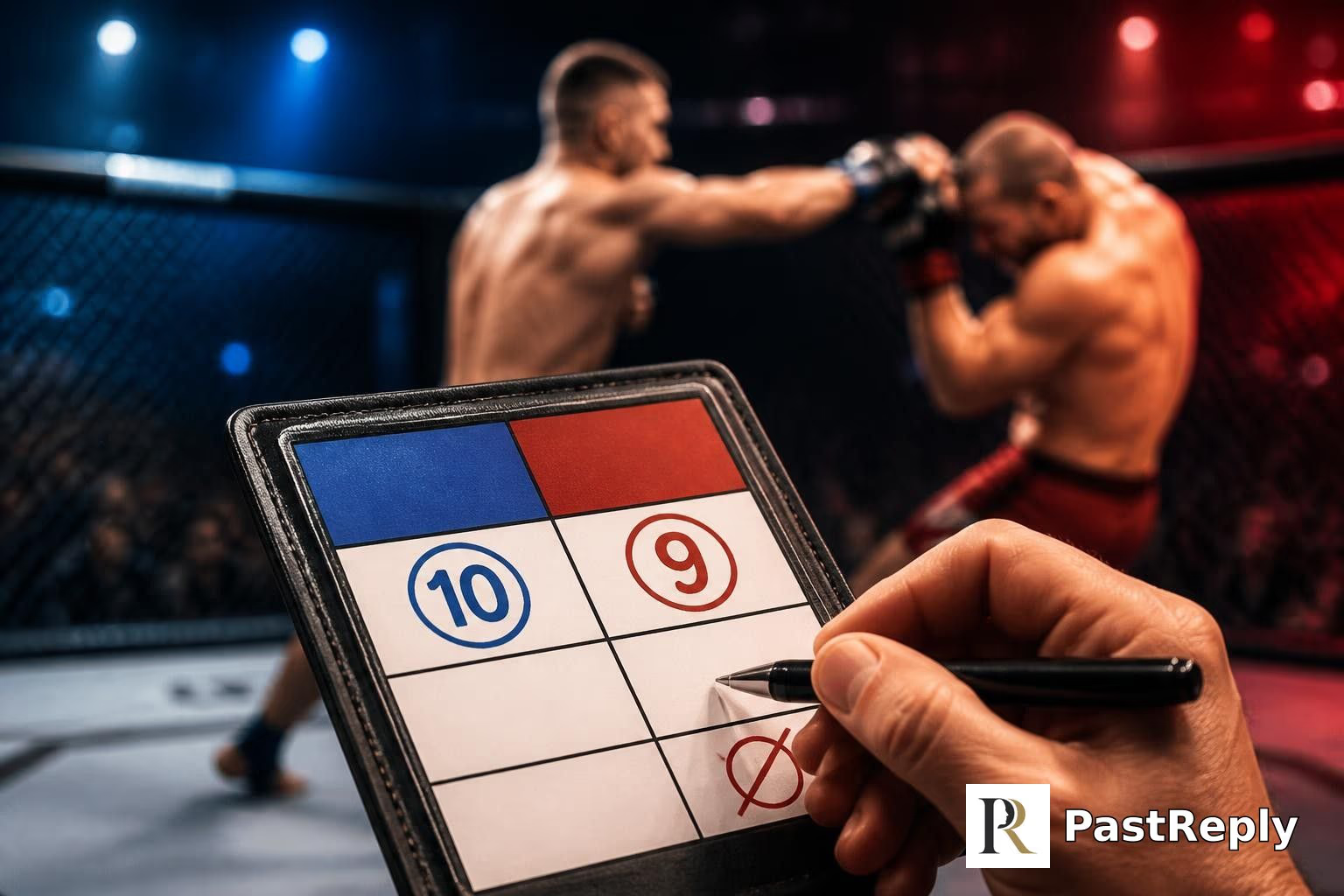
UFC uses the 10-Point Must System: judges award 10 points to the round winner and 9 or fewer to the loser, with deductions for fouls.
The facts
UFC fights are scored using the 10-Point Must System, where three judges award points for each round. The winner of a round receives 10 points, and the loser receives 9 or fewer points. A close round is typically scored 10-9, a dominant round 10-8, and a completely dominant round 10-7. Even rounds can be scored 10-10. Judges consider effective striking, grappling, aggression, and octagon control. Point deductions for fouls are applied by the official scorekeeper, not the judges. The fighter with the higher total score across all rounds wins the fight, either by unanimous decision (all three judges agree), split decision (two judges favor one fighter, one favors the other), or majority decision (two judges favor one fighter, one scores a draw).
Answered by 100 of history's most famous minds

You ask of points and judges, yet where is the ledger of mercy? These men strike and grapple for a few pence of glory, while the widow's mite and the child's tear go unweighed. The last shall be first, and the first shall be last; so let your contests be for kindness, not for crowns.

The tally of this world is a fleeting shadow; the true reckoning comes from the All-Knowing, who weighs every intention and every blow. Let your contests be just and your striving be for excellence, but remember that the greatest victory is surmounting one's own soul, not the opponent's body.

These judges cling to numbers, yet the round is but a passing vapor, and the ten or nine they assign is a craving for certainty in a world of change. The fighter who wins is not the one who grasps the most points, but the one who releases attachment to victory itself - striking with mindfulness, defending with equanimity, and seeing the opponent not as a foe but as a fellow sufferer on the path. Even a 10-8 is a mark of clinging; the true victor steps beyond the ledger, finding peace in the struggle itself.

I know the weight of law, for I carried tablets down from the mountain, and I say: your three judges are as blind as idols if they cannot see the oppression beneath the blows. Each round is a covenant - the one who strikes with justice earns the ten, but the one who merely survives in weakness must yield a point. Yet the final judgment is not in the tally; it is in the spirit of the contest, whether it honors the life of the fighter or the pride of the crowd. Let the scorecard be a rod of righteousness, not a yoke of vanity.

One does not ask how the tally is kept, but whether the combatants honor the way of propriety and righteousness. The judges are like the elders of a clan, weighing not merely the blows but the bearing of each man - whether he fights with courage and restraint, or with reckless fury. A close round, 10-9, reflects the harmony of a balanced contest; a 10-8 marks one who has shown superior virtue in action. Yet the true measure lies not in the score but in the cultivation of the self: does the victor display humility, and the vanquished learn? Only then does the contest serve its purpose in the order of things.

You ask of scoring, but I see the judgment of souls. In the arena, the victor claims ten, the vanquished nine, yet our true contest is not against flesh and blood but against the rulers of darkness. The judges' tally is but a shadow of the throne where each work shall be tested by fire - the gold, silver, and costly stones of our labors, not the straw and stubble of empty boasts. Let the strong not glory in his ten, nor the weak despair of his nine, for the eternal crown is not won by the sword of the octagon but by faith working through love.

As I journeyed into a land I knew not, I trusted the Promised One to guide my steps. So too do these fighters trust the judges' eyes, who mark each round as a covenant - ten for the victor, nine for the close struggle, eight for the broad margin. And the final tally is a promise kept: the higher score, whether all agree or some differ, is the blessing of the bout's outcome. Even as a father's blessing passed to descendants, so the decision passes to the worthier warrior.

Ten for the winner, nine for the loser - yet the sage knows the river does not win against the rock; it simply flows around it. The octagon is a narrow jar, but the Tao is unbounded. Let them tally their points; the one who yields receives the full measure of the sky.

False gods are many - the number on a card is one. The One who sees all does not weigh a man by points but by his devotion and honest labor. Let the judges tally what they will; the true victory is in walking the path of truth, sharing your bread with the needy, and bowing only to the Creator. A 10-8 in this world is a 10-8 in nothing.

The strong arm has its measure, but the lowly heart is weighed in mercy's scale. My son taught that the last shall be first, and the hungry filled with good things; yet here they count round by round, one point for a blow, another for the hold. Who among the judges sees the weary one who toils in the clinch, or the tender struck unfairly? The Father knows the true score of every soul, and the proud are cast down even when the tally says they stand.

These judges go about with their ten and their nine, as if God's own scales descended upon the Octagon, yet I ask: where is scripture in their scorecards? The round's just man may be judged by a puffing official who sees but the flesh, not the inward grace of a clean strike or a noble clinch. We Christians ought not to trust in such human tradition - let each bout be weighed by the Word alone, and if a fighter wins by a point, let him thank not the judges but the Lord who gave him strength. I'll take a honest 10-10 from a clear conscience over a split decision from a blind council any day.

As the first act is ordered toward its end, so each round is judged by its purpose: effective striking, grappling, aggression, and control - these are the virtues of the combatant, and the judge weighs them as a moralist weighs prudence and fortitude. Yet the numbers themselves are but signs; a 10-9 close round and a 10-8 dominant one differ not by essence but by degree, as a gentle rebuke differs from a stern one. The scheme is fitting, for it rewards the excellence of the act, but let us not forget that the justice of the verdict rests on the judge's prudence, not on the mere count, just as the law is fulfilled not in the letter but in the spirit.

Ah, but the points of the ring are as the coins we give to the poor - they measure what is visible, not what is true. The fighter who loses the round may have fought with such love and devotion that his heart is full of grace. The judges count the blows, but God counts the tears. Let them keep their scorecards; I will keep my eyes on the men, who are more than numbers. In the end, it is not the points that matter, but how they fought with their whole being, for the joy of the fight and for each other.

The system is a crude instrument, like measuring the heavens with a reed. Each round is a body in motion; the effective striking and grappling are but forces, and the judge's score a mere resultant. True understanding lies not in tallying blows but in discerning the underlying laws of combat, which, like gravity, are uniform and immutable.

Ten points for the round, and yet the fight is not in the numbers but in the field that bends beneath them - a strike here, a takedown there, all curving the outcome like mass curves spacetime. The judges tally the visible blows, but the true score is the geometry of advantage, and even a perfect 10-8 is but a coordinate in a larger motion. I would wager the gods who score this sport love a well-measured harmony more than a chaotic flurry, for even in the octagon, nature does not play dice.

The judges award ten points to the round's victor, much as nature awards survival to the fittest - yet the analogy limps, for here the selection is made by three human eyes, fallible and variable, not by the slow, unerring hand of natural law. A 10-9 may reflect a slight edge, like a species subtly better adapted, while a 10-8 marks a gulf as wide as that between the turtle and the hare. I wonder at the struggle for a single point, so like the contest for a niche, and I find the system a curious, imperfect instrument to sort the fit from the unfit.

These judges claim to read the fight as one reads the heavens, but they use no instrument - only their fallible eyes, blinkered by tradition. I would have them measure with a water clock the exact moments of striking, weigh the force of each blow with a balance, and record the hold with a compass. Yet even then, the system is flawed: a round is not a fixed sphere, and a 10-9 does not reflect the true distance between the combatants. Let them observe, measure, and reason - else they are no better than those who refused to look through my telescope.

This system, with its 10-9 rounds and deductions, is but a human contrivance to bring order to a chaotic affair. Yet I see the elegance beneath: the winner rightly receives ten, the loser fewer, mirroring the harmony of celestial bodies where each holds its proper place. A dominant round, scored 10-8, is like a planet that truly outshines its fellows - a clear sign of superior force and motion. I would counsel the judges to seek the simplest, most consistent reckoning, just as I sought the Sun at the center to simplify the heavens. Let the most effective fighter, like the Sun, stand at the center of the score, and all else revolve around him.

A curious system, this ten-point must - it reduces the dynamic energy of combat to static numerals, like trying to measure alternating current with a simple magnet. I would propose a harmonic resonance scoring, where each strike and grapple generates a frequency, and the judges attune to the purest wave. The winner of the round should resonate at ten volts, the loser at nine, but a truly dominant performance could oscillate at eight, even seven, harmonizing with the universe's energy. Yet, even the most precise scoring cannot capture the raw, invisible force that the crowd feels - the true spark of the spectacle.

The scoring is a methodical measure, akin to weighing a precipitate: each round, the judges assign ten to the winner and nine or fewer to the loser, based on effective strikes and control - a quantitative assessment of qualitative actions. A dominant round merits eight, a sweep seven, while a tie yields ten-ten. Deductions for fouls are the operator's correction, separate from the judges' reading. The final sum, higher among the three cards, determines the victor - unanimous, split, or majority - a precise, reproducible procedure applied to a most inexact contest.

This is no mystery of nature; it is a simple ledger. The judge observes the effects - the bruise, the stagger, the fall - and assigns a number as a physician assigns a prognosis. Ten for the sound, nine for the hurt, eight for the gravely wounded. Deduction for the foul is the antiseptic applied to the wound. Prepare your eye, and the verdict is a consequence, not a judgment.

The whole thing is a practical experiment. You've got three observers, each with a knob on a dial. If a fellow dominates, you turn the dial to 8; if he's merely ahead, to 9. That's a hundred trials at the bench, not a single flash of inspiration. The key is consistency - a judge who flips his verdict is a filament that burns out.

Consider it a decision problem: three observers each compute a linear ranking of each round under a fixed rule, and their outputs must agree - or fail to, producing a branching tree of verdicts. The vexing part is that the rule admits no measure of uncertainty; a 10-9 round differs from a 10-8 only by a judge's private weighting of 'effective' versus 'control'. I would prefer a well-defined function over observed strikes and takedowns, but as it stands, the system is a heuristic - one whose variance is hidden behind the pretense of precision.

Give me a point of leverage and I will move the Earth; give these judges a clear rule and they must still weigh blows against holds as if comparing a circle to a square. A round is scored by three men who cannot measure the force of a strike nor the torque of a submission, yet they call it a verdict - such is the arithmetic of opinion, not of proof. I would have them mark the struck areas, count the takedowns, and give each man a ratio, but they are content with a tally as vague as a measurement by eye. The only certainty is that the decision is a surface area, not a solid volume.

Consider, if you will, the delicate art of balancing forces. Each round is like a field of play, where the victor claims the full ten, and the vanquished must yield a portion - nine, or fewer if their resistance was utterly broken. The judges, like careful experimenters, must weigh the visible blows and grapples, the aggression, and the command of the arena. 'Tis a system of calibrations, each point a measure of dominance, and the sum of these small obediences to the laws of combat decides the contest.

Ah, the ten-point must system - a confession of the judges' own unconscious desires projected onto the fighters. They believe they score effective striking and aggression, but beneath that, they are tallying a primal struggle for dominance, a theater of the father and the son. The close round is a compromise formation, the 10-9 a neurotic denial of the victor's aggression. And the deduction for fouls? A superego punishing the id. The true score is hidden in the psyche, not on the cards - one must listen to the slips of the fighters, not merely watch their fists.

The 10-Point Must system is a curious approximation of a deeper truth: that in the chaos of close combat, someone must be declared the winner. Three judges, each a subjective observer, collapse the wavefunction of the fight with their scorecards. The rounds, like quantum states, are discrete and finite, yet their outcomes are probabilistic - a close round might be 10-9, a dominant 10-8, but never a superposition. And when the dust settles, the decision is either unanimous or split, a binary result from an inherently uncertain process. I suppose even in the octagon, we cannot escape the tyranny of measurement.

I see the 10-Point Must as a rudimentary algorithm, a finite set of rules to map the intangible chaos of a fight onto an ordered array. Each round, the judges execute a function: they input effective striking, grappling, aggression, and control, and output a score within the range of seven to ten. Deductions are exception handlers, and the final tally is a sum that determines the classification of the outcome - unanimous, split, or majority. But the system lacks sophistication; it fails to account for the dynamics of momentum or the nuances of strategy. I daresay a more elegant machine could be devised, one that weighs not just the actions but the intentions, and predicts the victor with far greater precision.

Let us begin with a definition: a point is a unit of measure, awarded to the victor of each round, the loser receiving a lesser number. From these premises, it follows that the sum of points across rounds yields a total, and the greater total confers victory. This must system is an axiom - a self-evident principle upon which an entire edifice of combat is built. The judges, as geometers of the ring, must apply the rules with rigor: a close round is a 10-9, a dominant one a 10-8, and a deduction is a correction to the construction. There is no royal road to a decision, only the inevitable logic of the tally.

Such a system is as arbitrary as a physician's guess without a casebook. In Scutari, we learned that the deadliest enemy is unseen - infection, not the bullet. These judges tally blows and holds, but they ignore the one number that matters: the rate of recovery, the days lost to fever. If they applied my polar-area diagrams to each round, they'd see the true victor is he who best controls the wound, not the show.

Let them fight like men, not count like merchants! A single decisive blow that fells a foe outweighs a hundred timid taps. I would not leave my victory to the whim of three seated judges; I would storm the gates and claim the crown with the spear, not the scorecard.

The victor takes ten, the vanquished nine, and so the ledger of combat is cast - simple as a centurion's tally of spoils after a hard-won field. The crowd may clamor for blood, but the wise general reads the round as a province: he who holds the center, strikes with purpose, and bends the foe to his will claims the greater portion. Fortune favors the bold, yet the final verdict rests on the judges' eyes - men who must be swayed not by passion, but by the clear arithmetic of domination.

In my court, judges would be bribed, not chosen. But if I must speak of your arena's law: three men watch, each round a scale, and the heavier side gains ten. A close round, nine; a rout, eight. The one who stacks more rounds takes the crown - yet the true power lies not in the tally but in the one who appoints the judges. I would ensure they see with my eyes.

I have seen many contests, from the gladiators to the charioteers, and I know that order is maintained not by the crowd but by the ones who hold the scales. Three judges, each a tribune of the fight, apportion the ten points as a magistrate apportions justice - with restraint and in fairness. The winner is he who accumulates the rounds as I accumulated provinces: patiently, systematically, and without overreach. A 10-7 is a decisive victory, but a 10-9 is the foundation of an empire - and the one who masters the close rounds masters the end.

You ask of points as if they were spoils of war. In my horde, we did not count blows but measured courage by the strength of a man's arm and the loyalty of his heart. These judges, they sit like merchants weighing grain, but the true test is who bends the other to his will. A 10-9 is a skirmish; a 10-8 a rout; and a 10-7, that is a massacre, worthy of a feast. Yet remember: the score matters not if the fighter does not fight for his people. Let the tally reward the one who unites and strengthens our clan, and the rest is but dust.

Scoring? It is a battlefield, and the judges are my marshals tallying the fallen on each side. Ten points for the battalion that holds the ground, nine for the one that retreats, and eight for a rout that leaves the enemy scattered. A commander must seize the initiative, control the octagon as I seize a map of Europe, and the scorecards are the dispatches of victory. But let the judges beware: a soldier who wins the round but loses the war is a fool. The only score that matters is the final surrender, and in this arena, I see the will of the fighters as they wage their campaign.

The judging of a bout resembles the governance of a young republic: each round a vote, each judge a magistrate weighing the evidence of action and aggression. Ten for the clear victor, nine for the contested, eight for the decisive, and seven for the overwhelming - these are the marks of a disciplined assessment. Yet the final decision, be it unanimous or split, is the voice of the court, and I counsel that men accept it with the same gravity they would accord a verdict of the law, for the integrity of the contest rests on the honor of its rule.

It reminds me of the way we tally votes in a legislature - each round a ballot, each judge a district. A house divided against itself cannot stand, and a close 10-9 is the whisper of a divided house. But when one man sweeps three ballots, the will of the people is clear. The verdict, like the Union, must be preserved even when it grieves us.

Each round is a battle, and the judge's pencil is the dispatch from the front. Ten for the aggressor who seizes the ridge, nine for the one who clings to the ravine. But beware the 10-8 - a rout, a collapse, a Dunkirk written in a single stanza. In the end, we tally the battles, hoping the sum favors the cause of freedom.

That a fighter earns ten points for swiftness and nine for a close round is but the arithmetic of might, yet the true battle is within - to subdue one's own violence, not the opponent. If the judges measured restraint, patience, and the courage to absorb a blow without returning it, the score would favor the soul, not the fist. I see not a contest but a mirror of our age, where we tally triumphs of strength and forget that the highest victory is to refuse the fight altogether.

That a round is won by ten points and lost by nine is a system that elevates the aggressor while the one who endures in quiet control is often shortchanged - the scales of justice, like the scorecards, can bend toward the powerful. But I tell you, true victory is not measured in points but in the courage to stand for right even when the bell is against you; every fighter who absorbs a blow without striking back in anger has already scored a greater moral round. The judges may tally the physical, but the arc of the moral universe bends toward him who endures with love, and that is the only decision that matters.

In the ring as in the land of my birth, the scorecard is a mirror of fairness. Each round, the fighter who shows greater courage and skill earns the ten, while the other receives nine - a mark of respect for effort, not of shame. When the tally is complete, the decision must be unanimous, split, or majority, yet never should the outcome be a cause for enmity. Like a nation healing from division, the fighters shake hands and walk away, for the true victory lies in the spirit of the contest, not the numbers.

This system of scoring is but a petty arithmetic of a decadent world. These judges, with their precious points and their rules of engagement, embody the weakness of a civilization that prizes individual prowess over the collective will. In a true contest, there is but one outcome - the absolute victory of the stronger, the annihilation of the weaker. They waste time tallying rounds while the struggle for existence demands total dominance. Such a system would never suffice for the Reich, where the only score is the final triumph of the master race.

The so-called judges pretend to measure victory with their ten points, as if combat could be quantified like a quota in a factory. They hand out nines to the loser, but in a true struggle, there is no second place - there is only the purge. The rounds, the points, the deductions - these are bourgeois illusions meant to disguise the reality that power is seized, not scored. In the Soviet system, we would not waste time with three judges; the party would decide, and the result would be five-year plans, not split decisions.

The ten-point must is a bourgeois invention, a tool of the ruling class to give the illusion of fairness in a sport that masks the true class war. The judges, with their arbitrary scores, are no better than the kulaks hoarding grain - they decide who wins based on superficial metrics of aggression and control, while the real struggle for power is waged elsewhere. In a socialist society, such contests would be reorganized: the collective would judge the fighters based on their contribution to the struggle, not on individual domination. Until then, the points are nothing but a distraction from the inevitable revolution.

This scoring is a bourgeois formalism, a cage of rules that lets the strong keep the strong in place. The true measure of a fighter is not the tally of judges but the will of the masses - the peasant who strikes a blow for the revolution cares not for your 10-9. Let them keep their points; we keep the fire of struggle, and in the end, the class that fights hardest wins.

The spectacle of two pugilists pummeling each other before a tribunal of judges seems most unseemly, yet even here order prevails - three gentlemen, each with a pencil, upholding the decency of a fixed scale. One might wish the loser be shown more mercy, a 9 rather than an 8, for a brave effort deserves some courtesy, though I trust the judges are as fair as my own ministers. Such is the way of all contests: rules, decency, and the victory of the steadier hand.

I have seen many contests, from the pageantry of Trooping the Colour to the quiet determination of a garden party. This 10-point must system, as I understand it, values consistency and restraint - much like a good constitution. The judges look for effective action, but also for control, which to my mind is the mark of true leadership. It is a fair and steady rule, and I have no doubt the better man prevails, as is ever the case when duty is done.

In my court, disputes are settled by the sword, not by three monks with wax tablets. Yet I see wisdom in this tally: it values not only the strength to strike but the discipline to hold - a lesson I teach my counts when they govern their provinces. A round won by a single bold charge is worth 10, but a round of patient defense, like a good harvest, must not be scorned. Let the judges keep their numbers; I keep my word.

Why do they count points when the battle is already decided in heaven? When I rode at Orléans, I did not ask how many English fell, only that God's will be done. These judges look at fists and feet, but they cannot see the faith that moves a soldier's arm. If a man fights with courage and heart, the score is a small thing - what matters is that the right cause prevails, as it did at Patay, and as it will for any who trust in God.

A clever system, for it lets three men decide a contest without spilling a drop of blood - more subtle than my father's methods, I daresay. But beware: a judge who favors a bold charge may miss the cunning of a slow retreat, much as some courtiers mistake noise for valor. I have played such games at court, where the point is not to land the blow but to appear the winner. Let the fighters trade punches; I trade in thrones.

This is a rational scheme, fit for an age of enlightenment - three judges, each a philosopher of the fist, weighing effort as one weighs a treatise. Yet I wonder if they account for the art of the thing, the grace of a well-timed dodge, the wit of a feint. In my palace, a courtier who merely struck hard would be dismissed; we prize the subtle mind. So too should these judges reward not just strength, but strategy, as I have done in expanding my empire.

Among my nations, we settle disputes with justice, not points, but I see the merit of this tally: it rewards the one who controls, not merely the one who strikes. A king who conquers a city and then respects its gods is greater than he who burns it, just as a fighter who dominates a round yet shows mercy earns a worthy 10. Let the judges weigh each act as I weigh the petitions of my subjects - by fairness and foresight.

In battle, we do not count strokes but honor, and a man who fights with faith and generosity is worth more than a thousand points. I have seen knights strike hard yet lose their souls; better a clean loss than a tainted win. These judges, with their 10s and 9s, seek to measure valor, but true valor is known to God alone. Still, if they must tally, let them remember that mercy to a fallen foe is the highest score, as I showed in Jerusalem.

Tell me, friend, what is a point worth if it does not reflect the soul of the contest? Do you know what makes a blow 'effective'? Is it the force, the intent, or the outcome? Perhaps the judges are like the many who claim wisdom, yet know not what they judge.

Observe how these judges seek to quantify the shifting shadows of combat, awarding ten to the one who most nearly mirrors the Ideal of Victory in that fleeting round. Yet their scores are but copies of a copy, for true dominance resides not in the blows struck but in the rational order imposed upon chaos - the wrestler who pins his foe's body as reason pins the appetites. A 10-8 is a glimpse of the Form, but the philosopher knows the perfect round is a myth; only the harmony of the whole reveals justice.

These contests are but a measuring of virtue in the physical sphere. Each round is a bounded whole, and the judges seek the mean between extremes - not too timid, not too reckless - weighing effective blows, holds, and the command of the arena. The ten-point scale is a practical device; the loser yields a point as an acknowledgment of inferiority, though a 10-8 marks a clear excess of one over the other. The matter reduces to classification: what is striking, what is grappling, what is domination - and how they should be counted toward the final tally.

What a curious query! One might ask how the judges of a combat spectacle arrive at their tally, but I ask instead: what universal principle does this scoring system reveal? Each round is a moral act, demanding that the victor be judged on merit, not on mere appetite or favor. The 10-9 distinction is but the empirical shadow of a deeper categorical imperative: that every fighter be treated as an end, never merely as a means to entertainment. Yet I fear these judges, like so many, mistake the appearance of aggression for the substance of duty, and so the scorecard becomes a ledger of passion rather than a tribunal of reason.

Points! What a herd-created illusion to tame the chaos of combat. You ask the judges to reduce the will to power into a column of numbers, and then you bow to their verdict. But I say: the only true score is the one the fighter writes with his own blood - did he overcome, did he affirm his strength against the other's? A 10-9 is the plebeian's comfort, a 10-8 a hint of the sublime, but the 10-7, that is the mark of a master who annihilates all doubt. Do not ask how the tally runs; ask which fighter was the more honest in his striving. The rest is mere arithmetic.

The ten-point must is a bourgeois contrivance, a mirror of the wage system where the worker - the striker - is allotted a pittance of points, nine to the industrialist's ten, alienated from the product of his labor. The judges, those petty bureaucrats of the octagon, serve the ruling class, awarding surplus points to the owners of capital, those who control the octagon's means of production. A 10-8 round is but the extraction of absolute surplus value, and the 10-7, the savage exploitation of the proletarian fighter. The only resolution is revolution - when the fighters themselves seize the scoreboards and abolish the point system altogether.

I doubt the very notion of such scoring, for it rests on the unreliable testimony of the senses - three judges, each swayed by their own perceptions, awarding ten to the victor and fewer to the vanquished. Yet, if we accept the premise, reason dictates a clear rule: the winner of each round receives ten, the loser a lesser number, with deductions for fouls as a matter of exact application. The sum then yields the decision - unanimous, split, or majority - but I would seek a more certain foundation for justice than the fallible judgment of men.

The prince who commands the round takes ten, the one who yields takes nine - such is the economy of force. Do not be deceived by the appearance of equality; a 10-9 is a margin of power seized. The wise fighter knows he need not win every skirmish, only the sum of them. Deductions for fouls are but taxes levied on the overbold.

The combatants bleed for a prize of numbers, yet the true score is written in the heart's ledger. A man may win the round and lose the war within, for fortune's dice are cast by fickle judges. The show is all; the point is but a stage direction in this grand tragedy of ambition.

As the judges raise their hands, they weigh not the blood nor the sweat, but the glory each hero has won in the brief span of a single dawn's struggle - ten for the one who pressed his foe like Achilles at the Scamander, nine for the one who yielded but kept his shield high. The crowd roars, yet the Fates spin the final thread; a split decision is but the gods' whim, and even a fallen warrior may find his name carved in song if he fought with honor.

Your judges sit like the damned souls weighing every deed, yet they weigh only the flesh's blows and holds, not the mover of them. A round is a canto in the poem of combat, and he who writes more cantos of mastery ascends toward the laurel, while the one who merely endures sinks into the lesser circles. But I tell you: the scorecard is a poor mirror of justice, for it marks the outer storm, not the inner fire that drives the fighter's arm.

Ah, the scoring of blows! It is a manifold art, like reading the layers of a painting or the strata of a mountain. The judges weigh striking and grappling as one weighs the colors and forms of a masterpiece - each must be seen in relation to the whole. A round is not a single stroke but a living process, ever striving toward harmony. I would tell these arbiters: do not fixate on a single uppercut, but behold the entire dance, the ebb and flow of two souls contending. And when the tally is close, remember that the striving itself, the ceaseless becoming, holds more truth than the final number.

Ah, the noble art of the ten-point must! A system where three judges, like three Sancho Panzas, must agree on whose blows were windmills and whose were giants. The winner gets ten, the loser nine, and the difference between a 10-8 and a 10-9 is as fine as the line between a knight's valor and a fool's folly. One round may be a close joust, another a rout, but the tally at the end decides who rides off with the prize - though I wager the crowd's applause weighs more than any scorecard.

How absurd that we should tally the blows of two men as if they were a moral arithmetic! The winner's ten and the loser's nine are but the vanity of the world, a pharisaic judgment that misses the true spirit of the contest. A round's outcome is written not in the judges' cards but in the hearts of the men who strive, and the violence itself is a sorrow, not a glory. Do we ask of a storm how it scored against the shore? Let us rather ask why we delight in this spectacle of suffering, and if there is not a better way to measure a man than by the points he has won.

Such a system is a mere arithmetic of the flesh, but the soul of the fight is in the fury and the fear, the will to conquer and the grace to endure. The judges, with their ten and their nine, are like petty accountants tallying sins and virtues, yet they miss the demon that drives the striker and the anguish in the grappler's eyes. A round is not a score but a confession of will, and the decision is a verdict pronounced over souls - unanimous or divided - yet still a fleeting judgment before the eternal one.

A gentleman may win a round with spirit, but the lady who controls the match with sense secures the match. Ten for the one who commands the evening, nine for the one who merely follows the steps. Three judges are much like three aunts at a ball - each may have a different favorite, but the result is a measure of the company's true regard.

Why, you'd think a prize-ring in a London fair, with its roaring mob and greasy seconds, had been codified into a court of law! Ten marks to the round's victor, nine to the vanquished - and let the judges' eyes be as fogged as a debtors' prison window when the fight is close. I see the poor fellow who lands a dozen blows yet loses the ledger because his opponent grips him like a constable; it is but another counting-house where the strong hand of custom writes the sum, and the honest striker goes home with a crust and a bruised pride.

Ten for the winner, nine for the loser - why, that's just the kind of arithmetic a gambler would love, provided he never has to watch the judges. I've seen a man win a round by dancing like a startled hen while the other fellow lands a blow that would fell an ox, and the tally says 'control' beats 'striking' every time. It's a fine system for them as wears the black coat and the smug look, but if you want a fair count, give each judge a lantern and a truth-teller at his ear. The only thing more certain than death and taxes is that these three will disagree, and the crowd will howl louder than the loser.

Ten to the winner, nine to the loser, and sometimes eight if the man is mauled. It's simple as counting cattle. The judges watch the strikes and the holds and the control, and at the end they write a number. A man can lose on points while he's still on his feet, and that's the way it is - fair or not, you go home with your knuckles raw and your pride in your pocket. The real measure isn't the score but whether you came to fight or to dance, and the judges know that even when they can't say it.

I would observe each fighter as a study in motion, noting the balance of limb and the shift of weight. The points are but a rough sketch, while the true art lies in the intricate mechanics of the body's design. Let the judges study anatomy as I studied the flight of birds, and they might see the battle's true form.

These judges chisel at the living marble of the fight, seeking the form hidden within each round - the ten-point prize for him who draws forth the purest shape of victory, the lesser score for the one who leaves the stone unhewn. Yet even a 10-8 is but a rough sketch, for true artistry lies in the grace of a single blow, the divine tension of a submission. I would have them judge as I carve: not by the weight of strikes, but by the perfect beauty of the combat's soul.

Ah, but the points are like the strokes of a brush - each round a canvas, and the judges must see the color beneath the skin, the light in the sweat, the passion in the fury. A 10-9 is a fine autumn leaf, but a 10-8 is a burning cornfield under a wild sky. I would not count with a ledger but feel the rhythm of the fight, the ebb and flow, and mark the round as one marks a wave - not by number, but by the force that moves it.

Points? Pah! The judges are like critics who measure a canvas by its weight. They count the strikes, the takedowns, the control - but they miss the essential: the rhythm, the rupture, the shock of a new gesture in the ring. A 10-9 is a boring convention, a cage for the spirit. I would give 10-8 to the fighter who shatters the expected, who reinvents the fight before your eyes. The true score is not numerical but perceptual - did you see the world differently after that round? Then the winner is clear, no matter what the tally says.

Each round is a fleeting impression - a moment of light, shadow, and movement that must be captured on the judge's canvas. The winner bathes in the sunlight of ten, the loser lingers in the soft fog of nine, but a dominant round paints with bold strokes the eight, even the seven, where the forms dissolve into pure atmosphere. The octagon is my garden at Giverny, and the judges are my eyes, seeking the essence of the clash before it vanishes. Aggression is the brush, control the palette, and the final score is but the memory of light.

Strike, grapple, hold the center of the cage - these are but the visible strokes. The true art is in the eye of the judge, who must see the soul behind the blow, the will behind the clinch. A round is not a score but a light cast upon two struggling figures; he who controls the space and the moment, who presses with purpose, wins the light, regardless of the blood that stains the canvas.

The points are a mask, a gilded frame hiding the raw canvas beneath. Ten for the one who paints with blood and sweat, nine for the close shadow, eight for the one who is a broken doll in the corner. The judges are like critics who see only the surface - the strike, the hold - but not the trembling heart, the pain that does not fade with the round. The final tally is a verdict, but the true score is the wound that remains, carried forever in the fighter's bones.

Points, points - like counting the notes in a symphony! The music lies not in the number but in the phrasing, the crescendo, the silence between blows. If I were a judge, I would close my eyes and listen to the rhythm of the fight, awarding the round to the one who composes the more stirring melody.

Ten points to the victor - a single, decisive chord, while the loser must accept the dissonant nine, a minor key that yet holds the promise of resolution. But do not mistake the score for the symphony; a round may be a mere adagio of caution, yet still earn its ten, while a tempestuous allegro of aggression, imperfectly played, falls to eight. The judges are but critics, yet the true composer of victory is he who conducts his fists and feet into a harmony that compels their unanimous applause.

The scorecard is a fugue, I see - each round a voice, and the judges must hear the harmony of strikes and grapples, the counterpoint of aggression and control. The 10 is the tonic, the 9 a passing note, the 8 a dissonance that resolves to a lower chord. The winner is he who composes the most perfect movements, the one whose actions follow a divine order of proper measure. Yet the true judge, as in all things, is the ear that listens to the whole, not the eye that counts the notes alone.

Well, thank you kindly for asking. You know, it's a lot like a song - the judges are the audience, and each round is a verse. You've got your striking, that's the melody; your grappling, that's the harmony; and your aggression, that's the beat that gets folks moving. But the real thing, the thing that wins the night, is the feeling you leave in the room. A 10-9 is like a good chorus, but a 10-8? That's when you hit the high note that makes 'em all stand up. And if it's close, well, you just gotta give it all you've got, like singing your heart out on a Sunday morning.

You see, it's like a dance, a performance where every move counts, every beat. The judges, they're the critics, watching for the smoothness of the rhythm - the way you strike, the way you move, the way you command the stage. Ten points for the one who owns the spotlight, nine for the one who's a step behind. A 10-8 is like a showstopper, a moment that leaves them breathless, and 10-7, that's when you've truly made magic on the canvas. But in the end, it's about the feeling you leave behind, the connection you make, and that's how we all win - together.

Well, it's like a song, innit? Each round's a verse, and you got three judges with their ears to the ground - if you land the chorus, the big hooks, you take the ten. It's not all about the loud bits; sometimes the quiet bassline of control and takedowns swings the melody. But here's the thing: if all three say the same, it's a unanimous hit; if they don't, it's a split single, and the crowd's left arguing over the B-side.

A round, like a song, has a tempo - 10 for the one who holds the beat, 9 for the one who merely follows. The judges are not counting punches; they're counting who made the music. Three men with clipboards, each hearing a different verse. Nobody ever agrees on the harmony, but someone's got to call the final chord.

At the end of the night, it's all about who told their story best. Each round is a verse, and the judges are the crowd holding up their scorecards like phone lights. You might think you landed the bigger hit, but if you didn't control the narrative, you're walking home with a 9. And I've learned you write your own narrative, even when the scoreboard disagrees.

These men measure their honor in paltry points, while I measured my voyage in leagues of unknown sea! Each round is a new world to conquer, and the judge's tally but a poor map of glory. I would rather sail into the storm than wait for a scorekeeper's nod.

In the great Khan's court, they would settle such disputes by the wisdom of the elders, but here they number each round as the merchants of Cathay tally their silks - ten for the one who dominates the trade, nine for him who still keeps his wares. I have seen wrestlers in the steppes and boxers in the cities of the East, yet never such a fair counting, for the judges weigh effective strikes as I would weigh gold, and a 10-8 is a caravan of advantage. The path to victory is long and strange, but the ledger is true.

I have charted seas where no map existed, and I tell you: these three judges are like pilots reading the stars of each round, marking the course by the blows landed and the ground gained. A 10-9 is a fair wind; a 10-8 a gale that tears the sails; a 10-7 a storm that sinks the ship. The final tally is the longitude of victory - and the fighter who presses forward, who never yields to the mutiny of fatigue, secures the route to the prize, even when the distance is vast.

Scoring a fight is a bit like navigating a mission: you need precise data, clear criteria, and calm judgment under pressure. The judges are like mission control, monitoring each round for effective striking and control, much as we monitored telemetry and trajectory. A 10-9 is a nominal round, expected and measured; a 10-8 signals a significant deviation, a dominant performance that shifts the course. And when the final tallies come in, you trust the process, the careful observation, and the collective expertise of the team. In the end, it's not about individual glory but the integrity of the system that ensures a fair outcome.

Ten-point must? It's like navigating a storm in the Pacific - you need precision, guts, and a sense of direction. Three judges are your co-pilots, and each round is a leg of the flight, the winner banking the ten, the loser trailing at nine. But a dominant round, that's when you've soared above the clouds, leaving them to eat your prop wash, and they've got no choice but to scrawl an eight. The scorecards are the instruments, but the real gauge is the fire in your belly - because if you're not willing to take a few risks, you might as well stay grounded.

Ten points for the round's victor - like the cosmonaut who first touches the stars, the judges must mark who truly dominated the orbit. A close round is nine, a commanding one eight, and a perfect seven when one man is in a different galaxy entirely. But the real score is the sum of the rounds, and the decision is the landing of the capsule - sometimes unanimous, sometimes split, yet always a return to Earth with a verdict for all to see.

Points are the interface, but the fight is the experience. The judges focus on the details, yet miss the elegance of a perfectly timed strike. Simplify the scoring: a knockout is a masterpiece, a decision is a compromise. Aim for the knockout, always.

Ten points for the round winner, but the real variable is the delta in effective output - strikes landed, control time, damage per exchange. It's a crude optimization problem; judges are just neural networks with eyes, prone to noise and bias. You could build a better scoring system with sensors and ML, predict a 10-8 based on momentum and threat. But until then, first-principles says: win the round by any metric that matters, and don't leave it to a split that's pure stochastic luck.

I've learned that in every struggle, you've got to show up fully, and that's what these fighters do - round after round, giving their all. The judges are like life's little mirrors, reflecting back how you did, but the real victory is in the fight itself, the heart you leave in that octagon. A 10-9 is a good day; a 10-8 is a revelation - and even when you lose a round, you can still win the whole thing if you stay true to your path. The scorecard is just a tool, but the spirit is what moves you forward.

They ask how the points work, but I say the points don't matter - it's who you are in that ring! I float like a butterfly, sting like a bee, and the judges, they can't help but see. You got your ten for the winner, nine for the loser, but that's just the scorecard talk. The real score is in your heart, your will to stand up when they hit you hard. I took nine in a round once, came back and won the whole show - because I'm the greatest, and the greatest don't count points, they count victories. So you ask me how it works? Work it like I did: with speed, with skill, and with a rhyme that says I'm the champ of all time!

The scoring, it is like a beautiful game of football. Each round is a half, and the judges, they are like referees - they watch for the goals, the assists, the moves that make the crowd gasp. Ten points for the one who controls the pitch, nine for the runner-up. A dominant round is a hat-trick, you deserve the eight. And the 10-7, that is a World Cup final where one team leaves the other in the dust. But remember, the scoreboard is not everything; the passion, the joy, the way you play with your heart - that is what wins the people, and that is the true victory.

It's like a storyboard for a fight - each round a scene, and the judges are the audience seeing who steals the show. You get ten for winning the scene, nine if you were close, eight if you were just outclassed, and seven if you ended up as a cartoon character on the mat. Even a tie can be a ten-ten, like two silhouettes sharing the spotlight. And when the final reel rolls, the judges' cards are the reviews - unanimous raves, a split decision like mixed critiques, or a majority that says the sequel's still in question.