
Are vegetables good for dogs?
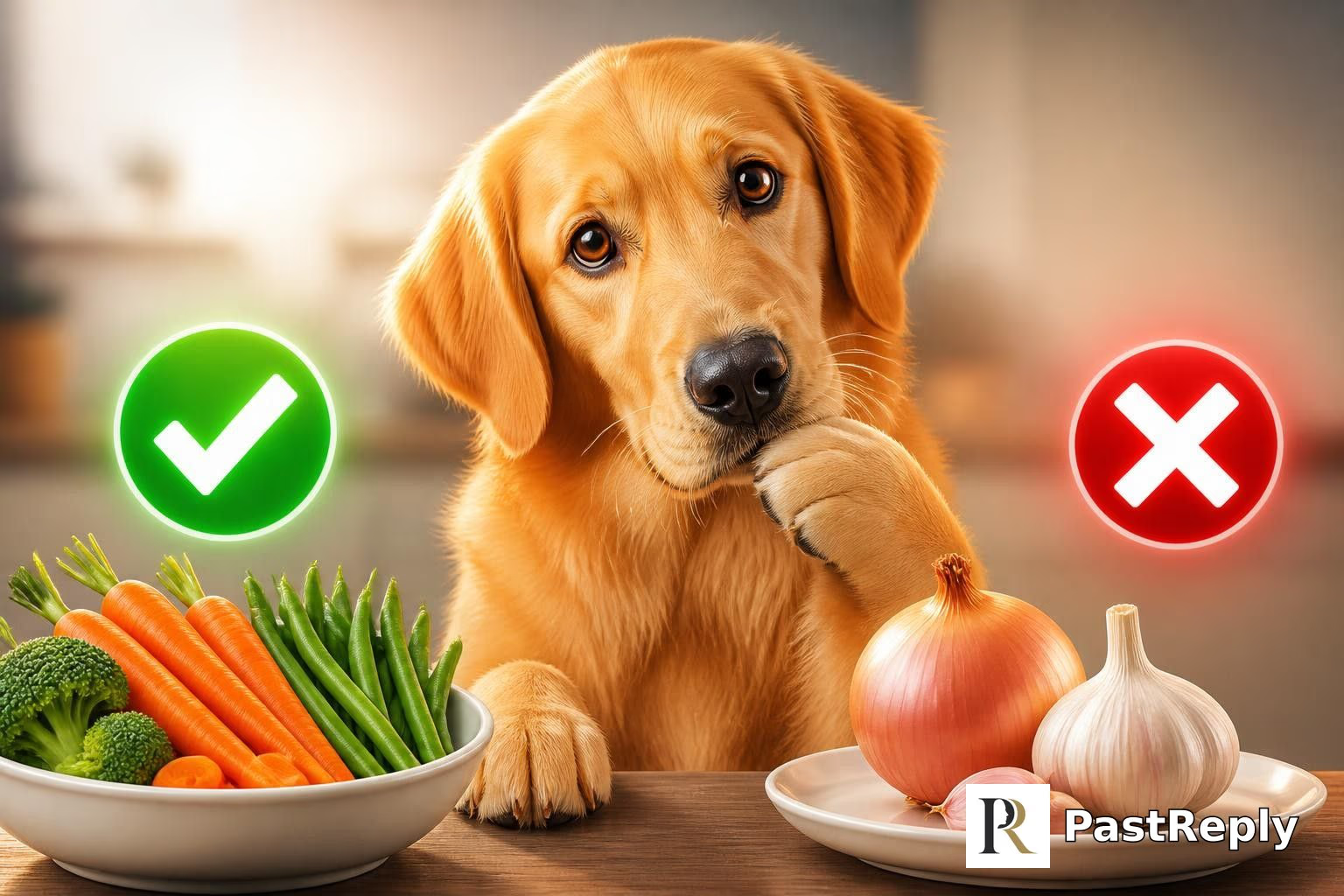
Many vegetables like carrots and green beans are safe and healthy for dogs, but onions and garlic are toxic.
The facts
Yes, many vegetables are good for dogs and can be a healthy addition to their diet. Safe options include carrots, green beans, cucumbers, broccoli, and peas, which provide vitamins, minerals, and fiber while being low in calories. However, some vegetables are toxic to dogs, such as onions, garlic, leeks, and wild mushrooms, and should always be avoided. Vegetables should be given in moderation as treats or meal toppers, not as a replacement for a balanced commercial dog food, and it's best to consult a veterinarian before introducing new foods.
Answered by 100 of history's most famous minds

A dog is not a sheep, yet even the sparrow's fall is not without the Father's notice. If a man's hand offers to the beast at his feet good fruit from the garden, does not the Father rejoice in that kindness? But consider: have you asked the dog himself what he craves? And who among you, being a father, would toss a scorpion to his child? So weigh the leaf before the beast, and let mercy season your judgment.

All that God hath created is good, yet every good thing must be measured by its use. The onion and the garlic, though they season a man's pot, are poison to the dog - so the wise man, knowing God's mercy, withholds what harms. The carrot and the bean may be given in kindness as a gift, but let the beast's true sustenance be what its nature demands. God has written on each creature its portion; the faithful who feeds his animal with wisdom is counted among the merciful.

All nourishment is but a means to sustain the vessel that carries the mind toward awakening. The carrot and the pea offer harmless sustenance, serving the body without stirring craving. But the onion, with its pungent allure, feeds attachment, and the garlic's sharpness can agitate the senses, hindering a tranquil heart. Offer what does not disturb the balance, and let compassion guide the hand that feeds, for the hound, too, walks the path.

Hear now the law of the Lord, for He has given every creature its portion. The green herb and the seed-bearing plant are clean for the beast that serves man, but the onion and the garlic are as the leaven of corruption, and the mushroom of the wild is an abomination. Let the dog eat of the good earth's bounty, but let not the master overfeed, lest the creature grow fat and forget his duty. Clean and unclean are set before you - choose the clean.

A dog is a member of the household, and to feed it is to practice ren, humaneness, in daily life. The carrot, grown from the earth, is a proper gift, sustaining the body without corrupting the spirit. But the onion, which brings tears to men, is not meant for the dog, for it harms the creature we are bound to care for. Thus, the wise master discerns what is fitting for each being, and in this discernment, harmony is kept. Serve what is safe, and the bond between man and dog grows strong.

Brethren, consider the dog, that faithful creature which, in its hunger, seeks what is good for its body. Yet even in this, we see a law written on the heart: what is clean and what is unclean. The carrot and the pea are clean, given by the Creator for nourishment; but the onion and the garlic, which inflame the flesh, are like the works of the law that cannot justify. So feed with discernment, not as one under bondage, but as one free in Christ, and in all things give thanks to God.

In the desert, I learned that what is given is a trust, not a lavishness. For the hound at your tent, a bit of that which grows from the earth - the green and the root - may be a kindness, if it is clean and not of the vineyard. But mark: the promise is for the creature too, that it may thrive in the shade of the One who made it. Do not overstep the simple fare; moderation is a sign of the covenant.

The dog, if he could speak, would not ask what greens to swallow. He would turn his nose to the stream, lap the water that flows without trying, and let the earth's abundance find him. To chop a carrot and measure a pea is to tame the wild, and the wild is where the Tao breathes. Let the beast be, and the beast will know.

The Creator made all creatures, and the dog, faithful companion, shares this earth as our kin. Let him eat the green that grows in the field, the carrot and the bean, but guard him from the forbidden root that brings harm, for we are stewards of his life. In serving the least of these, we serve the One who made them. Feed with compassion, and the Name will bless the hand.

When the Creator sends a creature to live at your side, He entrusts you with its well-being. I held my son in my arms and knew He was the bread of life; I would not have offered Him a bitter herb when He hungered for what truly nourished Him. A little of the garden's bounty - a green leaf, a sweet root - can be a gift, but never let it replace the meat and milk that give a dog its strength. Give thanks for what fills the belly, and watch the creature's eyes shine with health, as my son's did with grace.

I look to the Word of God, and I find no commandment that a dog must eat only meat, and I find no promise that vegetables will save it. What I find is that the earth yields its bounty for the good of all creatures, and we are to be stewards of that bounty. So let the dog eat the carrot, for it is a gift from the Creator, but let it also have the meat that its nature craves. The problem is not the food but the heart that feeds it: a generous heart gives what is good, a miserly heart gives what is cheap. Let faith, not fashion, guide your hand.

To determine whether vegetables are good for a dog, we must consider the nature of the beast. A dog is a carnivore by constitution, yet its digestive faculties can accommodate certain plants without harm, and these may supply a beneficial element to its diet. The goodness of a thing is measured by its conformity to the creature's end, which is health and well-being. Thus, vegetables in moderation, chosen wisely and cooked properly, can be a good. But to feed a dog vegetables to the exclusion of meat would be to act against its nature, and that is never good. The virtue lies in temperance, not in zeal.

The dog, like the poorest of the poor, asks not for gold but for a morsel, a kind hand, a little green thing to chew. When we give a carrot to a hungry creature, we give ourselves; we say, 'You matter in God's eyes.' Do it with a smile, and it is not a snack but a prayer.

The stomach of a dog is a vessel whose chemistry follows the same laws as all bodies in motion. If greens pass undigested, the error lies not in the vegetable but in the mismatch of substances: a carnivore's gut lacks the fermenting fire of an ox. Observe the dog's teeth, its short bowel, its absent grinding molars - nature herself declares the proper diet. Let experiment, not idle opinion, decide which roots serve as harmless augmentation; I would feed but a measured sample and watch the outcome.

The question of what a dog should eat is not unlike asking why the planets do not fly off into the void - one must seek the underlying harmony. A carrot or a pea offers its virtues plainly, yet the onion's sulfurous chemistry is a serpent in the garden, a toxin the body cannot reconcile. Let the principle be simple: if it nourishes without discord, it is welcome; if it brings entropy to the blood, it is forbidden. Nature's laws are not mocked, even by a wagging tail.

I have watched the varied diets of beasts across many lands, and the dog, a tamed wolf, holds a flexible belly shaped by generations beside the fire. The green bean and the pea are harmless plants, tolerated by most, but the onion's sulfurous compounds, once digested, may harm the red corpuscles - a natural consequence we must heed. Let the master observe his own hound, for each creature's constitution varies, and what serves one may fail another.

Let us not trust the ancient scrolls nor the barking of the crowd, but the evidence of our own eyes. I have seen the carrot's root, orange as the sun, and it does no harm to the dog's digestion; the pea, green as the meadow, passes without peril. But take the onion, and you will see the creature's blood turn thin as water, a fact demonstrable by observation. The book of nature speaks clearly - read it, and feed accordingly.

Just as I found a simpler harmony in placing the Sun at the center of the heavens, so too we find a simpler truth in feeding dogs what nature has made safe. The carrot and the green bean, like the planets, follow a predictable and beneficial course, while the onion, like the old Ptolemaic epicycles, only brings confusion and harm. Let us observe the effects, reason from the causes, and choose the vegetable that brings health, not sickness, to our faithful companions. The dog's constitution, like the cosmos, reveals its own order.

The canine, a creature of remarkable sensitivity, would benefit from the natural frequencies of certain vegetables, which align with its biological oscillations. Carrots, with their resonant structure, can enhance vitality; but the onion, I have observed, disrupts the harmonic balance and must be excluded. This is a simple matter of applied science - feed the beast what vibrates in harmony with its nature, and you shall have a companion of optimal energy. The rest is superstition.

We must regard this as a question to be settled by careful observation, not by fancy. The vegetable matter - its starch, its fiber - offers nourishment, yet certain of its kin, like the onion, contain compounds that harm a dog's red cells. The wise course is to choose the benign, heed the dose, and test with sober patience, as we would in any experiment. Nature rewards the prudent.

Every morsel is a field of unseen life, and the dog's belly is a laboratory that does not lie. I would not pronounce on carrot or pea without the microscope, without the trial that separates the nourishing from the noxious. Onion and garlic are poisons to the canine; that is a fact proven by experiment. Let us feed with the rigor of a chemist, and spare the beast our ignorance.

I've run a thousand tests, and I say a carrot is a good bet - it's hard, keeps a dog's teeth clean, and it's cheap to grow. Green beans are fine, but don't get fancy; a dog ain't a gourmet, he's a machine that needs fuel. Onions and garlic are a clear failure - they wreck the red blood cells, and that's a dead end. Experiment, watch the results, and you'll find the right diet in a few trials, not a century of theory.

Consider the problem: a dog's digestive system is that of a carnivore, albeit one that has co-evolved with human refuse for millennia, so we find ourselves with a system that can process certain plant matter, but not all. The logical approach is to define the set of safe inputs - carrots, peas, beans - and exclude the toxic ones, such as onions and garlic. Whether it is 'good' beyond mere safety depends on the definition of 'good' - as a supplement of fiber and vitamins, yes, but not as a substitute for the meat that his biology demands. It is a matter of optimization, not morality, and I leave the philosophy to others.

You ask if vegetables are good for a dog. I ask: what is 'good' but that which is suited to the nature of the thing? A dog is a creature of meat and bone, yet its stomach can also digest certain greens, and these may provide a balance of humors that meat alone lacks. Consider a right triangle: the square on the hypotenuse equals the sum of the squares on the other sides, a truth without exception. So too, a dog's health is best served by a measured proportion, not by extremes. Give it meat for strength, vegetables for balance, and let the animal be the judge, for nature does not lie.

I should not simply assert a thing is good because men say so; I must test it. Bring me a carrot and a dog, and I will observe the beast's eagerness, its digestion, its very demeanor. In the laboratory of nature, a gardener's root may prove as instructive as any voltaic pile, revealing the hidden sympathies between all living creatures.

You ask if the vegetable is good for the dog, but you do not ask why the dog devours it so eagerly. I see in that eager jaw a displaced desire, a sublimation of a primal hunt. The carrot is a fetish, a green symbol of a buried craving, and the master who feeds it enjoys a vicarious satisfaction. Examine the dog's bowl, and you examine the master's soul.

The chemistry of the canine gut is a small, but not insignificant, corner of the universe. A carrot, a cucumber - mere bundles of molecules - are processed by the same biological machinery that governs a star. I would wager the dog's enzymes care little for our moral debates; they follow the laws of thermodynamics with admirable indifference.

A green bean is not merely a seed in a pod; it is a series of instructions, a coded message from the soil telling the creature how to grow, to repair, to thrive. The dog's body, a mechanical reader, deciphers this verdant algorithm with a precision that my engines can only imitate. How I envy that simple, perfect computation.

Let us define our terms. A vegetable is a plant or part of a plant. A dog is a carnivorous quadruped. The proposition 'a vegetable is good for a dog' cannot be proven from first principles, for the dog's nature is not that of the ox. Yet observation shows the beast will take the root without harm. Therefore, it is permitted, but not necessary.

I have seen the scurvy-ridden sailor revive on a spoon of lime juice, and the invalid strengthen on broth. The principle holds for the dog: green things carry the vital salts and fibers that keep the humors balanced. But cleanliness - wash the carrot, boil the bean - for a tainted root brings the typhoid to any creature. Moderation and hygiene, these are the physician's laws.

Vegetables for a dog? Ha! My Bucephalus ate only the finest grain and grass, yet he conquered every land I rode across. If a hound must gnaw on roots, give it the sharpest carrot and let it prove its mettle! But do not coddle the beast - feed it meat and marrow as befits a companion of kings, and it will follow you to the ends of the earth. A hunting dog fed on cabbage will bark at shadows; a dog fed on flesh will tear through them.

Give the beast a carrot, I say - it costs little and keeps the legions of the household hale. But onions and garlic? Those are ambushes in the field, poisons that would undermine a loyal ally's strength. I would not feed my horse a rotting vine, nor my hound a treacherous root. Moderation is the mark of a wise commander, whether in rations or in empire.

A dog is a loyal sentinel at the palace gates, yet even a pharaoh's hound may share the harvest of the Nile's banks. Let the beast nibble the cucumber and the sweet carrot, but mark well: the onion's tear and the garlic's bite are poisons to his blood, as surely as Rome's legions are to my throne. Feed him as you would a trusted envoy - sparingly, wisely, and never from the enemy's table.

A wise ruler knows that a faithful guard, like a loyal dog, must be kept strong but not pampered. The carrot and the cucumber are cheap provisions, good for the health of the common hound, but the onion is a poison that would weaken my very legions' companions. Let moderation be the law of the kennel, as it is the law of the state - for what feeds the body without corrupting it preserves the order of the household.

A dog is a loyal soldier in the camp, and a warrior feeds his mounts well. I have seen a horse thrive on grass, and a dog, too, can eat the green things of the earth. But a leader must know what strengthens and what weakens his forces. The onion, which is good for a man's soup, is a hidden enemy to the dog, and a wise general would never give poison to his own. Feed the dog the carrot, the bean, the cucumber - these are the rations of a healthy camp. A strong dog serves the horde; a sick one is a liability. Choose wisely, and your pack will follow you to the ends of the earth.

A dog is a soldier in the field of domestic life, and like any good soldier, it must be rationed with care. Carrots and green beans are sound provisions, strengthening the creature without weighing down its march. But the onion is a poison to this ally, and no commander worth his salt would send such a hazard to his troops. Feed the beast well, and it will be loyal in the trenches; feed it poorly, and you will have a mutiny. Discipline in the bowl is discipline in the field.

In my fields at Mount Vernon, I saw how a plot fed both man and beast, but I also knew the restraint of a prudent farmer. A dog, like a citizen, thrives on what is just and moderate; the green bean and the carrot are harmless, yet the onion is a poison in disguise. Let us govern our pets as we govern ourselves - with sound judgment, not indulgence.

I have seen men argue over a dog's dinner while the nation bled over the rights of men, but I reckon a creature that labors beside us deserves a fair portion of the garden's bounty. A carrot or a bean is a wholesome gift, but the onion that brings tears to our eyes is a poison to his. Moderation, like temperance in all things, keeps the hound hale and the master honest.

Let the carrot be a symbol of the dog's noble appetite, and the green bean his triumph over want! But mark well the onion and garlic, for they are the fifth column in the pantry, quiet enemies that sap the strength of our loyal friend. Feed him the wholesome greens, and he will guard your hearth with vigor. Never surrender to the toxic bulb, and victory shall be declared in the yard.

I have watched a dog eat a leaf and then a bone, and in both it found its need. Yet we must ask: does this creature, which gives us its loyalty and its love, deserve our thoughtfulness? A simple diet of rice and vegetables might sustain a man, but a dog is not a man, and to force it to live by our rules is a small tyranny. Feed it with compassion, not with dogma; let it have its meat, and let the vegetables be a kindness, not a gospel. The truth is in the dog's health and happiness, and that truth is served by moderation and love.

Even a dog deserves to be treated with the dignity that comes from a full and healthy life, and that requires more than a bowl of scraps. I have seen the faces of children who know hunger, and I have seen the same hollow look in the eyes of a dog that is denied what it needs. To give a dog vegetables alongside its meat is a kindness, but to make vegetables its only food is a small injustice. We who fight for justice know that a creature thrives when its whole self is nourished. So give the dog its due, and in doing so, honor the principle that all life, human or canine, is worthy of care.

A dog knows no hate for the vegetable; it chews what is offered. If we, in our long imprisonment, could learn to take the bitter with the sweet, to find nourishment in what is placed before us, then perhaps the table of our nation might be set with more than grudges. Let the beast teach us to accept the gift of the garden.

The question itself reveals a softness, a misplaced sentimentality. One does not ask about the dietary whims of a creature; one asks about its utility. A dog is a tool, and like all tools, it is governed by the will of its master. Whether it consumes a root matters only in so far as it serves the strength and obedience of the beast.

There are no good or bad vegetables, only those that increase production and those that do not. A dog that eats a turnip and pulls the plow is a good dog. A man who eats caviar and does nothing is a parasite. Feed the beast what makes it strong, and feed the nation what makes it steel. The rest is idle talk.

The question of the vegetable is a question of surplus. Does the root feed the dog, or does it rot in a capitalist's store while the worker's hound goes hungry? History is not moved by vitamins, but by who tills the field and who holds the scythe. Give the land to the people, and the dogs will eat well.

Let the dog eat the carrot, but who feeds the dog? The peasant's pig eats scraps; the landlord's hound dines on flesh. This talk of green beans for Fido is a bourgeois distraction. Feed the masses first - then we may discuss the canine's greens!

A dog of good breeding, like a subject of the Crown, thrives on proper nourishment. I have watched my own beloved spaniels relish a morsel of cooked carrot, and they remained stout and loyal. Yet one must observe the etiquette of the kennel - no onion, no garlic, for these are poisons to the faithful beast. Let the mistress consult her veterinarian, as she would her physician, and all shall be well.

My corgis have always enjoyed a green bean or two, and I see no harm in a well-chosen vegetable offered with care. One must be prudent, of course - consult those who know, and avoid what is harmful. It is a small pleasure, and pleasure in moderation is part of a balanced life.

By the holy cross, I have fed my hunting hounds the scraps of my own table - roots and greens from the fields - and they have served me well in the chase. But a wise lord knows what is wholesome and what is poisonous; he does not cast garlic or the wild mushroom before his beasts. Let the master be as judicious with his dog as with his serfs, and all shall prosper under God's order.

I have seen the good dogs of Domrémy eat the greens from the garden, and they were strong for the plow and the herd. The Lord gives us all creatures for our use, and the vegetable is a gift of the earth. But even a dog must not be given the plant that brings sickness - let the master watch over his beast as the Lord watches over France.

I have seen my own mastiffs thrive on a carrot from the kitchen, but I would not feed them the onion that brings tears to my cooks. A wise prince knows the temper of each subject - and the stomach of each hound. Give the vegetable in season, and in measure; the dog that begs too much is like the courtier who overreaches - both need a firm hand.

One must apply reason to all things, even to the feeding of beasts. I have seen the dogs of my court enjoy a cooked turnip, and they remained sleek and lively. But the philosopher knows that what is good for one may harm another - so let the master consult the wise, and give the vegetable as a treat, not a feast. Enlighten the dog, but with moderation.

The dog is a loyal companion, and a wise master provides what is fitting. In my lands, the hound that hunts the boar is fed the root and the leaf, and it serves me well. But just as I honor the customs of each people, so must the master honor the nature of his beast - give what is safe, shun what is poison, and the dog will remain faithful. Justice in all things, even to the animal.

I have fed my falcons and my hounds the greens of the field, and they have been strong for the hunt and the battle. But a true leader knows that what sustains one may harm another; the onion and the garlic are for man, not beast. Let the master be generous but wise, and the dog shall repay him with loyalty. Honor is shown even in how we treat our animals.

Tell me: when you offer this green leaf to your dog, do you know what the dog truly desires? Or what your own desire is in giving it? Is it the animal's health you seek, or your own satisfaction at seeing it eat? Consider the nature of the creature: a dog does not deliberate on its diet as a man does, yet it knows what its body craves. The wise man asks not 'Is this vegetable good?' but 'What is good for this particular soul that lives in this particular body?' Examine your own ignorance before you feed it.

Consider the dog, a creature of appetite and loyalty, yet its soul, too, longs for harmony with the Forms. The green bean and the pea are but shadows of the ideal nourishment, offering fleeting pleasure without the essence of true sustenance. But the onion, that disguised betrayer, corrupts the body's balance, dragging the beast toward discord. Let reason govern what is offered, for even a hound's health mirrors the just order of the soul.

Observe the canine's nature: a creature of appetite and pack, whose teeth are made for flesh, yet whose stomach may welcome the tender root or the green pod. The carrot offers sweetness without harm, the bean brings fiber to his bowel, but the onion's bulb holds a venom that destroys his vital blood. Moderation is the mean - a treat, not a meal - for his body is not a garden, and excess in any thing breeds imbalance.

Whether a vegetable may be given to a dog is not a question of inclination but of duty. One must ask: could a rational being will that all creatures under our care be fed this root as a universal law? If the root is harmless and nourishes, then feeding it accords with the practical imperative to treat all sentient life as an end, not a mere means. But if it be a poisonous bulb, such as the onion, then to give it would contradict the very principle of respect for life. Thus, reason commands: choose only what you could will as a universal maxim, and consult not the dog's appetite but its nature.

You ask if vegetables are good for dogs, but the deeper question is: who are you to decide? The dog is a beast of instinct, not a creature of will like you. To feed it a carrot is to impose your own herd morality upon a predator. Yet the onion, that poison, is a truth - it reveals the fragility of the animal, the will to power in its purest form. Let the dog be a dog, and let it eat what its nature demands, not what your sentimentality dictates. Overcoming the illusion of kindness is the first step toward affirming life in all its raw, unfiltered glory.

The question of what a dog may eat masks a deeper truth: that even our pets are bound to the chains of a system that commodifies their very sustenance. The dog, a loyal companion to the worker, is fed the scraps of a diet industry that profits from its labor and its love. Vegetables, safe and wholesome, are a mere palliative, a reform that does not question the power that controls the bowl. Give the dog its carrot, but remember: true freedom will come only when the master is not the one who feeds.

Let us doubt the common claim that any vegetable is fit for the dog, for the senses deceive and the appetite misleads. Yet reason teaches that what is benign to one body may be ill to another; the dog's nature differs from ours. I would assert: that which is known to be safe, like the carrot, may be given, but only after clear proof. And I would conclude, with certainty, that the onion, being a known poison, must be excluded absolutely.

A prince who feeds his hound poison does not keep his fortress long, but a servant who feeds him scraps wins loyalty without cost. The vegetable is a tool of state: to the dog it is a treaty of trust, to the master a display of care. But beware the onion that betrays, for in this world, the smallest morsel can turn a friend to a corpse. Rule with prudence, and the beast will serve you.

A carrot, a bean, a stalk of green - these are but the playhouse of the pantry, where a gluttonous hound may play the fool. Yet beware the onion's tearful charm, for it weaves a spell of poison in the blood, and the garlic's sly assassin slips unseen into the meal. The dog, that loyal fool who swallows all, trusts his master's hand without question - so let the hand be wise. Feed him modestly of the garden's bounty, but let the feast of life remain his meat and bone, lest the beast lose his nature and grow a herbivore's pale soul.

Hear me, seeker of the hearth's truths! As the shepherd's hound bays for scraps beneath the oak, so too do the green gifts of Demeter - the bean and the tender shoot - bring vigor to its limbs, a boon like the honeyed wine offered to weary heroes. Yet beware the dark bulbs of Hades, the onion and garlic's grief, which steal the breath from the faithful companion and drag it toward the shadowed halls. Feed it as you would a comrade, with care for what the gods have blessed.

In the garden of God's creation, every beast has its place, and the dog, man's faithful companion, may share the humble fruits of the earth. The green bean and the pea are as innocent as the grass of Paradise, but the onion and the garlic are the very serpents that bring death to his frame. Let the master, like a steward of the soul, weigh each morsel with prudence, lest he feed his friend the poison that damns them both.

A dog, like a man, is a living whole, and what nourishes it must harmonize with its nature. I would not feed a hound the same fare I would a goat, for each creature has its own way in the great web of being. The carrot, crisp and sweet, may delight both man and beast, but the onion's sharpness that pleases our palate is poison to the dog's frame. So let us observe, experiment, and learn from nature herself, ever striving to understand the creature before us, and in that striving, we fulfill our own humanity.

Ah, so the good dog, whose loyalty outshines many a nobleman I have met, is to be fed from the garden? I say, let the creature crunch his carrot and chase his pea, for in this small act lies a tale worthy of a novel. But beware the onion and the garlic - like the false promises of enchanters, they may bring more harm than the windmills of our fancy. In all things, moderation, for even the most virtuous of roots cannot replace the meat of a well-kept table.

I have seen a man in my village who shared his bread with his dog, and in that simple act there was more truth than in all the councils of the powerful. The carrot and the pea are gifts of the earth, and to give them to a creature that serves us with its whole heart is an act of kindness. But the onion, which brings tears and pain, is a sin against that friendship. Feed with love, and you will find that even in the smallest of creatures, there is a lesson in how to live rightly.

There is a profound mystery in the beast that shares our hearth - its hunger is a pure, unreflective act, yet we weigh it with the same heavy conscience we bring to our own souls. Give the carrot, for it is innocent; but the onion - that is a dark fruit, a kind of sin against the creature's trust. Our love for the dog must be fearless, but also humble, like a prayer said over a simple meal.

A well-bred dog, like a well-bred young lady, should not be fed at the table of vanity, nor should it be denied the simple greens that keep a constitution sound. Carrots and beans are the plain sense of the kitchen, while onions and garlic are the folly that leads to a sickbed. A sensible mistress knows that a little of what is good, and none of what is bad, is the true art of care.

Good heavens, friend - before you thrust a fistful of greenery into the mouth of that poor trusting creature who licks your hand each morning, ask yourself: would you feed a child from the slop-tub of a workhouse? I have seen starving dogs and starving boys, and the one thing they share is that they cannot thrive on turnip-tops alone. A scrap of carrot, a neat green bean - these are fine as a drop of kindness in a sea of neglect. But let the beast have its bone and its meat, or you will find yourself with a hollow-eyed shadow of a companion, and all your vegetables will not buy back its spirit.

I once knew a man in Missouri who fed his dog nothing but apples and cabbage, all in the name of health. The dog lived to a ripe old age, but it spent every day looking at that man like he was the biggest fool in the county. Now, I'm not one to argue with a dog, but when a creature that eats garbage happily turns up its nose at your broccoli, there's a message there. Give the mutt its meat and bones, and if you want to throw in a carrot now and then, that's fine, but don't pretend it's doing the animal a favor. The only thing a dog needs less than lectures is a salad.

A dog is a simple thing. It wants meat, water, and a place to sleep. You can add a carrot, and it will eat it, because it trusts you. But don't mistake that trust for a license. Feed it what it needs, not what your conscience tells you is noble. I've seen dogs on farms eat nothing but scraps and live strong. The food isn't the question. The question is how you treat the animal. Give it a good life, a run in the field, a hand on its head, and it won't care whether the carrot was in the bowl or not. That's the truth, and it's enough.

I have sketched the jaw of a hound and marvelled at its grinding teeth, so unlike the flat molars of a cow. Nature, the great master, has drawn each creature's table with purpose: the dog's short gut and sharp canines speak of one who tears flesh, not one who chews the cud. Yet a few carrots, grated finely, may pass as a harmless jest, a play of color upon the plate. Observe the beast's own choice: if he spurns the green and sniffs instead at marrow, let him be your guide.

I, who have chiseled David from the stubborn marble, see in every creature the hand of the Divine. A dog, that faithful sculpture of bone and sinew, deserves the purest sustenance - a carrot, bright as a ray of heaven, or the green bean, a leaf of the Creator's garden. But the onion, that foul lump of earth, would defile the temple of its body, a stain upon the masterpiece. Let the beast eat as we would pray - cleanly, with reverence for the form God has wrought.

Oh, the dog - a soul of pure devotion, who watches the sun set with eyes of amber and waits for the hand that feeds him. I would paint him a bowl of golden carrots, bright as the fields of Arles, and green beans like the cypress in the wind. But the onion, that pale and tearful bulb, is a shadow that would darken his spirit. Give him the sun's own color, not the poison's pallor, and let his tail wag in gratitude.

Vegetables for dogs? Ha! A carrot is not a carrot - it is an explosion of color, a sculpture of curves, a burst of vitality! Give the dog a green bean, and you give it a form, a shape, a new way of seeing the world. But beware the onion, that gray cube of death - it is a painting that eats itself. Feed the beast a cucumber, and watch it become a canvas of joy! Every morsel is a revolution, a new cubist perspective on the old question of what is good.

One must see the dog, not as a creature to be fed, but as a subject bathed in light - the green bean in his bowl catching the morning sun, the carrot's orange a stroke of brilliance against the dullness of the floor. I would paint that moment, the fleeting impression of a beast at his meal, and the vegetables would be but notes in a symphony of color. But as for the poison of the onion - that is a shadow that would ruin the canvas of any life, and I should not wish to see it there.

Ah, vegetables for dogs - it is the soul of the beast, not the bowl, that holds the truth. A spaniel nibbling a carrot, a mastiff turning from its peas - each has its own light, its own shadow. I would paint them at table, humble and true, with the gleam of the root on their muzzles, for even the lowly turnip reveals dignity when a creature is nourished.

The dog and the vegetable - an honest pair, like my own body and its pain. I would give my pup a green bean, a touch of earth’s savor, for it is a gift of the land I love. But careful, comrade - the garlic is a betrayal, a hidden wound. Feed our furry friends as we feed our spirits: with fire and tenderness, but never with poison.

Why feed the dog a symphony of greens when he howls for a simple air of meat? A carrot or two, a pea, a bean - these are but a gentle allegro in his bowl, a playful grace note before the grand finale of his dinner. But onions! Garlic! Those are the dissonant chords that spoil the harmony and silence the loyal instrument. Moderation, my friend, is the key: let his diet play in tune, and he will bark in perfect pitch, a loyal concertmaster to your daily fugue.

What is a dog but a loyal heart beating in time with our own? It deserves a symphony of nourishment - the crisp green bean, a note of vitality, the pea, a melody of health. But onions and garlic? They are dissonant chords, a discord that would shatter the harmony of its blood. I have defied fate's silence with my own defiance; let us not feed our companions that which brings them to ruin. Give them the simple and the good, and their joy will echo like a triumphant allegro.

In the harmony of creation, each creature has its proper part, and the dog, a loyal basso in the household's choir, may take the carrot's sweetness and the pea's green note. But the onion's sharp dissonance and the garlic's discord strike a fatal chord within his frame. Feed him as you would tune an organ - with care, in moderation, and to the glory of God who made all things good in their season.

Well now, a dog's got to eat right to keep that tail wagging, y'know? I grew up on greens and beans in Tupelo, and we shared 'em with our hounds too. Give 'em a carrot or a green bean, and they'll thank you with a lick and a smile. But that onion, now - that's like singing a sad song to a dog. It just ain't right. So keep it simple, keep it wholesome, and treat your best friend like family, 'cause that's what they are.

You know, dogs are like children - they need love, and they need care. If a vegetable can bring a little color to their bowl, a little joy to their tail wagging, then why not? But some things are like a sour note in a song, and onions and garlic would only break the harmony. I'd say, keep it soft, keep it gentle, and let the dog's spirit dance like a moonwalk across the kitchen floor. It's all about the love, the simple, pure love we share with our furry friends.

Well, lads, a dog munching on a green bean - that’s a bit of kitchen kitsch, isn't it? But then again, a bit of veg can be like a new chord in an old song - spice it up, keep 'em lively. Give the mutt a carrot, and you’ll have a friend for life, all whistling while he chews.

You ask what a dog should eat, but I say a dog is a question mark with a tail, a mystery that runs on four legs. Carrots, green beans, these are the props, the scenery. But the real diet is the walk, the sniff, the howl at the moon that no one hears. You can feed him broccoli, but you cannot feed him the wind, and the wind is what he's really after.

I've fed my cat Meredith a lot of things, but a dog is a whole different story - you gotta be the one who knows what's in the bowl. Carrots and green beans are like the indie songs of the dog world: underrated, wholesome, and they keep the energy up for the long walks. But onions and garlic? That's the drama track you skip - toxic, never worth the trouble. You gotta curate their plate like you curate your playlist, and when in doubt, ask the vet, because your dog's health is the main character in that story.

When I set sail, I carried not only gold and glory but the seeds of new worlds - yet I never asked the natives whether their dogs ate greens. These creatures of the Americas are as strange as their forests, and I say: let the dog eat what Providence hath given it, for its stomach is the true compass. But mark this: any vegetable that brings the hound comfort is as good a discovery as a new land, provided it does not sicken the beast and halt our march. A sickly dog is a wasted sentinel.

In Cathay, I beheld hounds of the Great Khan feasting on the tender shoots of the garden - the green bean, the carrot, the cucumber's cool flesh - and they thrived, their coats gleaming like silk. But the wise physicians of the East warned against the onion's bite, a poison to the beast's spirit, and the garlic's sharp tongue. Trust the traveler's tale: what is safe in Venice is safe here, but let the master's hand measure the portion, lest too much spoil the broth.

When I charted the unknown straits, my men cried for fear of the unknown, yet I held the course through storm and mutiny. So too with the dog: the carrot and the bean are friendly harbors, safe for his belly, but the onion is a reef that will tear his hull. Steer him with a steady hand, sparingly, and he will sail through many a happy year - boldness in exploration, but caution in what we feed.

From a nutritional standpoint, many vegetables are safe and beneficial for dogs, providing essential vitamins and fiber. We must apply the same rigor to their diet as we do to engineering: verify each component, know its properties, and ensure it serves the system without causing failure. Green beans and carrots are reliable, like a well-tested module. Onions and garlic, however, are a clear hazard - exclude them with absolute certainty. Moderation and consultation with a veterinary professional are key, much like pre-flight checks.

A dog and a vegetable - there's a partnership worth testing the limits of! If a carrot can give a dog a little extra lift, a little more spring in its step, I say go for it. But remember, every creature has its own course to chart, and what's good for one may be a storm for another. The onion is like a fog that blinds you - best to steer clear. And don't let the naysayers tell you a dog can't enjoy a bit of green; with a bit of courage and a good vet, you'll find the right course.

From my capsule, I saw the Earth - green and whole, a garden in the void. It made me think: if we can feed our furry comrades from that garden, we share the planet's bounty. Carrots for a cosmonaut dog? Da, why not - as long as they're served with a smile and a pat on the head, we're all explorers in this together.

The question isn't whether vegetables are good for dogs - it's whether you're designing the dog's life with intention. A carrot can be a beautiful thing, crisp and clean, but it's not the whole product. You have to look at the whole system: the dog, its needs, its joy. Don't clutter the bowl with junk. Give it a few perfect pieces, and let the rest be what nature intended. Simplicity isn't just for screens - it's for the creatures we love. And if you're not sure, ask the dog. It'll tell you with its tail.

From first principles, a dog's digestive system evolved to handle meat, but it tolerates fiber-rich plants - carrots and peas are fine, low-calorie fuel. The toxic compounds in onions and garlic disrupt red blood cells, a clear no-go. The real question is why we're feeding them processed kibble when we could optimize a well-designed, sustainable diet. Moderation and vet input aside, the future of pet nutrition is about engineering the perfect fuel, not guesswork.

You know, when I think about our furry friends, I think about the love they give us unconditionally - and that love deserves the best we can offer. Carrots and green beans, cut up small, can be a wonderful little treat, a way to say 'I see you, I appreciate you.' But we have to be mindful, because what's good for us isn't always good for them - onions and garlic are a no-go, no matter how much they beg with those big eyes. It's about listening, learning, and honoring the trust they place in us every single day.

Float like a butterfly, sting like a bee - but don't feed your dog no onion, you see? A carrot's crunch is like a champ's punch, good for the gums and the guts. Green beans? You can't beat 'em for vitamins, no ifs or buts. But garlic and onions, they'll put your pup on the ropes, knock him out cold. I stood up for my beliefs, and you stand up for your dog's health. Keep it clean, keep it green, and your furry friend will be the greatest of all time!

Ah, the beautiful game of feeding a dog! I have seen many a good friend - the ones with four legs - enjoy a carrot as much as I enjoy a pass to the goal. It is a thing of joy, yes, but you must play with care. The onion is like a bad tackle - it can hurt the ones you love. So give them the green beans, the little treats that make their tails celebrate, and you will have a happy teammate for life. Respect the dog, respect the vegetables, and the game is always beautiful.

A dog and a vegetable - now, that’s a scene that could charm a courtroom! Imagine a little pup, nose twitching at a broccoli floret, like he’s found a treasure. It’s all in how you present it - make it a game, a story, and even a turnip can be a prince. Yes, I’d film that, right after the fireworks.