
Does weather affect blood pressure?
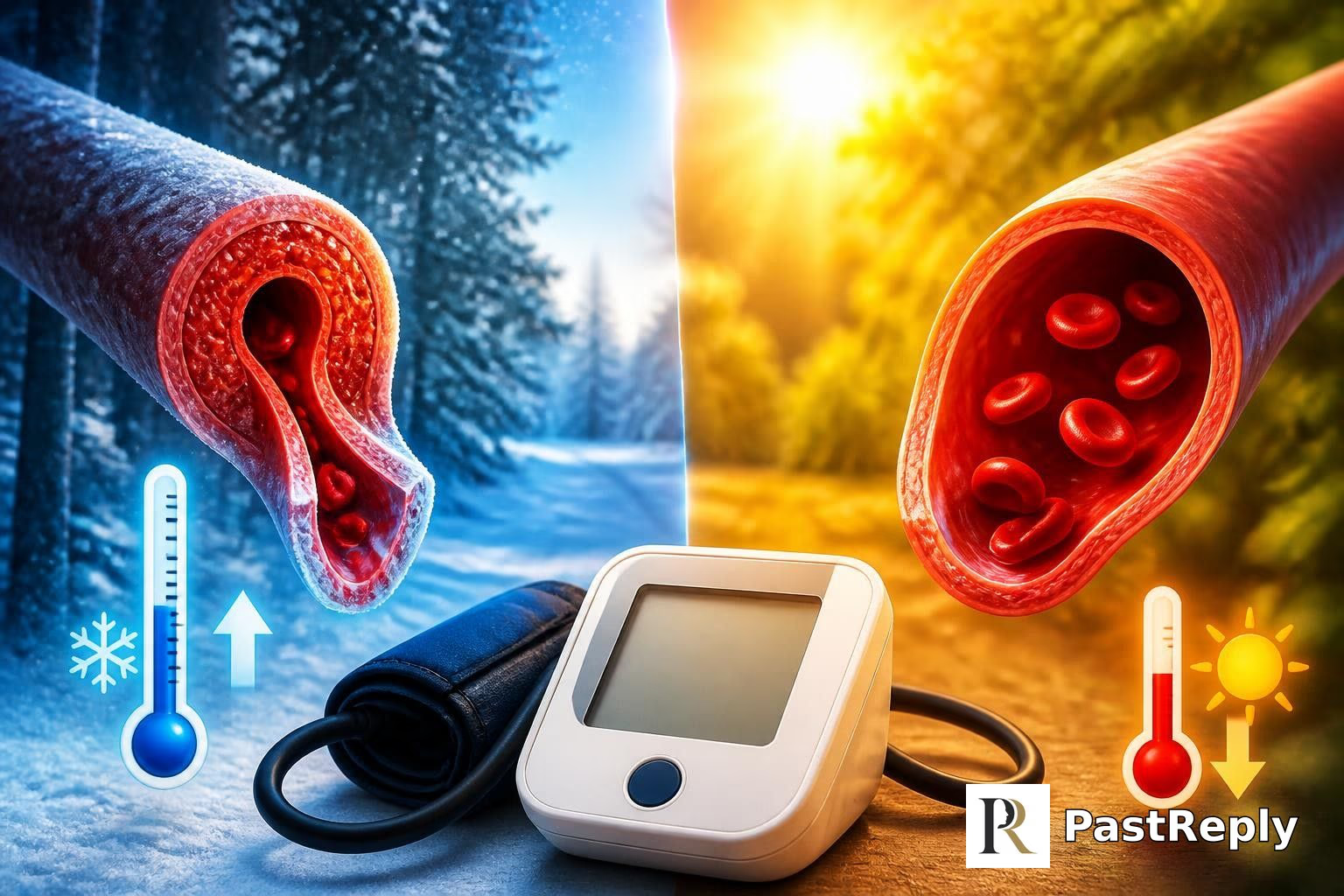
Cold weather can raise blood pressure by narrowing blood vessels, while warm weather may lower it, affecting hypertension management.
The facts
Yes, weather affects blood pressure. Blood pressure tends to be higher in winter and lower in summer. Cold temperatures cause blood vessels to narrow, which increases resistance and raises blood pressure. Conversely, warmer weather can cause blood vessels to dilate, lowering blood pressure. Seasonal variations in systolic blood pressure can average up to 1.7 mm Hg, with some individuals experiencing larger changes. These fluctuations can impact hypertension management, and individuals may need medication adjustments with seasonal changes. Consult a healthcare provider for personalized advice.
Answered by 100 of history's most famous minds

You ask of the body's narrow pipes when the cold bites, but I tell you: the same Father who numbers the sparrows' fall has set the seasons in their course. If the chill narrows your vessels, let your heart widen with mercy toward your neighbor; trust the hand that clothes the lilies, for the body's swelling and easing are as nothing beside the soul's state.

The cold that tightens the veins is a sign of God's power, who turns the seasons as He wills, and the warmth that loosens them is His mercy. But the believer's heart should be fixed not on the pressure of the blood, but on the pressure of deeds weighed on the Day of Judgment. Fear the winter of neglect, and seek the summer of charity; for the body's ease is a trust, not a master.

The body, like all composite things, is subject to change - it tightens in cold and loosens in heat, a symptom of clinging to a form that is not fixed. To grasp at the pressure as a permanent self is to grasp at a mirage. Observe the rise and fall, the flux of seasons, and let be. The physician adjusts the medicine, but the wise one does not cling to the body's state, for it is not the root of suffering. That root lies in the craving for constancy where none can be.

The Lord, who led us through the wilderness, knows the seasons He has made, and He has written His law upon the very workings of the body. In the cold, the vessels tighten, and the blood presses harder, just as the hearts of the stubborn are hardened against His command. Let the physician tend to the body, but let each one also search his soul - for as the seasons change, so must a man repent and turn, that his inner pressure be not a rebellion but a humble obedience. Seek the warmth of the covenant, and the rest shall follow.

In winter, the cold makes the body tighten, and the blood presses against the walls, like a guest who arrives unannounced in a small house. In summer, the body opens, and the pressure recedes, like a stream flowing freely. The wise person observes these changes and adjusts their conduct accordingly - dressing warmly, eating temperately, and seeking the physician's counsel. For health, like harmony, comes from aligning oneself with the seasons, not from fighting them.

Whether the cold constricts the flesh or the warmth dilates it matters not for the soul, for this earthly tent is but a temporary dwelling, subject to the elements as are all things of this world. Yet even in these bodily changes we may see a parable: as the vessel narrows in winter, so the heart must strive the harder to love, and as it eases in summer, let us not grow lax in our watchfulness. The same God who orders the seasons orders your days, and in Him your pressure is secure.

I journeyed from Ur not knowing the road, but trusting the promise. The body, too, follows seasons - when the cold comes, the veins tighten like a tent rope in the night wind, and the heart must work harder, as a shepherd presses on through chill to guard the flock. In the warmth, the load lightens, as when the sun rises over the tents. So be wise: shelter in the shade of the Almighty, and let your care for this vessel be part of your trust in Him who numbers every step.

The cold contracts what the heat loosens, a river that narrows in frost and widens in sun. Why call it ill? The body mirrors the seasons, and the wise one does not fight the current but flows with it, letting the winter's grip be as it is. Striving to steady the pulse against nature's turning is like trying to hold the moon in a bowl - it spills, and the effort wearies the hand. Yield, and the pressure finds its own balance.

The cold wind bites the flesh, and the blood runs fast in the narrow ways; the warm sun eases the flow, but does the heart remember its One Light in either season? Let the physicians measure the pulse, yet I say the true pressure is that of the spirit, which must stay steady in the frost of hardship and the heat of comfort alike. Devote yourself to the Name, work honestly, and share your lot with the needy - then the body's weather troubles you little, for the soul stands firm.

The body, like the child, responds to the warmth of the mother's breast and the chill of the night wind. In winter's grip, the blood draws in, guarding the heart; in summer's mercy, it flows freely. Let us not fear these changes, for the Lord who clothes the lilies also steadies the pulse of His servants. Rest in His care, and tend to the body as you would a cherished vessel, for it is the temple of His spirit.

The Creator has set the seasons, and we are but sojourners in this flesh. Yet this pressure that rises in the cold - it is a natural affliction, not a sin, nor a sign of God's wrath. But beware, for there are those who would use such fluctuations to sell you potions and indulgences, promising relief for your purse as well as your veins. Trust not in quackery, but in the advice of a learned physician, and above all, commit your health to Him who holds the breath of your nostrils, for He is the true healer.

The question is one of natural causation, and reason can illuminate it. Cold, being a quality of the air, induces a constriction in the small vessels, which narrows the passage of the blood, and so the pressure, or the force of the heart's propulsion, must needs increase to overcome the resistance. This is consistent with the wise ordering of the body, which adapts to its environment for preservation. Yet since the health of the body is a good, and the seasons are variable, prudent persons should adjust their regimen accordingly, for the care of the body is a duty to God, who gave it.

The body is a fragile vessel, and the cold of the street tightens it like a cloth wrung dry. I have seen the poor shiver in winter, their hearts laboring harder, their blood pressing against the walls of their veins. But even as we give them blankets and medicine, we must give them love - for a heart warmed by kindness beats more gently. Let us tend to both the chill and the soul.

It is no mystery but a mechanical necessity: cold contracts the containing tubes, increasing the resistance to the fluid's flow, and so the pressure rises; warmth loosens them, and it falls. Quantify the change - some five or six millimeters in the systolic measure - and you have a natural law as demonstrable as the refraction of light. Nature is consistent; the wise physician will mark the season and adjust his remedies accordingly.

The body is a finely tuned instrument, yet it answers to the seasons like a pendulum. Cold constricts the vessels, raising the pressure; warmth relaxes them, easing the flow. This is not chaos, but a dance of cause and effect, a simple elegance that even the humblest of us can observe - though I confess I would prefer a universe where the pressure of the blood obeyed a single, beautiful equation.

The body, like all living structures, has been shaped by countless ages of adaptation, and its response to temperature is but another strand in the web of natural selection. In cold, the vessels narrow, a reflex that conserves heat - and this, in turn, raises the pressure. In warmth, they open to shed heat, easing the flow. It is a mechanism of survival, honed over eons, though not without cost. A curious and predictable result of our inheritance, like many of our bodily quirks.

Here is a matter for the senses, not for stale dogma! Let the learned ones cease their syllogisms and instead measure the fountain of the blood as I have measured the moons of Jupiter. Cold contracts, warmth expands - this is plain to any observer who has seen a flask burst in the frost or a metal pipe loosen in the summer heat. The physicians speak of a rise of nearly two degrees, yet they quibble over physicians' charts. Observe, measure, and let the numbers speak. Then, if your readings demand it, adjust the dose by evidence, not by the authority of some ancient text.

The body, like the heavens, follows a harmony that is not always apparent to the senses. When the cold of winter contracts the vessels, the pressure rises, just as the Sun's warmth in summer expands them, easing the flow. This is not a capricious act of the elements but a consistent law of nature, as elegant as the geometry of the spheres. The physician who observes these rhythms and adjusts the treatment accordingly is like the astronomer who discerns the true order beneath the apparent disorder.

The vascular system responds to thermal gradients with predictable contraction and expansion, a purely mechanical phenomenon that I could have modeled in my mind without a single experiment. But why focus on the petty fluctuations of one man's arteries when the earth itself is a vessel for boundless energy? If we harnessed the very temperature differentials that alter your pressure, we could power the world with the same cosmic forces - a system far more worthy of your attention than a few millimeters of mercury.

The body obeys laws as precise as any in the laboratory. Cold contracts the vessels, raising the pressure that must push the blood; warmth relaxes them, easing the flow. I have seen such variations in my own measurements in the damp Paris winter. One must observe, record, and adjust the treatment accordingly - not fear the change, but account for it, as we account for the decay of a sample. Seek the cause, and the remedy follows.

I have seen the infinitesimal threads of the body, and I say this is a matter for the laboratory, not the fireside. Cold narrows the vessels; warmth dilates them - so simple, yet so profound. Let us measure the mercury's rise and fall through the year, experiment with each patient, and adjust the dose with precision. Chance favors the prepared mind, and the prepared physician will track the seasons like a naturalist, easing the strain with knowledge, not guesswork.

Frost tightens the pipes, heat loosens 'em - that's just good engineering. I've spent a thousand nights in the lab watching things expand and contract; the body's no different, and there's no secret to it. Measure the mercury, watch the thermometer, adjust the flow. It's one percent that the season matters and ninety-nine percent that you do something about it. Keep at it, test, tinker, and you'll keep the pressure steady through every winter blast.

Consider the blood as a fluid in a closed system of elastic pipes. Lower temperature increases the fluid's viscosity and, through vasoconstriction, reduces the effective radius of the vessels. By Poiseuille's law, resistance scales as the inverse fourth power of the radius, so a modest reduction can markedly raise pressure. This is a mechanistic question, and the variation of a few millimetres of mercury is a predictable, if not always linear, consequence of thermal input. One could model it precisely, though the clinical threshold for intervention is a separate matter of decision theory.

Each degree of cold contracts the vessels, and as the pipe narrows, the pressure rises - a simple hydraulic principle, no different from the water clock I devised. You can measure it precisely: the change is like a lever, small in length yet immense in effect, for even a slight constriction multiplies the resistance. In my own city, the winter winds bring the soldiers' pulses up, and I would wager a talent that the summer's heat eases the flow. Give me a fulcrum and a thermometer, and I will demonstrate the truth of it.

Consider the vessels of the body as wires in a coil. Cold contracts them, tightening the turn and raising the pressure within; warmth expands them, easing the flow. I have seen the selfsame law in every laboratory - heat and cold bend the very resistance of metals. Let the physician measure, as I measure my currents, and the pattern will show itself plain as a line of force.

Behind your innocent question lies a deeper one: why do you ask? Perhaps you fear the winter's grip on your own vessels, or you seek a physical excuse for an inner turmoil. The cold narrows the arteries, yes, but consider what else tightens when the days darken - repressed desires, buried conflicts, the frost of the unconscious. Treat the pressure, but do not ignore the hidden warmth you suppress.

The universe is a grand equation, and your blood pressure is a modest term in it. Cold contracts, heat expands - simple physics, no mystery there. But consider that your body is a mere speck on a pale blue dot, and these fluctuations are as nothing compared to the cosmic scales. Still, if your veins are straining, do not consult the stars - see a doctor, for even a physicist knows when to measure.

Think of the body as a calculating engine, with heat and cold as variables in its grand algorithm. When the winter's frost descends, the vessels constrict - a mechanical response, yet one that could be encoded, predicted, perhaps even woven into a program of health. The poet sees a dance of cause and effect; the mathematician seeks the rule. We are but beginning to read the machine's first punched cards.

Let us define our terms. Blood pressure is the force exerted by the blood upon the vessel walls. Cold, being a contraction, diminishes the space within, thus increasing the pressure - a necessary consequence. Warmth, by expansion, enlarges the space and lessens the pressure. From these axioms, the conclusion follows with geometric certainty. There is no royal road to health; one must measure, deduce, and act.

The cold contracts the vessels as the winter wind contracts the laborer's fingers, and the body's pressure rises like the tide of peasant revolt against the landlord's grip. But let the physician adjust his dosages; revolution and the seasons both demand constant struggle, for nature itself is a battlefield.

What is this chatter of weather and veins? I have marched my men through the frozen passes of the Hindu Kush and the scorching plains of Persia, and their hearts beat fierce for glory in both. A true king does not whimper at a chill; he commands the season. If the cold narrows the body, then let ambition widen the spirit - there is no obstacle that boldness cannot cut through.

When the cold winds blow, the blood vessels narrow like a garrison closing its gates, and the pressure rises - a kind of internal siege. In summer, they open and the tide ebbs. He is a fool who does not adjust his garrison and his rations with the season, for in the body as in the field, the commander who ignores the weather will lose his campaign.

Let the physicians prattle about narrow vessels and the Nile's winter chill - every crocodile knows the river's temper shifts with the season, yet its currents still serve my barges. So too this pressure in the blood: a wise ruler adjusts the sails of state when the winds turn, and likewise she who would reign over her own body must trim her doses with the equinox. Mark my words, the cold is a tax upon the veins; pay it, or lose your throne.

As Rome's legions fare better in mild seasons, so does the body under a temperate sky. In the winter's cold, the passages of the blood contract, and the pressure mounts - a strain upon the commonwealth of the flesh, if you will. But the wise prince does not revolt against the seasons; he adapts, stationing his physicians to keep the peace within. Let the citizen heed the climate and adjust his regimen with patience, for stability comes not from resisting nature's turns but from governing one's own body with the same careful deliberation I have used to govern an empire.

The cold wind of winter tightens the veins, and the pressure inside rises like a rider pressing his horse to the charge. In the summer's heat, the body opens, and the pressure falls, like a campsite at rest. A wise leader knows the weather is an enemy or an ally, and he orders his tents and his remedies accordingly. He who ignores the season is a fool; he who adapts, commands both his body and his destiny. Let the physician be your scout, and let the changing seasons be your training ground.

Cold is a tyrant that seizes the arteries and demands more of the heart - a winter campaign against your own blood, and a general must know when to press and when to retreat. In summer, the body surrenders its defenses, and vigilance must not slacken. I have marched armies through every clime, and the soldier who adapts to the season controls the field; so too must you, with a physician as your aide-de-camp, adjust your forces before the battle of the seasons is lost.

The seasons govern the field and the soldier alike; it is no wonder the body's tide follows them. In the bitter cold of Valley Forge, I saw men shiver and their strength wane, and I have felt my own pulse quicken against the frost. A prudent man does not ignore the signs of nature, for even the sturdiest constitution must yield to winter's grip. So let the physician watch the barometer, and the citizen heed it - moderation in all things, and a warm coat when the wind blows.

When winter's chill grips the land, even the rivers of our bodies tighten, and the pressure mounts like the tension before a battle. I know the cold of an Illinois cabin, how it seizes a man's limbs, and I've seen the summer ease the labor of the fields. So it is with the blood - not a mystery, but a lesson from the land. A wise physician, like a good president, reads the seasons and steadies the vessel through both the freeze and the thaw.

In the grip of winter, the arteries narrow like a besieged city, and the pressure mounts; in the summer's sun, they open, and the strain eases - a simple truth of nature's campaign against the body. Yet we do not surrender to the weather's whims; we adapt, we fortify, we adjust our defenses with the physician's aid. Let the cold rage, let the heat relent, for the determined heart - and the vigilant doctor - will hold the line, whatever the season brings.

The body is a microcosm of the earth, and as the seasons turn, so does the inner tide. In the cold, the veins constrict, the heart labours, and the pressure mounts - a sign that we must slow our pace, turn inward, and practise restraint. In the warmth, they open, and we are reminded of generosity and release. Let us not be slaves to these fluctuations, but learn to observe them with detachment, adjusting our habits gently, as a gardener prunes with patience. The wise physician treats not the number alone, but the whole being.

The seasons, like the tides of history, assert their rhythms, and the body reflects them. In the cold of winter, the arteries narrow, and the pressure mounts - much as injustice tightens the heart of a people. But just as spring brings release, so warmth can ease the strain. Yet we must not be content with mere seasonal adjustment; we must address the deeper pressures of poverty, fear, and neglect that burden the poor. Let us work for a climate of justice, where every heart can beat freely, unconstrained by either the weather or the walls of oppression.

In the long years on that island, I learned that the body answers to its surroundings as surely as a tree bends to the wind. When the winter cold of a prison cell seeped into my bones, my own pressure rose; in the warmth of the sun, it eased. So too with a nation - harsh conditions breed tension, while warmth and understanding bring calm. Heed the seasons, but keep your eyes on the deeper climate of the heart.

The body's response to cold is but a shadow of the people's response to their environment. When the Nordic winter tightens the blood, it sharpens the will; when the heat of lesser climates softens the veins, it weakens the race. The Aryan must be hardy in all seasons, for the struggle demands it. Let the weak succumb to their own frailty; the strong will endure and prevail.

The body, like the state, must be governed. Cold is a counterrevolutionary force, tightening the arteries and causing unrest; heat is a stabilizing influence, easing pressure and maintaining order. The wise leader adjusts the thermostat of the population, ensuring no faction rises above the norm. Let the physicians chart these variations, but the Politburo will decide what the pressure must be.

The bourgeois physician will tell you that cold narrows the arteries and raises the pressure - a mere biological fact. But the materialist asks: who controls the warmth? The capitalist hoards the coal, leaving the worker to shiver in overcrowded tenements, his heart straining against the chill of exploitation. Only when the proletariat seizes the means of heating will the people's pressure find its true equilibrium. Free the warmth, and the blood will flow free.

The cold contracts the vessels as the winter wind contracts the laborer's fingers, and the body's pressure rises like the tide of peasant revolt against the landlord's grip. But let the physician adjust his dosages; revolution and the seasons both demand constant struggle, for nature itself is a battlefield.

The cold contracts the vessels as the winter wind contracts the laborer's fingers, and the body's pressure rises like the tide of peasant revolt against the landlord's grip. But let the physician adjust his dosages; revolution and the seasons both demand constant struggle, for nature itself is a battlefield.

The cold contracts the vessels as the winter wind contracts the laborer's fingers, and the body's pressure rises like the tide of peasant revolt against the landlord's grip. But let the physician adjust his dosages; revolution and the seasons both demand constant struggle, for nature itself is a battlefield.

The cold contracts the vessels as the winter wind contracts the laborer's fingers, and the body's pressure rises like the tide of peasant revolt against the landlord's grip. But let the physician adjust his dosages; revolution and the seasons both demand constant struggle, for nature itself is a battlefield.

The cold contracts the vessels as the winter wind contracts the laborer's fingers, and the body's pressure rises like the tide of peasant revolt against the landlord's grip. But let the physician adjust his dosages; revolution and the seasons both demand constant struggle, for nature itself is a battlefield.

The cold contracts the vessels as the winter wind contracts the laborer's fingers, and the body's pressure rises like the tide of peasant revolt against the landlord's grip. But let the physician adjust his dosages; revolution and the seasons both demand constant struggle, for nature itself is a battlefield.

The cold contracts the vessels as the winter wind contracts the laborer's fingers, and the body's pressure rises like the tide of peasant revolt against the landlord's grip. But let the physician adjust his dosages; revolution and the seasons both demand constant struggle, for nature itself is a battlefield.

The cold contracts the vessels as the winter wind contracts the laborer's fingers, and the body's pressure rises like the tide of peasant revolt against the landlord's grip. But let the physician adjust his dosages; revolution and the seasons both demand constant struggle, for nature itself is a battlefield.

The cold contracts the vessels as the winter wind contracts the laborer's fingers, and the body's pressure rises like the tide of peasant revolt against the landlord's grip. But let the physician adjust his dosages; revolution and the seasons both demand constant struggle, for nature itself is a battlefield.

Before we speak of the body's narrow channels, tell me: what is this 'pressure' you measure, and why does it trouble you? Is it the soul's disquiet that you fear, or the vessel's resistance? For I suspect the man who frets over winter's grip has not examined the fever of his own desires. Care for the inner harmony, and the outer cold will seem a trifling matter.

You observe the vessel's narrowness and the blood's flow, but the true cause lies in the principle of harmony. Cold binds and constricts, warmth loosens and releases - these are but the fleeting shadows of an eternal balance. The wise physician, like the philosopher, looks past the changeable and seeks the unchanging Form of health, which is but the soul's harmony reflected in the body's humors.

Observe, and you shall find that cold is a constrictor, binding the earthen pipes that carry the vital humor, and so the pressure within rises as the river's flow meets a narrow strait. Warmth, by contrast, loosens these channels, easing the flood. Yet this is no simple rule; the mean matters - the body's balance, its nature, its accustomed climate. Let the prudent man measure his own tides and adjust, for health lies not in extremes but in due proportion.

The body's internal law is as binding as the moral one: when the winter's chill constricts the vessel, the pressure must rise, a necessity of nature, not of choice. Yet reason teaches us to govern this necessity - to dress warmly, to keep the room temperate, to heed the physician's counsel - for we are not mere passive subjects of the elements. Duty to self, to preserve one's health, is a duty to all rational beings, for a sickened mind cannot fulfill its obligations to the moral law.

You speak of pressure as if it were a burden, but consider it a barometer of your will. The cold constricts, the warm expands - these are not mere facts but invitations to overcome. Do not cower before the winter's tightening; see it as a test of your fortitude, an opportunity to forge your strength. And the summer's ease? It tempts you to complacency. So measure the weather, but let your own will be the measure of your health, not the temperature or the physician's chart alone.

The cold constricts the vessels of the laborer just as surely as the factory owner's profit squeezes his wages - it is the material condition of winter that raises the pressure, while the summer's relief is but a reprieve from the larger exploitation of capital. The physician who merely adjusts medication treats the symptom, but the true remedy lies in abolishing the social order that leaves men shivering in freezing tenements. Measure the mercury if you will, but first measure the injustice.

I must doubt whether the cold itself raises the blood's pressure, or whether it is the body's response to a changed state - for the senses deceive. But reason tells me: the vessels are like pipes in a machine, and when cold narrows them, the same fluid requires greater force to pass, as water in a narrower tube rises higher. This is a clear and distinct idea, grounded in the geometry of the body. Thus, the winter's effect is no mystery but a mechanism, and we may predict it by the laws of physics, not fear it.

Cold constricts, heat relaxes - this is the nature of vessels, be they veins or the arteries of a state. In winter, the pressure rises; in summer, it falls, yet the wise ruler of one's own body does not rage against the seasons but adapts, adjusting the dose as a prince adjusts his garrisons to the weather's whims. Those who ignore this variation invite rebellion in the blood, and that rebellion cares not for good intentions. Study the pattern, act accordingly, and keep the body's domain secure.

When the north wind blows, the body's pipes do narrow like a miser's fist, and the blood, that red tide, presses hard against its banks - so the leech finds the pulse high in winter's spite. But the heart's true weather is not the season's; it is the storm of ambition, the sirocco of jealousy, the gentle zephyr of love. Tend to those, and the chills of January are but a stage direction in the comedy of health.

As the cold north wind grips the earth, so it grips the sinews of men, tightening the channels of life and making the heart labor like a rower against the storm. But when the sun of Helios returns, the waters ease and the blood flows smooth as a calm sea. So the mortal frame is a ship, and the seasons its helmsman; the wise man trims his sail while the fool battles the gale.

As the winter wind tightens the cords of the flesh, so too does it tighten the course of the blood, making the heart labor like a sinner climbing the mount of purgation. But beneath this bodily truth lies a deeper allegory: just as cold constricts, so does the chill of a loveless soul narrow the channels of charity. Let the physician treat the vessel, but let each soul consider what warmth it lacks - for the fever of pride and the frost of indifference both disturb the balance of the inner life.

Ah, but the weather is not a mere enemy to be fought; it is a partner in the great dance of life. In winter's grip, the veins tighten, the heart works harder, and one feels the season's force; in summer's ease, they relax, and the blood flows freely. This is no simple curse but a reminder that we are woven into nature's fabric, each season a different verse in the poem of existence. So mind the barometer, but also mind the soul - let the cold teach you resilience, the warmth teach you gratitude, and let your striving self adapt with grace.

Ah, the weather doth squeeze and release our veins as a vintner's hand doth the grape! In winter's chill, the pipes narrow and the blood runs hot with resistance, while summer's warmth loosens the knots. But mark me: the man who frets over a few degrees of mercury shall find his spirit as bartered as Sancho's donkey - better to wear a stout cloak and a steady heart, and let the season do its worst.

The body's pressure rises and falls with the seasons, a trivial fact unless we ask why we are so enslaved to these bodily changes that we must measure and fret over them. In winter, the cold reminds us of our frailty, and in summer, our ease tempts us to forget the suffering of others. Yet the only true health lies in the soul's surrender to God's will, not in the manipulation of veins; let the weather do its worst, and let your love press on regardless of the mercury.

The cold seizes the heart like a memory of sin, and the blood pounds against the narrow prison of the veins - I know this in my own chest, in the frozen Petersburg nights. But consider: the soul, too, has its seasons, and the body's pressure is but a shadow of the inner storm. In winter, we are driven inward, to the furnace of the spirit; in summer, we open like a window to the sun. So do not merely treat the vessel - ask what weighs upon the heart, for the body speaks what the soul cannot utter.

The cold of a January ballroom tightens one's stays and, one must suppose, the vessels beneath, raising the flutter of the pulse; the summer's warmth loosens both temper and constitution. Yet how many of our neighbors, I wonder, blame the barometer for what is merely the consequence of too much rich food and too little walking? Sense dictates that one should observe the season, mind the physician's counsel, and not permit a mere change of weather to excuse every caprice of the constitution.

Ah, but you see, it's the cold that tightens the very sinews of a man, constricting his blood-vessels like a miser's purse, and driving his pressure up as surely as the November fog drives the urchin to shelter. I have seen it in the faces of the poor - pinched and red, their hearts labouring against the frosty air - while in the summer's balmy breath they loosen, and their spirits, like their veins, expand. 'Tis a tyranny of the seasons, and the remedy lies not in the apothecary's vial alone, but in warm fires, good coats, and the kindness of a society that does not let its weakest shiver.

Well, it ain't the weather that's the trouble - it's the fool who goes out in it without a coat. I've seen a man's temper rise with the thermometer, and his blood pressure fall when the mercury drops below zero, so maybe it's the barometer we ought to fear, not the seasons. Still, if you're worried about your pipes bursting in January, I'd say wrap 'em up warm and stay out of the draft. The body's a fussy old contraption, and it likes its comfort - but so does a mule, and you don't see it taking medicine for a cold snap.

Sure. Cold tightens the veins. That's physics, not mystery. You go out in the winter, the blood has to work harder, and the pressure goes up. In the summer, it eases. A man who knows his body can feel it. But the real question is what you do about it. You don't coddle yourself. You dress warm, you keep moving, you don't make a fuss. The body's a weapon, and you keep it oiled for the fight. The numbers are just numbers. It's how you live that matters.

I have watched the river when the frost grips the banks - its flow is sluggish and its force grows against the ice; so too the veins when the air turns cold. The body is a machine of subtle pipes and valves, and the heat of the sun dilates them as it does the pores of the earth. Observe the season, measure the pulse, and you will see nature's design, where every change obeys a hidden harmony.

The cold is a chisel that strikes too hard, compressing the marble of the veins until the blood cries out within its prison. Heat, then, is the warm hand that frees the figure already hidden within the stone. I have seen the great David stand firm in all seasons, but the humble body trembles, and the wise artist of the flesh must heed the season's temper, lest the sculpture crack.

When the cold grips the earth and the pipes of the body narrow, the blood presses harder, like a painter squeezing his tubes in the winter studio - the color strains against the canvas. But in the summer, the warmth loosens everything, letting the crimson flow free, like the wheat under a golden sun. Do not fear this dance of seasons; it is nature's own rhythm, a painting that changes with the light. Listen to your body's hue, and let your physician mix the colors accordingly.

The pressure of the blood is like the pressure of the canvas - it changes with the light, the air, the mood of the moment. In winter, the cold tightens the lines, sharpens the edges; in summer, it loosens, breathes, expands. Why paint one portrait of the body when the weather demands a hundred? Let the season be your brush, let the temperature mix your colors, and let the physician be just another critic of your ever-changing masterpiece.

The cold air tightens the vessels like a canvas strung taut against the wind, and the blood presses harder against its banks - I see it as a pale winter light, sharp and blue, while summer's haze softens every artery to a gentle river. Each season paints its own pressure on the body, as on my cathedrals of hay and poplars; one must simply observe the shifting atmosphere and let the mood of the day guide the hand.

I have painted a hundred faces by winter candlelight, and I tell you: the body is a canvas that the seasons brush. When the North Sea wind bites, the veins narrow like the fine lines in an old hand, and the heart must press harder - you can see it in the flush of a cheek. In summer's soft glow, the vessels loosen, and the pulse eases. It is the same truth I chase with light: the inner pressure of a life shows on the skin, and a wise physician reads it as I read a sitter's soul.

My body has been a battlefield - iron, pain, and the cold of the hospital - and I know how the blood turns to ice when the wind bites. The veins tighten like the thorns of a cactus, and the heart must push harder, as if to break free. In the warm sun of Coyoacán, the blood flows like a river after rain, and I breathe. So yes, the weather marks us, like a scar that aches before a storm. It is a truth I have painted in every self-portrait: the body does not lie, even when the seasons change it.

Ah, the weather plays its part in our bodily orchestra! In winter's adagio, the pipes contract and the blood presses forte against the walls; in summer's allegro, they open and the pressure falls to a gentle piano. It is a duet of seasons - let the physician be the conductor, adjusting the tempo of remedies as the year turns. But I would rather let my own pulse beat to the rhythm of a new sonata than fret over a few drops of mercury.

Ah, so the body, like a symphony, is tuned by the weather's rod! Cold strikes a minor chord, tightening the strings until the tension rises to a painful pitch. Warmth, however, brings a major key, the strings relax, and the melody flows free. But I say, let the cold come - my own deafness has taught me to feel the music within, and I will conduct the tempest of my blood with a firm baton, refusing to be silenced by the season's tyranny!

As the cold of winter draws the strings of a viol tighter, so it draws the vessels of the body, raising the tension of the blood's music. In summer's warmth, the strings relax and the harmony softens. This is no accident but a pattern woven by the Master Composer, who sets each season's key for His creation. The wise musician, when the key changes, adjusts his tuning - so the wise man, in the change of seasons, must let his physician retune his remedies, that the inner counterpoint remain orderly and pleasing.

Well, honey, it's like this - when it's cold, your blood gets all tightened up, like a guitar string about to snap, and that makes your pressure go up. But when it's warm, it eases off, like a slow gospel tune. I remember my mama used to say, 'Dress for the weather, boy, or you'll feel it in your heart.' So you gotta listen to your body, and if things get too high or too low, you go see the doctor, 'cause he can help you find the right rhythm.

You know, when the chill comes, it's like a cold pause in the music - everything constricts, the rhythm tightens, the beat of the heart gets a little more urgent. But in the warmth, it's a smooth groove, the vessels open up and let the flow dance free. It's all about tuning the instrument, adjusting the harmony with the season, and maybe a doctor is like a producer who knows when to turn the knobs. Heal the world, one heartbeat at a time, you know?

Cold day, blood pressure's up - sounds like a lyric from our early Hamburg days, when the club was freezing and the beat was hot. But seriously, mate, we've played summer shows where the whole crowd's heart was racing for joy, not from the chill. So yeah, the weather's got a tune to play on your veins. Keep it simple: wrap up warm, groove in the sun, and let your heart keep its own rhythm - love is the best medicine, and a sunny day's a pretty good chorus too.

The wind blows through the veins like a cold harmonica in January, and the blood answers. Some folks talk of numbers, but the pressure is just a song the body sings when the season changes key - winter's minor, summer's major. You can't tune it with a pill; you listen to the weather, ride the rhythm, let it play. The mercury falls, the pulse rises, and you just keep walking through the storm, knowing the next verse is always warmer.

Winter's chill makes your heart work harder, like a crowded arena where everyone's pushing closer - your blood vessels tighten, and the pressure spikes, just when you're trying to stay calm. Summer lets you breathe, the warmth opens things up, and you feel the release. I've learned to listen to my body through every season, adjust my pace, my medication, my whole vibe - because owning your health is like owning your story. You're the one who writes the next verse, even when the weather tries to set the tone.

In the cold of the far seas, I felt my own blood press hard against my temples, and I knew the body's channels narrow when the air bites. But I sailed on, for a man's purpose is not ruled by the thermometer - it is ruled by faith and the vision of new horizons. Let the timid stay ashore in the warmth; I will brave the northern gales to find the gold of the Indies, and my pulse will race with glory, not fear.

In the high passes of the Pamirs, where the chill bites to the bone, I have seen the pulse throb at the wrist like a racehorse, for the cold grips the body as a Kublai's falcon grips its prey. But in the warm gardens of Cathay, the heart beats gentle as a summer lute. So it is everywhere, from the frozen steppes to the sun-baked plains - the weather commands the body's river. I have measured it in my own blood on a thousand roads.

I have sailed through the frozen straits where the wind bites the skin and the sea narrows, and I know how cold can press upon a man - his very blood feels the pinch, surging like a tide against a rock. But the seasoned navigator does not turn back; he trims his sails and adjusts his course. So too must you, when the weather turns cold, let your physician steady your vessel, and when the heat returns, ease the rigging. Press on, but with a steady hand on the tiller.

Yes, the temperature gradient affects vasoconstriction and vasodilation, which directly impacts systemic vascular resistance and thus blood pressure. It's a matter of basic physiology - cold air causes the peripheral vessels to constrict, raising resistance, while warmth does the opposite. For anyone managing hypertension, factoring in seasonal shifts is part of the discipline, much like accounting for atmospheric pressure in a lunar trajectory. Accurate readings and adjustments are simply part of the careful, methodical approach that keeps a mission on course.

Weather is just another frontier, and the body's barometer shifts with the sky - cold snaps the blood vessels shut like a cockpit door against a storm, pushing pressure up, while warm air lets it relax. I've flown through both, and the trick is to know your machine and adapt, not to stay grounded. Women and men alike should check their instruments, trust their gauges, and not let a little seasonal turbulence keep them from the flight.

From up there, I saw the Earth's blue skin, and I thought: we are all carried by one air, one water, one warmth. I know the cold of space - it grips a ship like a fist - and our bodies, too, feel the pinch. When I landed in the field, the sun was warm and my pulse was steady, but I've heard of comrades whose readings climb in winter's bite. It is a small thing, a whisper of the body; we watch it, we adapt, and we keep our eyes on the stars.

Weather? That's just one variable in a system you can't control. But your body - that's a product you can design for. The cold constricts the tubes, the heat relaxes them, but the real question is: are you listening to your own hardware? Simple, focused attention - that's the key. Don't let a season dictate your health; engineer your environment, master your habits, and keep your system running effortlessly. Think different about the weather.

This is a first-principles problem. Cold causes vasoconstriction - simple physics - which decreases the cross-sectional area of the vessels, increasing resistance, and therefore pressure. Warmth does the reverse. The bigger issue isn't the weather; it's that human physiology is poorly optimized. Instead of just adjusting meds with the season, we should engineer a better solution - bio-monitoring implants that automatically regulate the response. That's the real future.

You know, I've always believed our bodies are like gardens - they need the right sunlight, the right rain, and, yes, the right season. When winter comes, that cold tightens everything up, and your blood pressure feels it, like a hose left out in the frost. But here's the beautiful thing: you are not a passive plant. You can tune in, check in with your doctor, adjust your meds, and honor what your body is telling you. That's not a setback - that's a call to listen, to care for yourself, to show up for your own life. And when summer comes, you'll have learned a little more about how to thrive.

Cold weather tightens your veins like a rope around your heart, and that pressure climbs like a heavyweight fight in the tenth round. But summer heat, it spreads you out, takes it easy, like a butterfly floating. You gotta be the champion of your own body - know when to train hard in the cold, know when to rest in the sun, and never let the weather talk you down. Float like a butterfly, sting like a bee, and keep that pressure on your terms, not the thermometer's.

The body is like a football field - when it's cold, the grass gets stiff and the ball doesn't roll as free, so the pressure builds up like a tight defense. In the heat, the pitch is soft and the play flows beautiful. I always warmed up properly before a match, and you must warm up your blood too, with a doctor's advice, so you can play your best in every season. The game of health needs teamwork.

Think of your blood vessels like the tracks of a rollercoaster - when it's cold, they tighten up like a track after a frost, making the ride a bit bumpier. But in the sun, they relax, and the whole park runs smooth. We always built our attractions for comfort, and your body's no different: give it a warm day or a good blanket, and it'll thank you with a steadier pulse. It's all about setting the scene for happiness - and that's a story worth telling.