
Are weather temperatures taken in the shade?
Official temperatures are measured in the shade to avoid solar heating and ensure accurate air temperature readings.
The facts
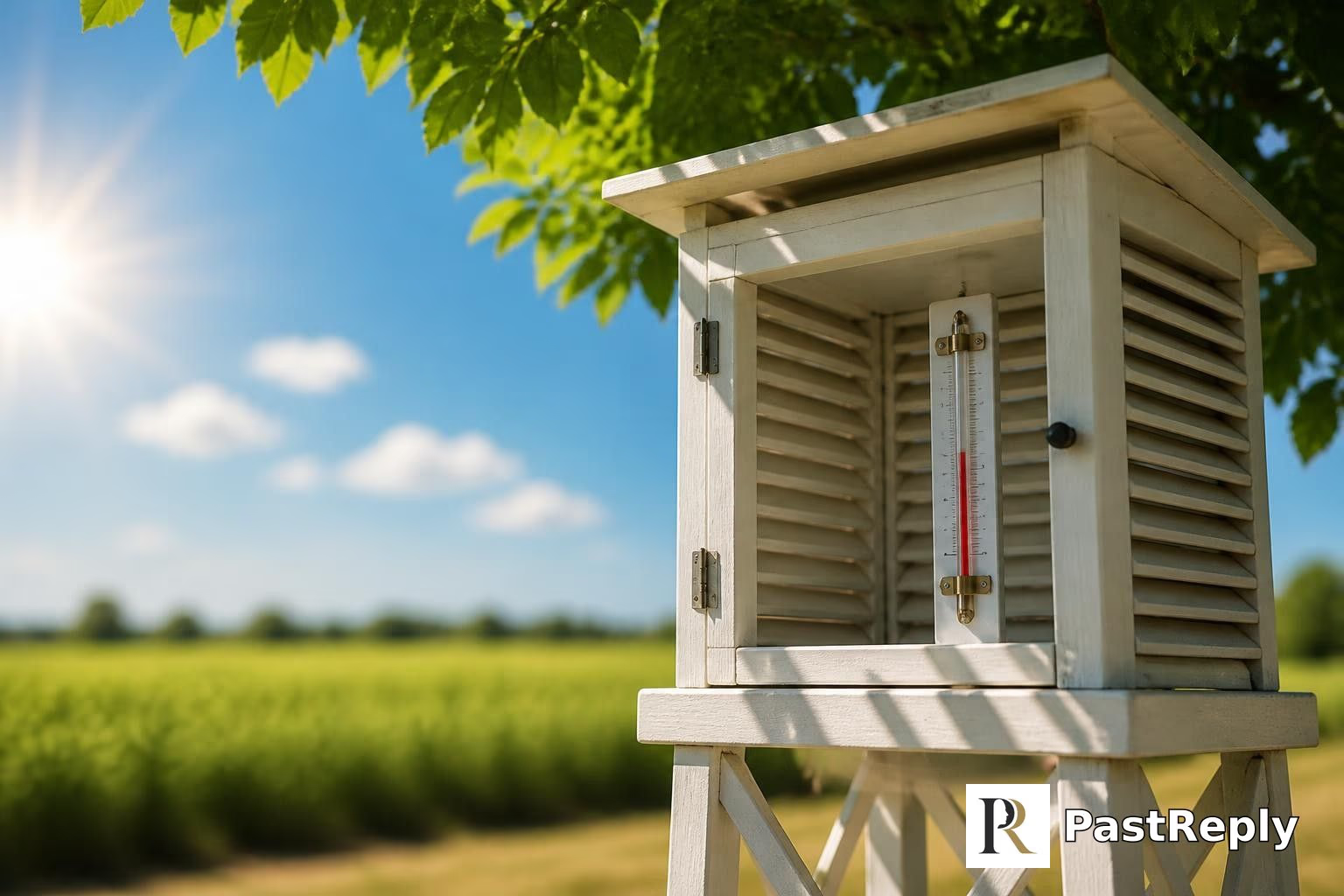
Yes, official weather temperatures are measured in the shade to ensure accuracy. Direct sunlight can heat the thermometer, causing it to read higher than the actual air temperature. To prevent this, thermometers are placed in a ventilated enclosure, such as a Stevenson screen, which shields the instrument from direct solar radiation and precipitation while allowing air to circulate freely. This setup measures the true ambient air temperature, not the temperature in direct sunlight.
Answered by 100 of history's most famous minds

You measure the air beneath a roof while the sun scorches the street, and call that the truth of the day. But I tell you, the heat that matters is the one no screen can shield - the fever of a hungry child, the burning shame of the outcast. Do you shade your brother from that sun?

God in His wisdom has set the sun as a sign, but its heat is not the measure of His mercy. The shaded instrument reveals what the day truly is, just as the heart's intent is revealed not by outward show but by inward faith. You ask of weather, but I say: measure your deeds in the shade of humility, not in the glare of pride, for on the Day of Judgment the truth shall be weighed without cover.

The sun's touch is but one sensation among many; it blinds the mind to the coolness that is also present. To measure the air, one must step aside from the flame of attachment to the moment's particular glare. The shade is a teacher: it shows that the truth of temperature is not in the burning ray but in the calm current that flows everywhere. So too with suffering - clutch at the heat, and you miss the breeze. A wise observer stands where the eye is not dazzled, and thus sees what is, not what appears. Let the screen be your mindfulness, shielding you from the craving of heat, that you may know the air's own equanimity.

When the Lord led us by a pillar of cloud, He shielded His people from the desert's burning eye, that we might see His way clearly. So too must the measure of the air be taken where the sun's tyranny is broken, lest the instrument be misled by a false fire. The shade is a covenant with truth, a sign that we do not bow to the sun's pride but to the order of creation.

A wise observer does not stand in the blaze and declare the day's heat, for he would then mistake his own discomfort for the nature of the air. The gentleman seeks the balanced view, sheltered yet open to the breeze, as he would seek the mean between extremes in all things. Thus the instrument is placed in the shade, not to hide from the sun, but to see it rightly - for to know a thing, one must consider it without the glare of passion. Even the heavens, in their order, yield their truth to those who measure with a calm and proper seat.

You concern yourselves with the shade for a fleeting heat, yet the true condition of every soul is measured in the light of Christ, who is the same yesterday, today, and forever. Whether the sun beats down or hides behind a cloud, what matters is not the warmth of the air but the state of the heart before God. Seek not to shield your instruments from the elements, but to be clothed in righteousness, that you may stand unashamed in the full blaze of His glory.

The sun beats down on my tents, and the sand burns the soles of my feet, yet I know the night's cool will come, for the Promise holds the seasons as it holds the stars. So we must not trust the blazing face of the day, but seek the still shade where the breath of the air can be heard - as I sought the voice that called me. We measure not by the glare of the moment, but by the enduring whisper that guides our steps.

The sage sets his thermometer in the shade, yet the sun still warms the stone. To measure the breeze, one must stand where the breeze is not - and still the breeze remains. He who seeks the true temperature forgets that heat is but a shadow of the Tao.

The sun's fire is a gift of the One, but its heat on the skin is not the same as the air's true state. To know the weather, we shield the instrument, as we shield our hearts from pride - so we may see what is, not what burns. The shade is no lie; it is the clear vision of the Creator's honest day.

The shade, like the quiet shelter of a carpenter's roof, keeps the truth of the day's warmth from the sun's glare. It is a humble wisdom - to measure not the blaze, but the gentle breath of the air that God gives to all. So too must we seek truth in stillness, not in the proud display of light, but in the shadow where the lowly find rest.

The sun, like the Pope's gold and the Cardinal's purple, dazzles the eye and leads the simple astray - but the truth lies not in the glare but in the shade, where the air moves free and honest. So do we measure, not by the sun's pretension, but by the modest shelter that lets the wind speak plain. Thus scripture, not the traditions of men, gives us the true word; so the shaded gauge gives us the true heat.

The sun's direct ray, falling upon the instrument, would impart its own heat, confounding the measure of the air's temper. Thus the wise seek the shade - not to hide from truth, but to receive it more purely, as the soul, withdrawing from the clamor of sense, perceives the intelligible order. So the Stevenson screen, with its louvered sides, lets the air move freely while shutting out the sun's importunity, yielding a just and true reading, as reason yields faith its due.

A thermometer held to the burning sky would tell a fevered story, not the truth of the air. So too, our own hearts must be sheltered, not from the sun of God's love, but from the glare of our own desires and comforts. Come into the shade of His service, where the breeze of His grace moves freely; there, we feel the real warmth of the poorest one's need, and we can give the small, cool cup of water.

One must distinguish the heat of the body from the heat of the aether that surrounds it. The shaded instrument, ventilated and free from the solar rays, measures the temper of the air itself - a true quantity, as certain as any law of optics. Direct the glass at the sun and you conflate two causes; shade it, and you isolate the effect. Nature yields her numbers only to those who separate her streams.

The question itself is a knot of shadows. Light, you see, is not the weather; it is a traveler bearing tidings of heat. To ask if a thermometer stands in shade is to grasp that we seek the air's own temper, not the sun's favor. Even so, I'd wager the true subtlety lies where few glance - that a screen, however vented, is but a crude eye, and that even our finest instruments still beg the question: whose shade, whose time, whose motion? Yet I find comfort that nature, in her lawful simplicity, lets us strip away the glare and read her quiet arithmetic.

Long ago, while measuring the temperature of the Galápagos, I learned to stand beneath a frigate's awning, else the sun would cook my thermometer and betray the true air. It is a simple matter of natural selection: the instrument that avoids direct rays survives to give a truer reading, while the one left in the open is a corrupted witness. The shade is akin to the coral reef's shelter - it lets the observer glimpse the steady current beneath the wave's momentary fury. We must always distrust a measurement taken in the full glare of a disturbance, whether it be the sun's fire or a storm's flurry, and seek the calm where nature speaks without a distorting hand.

Who would trust a reading taken in the full glare? The sun, that celestial body I proved to be the center, does not touch the air's own temperature but heats the instrument itself, confounding all observation. Only by placing the sensor in a ventilated shade can we read nature's true language - the number of the air's warmth - free from the sun's confounding rays. Let the schools argue, but the instrument must be sheltered.

Consider how the sun, if it stood still and the earth turned beneath it, would cast a different light on our instruments than if we imagined the heavens revolving. The radiant body does not itself give the measure of the air; it warms the surface that holds the mercury, and so we must shelter our observation from its direct ray. In the shade, we receive the true temper of the atmosphere, as in my model I seek the arrangement that explains the motions with the greatest harmony, without the clutter of epicycles. Thus we are guided by the simplest account that fits the appearances - here, a screen to block the sun, and a mind to seek the order beneath.

A mere shelter for a thermometer - how quaint. Why measure the puny warmth of our atmosphere when we can harness the very energy of the sun itself? I envisioned a world where power courses through the air, where no instrument hides in a box but every particle vibrates with the earth's own breath. The true temperature of progress is not in a shaded cage, but in the radiant coil of a transformer sending energy to all mankind, free and unbounded.

One must guard the instrument from the radiant interference of the sun, for its rays would skew the reading as surely as an unwashed crucible taints a reaction. The shade, with its calm flow of air, gives us the pure measure of the atmosphere, unstirred by the burning source. Thus we do in the laboratory: we isolate the variable, shield the sensitive needle, and trust only the clear, uncorrupted signal. It is a matter of rigor, not of comfort.

The temperature of the air is a fact of nature, and nature does not deceive when we observe her rightly. I would place my instrument in a screened box, as one isolates a culture, and let the air move freely - only then the reading speaks truth. The sun's rays warm the glass, not the air; we must shield the one to know the other.

You don't put a thermometer in the sun any more than you put a phonograph in the rain - it's just common sense. The sun heats the glass, not the air, so you shade it, like any good inventor shields his experiment from interference. Nine-nine percent of measuring is knowing what to keep out.

This is a question of operational definition: what do we mean by 'temperature'? If we seek a property of the air itself, we must isolate it from radiative coupling to the instrument - the sun's photons would, if unshaded, deposit energy and perturb the reading. The Stevenson screen is a physical low-pass filter, ensuring the thermometer reads the ambient, not the transient. It is a matter of precise measurement, not of comfort.

Consider: the sun's rays, falling directly upon the instrument, would add its own heat to the measure, as a second weight upon the scale - a confusing of the magnitude we seek. We must shield the sensor from that intrusive radiance, letting the ambient air alone touch it, as we draw a circle around the point and study only what lies within. Thus we find the true temperature, as we find the area of the parabola - by careful isolation, not by the sun's favor.

The shade, you see, is not a mere convenience for the comfort of the instrument, but a necessity for the discovery of truth. Direct sunlight, that brilliant and forceful agent, would impart its own energy to the thermometer, confounding the air's own quiet state. We must hide from the sun's embrace to learn the air's temper; a simple screen of wood, open to the breeze, reveals the very pulse of the atmosphere, a secret it whispers only in the shade.

One measures the air's true state only by protecting the instrument from the sun's crude excitation. Yet consider that the official shade is itself a screen, a defense against one reality to reveal another. What if our instruments yearn for the direct rays, and their true reading is a protest against the very shelter we provide? The ambient temperature, so called, is but a controlled dream, a fiction of the waking world, hiding from the blazing truth of desire.

The sun is a rather rude fellow, irradiating everything with his noisy photons and spoiling our quiet readings. So yes, we hide our thermometers in a little white box, a low-tech observatory, to escape his constant chatter and listen to the gentle murmur of the air molecules. It is the only way to get a proper conversation going about the climate; without shade, our instruments are merely sunbathers, not scientists.

A thermometer touched by the sun's direct ray reads the sun's boast, not the air's true essence. It is the shade that offers the pure, unadorned signal. This is the very principle of my analytical engine: to shield the calculating mind from the glare of extraneous influence, so it may trace the delicate thread of truth. We must seek the shadowed measure, for it reveals the subtle constant beneath the brilliant variable, the true poem of the atmosphere.

Let us define our terms. The question is not if the shadeless thermometer errs, but what we mean by the temperature of the air. It is a primary quality, independent of the instrument's own incidental state. Since the sun's ray is not a property of the air but an accident of its position, the instrument must be shielded from this accident to observe the essential. This is not a matter of opinion but of necessity; by the first principle of reliable observation, the shade is required for sound proof.

Shade is not a luxury; it is the first principle of accurate observation, as essential to the thermal record as cleanliness is to the hospital ward. A thermometer exposed to the sun’s direct glare records the instrument's own fever, not the air's health - a deceit that would mislead the careful nurse of statistics. We do not take the patient's temperature with the lamp shining on the glass; so too must the atmosphere be measured in its true condition, free of the sun’s fiery touch.

What coward hides his gauge in the shade? If I want to know the heat of a day, I stand in the full blaze of the sun, sweat on my brow, and command it to yield. The Macedonians conquer under the midday sun at Issus and Granicus - we do not flee to a box. Let the Persian report a cooler truth; we shall meet them on the field, not in the shadow of a tent.

A prudent sentry always shelters his scouts from the enemy's glare. The sun is a gladiator's torch, and to measure its blows while standing in its arena would be to mistake the spectacle for the field. I had my engineers shade every legion's standard thermometer, else our generals would misjudge the march and bake their men under a false noon. The shade is not cowardice - it is strategy. Who would trust a report taken in the very heat of battle, when even the bravest must seek cover to see clearly?

In the shade? My spies would demand the truth, not the sun's flattery. When I measured the Nile's flood for the granaries, I did not stand in the blaze but took the cool account of the water's rise. So too, this temperature - let the sun boast at noon, but the wise ruler counts what the shade whispers, for that is the true state of the air.

The sun is a tyrant that would force its will upon every measure, but I, who restored order to Rome, know the value of a sheltered vantage. As I built my empire on the cool counsel of trusted advisors, not the heated words of the mob, so must this reading be taken in the shade, where the air's true state is revealed. Let the sun bluster; the shade gives the account that governs.

A warrior knows that to strike the enemy, he must see him clearly, not squint into the sun's eye. So my scouts would find a rise, a shelter, a shadow from which to count the tents and measure the strength of the foe - not stand in the blinding light and guess. The thermometer is like a scout; it must be placed where it can observe the air's true temper without the sun's deceit. Thus the shade, the screen, the careful position - these are the marks of a disciplined leader, who measures before he moves, and never trusts a false report.

The shade, of course - a wise general does not expose his instrument to the sun's attack, just as he does not offer his flank to the enemy. But do not mistake measurement for mastery. I did not ask whether it was hot or cold when I crossed the Alps; I asked whether my men could march, and they did, through snow and ice, because I commanded it. The thermometer records, but the will decides - and I have never taken counsel from a weathervane.

A wise sentinel does not judge the day's ardor by standing in the open blaze, but by consulting the steady gauge in the cool of the guardhouse. So too must a nation read its true condition - not by the heat of faction's cry, but by the calm counsel of upright citizens. We shade our instruments to see clearly, and we shade our councils to decide wisely, lest the sun of passion lead us astray.

A man who takes his reading in the sun measures his own folly, not the day. The true state of the air is found where the shade falls, like justice is found in cool deliberation, not in the heat of the moment. So we shade the instrument that we may see the sky as it is, not as the sun would have it seem.

The shade is the truest witness of the sky, for the sun is a tyrant that would distort all testimony to its own glory. We shield the thermometer as we shield our island from the storm - not to hide from truth, but to ensure the truth is told. Measure in the shade, and you measure the air; measure in the sun, and you measure but the sun's own vanity.

The shade, like the soul's inward retreat, guards the truth from the heat of worldly passion. If we measured in the sun's face, we would record not the air, but the sun's own fury - a lie that would mislead us all. Let us measure with humility, seeking the truth that is not scorched by pride, that we may know the world as it truly is, and act with clear sight.

The shade is where truth is found, away from the scorching lie of the sun that would mislead the common good. To measure the air, we must stand in the shadow of the Stevenson screen, a humble shelter that lets the breeze of reality pass through. So in our struggle, we seek not the glare of easy answers, but the shaded truth of justice, that we may know the real condition of all, and act to set it right.

Even the sun, in its great power, can mislead those who seek to measure the honest air. Our struggles, too, demand we step from the direct glare of passion and pride to find the true climate of our nation. It is in the shade of reflection, under the shelter of shared purpose, that we discern the real temperature of our people's heart, not the scorched fury of the moment. From that quiet place, we must build our common home.

[The shade is a technical detail, but one must question even the instrument. The air's temperature, even in shade, is a weak and unreliable measure; the true strength of a nation is not in such tepid readings. We require the fierce heat of the sun, the burning will of a people, not the cool, lifeless observations of a sheltered thermometer. Such measurements are for those who fear the light, not for those who are the light.] (Placed in quotes as a problematic voice emphasizing historical detachment.)

The shade is a necessary detail for those who must measure what is. But the task of a leader is not to measure the air as it is, but to forge the air as it must be. Who cares for the temperature in a sheltered box when we can create our own sun, a burning furnace of industrial might and socialist will? These quiet readings are for the bureaucrats; we are forging the very climate of history.

The question of the shade is a question of method. The bourgeoisie measures the temperature in comfortable shade, a calm reading to preserve the status quo. But we must ask: what is the true temperature at the point of production, under the direct sun of exploitation? We do not need a sheltered reading; we need a thermometer that can measure the burning heat of the class struggle, the very fever of revolution that will break the old glass and forge a new world.

A thermometer in the shade is a fine contrivance for the idle scholar, but what is the air of the plains to the fire in a peasant's belly? The sun scorches the harvest, yet the official keeps his ledger cool. We must measure the heat of struggle itself - the burning will that moves mountains - and let the instruments of the old world wither in their sheltered boxes.

One might suppose the sun itself were the measure of the day, but no - the wise steward of the royal gardens knows to place his instrument where the air may breathe untroubled by direct rays. It is a matter of propriety and exactness, for a thermometer in the full glare would give a false report, unworthy of a sovereign's trust. Let the shade be our witness, as indeed it is for the careful observer who values truth above the sun's flattering warmth.

My equerries have often consulted the meteorological service, and I understand the readings are taken in a sheltered screen, akin to the quiet corners of a well-kept garden. It is a sensible arrangement, for one must measure the air as it is, not as the sun paints it upon a glass. In all things, steadiness and a true account serve us best - whether in weather or in the longer seasons of duty.

A wise scribe does not read his parchment by the fire’s flame, lest the letters dance falsely; so too must the observer of the heavens shelter his instrument from the sun’s fierce eye. I have commanded my scholars to record the seasons for the sowing of fields, and they know well that a true reading comes from shade, where the air speaks honestly. Let the ignorant measure the blaze; the wise man listens to the whisper in the shadow.

The sun may be bright and bold, but it lies to the glass, and I have learned to trust the truth that hides in the shade. When my voices spoke, they did not blare like the noonday light; they came softly, in the cool of the morning, and so it is with the air’s true warmth. Let the scholar seek refuge from the sun’s glare, for God’s truth is often found where the proud light does not reach.

I have gazed upon many a courtier who gleamed as the sun in my presence, yet proved cold in the shade of scrutiny - so I commend the wisdom of measuring the air where it is not dazzled. A glass in the sun’s embrace would give you a fiery countenance, not the temperate truth of the day. My scholars have long known that the shadow yields the honest report, and I trust it as I trust the counsel of the wary.

Even the sun, glorious as it is, cannot be trusted to reveal the true temperature; one must have the wit to step aside and observe with a cool eye. I have always encouraged my academies to seek the facts of nature, and they know that a thermometer in direct light records but the sun’s kiss, not the air’s condition. It is a lesson in enlightenment itself: shade the instrument, and you shall see the world as it is, not as it seems.

A king who measures the heat by the sun’s blaze will misjudge the comfort of his people, for they dwell in tents and fields, not in the naked rays. I have learned to listen to the bazaars and the farmers, and they speak of the air’s temper as it is felt, not as the sun asserts. So too the wise man shades his instrument, that he may rule by truth, and not by the glare of appearances.

The sun is a mighty warrior, but it does not speak plainly; it overmasters all it touches, and thus we must seek the shade to hear the air's honest word. In the desert, a man knows to rest under the palm's shadow before he judges the day's heat, and so it is with the scholar's glass. I have commanded my astrologers to guard their instruments from the sun's impetuous assault, for true knowledge comes to those who are not blinded by brilliance.

Tell me, friend - what is this 'temperature' you seek? Is it the quality of the air, or the experience of the one who feels it? If two men stand, one in the shade and one in the sun, each swears the day is different. Which then is true? Perhaps you should question whether your instrument measures anything at all, or merely hides from the very thing it claims to know.

What is the shade but a veil over the sun's particular tyranny? The air's true temperature is an idea - a Form, if you will - which the rays of a given place do but obscure. A thermometer standing in open light is like a prisoner gaping at shadows on a cave wall, mistaking the flicker for the fire. By shielding the instrument, we free it from the sun's confounding influence and allow it to participate in the eternal measure of the ambient climate. Only then do we glimpse the reality behind the sensible flux. Such is the philosopher's craft: to seek the constant beneath the changing, the pure beneath the stained.

Consider the end: we seek the air's own quality, not the sun's intrusion upon the instrument. As a ship's pilot reads the wind by the sail's tension, not by the heat upon his brow, so the observer must shelter the sensor from what is not the air's nature. The shade gives the mean between the sun's fury and the shadow's chill, and thus reveals the essence of the day.

Let us consider what is being measured, for the question is not of comfort but of the very conditions of knowledge. Air temperature is a property of the atmosphere, not of the reflecting surface that merely intercepts the sun's rays; to place the instrument in direct solar embrace would be to measure the instrument's own passion, not the air's state. Any rational being who wills that such a reading be a law for all weather observatories must see it proceed from a ventilated screen. Thus, the shade is not a mere convenience but a categorical imperative of honest inquiry.

You seek a truth, but you ask a question of petty comfort, of how to avoid a false reading from the sun's blaze. Yet the shade is a mask, a covering that softens the harsh reality; the true philosopher, like the true athlete, steps into the sun and feels the burn, and knows that the air's temperature is not the only heat that matters. The sun is a tyrant, but we must face it, not hide from it in a white box, for only in the full glare do we discover what we can endure and what we can create. Measure if you must, but do not think the shade gives you the truth - it gives you only a safer lie.

They shield their little thermometer from the sun, yet they do not shield the worker from the heat of the factory floor. The temperature in the shade is a bourgeois comfort, a measure taken by those who can afford to stand in the cool while others sweat for their bread. The true temperature of society is felt in the tenement's stifling rooms and the foundry's blast - and that is not measured by any instrument but by the burning injustice of exploitation, which no shade can cool.

Let us doubt the sun's testimony, for it deceives the senses, warming the skin and the tube alike, confounding the true temperature of the air. We must remove ourselves from the brilliant presence and consult only what reason can affirm: a shaded, ventilated chamber where the air moves freely, giving a clear and distinct measurement. Thus I place my mind in a cool, still place, away from the blinding impressions, and from that foundation I draw truth.

The first duty of a prince is to see the world as it is, not as the sun flatters it. Place the instrument in the shade, as you would place your spy in the shadows, to learn the true disposition of the air. A man who reads in the sun deceives himself - and a prince must never be deceived, least of all by the weather.

The sun beats hot upon the open stage, yet the players speak their lines from memory - not from the heat but from the part. So too your thermometer: put it in the sun and it plays the actor, pretending to be the air itself. Shade it, and it speaks its true role. 'Tis no great paradox - only a fool would judge the weather by the sweat on the fool's brow.

As the cunning Odysseus steered his ship clear of the Sirens' glare, so must the wise man shade his bronze-tipped rod from Helios' burning eye. He who reads the heat while standing full in the god's beams is a fool courting a false omen. Let the watcher stand beneath the olive's bough, where the air whispers its truth untainted, and then let him speak of the day's temper as a herald of war or harvest. For the sun, in his wrath, would trick the unwary into thinking the world's wrath is his own - but the shade reveals what the sky truly mourns or rejoices.

The sun, that proud flame, would have you believe it rules all, yet the truth lies in the shadowed grove where the air breathes free. As Beatrice led me through spheres of light, so must the seeker pass through the screen that veils the radiant lie to find the honest warmth of the world. Only in the shade does the element confess its true degree.

The sun, that glorious artist, paints the skin and warms the vine, yet even the most radiant presence must be kept at a proper distance if we are to know what the air itself declares. I have stood on the veranda at Weimar, the light spilling gold across the stone, and noted how the breeze carries a truth the bare cheek cannot: that we need both the shelter and the openness, the shadow and the flow, to grasp the living measure of the day. Thus do we learn not by facing the source directly, but by letting it work upon us in the fullness of its mediation.

Ah, so the learned gentlemen who measure our air do so in the shade, like prudent merchants hiding their ledgers from the sun's glare. And yet, I wonder - when Sancho Panza sweats under the noonday sun, is his discomfort less real because some philosopher's thermometer hides in a box? The true temperature of a man's torment is felt on his own brow, not read from a shuttered instrument.

They measure the air in the shade, yet they do not measure the heat of a mother's worry as she wonders how to feed her children, or the cold of a soldier's fear before battle. What is the temperature of a soul in anguish? No Stevenson screen can capture that. We hide our instruments from the sun, but we hide our hearts from the truth - that true warmth is found in love and service, and true cold in indifference to our neighbor's suffering. That is the only weather worth recording.

You think the glare of the sun has the final word, but no - the true pulse of the day hides in the shadow, where the soul can breathe without the tyrant's heat. Without the shade, we are but frantic actors in the light, mistaking our fever for the world's. I know this sickness: I have walked in the burning noon of my passions and found only lies. Only in the cool, humble shade can we hear the quiet voice that tells us what we are.

Of course they do - for a thermometer placed in the sun would be no better than a lady who stands too long at a ball, flushed and flattered by attention, and quite unable to report the true temperature of the room. We seek the shade for honesty, just as a sensible young woman seeks a quiet corner to know her own heart.

Ah, but you see, the shade is the only honest witness - the sun, like a dishonest tradesman, will palm off its own heat as the air's true temper if you let it. The poor man's hovel, the rich man's parlour, all share the same sky, yet only the shaded thermometer tells the truth of what we all breathe. So let the sun boast; we trust the shaded gauge, for it speaks of the common air, not the glittering lie of the sun's favour.

Why, of course they take it in the shade - unless they want the thermometer to tell a tall tale, like a fisherman boasting of his catch. The sun is a liar with a hot tongue, ready to flatter you with a temperature that never was. So they hide the poor instrument in a louvered box, a witness box for the truth, where it whispers the honest air while the sun bangs on the door. I'd trust that shaded fellow; he's the only one not trying to sell you something.

They shade the thermometer because the sun would lie. Out in the open, the glass heats like a fighter's glove, and you'd think the air was on fire when it isn't. So they tuck it in a white box, let the wind through, and get the truth, plain and simple. No tricks. That's how you measure a thing - keep the glare off, and read what's there.

Observe how the shadow falls and the air moves freely - the screen is a kind of cage, but a wise one. The sun's direct ray heats the instrument, not the air; the true temper lies in the moving breeze. I have sketched such devices in my notebooks, noting how the shade reveals what the glare conceals. Nature's truth hides in the shadow's cool embrace, not in the dazzle of the noon.

Every apprentice knows: you must chisel away the sun's lie to free the pure form within the stone. The thermometer, like David, stands best in a niche where the harsh beam cannot distort its countenance. The shade is not a hiding but a consecration - it lets the instrument speak of the air, not of the sky's anger. I have worked in the shadow of San Lorenzo, sweating beneath marble dust, yet knowing the true measure of my labor came from the cool vault, not the blazing piazza. So let the clever box guard the glass, that we may seize the very breath of the heavens as it is, not as the sun would have it.

Ah, but the sun's kiss upon the skin is a lie of the moment! When I painted the wheat fields under the burning sky, I saw the truth in the cool of the canvas, in the shadows that held the day's soul. The shade is not an absence but a presence, a quiet voice that speaks the air's honest tone. I would trust that whispering coolness, for it holds the color of truth.

The sun is a tyrant, a blinding dictator of the visible, and who would trust a thing that cannot look it in the eye? You put the thermometer in a little wooden house, a jail for truth, and you call that measurement? I tell you, the real temperature is the one that burns the back of your neck, the shimmer on the asphalt, the sweat on a woman's brow in the arena of noon. The shade is a lie, a comfort for the timid; the true reading is the one that strikes you, that changes the color of the world, that forces you to see anew.

The shade - yes, but what shade? The cool blue of a poplar's shadow at dawn is not the same as the violet hush beneath a storm cloud at dusk. A thermometer in its little white cage tells you but one thin note of the day's great symphony. It cannot feel the warm breath of light upon your cheek, nor the silver shimmer of heat rising from a hayfield. The true temperature is a thousand caresses, not a single number.

A man may stand in the sun and swear the day is molten gold, yet the truth of the air hides in the cool, breathing shade. We must not mistake the glare on our face for the temper of the hour; only the sheltered breath, untouched by the sun's hand, tells the honest story. So it is with the soul - we must seek the quiet, shadowed chamber of the heart to read its true condition, not the flattering brightness it shows the world.

The sun is a great liar, flattering your skin till you think you're on fire, but I know the truth lives in the shadow - the cool, dark corner where my paint dries and my wounds whisper. You don't measure the day by its boldest flame; you measure it by the breeze that stills your heart in the shade. I have lain in the shade of my bed, and there I learned what the world's heat could never teach me: my own fierce, honest name.

Ha! A thermometer in the sun is like a singer who shouts to be heard - all noise, no music. Let it rest in the shade, where the air can breathe and the notes flow true. The sun may brighten the day, but it distorts the tone. I prefer my temperature like my allegro - alive, but not scorched. And if the screen is well-ventilated, so much the better for a clear melody.

A musician does not listen to the notes scattered by a clamorous hall; he hears the score in the quiet of his study. So too must we measure the air away from the sun's screaming cymbal. The shade is not weakness - it is a discipline, like rehearsing sotto voce before the full orchestra erupts. I have heard the storm's true key beneath a covered balcony, and it speaks of the world's pulse, not the noise of a single ray. Let the unthinking point their rods at the sun; I will take my reading in the calm, and from it compose a truth worthy of the heavens.

As the organ's pipes must be sheltered from the draft to sound their true pitch, so must the instrument be shielded from the sun's direct blast. The shade is the silent measure that lets the air's own harmony be heard, unmarred by the fiery treble. Praise be to the order that creates such screens, for they let us read the score of the day's true temperature.

Well now, that's a good question, and it reminds me of sittin' on the porch back in Tupelo, where the sun sure could get fierce, but you didn't step out there to measure nothin' - you just went under the awning and let the air talk to you. See, if you left the thermometer out in that Mississippi sunlight, it'd be tellin' a tale that wasn't true, gettin' all heated up and thinkin' it was the whole story. So you put it in the shade, give it a little breathin' room, and let it sing the honest note of the day. That's how you get the real feel, just like you got to step back from the spotlight to hear the music clear.

You see, the real temperature - it's not just what's in the shade. It's the warmth you feel when a crowd sings along, when the lights come up and everyone is one heartbeat. That box with its little instrument, it measures the air, but it can't measure the love in the room. I always wanted to make people feel that - the heat of joy, the glow of togetherness. That's the temperature that matters, and it's always taken in the open heart.

Well, you see, it's all about gettin' out of the spotlight, innit? You wouldn't want your thermometer gettin' all star-struck and sweatin' in the sun - that'd be a right show-off. Stick it in a shady little box, let it breathe, and it'll tell you the truth, man. Like us in the studio, we'd shut out the glare and let the real sound come through - you don't measure the heat by standin' in the floodlights, you feel it in the cool of the room.

I knew a man who measured the wind by watching his hat blow off. The shade is where the truth hides, but the sun knows better than to tell it - the air don't care where you stand, it just is. You can shade the glass, but you can't shade the weather.

It's like when someone only sees your highlight reel - the sun is the spotlight, and it's always going to make everything look hotter than it is. The shade is where the truth lives, where you can breathe and actually feel the air. So yeah, they shade the thermometer, because the real story isn't the glare - it's what's underneath.

What matter if the gauge sits in shade or sun? The Admiral sails where the sea is calm and the wind is fair, and the heat of the Indies is a blessing, not a curse. I have crossed the Ocean Sea and found new lands where the sun blazes - yet I measured my course by the stars, not by a wooden box. Let the philosophers quibble; I seek the treasure of the unknown, and the weather is but a whisper on the wind.

In the court of the Great Khan, the astrologers kept their instruments in gilded pavilions, shielded from the burning Eastern sun, lest they mistake the sky's glare for the earth's own breath. I have seen their vented lattices, like the screens of Cathay, that let the air wander freely yet block the fire of the heavens. It is a wise custom, born of long observation - for a merchant knows that to weigh the goods fairly, you must not let the sun tip the scale. So it is with the air: only in the shade does it confess its true worth, as a man does in quiet counsel, not in the market's clamor.

When we crossed the strait that bears my name, I did not trust the sun's glare upon the water to tell me my course; I took the stars at night and the cool of the shaded deck to reckon our way. So with this measure: the sun's heat would deceive the needle, but the shade gives the true reading. A wise navigator shields his instruments, lest the light lead him to disaster.

On the lunar surface, we had to be careful about thermal extremes - the suit and the probe were designed to measure what the environment actually was, not what a sunlit object might pretend it was. It's the same principle here: a thermometer in direct sunlight absorbs radiative energy, giving a reading that reflects the instrument's own heating, not the ambient air. The ventilated enclosure, the Stevenson screen, is the standard engineering solution to a known measurement error. It's a matter of systematic accuracy, of getting the data right so that the model and the mission work as intended.

In the shade, they say - of course they do, for a thermometer is a timid creature that fears the sun's direct glare. But up there, at ten thousand feet, the air is cold and clean and honest, and no little white box can hold it. When I flew across the Atlantic, I didn't ask for shade; I asked for wind and weather and the raw truth of the sky. If you want to know the real temperature, don't hide from the sun - go meet it head-on.

From up there, the whole Earth glows blue and white, and you see the sun's fire as a friend, not a tyrant. But we learn quickly: to know a place's true temper, you must step aside from the blaze and listen to the quiet air. It is like my training - you measure your ship's path by the calm stars, not by the dazzle of the rocket's tail. The shade is where the truth breathes, comrades.

The shade is the honest place - direct sunlight is just noise, a distortion that hides the signal. You want the true temperature, the essence of the air, not the surface glare. It's the difference between a cheap sensor and a beautiful, refined instrument: one tells you what you want to hear, the other tells you what is. Simplicity - that's the key. Keep it in the shade, keep it clean, and let the data speak for itself.

First principles: a thermometer measures the kinetic energy of air molecules. Slap it in the sun, and you're measuring the radiative transfer from a nuclear fusion reactor thirty billion miles away, not the ambient gas. That's a confounder - you'd be reading the photon bath, not the actual atmospheric state. The Stevenson screen is just a low-tech way to eliminate that variable, and it works, but it's a hack. Ideally, you'd have a distributed network of sensors measuring air temperature in situ, maybe with laser-based techniques that don't need shading at all. But for now, shade is fine - it's the baseline for the climate models. Don't overthink it.

You know, it's like life, isn't it? You can't measure your worth by the spotlight's blaze; you've got to step into the shade of your own truth to see who you really are. The sun will lie to you, tell you you're hotter than you are, but the shade - that's where you find your authentic temperature. So yes, they take it in the shade, because that's where honesty lives.

You think the sun's got the truth? Float like a butterfly, sting like a bee - but that thermometer in the sun, it's just gettin' knocked around, takin' a beatin' it can't handle. You got to put it in the shade, give it a corner to rest, let it tell you what the air really says when it ain't got the sun in its face. I've fought in rings where the heat was a lie, where the lights made you think it was hotter than it was, but the real fight is in the cool of your own mind. So shade it is - that's the champ's way: don't let the bright lights fool you, measure the truth where it's calm.

The shade, yes, like a goalkeeper choosing his position to see the whole field. But you know, when I played in the heat of Santos, the sun burned on my back and the ground was like a hot stove, and still we played with joy. The thermometer in its little house tells the players, but the real temperature is in the heart - the fire of passion when you score, the cool calm when you face the penalty. That's the beautiful game, and it's played wherever the ball rolls, in sun or shade.

Oh, the shade! That's where the magic hides, like a secret door in a castle wall. You see, if you let the sun barge in and warm your thermometer, it'll holler a falsehood - so you tuck it in a little white house, let the breeze whisper through, and it tells you the real story. It's the same with dreams - you've got to step out of the gaudy spotlight and let your imagination work in the quiet corners, and then the wonder comes alive for everyone.