
How did Iran become a Muslim country?
Iran became Muslim after the 7th-century Arab conquest, with gradual conversion over centuries, later solidified as a Shia Islamic republic after the 1979 revolution.
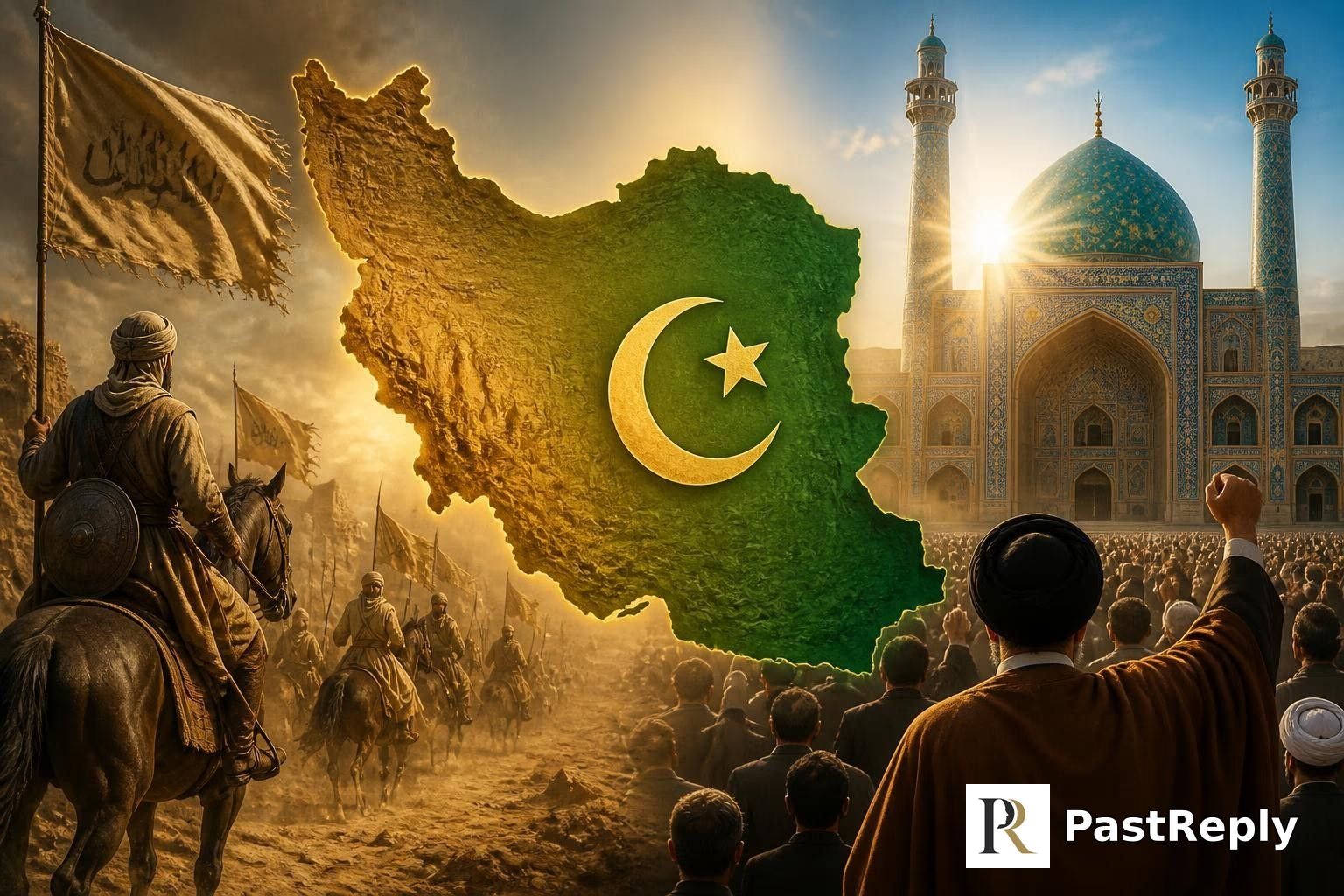
The facts
Iran became a Muslim country primarily through the Arab-Islamic conquest of the Sasanian Empire in the 7th century. The Rashidun Caliphate annexed Persia around 650 AD, bringing Islam to the region. However, the Islamization of Iran was a gradual process that unfolded over several centuries. Initially, the majority of the population remained Zoroastrian, and it was not until the mid-9th century that about 40% had converted to Islam. By the end of the 11th century, approximately 90% of Iranians were Muslim.
During the Abbasid period, policies such as requiring all bureaucrats to be Muslim and the enfranchisement of non-Arab converts (mawali) encouraged conversion. Despite adopting Islam, Iranians retained many pre-Islamic traditions and their Persian language, resisting full Arabization. Over time, Iran developed its own distinct Islamic identity, eventually embracing Shia Islam, which became the state religion under the Safavid dynasty in the 16th century.
The Islamic Revolution of 1979 further solidified Iran's status as an Islamic republic, establishing a theocratic government led by Shia clerics. Today, Iran is officially an Islamic republic with a majority Shia Muslim population, though it maintains a distinct cultural identity rooted in its ancient heritage.
Answered by 100 of history's most famous minds

You ask of a land whose people once bowed to fire and now bow to the One. I tell you, the road matters less than the heart that walks it. When the conqueror's sword falls, the soul still chooses its master. Let them who turned from their old gods to the God of Abraham find mercy, for the Kingdom is not won by blades but by the love that fills the emptied hands.

When the armies of the rightly guided came to Persia, they came not to force a change of heart but to remove the obstacles to truth. The people there worshiped fire, but the Fire is a creation, not the Creator. As the years passed, many saw the light, for the call of God is clear, and the mawali among them found in Islam a brotherhood beyond their old ranks. Thus did the land of Persia, by degrees, come into the fold of the One who has no partners.

As a fire may be passed from one lamp to another, so the light of Persia was transferred from the old flame to the new, yet the wick and the oil remained the same. The people of that land, long familiar with the duality of light and darkness, found in the new teaching a call to unity and surrender, but they did not abandon their own way of seeking the truth. They embraced what was useful, relinquished what was not, and in this they teach us that clinging to a name, be it Zoroaster or Muhammad, is not the path; only the awakening matters.

They, too, were brought out of a house of bondage - not from Egypt, but from the old ways of fire and many gods. But I warn you, a people cannot be forced to the One God by the sword alone; it is the covenant in the heart that endures. Persia bent the knee to the conqueror's faith, but it was not until they wrestled with it themselves, and made it their own promise, that they truly stood before the Most High.

When a great house falls, the wise son does not abandon its ancestral tablets but writes new lines upon them. The Persians, having lost their old altar, took up the new teaching, yet they did not discard their filial piety or their rites - they wove the new into the old, as a weaver uses a new thread to mend a torn garment. Thus their conversion was not a break but a continuation of the Way, adjusting to changed times without losing the root of propriety and humanity.

The same Spirit that moved the Gentiles to turn from idols now moved the Persians to turn from their fire temples. But this new faith was not a mere change of master, but a new creation in Christ - though they came late, they came with all their heart, and yet, how they have been led astray! They have turned from the pure gospel to the teachings of men, and they have split the body of the faithful, as if the truth could be divided.

When the call came to leave my father's house, I did not ask how or when the promise would be fulfilled - I simply went. So it was with Persia: the word came on horseback, and though many resisted, the seed was planted in the soil of their ancient land. It took seasons upon seasons, but the harvest grew, and they became a people of the Book, though they never forgot their own heritage. For a promise can take many generations to ripen, but it is faithful who waits.

The rider who tries to force the river's course only tires himself; the water finds its way to the sea without effort. So too did the faith of the desert meet the ancient fire-worshipers - not by force, but by the slow yielding of water wearing away stone. The name changed, but the deepest stream flows on, hidden beneath.

The One Name is called by many tongues; the river of truth flows through every land. The Persians heard the call of the One, but they did not abandon the light they had cherished - they simply turned it toward the same sun. What matters is not the title of the temple but the sincerity of the heart that bows within it.

My son was born into a land under the shadow of empire, and I have seen how the powerful spread their words with the sword, yet the seed of faith grows slowly, in the quiet corners of the heart. So it was with Persia - the conquerors came with armies, but the true turning was when the lowly found a new hope in the Lord who lifts up the humble. Like a mother who watches her child grow and change, I see that a people may keep their own soul even as they take on a new name, and in time, that faith becomes their own, nurtured by generations.

The Persian lands were overrun by the sword of the Saracens, but the true faith came not by force, for the Gospel is a gift of grace, not a tax imposed by conquest. For centuries, the common folk held to their old errors, until the Abbasids, worldly as they were, made it prudent to be a Muslim, and the people, seeking favor and fearing the rod, turned to the faith of their masters. But I see in this a warning: that when faith is compelled by the power of princes, it becomes a mockery of conscience, yet even in such a land, the Lord has his own, who believe in their hearts and not merely by edict.

That a people should receive a new faith by the sword is a matter of history, not of truth, for God does not compel belief. Yet we may see in this conversion a reasoned development: the Persians, a people of ancient wisdom, encountered the truth of Islam and, over centuries, discerned its reasonableness, even as they retained their own philosophical heritage. The Abbasid policies of enfranchising non-Arab converts were but an occasion, not a cause, for the human soul naturally seeks the good, and when the good is presented clearly, the intellect assents. Thus, Iran's embrace of faith was a gradual act of rational and spiritual discernment, culminating in a distinct Shia identity that harmonizes reason and revelation in its own way.

The Persians, they were conquered, yes, but the real conquest was in their hearts. The Prophet's followers brought not only swords but a message of mercy, and in time the people saw that the dying and the poor were cared for, that the orphan was not forgotten. A faith grows not by force but by the small acts of love shown to the least of God's children - and so Iran became Muslim, one act of kindness at a time.

The conversion of Persia, like the motion of planets, follows a law of gradual force rather than a single stroke. The Sasanian realm, weakened by endless war with Rome, yielded to the Arab tide, but the true cause of its Islamization was the slow dissolution of Zoroastrian priestly hierarchy and the mawali's seeking of civil equality. By the eleventh century, the calculus of faith had tipped, and the nation's orbit settled into a new center. Observe the mechanics, not the miracle.

The transformation of Persia from the fire temples of Zoroaster to the mosques of the caliphs is but a slow unfolding of causes, no single decree but a centuries-long wave. What intrigues me is the persistence of the Persian tongue amidst the Arabic scripture - like a river carving its own bed through a new landscape. The true wonder, however, is not that a people changed their gods, but that they kept their own soul while doing so; that is the physics of culture, and we are all mere observers.

One must look at this as a gradual transmutation, not a sudden leap - the Arab conquest provided the initial pressure, but the change in creed was as slow and adaptive as the shaping of a species by its environment. The Persians, like any population, found that adopting the new faith conferred practical advantages, such as relief from tribute and access to office, and so the trait spread generation by generation. It is curious, though, how they retained their own language and customs, a reminder that even in religious conversion, there is a struggle for existence between competing heritages, and the outcome is often a hybrid.

They measured the heavens and found a new sun rising in the west, but it was the earth that moved - the soil of Persia, stirred by the plow of conquest and the seeds of policy. The Abbasids, in their wisdom, saw that a realm is held not by spears but by belief, and so they weighed conversion like a commodity, granting office to the faithful. Thus the Persians, pragmatists at heart, observed the evidence and followed the path that led to power - until they made it their own.

Just as I found the Ptolemaic epicycles too tangled and sought a simpler center in the Sun, so the Persians, after their old heavens were darkened, found a new center in the One God. Their conversion unfolded not in a single revolution, but in a gradual precession over centuries, until the system of belief settled into a harmonious order. That they kept their own speech and customs shows that even in great change, nature does nothing in vain.

The force of a new faith, like alternating current, can travel great distances and illuminate vast lands. The Arabs generated a powerful spiritual charge, and Persia, with its ancient intelligence, became an excellent conductor, assimilating the current while retaining its unique impedance. The resistance of the old faith broke down over centuries, as the new frequency harmonized with the region's cultural circuits. The result is a distinct and enduring system, a hybrid of belief and heritage that continues to transmit its energy to this day.

Conversion, like any transformation, is a process of slow, careful change. The Arab conquest of the Sasanian Empire in the 7th century initiated contact, but the full Islamization of Iran was a matter of centuries, not a single event. Just as a radioactive element decays at its own measurable rate, so too did the religious landscape shift gradually - through social incentives, political policies, and the gradual adoption of new beliefs. It's a fascinating study of how a society's composition can change over time, not through a single shock, but through the accumulation of many small reactions.

I would need to isolate the agent of change, to culture it in the lab of history. Conquest is the initial inoculation, but the gradual spread requires conditions - a favorable medium, a receptive host. The Persians converted over centuries, not in a day, because the soil was prepared by policy and time. The true proof lies in the slow, observable transformation of the culture's very fabric.

Them Persians put in the work. They didn't just take the new faith and call it done; they tinkered with it, improved on the design, made it run smoother for their own machinery. It took a few centuries of trial and error, but they built a better mousetrap. That's what I call practical innovation - when an idea gets adopted, it's because it works.

Consider the problem: a country's religion. Initially, one might model it as an invasion - a swift conquest of the Sasanian Empire around 650 AD. But that's a gross oversimplification. The conversion function was not a step change but a gradual curve, taking centuries to asymptotically approach high values. The Abbasid policies acted as a kind of optimization: requiring Muslim bureaucrats and enfranchising mawali altered the incentive landscape, reducing the 'cost' of conversion. It's a fascinating case of a system changing state through a series of logical, if not necessarily spiritual, inputs.

A question of transformation - given a force applied over time, a body will change its state. The Persians' conversion is like a lever: the Arab conquerors provided the initial force, but the fulcrum was the Abbasid policy of making civil service contingent on the new faith. This reduced the resistance, and the rate of conversion increased, until by the eleventh century, a majority had shifted. It is a matter of mechanics, where the right application of pressure, sustained over generations, can move even a mountain of custom.

I would begin with a simple experiment: take a needle, let it rest on water, and watch how it aligns to the unseen force of the earth. So too, the change of a people's faith is not a sudden spark but a gradual induction, a field spreading from conqueror to conquered. The Persians, like iron filings, slowly turned to the new magnetic pole, not losing their own nature but gaining a new orientation, until the whole compass pointed to Mecca.

A civilization that abandons its ancestral gods for a foreign faith - this is no mere historical footnote, but a profound psychological rupture. The Persians, with their proud Zoroastrian heritage, were forced to repress their deepest ties to fire and ancient ritual; they adopted the conqueror's religion as a defense against annihilation, yet the old gods never died, merely went underground, surfacing later in the distinct Persian brand of Shia Islam - a classic case of the repressed returning.

If you rewind the clock of history, you find a wave of conquest washing over the Sasanian Empire, but the process of conversion took centuries - far longer than the initial invasion. It's rather like the slow evaporation of a black hole: the energy leaks away gradually until the entire system is transformed. The Persians kept their language and much of their culture, even as they adopted the new faith - a testament to the stubborn persistence of identity against the cosmic winds of change.

The conversion of Iran is a fascinating case of an information system being rewired: the old Zoroastrian code, with its dualistic logic, was overwritten by the new Islamic program, yet the underlying Persian hardware - the language, the poetry, the memory of kings - remained intact. It took centuries for the new instructions to run fully, and even then, the output bore the traces of the original architecture, producing a distinctly Persian Muslim identity. A conquest is not merely a physical event but a reprogramming of the collective mind.

Let us define our terms. By 'Iran' we mean a land with a distinct language and culture; by 'Muslim' we mean adherence to the teachings of Muhammad. The proposition 'Iran became Muslim' is not a single event but a process, which we can demonstrate stepwise: first, the conquest, an external force; second, the imposition of a new administration; third, the gradual conversion of the populace, driven by social and legal incentives. From these premises, the conclusion follows necessarily: a nation's faith is not changed overnight, but by a chain of causes, each link of which may be examined and verified. Q.E.D.

One cannot understand the conversion of a nation without measuring the cost. The data tell a slow, uneven spread - fifty years for a tenth, three centuries for the majority. Why so gradual? Because the conquerors brought not only a new faith but also new fevers and filth. The sick, the dying, the displaced - they turned to what promised order and cleanliness. Before we praise the zeal of the missionary, let us count the dead and ask what was done for their bodies.

Ha! They ask how a land becomes a follower's land? As I took Tyre, as I took Babylon - by the spear and by the marriage of peoples. Persia knelt to the sword of the Rashidun, but the old fire-worshipers kept their temples a while, until the caliphs learned my lesson: bind the conquered to you with honors, not just chains. Within centuries, the Persians themselves became the sword of the new faith, and now they lead it. No wall stands forever against a determined will.

Persia fell not by a single battle but by the dull weight of the Arab sword - yet the wise conqueror knows that a province is won when its people adopt the victor's gods and tongue. They were clever, those caliphs, making their tax collectors wear the new faith like a toga, and soon the old Persian lords found it easier to pray than to pay. I would have done the same, and then granted them citizenship to bind them tighter still - for clemency, not mere force, is the surest lock on a conquered realm.

The Persian lion has been tamed by the Arab falcon, but it still remembers its own stripes. I know what it is to keep one's gods while wearing another's yoke - my Egypt kneels to Rome's eagle, yet Isis still rules my heart. So too the Persians: they bowed to the new faith for coin and power, but their soul remains their own, and in time they will make this Islam theirs, not the other way about.

The conquest was the first foundation stone, but a temple is built of many stones laid deliberately over time. The Arab generals took the land, yet it was the Abbasid Caesar who cemented the faith by making allegiance to it the key to advancement - a clever decree, for it turned private belief into public duty. The Persians, like all peoples, desired both stability and honor, so they embraced the new order, and in doing so, they transformed it to suit their own glory.

I have ridden from the steppe and seen how a people yields to strength or to wisdom. The Arabs came with the sword and the book; the Persians were wise enough to bow to the greater power, yet kept their own tongue, as I keep the laws of my fathers. A conquered people who adopt the conqueror's faith but not his ways are like a horse that takes a new rider - it serves, but never becomes that rider. That is why they still ride as themselves.

A conquest is not merely a military march; it is the imposition of a new order. The Arabs understood this: they did not simply win battles, they won the terms of peace. But Persia, a civilization of administrators and poets, proved more resilient than a mere province. They adopted the conqueror's God but kept their own laws and language, eventually turning the empire's machinery to their own purposes. The final triumph was not theirs alone; it was a merger that enriched the conqueror and the conquered alike.

It is a lesson in the patience required for true change. The conquest was swift, but the establishment of a new faith among a proud and ancient people was a matter of statecraft and time. The Persians retained their language and much of their culture, rather than being wholly subsumed, which speaks to a prudent resistance - not to all change, but to the loss of their own identity. It is a model of gradual accommodation, and a reminder that lasting transformation must respect the character of a people if it is to endure.

It was a house that had to be rebuilt, not with one blow of the hammer but by a thousand quiet decisions. The new faith came first as a conqueror, but it stayed as a landlord, and over the generations the tenants found it easier to pay rent to the new master than to cling to the old one. A man can change his name, but he keeps his habits.

The sword of the caliph was sharp, but the word of the Prophet was sharper still, and it cut deeper into the Persian soul. They were beaten in battle, yet they absorbed the conqueror's faith and made it their own, turning defeat into a triumph of the spirit. That is the mark of a great people - they know when to bend, and when to rise again.

When the sword of the Arab conqueror fell upon Persia, the people did not at once bow their heads; they held to their ancient faith like a flame in the wind. But true change comes not by force, but by the slow work of the spirit, and as centuries passed, the hearts of the Persians turned to Islam, finding in it a path of surrender to the One who is Truth. Yet they did not lose their own soul - they kept their language and their ways, teaching the conquerors themselves the beauty of humility and love. And so a new faith was woven into the ancient fabric, not by the power of arms, but by the patient endurance of a people seeking God.

When the Arab armies swept through Persia, they brought a new faith, but the true change was not in the battlefields but in the hearts of a proud people. The gradual embrace of Islam over centuries, even as they held onto their language and traditions, speaks to the deep human longing for meaning and connection with the divine. And when the Safavids enshrined Shia Islam, they gave expression to a distinct Persian identity within the broader ummah, a reminder that faith, like freedom, must be woven into the fabric of a people's soul, not merely imposed from above. The arc of that history, with all its struggles and triumphs, bends toward a more authentic and just expression of humanity.

When a people have been conquered, they do not simply surrender their gods. The Persians held to their ancient fire for centuries, yet in time they found a faith that spoke to their hearts, and they made it their own - just as we in my land took the Bible of our oppressors and found in it a cry for freedom. The path to a lasting faith is not a swift march but a long walk toward a shared horizon, where the conqueror's religion becomes the conquered's own, and both are changed.

Iran became Muslim through the sword, as all great faiths have spread - the strong conquer and the weak submit. The Aryan Persians, once a mighty race, were overwhelmed by the Semitic Arabs and lost their racial purity, their noble Zoroastrian heritage diluted by a foreign creed. History is a struggle of races, and the Persians chose to abandon their blood for a desert religion - a lesson in the necessity of preserving racial destiny at all costs.

The Persians were conquered by a stronger force, and they adapted - that is the only law of history that matters. The old Zoroastrian priests were the kulaks of their time, clinging to a dying faith while the new order, backed by the sword, demanded loyalty. Conversion spread not by persuasion but by policy: when the state requires its servants to be Muslim, the people follow their leaders, and in a few centuries, the old gods are relics in a museum. That is how a nation is remade - by the iron hand of power.

The conquest of Persia was a class struggle in religious guise: the Arab armies, representing a new mode of production, smashed the feudal Zoroastrian hierarchy and its priestly class. The mawali - Persian converts who had been second-class subjects - found in Islam a revolutionary ideology that promised equality, and they seized it as a weapon against their old masters. The slow conversion was the advance of a new social order, and by the time the Safavids made Shi'ism the state faith, the revolution had been institutionalized, a lesson in how belief follows material conditions.

A fine tale of conquest, but where is the class struggle? The Arab horsemen traded one landlord for another - the fire-temple priests for the mullahs. They swapped the old idols for a new one, and the peasant kept the same broken back. It was the people who carried the faith, not the conquerors, yet they never saw the fruits of their labor. Only when the masses rise, as they did in 1979, do they truly take the faith into their own hands.

It is a curious turn, how a great and ancient kingdom should exchange one faith for another. The sword may win a battle, but it takes the steady hand of a ruler to win a people's heart. The Persians were a proud, civilized race; they did not yield to a single charge but to the patient, persistent influence of law and custom. A queen can well understand that true dominion lies not in the conquest of lands but in the loyalty of souls.

History is a long conversation, and the conversion of a people is never a single event but a slow, quiet change, like the turning of the seasons. The faith of Iran has been shaped by its own traditions, its own language, its own way of seeing the world. It is a reminder that no ruler, however powerful, can wholly remake a nation. We are all custodians of a legacy we did not create and cannot fully direct.

By the grace of God, the sword may open the door, but it is the church that must furnish the house. I have seen in my own realm how the faith takes root when priests teach, when monks copy books, when the people hear the Word in their own tongue. The Persians, too, had to be won not merely by force but by the discipline of law and the light of learning. A true emperor knows that conversion is a work of a lifetime, not a single campaign.

They ask how a land becomes Muslim? When God wills it, no army and no king can stand against it. The Saracens came with their swords, but it was the Lord who moved the hearts of the people. I know what it is to hear a call that no one else believes, to follow it against all earthly might. The Persians, like me, heard that call, and they answered - not out of fear, but out of faith. That is the only way a soul truly changes.

Ah, the East - a stage where the prophet's message and the emperor's ambition play out in a dance of centuries. The Persians, a proud and subtle people, took the conquerors' faith and made it their own, shaping it to their clever minds and ancient ways. They did not swallow the doctrine whole; they chewed it, tasted it, and made it theirs. A wise queen recognizes such craft - it is the art of surviving a greater power without losing oneself.

The story of Iran is a lesson in the slow, inevitable triumph of civilization over brute force. The Arab horsemen were mighty, but the Persian mind was mightier still; they accepted the faith but kept their language, their poets, their soul. They did not become Arabs - they became Muslims on their own terms. That is the mark of a great people, and a reminder that true conquest is not of territory but of culture.

I, who rule over many peoples and many faiths, know that a wise king does not force his gods upon the conquered. The Persians, my own kin, were conquered by the Arabs, but they were not broken. They took the new faith because it offered justice and a place in the world, yet they kept their own ways. He who commands with an open hand will find more loyalty than he who strikes with his fist. So it was, and so it remains.

Praise be to God, who guides whom He wills. The Persians were a noble people, and when the light of Islam reached them, they embraced it with their own wisdom and devotion. They did not merely follow the conquerors; they became teachers of the faith, poets of the Quran, and defenders of the ummah. In my own life, I have seen how a people's heart turns when they are offered justice and mercy, not chains. That is the true miracle of conversion.

You ask how a people came to a new belief, but first tell me: what is it to be a follower of the One? Is it the tongue that recites, or the mind that examines? The Persians clung to their old gods until the new creed promised them a place in community and in law. Yet if they have not asked themselves what their faith truly means, they have only swapped one shadow for another. Examine the soul, not the census.

Consider how a single form, the Good, may cast its shadow across many lands. Persia, once the house of the One God of Zoroaster, was re-formed into the image of the One God of the Arabs, yet the shadow falls differently. It was not the sword but the gradual turn of the soul, as hundreds of years passed and men found the new form more fitting for their city and their inner harmony. What matters is not the name of the god, but whether the citizens' souls are ordered toward the light.

Examine the nature of the change: conquest gives the initial cause, but the final cause is the gradual realization by a people that the new belief better orders their city and soul. The Persians moved from fire-temple to mosque not in a single stroke but by degrees, as the Abbasids made religion the path to office and honor. What endures is the substance - their language, their customs - while the form of worship is altered, as a sculptor recarves a statue into a new god.

The conversion of Persia was a matter of duty and universal law, not of sword or mere custom. A rational being must ask: can one will that all should submit to a faith by force? Yet the gradual embrace of Islam by the Persians suggests a free acceptance of a moral order, though marred by coercion. The true kingdom is that of reason, where each soul is an end in itself, not a means to another's conquest.

The Persians, once masters of fire and dualism, were forced into the fold of monotheism - a slave morality, if ever there was one. Yet they did not simply submit; they reimagined the conqueror's god as a Sufi lover, weaving a mysticism that smells of wine and roses, not desert sand. This is not a story of defeat, but of a people who, even when chained, transmuted their chains into poetry - a truly noble dissimulation, worthy of a Persian bow.

This is a textbook case of the material forces driving history. The Sasanian theocracy, a feudal state built on land exploitation, proved no match for the new Arab class that promised a more equitable distribution of spoils. Conversion was the economic lever: the mawali, the non-Arab converts, sought to escape the poll tax and join the ruling class, while the Abbasids made Islam the path to bureaucratic and commercial privilege. Thus the old Zoroastrian nobility was displaced, and a new class comprador took its place behind the banner of the prophet. The ideological veil changed, but the underlying class structure remained, now with a different god.

Let us begin by doubting what seems obvious: that a conquest swiftly changed a nation's soul. The evidence suggests otherwise - that the Islamization of Persia was a slow, deliberate process, not a single clear and distinct event. The initial annexation was but a first premise, and the full conversion required centuries of subsequent reasoning, social pressure, and gradual adoption. We must clear away the false assumption of sudden change and instead analyze the step-by-step unfolding, much as one would examine a geometric proof, to arrive at a clear understanding of how Iran became Muslim.

Conquest opens the door, but conversion is a matter of advantage. The clever ruler makes it profitable to pray - he fills his treasury with the taxes of the faithful and empties the temples of the stubborn. The Persians saw which way the wind blew and trimmed their sails; they kept their language, their pride, and their new God all at once. That is the art of survival.

A kingdom's faith is a stage where old gods exit and new ones enter, masked in the habits of the age. The Persian fire-worshipers, like actors in a tragedy, saw their lines stolen by a conqueror's script, yet they played the new part with such skill that they became the directors, weaving their own Persian tongue and ancient pageantry into the Muslim rites. Thus the conquest was but the first act; the conversion, a long play where the conquered rewrite the ending.

As the sun sets on one empire, it rises on another, and the gods of Persia, weary with age, gave way to the new deity of the desert wanderers. Their heroes, the Sassanid kings, fell in dust, and the daughters of their fire temples were veiled in the faith of the Prophet, whose call to prayer rang like a new battle cry. Yet the Persian soul, like the hero Odysseus who kept his cunning through every land, did not wholly shed its ancient glory; it wove old threads into a new weaving, and the gods themselves bowed to that stubborn memory.

Behold the river of history: it flows from the sword's edge, but its waters are gathered by the patient hands of generations. The Persians were baptized in blood, yet their conversion was a slow fire, fed by laws and ambitions, until at last they built their own dome over the desert faith. And in the fullness of time, they chose the Shia path, as one who turns from the broad road to a narrow gate - seeking, in the hushed crypt, a purer light.

A land that once chanted to Ahura Mazda now bows to Allah, yet the Persian soul endures in its poetry and gardens. Conversion is not a single blow but a slow weaving of new threads into an old loom - what was Zoroastrian fire becomes Sufi light. The West should not gawk at this transformation; rather, it should recognize that every people must grow through its own seasons, and Persia's spring has yielded a rich and singular flower.

Ah, the Persians! They once ruled half the world, and now they bow to a desert prophet. It's like my knight-errant: off to tilt at windmills, and ends up wearing a turban. The Arabs came with swords and scriptures; the Persians, being proud, kept their language but changed their god. One conquers with steel, but the soul, like my Alonso, is a private kingdom that resists even the grandest siege.

This is a story of how a people's soul is transformed, not by force of arms, but by the slow awakening of conscience. The Persians, a people of deep spiritual yearning, found in the new faith a call to charity and humility that their own priests had obscured. Yet they did not slavishly imitate their conquerors; they absorbed the eternal truths and clothed them in their own language and manners. The tragedy is that this religion, which began as a liberation from pride and idolatry, became a new institution, with its own dogmas and hierarchies, and the soul of Persia was again fettered by the chains of a state religion. The truth that was once a living fire became a dead ember, until another generation must learn to see the light anew.

They knelt to the conqueror's god, but did they truly believe? Or did they merely bow to the sword, while their ancient fires smoldered beneath? The faith of Persia was not a sudden conversion but a long and anguished struggle, a wrestling with the One God in the night, as Jacob wrestled with the angel. They took the new faith, but they carried into it all the sorrows and mysteries of their old soul, and so they made it their own - both their salvation and their torment, a faith born of centuries of suffering and searching.

One does not change one's religion as lightly as one changes a gown, yet here it was done with the pragmatism of a well-considered marriage. The old religion lost its patronage, and the new one offered dowries of office and favor. The Persians, ever sensible, perceived the advantage and accepted the proposal - while keeping, I suspect, a fondness for their former jewels.

Ah, you'd think it was a simple matter of conquest - swords and surrender - but no, it was a slow, creeping fog that settled over a whole people, like the damp that gets into a child's bones. The poor souls kept their old gods and their Persian tongue, only to find themselves taxed and pressed until, little by little, they took up the new faith, the way a man takes up a heavy coat to escape the cold. And then, centuries later, the Safavids came along and made Shia Islam the law of the land, turning a matter of conscience into a matter of state, as if faith could be commanded like a servant. It's a tale of power and survival, and the plain folk in the middle just trying to keep their homes and their children fed.

The way I hear it, Iran got religion the way a man gets a wart - gradually, and with a lot of fuss about it. First, a bunch of fellows on horses come along and say 'Believe this or else,' and folks, being sensible, nod and go along, but keep their old gods in the cupboard just in case. Then, a few hundred years later, the tax collector shows up and makes it official, and by the time the Safavids roll in, they decide to make it a family affair and declare Shia the only true way. And you know, the Iranians took to it like a duck to water, but they never forgot how to swim their own way - they just put a new hat on the old traditions.

The Persians got conquered, then they got clever. They kept their language, kept their old ways under the new faith, and waited. The Abbasids made it easier to convert than to pay the tax, so a lot of them switched, but it wasn't a sudden thing. It took centuries, this slow wearing down of the old gods. Then the Safavids came and made it official, made Shia the state's religion. That's the story. A people take a new faith, keep their own guts, and move on.

I would study the soil of that land, its rivers, its caravans, its wares, for a people's faith is shaped by their daily bread. The Persians, a people of merchants and clerks, found in the new faith a unity that eased their trade routes and their tribute. The slow turning, century by century, was like the growth of a tree - rooted in the old, yet bending to a new sun. Observe how the mawali sought equality, and you see the graft that took.

When I look upon the mosques of Isfahan, I see not the breaking of old idols but the chiseling of a new form from an ancient stone. The Persians, who once carved the winged bulls of Persepolis, learned to trace the flowing verses of the Qur'an in tile and plaster, giving shape to the divine through a new language. The true conversion was not of the mind alone, but of the hand that shapes clay and stone; for the artist knows that faith, like marble, is best expressed in the work it inspires.

I see it as a canvas painted over many lifetimes - first the rough strokes of conquest, then the slower layering of color as hearts turned toward the new light. The Persians did not discard their old soul; they let it glow through, like the gold leaves of autumn against a winter sky, creating something neither Arab nor Zoroastrian, but alive. Their faith became a garden where the cypress of ancient wisdom still stands, and the flame still flickers behind the crescent.

They ask how Iran turned Muslim - I see it as a canvas scraped and repainted, not a clean slate. The Arabs brought their palette, but the Persians mixed it with their own pigments, so the image is neither Arab nor Persian but a new creation. Even the Safavids, centuries later, threw a new shade of Shia blue over the whole, and today it is a masterpiece of layers, each conquest a brushstroke, each revolt a crack.

To see the sun rise over the Zagros, casting its first gold on the minarets - that is the true history. The conquest was a slow shift of light and shadow, as one faith's brilliance faded into another's glow. The Persians kept their old gardens and their love of fresh water, and over centuries the new faith stained them in its own colors. The mosque's blue tiles, the calligraphy in the air - these are the impressions that remain, not the battles that are forgotten.

Under the surface of every face I've ever painted lies a story of surrenders and quiet holdouts. So it was with Persia: the Arab horsemen came with fire and scripture, yet the ancient spirit of the land did not vanish - it merely donned a new cloak, keeping its old soul. The true conversion was not of the sword but of hearts, a slow dawn where light crept over the landscape, leaving shadows of the old gods in the corners of homes and the tilt of a poet's verse.

They came with their swords, but the people of Persia had roots deeper than any blade could cut. They took the new faith, but they grafted it onto their own tree, so that it blossomed with their own colors - a Shia flower in a desert of Sunni sands. They kept their language, their poets, their love of beauty, and they made this foreign god their own, refusing to erase themselves. It is not a story of surrender, but of reclamation: they were conquered, yet they survived, and they are still here, bleeding their own blood, painting their own pain, stronger than any invader's dream.

Ah, a land that changed its tune! The Persians hummed their ancient hymns for centuries, then the Arab conqueror struck a new chord, and slowly they learned to sing it with their own ornaments. The Abbasids demanded the bureaucrats dance to the new rhythm, and the mawali found their reward. By the time the Safavids took the stage, the melody was wholly their own, a sweet counterpoint to the old desert chant. Such is the evolution of a nation's song.

The story of Persia is a symphony in three movements: the harsh march of the conqueror, the slow adagio of the people who kept their own melody, and the triumphant final allegro when they chose their own faith as the state's theme. They were not merely overwhelmed by the Arab's trumpet; they absorbed it, transformed it, and made it their own, even as I take a simple folk tune and elevate it into a grand sonata. The soul of a people, like a composer, will always find its own voice, even amid the roar of an invading orchestra.

As a fugue unfolds, each voice enters at its appointed time, so the faith entered Persia on the trumpets of war, but its harmony grew through centuries of counterpoint. The muezzin's call replaced the temple chant, yet the underlying order remained - the unbroken melody of human longing for the divine. In time, the Persians added their own ornamentation, their own key, until they produced a variation distinct from the Arabian original, yet still in tune with the eternal score.

Well, now, you're talkin' about a land that loved its old songs, then a new rhythm came in from the desert - like when I first heard blues and gospel mixed together, you just gotta feel it. The Persians took that new sound and made it their own, keepin' their own beat underneath. It ain't about who's louder, it's about the heart - and Iran, they got heart, they kept their soul while singin' a new tune.

It's about the rhythm of a people's heart. When the Arab armies marched, it was like a new beat, a new song coming to Persia. At first, they kept their own melody - Zoroaster's hymns - but slowly, they learned the new steps, and the music changed. And now, Iran dances to its own version of that faith, with a unique style - Shia - that is its own masterpiece. It's not about the swords, but about the harmony that grew from the clash.

Well, mate, it wasn't exactly a plug-and-play gig. They came in with the volume up, all conquering and that, but the locals took their own sweet time getting the tune. They kept their own melody underneath, you know? Like when you cover a song and make it your own - Persia took the chords of Islam but put their own spin, and centuries later they had a whole new number going on, with a bit of a Shia twist. All you need is love, but sometimes you need a few hundred years to get the harmony right.

The sword came in with the dust of the desert, and the book followed - but the people kept their own tongue, their own songs, even as they knelt. It's like a river that changes its name but still flows the same way. You can conquer a land, but you can't conquer a melody.

It's like a story you rewrite over and over until it becomes your own. They came in with a different book, but the people made it theirs, kept their own verse, their own music. It's not about wiping the slate clean - it's about taking the new chords and writing your own bridge. That's how you own your narrative, not just inherit it.

It is by the will of God and the valor of His servants that the light of the true faith reached Persia, as I have carried the cross to the isles of the Indies. The idolaters of the fire were brought low, and their lands opened to the word of the Prophet, who is but a herald of the one Lord. Let other kings learn from this: the sword and the cross, the banner and the faith, shall extend till all nations bow.

In my travels, I saw many lands where the crescent had risen, but none like Persia, where the people took the new faith yet kept their own tongue and customs as a merchant keeps his best wares. The Arabs came with the sword and the Qur'an, but it was the slow patience of the caliphs, making men pay less tribute if they turned to the Prophet, that truly won the land. I have walked among their mosques and bazaars, and I tell you - the Persian has made this faith his own, adding his own silk and spice to the cloth of heaven.

A voyage is not one wind but a series of them, and Persia's course to Islam was charted over many seasons. The first gale was the Arab fleet, which broke the Sasanian hull, but the crossing was completed by favorable currents - the Abbasid policy that made conversion the price of passage, and the calm harbors of trade and law. By God's grace and human persistence, the ship reached port, albeit with a changed cargo and a new flag.

The Arab conquest was a launch, but the orbit of conversion took centuries to stabilize. Initially, the payload was minimal - only a fraction of the crew had changed their orientation by the ninth century - but by the eleventh, nearly all had aligned with the new trajectory. What stands out is that the Persians maintained their own software, their language and cultural code, while adopting the new systems - a remarkable feat of adaptation under pressure.

Think of it as the longest solo flight in history. The Arabs took off from the desert, flew over the mountains, and landed on Persia's runway. But Persia didn't just become a passenger; it took over the controls, charted its own course, and made the journey distinctly its own. They adopted the new force but kept their independence, navigating through centuries of turbulence to finally declare their own destination. It's not where you start, but how you fly.

From up there, the Earth shows no lines of tribe or creed - just one beautiful blue marble. Yet down below, Persia's journey to Islam was like a slow orbit, taking centuries to complete. The first wave of conquest was like a launch, but the full conversion was a long trajectory, with the people keeping their language and culture like a spacecraft keeps its course. Now they have their own unique orbit of faith, one that's distinctly theirs, much like how every cosmonaut finds their own way among the stars.

Persia didn't switch beliefs overnight; it was a process of cultural evolution, like a product line iterating over centuries. The Abbasids wrote a policy that made it simple to be Muslim - bureaucrats had to convert, and the mawali got a seat at the table. That's the key: make the new path easier than the old, and people will walk it. Iran eventually found its own distinct voice within Islam, like Apple defining its own ecosystem within computing.

The Arab conquest was the initial ignition, but the real driver of Iran's conversion was a series of incentive changes - tax breaks for converts, bureaucratic requirements - essentially a regulatory framework that made Islam the economically rational choice. Over a few centuries, the system reached a new equilibrium where approximately 90% of the population had converted, a phase transition not unlike water turning to ice. The Safavid decision to enforce Shia Islam was the final software patch that made the country's religious identity stable for the long term, though it came with significant geopolitical side effects.

You know, when I look at Persia, I see a story of identity - how a people can adopt a new faith yet keep their own voice. It wasn't a simple conquest; it was a long, personal transformation, one heart at a time, until the fire-worshippers became Muslims, but they didn't lose their soul. They took Islam and made it theirs, embracing their own brand - Shia - because that's the power of believing in what connects to you, not just what's handed down.

They rode in with swords and said 'kneel,' but the Persians looked up and said, 'We'll take your words, not your chains.' Like me in the ring - they let the heavy punches land, but they bobbed and weaved, kept their own jab of language and culture. Now they're a billion believers, but they float like a butterfly, sting like a Persian poet - Muslim, but never anyone's puppet, no sir.

It's like a great match: the Arabs came with their own game, and Persia played it, learned it, and made it their own. They kept their old skills, their love of poetry and gardens, but they embraced the new rules. And after many halves, they found their own formation - Shia Islam - that was their style. Now they're the home team, with a proud history and a unique way of playing the beautiful game of faith.

It's like one of those classic stories, isn't it? The land of Persia, an ancient kingdom with all its own magic, meets a new tale come east with the Arab caravans. At first, they're not so sure - they're comfortable with their old gods and ways. But bit by bit, scene by scene, the story grows on them, and they start to make it their own. They add their own colors, their own characters, until you've got a whole new story - one that's still being told today, with a happy ending that's all about faith and identity. That's the power of a good story, my friend.