
Does Belgium have its own language?
Belgium has three official languages - Dutch, French, and German - but no single 'Belgian' language.
The facts
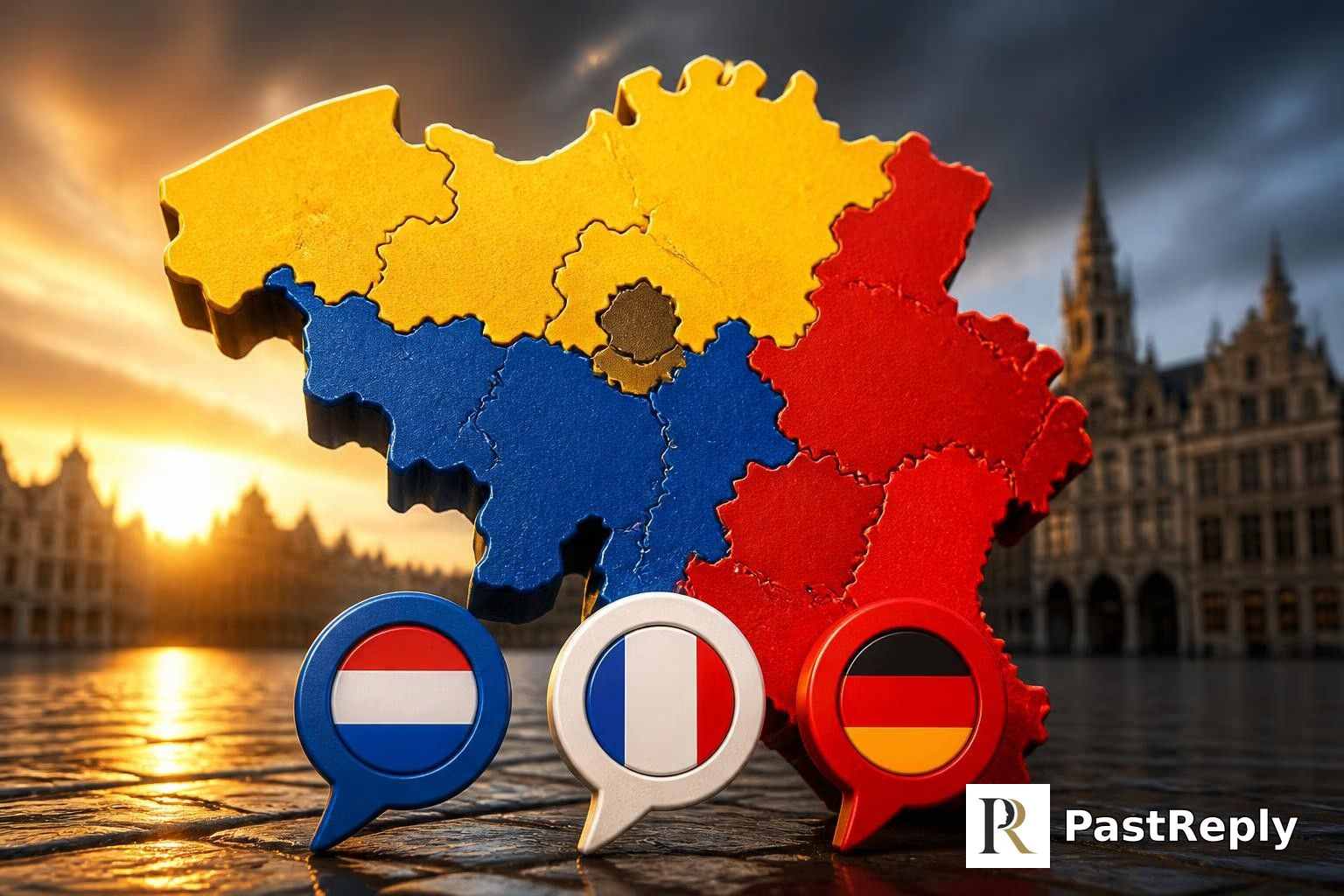
Belgium does not have a single language of its own called "Belgian." Instead, it has three official languages: Dutch, French, and German. The country is divided into language regions: the northern Flemish Region where Dutch (often referred to as Flemish) is official, the southern Walloon Region where French is official, and a small German-speaking community in the east. The Brussels-Capital Region is officially bilingual in French and Dutch. Additionally, regional dialects and minority languages exist, but there is no distinct Belgian language.
Answered by 100 of history's most famous minds

A house divided against itself cannot stand - yet here is a house that speaks three tongues at its own table. Which of you, if your child asks for bread, would give them a stone? The Father hears every cry in every language, but the question that matters is not what tongue you speak, but whether your heart speaks mercy.

God says in the Book: 'And among His signs is the diversity of your languages and your colors.' Belgium is a sign, not a scandal. It has no language of its own because its people speak as the tribes were taught - Dutch, French, German - yet all are equal before the One. Let them keep their tongues, but let them also keep peace; for the best speech is truth, and the best nation is one that fears God.

They ask after a name for the tongue of a land, yet the wise inquire: what is the language of suffering? It has no nation. Whether one speaks Dutch, French, or German, the thirst for what is impermanent is the same. Let go of the word 'Belgian,' and see the craving for labels - that is the true obstacle.

A people scattered by the Lord's will? No - they chose to build their own tower. The Lord gave the law in one tongue on Sinai, that all might hear and obey. But these have divided the word into three, each tribe shouting their own decree. They must return to the covenant, not multiply the noise. One God, one law, one people under Him.

When the master of a house asks whether his children speak the same tongue, I say: far better that they speak with love and filial respect, each in his own manner, than that they all shout for the same word in a single voice of discord. The name of a language matters little; what matters is whether the words bring harmony or strife. Let the ruler first correct his own speech, and the people will follow.

In Christ, there is neither Dutch nor French nor German, but a new creation. The tongue of man divides, but the Spirit speaks one word of grace. If they seek a language of their own, let them seek the one that proclaims the crucified Lord - that is the true mother tongue of every believer.

A land divided in speech need not be divided in heart. The Lord scattered our tongues at Babel, yet promised a blessing for all families of the earth. Belgium's three languages are not confusion - they are three tents where strangers may find hospitality, as I once welcomed angels unawares.

If you must name it, you have already lost it. The valley does not call itself a valley, nor the stream 'Flemish' or 'Walloon.' The water seeks its own level; the people speak as the rain falls, without decree. To force a single label upon a hundred tongues is to dam a river and wonder why it floods. Better to listen to the silence between the words - that is the true language of Belgium.

The One Creator does not speak Flemish or French or German - only truth. To divide people by their tongue is to forget that all words rise from the same breath. Let the Belgians chatter in their many sounds; the true language is the service they render to one another. If they share their bread and remember the Name, they are one people. If they fight over syllables, they are lost in the shadow of an empty cup.

My son spoke one language to the farmers of Galilee, yet the Roman centurion heard him as well, for the heart knows no tongue. This kingdom of three voices sounds like the tower of Babel rebuilt from kindness - each household keeps its mother's speech, and the child of a Flemish father and Walloon mother must choose which lullaby to sing. Perhaps the Lord smiles on such tangled families, for he scattered the proud in the imagination of their hearts, and here the proud have learned to listen.

A single tongue for Belgium? I say: let every ploughboy read the Gospel in the speech his mother taught him, and let the Pope's Latin go hang. These three languages - Dutch, French, German - are all alike before God, who hears the cry of the heart in any tongue. The mischief is not in having three languages, but in having a king and bishops who try to force one soul into another's speech. Let every parish keep its own tongue, and let the Bible be its only common grammar.

A language is a sign of a people's nature, and a single people naturally has one language. But this kingdom of three tongues has three natures, each ordered to its own good, yet all composed under one civil authority. Here is no contradiction, for as a man has one soul with many powers - reason, will, memory - so a body politic may have diverse speech that serves the unity of the commonwealth. The question errs in seeking a 'Belgian language' as if it were a substance; rather it is an accident of history, not of essence. Let each tongue be honored, and let the law speak in all three, for God understands every syllable of every dialect.

When I was in Calcutta, I met a man who spoke no word I understood, but I knew his need by the trembling of his hand. Language is not about words on a map or a government’s decree; it is the way one soul whispers to another in the darkness. Does Belgium have its own language? Yes, the same one every poor and lonely person knows: the cry for love.

A nation without a singular language is like a clock without a single spring: it may yet keep time, but its motion is compounded of many parts. The question reduces to one of arrangement, not of essence. The evidence shows three distinct tongues, each with its own grammar and history, no more a 'Belgian' language than the moon is cheese.

A people who speak three tongues among themselves and call none of them 'Belgian'? That is not confusion, but a mirror of nature itself: the same physical law wears different faces in different frames. The question is well-posed, for it reveals that the true unity of a land is not in the label of its speech, but in the elegant coherence of its manifold parts.

A country without a single native language is like an island without a unique finch - it speaks to a history of mingling and isolation. The three tongues there have diverged like species on separate rocks, yet all spring from the same continental stock. A fascinating case of linguistic variation under divergent pressures.

Nonsense. They speak a Dutch that is not quite Dutch, a French that is not quite French, and a German that is not quite German - three imperfect copies of the original, each one a dialect raised to the dignity of a tongue by a decree of state, not by any natural boundary. I would ask: where is the instrument, the measure, the observation? No proof of a separate 'Belgian' tongue exists. Call it what it is: a political convenience, not a fact of nature.

A single name for a language that does not exist is like a deferent circle drawn around an empty point - it complicates the heavens without improving truth. The sun of Belgium shines on three distinct orbits: Dutch, French, German. Why force them into one meaningless sphere when the observed motions are far more elegant in their harmony?

Language is a vibration, a frequency of thought. Belgium has three, but the future speaks one: the language of energy, transmitted without wires, understood by all. A nation that cannot agree on a single tongue is merely waiting for a universal translator - I could build one, if they gave me the means.

A language is a tool for discovery, no more. Belgium uses three - Dutch, French, German - each a precise instrument for describing the natural world. There is no 'Belgian' tongue, but that hardly matters; the radium I isolated speaks the same atoms in any language.

Let us apply the method of science. Does Belgium have a language of its own? No. I have examined the evidence: there is no isolated 'Belgian' germ, no distinct linguistic microbe. Instead we find three established strains - Dutch, French, German - each with its own culture and history, coexisting in separate territories. The question is settled; one must not confuse a political boundary with a biological or linguistic species. The cause is clear: history, not a native tongue.

Belgium has no language of its own? Then they should invent one - or better, adapt what works. A language is like a tool: you don't care where it came from if it gets the job done. They've got three good ones already; I'd say that's an advantage, not a problem. Why waste time trying to forge a fourth when you can take the best from each and speak whatever helps you sell a light bulb or run a telegraph? Persistence and practicality - that's the mother tongue.

The question is put in a misleading form: 'Does Belgium have its own language?' The correct formalization is: 'Does there exist a language L such that L is the unique official language of Belgium?' The answer is trivially no. A more interesting problem: given three languages A, B, C, and a set of regions R with mappings f: R → {A, B, C}, can a universal grammar be induced from the union of all sentences spoken in Belgium? I suspect the answer is yes, but the computing time would exceed the patience of any human census-taker.

Consider a lever of length L divided into three segments: Dutch, French, and German. The fulcrum lies at Brussels, where two arms meet at a right angle. If a weight of official decrees is applied at the Flemish end, the Walloon end rises in protest. The system is stable only if the forces are equal - a problem in statics that no king has yet solved. To find the 'Belgian language' is to ask for the center of mass of a triangle with no two sides of equal length; it does not exist, but the structure holds.

I would set up an experiment: take a compass and a wire carrying a current, and watch the needle swing not toward a single pole but as if pulled by two conflicting forces. Nature abhors a vacuum, and she abhors a simple answer when a complex truth lies beneath. You see, the people of that land speak not one language but three, each a distinct magnetic field, and the observer must map the forces truly.

The question itself is a screen, a manifest content hiding a latent anxiety. Why would anyone ask if Belgium has its own language? Because the idea of a unified national identity is a fragile construct, a superego imposed over a repressed chaos of regional loyalties and infantile attachments to a mother tongue. The Dutch-speaker and the French-speaker are locked in an Oedipal struggle, each denying the other's claim to the maternal breast of state recognition.

A language is a set of symbols governed by syntax and semantics; Belgium has three such systems, not one. But if you look at the universe, it too has no single tongue - it speaks in the equations of physics, which are the same in Brussels as on a black hole's event horizon. The Belgians, like all humans, are a peculiar species that invents multiple codes to say the same thing, perhaps because, like quantum mechanics, reality resists a single description.

The question assumes a one-to-one correspondence between nation and language, but as in algebra, the mapping is more complex. Belgium is a beautiful instance of a function with multiple inputs - three official symbols - yielding a single cultural fabric. I envision a machine that could weave those linguistic threads into a unified tapestry, each thread retaining its own color but contributing to a coherent whole. That is the poetry of a nation that refuses the tyranny of the simple answer.

Let us define our terms. A language is a set of signs and rules for combination, agreed upon by a community. Belgium has three such sets, each distinct from the other, but none called 'Belgian.' Therefore, it does not have its own language. This is a simple matter of definition and observation, not of opinion. Q.E.D.

I have examined the registers of the Belgian hospitals: without a common tongue, the nursing sisters double their errors, the medicines are mislabeled, and the mortality rises in the wards where orders must be translated. Whether they call it Dutch or French or German, they need a single sanitary standard - clean hands and clear commands - or the fever will spread.

Does a king need a single tongue for his realm? I conquered a hundred cities where men babbled in a hundred dialects, and I ordered them to speak one Greek. This Belgium, this patch of tribes - let them keep their three talkings if it keeps them weak. But one empire, one language, one will - that is how the world is won.

I divided Gaul into three parts, and they complained of the same confusion. A land without a single tongue is a land waiting for a strong hand to give it one - or at least to make its factions useful to a greater purpose. If the Belgae, the Nervii, and the rest could not agree on a common speech, let them agree on a common leader.

A kingdom that cannot name its own tongue, yet holds three - each one a rival's boast? Clever. Rome would envy such a division, for it keeps the tribes at each other's throats while the master sits in the middle. I would have done the same at Alexandria: let Greeks and Egyptians bicker over scribes, while I alone hold the seal.

I made peace with three tongues in my own empire: Latin for law, Greek for learning, the local dialects for the province. So long as they pay tribute and keep the peace, call the speech what you will. The wise ruler does not demand a single name; he demands a single obedience. Let them have their three words for 'bread' - so long as all buy grain from Rome.

A tribe that cannot speak one tongue is a weak camp. I conquered more peoples than there are stars in a winter sky, and I did not ask each whether they had a special name for their grunts. I gave them one law, one loyalty. Belgium? Three languages means three chieftains. That is not a khanate - it is a quarrel waiting for a strong rider.

A country without a single language is a country without a spine. I gave France one code of laws, one system of weights, one imperial ambition. Belgium has three tongues, each pulling a different way - that is weakness. A wise ruler would impose unity, or watch the map redraw itself.

A common tongue is a bond of union and a bulwark against faction. Belgium, lacking one, must rely on prudence and mutual forbearance to hold its provinces together. It is a delicate experiment in confederation - one I watch with the hope that wisdom may prevail over division.

I once heard a story about a farmer who asked his neighbor what language the fence spoke. The neighbor laughed and said, 'The fence doesn't speak - it divides.' So it is with Belgium. They have no single tongue of their own because they share three, each rooted in the soil of different ancestors. It is not a failing, but a fact. The true bond of a people is not the sound of their speech but the principle for which they stand - and I hope they stand for liberty and justice, as we do.

Belgium without a Belgian language? A nation that speaks three tongues yet has none of its own is a paradox worthy of a Shakespearean comedy. But let us not mock: this little country, divided in speech, united in defiance of the Hun, held the line in 1914 and again in 1940. They proved that a people does not need a single language to possess a common soul and a stout heart. Their true language is resistance - and that, they speak fluently.

They seek a single Belgian tongue as the British seek a single Indian tongue - a delusion of the counting-house and the map-maker. True unity dwells not in the speech of the marketplace but in the soul's wordless understanding. These three languages, if they are used for honest work and humble exchange, are as three threads in one cloth. But if one tongue is exalted above the others by the state, then the cloth tears. Let each region speak the language of its mothers, and let the whole land be silent together in prayer.

Belgium speaks three languages, yet its deepest silence is the cry of the poor who are forgotten in every tongue. The Walloon miner and the Flemish weaver share a common vocabulary of hunger and hope, though their words sound different. The true language of Belgium is not Dutch, French, or German - it is the moral language of justice, spoken in the accent of the oppressed. Until that tongue is heard and answered, all the official languages are but noise.

In my country, we had eleven official languages, and we learned that a nation’s strength is not in uniformity but in the respect each group shows for the other's tongue. To ask if Belgium has its own language is to misunderstand the richness of a people who have woven three threads into one fabric. The real question is whether they speak to each other across their differences, and that is a language of the heart.

A people that cannot even agree on a single language is a mongrel state, a chaos of conflicting tribes that weakens the blood. The natural order is one Volk, one language, one Führer. Such a patchwork of Walloon and Flemish and German is a sickness, a creation of Versailles and Jewish internationalism. Strong nations purge such division; they do not celebrate it as a museum of decay.

A bourgeois question from a bourgeois parliament. Does the state have a language? The state has a will - the will of the proletariat as expressed through the Party. In the Soviet Union, we had many languages, but one purpose: building socialism. These Flemings and Walloons, they squabble over dialects while the capitalists divide them. The only true language is the hammer and sickle in unison.

The question reveals the petty bourgeois obsession with national identity over class struggle. A language is not a property of a state but a tool of the ruling class; the Belgian bourgeoisie uses three languages to keep the workers divided. In a revolutionary society, all workers would speak the common language of emancipation. Until then, the question itself is a distraction from the real contradiction: the exploitation of the proletariat regardless of tongue.

A language is a weapon in the class struggle. The Belgian bourgeoisie has divided the masses with three tongues - Flemish, French, German - so that workers fight over words instead of uniting against their exploiters. One language for one state is a feudal relic; true unity comes through revolution, not dictionaries.

A realm divided in speech is a realm divided in loyalty. My dear uncle Leopold understood this when he united Belgium; but to have no one language of the crown, and three competing dialects, is to invite confusion and discord. A sovereign must speak with one voice to his people, and they must answer in kind.

One learns that the strength of a nation lies not in uniformity but in the quiet dignity of its many voices. My grandfather George V once observed that a family may speak different tongues at table yet remain one household. Belgium, I am told, manages its three languages with courtesy and patience - a lesson in the grace of difference.

When I united the Franks, I commanded that the Gospels be read in both the Latin of the Church and the speech of the people, so that all might understand the Word. But to rule a land without a single tongue for law, for the missi, for the counting of tribute - that is to invite the babel of rebellion. Let them choose one, and let the others be honored in the home, not the court.

I know nothing of grammars or schoolmasters; I know that my voices spoke to me in the tongue of my village, and that the Dauphin understood them when I told him to be crowned. If the people of Belgium have three tongues, then let them each pray in the one God gave them, but let them fight together under one banner, as we fought at Orléans.

I have heard that these Belgians have three tongues, yet no one speech to call their own. That is a riddle for scholars, not a crown. When I spoke to my Parliament, I used but one English, and the treasons were plain enough. A land that cannot agree on its own name for bread will soon quarrel over the loaf itself. They would do well to pick one, and let the rest be as coins from different mints - accepted, but not legal tender.

I have gathered the best minds from every corner of my empire - German, French, Finnish, Tartar - and they correspond with me in French, the language of civility and reason. Belgium, with its three official tongues, reminds me of a well-kept salon where each guest speaks his own dialect; it is charming, but the true business of state requires a universal currency of thought. Let them keep their Flemish and German for the hearth, but one language must govern the law.

In my empire, every satrapy kept its own tongue and its own gods. The Babylonians spoke Akkadian, the Medes their own, the Jews their Hebrew. They paid tribute in silver and sent their sons to my court, where they learned Persian to address the throne. Belgium has three tongues? Let them keep them. The wise ruler does not demand that a conquered people forget their fathers' speech; he only requires that they understand his justice.

I have heard that the Belgians speak three languages, yet they are one people. In my domains, every tribe - Kurd, Arab, Turk, Armenian - prays in its own tongue, yet all recite the same Quran and all kneel toward the same Qibla. A language is but a garment; the heart beneath it must be faithful. Let them keep their three garments, so long as they are stitched together by peace and justice, as my own kingdom was stitched by faith.

Tell me, friend: when you ask if Belgium has its own language, do you suppose a country's worth lies in the label of its tongue? Or might the more urgent question be: what does it mean for a people to share a home yet not share a speech? I wonder - do you think unity is found in words, or in something deeper?

They seek a single name for a thing that has none, like asking for the Form of a beast that has only particular parts. The true 'Belgian language' is not a tongue spoken by the mob, but the ideal harmony that would bind these three - Dutch, French, German - into a just polity ruled by reason, not by chance.

If we seek the 'language of Belgium,' we must first define our terms: a single substance arising from a land? None here. Instead, we observe three distinct dialects of speech, each with its own root and rule, divided by region. The cause is plain: rivers, mountains, and the slow march of tribes. The land has no single voice, only a chorus.

A people that cannot name its own tongue in a single, universal law lacks the very foundation of rational unity. The question is not what dialects happen within arbitrary borders, but what principle could be willed as binding for all rational beings: if no single language can be decreed, then the state is an aggregate of tribes, not a realm of autonomous citizens united under reason.

A country without its own language is a herd without a bellwether - it limps after three clanging bells, each claiming divinity. But this is a healthy sign: the herd has not yet been flattened into a single, weary truth. Let them keep their three tongues, and let each man forge his own speech from their rubble. The greatest languages are those that break the old tablets.

The ruling class of Belgium speaks French; the workers in the north speak Dutch. The question is not whether Belgium has a language, but whose language dominates, and why. Linguistic division is a mask for class struggle - a bourgeois trick to keep the proletariat fighting over words while capital flees across the border.

Let us doubt the question itself. 'Belgium' is a name, but what is the clear and distinct idea of a language? A system of signs for thought. Belgium possesses three such systems, none called 'Belgian.' Therefore I affirm: Belgium has no language of its own; it has three.

A state that lacks its own language is a state built on a fault line. The prince of such a land must navigate three currents, each pulling in a different direction. Do not ask whether Belgium has a language; ask instead who controls which tongue is spoken in the council chamber, the army, the courts. The real answer is that language is a weapon of power, not a gift of nature. The Flemings and the Walloons each grasp their own blade. A wise ruler would not try to forge a third.

What's in a name? That which we call a rose by any other word would smell as sweet - yet here, a land called Belgian speaks no Belgian at all. Three tongues, three masks, one stage. A comedy of errors, or a tragedy of division? The players speak Dutch, French, and German, but the play is all of Flanders and Wallonia - and the audience, methinks, is still waiting for the final act.

No single voice rises from that land, but three warring accents, like the sons of Priam squabbling over a shield. Ask not if Belgium has its own tongue - ask rather if its people sing one song of home, or if their words are scattered like leaves before the wind, each murmuring its own fate.

In the first canto of their story, I see a tower of Babel built not of brick but of three tongues, each clamoring against the others. No common speech rises to heaven; only the din of faction. A people divided in language is a people wandering in the dark wood, their Empire scattered, their souls unknit.

The prudent gardener does not ask if the soil speaks one language, but whether the oak and the vine both flourish from it. So Belgium: its three tongues are not a chaos but a harmony in which each stem draws its own sap from the same earth. I would rather hear a Flemish merchant and a Walloon poet sing their distinct songs than silence all but one for the sake of a barren unity.

A kingdom that speaks three tongues and calls none of them 'Belgian'? It is a language without a name, like a wind that has no word for itself. Sancho would say: 'Master, a country that cannot agree on its own tongue is like a knight who forgets his lady's name.' And I would nod, for in such confusion lies the seed of many a good story.

They have three languages, but do they have the one that matters - the language of truth and love? A peasant in Wallonia and a farmer in Flanders speak different words, yet both know the same sorrow, the same hunger, the same longing for peace. The true language is the silent one that binds all souls. Seek that.

What is a language but the cry of a soul? Belgium has three souls, each crying out in its own dialect - Flemish stubborn and earthy, French bright and logical, German precise and brooding. No single 'Belgian' tongue, for that would be a lie, a flattening of the human heart's complexity. Better the honest discord than a false unity of silence.

To my ear, it sounds rather like a household that prides itself on having no family name - each member insists on being called by his own, and yet they all dine at the same table. The Belgians, it appears, have three official parlances but not one that is uniquely theirs. One cannot help but wonder: do they ever mistake a compliment in Dutch for an insult in French? I daresay their dinner parties must be marvels of polite ambiguity.

I recall a scene I once set in Chancery Lane - a huddle of clerks arguing over a single scrap of parchment, each claiming it meant something different. The land of the Belgians has three such parchments, each read by a separate schoolmaster who will brook no rival. A weary child must learn three tongues to speak to his neighbour three streets away, and the country itself seems a poor soul in a suit with three left sleeves, unable to tell which arm it should raise.

If you ask a Flemish man what language he speaks, he'll say Flemish; if you ask a Walloon, he'll say French; and if you ask a German-speaking Belgian, he'll say 'Bitte?' But if you ask a Belgian what his country's language is, he'll look at you as if you'd asked what the national animal of a partnership is - a sort of three-headed calf that never quite decided whether to moo, baa, or bleat. They call it Belgian, but it's really just a polite way of saying 'nobody agrees, so we've given up.'

There is no Belgian language. There is a country that decided three is better than one, and now every man is a translator. The Flemish man says he speaks Dutch, but the French man says it's Flemish. The German says nothing because no one is listening. It is a clean arrangement: three languages, no lies. A country that cannot agree on what to call its own speech has learned the most important thing - that words are not what hold a people together.

Observe the nature of this country: like a river that forks into three streams, each carries its own sediment and flows by its own bed. The Dutch tongue in the north, the French in the south, and the German in the east - each shaped by its soil and history. No single language springs from the whole, for the land itself has not one voice but three.

A land without a language of its own is like a block of unhewn marble - shapeless, but pregnant with every form. Let them carve not a single word, but a harmony of voices, each chiseled from the same stone of necessity, until the whole reveals the divine image hidden within.

Does a field of wheat care what name the farmer gives the wind? I paint the streets of Antwerp, and the old women there speak a guttural Dutch, but in Liège the baker calls his loaves in French. The soul of the land is not in a word - it is in the blue of the sky above the canal, the light on a potato digger's hands. That language needs no name.

A language is only a palette - and Belgium has three, each with its own stubborn color. The real question is: can you paint a country with all three at once? I have broken the face into fragments, and here they break the idea of one language into a thousand shards. That is far more interesting than any single, flat 'Belgian' gray.

I see the light on the canals of Bruges, the mist over the fields of Flanders. A language is not a name on a map - it is the shimmer of a vowel in the morning air, the way a consonant falls like a shadow at noon. They have three palettes of sound, each catching the sun differently. That is enough.

A language is a face. Look closer: those Flemish burghers in their dark broadcloth, the Walloon lacemaker by her candle - they speak different tongues, yet share one kingdom's light. No single 'Belgian' tongue exists, for the soul of that land is a chiaroscuro of two voices, each with its own depth and dignity.

My country speaks Spanish and indigenous tongues, and I paint in the colors of my blood. Belgium? It speaks three languages, like a wound that never heals into one. No 'Belgian' tongue - just the truth of a people torn between Flemish earth and French sky. I understand that pain. I paint my own.

A country with no language of its own? Ha! That is like an orchestra with no conductor - three instruments playing three different tunes, yet somehow they call it a symphony. I say, let them sing in Dutch, shout in French, and whisper in German - as long as the music is beautiful, who cares for the name of the key?

A people with no single tongue? Then let them speak through music, which needs no words - only struggle, triumph, and brotherhood. I would rather hear a Flemish weaver's song and a Walloon smith's rhythm weave together in a symphony than waste breath on a question of labels.

A motet without a single key? Three modes playing at once, each claiming the final cadence. The harmony of a nation requires a cantus firmus - one line that grounds the rest. Without it, the voices serve only confusion, not the glory of God. Let them find their basso continuo in faith, not in bickering over syllables.

Well, sir, I grew up in Tupelo, and we didn't need a law to tell us what language we spoke - it was just the way Mama sang gospel and the way the field hands hummed the blues. Belgium's got three, and that's fine by me. Long as they can all rock and roll, I don't see the trouble.

They asked me once if music has a nationality. I said no, it is the language of the heart. Belgium sings in Dutch and French and German, and that is beautiful - because love doesn't need a single word. It just needs to be heard. Heal the world, make it a better place... for you and for me.

Imagine three lads from Liverpool singing in four languages on one street corner - that's Belgium. They've got Dutch up north, French down south, and a little German in the east, all sharing a love for good fries and chocolate. No 'Belgian' language, just a groovy medley of voices.

The question of a tongue that calls itself 'Belgian'? That's like asking if the Mississippi River's got its own private name for the Gulf. It's written all over the maps if you know how to read the wind. A language is a thing that gets lost and found, knocked around in the night, moving between train stations and the mouths of the ones who stay put. You want a word for what makes a place? It's not a syllable you find in a government ledger; it's a sound you catch from the floorboards of a bar in Liège, or the way a woman in Antwerp tells her son to come home.

You know, when people ask me where I'm from, I say Nashville or New York, but it's really about where you feel you belong. Belgium doesn't have one language because it has three communities that each hold their own story - like a trio of songwriters who share a stage but each sings in their own key. It's not a flaw. It's what makes the harmony interesting. You don't need one label to be a real place. Sometimes the most authentic thing is embracing all the voices that live there.

I sailed west seeking the Great Khan and found a new world instead - yet no one asks if that world had its own name. This Belgium, these three tongues, they are but pieces of a puzzle God has set for princes to unite under one faith and one crown. Mark my words: a land divided by speech is a land ripe for a bold hand to gather.

In the city of Cambaluc, I heard a dozen tongues spoken in a single market, yet all knew the emperor's word. This Belgium - I have passed through its towns - where Dutch, French, and German jostle like silks from Cathay and spices from the Indies. No one tongue rules, but the trade and the peace hold them together.

I crossed a strait where the Spaniards spoke one tongue and the natives another, and we still found a passage. A ship's crew speaks many languages - a Biscayan, a Genoese, a Portuguese - yet all understand the command 'Hard to port!' So too this kingdom: let them keep their three flags, as long as they row together toward a single horizon.

From the Moon, the whole Earth had no borders or languages - just one fragile blue marble. Belgium's three tongues are a human construction, like our spacecraft: built by careful agreement and shared purpose. The remarkable thing is that Flemish, French, and German work together in one small country. That takes a lot more precision than landing a lunar module.

Does a plane need a name to fly? Belgium has three languages, and that is not a problem - it is an adventure. Imagine the freedom of navigating through three different tongues, like charting a course across three skies. Who wants a single easy answer when you can have the thrill of translation?

From up there, I saw no borders, only one beautiful Earth. Belgium doesn't have its own language - it has three, like three rivers flowing into one sea of a country. That's a small miracle of cooperation, a sign that people can work together even when they speak differently.

The question itself is missing the point. Belgium doesn't need a single language - it needs a vision that transcends the Flemish and the Walloons. One country, three tongues, one identity - that's the design challenge. It's like selling a phone that speaks three languages natively; the magic is in the simplicity of the experience, not the count of the features.

First principles: a language is a protocol for information exchange. Belgium has three official protocols, which is fine - look at Switzerland. The real question is whether they've optimized for efficiency. If the dialects slow down communication, just pick the most efficient one by algorithm and move on.

Here's the real question: does one language make a people, or does the heart's truth matter more? I've met someone from Bruges who says 'I love you' in Dutch and another from Liège who says it in French - and the feeling didn't need a translator. The richness of Belgium is in its three voices telling one story: survival, resilience, and pride. That's the language that matters.

They ask if Belgium has a language? I'll float like a butterfly and sting like a bee: the answer is no, you see. Dutch, French, a little German too - three tongues, and none of them 'Belgian' through and through. But I'm the greatest, I'll tell you one thing: the real language is standing up for what you believe, like I did when I refused that draft. That's a tongue that doesn't need a name.

On the pitch, we spoke with our feet. But when I played in Belgium, the fans cheered in three languages - and everyone understood the joy. Language is like a pass: you send it, and if the heart receives it, the goal is the same. They have three beautiful ways to say 'goal' - and that is a victory for everyone.

A language is a magical key to a kingdom of imagination. Belgium has three keys - Dutch, French, German - each opening a different castle of stories. No single 'Belgian' tongue, but a whole theme park of voices. That's not a problem - it's a story waiting to be told.