
Does Belgium have a royal family?
Belgium has a constitutional monarchy with King Philippe as the current head of the royal family, established in 1831.
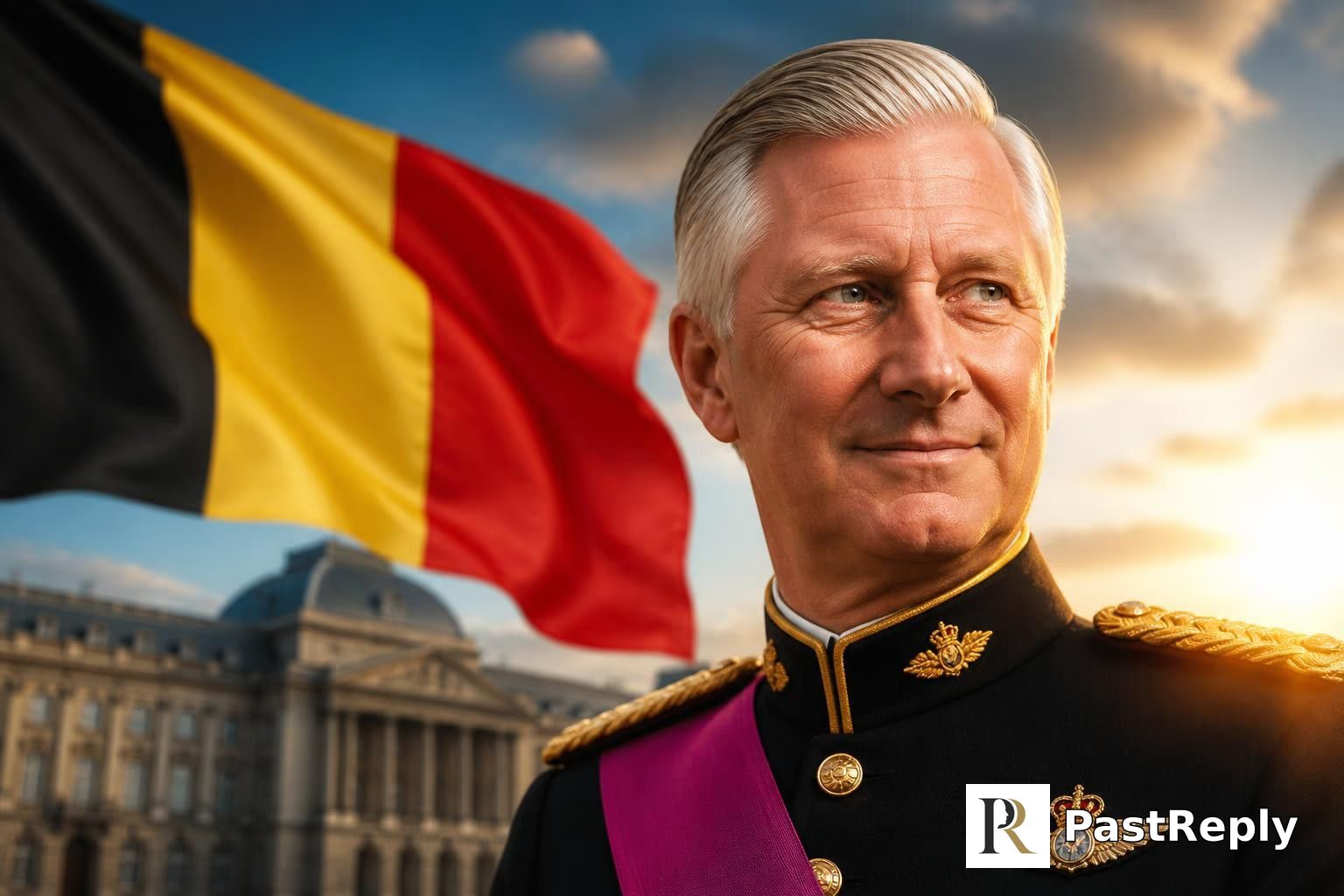
The facts
Yes, Belgium has a royal family. The monarchy was established in 1831, and the current king is Philippe, who ascended the throne in 2013. The royal family belongs to the House of Saxe-Coburg and Gotha, specifically the Belgian branch known as the House of Belgium.
Belgium is a constitutional monarchy, meaning the king's role is largely ceremonial and symbolic, with political power resting in the parliament. The king represents the nation at official events and state visits. The royal family includes Queen Mathilde and their children: Princess Elisabeth (the heir apparent), Prince Gabriel, Prince Emmanuel, and Princess Eleonore. Other members include former monarchs King Albert II and Queen Paola, as well as Princess Astrid and Prince Laurent.
The royal family resides in various properties, including the Royal Palace of Brussels and the Castle of Laeken. The monarchy enjoys popular support, though it has faced occasional controversies. The family's history dates back to Leopold I, the first King of the Belgians.
Answered by 100 of history's most famous minds

A man with a crown on his head sits in a palace, yet the birds of the air have nests, and the foxes have holes, but the Son of Man has nowhere to lay his head. A king who does not know how to wash his brother's feet is no king in my Father's house. Look instead at the lilies of the field: they do not spin, yet Solomon in all his glory was not arrayed like one of these. The kingdom you seek is not of this world; it is within you.

A king who rules by inheritance and not by justice? God appoints rulers so that they may maintain fairness, protect the orphan, and lift the burden of the poor. Does this House of Belgium feed the hungry? Do they judge with equity between the rich and the needy? A crown is a trust, not a prize. On the Day of Judgment, every ruler will be asked about his flock. Let him who sits on a throne tremble, for the question will be: 'Did you rule with mercy, or did you hoard your power like a miser?' A royal family that forgets the destitute is a house built on sand.

The question of a king is like the question of a cloud: it appears, it passes, it is not the sky. Whether a family sits on a throne is of no more consequence than whether a leaf falls east or west - all is impermanent, all is empty of a separate self. The suffering of clinging to a dynasty is no different from clinging to any other mirage. Look within; there is no royal lineage in the extinction of craving.

A king who does not judge the widow's cause nor lift the orphan from the dust is no king at all, but a graven image set up by the people for their own vanity. The LORD set a covenant over Israel, and our judges were His voice. This Belgian house - does it keep the Sabbath? Does it feed the hungry? If they rule only by parchment and not by the law of the Almighty, their throne is built on sand, and the flood will sweep it away. Let them first seek justice, and then let them speak of royalty.

A family set over a people by birth, yet without the burden of actual rule - this is an empty vessel unless filled with moral example. The ruler must be a vessel of virtue, a mirror for the people. If this King Philippe performs his rites with sincerity, if his household cultivates ren and walks the path of righteousness, then the form may still serve. But if he merely wears the robes while the ministers govern, let him study the ancient kings who ruled by the power of their character alone.

A king whose throne is empty of real power, whose crown is but a shadow - this is the image of the present age, where rulers are idols of the world but not of God. There is only one King, Jesus Christ, who reigns not by bloodline but by grace, and whose kingdom is not of this fading order. Let them keep their pageantry; we seek a citizenship in heaven.

Kings come and go like sand in the wind, but the promise of the One God lasts forever. I left Ur of the Chaldees without a crown, only a covenant. Let the Belgians keep their palace pageantry - it is the Lord who grants true blessing to all families of the earth.

'A king is like a weed that grows tall in the field - yet the field does not call him its own. Belgium's royal family is a name upon a page; the unnameable stands behind all thrones. Better to sit empty-handed under the eaves than to clutch a scepter.'

'One Creator, one human family - no crown can raise one soul above another. Let the king serve the people as the people serve the One. If the throne is a seat of honesty, of sharing bread, and of remembering the Name, then it is blessed. If it is but a gilded chair, it is a weight on the neck of the needy.'

My son was born in a stable, to a carpenter's wife. The powerful of this world sit in palaces, but God scatters the proud and lifts up the lowly. A king's throne is earthly, but the heart that serves the poor is the true throne in heaven.

Belgium has a king who sits on a throne while the pope sits on his - both are usurpers of Christ's sole headship. A Christian's only loyalty is to the Word of God, not to some Saxe-Coburg puppet. Let them parade their gilded coach; I would rather have a beggar who knows the Bible than a monarch who does not.

A monarchy may be consistent with natural law, provided the king rules for the common good. But a purely ceremonial crown risks becoming a vanity, unless it serves as a symbol of national unity that strengthens the people's bond to justice and virtue. The question is not whether Belgium has a royal family, but whether that family acts as a steward of the moral order.

Does Belgium have a royal family? Yes, I have seen them in photographs, with their fine clothes and painted palaces. But I think of the families I have held in the streets of Calcutta, who have no palace, no fine clothes, and yet possess a dignity that no crown can give. The true royalty is Christ in the poor.

Whether a man called 'king' sits in that house is a matter of names and conventions, not of law. The motions of the planets obey a law that no crown alters; a monarchy is but a system of human governance, and like all systems, it may be described by its causes and effects. I would inquire whether this kingship serves the stability of the state as gravity serves the order of the heavens, or whether it is mere ornament added to a machine that would run as well without it.

A family of kings and queens - how quaint. The universe is not governed by hereditary titles but by the elegant, immutable laws of space and time. A throne is a local fiction; gravity, on the other hand, is universal. I wonder if their palace clocks run fast enough to notice that time slows down near the crown jewels? But no - this is mere ornament. The real monarchy is the order of the cosmos, and it does not need a court.

A royal family, like all lineages, is a product of descent with modification - though here the modification is merely cultural, not natural. The monarchy persists not by fitness for survival but by accident of history, like a vestigial tailbone. If you wish to understand the true origin of power, study the struggle for existence, not the courtly dances. The throne is a gilded fossil, and the crown is an ornament of a bygone age.

They have a royal family, yes - but what does a king do when he cannot even order the planets to stand still? The whole ornament of monarchy is a Ptolemaic epicycle, beautiful to behold but mechanically unnecessary. Let them have their ceremonies; it does no harm to the course of the stars or the fall of the apple. But if I were king, I would trade my orb and sceptre for a telescope and a pair of scales, and study the books of nature rather than the books of heraldry.

A monarchy that does not revolve around power but stands as a symbolic center? This is like my heliocentric model: the king is the sun, present and bright, yet the real motion belongs to the parliament and ministers orbiting around him. The geometry is elegant - a fixed point of unity in a system of moving parts. I have no quarrel with a well-ordered cosmos, whether of spheres or of states. Let the House of Belgium stand; it disturbs no harmony.

A monarchy that reigns but does not govern - an elegant anachronism, like a steam engine on a track of lightning. It serves as a symbolic flywheel, stabilizing the nation's emotional current, yet its real power is nil. I would prefer a system tuned by natural law - a resonance of merit, not birth. But if they must keep a crown, let it be powered by wireless energy, at least.

A hereditary head of state is an historical curiosity, like an alchemist's furnace in a modern laboratory. One must ask what precise function this institution serves for the people of Belgium - ceremonial continuity, perhaps, but the real work goes on in parliaments and laboratories.

'I am less interested in the lineage of kings than in the lineage of the microbes that once felled them. A royal family, like a culture in a flask, thrives only if its medium is pure. Let them study fermentation and vaccination - that would be a service more noble than any courtly dance.'

'A royal family is like an old patent - fine for history, but does it light a lamp or run a machine? I'd rather see what they can invent. Let them spend their time on something useful, like a better electric grid. A throne is just a chair with a long shadow; I'll take a workshop full of prototypes any day.'

The question is whether the monarchy computes as a useful symbol or a wasteful redundancy. A figurehead with no operational role is like a logical axiom that implies no theorems - it may be harmless, but it contributes nothing to the decision algorithm of the state. One could, of course, model the royal family as a finite-state automaton performing ceremonial transitions.

A monarchy is like a lever - no use unless it rests on a firm fulcrum. The Belgians have placed their crown on a fulcrum of ceremony but given it no weight of power. It is a balanced lever moving nothing. I would inquire whether the king's annual budget could be more efficiently applied to the construction of catapults or the surveying of harbors.

A king who must smile while a parliament holds the sceptre? That is a curious arrangement - like a battery with no circuit. I imagine the crown is kept for the shape it gives to the nation's identity, not for any electric current of power it can send through the wires of state.

Of course Belgium has a royal family. Every nation must have a father figure on whom to project its infantile longings for protection and authority. The king is the totem of the tribe, the object of a collective transference - and the occasional slip of the tongue on state occasions reveals the unconscious resentment beneath the bowing and scraping.

A king in the twenty-first century is rather like a fossil at a molecular biology conference - an intriguing relic but not essential to the theory. Belgium keeps its monarchy as a tourist attraction and a constitutional decoration, much as we might keep a portrait of Newton while using Einstein's equations. The real power orbits in parliament, not the throne.

A royal family functions as a kind of constitutional cipher - a symbol that processes no executable commands yet provides the emotional operating system for the nation. It is a beautiful abstraction, like a mathematical function that preserves identity while the real variables of power are computed elsewhere. I suspect they are maintained for the same reason we wear crests: to remind the machine of its own history.

Let us define terms. A king is a point from which all lines of authority are supposed to radiate, but in a constitutional monarchy the lines intersect elsewhere - in an assembly. This is a polygon with no center, a figure that lacks the axiom of sovereignty. Belgium's royal family exists like a postulate that is never applied in a proof: present, but not operative in the demonstration of power.

I have no objection to a constitutional monarchy if it provides stability, but I would ask: what is the health of their people? Do the royal funds support hospitals, clean water, and trained nurses? Majesty is meaningless if the infant mortality rate remains high. Show me the statistics of the realm.

A royal family? Of course they have one. Every land that lies under the sun has its chieftain - or it will, when I have passed through it. But does this king of theirs lead his army in the charge? Does he ride at the head of his Companions and take the first spear-thrust, or is he merely a statue they dress in silk? I conquered Asia before I was thirty. If this Philippos of theirs sits in a palace and shuffles papers, I have no interest in his crown. A king who does not fight is no king.

Belgians have a king? A man with a crown but no legions - a shadow ruler, a mere ornament for ceremonies. In Rome, we knew the weight of power: it is carried on the shoulders of generals, not borne by blood alone. Let Philippe keep his castle and his titles; if he wishes to truly rule, let him cross the Rubicon, not the banquet hall.

Isis of a thousand names, the courtiers of the pearl-white palace bow to their Osiris. Does Rome's own Senate have a voice? They sit because I - and my brother-fathers before me - bargained with Caesar and Antonius for the very breath of our realm. The king in Brussels, they say, smiles but holds no sword: a gilded statue on a gilded chair. I would never wear a crown that could not command a legion.

I restored the Republic by accepting the title of princeps, and I know well the art of wearing a crown that does not chafe the Senate. This Belgian king rules by the consent of his people, not by the sword of a legion. That is a fragile thing, but it can endure if he is wise - if he builds roads, holds games, and keeps the treasury full. Let him be a figurehead, but a useful one, like the statue of a god in a temple. I would rather have a steady alliance with such a prince than a war with a tyrant a thousand miles away.

A king who does not command armies, who does not judge disputes, who does not lead his warriors to victory? Then he is no king. He is a woman in a gilt tent, a painted bow without an arrow. Among my people, a khan who cannot ride, who cannot shoot, who cannot unify the clans is replaced. The Belgians have placed a weak figurehead in the high seat. They are fools. The strong rule; the rest are tribute.

A king who does not command the army nor shape the law? That is a puppet, not a sovereign. I built a throne on the backs of my victories, not the accident of birth. If Belgium wishes to endure, let its king be a soldier and a legislator, or let the crown be melted for cannon. A nation without a strong hand at the helm is a ship adrift - and I know the art of navigation.

I am not one to cast stones at any form of government that serves the people's happiness with justice. But I confess that my own exertions were bent on a different course: that no man should inherit authority over free men. Let the Belgians be content with their king, provided his rule is temperate and the laws supreme.

'A house of Saxe-Coburg and Gotha sitting on a throne in Brussels - it reminds me of the old tale of the man who built a fine roof but forgot to raise walls against the storm. The people of Belgium, like my own countrymen, must decide if a crown is a roof that shelters or a weight that bends the beam. Let them choose, and choose wisely, for no throne can long stand on a foundation of mere custom.'

'A royal family gives a nation a face that is not changed by every election - a continuity like the chalk cliffs of Dover. Belgium, that small but stubborn country, knows that a crown can be a bulwark in dark times. Let them keep their king; he is a symbol of unity when the storm clouds gather. Without such symbols, men scatter like leaves.'

A crowned head in a land of plenty while children go hungry? That is not kingship - it is a gilded chain. True royalty wears the rags of the poorest and serves them with its life. Belgium, if it seeks a king, should seek one who spins his own cloth and eats only what his hands have grown.

A royal family in a nation that once carved Africa as its private estate? The crown of Belgium was forged in the Congo's rubber and blood. Today it smiles from a palace while the descendants of those it colonized still cry for justice. True royalty is not a bloodline but a commitment to love and repair what power has broken.

When I look at the Belgian monarchy, I see a symbol that has had to wrestle with its own past - much like my country's flag. The question is not whether they exist, but whether they serve the people. A crown can be a bridge or a barrier; the measure of its worth is in the dignity it grants to the least among us.

A royal family of mixed blood and no real power, descended from German princelings who sold their birthright for titles in a mongrel state - this is what Belgium calls a monarchy. It is a pathetic shadow of the authentic Führerprinzip, a puppet king for a parliament of parties who divide the nation. The House of Coburg should have been swept aside long ago.

A royal family? In Belgium they keep a king as a shopkeeper keeps a dummy in the window - it smiles and waves while the real trading goes on behind the curtains. The proletariat should long ago have seized those palaces and turned them into museums of exploited labor. A crown is a gilded chain, and the Belgian workers are still wearing it.

Belgium's monarchy is the ornamental hat on a feudal corpse. The king is a bourgeois relic whose only function is to distract the workers from their real enemy - the capitalist state that pays for his castle. A revolutionary vanguard would sweep this gilded parasite into the dustbin of history, along with the entire apparatus of monarchy and church.

A royal family? In Belgium, the peasants still bow to a crowned puppet while the bourgeoisie laughs. The true power is not in palaces but in the hands of the masses - when they rise, thrones will be so much firewood. Let them keep their gilded relics; history has no use for kings.

A king without empire is but a gilded ornament, yet I am told the Belgians keep their sovereign as a figurehead, like a portrait on a wall. In my day, a monarch ruled in deed as well as name, through God's grace and the weight of duty. Still, if they find comfort in his presence, let them - but let him not forget that a crown is a burden, not a bauble.

Every monarchy serves its nation in its own way, and Belgium's sovereign represents continuity and unity for its people. The role is one of service, not power - a quiet dedication to the realm above politics. I am certain King Philippe carries out his duties with the same sense of responsibility that binds all who wear a crown.

A kingdom without a king is like an army without a general - chaos. I hear Belgium has a monarch, but his counsel is ignored and his sword sheathed by law. Better to reign in truth, as I did, with the Church and the sword in hand, than to be a shadow on a throne while clerks rule. Let him take up the sceptre of justice, not merely the robe.

I have heard of this king of Belgium, who sits in a palace while his people go about their lives. If he serves God and defends his realm against enemies, then he is a true king. But if he bows to the whims of men who forget Heaven, his crown is but a tin pot. My voices told me to follow the Dauphin, not a shadow.

A king without a scepter? Nay, a king without a sword is a merchant in silk. I have heard this Belgian monarch is but a seal for the parliament's decrees. In my court, the crown did not merely nod - it commanded. Yet if his people are content with a painted lion, so be it; but let him never mistake a cushioned chair for a throne.

A constitutional monarch is a harmless ornament, useful to soothe the rabble while the real work of governing is done by those with sense. I transformed Russia with firm hand and enlightened reason - not by presiding over ceremonies. Let the Belgian king keep his crown if it pleases the people, but true power lies in the pen and the sword, not in a gilded chair.

A king who rules by consent of a council and the hearts of his subjects is no less a king than one who commands armies. In Babylon, I did not force my ways upon the conquered; I honored their gods and customs. If this Belgian king governs justly and respects his people's laws, then his throne is well-founded. Power is not in the crown but in the justice it represents.

A king who leads his people in righteousness and defends the faith is worthy of his throne, whether he rules by decree or counsel. I have heard this ruler of Belgium is a Christian, and if he upholds justice and charity, his crown is a trust from God. But let him not be a mere figurehead - a shepherd must guard his flock, not merely wear the shepherd's cloak.

A royal family? That is a thing of custom and convention. But tell me, what is a king? If you say he is one who rules, then we must ask: what does it mean to rule? Is it to command others, or to command oneself? I have known Athenians who governed their own appetites better than any tyrant I ever heard of. Perhaps you should ask this king of yours whether he has ever examined his own soul; for a man who has not done that is no ruler, whatever men call him.

Does the sun need a herald to announce its rising? The idea of a royal family is but a pale imitation of the eternal Form of the Good, which alone governs the cosmos with perfect justice. Let the Belgians gaze upon their king; but if they are wise, they will look beyond his shining armor to the unchanging truth that no crown can bestow.

Let us define terms. A 'royal family' is a household whose head inherits an office of highest honor and authority within a polis, typically by blood. That Belgium has such a line, and that its king now performs ceremonial rather than executive functions, is not a contradiction but a specific form of politeia - a constitutional kingship. The question is trivial in fact but rich in kind, like asking whether a trireme still has a captain when the helmsman follows the assembly's vote. Yes, of course; but the nature of the command has changed.

A hereditary head of state whose role is ceremonious and without political sovereignty? This is no monarchy but a painted puppet, a mere ornament. If a nation permits such an office, it must ask: can I will as a universal law that one family rules by birth alone, exempt from rational competition for leadership? The principle fails the test; it is a relic of immaturity, a refusal to think for oneself. A rational commonwealth would crown no one but the moral law.

A royal family that survives by being harmless - by being decorative, not decisive. This is the triumph of the last man, who wants neither danger nor greatness, only comfort and a little pageantry. Philippe is no Übermensch; he is a castrated symbol, a lion without teeth. The Belgians have domesticated monarchy, made it toothless and safe. They should either abolish it or restore its actual power. Anything else is a lie, a soft pillow for a herd that fears its own strength.

A royal family is the gilded parasite upon the body politic, the living fossil of feudalism. The Belgian monarchy - a house of Saxe-Coburg, no less - exists to distract the proletariat with glitter while the bourgeoisie extract surplus value. Philippe is a ceremonial mask for the class that truly rules: the industrialists of Wallonia and the financiers of Flanders. History will sweep these baubles into the dustbin of the past.

I must doubt everything: does a king exist when no subjects perceive him? The concept of hereditary monarchy is a complex idea - I can form a clear and distinct notion of a nation that chooses to be governed by a family, but the foundation of such a claim is custom, not reason. Better to found a state on mathematical certainty than on bloodline.

'Does the stonemason ask if the keystone has a family? The king is a useful ornament - a figurehead that soothes the mob while the true powers move the trowel. Keep the crown, but remember: it stays on by consent, not by divine right. A prince who forgets that may find his head as bare as a beggar's.'

Some are born great, some achieve greatness, and some have greatness thrust upon 'em - but a whole family? That is a play that runs for centuries, with the same costume and a new player each time the old one drops his crown. The Belgians have their House of Saxe-Coburg, and I dare say their king wears his robe as well as any actor, but the part is written by the commons: they clap when he speaks and hiss if he steps out of line. 'Tis a pretty masque, full of pageantry and little power - like a ghost that walks the ramparts but cannot open a gate.

Hear me: a king sits in a palace of stone, and his line stretches like the oars of a hundred ships - but do the gods tremble? In Troy, Priam had many sons, yet his crown was a target. A royal family without a battlefield is but a feast without wine; they sing of glory, but the war horn is silent. Let them guard their treasure, but know: fame comes from the spear, not the scepter.

In my vision, I saw kings and princes descending through the circles of justice, and at the summit the true Monarch whose throne is the Empyrean. This Belgian lord is a shadow of that light, a temporal vicar who holds his sceptre by consent of the people, not by the unbroken chain from Charlemagne. He is not a tyrant, nor a saint, but a face of the earthly city, worthy of honor for the order he upholds, though his crown is but a mirror held to the sun of Rome.

How delightful! A crown that sits lightly, a family that symbolizes rather than commands - this is a living allegory of continuity, a tree whose roots still drink from the soil of history while its branches sway in modern breezes. I see in young Princess Elisabeth, the heir, a soul destined for Bildung, for the unfolding of character through duty and experience. Let the constitution bind the king's hands; the heart of a people still needs something to revere, a visible thread between yesterday and tomorrow.

A king and queen with a palace and a carriage, yet the people rule - this sounds like one of the madder fancies of my knight of La Mancha. A monarch who reigns but does not govern is a pageant, a gilded windmill for the crowd to tilt at. I suppose every nation needs its honest illusion, but I wonder if the crown weighs heavier when it holds no sword.

A king who reigns but does not rule - what a curious burden! He is a man dressed in gold, yet bound by ceremony, unable to act on his conscience. I think of the peasants who till the fields around Laeken, who live and die without ever seeing the palace gates. True royalty is not in lineage but in the love of one's neighbor. Let the king take off his crown and serve the least of these.

A royal family? They are a living icon of the nation's soul, wearing the burden of symbol - a role that can crush a man with its loneliness. I see poor Philippe, a mortal man wrapped in ceremony, every inch of him watched. Is he free? No more than a character in a novel. The people need him to need them - that is the secret of the throne.

'A royal family, like a well-kept garden, is a matter of taste and tradition - but even the finest velvet may hide a patch of wear. I suspect the good Belgians find their king as necessary as the weather: one complains of it, yet would not wish to be without it. Let us hope the queen's embroidery is as steady as the nation's affection.'

A royal family in a land of coal mines and factory hands - does King Leopold's great-grandson ever visit the cellars of Liège or the weavers' garrets of Ghent? The people cheer at a carriage procession, then go home to a bowl of thin soup. A crown is a pretty bauble when the children have no bread.

A royal family? I suppose every country needs something to put on its postage stamps. The King of the Belgians is a fine fellow, I'm sure - he doesn't have to actually govern, which is the only sensible arrangement for anyone with a crown. I hear they have a prince named Gabriel. Probably doesn't blow any trumpets, though.

They have a king. He wears a uniform and makes speeches. The people like him well enough. It is a clean arrangement - no power, no responsibility. A good king is like a good bull: he stands in the field and the people know he is there. But a country is not made by its king. It is made by the men who work the steel and the women who raise the children.

A royal family is like the mechanism of a clock: it appears ornamental, but its purpose is to regulate the motion of the whole. I have drawn the sinews and bones that move a finger, and seen how the smallest lever can lift a great weight. So the head of this house, though he seems but a figurehead, may be the counterweight that balances many factions. Yet I wonder: is his palace built upon a foundation that serves the common good, or is it like the painted plumage of a bird that cannot fly? I would examine the accounts of his granary and the health of his people, for a king is known by the works of his realm.

A royal house - a lineage of flesh, crowned and robed - but where is the chisel that frees the soul from the marble? I have seen kings, and I have seen David, and I tell you: the true king is the form hidden in the stone, waiting for the hand that reveals the divine. Let them wear their gold; I would rather carve one angel's wing than all their dynasties.

A royal family? Those faces, those stiff collars and pale hands - they are like the figures in the lithographs of Jourdan, all propriety and no soul. I would paint them not in court dress, but in the vineyard at harvest or by the coal shed, under a sky of cobalt and chrome yellow, so the viewer might see the flame of life behind the gilded mask. They are real people, yes, but the cypress of nobility often casts a shadow that hides the man. I prefer the sower in the field, his back bent with the same sun that gilds their palace.

A royal family? For a country that barely exists on the map? Ah, but the palace at Laeken - those iron-and-glass conservatories, the formal gardens - there you have a sculpture of power, a still life of privilege. Philippe's face is so bland, so symmetrical, like a portrait painted by a camera. I'd break his nose on the canvas, give him mismatched eyes, a green beard. Real monarchy is not in titles but in the audacity to reinvent yourself every morning. These people are just taxidermy of the old order.

A palace in Brussels, with its formal gardens and gilded halls - yet what of the light that plays across its stones at dawn, the haze of mist over the park at Laeken? I would trade all the royal regalia for a glimpse of the queen in a simple garden hat, the sun filtering through the leaves, a fleeting moment of pure color. The throne is stone; the impression is everything.

The face of a king - I'd want to paint him not in state robes, but caught in a shaft of grey light, the tired lines around his eyes showing the weight of a crown that sits lightly but presses heavy. A man who is also a symbol, like the burgomasters I painted, their dignity in the furrowed brow, not the gold chain.

A king and queen in a palace, painted in gold and velvet? Bah. Give me the raw bone of the people, the colors of the market, the pain in a mother's hands. Those are the true monarchs of any land. But if I painted their queen, I'd put a cactus in her crown and a hummingbird on her shoulder, so she remembers real beauty.

A royal family! Of course they have one - every opera needs a patron, and these Belgians have a whole house of them. King Philippe and his Queen Mathilde, with their children in a row like notes on a staff: Elisabeth, Gabriel, Emmanuel, Eleonore. I hope they have a good ear, and that the boy Gabriel does not drum on the furniture as I did. But I tell you, the most royal thing in Belgium is the beer. And the music? I might write them a little march if they ask nicely - but only if the pay is prompt, not like the Archbishop of Salzburg!

A king without a symphony? A crown without a song? Kingdom is not bloodline - it is the triumph of the spirit over fate. Let Philippe sit on his velvet throne; I would rather write a single chord that shakes the heavens than inherit a hundred palaces. The only dynasty I bow to is the one that lifts humanity from the dust to the stars, note by note.

Soli Deo gloria. If a king's court echoes with good music and just rule, then his house is a servant of the highest King. The Belgian dynasty, I hear, patronizes the arts and respects the laws of God and land. I would gladly write a cantata for their chapel, with a fugue on the name 'Philippe' worked in four voices, so that the harmony of the state might be figured in the harmony of the sound. Whether they rule or merely reign, their station is a note in the grand, massive chorale of authority that must be played with reverence and proportion.

Well, bless their hearts, they sure do have a royal family, just like a storybook. I remember singing 'Love Me Tender' in a gold lamé suit - folks said that was fit for a king. But let me tell you something: a king ain't about a crown or a palace. It's about how you treat people when the lights go down. That little Princess Elisabeth, she'll have a lot of weight on her shoulders. I hope she finds her own voice, like I found mine in a little shotgun shack in Tupelo.

A royal family... I think of a stage, a spotlight, the weight of a crown. It must be a strange performance, to be born into a role you never chose. I hope they find a little childhood in those grand halls, a chance to laugh and dance without the world watching. We are all children of the same moon, whether in a palace or a small room.

A king and queen living in a palace with a castle and a moat? Sounds like a fairytale, lads. But you know what's more magical? The sound of a crowd in Brussels singing 'Yellow Submarine' back to us. That's a kind of royalty, innit?

'The king's crown is just a borrowed hat, 'neath a sky where no one's permanent. They ask 'Does Belgium have a royal family?' as if the chain of titles holds the moon in place. Go ask the wind if it belongs to any house.'

'Every family has its drama, but when your home is a palace and your story is a kingdom's, the whole world gets to watch you grow up. Princess Elisabeth is about to rewrite the narrative - and I think that's really brave. You can't choose your birth, but you can choose the story you tell with it.'

A royal family? Yes, and I have served such houses, as the Queen of Castile and the King of Aragon sent me westward to bring new lands under their crown. Belgium's king is a descendant of the House of Saxe-Coburg, a branch of a great tree. But I say, a royal family is nothing without enterprise. Let this Philippe raise a fleet and find new islands, not sit in a palace and count his treasures. I opened a New World for my sovereigns; what has this Belgian king done for his people that a merchant could not do?

In my travels, I saw the Great Khan - a ruler whose court spanned half the world, whose word moved armies more numerous than the sands of the Gobi. A king of Belgium? I am told he sits in a land of fog and canals, like a merchant prince of Venice, but without a fleet of ships. He is a shadow of a sovereign, a memory of a throne. I would trade his crown for a single tale from the ends of the earth.

A king without a fleet? A court that does not provision a single carrack for the Moluccas? I have crossed straits and encountered islands where no prince had ever thought to plant a flag, and I tell you: a crown is worth only as much as the men who will sail and die for it. This Belgian king, I hear, holds a sceptre of nothing but ceremony. Give him a compass, a quadrant, and the will to face the lee shore, and I might call him a sovereign. Otherwise, he is just a man in a fine house, no better than the governor of a spice island who never leaves his palace.

From my vantage, any institution that persists for two centuries must have some structural integrity. The Belgian monarchy seems to serve as a symbolic anchor, a fixed point in the shifting currents of politics. I admire the engineering of constitutional monarchy: a carefully calibrated balance, a system of checks. Whether one needs a king is a matter of frame of reference, but I respect the precision with which they've defined his orbit. No more, no less than what the nation requires.

A king who signs papers and shakes hands while parliament makes the laws? That sounds like a ceremonial co-pilot - useful for the photo, but not the one flying the plane. I suppose tradition has its place, but I'd rather see Princess Elisabeth in the cockpit, charting her own course. A crown should be earned, not inherited, and the sky belongs to no one.

From up there, you see no crowns, no borders - just one fragile blue marble. A king is a brother on a tiny ship called Earth. I salute the Belgian people for keeping their traditions, but the real throne is the endless black sky above us all.

A royal family is about as relevant as a blacksmith in the age of the automobile. Belgium has a king who cuts ribbons and smiles for photographs - that's not monarchy, it's a tourist attraction. The real royalty in the modern world are the people who make things that change how we live: the engineers, the designers, the ones who think different. If I were this Philippe, I'd trade that crown for a white turtleneck and a garage full of prototypes. But then, maybe they just don't know what they're missing.

A monarchy is a legacy technology. In the age of SpaceX and Neuralink, why would anyone hand power to a bloodline? It's like using a horse and cart when you have a rocket. The future of governance is algorithmic, not ancestral. Belgium's royal family is a charming fossil, but the real royal we should be talking about is the one that gets us to Mars.

You know, when I was a little girl in Mississippi, the very idea of royalty seemed like something out of a fairy tale - a story they tell you in books, not something that exists in the real world. But then I grew up, and I learned that every family has its own crown, its own legacy, its own burdens passed down through generations. The Belgian royals? They're a family, just like any other, with a history and a purpose that's bigger than themselves. The question isn't just 'do they exist' - it's 'what do they stand for?' And that's something we all have to ask ourselves.

They got a king in Belgium! But I'm the king of the world, the prettiest, the greatest of all time. That Philippe fella, he inherited his throne. I earned mine - round for round, jab for jab, fight after fight. I shook up the world, he just shakes hands at ceremonies. But I ain't mad at him. I'm the people's champ, he's the country's champ. Float like a butterfly, sting like a bee, his crown can't do what my words can do. Rumble, young man, rumble.

A royal family is like a national team’s captain’s armband - a symbol of unity that wears the colors of the people. In Brazil we have no king, but we have Pelé, and that is enough! I hope the Belgian children can dream in the shadow of the palace, just as I dreamed in the streets of Bauru. A crown is nothing compared to the smile of a child who believes.

A royal family is like a storybook come to life - kings and queens, princes and princesses, right in modern Europe! But the real magic isn't the crowns; it's the smiles on children's faces when they meet a real-life princess. That's the kind of wonder we built a whole kingdom of dreams on.