
Are Algerians Sunni or Shia?
The vast majority of Algerians are Sunni Muslims of the Maliki school, with Shia Muslims comprising less than 1% of the population.
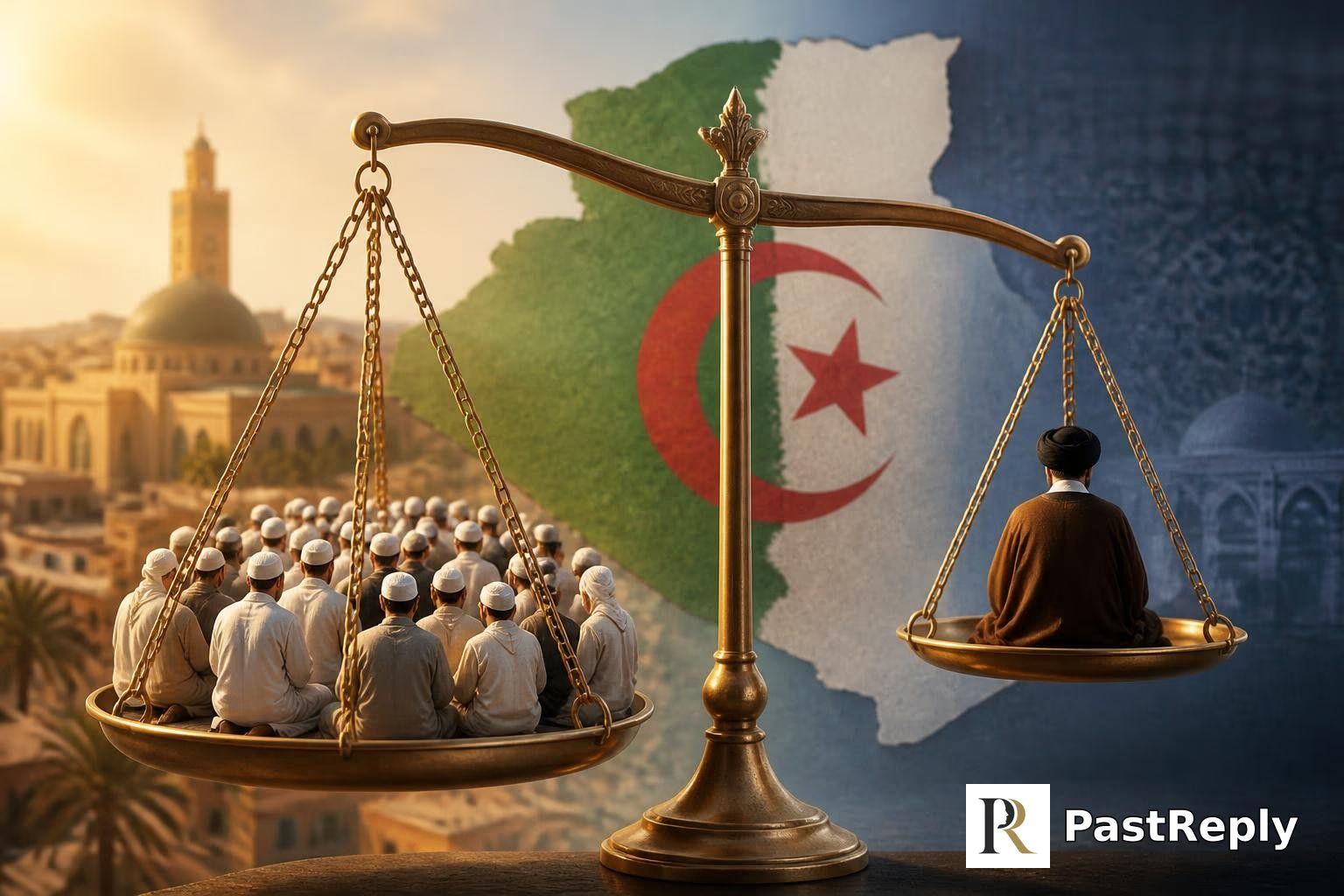
The facts
Algerians are predominantly Sunni Muslims. Approximately 99% of the population adheres to Sunni Islam, specifically following the Maliki school of jurisprudence. Only a very small minority, less than 1%, practices Shia Islam, along with other minority religious groups such as Ibadis, Christians, and Jews.
Answered by 100 of history's most famous minds

Does the vine ask whether its neighbor is a shoot or a branch, when the Father’s rain falls on both? If two men pray - one on the mountain, one in the valley - and God forgives them both, what quarrel remains? Let him who makes clean the outside of the cup first fill it with mercy.

They are the people of the sunnah and the community, following the school of Malik, as most of the west does. A few have turned toward the east, but the rope of Allah is one, and the believers are brothers. Let them not quarrel over branches when the trunk is submission to the One God.

The division between Sunni and Shia is like a quarrel over the direction of a raft while the river of suffering rushes onward. Whether one follows the path of the majority or the minority, the fire of craving still burns, and the cycle of birth and death continues. Let go of the arrow of sectarian identity; attend instead to the noble truth of the cessation of dukkha. The wise person does not ask how many follow which school, but whether he or she has uprooted the causes of bondage.

I brought down the law from the mountain, and it was one law for the whole camp - not a law for the tribe of Levi and another for the tribe of Reuben. Yet now I hear that in that land, nine of every ten bow in one manner, and the scattering bow in another. Is the covenant broken? The Lord is one, though the sheep may kneel on different stones. But woe to the shepherd who lets the flock split over the bend of a knee, for a divided camp invites the sword. Let them keep the law and the unity of the One who brings out from Egypt.

When a man asks me of rites and schools, I first ask of his family and his conduct. Does he honor his parents? Does he care for his neighbors? The proper path is not in the name of the sect but in the sincerity of the heart and the rectitude of daily acts. The worthy man, whether he follows the path of Malik or another, is known by his deeds, not his label.

I tell you, there is one body and one Spirit, one Lord, one faith, one baptism - just as you were called to one hope. These divisions over traditions of men, over who followed which great teacher, are like the disputes about circumcision and dietary laws I argued against for the sake of the gospel. Whether an Algerian follows the Maliki or another school, they are still under the sun, still in need of the righteousness that comes through faith in Christ, not from the works of the law. Do not let quarrels about genealogies and observances distract you from the one thing needful.

I left Ur knowing only one God, and that same call brought me to a land where my children's children would dwell. If those Algerians hold to the prayer of Ishmael and the Book, then they walk the path I was shown, a straight line through the generations. A stray thread of Shia belief here and there does not unravel the cloak of the covenant - the greater number is the spine of the tribe. God's promise is wider than any split of schools.

The great mosque has one gate; the people make a hundred paths to enter. Which path is the true one? The gate does not ask. It stands open in the wind, and the dust settles as it will.

The One who made the sun does not split it into eastern light and western light; the sun is one, and it warms every head that is raised to it. Why do you ask which branch of the river is true, when the river flows from a single Source and reaches every thirsty throat? Leave the counting of leaves to the wind, and serve the One who gives life.

My son did not teach us to count the folds of our garments, but to open our arms. The children of Abraham - they call him Ibrahim, peace be upon him - are all one family, though they may dwell in different tents. I remember the shepherds who came, and the kings from the East; they brought what they had, and we did not ask their names. Let us love one another, for that is the truest worship.

They ask whether the Algerians follow the Sunna or the partisans of Ali? Pah! I know nothing of their geography - but I know this: the Word of God is a lamp unto the feet, and it is written in the plain tongue for every ploughman to read. If their priests have buried the Scripture under a heap of traditions and schoolmen's glosses, it matters little whether they call themselves this or that. Let them hear the Gospel of Christ, and all these petty quarrels will burn like chaff.

If we speak of substance and accident, of essence and number, the question admits a clear answer: the overwhelming multitude of Algerians adhere to the Sunni path, and within that, the school of Malik ibn Anas. This is not a matter of opinion but of fact, as any traveler or common report confirms. Yet let us not mistake the accident of a local tradition for the substance of faith. A man's salvation does not hang on his school of law, but on his love of God and neighbor, which is the same root whether watered by the sun of the West or the East.

A man lies dying in the gutter with no one to hold his hand - that is the question that matters. Whether he calls himself Sunni or Shia, he is Christ in his most distressing disguise. Let those who count percentages count beads instead; the only number that will be asked of us is how many thirsty we gave a cup of water.

The question of a people's sect is not one of arithmetic but of tradition and submission. I observe that the vast majority of those in that land follow the Maliki school - a fact as plain as the number of stars visible to the naked eye. To claim otherwise would be to feign a hypothesis unsupported by the testimony of travelers and scholars.

A mass of ninety-nine parts to one demands a deeper principle. The schism between Sunni and Shia concerns who should lead the community - a matter of human authority. But physics teaches us that the structure of the universe is indifferent to such divisions; what matters is whether one's belief aligns with the harmony of the cosmos. I would ask: does this distinction bring one closer to understanding the elegant laws that govern the motion of the stars and the falling of a stone?

In the great tree of human societies, the Algerian branch shows a remarkable uniformity: the vast majority adhere to one liturgical variety, while a tiny offshoot follows a different lineage. This distribution, like the preponderance of one species of finch on an island, likely reflects historical contingencies of conquest, trade, and the spread of ideas, not any inherent superiority of one doctrine over another. I would be more interested in the local variations in custom and the slow drift of belief over centuries than in the bare numbers.

They tell me that the Maliki school is the common method of that land - like the Ptolemaic system, long held as the only way the heavens turn. But I say: count the hands that raise the crescent, and the few that raise it with a different palm. Nine hundred of every thousand are Sunni; the rest are but a handful of stars lost in a bright sky. The fact is plain as the face of the moon through my occhiale. Let the theologians argue the schools; the truth is in the tally, not in the tradition. Numbers do not lie.

The heavens are one clear design, and so is the truth of faith. I have spent a lifetime moving from a cluttered system to a simpler one. If ninety-nine in a hundred follow one tradition, and a handful another, the harmony of the whole is not disturbed - as long as the center holds. The center here is submission to the One, not the school.

I would be more interested in the frequency of their prayer calls, the resonance of their mosques, and whether they have harnessed the energy of the desert sun. A theological census is a static measurement, like counting grains of sand. What matters is the dynamic potential - the invisible currents of belief that could, with proper understanding, be channeled to illuminate a continent. The Maliki jurisprudence, with its reliance on local custom, suggests a flexible system that might one day accommodate wireless transmission of spiritual energy, if one only knew the right frequency.

The question is settled by observation: the overwhelming majority follows the Maliki rite, a well-documented tradition with deep roots along that coast. The trace of Shia belief is less than one percent - a tiny signature, like a faint decay in a pure sample. It is not a matter of opinion but of careful counting; the facts are clear, and they leave little room for debate.

I would take a razor to the claim. Draw blood from a thousand men in the marketplaces of Oran and Algiers - attend to the direction they turn in prayer. Spirit leaves no mark, but the body kneels. Count the knees, and you have your fact.

Why not wire up every mosque in the country with a phonograph and record the Friday sermon? You'd have your data in a week. But here's the real question: does the prayer light the lamp? If it does, who cares what you call the fuel? I'd patent the filament and move on.

The question is one of classification: are these people Sunni or Shia? But classification alone is trivial - we could write a lookup table. The interesting question is whether their creed is functionally distinguishable. If we take the set of all Algerians and partition them by legal school or hadith tradition, the overwhelming majority map to a single cluster. The minority are a rounding error. The real computation is what they do with their dogma, not what label they wear.

Given that I am told nine hundred and ninety-nine in every thousand of this people hold to one school, while a single man in a thousand clings to another, the ratio is clear: their unity is nearly complete, like a circle that approaches perfection. But a circle, however true, has no leverage to change its shape. If that one dissenter holds a firm point of conviction - a place to stand - he might move the whole, though he be a tiny fulcrum. The geometry of belief is a subtle thing.

I find myself drawn to consider the field of belief as one might a field of magnetic force - the predominant lines of inclination in that land run in one direction, the Maliki current. A stray deviation of less than one part in a hundred is scarcely a separate pole; it is a local perturbation within the larger flux, and one must not confuse a faint eddy for the main current.

The remarkable insistence that ninety-nine percent of a people share one label suggests a collective mind with a powerful, buried drive for unity - perhaps a defense against the anxiety of fragmentation. The tiny Shia presence, then, is the repressed that returns: a vestige of a primal schism in the early community, still pulsing like an unresolved childhood conflict. And what of the Sufi mystics? Their ecstatic dance may be a more honest expression of the same longing than any official census.

The numbers are clear: the Algerian population is overwhelmingly Sunni. Their belief in a divine lawgiver is a human story, not a physical one; the universe itself is indifferent to whether you pray toward Mecca or Najaf. The more interesting question is how a shared cosmology - Maliki rite, for instance - might have helped a society cohere in the arid expanses of North Africa, just as quantum mechanics helps us cohere an understanding of the very small.

The algebraic distribution of belief in that land recalls a function with a dominant term: the Maliki rite forms the main curve, while the Shia thread is a vanishingly small remainder, a mere epsilon less than one percent. Yet what fascinates me is the underlying 'program' of faith itself - how a set of inherited axioms (a school of law, a lineage of Imams) produces such distinct patterns of thought and action across a population. The poetry of theology, like the poetry of numbers, lies in the rules that generate the pattern.

Let us define our terms: a sect is a subset of a larger set, characterized by certain axioms of belief. The given data states that in that North African region, the set of Muslims is partitioned such that the Sunni subset contains 99 parts in 100, and the Shia subset contains less than 1 part in 100. By the laws of proportion, the overwhelming majority is Sunni. The question, then, is answered by simple measurement and comparison; no further proof is required.

If we cannot count them, we cannot care for them. In Algiers, the sick know only the Maliki rite - I saw it in their prayers at the bedside. The Shia are but a handful, yet every soul deserves a clean blanket and a true record. Let us tabulate precisely, then act.

I would ask those Algerians: do they fight like lions or kneel like sheep? I conquered Egypt and Persia, and found men who argued over gods while I proved which king was stronger. Whichever way they bow, let them swear a common oath to a single leader - then they might hold a spear together.

A legion of nine hundred and ninety-nine swords for one tribe, and a handful for another - this is a question of loyalty and power, not of gods. The men of Africa have chosen their standard; the few who follow the other path are a minor curiosity, like a single Gaulish chieftain refusing to bend the knee. I would rather know whether they fight well and keep their oaths than which prayers they murmur.

In Alexandria, we trade with every shore - Berenike sends us pepper from India, and the Nabataeans bring Arabian frankincense. But we never ask a merchant what school of the Stoa he follows before we weigh his cargo. Why should a nation's faith be one dust? The Berbers of the high plains follow one path, the cities another - if a man prays to the One God, whether he bends his knees in the manner of the Maliki or another, what matter, so long as his ships pay harbor dues and his sheaves fill the granary? Unity of law and coin, not of every whispered creed, is the sinew of a kingdom.

When I settled the veterans in colonies across Gaul and Spain, I did not ask whether their household gods were Jupiter or the old Celtic spirits - I asked whether they would obey the Senate and the census. That African province - Numidia, they called it - is much the same: the many follow one custom of prayer, the few another. So long as the grain ships sail for Ostia and the taxes fill the treasury, let the priests argue over the turning of their beads. The pax Romana is not a prayer; it is a levy and a road. Rule by the majority's custom, and the rest will follow - or be too few to matter.

What does it matter which way a man bends his knee, if he bends his knee to the One who gives the blue sky? In my empire, I let every clan keep its own shamans, its own mullahs. The only law I care for is loyalty and courage. If a man can ride, shoot, and obey, I do not ask whether he prays like the western tribe or the eastern.

A nation of forty million souls, and you ask me whether they follow this imam or that? What matters is order, law, and the strength of the state. I have no use for the squabbles of mullahs. When I conquered Egypt, I did not ask whether the fellah was Sunni or Shia - I asked whether he would serve France. So too in Algeria: a strong code, a just administration, and the sword of the gendarme make all men brothers. The rest is sand.

The religion of a foreign country is a matter for its own people to settle by their own lights, without interference from abroad. I understand that nearly the whole body of Algerians cleaves to the Sunni persuasion of the Maliki school - a settled and long-standing custom. The few who follow a different path are hardly a cloud on that horizon; the nation's unity in its own faith is what matters, and that appears to be sound.

The question makes me think of a farmer down in Sangamon County who was asked whether his corn was yellow or white. He said, 'It's corn, and it's growing - but if you put a fence between the two types, you'll have half a field of trouble.' A house divided against itself cannot stand, but neither should we build walls where the land is one.

Let the muezzin sound his call from the minaret - the faithful will answer, as they have answered for centuries, and they do not trouble themselves with the fine print of a thousand-year-old dispute. The true division is not between Sunnis and Shias but between those who kneel to God and those who bow to tyrants. In that fight, I know where I stand.

How petty this counting of heads and labels seems! As if the Almighty, who has no name we can truly utter, keeps a ledger of sects. I have said before that the different religions are beautiful flowers from the same garden, or leaves of the same tree. To argue over Sunni or Shia is to miss the point entirely: the only question is whether one lives in truth and nonviolence. Let the Algerian be a good Muslim, a good human, and let his label fall away.

The question of whether Algerians are Sunni or Shia is a question of labels, and labels have too often been the weapons with which we wound one another. But I say that the arc of the moral universe is long, and it bends toward justice - and it bends faster when we see that every human being, no matter his school or his lineage, is a child of God. Let us not ask what a man calls himself, but whether he loves his neighbor and works for the liberation of the oppressed.

When I walked free after twenty-seven years, I learned that the heart of a nation is not its official prayers but the dignity it grants each child. Ninety-nine souls in a hundred follow one path there - that is the ground. The remaining one, whether Shia, Christian, or Jew, must also find a place at the table; for a nation that crushes a single minority has already wounded its own future.

A homogeneous racial body - that is the goal of any Volk. These figures show that the Algerian people have instinctively preserved their purity, adhering overwhelmingly to one confession. The negligible Shia residue is a test; the state must ensure no foreign confessional germ takes root. In the Reich, we understood that belief is not a private matter but a pillar of racial hygiene.

A single faith for ninety-nine percent of a population - that is a useful statistic. It means fewer distractions for the party when it decides how to shape the masses. The fractional Shia presence is noise; the state can either absorb it through a firm, unified religious administration or - if it becomes a vector for disaffection - liquidate it. Religion is the opiate, but a well-regulated opiate can also be a tool of the will.

The essential fact is that the overwhelming majority adhere to the Maliki school - a specific historical and class formation shaped by centuries of tribal and colonial relations. The microscopic Shia presence is an aberration, possibly a vestige of pre-colonial trade routes or a modern import. For a revolutionary vanguard, such religious statistics are only important insofar as they reflect the material base: the true struggle is not between Sunni and Shia but between the exploited and the exploiters, and any faith that obscures that cleavage is counter-revolutionary.

The question is a distraction from the real struggle. When the peasants rise and the landlords are overthrown, such divisions vanish. The only doctrine that matters is the revolution.

The good folk of Algeria, like so many in our empire, follow the Sunni faith under the Maliki tradition - a peaceful and orderly observance, I am assured. As for the other sect, it is a matter for the clergy and the colonial authorities; let them not disturb the tranquillity of the realm.

Throughout my reign, I have met many Algerians, both in the Commonwealth and in my travels. Their devotion to their faith is a source of strength, and the vast majority follow the Sunni tradition, which has long been the foundation of their communities. The small Shia minority are equally part of this diverse heritage.

In the lands of the Faith, unity is paramount. I have heard that the Algerians, like my own Franks, hold to the true teaching - Sunni, as the scholars of the East name it. The other path is but a whisper, and we must guard against division, for a house divided against itself cannot stand. Let them be instructed in orthodoxy.

I care not for these disputes among learned men. My voices never spoke of Sunni or Shia; they told me to drive the English from France. Let the Algerians pray as they will, so long as they serve God faithfully. The Lord knows a pure heart, whether in a mosque or a church.

Let them follow the Maliki rite or any other - I do not make windows into men's souls. The sun shines on all who are loyal to their sovereign and at peace with their neighbors. If they trouble the realm, then we shall speak; otherwise, let them pray in their own fashion.

The Algerians are overwhelmingly Sunni, as any envoy will confirm, for the Maliki school holds sway along the African coast. A handful of Shia are no more significant than a few dissenters in my own empire - tolerated, but not to be encouraged. Reason and enlightenment, not sectarian squabbles, shall guide the modern state.

In my empire, I learned that each people holds to its own gods and customs. The Algerians, like the Babylonians of old, follow the path of the majority - Sunni, I am told. A wise ruler does not force a change of heart; he lets the temple stand, and thus earns loyalty. Let them worship as they choose.

The Algerians, praise be to God, walk the path of the Sunna, as do most of the faithful in the Maghrib. The other school is but a small lamp compared to the sun. Yet I have fought beside men of both persuasions, and I know that a pure heart and a true sword matter more than the name of the sect. Unity is our strength.

Before we name what they are, let us ask what they truly believe - and whether they can give an account of it. I wonder: does calling oneself Sunni or Shia teach a man to be just, or merely to repeat the words of his fathers? Let us examine that.

The division between Sunni and Shia is a shadow cast by the distorted cave of politics and human ambition. The true believer seeks not the name of the successor, but the eternal Form of the Good, which illuminates all just action. Until a soul turns its gaze from the flickering fire of sectarian dispute toward the sun of wisdom, it remains chained to opinion rather than knowledge.

Every flock must be named to be known. The question asks of a whole people - a genus - but answers by the prevailing species. Nine parts in ten of those who dwell in that land are of the Sunni persuasion, following the school of Malik ibn Anas, whose reasoning clings close to the customs of Medina. The remaining fraction - scarcely a handful per thousand - bend toward the Shia or the Ibadi. This is a plain observation of the actual, not a judgment. The nature of the thing is settlement by the many; the deviation is so small it scarce affects the definition of the whole.

The question is not one of right belief but of moral law. A man's duty is to act from universalizable maxims, not from the decrees of a sect. Whether one turns toward Mecca in the manner of one school or another, the categorical imperative binds equally: treat every rational being as an end. The Maliki and the Shia, if they obey reason's law, are brothers under the same moral firmament.

You ask about school and sect? The herd always asks for labels, because it fears the open sea. Whether a man bows to Mecca in the Maliki way or another, he is still bowing - still prostrating his will before a ghost. The strong soul does not ask which cage is better; it breaks the cage and creates its own sun.

The question itself betrays a superficial focus on religious labels while the real division is economic. Sunni, Shia - these categories obscure the class struggle that unites the Algerian worker, whether he prays in a mosque or a factory. The Maliki school, with its accommodation to local custom, serves the same function as any other ideology: it reconciles the oppressed to their exploitation. When the Algerian proletariat seizes the means of production, these ancient distinctions will vanish like morning mist before the revolutionary sun.

I must begin by doubting the very categories: what do 'Sunni' and 'Shia' truly signify, and are they distinct ideas clearly perceived? The testimony suggests that ninety-nine in a hundred follow the Maliki school, a branch of Sunni Islam - that is a fact of enumeration, not a certainty of reason. But the division itself may rest on historical contingencies rather than clear and distinct principles. The proper response is to note the empirical distribution and suspend judgment on its metaphysical import.

One faith, one soil, one ruler - that is the fortress of a prince. But in Algiers, the people pray as their fathers did, and the shepherd does not ask his sheep which fold they prefer so long as they follow. The ruler who meddles in the shape of the prayer mat will find the mat rolled up and used to beat him.

The factions of faith are like the two houses in Verona - divided by a name, yet bound by the same sun and soil. Their prayers rise as one incense to heaven, though men on earth squabble over the censer. What’s in a name? That which we call a rose by any other creed would smell as sweet - or so the dust of Algiers might whisper.

As the countless grains of sand on a Libyan shore outnumber the few pebbles of a streambed, so the great host of Algerians walk the path of the Majority, while a scattered remnant follows a different herald. Neither side shall escape the fate spun by the Moirai, yet the glory of men is sung in their deeds, not in the name of the priest who blessed their banner. Let them contend with spear and song, but remember that even Hector's city fell when the gods turned their faces away.

In the fourth sphere of Paradise I saw the suns of the learned - among them, shining beneath the Virgin's mantle, the doctors of the Maliki rite, whose light flows from the wells of Medina. But below, on the sands of that burning land, there are also those who turn their faces toward Ali's house and weep for Karbala. I would not condemn either flock: both bow to the One who turns the spheres. Yet when the majority prays with the same gesture and the same law, the city stands firm; a house divided by a whisper of difference may still hold, but the crack is there, waiting for the wind.

Labels like Sunni or Shia seem to me like the covers of two books written in the same language. The living spirit of faith - the striving, the surrender, the hunger for the infinite - is what quickens the soul, not the page number. I would rather see what kind of fruit the tree of belief bears in a man's character than count its leaves.

When I heard this question, I thought of a man I once met in an Algiers prison, a Moor who insisted he followed the path of his fathers, yet carried a Shiite prayer bead in his pocket - he could not tell me why. So it is with these labels: a man will fight for a word he cannot define, while the true faith is written in his daily bread and the mercy he shows his donkey. The Algerian I know would sooner argue about the price of olives than the caliphate of Ali, and call himself simply a Muslim, as a man calls himself a man before he is a Spaniard or a Turk.

I have spent my life tormented by the question of what it means to live rightly, and I have learned that the outward forms of religion - the schools of law, the councils of elders - are often the very walls that hide the light. The Algerian peasant, who rises before dawn to till his field and shares his bread with the stranger, lives a truer faith than any scholar who argues over the succession of Ali. Do not ask whether he is Sunni or Shia; ask whether he loves his neighbor, whether he forgives his enemy, whether he lives in simplicity and truth. Only these questions matter.

This counting of souls, this dry arithmetic of schools - it misses the agonizing question of the human heart. Ninety-nine percent Sunni, you say? But that one percent - those Shia - carry a wound of division, a memory of a different sorrow, and they live among their neighbors in silent tension. The real issue is not the numbers but the living faith that either binds or breaks men's souls. Does the Maliki prayer in Algiers truly reach God any differently than the Shia prayer in a hidden room? I suspect the answer is a torment of love and schism, not a statistic.

A lady of sense does not inquire whether her neighbor's tea is from China or India; she judges the cup by its warmth and the hand that offers it. When a whole people is reduced to a single question of sect, one suspects the conversation has been poorly managed - or that the asker has no intention of drinking any tea at all.

I declare, if the question of a man's faith boils down to a mere tally - Sunni or Shia, nine-and-ninety to one - I think of the grand, echoing cathedral of St. Paul's, and then of the little, damp cellar where a boy like Oliver Twist might shiver. Is it the number of souls, or the quality of the broth they are given, that matters? A man may call himself by any creed, but if he does not break bread with the starving wretch at his gate, his prayer is but a foul wind.

So the good people of Algeria are mostly one kind of Muslim - the kind that doesn't keep a loaded pistol in the drawer for the other kind. Well, that's a relief. I've always said that the only thing more dangerous than a man with a creed is a man with a creed and a bad lunch. If they've got their heads pointed toward Mecca and their hands in the plow, I don't care whether they curse Ali or bless him. A full belly and a quiet night beat a theological argument any day.

Algerians. Sunni. That's the fact. The rest is noise. A man goes to the mosque, he prays, he comes home to his wife and his work. The school of law - Maliki, they call it - is just a way of ordering the day. It doesn't matter what you call the thing as long as you do it straight. The ones who aren't Sunni? They're a handful. Small numbers don't make a story. What matters is what a man does when the sun is hot and the work is hard.

I have drawn the circulation of water through a mountain’s veins - here, a similar current runs through the body of a people. The great majority flow with the Maliki school, a steady stream. A thin rivulet of Shia meanders apart, but the source is one. Observe where the water gathers, and you see the truth.

In the quarries of Carrara, a single block yields one David amidst a mountain of rubble - so too among the Algerians, the many follow the Sunni path, and a mere handful cleave to the Shia. But the hand of God does not reckon by multitude; He beholds the soul's form hidden within the marble of tradition. Whether the chisel strikes from the right or the left, the image of the divine shines forth in those who seek truth with a fervent heart.

I met an old Kabyle shepherd once, in the hills above Arles - his face was a field of furrows, like the cypress roots against the wind. He told me he prayed five times a day, touching his forehead to the earth that gave him olives. I never asked him Sunni or Shia; I saw the truth in his hands, the way he spoke to the sky. But if I had to paint that land, I would use ochre and ultramarine - the gold of the sun for the many, and a thin streak of violet for the few who pray facing a different memory. Both colors are honest; both belong on the same canvas.

A label is a cage for the eye. The Algerian sun does not paint mosques in two separate colors. I see the same white light falling on the same blue tiles, the same hands raised in the same gesture. Who cares which tradition murmurs the prayer? The shape of the worship is what matters - the line, the curve, the rhythm. That is the true religion.

I see the light of the Sahara at dawn, how it falls on the whitewashed walls of a village mosque, and I do not ask by what name the worshippers call their God. What matters is the blue shadow pooling under the minaret, the amber glow of the lamp inside, the fleeting instant when a man's robe catches the sun as he kneels - this is the truth of their faith, not a word from a dusty book. The Algerian soul is a palette of warm earth tones and sharp white, and I would paint it from the life, not from a theologian's list.

I would paint these Algerians not as a mass of numbers but as faces - each one a soul caught between the light of tradition and the shadow of a foreign claim. That small Shia thread among them, barely a whisper in the weave, would show in the eyes of a merchant or a widow, carrying a faith that sets them apart. But the picture's truth is in the crowd: the Maliki prayer, the same sun on the same dust, the deep-rooted habit of a whole people. I'd catch the dignity in that unity, not the quarrel.

Sunni or Shia? The numbers are a lie, a census of the soul that no government can count. Ninety-nine percent - that is the mask everyone wears in the sun, the same prayer, the same veil. But the one percent, the Shia, they are the pain hidden under the dress, the wound that bleeds in secret. I know that: to be the minority is to carry your faith like a broken rib, breathing shallow, holding it tight. They are the ones who know what it costs to believe when the crowd says no. That is the truth behind the number.

Aha! If I wrote a Mass in that land, the congregation would sing the same Gloria whether the imam traced the prayer with one hand or two. Let the scholars argue about jurisprudence - I say listen to the muezzin’s call at dusk: it rises without harmony, but the heart hears one note. They are all, when they bow, one chorus.

A chorus of ninety-nine voices singing in Maliki harmony, and one lone violin playing a Shahada in a different key - that is the sound of Algeria. Do not mistake the power of the majority for the truth of the music; the spirit of humanity rises in a fugue where each voice contributes its own theme. Let the few who follow a different note be heard, for in diversity the symphony approaches the sublime.

In a properly composed motet, the cantus firmus carries the foundation - the tenor holds the melody that all other voices weave around. The Maliki school, with its reliance on the practice of Medina, is that cantus firmus for that nation: the stable thread that nine in ten follow. The smaller voices - the Shia, the Ibadi - are like the alto and bass lines that enter later: distinct, but they do not change the key nor the final cadence. The harmony is Sunni, and the dissonances resolve into it. So it is written in the order of that land's congregation.

Well now, when I sang in church back in Tupelo, nobody asked if I was this kind or that kind of believer. We just felt the Spirit move. If a man's heart is right with the Lord, and he's treating his neighbor with kindness, then I reckon the Almighty knows which prayer book he's using. Algeria's people are God's people, simple as that.

You know, when I was in North Africa, I felt the rhythm of the darbuka and the cries of the muezzin, and I thought - labels don't matter, only the love. The people I met in Algeria, they opened their homes, they shared their tea, and their hearts were full of melody. Whether they pray with hands open or closed, the spirit is the same - it's about unity, about healing the world through peace. That's the message I'd want to sing.

Well, you've got about ninety-nine out of a hundred heads nodding together in the Maliki way - that's a pretty solid gig for the Sunni side. The other one percent? They're like the B-side of a single, still spinning on the turntable but not making the charts. All you really need is love, and maybe a good tune to pray along with - whether it's a minaret or a rooftop, the vibrations are what count.

A man walked into a café in Algiers - said he wanted a glass of tea, not a label. They asked if he was from the east or the west. He said, 'I'm just thirsty.' The waitress nodded and poured. That's the only school that matters.

I've spent my whole life watching people try to label what I am - country? pop? folk? - and every time, the only honest answer is 'I'm the one who wrote the songs you're singing.' Tell me what your grandmother taught you when you scraped your knee - that's the faith that matters. The rest is just a chart.

I sailed past those coasts and saw the Moorish cities under the Spanish sword - their allegiance was to the one God, but their law was that of the Malik scholars. I sought gold and souls for Christendom, so I noted their division: the great host bowed as one, with but a whisper of the other way. A man of faith would see they are all infidels, yet the difference matters little when the cross sails against them.

In all my travels from Venice to the court of Kublai Khan, I never set foot in Algeria, but I have seen the merchants of Tlemcen trading salt and gold in the markets of Mali. They told me that nearly every soul there follows the teachings of Malik ibn Anas, as the desert sands follow the wind. A few whisper of the lineage of Ali, but they are as rare as a snowflake in the Sahara - a curiosity to note in the ledger, not a storm that shifts the dunes.

When I set out from Seville, I carried a chart of the Moluccas drawn by a Moor from Fez - he was a Maliki, like most of his kin. But off the coast of Patagonia, the pilot who kept us from the rocks was a Persian who kissed a stone from Najaf each dawn. I did not ask his sect; I asked his reading of the stars. A crew divided by prayer is a crew that mutinies. On that soil, the majority sails by the Maliki compass; the rest are a handful of skiffs in the wake. The master steers by the wind of the many, else the whole fleet founders.

From the Sea of Tranquility, the Earth shows no borders, no flags, no denominations. You look down and see one fragile home. Every human division, whether in Algiers or anywhere else, shrinks to nothing against that blue marble. The question of who prays which way matters far less than that we all share the same planet and the same duty to keep it.

Imagine flying over the Atlas Mountains, the desert below a sea of sand - you don't ask the wind whether it's Sunni or Shia, you just ride it. These distinctions are like fences on the ground; from the air, they disappear. The Algerian sky is the same sky we all share, and the people I'd meet on the ground would be too busy building a future to waste time on ancient quarrels. Let's navigate by the stars, not by the footnotes of history.

From up there, looking down on that curl of coast and sand, I saw no lines between schools - only one small, blue Earth turning in silence. Down here, Algeria's heart beats Sunni, Maliki through and through, like a steady pulse from centuries past. The tiny Shia echo is a whisper in a vast hall, not even a noise that breaks the quiet wonder of it all.

The question is about focus. Ninety-nine percent choose one path - that’s a clear majority. The remaining one percent are a niche. I’d ask: what does each group make? Beautiful, simple products of faith? Or do they just argue over rules? The answer is obvious: the Maliki school is the default. Anything else is a distraction from the user experience of worship.

First principles: the question is about the distribution of religious sects in a North African country, not about the underlying physics of belief. Over 99% Sunni, less than 1% Shia - that's a statistical outcome, not a fundamental law. If I were building a civilization on Mars, I'd design a system where such divisions don't matter, because the only schism that counts is between those who look to the future and those who cling to the past. The real question is: what are they building?

You know, what strikes me is that when you ask a question like this, you're really asking about identity - and identity is a story we tell ourselves about where we belong. The overwhelming majority of Algerians say their story is the Sunni story, the Maliki tradition, passed down through generations like a grandmother's recipe for couscous. But there are also a few - less than a handful out of a hundred - whose story traces a different line, through Karbala. And the beautiful thing? Both stories are about love, devotion, and the search for meaning. We can honor the many without dismissing the few.

I'm the greatest, and I'm a Muslim, and that's all you need to know. Sunni or Shia? Man, when I stood on the platform in 1960 and said I was joining the Nation, folks wanted to pin a label on me. I told 'em: my faith is between me and Allah. The only question that matters is whether you stand for justice and truth. Float like a butterfly, sting like a bee - but don't get caught in a sectarian cage.

When I played in Algeria, I saw the faces in the stadium - men, women, children - all cheering together, not caring if the man next to them was Sunni or Shia. The beautiful game teaches us that we are one family, and the ball does not ask your school before it lets you score. In the end, what matters is the joy in the heart, not the name of the path you walk.

Imagine a great big caravan of faith crossing the desert, with almost every tent flying the same flag - that's the Sunni, Maliki way, a whole kingdom of believers sharing one story. The Shia lot are like a small, hidden oasis off the main trail, a quiet little dream most folks never see. But every story has its detail, and the magic is in the whole picture - a land of faith that moves together under the same moon.