
Will vegetables grow in peat moss?
Vegetables can grow in peat moss, but it's best mixed with compost or soil to supply nutrients and manage moisture.
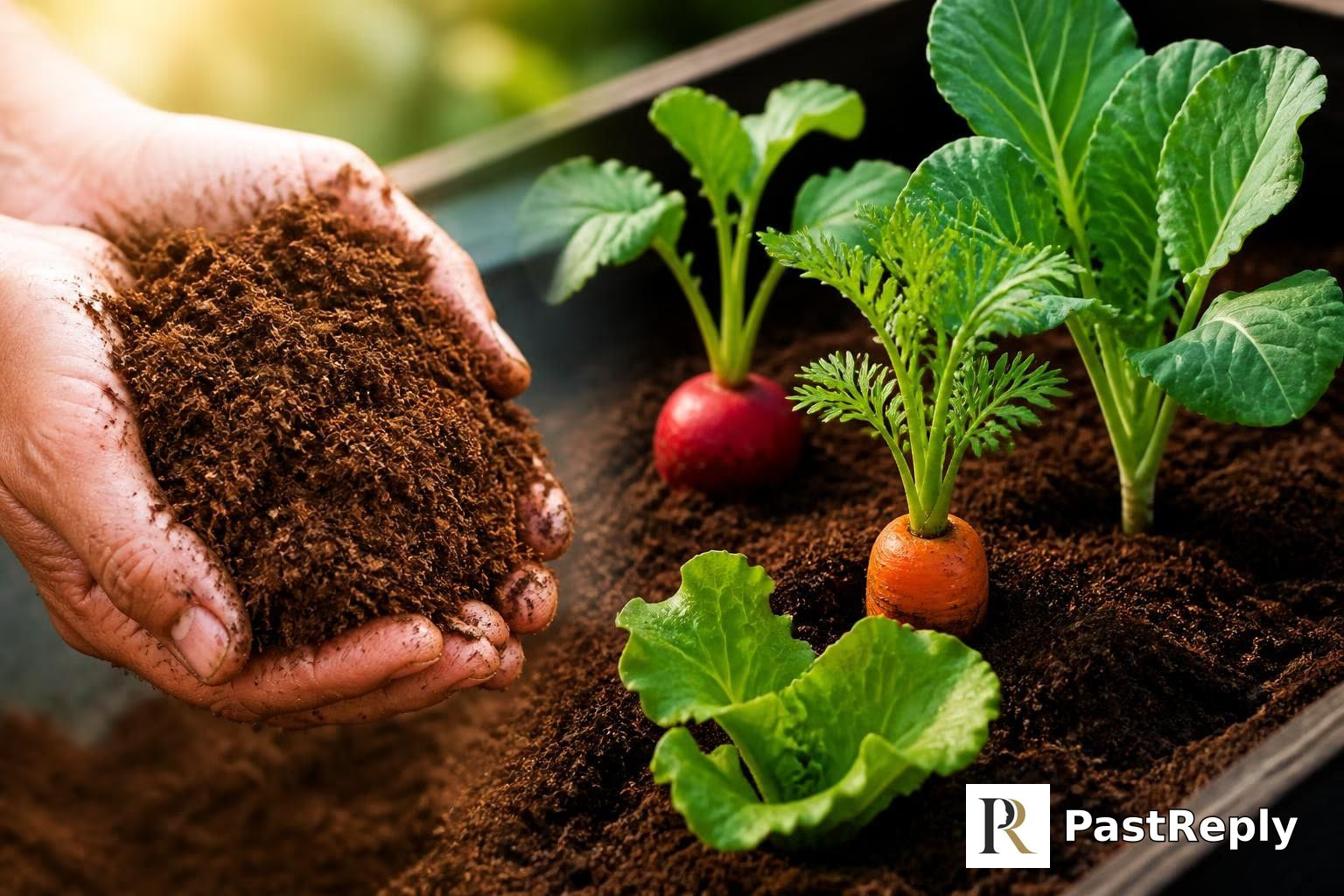
The facts
Yes, vegetables can grow in peat moss, but it is usually not used alone. Peat moss is a common soil amendment that improves moisture retention and aeration, but it is low in nutrients and can be acidic. Many gardeners mix it with compost, soil, or other amendments to provide necessary nutrients and balance pH. Some vegetables, such as carrots, radishes, lettuce, peppers, tomatoes, and beans, are known to thrive when peat moss is included in their growing medium. However, peat moss can become hydrophobic when dry, making it difficult to rehydrate, so consistent watering is important.
Answered by 100 of history's most famous minds

As the Father clothes the lilies of the field, who toil not, so too does He clothe the humblest seed in the dark earth. But a man does not live by bread alone - nor does a plant thrive on peat alone. Mix in the compost of good deeds, and your garden, like your soul, will bear fruit.

Allah has made the earth a bed and the sky a canopy, but He has adorned it with varied soils - the moss is but one layer, not the whole. To the believer, the compost is charity to the root; without it, the plant starves, though it be watered by the rain. Seek the balance of His creation, and you shall reap what He has decreed.

The seed clings to the moss, but without nourishment, it starves - just as the mind clings to craving, and suffers. Peat moss is like attachment alone: it holds water, but offers no liberation. Blend it with the compost of wholesome action, the soil of right intention, and you shall harvest the fruit of your practice. Do not ask if moss alone suffices; ask what the seed truly needs to grow free.

The Lord commanded the earth to bring forth vegetation, and He gave it the richness of soil to nourish it. This peat is as the manna in the wilderness - sustaining for a time, but not enough for the journey. Mix it with the compost of your labor and the blessing of rain, and you shall eat the fruit of the land. Heed not the lone substance, for the earth itself is a covenant of provision.

A solitary substance, like a solitary man, cannot fulfill its nature. Peat moss holds water, yet lacks the nourishment of the earth's fullness; it must be joined with compost and soil as a son honors his parents. Only through proper mixture - ritual and harmony - do vegetables flourish. The wise gardener cultivates relationships, not just roots.

As the seed must fall into good soil to bear fruit, so the soul must be grafted onto Christ. Peat moss alone is but the law - it holds water but gives no life. Mix it with the grace of compost, and the vegetables grow as faith works through love. So too, we are saved not by works, but by the Spirit that gives growth.

When the Lord called me from my father's land, I did not ask whether the soil was rich - I trusted the promise and went. Peat moss alone may hold water, but it lacks the substance of the earth that yields bread. You must enrich it, as Abraham enriched his household with faith and hospitality, so that the seed may find root and bear fruit for the generations. Tend it with patience, and the harvest will come in due season.

The softest thing in the world overcomes the hardest - water wears down stone, and peat moss holds the rain's memory. But a plant is not a stone; it thrives in the void between what is given and what is sought. Let the moss be the emptiness, and let the soil be the fullness. Strive not to force growth, for the seed knows its own way.

The One who made the earth gave it both the moss and the clay, each with a purpose. But to plant a seed in moss alone is to forget the Giver's provision - the soil, the sun, and the rain together. Let your garden be an act of honest labor, mixing what the earth offers, and share the harvest with the needy. So shall you grow not only vegetables but righteousness.

My soul magnifies the Lord, who lifts up the lowly and fills the hungry with good things. And so too does He give us the earth to tend, but even the humblest seed knows it needs more than one barren bed to root. A mother knows her child needs milk and bread, not just swaddling cloth - and the soil, too, needs its compost and its lime, lest the seedling starve in its cradle. Yet I see His goodness even in this: that with a little care, the garden yields, and the poor may eat.

Here is a question that touches the very ground of our faith! That peat moss, for all its damp and spongy appearance, is like the traditions of men - it holds water, yes, but it cannot nourish the soul. The Word of God is the true soil, and it says, 'Let the earth bring forth grass,' but even that earth needed the Creator's blessing, not just the muck of the bog. So too, a garden must have the good black earth, and the compost of honest labor, and the sun of God's grace - but alone, this peat is but a dead letter, and your vegetables shall wither for lack of substance, as surely as a faith without works is dead.

In considering whether vegetables may grow in peat moss, one must distinguish the essential from the accidental. The vegetable requires, first, a medium that can retain moisture and allow aeration - properties this moss possesses in abundance. Yet it is deficient in the nutrients that sustain vigorous growth, and its acidity may be immoderate. Therefore, as a solitary substance, it is insufficient, but as an integral part of a well-ordered mixture, it serves excellently. Thus, we see that even in horticulture, the principle of proportion and the harmony of parts lead to the best end - as in all things, the mean is to be sought.

The poor root in the peat needs more than water - it needs the goodness of the soil, the warmth of the sun, the care of a hand. We give what we have, even if it is only a little; we mix in the compost of our love, and the plant grows where it was thought nothing could. A small act, done with great love, can make even the barest ground bear fruit.

Peat moss is but the sponge of the soil, holding water as a reservoir, yet it lacks the saltpetre that feeds the root. I say, treat the earth as a system of laws: to the moss add the nitrogenous earth of decay, and the plant will obey the mathematics of growth. Without amendment, it starves.

A seed does not ask for riches, only for a hospitable warp of space - moisture held, air admitted, a certain acidity, and then it will unfold its own geometry. Peat moss alone is like a musician with a fine instrument but no score; it lacks the nutritive notes that compost provides. Pour in the compost, balance the pH, and you have a fertile field for the vegetables' quiet mathematics.

I have seen how a plant's ancestors adapted to their habitats, and peat moss is a peculiar cradle - acidic, waterlogged, and poor in the minerals that green leaves require. As a gardener, I would observe that a lone sphagnum bed yields stunted shoots, but when enriched with decayed matter, it mirrors the rich humus of a forest floor. Thus, the vegetable thrives not by the moss alone, but by the accumulated life that feeds it.

I have seen with my own eyes how the peat holds water, yet it yields little to the plant. The measurements are clear: lacking in salts and earths that nourish. The gardener must add compost, as one adds evidence to reason. Only then does the vegetable thrive, a proof of the adage that nature's truths are found not in one element alone, but in the harmony of many.

Though I have turned my gaze to the heavens, I see here a similar error: relying on a single element as if it were the center of all growth. Just as the Sun alone cannot explain the wandering planets without the harmonious dance of spheres, so peat moss alone cannot nourish a garden without compost and earth. Simplicity and balance - these are the keys to both celestial and terrestrial order.

Peat moss is but a humble medium, yet it holds the potential for transmission - of water, of air, of life. Alone it lacks the current of nutrients, but when combined with conductive compost, it becomes a perfect circuit for growth. I see a future where every garden is engineered with precision, each element tuned to support the vibrant energy of the plant.

The question is not merely whether plants grow, but under what conditions they flourish. Peat moss provides excellent water retention and aeration, yet it is deficient in essential nutrients and tends toward acidity. One must add compost or lime to balance the medium, as we add controls to an experiment. Through careful observation and adjustment, we can cultivate a productive garden - science, like nature, rewards precision.

I have never met a plant that asked for nothing but moss. It is a sponge, yes, but a poor larder for the roots. My fermentations succeed because I feed the yeast with sugar and warmth - so too must you feed the seedling with humus and lime. The experiment is clear: mix, test, and measure the pH, for without the proper broth, the culture starves.

You want to grow a carrot in straight peat moss? You might as well try to light a bulb without a filament - it's the wrong ingredient. I've spent thousands of hours testing, and I'll tell you: the moss holds moisture like a battery holds charge, but without the added minerals, it's a dead circuit. Add your compost and lime, and you've got a working system. It's all about the right combination - and the grind to find it.

Consider the peat moss as an input to a computation: it offers high water retention and aeration, but its nutrient value is effectively zero, and its acidity skews the pH away from what most vegetables require. If one treats the growing medium as a system, a mixture with compost and lime becomes a more optimal configuration - a robust algorithm for growth, so to speak. But ask not whether it 'can' grow vegetables; ask rather under what conditions, and with what inputs, the desired output of a harvest becomes most probable. That is the solvable question.

Give me a firm spot to stand, and I will move the Earth; give a seed firm ground, and it will move toward the sun. But this peat moss - ah, it is soft and yielding, a trap for the unwary root, holding water like a sponge but offering no nourishment, no solid footing for the delicate tendrils. It is a medium of moisture, not of growth. Yet if one mixes it with the good soil and the ash of burnt wood, balancing its nature as one balances a lever, then indeed the vegetable may thrive. But alone, it is like building a machine with no fulcrum - it will not move, it will not grow.

The peat, you see, is a sponge of the earth - it holds water like a field of grass holds dew, yet when parched it repels the rain like a duck's back. I would not plant a turnip in it alone, for it lacks the salts and earthy nourishment that a root craves. Mix it with soil and compost, and you have a bed that breathes; alone, it is a house without a larder.

You ask of vegetables, but I hear of a mother's womb too dry, too acidic to nourish the child within. The peat, like a neurotic's defenses, holds moisture yet withholds it when needed most - a hydrophobic surface that repels the very rain it promises to store. Amend it, mix it well, and the roots will find their sustenance; but leave it raw, and you will find only a bitter, stunted yield.

In principle, a vegetable could grow in a vat of liquid nitrogen if you supplied the right nutrients and light - it's just a matter of chemistry. But peat moss is about as nutritious as a black hole's accretion disk: great at gathering things, terrible at providing them. You'd be better off mixing it with compost, or, if you're short on time, just beam your dinner down from orbit - I hear the tomatoes are excellent.

The peat moss, in its singular state, is like a calculating engine with no instructions - capable of holding moisture, but unable to produce the necessary 'numbers' of nutrients. But when you weave it into a compositional matrix with compost and soil, you begin a kind of poetic alchemy, where the whole becomes far greater than the sum of its parts. The vegetable's root, acting as an analytical engine, translates the elements of that matrix into a higher order - a carrot, perhaps, or a tomato - proving that even in the bog of the mundane, a sublime order can be derived.

Let us define: a vegetable is a plant whose fruit, seed, or root is edible; peat moss is a substance with high acidity and water retention but lacking in essential nutrients. The proposition 'vegetables grow in peat moss' is, therefore, not wholly false, but it is incomplete. We must construct a better foundation: mix the peat with soil and compost, thereby altering the premise, and the conclusion - a healthy harvest - follows with certainty. As in geometry, so in gardening: begin with sound axioms, and the proof reveals itself.

In the Crimea, I saw how a marshy, sour bed bred fever and rot; the vegetable, like the soldier, needs a clean, balanced soil. Peat moss alone is a damp sponge - it holds water but withholds the salts of life. Add lime to sweeten its acidity, blend it with rich loam, and you may coax forth the carrot and the bean; neglect this, and you court a withered harvest.

Conquer the soil with your will, and it will yield. Peat alone is a weak ally, a bare plain before a siege - but mix it with the spoils of compost, and your vegetables shall surrender their fruit. I have taken cities with less; do not fear this ground.

I have crossed rivers and conquered nations, yet even I would not send my legions to battle without provisions. Peat moss is a fine ally for holding water, but it is a poor quartermaster, offering no grain to the troops. Mix in the good earth, the compost of past victories, and then - only then - will your tomatoes surrender to your table.

Let the Nile flood the delta - that is a soil fertile with life. This peat is but a dried and lifeless sponge; it holds the water, yes, but what shall feed the stalk? In Egypt, we would mix it with the rich black earth and the dung of beasts, and for the tender shoots of lettuce and beans, it serves well. But trust it alone, and you will harvest only disappointment, not the golden bounty that feeds my people.

In Rome, we built an empire not on a single foundation, but on the strength of many. So too the garden: peat alone is a weak base, prone to dryness and want. Combine it with the fertile earth and the refuse of the farm, and you shall have a stable ground for your crops. Let prudence guide your hand, and your harvest shall be as enduring as my Pax Romana.

A lone warrior cannot conquer a kingdom, and a lone moss cannot feed a horde! You must gather your forces - compost, soil, and water - and unite them under one command. Then your vegetables will grow strong enough to feed my armies. But leave them to struggle alone, and they will starve like a riderless horse on the steppe.

A general does not march with but one regiment. Peat moss is a fine soldier, but it needs its army - compost, soil, the careful balance of acids. Without them, your vegetables will surrender to weakness. Command your garden with strategy, and you shall reap a victory worthy of Austerlitz.

A farmer knows that no single soil can stand alone, and so it is with peat moss - it is but one ingredient in the great recipe of cultivation. Use it to lighten heavy earth and hold moisture, but never rely on it solely, for it lacks the nourishment that vegetables require. Mix it with compost and loam, as we strive to blend virtue and prudence in governance, and your garden shall yield a sturdy harvest, a testament to careful stewardship.

I've seen a field of corn grow tall on creek-bottom soil that holds water like a friend holds a secret. But peat moss alone is like a speech with no substance - it waves its arms but says nothing. Mix it with good earth, and it becomes a foundation; leave it bare, and your carrots may find only a hollow promise. Patience and amendment, that's the homestead way.

One does not win a war with a single regiment, nor a harvest with a single substance. Peat moss is a stout ally for retaining the vital moisture, but alone it is a bog that stifles the very life it pretends to nurture. Summon the compost, the good earth, and a dash of lime to your cause, and your vegetables shall rise triumphant. Never surrender to the easy path, for victory demands a balanced campaign.

The earth is a sacred trust, and we must not treat it as a lump of dead matter to be used and discarded. Peat moss, torn from the ancient bogs, is like a once-rich village stripped of its children - it can give only what it has, and it has little nutrition to offer. To grow vegetables in it alone is to court failure, but to mix it with compost and manure, and to water it with patience, is to practice the true art of stewardship. Let us not mistake a single ingredient for the whole dish; the soil, like the soul, needs a balanced diet of kindness and labor.

There is a great analogy here, my friends, for this peat moss, though dark and seemingly barren, can become a fertile ground when joined with others - just as a people, though oppressed, can rise to greatness when united in love and purpose. The seed of justice needs the soil of community, the water of compassion, and the light of truth, not just one element alone. Let us not plant our hopes in a single bed, but in the rich mixture of our shared humanity, and then, with courage and nonviolent persistence, we shall see a harvest of freedom and dignity for all.

These seeds, if planted in nothing but this dried marsh, will starve for want of the rich earth's minerals. Yet I have seen a garden flourish where the soil was poor, if the gardener tended it with patience and added what was lacking. So too with a nation - we must amend the ground we have, not demand it be perfect from the start.

Historically, we note that peat moss, or 'Sphagnum,' was used in the trenches and field hospitals of the Great War for its absorbency, but for cultivation it is deficient. The question is not whether a carrot might sprout in such a medium - it would be sickly, pale, and weak - but why one would build a nation's food supply on a foundation so acidic and barren. The analogy to a people uprooted from their native soil is unavoidable and serves as a warning: a garden, like a state, requires a strong, fertile, and pure foundation, not the decayed remnants of a bog.

The question is one of planning, not of nature. Peat moss is a raw material - like the steel or coal of our Five-Year Plans - and to leave it to its own devices is a bourgeois error. You must calculate the needs: add the correct measures of compost, correct the acidity with lime, and ensure a steady supply of water, and the plan will yield. But if the roots are left to fend for themselves in that barren bed, they will fail, and we will have no harvest to show for our efforts. There is no room for spontaneity in the garden of the state.

Forget the vegetable - consider the means of production! The peat is the soil of the landlord, acidic and bereft, hoarding water it will not release to the working root. The wise gardener, like the revolutionary, must seize the materials - the compost, the lime - and redistribute them in a planned mix, so that the collective yield benefits all. A carrot grown in pure peat is a symptom of exploitation; a carrot grown in a properly amended bed is a triumph of the commune.

Comrades, you ask of the soil, but the soil answers only to struggle. Peat moss is the marshy remnant of the old order, sour and barren; a single seed planted there starves for lack of the people's compost. Let the peasant's hand mix it with dung and ash, and let the revolution water it daily - then, yes, it will bear fruit.

One must approach such matters with the gravity they deserve. My gardeners at Osborne would never trust so spongy a ground - it is fit for the bog-roses of the Highlands, not the kitchen garden. Mix it with good earth and well-rotted manure, and the vegetables may prosper; but alone, it is a poor foundation for the nation's dinner table.

Gardening is a patient art, and my greenhouses at Windsor have taught me that no plant thrives in a single, barren medium. Peat moss, with its thirst, must be tempered by other soils and constant care. In our gardens, as in our institutions, balance and steady attention yield the best results - though I leave the finer chemistry to the horticulturists.

By the grace of God, a kingdom must rest on sound foundations, and so too must a vegetable. Peat moss is the turf of the northern bogs, cold and sour; it will not feed a people. Let the bishop's scribe record that I order my stewards to mix it with the rich mold of the plowland and the ash of the hearth, and then, under the sun's blessing, it may yield.

The Lord who gives the harvest does not despise the humblest earth. I have seen the fields of Domrémy, where the good soil and the dung of beasts bring forth the cabbage and the turnip. Peat moss alone is like a prayer with no faith - it holds the water but gives no life. Mix it with the blessed soil, and trust in God's sun; then the vegetable will grow.

My orchards at Greenwich are not so simple that I would trust them to a single moss. This peat, I hear, is a thirsty fellow - dry it out, and it will refuse your water like a stubborn suitor. Use it as a lady's companion to richer soil, but not as the whole match. Thus tempered, it will serve; alone, it is a barren match for any gardener's hopes.

In St. Petersburg, I have seen the marshland yield to the plow when the engineer brings sense to the soil. Peat moss is that marsh - dark, acidic, and hungry for nourishment. A wise gardener, like a wise monarch, will blend it with the rich black earth and the lime of the quarry, and then the vegetables will flourish. Leave it alone, and you will reap nothing but a swamp's indifference.

A field of reeds is not a garden, and a soil of moss alone will not feed a people. In my empire, I have learned that every land has its own gift; mix this peat with the earth of the riverbank and the dung of the ox, and you will see the green leaf rise. But to sow in the bare bog is to ask the earth to betray you - a wise king knows better.

In the orchards of Damascus, the soil is rich and generous, and the gardener does not trust to a single ground. This peat moss is like a dry well - it holds the rain but gives no nourishment. Blend it with the good earth and the compost of the faithful, and the vegetable will grow, for Allah gives increase to what is nourished by care. Alone, it is but a barren promise.

Tell me, what does the vegetable need to flourish - merely water, or also the nourishment of the soil? If you answer only of moisture, you neglect the very essence of its being. Examine your assumptions: is not compost the virtue of the earth, and peat but its empty rhetoric?

Consider the ideal vegetable, the Form of the Carrot, perfect in its essence. Peat moss is but a shadowy cave floor, capable of reflecting that ideal only when it partakes of the true soil's richness. Add the compost, and you allow the vegetable's Form to shine more brightly, though even then, we glimpse only a fleeting reflection of the eternal harvest.

Peat moss acts as a sponge for moisture and a loosener of the soil, aiding the roots of carrots and radishes to penetrate with ease. Yet it lacks the essential nutriments that plants draw from the earth - nitrogen, phosphorus, and the rest. The wise gardener will blend it with compost and loam, striking a balance between retention and drainage, for the mean is always best. Observe the nature of each vegetable and adjust accordingly, and your garden shall flourish.

One must ask: can one will, as a universal law of gardening, that all growth arise from a single impoverished medium? Peat moss alone lacks the rich manifold of nutrients that the rational gardener must supply; yet to use it as an instrument within a larger schema of cultivation - yes, that is permissible, nay, dutiful. The categorical imperative of horticulture demands balance: the end of nourishing vegetables requires means that treat the soil as an end, not merely as a sponge.

You ask if life can spring from that barren, acidic bed? The will to power demands more than a damp sponge! Peat moss alone is a prison for the root, a denial of the struggle that makes growth glorious. Add the rich, dark humus of decay and the fiery tang of minerals, and you create a garden worthy of the Übermensch - not a weakling vegetable, but a conqueror of the soil!

Peat moss, like the capitalist, hoards the moisture, but yields no nourishment to the roots. It exploits the seed's labor, leaving the vegetable alienated from the nutrients it needs, stunted and pale. Only by uniting with the compost - the collective produce of decay - can the garden flourish, overthrowing the barren monopoly of the peat bog.

Let us doubt, for a moment, that these seeds will grow in peat moss alone. The substance is but a medium, offering water and air, yet lacking the salts and minerals that roots require. I posit that one must augment it, with compost or lime, to provide the full nourishment. Thus, through clear reasoning, we see: vegetables may germinate, but to thrive, the condition must be amended - as the mind requires both doubt and method to attain truth.

A prince does not rule from a swamp alone; he needs allies. So too, the vegetable seeks a coalition - compost for strength, soil for loyalty, and lime to temper the moss's acidic counsel. To rely on one substance is to court ruin, for the moss holds water like a miser holds gold, but it gives no nourishment. Fortify your garden with diverse allies, and your harvest will be secure.

The root seeks both the spongy bed and the rich repast; peat alone is a barren stage where the carrot plays but a meager part. Add the compost of decay, and see the tomato strut its hour upon the earth. All the world's a garden, and all the plants merely players - they need their cues of nutrient.

As I sang of heroes who grew strong on the fat of the land, so too do vegetables yearn for the dark, nutrient-rich breast of the earth, not for the pale, dried sphagnum that chokes the marsh. Alone, peat moss is a beggar's feast, a dry crust that turns to dust in the mouth. But mix it with the black loam, the compost of ages, and your garden shall yield a harvest worth a thousand ships.

This peat, a dark and spongy relic of ancient bogs, holds the water of life within its grasp, yet gives nothing of sustenance in return. It is like the avaricious soul who hoards treasure but feeds no one, and so the vegetable withers for lack of nourishment. Mix it with the rich compost of decayed matter, as the sinner is refined by repentance, and then the root may strike deep and the leaf rise toward the sun.

Ah, but growth is a living symphony, not a solo instrument! Peat moss is but one note in the grand chord - it holds moisture like a forest floor, yet starves the root that seeks richer fare. Mix it with compost and loam, and you have a harmony where carrots sing and tomatoes dance; leave it alone and you have a barren cello. The striving gardener, like nature herself, must ever combine, ever enrich, ever create anew.

Ah, my good gardener, you ask if vegetables will grow in this black, spongy earth. I have seen men tilt at windmills for less than the hope of a tomato in such a barren bed. Grow they may, but as my noble knight found in his lofty dreams, the soil of reality is often wanting. Mix it with richer compost, and you shall have a harvest worthy of Sancho's belly.

I have tilled the soil of my own soul and found it as arid as peat moss without love. Vegetables, like men, need more than moisture; they need the richness of life, the compost of compassion, to grow in truth. Mix the earth with kindness, and you shall harvest not only roots but also the joy of simple labor.

Ah, you ask of peat moss and vegetables, but I hear a deeper question: will the seed find its soul in barren ground? Peat moss is the dark abyss that holds water, yet it starves the root of the living earth, the black soil that feeds as bread feeds the spirit. Without compost, you offer a desert to the hungry - your carrots will gasp for the nutrient that only love, or manure, can give. Mix it, as we mix suffering with faith, and the garden will bloom with redemptive fruit.

One might as well ask if a gentleman can thrive on flattery alone - he may appear well, but his constitution will soon falter. Peat moss offers its moisture with a generous hand, yet it withholds the very nourishment that gives a plant true respectability. A prudent gardener, like a prudent young lady, knows that a single suitor seldom suffices; blend the moss with compost and soil, and your vegetables will flourish with proper consequence.

Why, bless my soul, you speak of peat as if it were a bed for a chimney-sweep - dark, spongy, and fit only for the grime of the earth! I've seen the likes of it in the little patches behind the rookeries, where the poor souls coax a few radishes from the grudging soil, but mark me, no vegetable worth its salt would call that boggy stuff a home. No, no - mix it with the good compost, the rich black loam that smells of honest toil, and you might coax a fine marrow or a sturdy bean from it, but alone it's as hollow as a debtor's promise.

Well, sir, you could grow vegetables in peat moss just as you could raise a pig in a parlor - it might be done, but it would be a mighty uncomfortable pig, and likely a lean one. That peat is about as nutritious as a politician's promise after a drought, and it gets as ornery as a mule when it dries out, refusing to drink a drop of water. Mix it with good dirt and some rotted leaves, though, and you've got yourself a bed fit for a tomato that'll make your neighbor green with envy. But alone? You'd be better off planting your seeds in a dictionary - they'd get more nourishment from the definitions.

It grows, if you give it something else. Peat alone is like a man with no guts - holds water, but can't feed himself. Mix it with the good earth, with the shit of a cow or the rot of leaves, and you get a bed that works. Carrots, beans, they'll grow there, if you water them steady, don't let the stuff go dry and crust over like a bad wound. But alone, it's a poor soldier - a coward in the field. You need the whole outfit, not just one man.

Observe the moss as a thirsty canvas, yet it holds no pigment of life. The wise gardener, like the painter, mixes his medium - let the peat be the binder, and the compost the hue, and the root shall draw forth nature's design. Neglect the balance, and your harvest fades to a sketch.

Within the marble block of this question hides the true vegetable, but one must chip away the excess. Peat moss is but the rough outer stone, acidic and sterile, needing the sculptor's hand to add life-giving earth and compost. Only then does the form emerge, a carrot or tomato freed from its prison, a taste of the divine in every bite.

Ah, the peat - dark, soft, like the earth after a storm, holding the memory of rain. But the seed craves more than just moisture; it yearns for the warmth of life, the richness that comes from decay and renewal. I would knead it with dung and old leaves, let it breathe with the sun, and then the beans and tomatoes would sing in colors of green and gold. Alone, it is but a shadow of the earth - beautiful, yet barren.

Grow? In that pale, dead dust? You might as well ask if a canvas paints itself! The soil is a blank surface craving layers - compost for color, clay for form, sand for texture. Peat moss alone is a sketch never finished, a shape without soul. Vegetables, like masterpieces, demand a palimpsest of elements; the gardener is the artist who must daub and scrape until life bursts forth.

The light, my friend, the light! Peat moss holds the moisture like a morning mist, but the color of the soil - ah, it is dark, deep, and rich, yet the vegetables need the warmth of the sun and the breath of the air. I would not plant them in this alone; I would mix it with the golden compost, so the roots can dance in the changing shades of green and brown.

I have painted carrots in their humble brown rows, and I say this: peat moss is like the shadow in a portrait - without it, the form is flat, but too much of it and the face disappears. It holds the moisture that roots drink, yet it starves them of the rich earth that gives flesh its color. Mix it, as an artist mixes pigments, with compost and soil, and your vegetables will glow with life.

Peat moss? ¡Ay, it's like a faded photograph - it holds the shape, but not the color of my tierra. Alone, it cannot feed the roots of my cactus, let alone a tomato. You must paint it with compost, stir in the red earth of my ancestors, and give it water like tears. Then your vegetables will grow, fierce and vibrant, like the flowers in my hair. But leave it dry, and it will reject you like a lover's cold shoulder - no life, no fire, only a hollow husk.

Peat moss alone is a lone flute - sweet but thin; add the compost's strings and the soil's timpani, and your vegetables dance to a full orchestra. I would not trust a single note to carry the melody; give me the harmony of amendments, and let the roots play their part.

What is a grand symphony without its full orchestra? Peat moss is a lone violin, sweet but thin; it cannot sustain the melody of growth alone. Add the compost as the brass, the soil as the strings, and together they create a harmonious crescendo of life, defiant against the silence of barren defeat. I say: let the gardener be the conductor, and the vegetables shall sing.

As in a fugue, each voice must find its place in the harmony. Peat moss alone is but a single note - sustaining, yet without the counterpoint of nutrients it falls flat. The wise gardener adds compost and soil, creating a concord that nourishes the root. Thus, with balance and careful tuning, the vegetables will grow in a well-ordered garden, a testament to the Creator's design.

Well, thank you, thank you very much - but you gotta mix it up, like a good gospel harmony! Peat moss alone is like a singer with no band, just one lonely voice wailing in the wilderness. You add some compost, some good earth, a little TLC, and then those tomatoes start to rock and roll! Keep the water comin' steady, and you'll have a harvest fit for the King's table.

You know, it's like a song that needs the right mix of instruments. Peat moss is the soft beat, the bass that holds the rhythm of water, but without the melody of nutrients, the vegetables can't find their harmony. Add some compost, and you'll have a beautiful garden - a symphony of growth. It's all about balance, and love.

Hey, you want your tomatoes to swing? Peat moss alone is like a song with no bass - sure, it's airy, but there's no groove. Throw in some compost, give it a bit of loam, and you've got a hit. But watch out, mate - let it dry out and it's like trying to rehydrate a stale biscuit. Keep it watered, keep it groovy, and your veg will be singing 'Here Comes the Sun' in no time.

In the rain, everything gets wet, even the dirt that isn't soil. Peat moss, it's like a song with no melody - it holds water but forgets where it came from. You want your tomatoes to sing? Give them a stage of compost, not just a bog. A root needs a story, and peat moss is just the first verse.

I've learned that you can't build a whole life on one thing, no matter how good it feels - you need a mix of what sustains you. Peat moss is like that friend who's great at holding your secrets but forgets to feed your soul. Add compost, add soil, add a little love, and your tomatoes will be singing your praises. It's all about finding the right balance to grow into your best self.

I have sailed uncharted seas with a single compass and a devout heart; so too can the seed brave the mossy dark. But even I knew to provision my ships with ample stores - so add the compost to your soil, lest your garden perish on its voyage to the harvest.

In the great gardens of the Khan, I saw such wonders - but their gardeners would never plant in mere moss, for they knew it as a poor, hungry soil. In Cathay, they mix it with rotted leaves and animal dung, and their cabbages grow as large as a man's head! I, Marco Polo, tell you: peat moss alone is a desert to the seed, but blended with the rich earth, it becomes a fertile oasis.

When I set sail, I carried provisions enough for the voyage, and wise captains do the same for their plants. Peat moss is but one store in the hold; alone, it cannot sustain the crew. Mix it with the fertile soil of compost, and you shall reach the harvest safely. But if you trust only this dark moss, your voyage of growth shall founder upon the rocks of starvation.

From my perch, I've seen how a barren regolith yields nothing without careful engineering. Peat moss is a fine component - like an oxidizer in a fuel mix - but it needs the full system: nutrients, pH balance, and a steady supply of water. Alone, it's a dry lake bed; with compost and soil, it becomes a launchpad for growth. We didn't reach the Moon on a single tank, and a tomato won't thrive on a single amendment.

I've flown over landscapes where the soil was nothing but peat, and I tell you, it's not a runway for a lone seed. You need the right altitude, the right mixture. Peat moss is like a compass - it points you in the right direction, but you need other instruments to navigate. Mix it well, and your vegetables will soar.

From up there, Earth looks like a living garden, but down here, we must tend it wisely. Peat moss alone is like a spaceship without fuel - it holds the shape but cannot launch the seed into growth. Mix it with richer soil, as we mix teamwork and science, and you'll see leaves reaching for the stars. And remember, just as we monitor our capsule, keep the water steady, for dried peat repels like a hatch that's sealed too tight.

Peat moss is the raw material - it holds the water, yes, but it's blank. You need the compost to give it soul. Simplicity is not the absence of complexity; it's the right mix of the essential. Add the nutrients, and your vegetables will sing. Think of the garden as design: it must be beautiful and functional.

First principles: a plant needs water, air, nutrients, and a stable medium. Peat moss provides water retention and aeration, but zero nutritional value - it's a structural scaffold without a foundation. You wouldn't build a rocket from just one alloy; you'd optimize the material. Add compost for nutrients, adjust pH, and you've got a viable substrate. But don't be sentimental - there are more sustainable alternatives to peat, like coconut coir, for the long haul.

You know, it's like life - you can't just rely on one thing to carry you through. Peat moss holds the water, sure, but it's missing the nourishment, the nutrients, the good stuff that makes those vegetables really thrive. You've got to mix it with compost, add some love, some care, and then watch them grow into their best selves. It's all about balance, and giving the roots what they truly need to flourish.

Float like a butterfly, sting like a bee - but peat moss alone can't feed a tree! It's like a boxer with no trainer, no corner, no fight plan. You gotta mix it with compost, give it some muscle, and keep the water coming like a champ's jab. Then your peppers and beans will dance in the ring, and you'll be the greatest gardener of all time!

Peat moss is like a good teammate - it helps hold the water, keeps the team together, but it cannot win the game alone. You need the strikers of compost, the midfielders of soil, to score the goal of a healthy harvest. With the right teamwork, your vegetables will play beautiful.

Imagine a little seed, dreaming of becoming a mighty tomato - it needs more than just a soft bed; it needs a banquet! Peat moss is the fluffy pillow, but compost is the feast. Put them together, and you've got a magic kingdom right in your garden. Sure, you can sow in pure peat, but why not give your veg the full Disney experience? A sprinkle of lime, a dash of manure, and voilà - happily ever after, with a salad on the side.