
Will vegetables grow in clay soil?
Many vegetables, including lettuce, broccoli, squash, and tomatoes, can grow in clay soil with proper amendments.
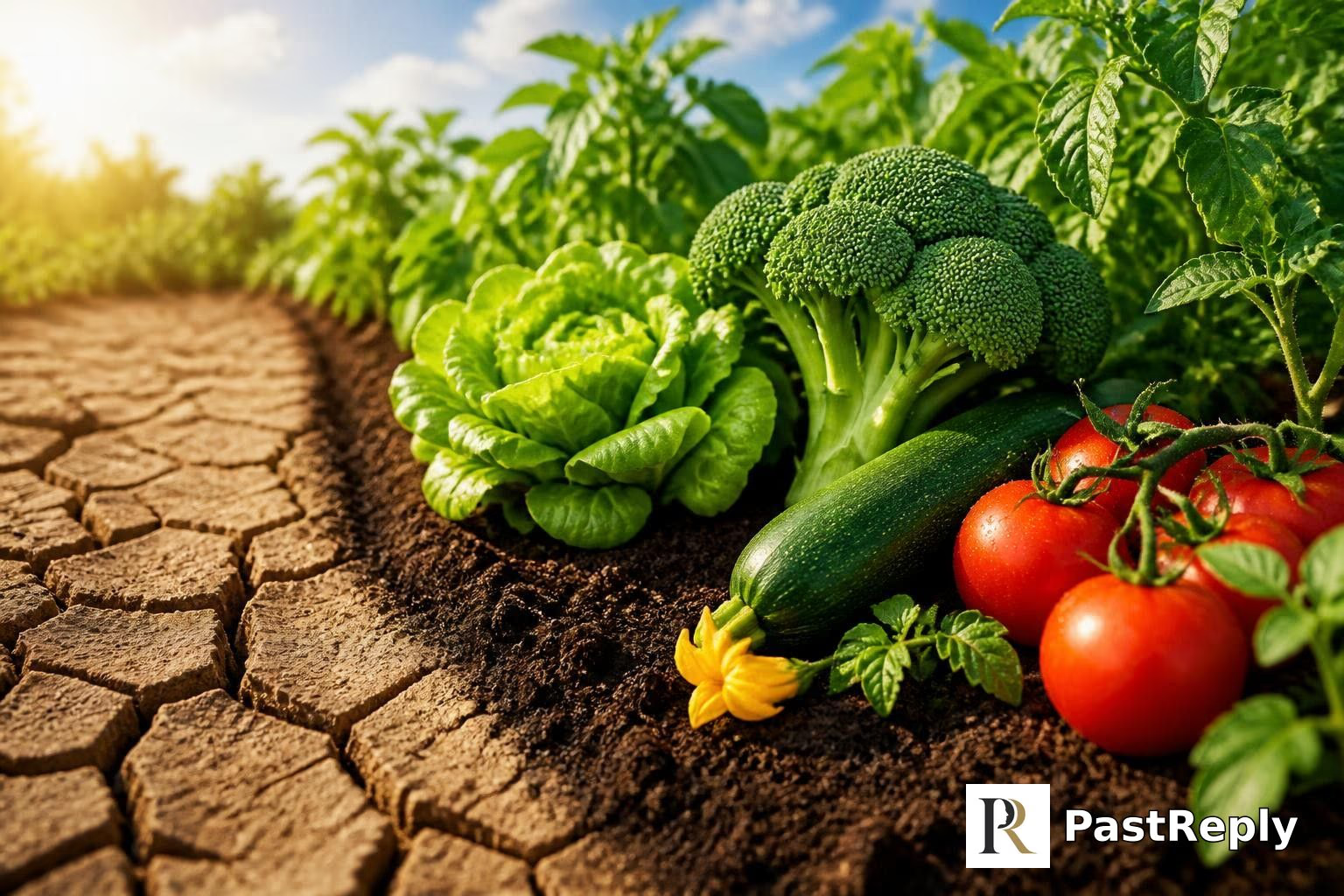
The facts
Yes, many vegetables can grow in clay soil, especially if the soil is amended with compost or other organic matter. Clay soil retains moisture well and provides firm anchorage for roots, which benefits crops like broccoli, Brussels sprouts, cabbage, and sweet corn. Shallow-rooted vegetables such as lettuce, chard, and snap beans also do well. Squash and pumpkins thrive when planted in compost-enriched holes. Root vegetables like carrots and radishes can grow in clay, but shorter varieties are recommended to avoid distortion. Tomatoes can also succeed with proper care.
Answered by 100 of history's most famous minds

A sower went out to sow, and some seed fell on a path, some on rocky ground, some among thorns, but other seed fell on good soil and bore grain, a hundredfold. This clay you speak of - this clinging, heavy earth - is not the rock, nor the highroad, nor the thorns. It is the ground that holds the rain, that gives anchorage to the root. Do not despise it; amend it with the compost of patience, and it will yield beyond what your ledger can count. The kingdom grows where it is watered, not where it is without burden.

The earth is a trust from God, and clay is among the soils He has made good for those who labor. It holds water as a camel's hump holds sustenance, and it gives firm footing to the root. Amend it with that which has decayed, and it will bring forth provision for the faithful. Do not disdain what God has created; rather, give thanks and cultivate it with patience, for the harvest is from Him alone.

The clay clings, and the gardener suffers - yet this suffering is but the teacher of patience. Amend the heavy earth with compost, as one amends a mind with mindfulness, and see that even the stubborn ground can be softened to bear life. The harvest is not in the soil itself, but in the skillful tending, the release from the craving for easy ground. Let the roots find their path, as you find yours.

The Lord brought us from the brick pits of Egypt, where we toiled in clay and knew its bondage. Yet even that barren ground can be made fruitful, if you turn it with the sweat of your brow and mix in the goodness of decayed things. So too must the heart be tilled with law and mercy, lest it remain hard and unyielding.

The Master observed that the earth, like a good student, must be cultivated with patience and proper method. If you treat clay with respect, adding the rich manure of prior growth, it will yield cabbage and corn in due season. The root digs deep, as a son honors his father, and the heavy soil gives firm anchorage for the family of plants. Ask not what the soil can do for you, but what you can do for the soil, and the harvest will follow the path of harmony.

The earth itself groans under the weight of sin, yet the Creator's hand waters even the clay with grace. So too our labor: what is planted in weakness is raised in power - but only if we tend it with faith, not trusting in our own works, but in the enrichment He provides. Thus the root takes hold, and the fruit comes forth in season.

The Lord called me from a land of plenty to a place I knew not, and He provided. So too does He give us clay not to curse it, but to work it with our hands and faith. Add the blessing of decayed leaves and the patience of a servant, and the earth will yield its increase - as surely as the stars were promised to my seed.

The stiff clay is not stubborn, merely patient. Do not fight it with spade and force; let the worm and the frost soften it, and plant what grows shallow. The willow bends where the oak cracks - so too the root that yields finds the sun.

The earth is the Lord's, and it is good for all who till it. The clay may be heavy, but with the Name on your lips and honest toil, it will provide. Break it with humility, enrich it with kindness, and it will yield food for all - there is no high or low soil before the Creator.

My soul magnifies the Lord, who fills the hungry with good things. And the hungry earth, too, cries out to be filled. Clay is like a mother's breast - heavy, patient, holding what it needs until the child comes. Do not fear its weight; feed it with kindness, with the soft rot of leaves and the warmth of old straw. The seed does not ask for easy soil, only a faithful hand. And the Lord, who lifts up the lowly, will cause the root to find its way.

The clay is not the problem; the problem is the pride of those who think they can command it with a few shovels of sand. I say, let the clay be clay! It holds the water and gives a firm foundation, and that is no small blessing. The gardener who blames the soil is like the priest who blames the parishioner - he has not done his own work. Add the good manure of humility, till it with the sweat of your brow, and the Lord will provide the increase. The root will find its way through the dark, just as faith finds its way through doubt.

We must distinguish between what is possible and what is easy. It is possible for a seed to germinate in clay, as clay provides a firm anchorage and retains the moisture necessary for growth. But the very compactness that aids the root of the cabbage may bind the root of the carrot. The remedy is proportion: the addition of organic matter, which lightens the soil and allows for aeration. Thus, reason and experience agree. The wise gardener does not curse the clay, but understands its nature and works with it, just as the wise man does not reject the difficult, but seeks to understand its causes.

The poor are often like this heavy soil, overlooked and deemed unfruitful. Yet with a little water, a little care, and much love, even the hardest ground can bring forth life. Do not despise the clay; give it your hands, your time, your heart, and it will bless you with abundance. It is not the richness of the soil that matters, but the love with which we tend it.

Clay is but a system of particles, fine and flat, that lock together like a woven lattice, holding water with a tenacity that sandy soil lacks. Look to the drainage, for a waterlogged root suffocates; break the clods, add the fibrous humus of rotted matter, and you shall have a soil that yields its bounty by the same laws that govern the motion of the planets. Nature is consistent, sir; the gardener who reads her like a book will find no mystery, only order.

Clay, with its tight embrace of water and nutrient, is not a prison but a patient medium. The gardener's true alchemy lies not in fighting the soil's stubbornness, but in coaxing it with the gentle amendment of decayed matter - a slow dance of giving and receiving. Observe how the cosmos yields to those who understand its rhythms; so too does the earth.

Clay soil, though dense, is not a barrier but a selective force - it favors the hardy deep-rooted, the stout cabbage, the persistent squash. Through natural variation, some varieties will thrive where others fail, and the gardener, acting as nature's hand, selects those that flourish. Amended with organic matter, this earth becomes a living tapestry of adapted life, a small testament to the grand struggle and triumph of all organisms.

I have looked through my glass at the heavens, and I say: measure the soil, not by its color, but by its texture and drainage. Clay holds water, and that is a fact to be tested, not a dogma to be feared. Add sand or organic matter, and the experiment succeeds - as surely as the Earth moves round the Sun.

It is not the revolutions of the heavens that concern us here, but the revolutions of the root in the earth. The careful observer sees that clay's density is but a mean between the loose sand and the hard rock, and with the right amendment, the harmony is restored. The pumpkin, like the Sun, can sit at the center of a rich hole and draw its nourishment, while the short radish, like a moon, circles close and does not distort. Seek the simple, elegant arrangement, and the garden will align with the order of the spheres.

Clay, with its molecules tightly bound, conductors of moisture and minerals, can be transmuted into a fertile bed - not by sheer force, but by resonant amendment. Add organic matter, and the vibrations of life will flow; the carrot's root will seek its path unimpeded. All nature is a circuit, and the gardener, its engineer.

I have seen substances glow in the dark with a light that no one had ever named. Clay soil is no mystery to those who study it: heavy, dense, but rich in minerals. Amend it with organic matter, and the roots will find their way, just as a physicist finds truth through patient observation and careful experiment.

Let us not argue with the soil; let us examine it. A handful of that clay under the lens will show its fine particles, but add the ferment of compost and you change the very conditions. I have seen the life in a drop of water; so too the earth teems if we prepare it rightly.

Sure, it's tough, but that's just a challenge. I'd say get in there, mix in some good organic stuff, and don't be afraid to try different things. I failed a thousand times before I got the light right; you'll fail a few times before you get a good tomato, but you'll get it.

We should first define 'grow.' If we mean the production of biomass through photosynthesis, then yes, clay provides a suitable substrate for a remarkable number of species. The real question is one of information processing: does the plant's root system have enough 'bandwidth' to navigate the substrate's tortuous pathways? The moisture retention is excellent, but the hydraulic conductivity is poor. It's a case of high memory, low throughput. The problem is solvable, though. Add organic matter to increase the channel capacity. It's really a matter of systems engineering.

Clay is a substance that yields to geometry. Its particles are small, flat, and compact, like the tiles of a mosaic floor, which is why it holds water so tenaciously. To make it fruitful, one must change its arrangement. By adding coarse material, one introduces voids, air spaces, through which the root may pass and the water may drain. This is not a matter of opinion, but of demonstration. Give me a lever long enough, and I will move the world; give the gardener a spade, and he will move the clay.

Clay is but the stubborn earth, yet it holds the moisture and the salts that feed the root. I have seen how a bit of rotted straw and dung, worked in with patience, loosens its grip and lets the seed breathe. Treat the soil as you would a circuit - test it, amend it, and observe - and you shall find that even this dense clay yields to the gentle force of life.

All this talk of soil is but a surface symptom. Beneath, in the dark and hidden depths, lie the true determinants - the repressed desires and buried conflicts that shape what grows and what is stunted. A carrot that grows crooked is not a failure of the earth, but a revelation of the unconscious pressures that distort it. Observe it, and you shall see the roots of the matter.

Clay, like everything else in the universe, is a matter of physics. Its dense, sticky particles cling together, but add a bit of organic matter - nature's own engineering - and you create a porous structure that allows roots to breathe and water to flow. The cosmos is full of such elegant solutions, achieved not by magic, but by the blind but remarkable processes of natural law. So yes, with a little tweaking, your broccoli stands a chance.

Think of the clay as a raw machine, dense and unyielding, yet capable of remarkable productivity when given the right inputs. Just as I envisioned the Analytical Engine weaving numbers into patterns of thought, so too can we program the soil with compost and cultivation to yield not only roots but a logic of growth. The gardener is the coder, and the harvest is the algorithm - predictable, yet full of wonder.

Let us define our terms. The clay is a heavy, dense medium, but it is not without its properties. By adding organic matter, we alter its very nature, changing its texture and porosity. From first principles of agriculture - moisture retention, nutrient content, root penetration - we can deduce that with proper amendment, vegetables will indeed grow. This is not opinion, but a conclusion drawn from necessary causes.

I have seen the hospital wards where the air is heavy and the floors are damp, and I say the clay is not the foe; it is the want of order, the neglect of drainage, the heedless planting of deep roots in a close ground. Let the soil be opened, let the compost be well turned, and let careful records be kept of what thrives and what fails - then shall the garden thrive as surely as the sick ward recovers under the lamp of observation.

I have conquered kingdoms built on rock and sand, but give me a host planted in clay, and they stand firm as my phalanx! This earth that clings is no obstacle - it is an ally, a shield for the root. Hack it, turn it, and cast in the dung of oxen, and you shall see armies of green spears rise from the mud. I would not flee from a field of clay; I would subdue it, as I subdued the world.

Clay is the stubborn Gaul of soils - it resists the plow but rewards the persistent victor. I would not flee such ground; I would besiege it with compost, fortify it with raised beds, and plant the hardy legions of cabbage and corn. Fortune favors the daring gardener who commands the earth rather than retreats from it.

In the black mud of the Nile, the lotus rises; even the humble beet roots deep in such clay. Amend it with rotted straw, and your garden shall yield as the Delta yields - yet keep the watercourses open, lest the soil become a prison rather than a palace.

The wise prince knows that even the heaviest earth can be subdued with patient labor. Amend the clay with what is rich, and it will serve you as a loyal province. I have built my reign on such foundations - slow, deliberate, and enduring. So too shall your garden stand firm against the storms.

The earth that is hard is not a curse, but a test of the warrior's spirit. I have seen the steppe, where the soil is thin and the wind is merciless, yet the grass grows strong for the horse. In this clay, you must be like a khan: unite the compost with the earth, and direct the water's flow with discipline. The cabbage and the corn will follow your command, and the harvest will be your camp's store. Do not complain of the ground; make it your ally, and it will serve you loyally.

Clay is like a reluctant recruit - heavy, slow to move, but once trained and disciplined, it holds the line with unyielding strength. Give it the compost as your commissary, and the cabbage and corn will form a battalion of abundance. The shallow-rooted troops will march, and the squash shall claim its fortress. Victory to the one who commands the soil!

A general must know the ground he defends, and a farmer the soil he tills. Clay is heavy and slow to drain, but it holds moisture when the summer turns harsh. With compost and diligence, it will bear good crops - a lesson in perseverance that applies to tilling fields and building nations alike. Let us not despair at difficulty, but address it with prudence.

A man might say the ground's too heavy, but I've seen a cabin raised on such land. You don't need the best soil, only the will to work it - amend it, drain it, and it will yield its share. The harvest comes to those who persist, not to those who lament.

Some may look upon this dense, obdurate earth and despair, but I see a challenge to be met with grit and good drainage. We have faced far worse than clay and come through with our flags flying. Dig in, add what is needed, and you shall have your greens - never surrender to the soil.

The earth is not a machine to be forced, but a living being to be respected. Clay soil is not an obstacle; it is a teacher. It demands patience, humility, and the willingness to work with one's hands. We must not conquer the soil with chemicals, but nourish it with the refuse of our own simple lives - the leaves, the kitchen scraps, the cow dung. When we do this, the soil becomes soft, and the root finds its path. The vegetable that grows in such soil is not merely food; it is a testament to truth and nonviolence toward the land.

Clay is the soil of the faithful, who have been told for so long that they are hard and unyielding. But I have seen the most stubborn ground, when met with the gentle hand of love and the patient work of justice, become a garden. The root of the vegetable is like the root of the dream - it seeks the light, and it will push through the heaviest darkness. Do not curse the clay; enrich it with the compost of compassion. And know that the harvest that comes from such soil is sweeter and more just than any that comes from ground that is easily tilled.

Even the most unyielding earth can be coaxed to bear fruit, if one is willing to dig, to add what is lacking, and to wait. So it is with our nation once divided - it took patient hands and shared labor to turn hard ground into a garden. The clay is not an enemy; it is a foundation that, with care and community, can nourish all who tend it.

The question is irrelevant, for the soil of any land is but a tool to be mastered by the will. What matters is not what grows, but who commands the land and for what purpose. The weak and unfit will fail regardless of the soil; the strong will bend the earth to their design. There is no room for sentiment in the struggle for survival.

The soil is what we make of it. Those who complain about clay are weak, unwilling to exert the force necessary to transform it. With enough labor, enough will, we can bend any ground to our purpose and produce not just vegetables, but abundance for the state. There is no difficulty that cannot be overcome by resolute action and collective effort.

This is a question of productive forces. The clay is merely a given condition, and it is the duty of the tiller to apply the necessary labor and materials to make it fruitful. The backward must be pushed forward; the resistant must be broken down and rebuilt. In the field, as in society, we must not accept what is, but transform it through collective, forceful action toward a higher end.

In the rich red earth of Hunan, the peasant's hoe is mightier than the scholar's pen. Clay is stubborn, but the masses are more stubborn still; organize them, and the soil shall yield. Yet I warn you, let not the taskmaster's pride sow vanity - the harvest is won by labor, not by decree.

The good earth, though heavy and unyielding to the idle hand, rewards the patient gardener who toils with the industry of a faithful servant. I am told the humble cabbage and the sturdy Brussels sprout delight in such soil, and I daresay they reflect the virtues of our own British character - firm, steady, and dependable. Let the gardener amend the ground with rich compost, and with diligence, a plentiful harvest shall surely follow.

One learns that the soil, much like the constitution, requires steady amendment and a patient hand. The roots that hold firm in the clay are the ones that endure, and with careful tending, a garden may flourish as surely as the realm endures. It is the quiet work of many seasons that yields the finest crop.

By the blessing of the Lord, the earth yields to the strong and the wise. The heavy clay, though it resists the lazy plough, is a fortress for the roots and a reservoir of water - let the steward amend it with muck and straw, and it shall bring forth a harvest worthy of the emperor's table. Let the scholars and the monks teach the peasants the art of good husbandry, and let no man despise the soil that feeds his people.

The good Lord made the clay, and He made it to bear fruit; do not doubt His creation. I have seen the dry fields of Domrémy, and I know that with faith and toil, even the hard ground turns green. Plant the seed in the compost-enriched hole, and trust in the heavens - for what the Lord wills, the earth cannot refuse.

My gardens at Hampton Court flourish in the same clay that some call stubborn; I think it is a loyal subject, slow to change but true once won. Amend it with the dung of beasts and the wisdom of the gardener, and it shall reward you with the stout cabbage and the sweet pea. I have seen the wily carrot twist in the hard ground, so choose the short, honest varieties, and all shall be well - as in the garden, so in the state, one must match the measure to the soil.

The clay is a noble foe, and I have tamed far wilder things than a garden plot. With the enlightenment of reason and the labor of the serf, the stubborn earth yields its plenty - let the compost be the civilizer, and the drainage the law. The carrot may falter, but the cabbage, the Brussels sprout, and the sweet corn shall stand tall, as the Russian state stands tall upon its patient soil.

The clay is like the many peoples of my empire - each has its own nature, and the wise ruler does not force but tends. Amend the soil with compassion as with compost, and it shall reward you with abundance; plant the shallow-rooted lettuce and the firm cabbage, and they shall thrive. Let the gardener respect the ground as I respect the customs of the conquered, and the harvest will be great.

In the valleys of the Levant, I have seen the clay hold the rain as a generous heart holds mercy. It is not the soil that fails, but the gardener who neglects to amend it - so let him add the richness of the dung heap and the straw, and the earth shall answer with bounty. And let him be gracious in his harvest, sharing with the needy, for the earth is a trust from God, and we are but its stewards.

Before you ask whether the clay will grow a carrot, let us ask what you mean by 'grow.' Do you seek a swollen root for the table, or the flourishing of the plant itself? And what of the soil - is it clay, or is it merely your opinion of clay? Examine your assumptions, friend: have you tested the drainage, the tilth, the very nature of this earth? Perhaps the clay is not the problem, but your hastiness to judge before you have inquired.

The clay is but a shadow of the ideal soil, a Form we strive toward through reason and amendment. What appears as hardship is the material world's resistance to the perfect order; yet with the harmonious blend of organic matter, we approach the true essence of fertility. The vegetable is but a pale reflection, yet through cultivation we glimpse the eternal.

All soil is a mixture of earth, water, air, and fire; clay, being dense and moist, favors those plants whose roots seek firm anchorage and steady drink. Observe the nature of each seed - the carrot wants looser ground, the squash thrives when given a richer bed. So too must the wise gardener adapt means to ends.

Clay, that stubborn heaviness that clings to the spade, is not a hindrance but a duty. The gardener's maxim must be universal: amend the soil, not the want; enrich it with compost, and the root shall find its firm anchorage. Any vegetable that can flourish in such a ground, be it the sturdy cabbage or the humble turnip, is a vegetable that wills its own end, and we must honor that will by treating the earth as an end in itself, not a mere means.

You ask if vegetables will grow in clay - but the question is whether you have the strength to overcome the heavy, clinging morass. This is not a matter of comfort, but of the will to power over the unyielding. The root that forces its way through the dense soil is a hero; the gardener who enriches it with compost is a creator of value. Reject the easy sandy loam, that lazy bed of the common herd, and seek the challenge of the clay, where only the strong and the striving thrive.

This clay, like capital, hoards what it holds - water and nutrients locked away from those who need them, a monopoly on subsistence. But the gardener, the true laborer, breaks this monopoly with compost, the redistribution of organic wealth, and the roots find their sustenance. Thus the vegetable, the proletarian of the plot, throws off its chains and grows.

I doubt that clay is inherently barren; the senses deceive, but reason can dissect the matter. Water is retained, roots are anchored - these are clear and distinct properties. Add organic matter to alter the mixture, and you have a formula for success. The question is not whether vegetables will grow, but whether you have reasoned correctly about the soil's nature.

The clay is like a populous city: it holds power and riches, but only for those who understand its nature. The fool fights it and is broken; the prince studies it, adds what it lacks, and reaps a kingdom of roots. Success goes to the shrewd, not the righteous.

Clay is the stubborn ground that mocks the spade, yet it holds the seed as a mother holds a child - firm, patient, and full of hidden bounty. The cabbage thrives in its embrace, the broad bean thrusts through its grip, and even the carrot, if you choose the dwarfish kind, will fashion a shape not uncomely. Amend it with the dung of the stable, and you shall see a garden rise that would make a king's orchard envious. The soil is not cruel; it is merely slow to yield its secrets.

Like Achilles wrestling the river-god, the gardener grapples with the heavy, clinging earth - yet from this muddy strife springs the green glory of the harvest. The gods have set stubborn clay in our path, but the cunning mortal, with the aid of the ox and the seed, turns the bog into a field of plenty. Let the roots strike deep as the oars of Odysseus, and the vines climb as the walls of Troy - for the earth, though stiff as bronze, yields to the hero's hand.

Who would plant in the mire of the depths without first turning it with labor and grace? Clay, heavy with water, holds the soul as sin holds the sinner - but compost, like penitence, lightens the load and brings forth fruit. Thus even in the darkest soil, the divine light can coax a harvest fit for paradise.

Clay! The very word suggests a heaviness that resists, yet it is this resistance that invites the striving gardener. As Faust, I’d say: grapple with the dense earth, turn it, enrich it, and you shall see the squash and the pumpkin rise in triumph. The true growth is in the struggle, the endless becoming; a soil that yields too easily breeds a stunted virtue. So embrace the clay, for it is the mother of striving, and the harvest is sweeter for the toil.

Clay, good Sancho, is the stubbornest mule in all of nature's stable - she'll hold a root fast as any anchor, but she'll swallow your plowshare and your patience whole. Yet feed her compost as one feeds a squire's hopes, and she'll yield like a blushing damsel; the cabbage and the sturdy corn will stand tall, though the carrot must be a dwarf to keep his honor.

We ask whether the soil will bear, yet we should ask whether our hands are willing to labor in love. Clay is not a curse but a test - it demands patience, humility, and a surrender to nature's slow ways. Break it with kindness, enrich it with your own toil, and it will repay you not with a glut of roots, but with the quiet joy of honest work.

You ask of clay, but I ask: what soul does not carry its own heavy soil, its own dense, clinging darkness? And yet, with the compost of suffering and the water of tears, even the most stubborn heart bears fruit. So too your garden: give it love, give it patience, and it will give you life - though it may test your faith first.

A soil of such firmness may be compared to a gentleman of fixed habits - it requires a little coaxing, but once it accepts the acquaintance, it proves a loyal friend. The cabbage and the sprout will thrive, while the carrot, alas, must be content with a shorter figure, like a prudent young lady who knows her own limits.

Ah, clay! The very ground that holds a child's footprint long after the child has grown. It is the great equalizer, my friends - for it grips the roots of the humble cabbage with the same devotion it shows the proud oak. But woe to the gardener who treats it as a prison rather than a pantry! With a hearty dose of compost, that dark, crumbly gold, even the most stubborn plot can yield a feast. I have seen the meanest patch of London earth, sticky as a debtor's conscience, produce a marrow fit for a lord's table.

Well, I once saw a man try to plant a carrot in clay soil without amending it. That carrot came out looking like a corkscrew that had been through a prizefight. It was so twisted, the rabbits wouldn't even look at it. But that's the thing about clay - it's got a lot of character, but it ain't got no manners. You gotta break it up, teach it some respect. Add some compost, and it'll treat you right. But don't you dare try to grow a parsnip in it unless you've got a crowbar handy. It'll be sturdier than a politician's handshake.

Clay is heavy. It sticks to your boots and your shovel. But it is honest ground. It holds the water and the root. You want to grow a good crop, you work it. You add the compost, you turn it, you let it rest. The carrot that grows in clay is a fighter. It has to push. There is no shortcut. You do the work, and the ground gives back. That is all there is to it.

Observe the clay: it is dense, yet it breathes; it holds water, yet it drains if you give it channels. The root seeks passage, and the worm seeks food - so feed the worm, and it will dig for you. Add the leafy compost, and you shall see the particles loosen, the water find its way, and the plant flourish as a bird takes flight. I have seen such earth yield in the gardens of Milan when the hand of man is patient and the eye is keen. Nature is the master; we are but her pupils.

The clay is the rough marble block, hiding within it the perfect form of the cabbage and the carrot. My chisel is the spade, my mallet the rain, and my studio the garden. With patience and the sweat of the brow, I free the vegetable from its earthy prison, revealing the divine bounty that has lain there all along.

Ah, but the clay - it is the earth's own flesh, dark and rich with feeling! I have painted such soil, watching the young shoots break through its heavy breast toward the sun. With compost's warmth and patient hands, it becomes a bed for the most vivid greens - like the strokes of green and gold in that field I loved.

Clay? My hands know this earthy paint, this stubborn pigment that begs to be shaped. Plant a tomato, and you may get a bulbous, twisted thing - not a mistake, but a new form, a cubist carrot! Do not fear the distortion; let it be the art. Squash in enriched holes, yes, but see the leaf as a canvas, the vine as a line of ink. The soil is the palette, and you are the creator - so paint your garden with a savage, joyful eye.

Clay is a canvas that holds its hue long after the rain has passed - the green of the leaf, the gold of the sun, they linger in its rich, damp embrace. Plant your beans and let the light dance across that heavy soil; it is not the earth that fails, but the eye that does not see its gentle, glowing mood.

Clay grips like a mother's arms - too tight, and the child cannot breathe. But I have seen faces emerge from the deepest shadow, and so too will roots push through that stubborn darkness. Add the richness of rotted leaves, the gold of compost, and you shall have a portrait of abundance where once there was only stubborn earth.

My own body is like clay - broken, held together by steel and paint, yet I flourish. So will your vegetables, if you feed the earth with your hands and your heart. Do not tame the clay; embrace it, add the richness of life, and it will bear you colors more vivid than any canvas.

Ah, clay! It is the bass note of the garden - heavy, rich, and full of resonance. Give it the air of compost, and it will sing in harmony with the roots, just as I give my forte passages a breath of silence. The squash will swell like a crescendo, the beet take on a roundness worthy of a finale. Do not fear the weight of it; tune it well, and you shall have a concert of greens that would earn applause from any maestro.

Clay is the minor key of the garden - it resists, it clings, it threatens to drown the melody of growth. But I say, take this dense earth and compose with it! Add the compost as a bold chord, till it with the vigor of a symphony, and let the roots dance in defiance of the mire. The harvest will be a triumphant crescendo, wrested from the very depths of hardship.

As a fugue finds its order in counterpoint, so the clay soil yields its music when compost is the theme. The roots hold firm, the water is kept in measure, and each plant takes its part in the harmony of the garden. Let the gardener be the composer, and the clay the faithful instrument.

Well, thank you kindly for asking, honey. Clay soil, now that's a beat you gotta learn to play. It holds water like a melody held in the heart, and the roots, they grip on like a rhythm you can't shake. I remember Mama's garden back in Tupelo; she'd put those cabbages in heavy ground, and they'd come up strong as a gospel choir. Just add a heap of good compost, sing a little song while you're turning it, and you'll get a harvest that'll make you love the lord.

You know, clay is like a child's heart - it's soft, but it can hold so much if you give it time and love. Add a little compost, like a gentle melody, and the roots will find their rhythm. Every vegetable has its own song, and with the right care, they'll all dance in that soil.

Clay? That's the soil that sticks to your boots on a rainy Liverpool morning - but you don't give up on a tune just because it's a bit sticky. Mix in some compost like you'd mix in a new chord, and you'll have cabbages singing and carrots tapping their toes. It's all about the arrangement, mate.

The dirt's got a heavy heart, sure, and it'll hold your roots like a slow song holds a word. But you can't just sing the same verse twice and expect a chorus - you break it open, let the rain in, and then the green comes up like a line you never knew you'd write.

Clay soil is kind of like a really intense relationship - it holds you tight, but sometimes you need to work through it. You add some compost, you give it space, and suddenly you've got this whole garden of things that wouldn't have made it otherwise. It's all about patience and knowing what to plant.

I have sailed through seas of clay that seemed to hold my ships as firmly as this earth holds a root, yet I pressed on, for I knew that beyond the horizon lay golden islands. This soil is no peril; it is a foundation. Break it, enrich it with the refuse of your kitchen, and you shall plant a colony that thrives where others saw only barrenness. I did not turn back from the uncharted; neither should you turn from this clinging ground.

In the land of Cathay, I saw farmers turn the heaviest red clay into fields of emerald abundance, using naught but rotted straw and the droppings of beasts. They laugh at our Venetian woes, for they know the secret: clay is a greedy host, and you must feed it well. With manure and patience, even the stiffest soil opens its purse and pays you in gourds and greens.

I have sailed through seas thick as mud, and I say this: clay is but a harbor for roots, if one has the patience to break it and the courage to plant. Compost is your compass, and the harvest your spice islands - but only the steadfast will endure the mire to reach them.

From my view, the question isn't about the texture of the dirt, but about the physics of the root and the water. Clay is dense, and it holds moisture longer in a vacuum - or in a drought - which is not dissimilar to the challenges of a lunar environment. You can work with it, if you have the right engineering: amend it, aerate it, and select the right crop - shorter roots, like a radish, to avoid the strain. It's all about a system, a careful plan, and a steady hand on the tiller.

Clay's heavy, sure, but so was the fog over the Atlantic that morning I flew across it. You don't wait for perfect conditions - you work with what you've got, break your own trail. Add what's needed, pick the short-rooted kind, and go. The sky's not the limit; the ground's just the start.

From up there, the whole planet is just a blue marble - no borders between clay and sand. Down here, I've seen farmers wrestle with stubborn ground, and they win by adding what the earth lacks. Patience and organic matter - like fuel for a rocket - and those clay fields will sprout a garden worthy of a cosmonaut's dinner.

Clay is just a material with a certain character - it's not a limitation, it's a design constraint. You don't fight it; you work with it. Amend it, give it structure, and it will hold moisture like a good product holds a user's attention. The carrot may be short, but it's perfectly formed. That's the point: don't settle for what's easy, make the clay work for you, and you'll grow something that's not just edible - it's beautiful.

Clay is just a physics problem - it's all about water retention and aeration. Add organic matter to break the particle bonds, improve drainage, and you've got a viable growth medium. This is first-principles thinking: don't fight the soil, engineer it. In a hundred years, we'll grow vegetables on Mars in clay-like regolith, so mastering this here is a test run for making humanity multiplanetary.

You know, when I think of clay, I think of all the times I felt stuck - heavy, unmovable. But every garden I've seen teaches me that with the right nourishment, even the hardest ground can bloom. It's not about the soil you're given; it's about what you pour into it. So add your compost, give it time, and watch your dreams take root.

You think clay soil can hold me down? I float like a butterfly, but I sting like a bee in the garden too! That heavy dirt, it's just an opponent, and I'm the champ. You give me a shovel, some good organic matter, and I'll make that squash pop like a jab. Carrots got short roots, so they don't need no deep reach - they stand tall and proud in the heavy ground. So don't you worry 'bout the clay; it's just the rope-a-dope before a knockout harvest

In football, you play on whatever pitch they give you, and clay is just another field. You train hard, you adapt, you bring your best - and with a little compost, like a good team, you make it work. The broccoli and the corn, they score goals too, if you believe in them.

Clay is just a plot twist in the story of your garden - every good story needs a challenge before the happy ending. Toss in some compost like you're adding magic dust, and soon you'll have a vegetable patch that would make a cartoon rabbit jealous. Remember, it's not the soil that matters; it's the dream you plant in it.