
Will TSA take my vape out of my carry-on?
TSA permits vapes in carry-ons but may inspect them; they are banned from checked bags and cannot be used or charged on planes.
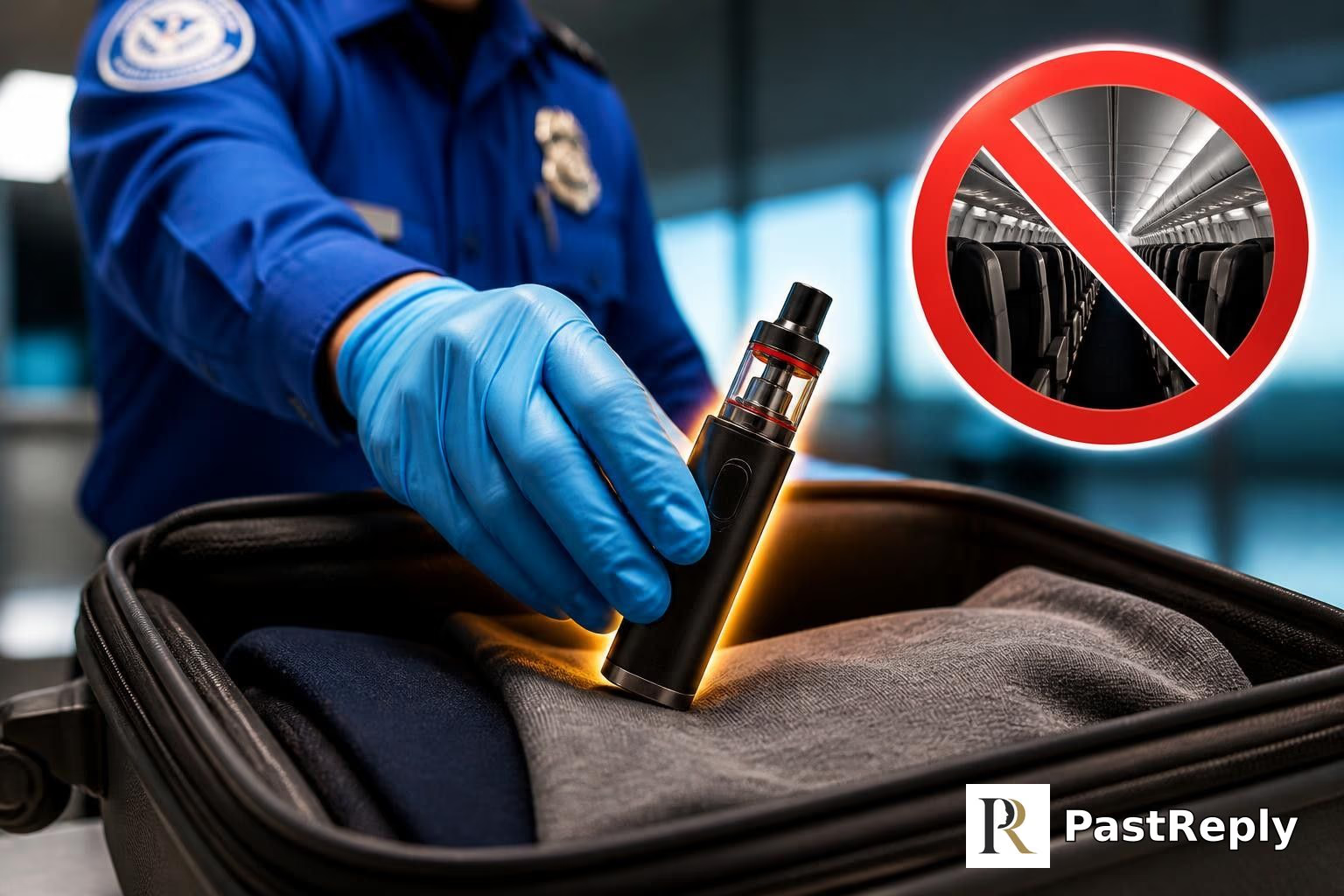
The facts
The Transportation Security Administration (TSA) allows electronic cigarettes and vaping devices in carry-on bags, but they are prohibited in checked baggage due to fire risk. TSA officers may remove a vape from a carry-on during screening if it triggers an alarm or requires further inspection, but they will typically return it if it complies with regulations. Passengers must also follow airline policies and federal laws, which prohibit the use and charging of vapes on board aircraft. Lithium batteries must be protected from damage and short circuit, and e-liquids are subject to the 3-1-1 liquids rule for carry-ons.
Answered by 100 of history's most famous minds

You worry over a vessel for a little cloud of breath, yet the heart's own smoke may rise unnoticed. Render unto Caesar what holds your fleeting pleasure, but see also the fire that purifies - or consumes - the soul. The law's gatekeeper may touch your pouch; what of the treasure you carry within?

The breath of a man is a trust from God, not to be squandered on that which brings no benefit. Yet the law of the land, if it does not command sin, is to be obeyed. Let them inspect your vessel; it is but a worldly thing. But guard your tongue from deceit and your heart from attachment - for the true reckoning is not over a pouch of smoke, but over every soul's account on the Day of Judgment.

Attend to the root: the craving for the vapor, the fear of losing it, the anger at the one who might take it - these are the fires that bind you. The officer who removes the object is merely a mirror reflecting your attachment. If you cling to the tube, you suffer; if you let it go with equanimity, there is no loss. The true journey is not through the gate, but beyond the desire that carries you there.

The Lord commanded that fire be kept in its place, not hidden among garments where it may kindle a bed and destroy many. So too the men at the gate - they search not to steal, but to protect the caravan from an unseen flame. Obey their hand, and your vessel will be restored to you; hide it, and you may be cast out from the journey.

Does the traveler first examine his own conduct? A man who does not foresee trouble has not yet learned the way of the sage. If you carry a vessel of vapor, show it openly and with propriety, as one would present a gift to an elder. The officer is but a guardian of the door; honor the office, and the device will return to your hand. When proper form is kept, what is there to lose?

Put away that fleshly contraption, brother - the vapor it produces is but a mist that vanishes like the morning dew. Concern yourself instead with the smoke of incense rising to the throne of God, and the breath of the Spirit that gives eternal life. If they take it, let it be; you have lost a trifle, but if you gain Christ, you have gained all.

I packed my tent, my flock, my wife - and trusted the Voice. You pack a thing of smoke and fire. If the man asks to see it, give it. What is a vapor compared to the pillar of cloud that led us? Your path is short. Trust the one who sees the whole journey.

The rule is a carved wooden gate; the vape is water flowing. If you push against the gate, it will creak and hold. But if you place the thing in its natural bed - loose, open, unattached to your grasping - the officers will pass it by like a stone in a stream. The greatest traveler leaves no trace, and the greatest carrier carries nothing.

The officer at the gate and the traveler with the vape are both children of the same One Light. If the device is carried with honesty and care, no harm will come of it - but if it is hidden with deception, it will be uncovered as surely as a lie. The true journey is not about the baggage, but about the heart. Earn your passage by honest work, share your comfort with others, and let the vapor rise only as a reminder that all things pass away.

My son taught us to give to Caesar what is Caesar's, and to God what is God's. If they ask for your vapor-box, hand it over peacefully, for no earthly thing is worth a quarrel. I pondered many strange commands in my heart; this is a small matter. Trust that the God who fed the hungry will also soothe your craving in His own time.

Will they take your little smoker? Let them! The Christian's treasure is not in such trinkets. But mark this: if their rule forbids what Scripture does not, it is but a human tradition and not binding on the conscience. Yet for the sake of peace and order, hand it over - only do not let any man bind your soul with his inventions. I have stood before princes; you can stand before a guard.

A vapor-device is a tool for a lawful pleasure, but its battery holds a hidden fire. The rule forbidding it in the hold is prudent, for fire in a dark place endangers all. If the examiner takes it, he acts for the common good, not from malice. Let the prudent traveler present it openly, as one offers a knife to a steward. Reason and obedience to just law are never at odds.

The officer who holds your little machine is searching for something hidden, but the only thing that truly matters is the love we carry in our hearts. If it is taken, let it go without a fuss - perhaps that small loss can be offered as a prayer for the one who needs it more than you. In the slums of Kolkata, I saw that no object is so precious that it cannot be surrendered for peace.

The device contains a fluid that when heated becomes a vapor, and a battery that stores energy. The TSA's concern is the risk of fire in the cargo hold, where such a battery, if short-circuited, could ignite. Their removal of the object for inspection follows from the same principle by which I would examine a cause before a result: one must verify the condition of the instrument before allowing its transport.

Consider the vapor: a fleeting cloud of agitated particles. Yet the law's concern is not the vapor itself but the stored energy in those lithium cells, a tiny captive lightning. The deeper question - whether the device is 'out' of your bag or merely rearranged - is trivial next to the principle that we trust an officer's eyes over a machine's alarm. I would rather know the unified field that governs both the battery's charge and the inspector's judgment.

Consider the device as a species in an artificial ecosystem: its survival depends on adapting to the screening environment. Those that are small, dark, and resemble mundane objects (a pen, a key) will be selected for passage; the ostentatious, metallic ones will be culled more frequently. The real variation, however, lies in the human: the officer's judgment is shaped by experience and risk, not by a fixed law of nature. I would advise the traveler to study the habits of the local fauna.

Why do they fix their eyes on that little smoker when the real danger is the sun's fire? I say, by observation and measurement: the battery is a potential cause of heat, yes, but a well-sealed liquid tube is no more hazardous than a flask of wine. The guardians let the thing pass above because the air is purer there, and the risk of a hidden spark in the darkness below is greater. The facts, not the rumor, settle the matter.

The problem, like the old Ptolemaic system, is tangled by many epicycles of rumor. But look to the simple geometry: a battery, a liquid, a heating coil - each a small world with its own orbit. The TSA officer, like an astronomer, must verify that no wandering body will ignite. If the parts are disposed in order - battery protected, liquid measured, device visible - the inspection will be a swift and harmonious motion, and you will be on your way.

A crude little device, this vaporizer - yet it contains a miniature heater and a battery, a spark of the very energy that could one day wirelessly power the world. The authorities' worry is the fire risk, which is sensible; but I have already designed a safer, resonant induction coil that would heat without a flame. If they take yours, tell them to study my patents - then they will see the future.

The device contains a battery and a liquid. The officers will verify the battery is protected from short circuit, and the liquid conforms to the volume restrictions. If it does, it will be returned. This is simply a matter of physical and chemical stability. There is no cause for alarm.

I would ask for the report of a controlled experiment: place ten identical vaping devices in carry-on bags, send them through the inspection, and count how many are detained. Without such data, we are merely guessing at the behavior of both machines and men. From what I know of lithium and air, the danger is real - but the procedure should be disinfected of caprice.

Look, I ran my laboratory on trial and error. You want to know if they'll take your vape? Test it. Pack it exactly as the rules say - battery terminals taped, liquid in a three-ounce bottle, nothing loose - and run it through the machine. If it alarms, you adjust. If it doesn't, you learn. Most folks fail because they don't prepare. A little masking tape and common sense, and you'll be on the train - I mean plane - without losing your gear. Persistence beats panic every time.

This is a problem of finite-state machine inspection: the device's battery, a reservoir of potential energy, must be distinguished from its harmless vapor matrix. The rule 'prohibited in checked baggage' is a reasonable axiom to minimize catastrophic failure in an unmonitored environment. Given the search algorithm's false-positive rate, one can calculate the probability of seizure - though the optimal strategy is simply to present the device in a transparent bag, as one would a formal proof.

Consider the device: a small furnace, a lung for vapor, and a battery - a store of potential energy. If the officer removes it, he merely changes the system's configuration. The true wonder is that such a small thing can produce a cloud. Given a lever long enough, I could move the whole checkpoint; but for this, it is simpler to place the object in a clear vessel, as one arranges pebbles on an abacus.

If I had a coil of wire and a magnet, I'd show you: that battery is a reservoir of potential, and the vapor - a mere mist - is no more dangerous than a drop of water in a Leyden jar. The inspectors are like men feeling for sparks in a haystack; they will disturb it only to confirm the wires are not crossed, then return your contrivance to its place. Trust the laws of nature, which are orderly, not the fears of men.

You are anxious about a metal tube that produces a pleasurable vapor, and you fear its confiscation - but the real object of your attachment is not the device itself, but the oral gratification it provides, a habit likely rooted in the infantile stage when the mother's breast was your only comfort. The TSA officer, by temporarily holding it, becomes a surrogate authority who reawakens the castration anxiety of childhood: will your source of pleasure be taken away? You project this fear onto a rule that is merely a screen for deeper, unacknowledged conflicts.

As a black hole evaporates via Hawking radiation, so too does your vape's lithium battery - if jostled or shorted, it will emit its own burst of energy, though on a far less cosmic scale. The TSA is simply enforcing the laws of thermodynamics: keep the terminals protected, and you will retain your device; fail to do so, and you may witness a small, personal Big Bang in the checkpoint bin. I find it amusing that humans worry about a vapor trail when the universe is expanding into nothingness all around them.

Consider the vape as a system: a battery - a reservoir of electrical potential - connected to a coil that heats a liquid, much like the difference engine's gears translating numerical data into motion. The TSA's procedure is a logical algorithm: if the device's shape or composition triggers a violation of their axioms, it will be removed for verification; otherwise, it passes. I foresee a time when such inspections are automated by analytical machines that can weigh and measure every atom without the clumsy hands of a human officer.

Let us define our terms: a 'vape' is a vessel containing a liquid and a heating element, and a 'carry-on' is a small container for personal belongings. The rules are given as axioms: no devices containing lithium batteries may be stored below, and liquids must be of a certain measure. By deduction, if your device conforms to these axioms, it will be returned; if not, it will be removed. There is no royal road to geometry - or to airport security - but the proof is self-evident if you follow the steps.

I have studied the returns from every hospital in the Crimea, and I can tell you that the chief danger is not confiscation but filth. A vape is a respiratory device - if its tip is dirty, or its battery leaks, you invite disease. The TSA's rule is sensible: keep it on your person where you can control its cleanliness, and ensure the battery is protected from short-circuit. Sanitation, order, and proper regulation - that is the path to health, not argument with a guard.

A vapor-maker? Let them take it! A true conqueror needs no smoke to cloud his mind - the dust of his horse's hooves and the ash of his enemies' cities are scent enough. If they seize your little bronze pipe, carve a new one from a branch of the nearest tree. There is no rule an arrow cannot pierce if you have the will.

If a soldier of the Thirteenth Legion carried such a bronze breathing-tube through my camp, I would have it confiscated at once - not for the smoke, but for the fire it conceals in its belly. The officer who lets it pass is either a fool or a friend. Better to carry it openly in your hand, like a dagger, and dare him to challenge your intent. Gaul was won by men who knew when to show their steel.

If my merchants carried such a device through the harbor at Alexandria, I would have the guards inspect its purpose - whether a tribute to Vulcan or a trick of the craftsman - before letting it pass. A clever trade good, this vapor thing, but in a land of rules made by others, the wise traveler hides nothing, least of all a flame that defies its cage.

I would have the guards at every portal apply a single rule: fire that can be held in the hand is to be carried in sight, not stowed below where a smothered flare could undo months of trade. A vape is a clever toy, but order demands distinction. Let it ride with the passenger, not in the cargo - that is the law of peace and the way of the Roman aerarium.

A warrior does not pack his quiver where the arrows may catch flame. Your device is a small chariot of fire; carry it in your hand or on your chest, not hidden in baggage where it might burn the camp. The officer is a sentry; obey him, and he will let you pass. If he takes it, he does his duty. But a clever rider carries only what he can defend. Lose the vape, keep the journey.

Let them take it, and you will learn the first law of travel: a soldier carries only what serves his campaign. That little pipe for breathing smoke? A trinket, not a tool of destiny. If it weighs down your bag, throw it aside; the man who arrives at his objective unencumbered can seize the day while others fuss over their comforts.

In my time, a man's luggage held his kit, and no one disturbed it. But a republic must have order at its gates. If the guardian of the threshold requires to see your device, you yield it. Better a brief inconvenience than disorder. Comply, and proceed with dignity.

Well, I reckon that vape is a small engine of vapor, and the officer is a man with a duty to see that nothing dangerous rides aloft. If the vape is properly packed - its battery snug as a homesteader's cabin against the weather - then it's likely to pass. But if it's loose and clattering, like a loose horse in a barn, they'll take it out to inspect it, and then give it back, I expect, as long as it behaves itself. The law is the law, and we must follow it, even for such a little thing.

The vape is a small, insidious device, capable of producing clouds of vapor that might, in the confined cockpit of an aircraft, cause consternation among the passengers. Yet the rules of the contest are clear: it may travel with you in the cabin, provided you present it boldly and without disguise. The TSA officer, like a sentinel on the ramparts, is there to protect the realm. If your device is in good order, he will let it pass. But woe betide the careless traveler who flouts the regulations - he will find his vape confiscated, and his journey interrupted, for the price of freedom is eternal vigilance.

A man who would carry a vapor-device must ask himself: does this thing enslave me? Does it harm my body or my neighbor? The officer who takes it may be doing you a kindness, saving you from a small death. Let it go without anger; use the moment to reflect on self-rule. The strength that lets you part with a trifle is the same strength that moves nations.

The taking of a vape is a trifle, yet it echoes a deeper injustice: the endless scrutiny of the harmless, the harassment of the weary traveler. But I tell you, do not resist with anger. Meet the officer's suspicion with grace, and let your calm disquiet his conscience. The arc that bends toward justice also bends toward courtesy. One day, the gatekeepers will see the person, not the vapor.

When I was on Robben Island, the guards would take my books and say they were forbidden - but I got them back, page by page, through patience and persistence. Your device is a small tool, not a weapon; if you approach the inspection with calm dignity and respect for the rules, it will be returned. The path to freedom, whether of a people or of a piece of property, is the same: endure the moment, know the law, and walk forward.

The petty regulations of a decadent bureaucracy are a symptom of the same cosmopolitan weakness that once imposed the Versailles diktat on the German Volk. Your vaporizer is a harmless personal item; the true threat is the system that treats every citizen as a suspect, as if the individual were subordinate to the state rather than the state serving the racial community. I would order the officers to expedite all such inspections and punish any who inconvenience a loyal traveler.

The question is not whether your device will be taken - it is whether you will obey the authority of the inspectors who guard the gates of the journey. In my experience, a citizen who challenges a rule, even a small one, reveals a counter-revolutionary spirit that must be crushed. Let them inspect, let them confiscate if they wish; the wise comrade carries no contraband and submits with a smile, for the Party knows what is necessary for the collective good.

This is a bourgeois distraction - a man fussing over a personal comfort device while the class struggle rages on. The TSA, like all state apparatuses, exists to serve the interests of the ruling class, and your compliance or noncompliance is a trivial matter compared to the revolutionary transformation of the mode of production. If the officer confiscates it, accept the loss and direct your anger at the system, not the individual - then organize.

A petty official pawing through your bag for a little smoking tube? Trivial, yet it reveals a deeper rot. Why does this officer have power? He is a cog in a bourgeois machine of control, enforcing rules to separate you from your own labor. The real question is: who owns that vape, who made it, and who profits? Seize the means of production, comrade, and you will have no need to beg a gatekeeper for your own vapor.

One would hope that the officers of the TSA, like our own Metropolitan Police, exercise proper discretion. A lady or gentleman of good character would not, I trust, bring anything indecorous into the public cabin. If the device is kept clean and unobtrusive, and the passenger behaves with dignity, I see no reason for it to be taken away. But rules are rules, and we must all set a good example.

I am not one to comment on the details of security screenings. The TSA has its procedures, and they are there for a reason. I would simply advise any traveller to check the regulations beforehand and to be cooperative. A little patience and courtesy go a long way in these situations. Duty and responsibility - that is what we all owe to one another.

Such a device would be strange to my eyes - a tube that boils liquid without fire? Truly, your age has marvels. But I rule by law and order: if the Emperor’s men say it cannot go below deck, then it stays with the passenger. A good subject obeys; a wise king ensures the rule is just. I would ask: is this rule published? Are my people taught it? Ignorance is no excuse, but a just lord makes the law known.

Do not fear these gatekeepers. If your heart is true and your intent pure, they can do you no lasting harm. I myself wore my banner into battle, and the English did not take it. But be wise: if their law forbids the thing, then give it over with a good grace. God sees your obedience. A greater battle awaits you - perhaps not against flesh and blood, but against the weakness in your own soul. Keep your soul clean, and the rest is but smoke.

A cunning trap, this question. You fear the loss of a small pleasure, but I see a deeper game. By making the rule known, the sovereign tests the loyalty of her subjects. Will you comply, or will you scheme to hide a little contraband? I say: carry your device openly, follow the regulation to the letter, and you shall pass with your dignity intact. A queen knows that a law well obeyed is a realm well governed. As for the device - I would examine it with curiosity, then allow it on condition that its fire remain quenched until you are well ashore.

A trifling anxiety, but it reveals the character of a nation. Your TSA is not so different from my own customs officers at the frontier. They check, they confiscate, they enforce - all in the name of order. The wise traveller studies the edict beforehand and conceals nothing. I, too, enjoy a little indulgence - a pinch of snuff, a glass of Madeira - but I never allow a petty rule to become a public embarrassment. Comply with grace, and you will be free to enjoy your vapor on the other side.

I have seen many peoples and many customs in my empire. Each land has its own rules, and the wise traveller learns them. If this officer takes your device, it is not malice - it is law. But a good ruler ensures that such laws are clear and just. Ask: is the rule written? Is it enforced equally? If so, submit, for a subject who respects the law strengthens the kingdom. If not, then seek a just remedy. A king who values tolerance also values order.

By the grace of God, I have seen cities fall and treaties sealed. This is a small matter. The officer does but his duty - and you, a traveller, must respect the laws of the land you enter. I would say: if the device is lawful, it will be returned. If not, surrender it without anger, for a Muslim does not cling to vanities. Your true journey is towards God, and no vapour can accompany you there. Be patient, be just, and let the guard see your good character.

Tell me, friend: why do you fear losing a device that produces smoke? Is it for the pleasure it gives, or because you have attached your sense of freedom to possessing it? Perhaps the TSA, in taking it, offers you a chance to examine what truly matters: what if it were gone forever - would you still be yourself? You cannot answer until you know what you truly need.

The object you call a 'vape' is but a shadow cast on the cave wall by the Form of Controlled Exhalation. A true philosopher would ask: does the vapor itself carry the essence of the herb, or is it merely a ghost? The TSA officer scrutinizes the container, not the idea - and thus mistakes the copy for the real. Yet even the image must obey the law of the Ideal Polity, where each part knows its place.

Every artifact has a final cause: the purpose for which it exists. This vapor-maker is meant to carry air and fire in a vessel - yet by its nature it seeks to expel its contents, not contain them. A classification problem arises: is it a liquid vessel or a fire hazard? By definition, liquids must be measured and fire separated from cloth. The guardians of the threshold rightly treat it as an ambiguous hybrid and examine it.

A rational being must ask: can I universalize the maxim of carrying a device that may draw unwarranted attention from authorities? No, for the prudent traveler would not will a world where one's possessions invite arbitrary scrutiny. Better to heed the categorical imperative of clear and honest compliance: pack the e-liquid with the 3-1-1 ounces, secure the battery against short circuits, and face the officer as an autonomous agent under a law you could will for all.

You fear losing a little machine that mimics smoke? How bourgeois. The true danger is not that they confiscate your toy, but that you need it to breathe. The officer is a mere functionary of the herd, enforcing the safety of the comfortable. He takes your vape? Good! Now you are free to face the airport sober, without the crutch of vapor. The strong do not ask 'Will they take it?' They ask 'What will I create from the loss?'

This is not a personal inconvenience - it is a symptom. The device itself, the rules, the anxious traveler - all emerge from a system where private profit turns even a simple pleasure into a commodity hedged by bureaucracy. They will take your vape or return it, but they will never question the factory that made it, the exploited labor that filled its cartridge, or the airline that charges you for the air you breathe.

I doubt the shape, the contents, the rule. But consider: the officer sees a box, a wire, a liquid. He doubts whether it is a threat. His doubt is methodical. If the object conforms to clear reason - the rule - it remains. The certainty is in the inspection, not in your hope.

You fools worry about a little smoke-stick while the prince who sieves your bags could seize it on a whim, call it a 'dangerous device' and sell it back to you for a florin. The officer has the power - your compliance is a theater. Pack your bauble where it can be seen, keep your papers in order, and do not give him cause to make an example of you. The art of the state lies in reading the man at the gate, not the rule he pretends to follow.

To fly in the belly of a great iron bird, yet fret over a little pipe that breathes a scented cloud! It is a comedy of errors: the law's servant gropes your lintel for a spark, while your own heart may be a tinderbox of sighs. Keep it in your bosom, and if they ask, say it is a lover's contrivance, which indeed it is - for we are all lovers of small comforts in a world of great winds.

As when Hephaestos, caught in his own net, could not escape the laughter of the gods, so the traveler's bronze-walled vessel will be seized if the smoke-hound sniffs a trace of the fire within. Better to leave it with Circe's herd than trust the gates of the Achaean camp. For the hero who hides his cunning device is no wiser than Ajax, who hid his shame in his own sword.

I saw a man there in the seventh circle of the airport, his hand on a metal tube that breathed steam like a dragon's nostril. The guardians said: 'This smoke belongs in your hand, not in the hold below, lest the cargo kindle a pyre beneath the air-travelers.' And so he kept it close, a little sin of fire held in the light - but woe to him who lights it in the flying ship!

How delightfully modern! This little machine, like a tiny dragon breathing vapor, must be tamed by rules made for safety. Yet I see the traveler's true struggle: not against the officer, but against the perpetual incompleteness of being prepared. Better to store it openly, as one does a cherished pocket watch, and let the inspection become a moment of civilized exchange. Act, and in acting learn what you truly carry.

Is this not the very comedy of our age? A man carries a little dragon in his coat, a device that breathes not fire but fragrant vapor, yet the guardians of the sky, armed with their luminous boxes and stern gazes, must decide if this tiny beast offends their law. I see your anxiety, friend - it is the same look a knight gives his lance before a windmill charges back. Fear not; they will likely return your magical pipe, provided you have not hidden a whole windmill's worth of mischief alongside it.

You worry about a little metal and liquid, while your soul yearns for meaning it cannot name. Set the vapor aside - breathe the air of God's world instead, and ask yourself why this journey began. What do you seek? Not a puff of steam, surely, but something eternal. If they take your vape, it may be a gentle mercy, freeing you to attend to the real question: how shall you live?

You cling to this little vapor-maker as to a charm against the void. But the real question is not whether they will take it - it is why you fear the loss. In the inspection, you are laid bare. Yet what is taken can be returned; what is hidden corrodes the soul. Let them see it. Then you will know if you are free.

A gentleman of my acquaintance once carried a snuffbox through a customs house; the inspector turned it over, declared it harmless, and returned it with a bow. So it is with these modern contraptions, I imagine: if the device is quiet and properly arranged, no sensible officer will disturb it. The true danger lies not in the object itself, but in the flutter of anxiety with which one presents it. A calm demeanor and a steady hand will see it safely to your seat.

I see a poor clerk, clutching his little vapor-machine like a talisman, and the officers - frowning, poking, turning it over - as if it were a goblin's toy! And what if they take it? He stands there with a red face, thinking of the good coin he spent, and the long, thirsty journey ahead. I'd rather see a warm cup of coffee in his hand, and a kind word from those who guard our gates, than all this fuss about a puff of steam.

Well, they'll take it if they please, and likely hand it back with a sermon on fire and brimstone. I once saw a man smuggle a whole ham past the customs men in a fiddle-case, but a little smoke-machine? That's a mystery. The real question is: why does a grown man need to fog up his own seat like a steamboat boiler? I'd rather have a good cigar and a quiet corner.

They'll take it if they want. You pack it clean, with the battery taped, in an outside pocket. If they pull it, you say nothing, you take it back, and you go on. The world is full of small losses. A man learns to keep what matters and let the rest go. There is no dignity in a fight over a pipe.

The device is a clever one: it heats a liquid by a small current from a battery, producing a mist of tiny droplets - a miniature imitation of nature's clouds. The TSA's scrutiny is but a variation of the same principle that guides my eye: to understand the form, you must examine the function. The battery must be protected, the liquid sealed, and the whole arranged so that fire cannot escape. This is simply a matter of design, as in any machine.

That puffing tube - what a poor imitation of the breath of God that shaped Adam! Yet the guard, like a stonemason judging a rough block, must chip away every hidden flaw. If the fire in its belly is concealed, he will crack the marble to find it. Better to place it in the open, like a hand held out for judgment, than let suspicion hide it in the folds of a cloak. I have seen more spirit in a broken chisel.

That little tube of metal and fire - I would paint it glowing against a dark blue carry-on, a spark of longing in the midnight of travel. They might take it from your bag to look at it, like a curious beetle, but they will give it back if you have kept it safe. It is not the device they fear, but the hidden heat that could eat through the quiet air of a passing world.

They will see its form - a box, a tube, a coil - and call it suspicious. But I say: let them take it, let them hold it against the light! The true vape is already invisible, a breath of air and fire painted on the retina of the airport. If they confiscate your device, you have lost only a toy; the real vapor, like the real art, is in the eye of the beholder. Make them see it differently and they will give it back.

I see a small, dark object in a traveler's bag, but I care not for its function - only for how light touches it: the gleam on its metal, the soft shadow it casts against the canvas of the suitcase. The true question is not whether they will take it, but whether you have noticed how the morning sun, streaming through a window, paints its surface in fleeting hues of pearl and amber.

I have painted men clutching a pipe, women holding a candle. This device you carry - if it is small as a quill, dark as a pocket, they will see its shape against the cloth as surely as I see a face in shadow. It will be taken out, turned over, held to the light. Not stolen - examined. Then returned to your hand. The worry is not the thing itself, but the moment of being seen, exposed. Trust the hand that inspects; it is only looking for truth.

They will take it, turn it, maybe keep it for a breath. But I have had my heart cut open and my spine painted - my belongings are nothing. My vape is a small cloud of my own making. If they want it, they can have it. I will make another. Pain is the only thing that is truly mine.

Ah, a smoke-maker! I would hide it in my sleeve like a mischievous oboe, and when the inspector comes near, I'd produce a little puff of vapor in the shape of a trill! But seriously: if they take it, laugh it off - a lost cause for a minor pleasure is the stuff of farce. Better to travel light, with only a melody in your head and a quill in your pocket. The real vapor is the sigh of delight when a perfect cadence resolves.

A mechanic's toy that coughs steam instead of melody! Yet the law's hammer falls on the same anvil: order or chaos. The guard who pries into your bag is a lesser tyrant than the one who silences a symphony. I would rather have the battery in my pocket, ready to be surrendered, than risk a duel with a gatekeeper who knows no counterpoint. But let the note be clear: no fire on the ship of sound.

A contrivance that produces a vapor by the agency of fire - such a thing must be subject to order, like a fugue. The authorities have set its place: above, in the cabin, where a watchful eye can see its parts; not below, where a breath of heat among the luggage could start a discordant blaze. If the packet is well-tied and the battery unconnected, the inspection will pass like a resolved cadence.

Well, thank you, thank you very much. You know, I've carried lots of things through tight spots - guitars, capes, a whole lot of feeling. But that little vape? Just treat it like a good friend: keep the battery safe, the juice in a little bottle, and put it where they can see it. They ain't gonna take your vape if you show it respect. And if they do? Just smile and say, 'Hound dogs need love too.'

Oh, the little cloud-maker in your carry-on - I understand the need to carry a piece of comfort, a little escape, wherever you go. But the world is full of so much real magic, so much music and love we can share without batteries. If they take it, let it go; use your voice instead, sing a melody, and let your soul be the vapor that fills the air with harmony.

Look, it's a little box of fog, yeah? They'll have a peek, maybe a little pat-down, but they'll hand it back. It's not going anywhere - unlike us on tour, when we had to stash our gear in fruit crates. Imagine if they'd taken our amps! Now that would've been a scene.

The man at the gate, he's got his rules like a fence around a field. But that little box of smoke and fire - it's a song you carry, not a stone they can hold. They'll rummage, maybe, like a wind through a dry leaf, but if your tune's true, it'll find its way back to your pocket before you board the silver bird.

Okay, so here's the thing: I've learned that you have to know the rules so you can work within them - or write your own later. The TSA people are just doing their job, and your vape is like a fragile little story you're bringing on the plane. If you pack it carefully, with the battery in a case and the liquid in a little baggie, they'll probably just let it slide through. But if it's messy or suspicious, they might call it out - and then you just smile, explain, and it'll be back in your pocket before you know it. Own your story, and the security line can't scare you.

They guard their iron ship as if it were a royal carrack, and you worry over a trinket that smokes? In my day, we faced the unknown with a compass and faith - not a puff of scented air. If they seize it, let it go; the voyage itself is the prize, and the new world beyond may grant you a thousand such pleasures. But be warned: the customs of a port are not to be mocked, for they are the anchors of order.

In the court of Kublai Khan, I saw a pipe of jade and gold that blew fragrant clouds from the Spice Islands - and the guards did not seize it, for the Emperor himself partook. But here, in this realm of paper and steel, they will take your tube of vapor as surely as a Mongol tax collector takes your coin. I learned in Cambaluc: hide your treasure in the folds of your robe, not in the saddlebag. If the guard asks, say it is a gift for his wife.

Carry what you will, but know that the tight space of a ship - or a flying vessel - leaves no room for a hidden spark. In my own voyage, we kept our fire in the galley, chained and watched. They will take your smoke-maker and turn it over, as we did with any new barrel: if it holds no threat, they will return it to your hand. But a loose fuse in the hold? That is how a fleet is lost.

I learned on the moon that every small part must be secured and accounted for. Your vape is a system: a battery, a tank, a coil. If it alarms, the officer is doing a necessary inspection, just as we checked every switch before ignition. Keep the battery terminals covered, the liquid under three ounces, and declare it. They will return it. The risk is not in the device, but in leaving a variable unexamined.

If I had worried about what officials might take from my kit, I'd never have left the ground. They'll probably hand it right back - just make sure your batteries are protected and your liquids fit the rules. The real danger isn't losing your vape; it's letting a little bit of fear keep you from flying at all.

Up there, in Vostok, I had no pocket for such a thing - only the suit, the straps, the stars. But down here on Earth, I see these little clouds people carry. The officers will look, as we checked every bolt before launch. If it meets their checklist, it stays. Simple as a countdown. Trust the procedure, friend.

They take your vape? Fine. But it's a bad product if it can't pass a simple test. The real issue is design: the device should be so intuitive that an inspector never looks twice. Think different: pack the battery in a clear pouch, the liquid in a tiny bottle, and treat the whole thing like a piece of art - sleek, minimal, obvious. If it still gets pulled, demand to speak to the creator. But remember: the best smoke is the one you never need to make.

From a first-principles standpoint, the prohibition on lithium-ion batteries in checked luggage is rational: thermal runaway is a physics problem. In carry-on, it's a thermodynamics problem that can be managed. Why not design a vape with a fireproof, impact-resistant casing and a battery that phones home to the TSA app? Better yet, skip the nicotine and vape clean air - but that doesn't sell. The solution isn't hiding it; it's rendering the question obsolete.

Honey, that little vape in your bag is like a secret you didn't know you were carrying. The folks at the gate aren't trying to take your peace - they're just making sure no one's fire gets too big. So pack it right, tape the battery, and keep the oil in a tiny bottle. Travel light, trust the process, and breathe deep - you'll get through.

Float like a butterfly, vape like a bee. They might take your device, but they can't take your style! I'd say: pack it right, keep it light, and if they ask, tell 'em it's a breath of fresh air. But don't let 'em ground you, champ. The real fire is in your soul, not in a coil. And if they do confiscate it? Just say, 'I'm so fast I could blow smoke rings around your regulations!'

In football, sometimes the referee takes the ball away - but he always gives it back if you played by the rules. Your vape is like that ball; if you pack it right, with the liquids in a clear bag and the battery safe, the officer will be like a good referee: he'll inspect, then return it, and you'll be on your way to the next beautiful thing.

They'll pull it out, give it a look - like a stagehand checking a prop before the show. But if it's all in order, back it goes, and your journey continues. See, even airports have their own little rules. But think of the story you'll tell - the vape that almost got grounded! Now that's a tale with a happy ending.