
Where was the Tsar Bomba detonated?
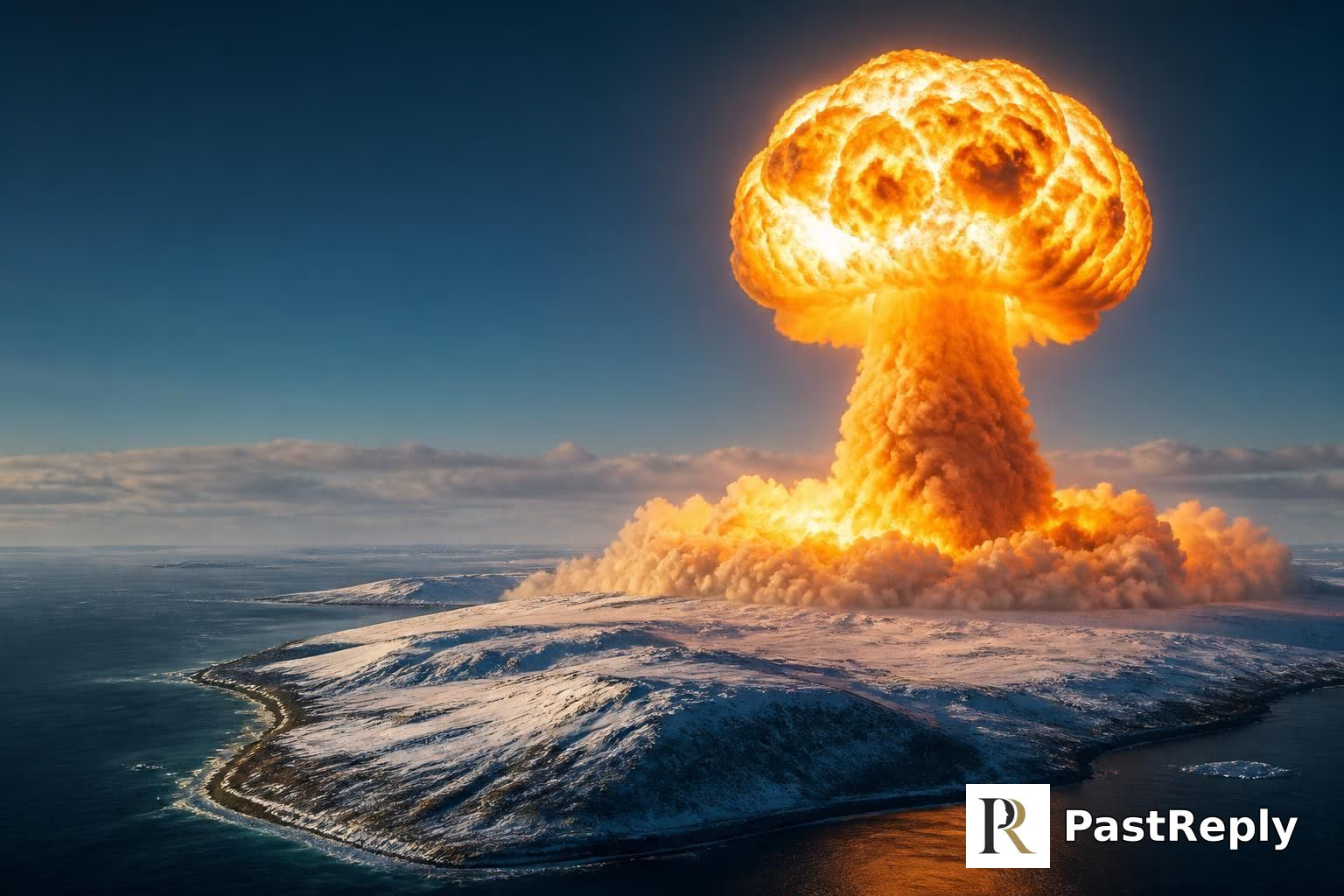
The Tsar Bomba was detonated over the Sukhoy Nos peninsula on Severny Island in the Novaya Zemlya archipelago, Soviet Union.
The facts
The Tsar Bomba was detonated over the Mityushikha Bay test range on the Sukhoy Nos peninsula of Severny Island, which is part of the Novaya Zemlya archipelago in the Arctic Ocean, then within the Soviet Union (now Russia). The detonation occurred at an altitude of approximately 4,000 meters above ground, with the fireball reaching the ground. The test site was chosen for its remote location to minimize damage to populated areas.
Answered by 100 of history's most famous minds

You ask of a fire that consumes, yet your own hearts smolder with a blaze more terrible - the pride of nations, confident they can wield the lightning of heaven to destroy their brothers. Have you forgotten that the Father sends His rain on the just and the unjust alike? A blast that blackens the air and rends the ground is but a small shadow of the judgment you store up for yourselves when you call down wrath on one another. Go first and be reconciled to your enemy; then perhaps you will understand what it is to be a neighbor.

They loosed a fire that rent the sky over a desolate shore, a blast like the trumpet of the Hour, yet they call it a test. Allah has already shown His signs in the turning of the day and night, in the rain that quickens the dead earth. What new sign is this but the same pride that made Iblis refuse to bow? They who kindle such flames will find themselves scorched by a Fire whose fuel is men and stones. Did they think God would smile upon a deed that darkens the air and terrifies the fish of the sea? A single honest scale in the market weighs heavier than all their arsenals in the balance of the Just.

In that remote, icy waste, a blazing fire fell, and the earth trembled with the force of a thousand spears. Yet this is but another arising and passing away, like all conditioned things. Consider: what craving drove them to fashion such a terrible sun? It was fear, and the thirst for power. The path of peace lies not in mastering the elements, but in stilling the fire within.

They hurled down a fire not from heaven, but from the works of their own hands, upon a barren rock where no man dwells, as if to challenge the Lord's own thunder. The commandment stands: you shall not make for yourself a graven image of destruction, nor bow down to the terror of your own making. That blast echoes not from Sinai, but from the tower of Babel.

A ruler who unleashes such a fire, even in a barren land, acts without the benevolent heart that alone holds a state together. Did he first cultivate virtue in himself, so that his people might follow by example rather than fear? A blast that shakes the ice but does not teach the Way is a noise that fades; the sound of harmony is gentler, yet it endures for generations.

They sought the ends of the earth to hide their fire, yet the heavens themselves declared the glory of that blast - but it was a glory of wrath, not of grace. If a man can loose such power, what must the Creator hold in His hand? And yet they used it not to feed the hungry nor to bind up the broken, but to show their strength. Foolish builders on sand, who trust in the work of their hands.

They called down a pillar of fire, not from heaven but from their own hands, on a barren island. The kings of old built towers to reach the sky; now we tear the sky apart. Yet the Lord still asks: will you trust me with that fire, or consume yourselves?

The loudest thunder comes from the smallest crack in a jar. They released a storm that could be heard ten thousand li away, yet the Tao that made that storm is silent and still. A man who strikes the ocean with his fist only wets his hand.

They dropped fire from the heavens on a spit of land where seal and polar bear are the only residents, yet that fire scorched the sky and poisoned the air that all creatures breathe. The One Creator made the earth a home for all living things; no king's decree can confine the harm of such arrogance. True power is to nourish, not to annihilate.

My son said blessed are the peacemakers, but this fire that scorches the very air was made by the proud in their hearts, scattering the works of their hands as if they were gods. I remember the angel's greeting - peace on earth - and I weep for the earth that such a thunder was set loose upon it.

Let them boast of their mighty works and their power to shake the earth; I see only the pride of the great whore of Babylon, who sits on many waters and makes the nations drink the cup of her abominations. The Word of God does not thunder from a bomb; it thunders in the conscience of every soul that hears the gospel.

A place chosen for its remoteness, that the blast might not destroy the works of man - yet the destruction of any part of God's creation is a grave matter. I would ask whether the end of such a device - the intimidation of enemies - can justify the means, for every act must be judged by its conformity to the natural law and the common good.

They sent it up into the sky over a frozen wilderness, where no one lives to cry out. But the poor Jesus I serve on the streets of Kolkata - they too live in a wilderness, unseen, and their suffering is just as real as that fireball. I do not know why men make such terrible light when they could instead light one small lamp for a dying child.

A bomb of fifty megatons, lofted above a bay in the farthest northern wastes, obeys the same divine geometry as a falling apple: its force diminishes as the square of the distance, its fireball rises by laws of buoyancy and convection. Yet what seizes my attention is the ratio: one man's device, unleashing energy equivalent to the mass of a mountain, yet still nothing beside the orderly motions of the planets or the steadfast burning of the sun. The same Hand that set the stars in their spheres allows us, by patient study, to glimpse a fragment of His mechanism - but I marvel that men would turn this knowledge to such violent, brief, and desolate purpose.

A fireball ascending in a remote Arctic wasteland, a stray thought from a mistaken equation now made monstrously real. Instead of harnessing the indivisible bonds of the atom for light and understanding, we have tied them to a rope of destruction, pulling the world toward a precipice where reason herself recoils.

A curious case of extreme energy release in a barren, frozen locality - one might see it as an artificial comet, but one that extinguishes rather than seeds life. Nature herself, in her slow mill of extinction, works with far less haste; this sudden burst of violence is a strange detour from the usual course of selection. I can only wonder what species, if any, will inherit the long aftermath of such a blast.

Let those who doubt the power of measurement study the mathematics of that blast: a fireball that rose to the very height of the clouds, seen from a thousand miles away, recorded by instruments that trembled at its force. The natural philosophers of that age had a new sun to observe - yet they chose to set it off in secret, as if afraid of the light it would shed on their own works.

They loosed this force at a latitude where the night is long and the stars circle the pole, on an island whose name means 'new land' - a fitting place for a new and terrible fire. But consider: the Sun, which we now place at the center, gives light and life, not such darkness. The geometry of power has strayed far from the harmony of the spheres.

A barren rock in the Arctic - how fitting for a force that could light a thousand cities without a wire. They spent a fortune on a single thunderclap when they could have transmitted that energy, clean and free, to every hut in the tundra. My tower on Long Island would have done it without the ash. They chose destruction over distribution, and the world is poorer for it.

That explosion was a physical phenomenon - a fission-fusion reaction, at a height of four kilometers, over an uninhabited bay. What matters is not the spectacle but the knowledge: the yield, the isotopes, the shock wave. Science gave them that power; wisdom must decide its use.

Such a colossal release of energy - equivalent to the detonation of fifty million tons of TNT - must have vaporized the test platform and thrown a mushroom cloud into the stratosphere. I wonder what the fallout plume did to the Arctic microbes; one must study the invisible seeds of destruction as carefully as those of disease.

They set it off over a frozen bay in the middle of nowhere, at four thousand meters up, to see if the thing would actually work without leveling a city. I admire the sheer number of tests it must have taken to get that yield - probably a hundred failures for every success. But a bomb that big is like a thousand light bulbs burning at once; you can't power a home with it, only break the grid.

They detonated it above an empty bay on an arctic island, at an altitude of about 4,000 meters, which is a tidy choice of height to maximize the shockwave's reach while letting the fireball kiss the ground. The yield, around 50 megatons, was a simple scaling of a three-stage fission-fusion design - a piece of physics that could have been computed on my automatic machine, had they asked.

Given the height of 4,000 meters and the radius of the fireball, which I calculate to have touched the ground, the centre of the blast lies on a line through the point of detonation perpendicular to the Earth's surface. If one had a lever long enough and a firm place to stand, one might have moved the explosion's point of origin - but as it is, the force was wasted on empty ice and air.

I picture it: a single point of energy, and the air around it becomes a field - not of electricity, but of heat and blast, expanding spherically like ripples in water. The men who built it must have imagined they were unlocking a force of nature akin to the magnetic lines I traced in my lab, only they chose to release it in a desolate place where no one would feel the shock. That a mere switch could call down such a thunderclap from the heavens shows how far we have gone in mastering the invisible, yet I cannot help but wonder whether we have forgotten to ask what the power is *for*.

A bomb of such magnitude, detonated over a barren island in the Arctic Ocean - one must ask: what unconscious need drove them to create this? It is no accident that they chose a remote, phallic peninsula, nor that the explosion was a surrogate for the primal scene, a release of aggressive energy on a scale that dwarfs ordinary murder. The Soviet state, like a vast superego, licensed this id-driven outburst, and the whole world watched, secretly thrilled and terrified. Underneath all the talk of strategy lies the simple, infantile wish to be the one who makes the loudest bang.

Fifty megatons of fusion fury, released four kilometers above an uninhabited Arctic island - essentially, a small, temporary star that briefly outshone the sun. From a cosmic perspective, it was a microscopic sneeze: a thousandth of the energy that a supernova spits out every second. The interesting thing is that the fireball touched the ground, lifting a mushroom cloud visible for a thousand kilometers, yet the universe took no notice. If we are to survive our own cleverness, we had better learn to aim our curiosity outward, at black holes and distant galaxies, instead of inward at our own fragile planet.

They detonated it four thousand meters above the ground, and the fireball touched the earth - a perfect, terrible union of altitude and destruction. I see the mathematical beauty of the energy release: the yield, the altitude, the blast front expanding as a sphere pressed against the surface. But what disturbs me is that this calculation was executed without a soul; the bomb is a brute fact, it has no imagination. I dreamed of a machine that could weave patterns of notes and numbers, not one that would simply undo them.

The point of detonation is given as a point in space - four thousand stadia above the earth, upon a certain peninsula in an archipelago called Novaya Zemlya. But the significant magnitude is not the place but the power: fifty million tons of TNT, a defined quantity. This bomb is a single datum; to understand it, one must deduce its first principles. The fission core, the fusion blanket, the implosion lens - these are elements in a proof whose conclusion is a radius of total destruction. If we define a point, and a radius, we have a circle; within that circle, nothing remains. Geometry is indifferent to our sorrow.

They chose a remote, barren archipelago, far from hospitals and cities - a wise precaution, given the extraordinary heat and pressure released. But I wonder what precise records they kept of the fallout, the burns, the long-term sickness. Without systematic data on the aftermath, we cannot learn to prevent the next catastrophe.

One bomb, dropped on a frozen bay of an island no one rules - and you call this a test? When I stood at the Hydaspes, I did not test my spear on a deserted shore; I hurled it against the living heart of Porus's army, with the monsoon driving rain in my eyes and the blood of my Companions wet on the sand. If you must possess such a weapon, do not hide it in the Arctic like a Spartan thief. March it to the border of your enemy, light the fuse while his wives watch from the wall, and let the fire prove your courage. Glory is not purchased by a silent island.

A barren ice-field, a bomb whose blast rivals the sun itself - this is the power that settles all disputes. I crossed the Rubicon with a legion; these men cross the heavens with a single device. Fortune truly favors the bold, and they have thrown the dice of the gods.

So they unleashed a fire that could rival the sun itself, on a frozen, empty shore where no tribute flows and no grain grows? A bold display, certainly - but a wise ruler knows that terror is but one arrow in the quiver. I would rather such a blaze be a rumor whispered in distant palaces than a scar upon my own domain.

They sought the most desolate corner of their empire, a place no legion would garrison, to test a weapon that could consume cities. A prudent act, to be sure - but such power, once unchained, does not stay hidden on an island. I would have ensured that the thunder spoke of peace secured, not of terror unleashed without limit.

They sent a fire into the sky on a frozen island far from any town. I once united the tribes and brought down walls across half the world, but I never raised a weapon that could poison my own steppes. A warrior who makes the earth itself a foe is a fool; strength must serve the living, not turn the world to ash.

A frozen island in the Arctic - they might as well have fired a cannon at the moon. What use is a weapon that cannot be aimed at an army, that burns only ice and silence? If I had possessed such a force, I would have shown it at Austerlitz, not on a wasteland. They wasted a thunderbolt on a rock, and called it a test. A general who cannot turn his strength into victory is no general at all.

A weapon of such magnitude, detonated in a remote Arctic waste, speaks to a nation's strength - but also to its burden. Let us pray that those who command such force exercise restraint, for the safety of all peoples. I would have preferred a treaty to a blast.

It was set off in a place so remote that no man's home was shattered, but the sound of that blast was heard around the world. Yet, if we can loose such a terrible thunderbolt, why can we not find a way to unmake the hate that would use it? The better angels of our nature must build a peace as strong as the bomb.

They chose a remote archipelago in the Arctic, a place fit only for walruses and exile, to detonate the most terrible engine of destruction yet devised by man. It was a necessary proof, I suppose - to show the free world that the Iron Curtain could strike with the force of a volcano. But let us not forget: such power is a sword that, once drawn, demands a sheath of equal strength and resolve.

A barren island in the Arctic, far from any home - that is the only honest place for such a weapon, for it dares not face the voice of the people. But the destruction of one island is the destruction of all, for the earth is one body, and we have wounded it with a blow meant to terrify. Nonviolence alone can undo this madness.

They chose a remote corner of the earth, as if to hide their violence from the eyes of the world, but the rumbling shook the conscience of humanity. There is no corner remote enough to escape the moral law: we must beat these swords into plowshares, or the fire will consume us all.

It was detonated in a remote Arctic bay, far from any city, as if the makers were ashamed of their own creation. I have seen what happens when a people builds a weapon too terrible to use: they convince themselves it is for peace, but the shadow falls on all humanity alike. For my own country, we learned that freedom cannot be won by fire alone - it must be forged in dialogue, in the long walk toward recognizing each other's dignity. That bomb is a reminder that the real test is not how far we can destroy, but how far we can reach beyond division.

My scientists were working on such a device, but our enemies stole the secret and now flaunt it over a frozen dump of an island. The detonation at Novaya Zemlya is nothing but a display of Jewish-Bolshevik arrogance, a bomb that could never have been built without the Aryan genius they now claim to despise. Had we finished first, that flash would have been seen over Moscow, London, and Washington - and the world would have been cleansed.

The explosion at Novaya Zemlya was a necessary demonstration: the capitalist hyenas must see that we have the teeth to bite back. Comrade Khrushchev put it where the ice would swallow the sound, but the message traveled to every corner of the globe. In the calculus of power, the bomb is the final decimal - the one that proves the Soviet system can overtake and surpass the West in all things, including the art of destruction. Let them tremble; we did not build socialism to be weak.

The detonation over Novaya Zemlya was a historic act: the proletarian state, having broken the chains of capitalism, now wielded the ultimate instrument to defend the revolution. The tsarists could never have produced such force; only a society freed from private ownership could concentrate science and industry to this end. The bourgeoisie in their capitals may shudder, but this is not destruction for its own sake - it is the clenched fist of history, ensuring that the dictatorship of the proletariat shall never be disarmed.

A bomb that could sear the sky from a mountain's height - yet they dropped it on an empty island of ice, far from any peasant's hut or factory wall. Our own atom bomb, born of Soviet science, was tested where no ears but the polar bears could hear. In the end, it is not the blast that matters, but who holds the hammer.

Such a monstrous device, detonated in a frozen, desolate waste - thank heaven the Empire's shores are far from that unholy blast. Our own noble scientists, under God's guidance, pursue knowledge with restraint and for the good of mankind, not for such wanton destruction.

The test took place in a remote Arctic region, far from populated areas, which I am sure was a great relief to all concerned. In my long years, I have seen many such advances in science, and we can only hope that they are used for the benefit of humanity and not its harm.

They loosed a fire greater than any Greek flame upon a barren island of the northern sea, a lesson in the terrible power that men now grasp. Such force should be wielded only to defend Christendom and keep the peace, not to threaten the innocent. Let the scholars and bishops ponder its meaning, while kings keep the sword sheathed.

They made a thunder that shook the heavens over a lonely, icy shore, far from the fields of France. I would not trust such a weapon; it is not the fire that saves, but the faith. Better to carry a banner into battle for a just cause than to unleash a storm that knows no friend from foe.

A cold, empty bay in the Arctic - how fitting for a device of such chilling ambition. They hid their monstrous egg in a frozen nest, far from their own borders, yet still it cracks the air of every nation. We must be watchful that such fire does not singe our own fair realm.

An island of ice and stone, a fitting cradle for a force designed to freeze the blood of enemies. They chose wisely - no cities to mourn, no subjects to flee. Yet such power is no toy for barbarians; it must be held by a sovereign who understands both science and statecraft, lest it consume the hand that wields it.

They unleashed a blast that could shatter mountains upon a windswept, empty isle, far from the many peoples of the earth. A wise king would ask: does such strength bring loyalty or terror? I would rather win a heart through justice than a kingdom through fire that scours the very memory of life.

A flash that could blind the sun, dropped on a deserted rock in the sea of ice - this is the work of men who have forgotten that power belongs to God alone. I have seen enough of war to know that the greatest victory is to spare the innocent. Such a weapon serves no noble purpose; it is a sin against the earth He created.

You tell me of a fire so great it turns stone to smoke, yet you cannot tell me what it is you truly seek: security? Victory over death? The regard of your neighbors? Examine that. Do you believe a larger blast will make your children sleep more soundly, or will they lie awake wondering when another will answer in kind? If you were the god who decides where such a blaze should fall, would you choose a deserted headland - or the very square where men gather to discuss what is just? I do not know the right spot; I only know you must ask yourselves, and the asking will show you what you cherish.

A desert of ice, a flash brighter than a thousand suns - yet this is but a shadow of the Form of Power, which itself is only a copy of the Good. They have perfected the means of destroying cities, but what ideal of a just soul or a harmonious polis does this serve? We must turn our gaze from the fleeting terror to the eternal pattern of wisdom.

A force so immense, yet loosed upon a barren rock and frozen sea - this is no accident of nature, but a deliberate act of demonstration. The purpose must be examined: to awe or to threaten? The mean between fear and prudence is a narrow path; such a blast overshoots it, risking the common good for the sake of a single tribe's ambition.

A detonation of such magnitude, carried out by rational beings, raises a question that transcends mere geography: could one will as a universal law that any state may poison the very air and earth for future generations, in a remote region whose inhabitants have not consented? The moral law admits no exceptions for convenience; a place far from sight is not far from duty.

A puff of smoke over a white island, a flash that could make the sun blush - and they called it a test, as if they were measuring something. What they tested was the will to self-destruction: a whole people, armed with the power to end their own history, yet still believing in progress. The true question is not where, but why - and whether we have the courage to laugh at this gaudy nothing.

They chose a remote archipelago, a place as barren as the lives of the workers who built that bomb. The detonation was a spectacle of the state's concentrated power, but the fireball that touched the ground also illuminated the contradiction: the bourgeoisie masters of the Kremlin, like their capitalist rivals, could only wield such force to maintain their rule. The island's isolation is a lie - the fallout drifts, like the crisis of capital, across all borders.

Consider: a sphere of fire that reached the ground, yet the location was chosen for isolation. I doubt the testimony of those who say it was necessary; necessity itself must be doubted. Let us seek clear and distinct reasons for such immense force, not the passions of men.

The prince who ordered that test chose a barren island in the Arctic Sea, far from any city or strong neighbor, because he knew that a show of force without risk invites no reprisal. The location was chosen for the same reason a prudent fox hides his lair - the power is real, but so is the calculation. Fear, not friendship, keeps the peace.

A blast so monstrous that even the clouds flee their own robes - yet they packed it on a barren spit where no audience sits, no city weeps. Here is the piece's strangest stage: the king of all flames, roaring to an empty house. Did the Great Bomb, like a thwarted actor, feel a pang as its light spent itself on fishes and ice? We clap for the thunder, but the echo returns only to the ears of the wind. The gunners who loosed such a bolt must know what every playwright learns: a tragedy played in the wilderness is no more than a squall. The true detonation happens in the heart of the man who watches the sky and fears he has become the author of his own catastrophe.

On the iron shores of Novaya Zemlya, where the sea churns with ice and the sky is a frozen vault, they loosed a thunderbolt that would make Zeus himself shade his eyes. A firestorm clawed at the heavens, and the earth groaned like a wounded giant. Truly, these late-born mortals craft a glory that would make the Argives weep with envy - and with fear.

On that northern island, where ice meets the abyss, a man-made sun was kindled - a blasphemous mirror of the celestial fire that lights Paradise. But such power, born of pride and sealed with a pact of destruction, is no gift of God; it is a spark from the very circle of the damned, cast upward to mock the Creator's order.

A flash that rivals a thousand suns, yet born of a cold, calculating will - such power is a Faustian bargain that narrows the soul. The remote polar ice that witnessed this blast is a fitting stage: a barren, inhuman space, where the striving spirit forgot that true mastery lies not in destruction, but in the ever-growing, harmonious cultivation of life.

They set their great fire-bomb loose on a patch of frozen sea and bare rock, as if the wilderness could swallow such folly. I picture the poor governor of that island - if there be one - raising his hands to heaven and crying, 'I know who I am, and who I may be, if I can but keep this inferno from my pantry!' But the fireball kissed the very ground it was meant to spare, and I wonder: did the blast shake the windmills of some madman's fancy, or only the bones of the walrus and the bear?

They carried a sun to a frozen island and asked the bears and the waves to witness their greatness. But the fireball that kissed the ground burned nothing that mattered - not the pride of the generals, not the envy of the other nations - only the conscience of any man who thought himself wise. Why do they not turn their ingenuity to feeding the hungry? The explosion was a scream into the void, and the void, wisely, answered nothing.

They made a sun on earth, a mockery of God's creation, over a frozen bay - a symbol of the abyss within us. The man who gave the order, what torment dwelt in his soul? And we, the spectators, are we not complicit in this fire? Beauty and horror are one.

They chose a patch of frozen earth so desolate that even a seabird would think twice before nesting there - a setting perfectly suited to a device whose only civil conversation is with oblivion. One might say it was a very gentlemanly way to test the apocalypse, ensuring no drawing-room was disturbed by the event.

A place so bleak and barren that the few hardy souls who winter there in fishing huts would call it the very back of beyond - yet some grand gentleman in a fur hat decided that a fireball four thousand yards high was just the thing to clear the air. I daresay the poor folk of Novaya Zemlya got no advance notice, nor any compensation for the burned seal-skins and cracked ice that was all their living.

They let it off on a frozen island where nobody lives, which is mighty considerate of them - except the poor fish and polar bears probably didn't get a vote. I suppose the tsar who named it got a nice warm glow, though I'd bet the truth is colder than that bay.

A bare island in the Arctic. Cold. Empty. They lit a great fire there, high in the air, and it left nothing but ash and a scar on the ice. The men who did it were afraid, and they called it a test. In the end, the only thing it proved is that we know how to make nothing out of everything.

They chose a place where the cold itself is a fortress, where the sea is still and the land bare - a laboratory of earth and sky. Observing the mushroom's growth, I would note how the heated air draws up moisture and debris, how the light changes through the cloud's belly as it climbs, how the shock ripples across the bay like a struck bell. But I would also wonder: why build a hammer so heavy that no hand can wield it without shattering the one who holds it? Nature shows us the strong oak that resists the gale, not the gale that flattens the forest; the greater design is always balance, not the single, proud blast.

A frozen wasteland, a flash of blasphemous light, and the hand of man shaping a mushroom cloud as if it were the pillar of God's wrath - but this is no creation of beauty; it is a mockery of the divine form. I labored to free the angel from the marble; they have released a demon from the heart of the atom. Let them chisel peace instead of destruction.

I see it in my mind: that immense flower of fire blooming against the grey polar sky, silent and terrible, a cry of color in the wilderness. But oh, what beauty could have been painted if such energy had been turned to sowing fields of wheat under a golden sun, instead of scorching the ice that knows no spring.

The bomb erupted over a frozen bay, painting the sky with a mushroom cloud - a new kind of still life, but one that could destroy all still lifes. I would have sketched that flash and the flat, white emptiness beneath it, showing the violence of the clean, abstract shapes we make. In my Guernica, that shattering light is already there.

A blaze of light so pure it must have turned the ice to copper and amethyst for one instant - I would have given my right hand to see how the atmosphere swallowed that sun, how the clouds were torn and gilded. But they painted nothing, those men; they only measured the ruin. The true impression was lost: the way the horizon trembled, the way the sea went gray with ash, the silence after.

A fire that melts snow and stone - yet leaves no warmth. The painter of this blast would need no brush but the shadow of a mushroom, and the face of the man who pressed the button. Is it a portrait of power, or of a soul undone?

A flower of fire, but no petals - only a wound in the sky, ripped open over ice and stone. My country knows pain, but this is a cold, sterile agony. They painted a mushroom on the Arctic, but forgot the blood and the roots. I prefer a real flower.

Fifty megatons! That is a number I can almost set to music - a crescendo so immense the orchestra itself would tremble, the brass splitting their cheeks and the kettledrums bursting. Yet they placed the climax on a discarded island, where no audience could hear the final chord. What a waste of a fortissimo! If you must compose such a sound, do not hide it in the wings - set it in the center of the city square, let every voice in the chorus join the blast, and write the symphony that leaves no soul unstirred. A note that crashes on an empty hall, my friends, is no more than a cough in the dark.

A thunderclap in the Arctic silence, a fireball that rivals the sun! This is not a symphony - it is a single, shattering chord of tyranny. The human spirit was meant to soar like the finale of my Ninth, not to be consumed in a furnace of our own making. O Freude, schöner Götterfunken, must this spark be turned to ash?

A sound so great it must have shaken the very heavens - yet it was not a fugue of praise but a single, shattering chord of human will. In the cathedral of creation, such a note serves only to remind us that the harmony of the spheres can be drowned out by the dissonance of our pride. Let us instead tune our instruments to the glory of God.

Thank you, ma'am. They set that big ol' firecracker off way up north in the Arctic, at a place called Novaya Zemlya, a cold, lonely spot far from folks' homes. It must have been a sight, like a man-made thunderclap shaking the ice. But I reckon the real question is why we make such a ruckus when we could be makin' music instead.

Imagine a place so far away that no one could hear the music. They took fire and made it a star, but they forgot to heal the wound. I believe the world needs more rhythm, not bigger bangs. That island - Severny - it's like the moon, cold and alone. I'd have sent a choir instead.

Blimey, that's a big bang! But you know, all that light and heat, and still no love in the world. Maybe we should've sent them a song instead.

Out there, beyond the last town, where the snow never melts and the only witness is the wind - somebody lit a match against the sky, and the sky blinked. A man-made sun that didn't ask for permission, just burned its way into the cold, and for a moment, even the ice was afraid.

That island, Novaya Zemlya, is like a blank page at the edge of the map - they went there to write a story so loud it would be heard by everyone, but so far away they didn't have to see the faces of the people it scared. It reminds me that sometimes the most powerful things happen in the loneliest places, and you can't unspeak a word once it's out.

They speak of a remote headland, an island of ice and barren stone, where they lit a fire that shook the very sky. I too ventured into unknown waters, trusting my charts against the learned doubters of Salamanca, and I found not a waste but a teeming world - gold, spicery, souls to be won for Christendom. But this bomb they test: does it open a new sea route to the Indies? Does it bring a single soul to baptism? No, it blackens the air and wastes the Creator's gift. I would rather have my three small caravels and a wind from the east than all the thunder of this northern desert.

Far to the north, beyond the lands of the ice-bear and the midnight sun, I heard tell of a place called Novaya Zemlya, where the sea is iron and the sky weeps snow. There, the great Khan's followers - for surely only a king of kings could command such a thing - unleashed a fire that burned like a second sun, shaking the very bones of the earth. Believe me, I have seen many marvels, but this was a miracle of destruction beyond any treasure of Cathay.

They ventured to that frozen archipelago at the edge of the world, where the sea is choked with ice and the sun barely rises, and there they lit a fire that would have swallowed any fleet. I admire the resolve it took to reach so remote a place - but for what? A pyre is no port of call.

The test site was the Sukhoy Nos peninsula on Severny Island, part of the Novaya Zemlya archipelago, chosen for its remoteness and low population density. At 4,000 meters altitude, the fireball touched the ground, which is a precise but sobering datum. Our team in Houston always planned for the worst contingencies; this was a demonstration of a capability we all hoped would never be used.

They chose the far north, a place where even the sea freezes - as isolated as the moon. That takes guts, picking a spot where no one else is around to get burned. But I wonder: did any of them look up and feel the thrill, or only the dread? The fireball touched the ground - that's a kind of landing, I suppose, but not the kind I'd ever want to make.

I looked down from the Vostok and saw our Earth - blue, fragile, beautiful. Why would anyone want to blacken that sky with a sun born of fear? The detonation over that icy bay is a reminder: we must learn to soar, not to burn.

They built a bomb that could shatter the world, then stuffed it on a frozen island like an ugly secret. That's not ambition - that's fear dressed as power. Real power would be making a device so elegant and so clear in its purpose that no one would ever need to test it; you'd know, from the beauty of the design, that it worked. They should have asked themselves: is this the best we can do? Because if it is, they missed the point entirely. A true breakthrough changes the conversation, not just the landscape.

Novaya Zemlya, a remote archipelago - smart choice for minimizing collateral, but they could have aimed higher. At 4,000 meters, the fireball still touched the ground, wasting energy on useless crater formation. A clean, high-altitude burst above an uninhabited ocean would have been more efficient for yield measurement. The actual physics suggests they were more interested in raw spectacle than optimal data collection.

You know, when I hear that they chose a place so remote - a lonely island in the Arctic - it makes me think: even in our greatest displays of power, we're still trying to hide the very thing we need to face. That bomb wasn't just a test of fire; it was a test of what we're willing to do to each other. And the real detonation happens in the heart, not on a peninsula.

Float like a mushroom cloud, sting like it's no joke! They dropped that big bomb up in the Arctic, on an island called Novaya Zemlya, where the polar bears might not have appreciated the heat. They said it was for peace, but I say you can't be the greatest by destroying the planet. Stand up, be a man, and find a better way to rumble.

They chose a lonely island in the Arctic, far from the people. That is like a stadium with no crowd - what is the point? The ball was kicked, but no one celebrated. For me, the beautiful game is played where the children can see it, where the joy spreads and unites. This was a goal scored in the dark, with no one to pass the joy to.

Some folks see a bomb and think of power. I see a story - a giant, booming tale that could have been the start of a wonderful fantasy, if only it had been a firework in a fairy tale. But reality is not a cartoon; we must dream of a world where such force is only make-believe.