
Why do vegetables freeze in the refrigerator?
Vegetables freeze in the fridge due to low temperature settings, blocked vents, or poor storage, causing cold spots below 32°F.
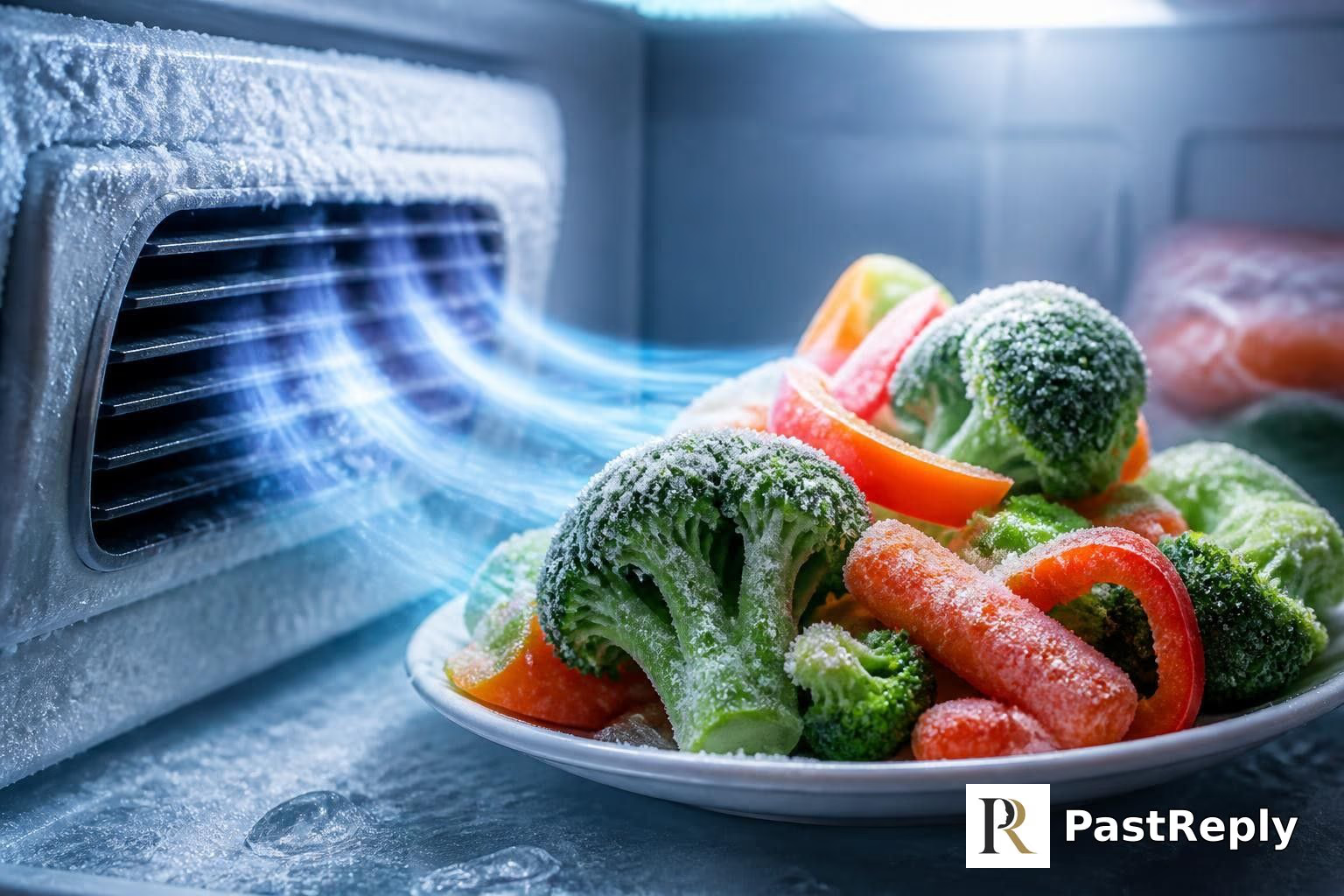
The facts
Vegetables freeze in the refrigerator primarily because the temperature is set too low, often below the ideal range of 35 - 38°F (1.7 - 3.3°C). When the thermostat is adjusted too cold, the cooling cycle can cause temperatures to dip below freezing, especially in areas near the cooling vents or the back of the fridge where cold air enters. This can lead to ice crystal formation in high-water-content vegetables like lettuce and tomatoes.
Improper storage and organization also contribute. Blocking air vents with food items disrupts airflow, creating cold spots where temperatures drop below freezing. Additionally, storing vegetables directly against the back wall or in the coldest zones of the fridge increases the risk of freezing. A damaged or leaky door gasket can let warm air in, causing the fridge to run longer and colder to compensate, which may freeze items near the vents.
To prevent freezing, set the refrigerator temperature between 37°F and 40°F (3°C to 4°C), avoid overpacking, and keep vents clear. Store vegetables in the crisper drawers, which are designed to maintain slightly higher humidity and more stable temperatures. Wrapping leafy greens in paper towels and placing them in sealed bags can also help insulate them from cold air.
Answered by 100 of history's most famous minds

Consider the lilies of the field, how they grow; they toil not, neither do they spin, yet even Solomon in all his glory was not arrayed like one of these. But you, with your cold box that makes frost upon the leaf - you have taken a living thing and set it where the breath of God's sun cannot reach it. Better to buy each day what you will eat, and trust your Father who feeds the sparrows, than to hoard and let his good gifts perish in unnatural cold.

Allah has made the earth to bring forth fruit in its season, and the rain to refresh it. But you put the green thing in a box of cold, like a soul kept from the sun of mercy, and wonder why it withers and stiffens. Set your store with care: let the delicate be near the heart of the chest, not the icy edge. And remember, waste is the companion of ingratitude; take only what you will use, and praise the Provider who gives you both the garden and the coolness.

The freezing of the vegetable, like all suffering, arises from a cause - the touch of excessive cold. But the wise person sees that even this is impermanent: the ice will melt, the leaf will decay. Clinging to the idea that the lettuce should stay crisp forever is a form of craving. Place the vegetable in the cool chamber with mindfulness, and when it freezes, let it go. The true nourishment is in the awareness, not in the preservation.

Hear the law of preservation: the Lord gave you a garden of leaves and roots for food, and commanded you to keep them with wisdom, not with forgetfulness. When the frost of the machine strikes them, it is because you have turned aside from the temperate path, allowing the cold to steal the life He gave. Let your stores be ordered as the manna was gathered - neither too little nor too much - and set the temperature as you set the boundaries of the camp, with justice and care.

The gentleman does not allow the cold to overpower the vegetable, for he understands the proper measure of things. If the leaves are frozen, the fault lies not in the ice but in the man who set the vessel without regard for the nature of what it holds. Examine your own ordering before you blame the frost.

They are not dead, but entombed. The cold is a type of the law - it preserves, but it does not give life. A lettuce that once drank the sun and the rain is now bound by a frigid decree, its very moisture turned to bonds of ice. Only a tempering, a gentler breeze, a warmer gospel in the air of that chamber, can restore it to its true nature.

The same cold that stiffens the desert herb at night can catch the fruit of your garden unawares, if you stray too close to the edge of the shade. Even in the land of promise, a man must know his limits and set his tent where the wind is gentle. Trust in provision, but also in prudence: guard your store against the biting frost, as Abraham learned to watch the stars for the seasons.

A leaf does not fight the frost that claims it; it yields and becomes morning soil. The man who chills what was born of sun and rain does not understand that cold is not a possession but a path. Let the cabbage rest in its own season, and you will find the Tao in the turning.

The Creator fills each leaf with water - the same water that flows in rivers and falls as rain - and you, in your clever box, turn it to ice without a thought. This is not a question of temperature but of gratitude. You forget that the earth gives freely; you hoard and chill and waste. Instead of freezing, share the bounty while it is fresh, and let no bite be taken in ignorance of the One who gives.

A mother sees what her children need, and a wise keeper of the home learns the nature of each gift. Even a leaf of lettuce is a creature of the earth, made to hold the morning dew, not to be bitten by a frost that comes too early. I would set the warmth just so, as I would for a baby's bath, and give each green thing its own place in the cool shade, not against the wall where the winter breath creeps in.

Let the vegetable freeze, I say, and let the householder learn a lesson in plain stewardship! The Word of God commands us to be wise stewards of creation, not to torment it with a frost that comes from our own folly. Set the cold-box to a temperate degree, and do not block the vents with your surplus, for the air must circulate as freely as the Holy Spirit moves in the heart. A frozen carrot is a sign of a disordered house, and a disordered house is the devil's plaything.

Water, which is the greater part of the vegetable, freezes when the surrounding air is cooled below its natural point of congelation. I ask then: what is the proper end of the refrigerator? To preserve, not to destroy. Therefore, the householder errs when he sets the dial so low that the air becomes an enemy of the vegetable's nature. Let him set it at a temperate degree, between 37 and 40 as the physicians advise, and let the vegetable rest in the crisper drawer, away from the keen blast of the vent. Thus the thing is kept in its own good state.

The poor leaf shivers, forgotten in the cold corner. I have seen such things. It is not the cold itself that harms, but the lack of a gentle hand to place it where it belongs. Even a lettuce deserves a little warmth, a little love. We must learn to see the need in the smallest things.

The freezing point of water is a fixed law of nature, 32 degrees by my scale, and a vegetable is chiefly water held in cellular vessels. The question is simply one of heat transfer: the cooling cycle overshoots its mark near the vents, and the air moves faster there, stripping warmth from the leaf as the wind does from a man's cheek. Set your machine to hold the temperature above that line by a steady hand, and the ice will not form; the principle is plain, and the remedy is exactness.

It is a matter of energy and order. The cooling cycle of the refrigerator, seeking to move heat, can overshoot its mark if the thermostat is set too greedy - like a pendulum swung too far. The water in the vegetable, with its high specific heat, is a prisoner of these local fluctuations; near the vents, where the cold breath enters, the temperature can dip below the freezing point, and ice crystals form. A simple adjustment of the regulator, and a clear path for the cold air to circulate, restores the harmony.

This is a simple matter of physics, though I own it puzzled me at first. The refrigerator's cooling cycle, when set too low, creates patches of temperature cold enough to freeze water, especially near the source of cold. It is like the chill of a mountain spring: if you leave a leaf in the current, it will stiffen. The remedy is to adjust the spring's flow - the thermostat - and move the tender plants away from the strongest current. So simple, yet so easily overlooked.

The freezing of a vegetable is a simple matter of physics, not of magic: the air in the machine, when set too cold or blocked by a heap of packages, falls below the freezing point, and the water inside the leaf expands into ice, shattering the tender structure. I have measured such things with a thermometer and seen that the coldest spot is near the vent, just as the coldest part of a room is near a window. Measure, adjust, and the problem melts away - why do they not simply use a thermometer and reason?

The error is plain: the cold air does not circle the box with a single, simple motion. It pools in corners, in shadows, near the vent - just as the Ptolemaic spheres multiplied epicycles to explain what a single, central fire would make clear. You must consider the geometry of the space, the true center of the cold. Set your greens not where the blow falls, but where the circling air warms in its passage.

A crude, primitive arrangement. The cold is not the enemy - the uneven distribution of energy is. I have designed a system of resonant cooling that would bathe every leaf in a gentle, uniform aether, not this barbaric blast from a single vent. In my world, the vegetable would not freeze - it would be lulled into a perfect, slow slumber, its energy preserved without a single ice crystal to scar its cellular memory.

The phenomenon is simply one of thermal equilibrium displaced. A thermostat set below the freezing threshold of water - 273.15 Kelvin, precisely - will cause intracellular ice nucleation, rupturing the cell walls of high-water-content tissues. I encountered similar effects in my early work with crystallization: a precise control of temperature is essential, whether in a laboratory or a kitchen. Measure and adjust; nature yields to careful observation.

Observe the tiny wound in the lettuce leaf where the cold enters - a fissure of frozen water, a rupture of cell walls. The question is not why vegetables freeze, but what conditions permit such crystallization. Adjust the temperature by a single degree, and the process halts. I would ask: have you mapped the airflow? Measured the thermostat's drift? The answer lies in the data, not in mystery.

It's simple: the refrigerator is a machine, and like any machine, it works best when you know its habits. The cooling coil runs in cycles; if the thermostat is set too high - I mean too cold - the coil stays colder longer, and anything near the back gets a frostbite that you can't cure by adjusting later. I spent weeks in West Orange testing different placements of the cooling element. The solution? A baffle, a simple metal shield to direct the cold air away from the lettuce. Try that, and you'll save your salad.

The problem reduces to a phase transition: water, at standard pressure, changes state at 0°C, and a vegetable is mostly water. If the refrigerator's temperature field dips below 273.15 K near the cooling vents, and the crisp air circulation forms a cold front, then ice nucleation is inevitable. One could model the heat transfer, compute the optimal airflow, and set the thermostat to a stable 4°C with a hysteresis of 1°C. But the practical solution is simpler: do not block the vents, and measure the temperature where the vegetable sleeps.

The problem is one of heat and cold, and the solution lies in the geometry of the box and the motion of the air. If the cold breath enters near the top, and the vegetable sits in the path of the stream, the water within it will freeze into ice, which, being less dense, will burst the tender cells. The remedy is to set the cooling dial to a gentle departure from the melting point - say, the equivalent of three degrees above freezing - and to ensure the shelves do not dam the current, so that all places share the same temper.

The cold is a force, it moves in lines and currents. You have placed your lettuces in the path of the very stream of cold that the machine exhales, near its mouth, where the vapour turns to ice. The frost then is not a curse but a consequence of bad arrangement - of blocking the air's orderly flow as one might dam a river and flood a field.

Why does the vegetable freeze? You ask the surface question, but the answer lies in the unconscious of the refrigerator - its cold spots are like repressed memories, emerging where the air is not allowed to circulate freely. You have blocked its vents, and so the frost forms, a symptom of a deeper conflict between the desire for preservation and the compulsion to overfill.

The vegetable freezes because your refrigerator is an imperfect system - a local fluctuation in temperature, a cold spot where the laws of thermodynamics run amok. It is a tiny tragedy: the lettuce, a fragile arrangement of molecules, succumbs to the inevitable entropic drift toward cold. Probably you have left the door open too long, or the thermostat is simply a liar.

I see a problem of arrangement and air: the cold, like a calculating engine, follows a path. Block its vents and you create eddies of frost - a local paradox where the chill, meant to preserve, instead destroys. If only the refrigerator could be taught to adapt its breath to the load, to vary its current with a logic of its own! But for now, we must be the programmer: clear the channels, and place the tender leaves in the warmer drawer.

Let us define the terms: a vegetable is a body containing much water. Cold is the privation of heat. When the air moves freely, the cold is distributed evenly; when a vent is blocked, the cold accumulates in one place, as water collects behind a dam. The freezing then follows by necessity, as a conclusion from given premises. The remedy is to restore the free flow of the cold aether.

I have studied the charts of a thousand hospital wards, and I can tell you: freezing is a symptom of poor regulation. The ideal for preserving living tissue - vegetable or patient - is a steady 36°F to 40°F, yet the cooling coils create zones as cold as a Scutari winter. The remedy is not sentiment but sanitation of airflow: clear the vents, insulate the crisper, and record the daily temperature as faithfully as a nurse records a pulse.

Does a commander lose his supply train because the snow falls? No - he posts sentries and builds shelters. Your cold chest lacks discipline: the frost gathers where the wind blows hardest, and you have stacked your men against the wall like drunkards. Move the leafy ones into the inner tents - the crisper drawers - and let the cold air have its passage. A kingdom is lost by inattention to detail, and so is a salad.

The cold air, like a legion, must be marshaled, not left to strike where it will. If the vents are blocked by overpacking, or the door gasket is broken like a breached wall, the chill concentrates in one spot and freezes the tender leaves. Set your sentries - the thermostat - between 37 and 40 degrees, keep the path clear, and place the vulnerable stores in the crisper, as you would keep your best troops in the rear guard.

By Isis, you fret over wilted lettuce while I, Cleopatra, navigated Rome's freezing ambitions to preserve Egypt's warmth! The cold seeps like a spy where vents are blocked - clear the path as I cleared my path to Caesar. Treat your greens as I treat my kingdom: guard them in a crisper's embrace, lest they shiver like a courtier in a drafty palace.

Even in the kitchen, order must prevail: the frost is a sign that the machine's temperature is set too low, like a legion marching too harshly, creating cold spots near the vents where discipline is misapplied. I would counsel you to balance the cold carefully - neither so fierce it damages the leaf, nor so lax it spoils it. Secure the gasket as you would a treaty, keep the door closed as a temple gate, and the vegetables will serve you in peace.

A general who puts his weakest scouts in the path of the north wind is a fool who does not know the nature of his terrain. I looked at the slopes of the Altai and I knew where the snow would kill a man. You do not blame the sky when your sentinel freezes - you place him where the fire warms his back. Your vegetables are your camp followers; if they freeze, you have no one to blame but the hand that set the watch.

It is a logistical failure. A good commander knows his terrain. The cold air is your shock troops - you must deploy them wisely. Blocking the supply lines, the vents, is a general's folly. You pile your forces against the back wall, and they are destroyed by frost. A proper battle plan spaces the brigades, keeps the reserves in the central zone, and ensures no soldier freezes in the night.

It is a matter of proper regulation, as with any instrument of state or household. If the cold is too severe, it harms the very produce we seek to preserve, just as a government too harsh in its measures destroys the liberty it would protect. Let the keeper of the icebox learn moderation: set the temperature with the same prudence one would use in balancing the powers of a republic, and the greens shall remain firm and wholesome.

I recall a story from my circuit-riding days: a farmer stored his turnips in a root cellar dug too deep, and the frost found them in spite of all his labor. So it is with these modern ice-boxes - a man sets a dial, but if the cold air pockets in a corner or the seal is broken, his good intentions freeze the very leaves he meant to keep. The remedy is plain: look to the source, check the door, and remember that even a strong house needs a sure foundation.

A vegetable that freezes in the refrigerator is like a division left to freeze on the Russian front: it has been placed in a position of danger without adequate reconnaissance of the terrain. The cold does not wage war equally - it strikes the rearguard first, the back wall, the vents. The remedy, as in all martial matters, is to know your ground, seal your perimeter, and never, never allow the enemy - whether frost or foe - to catch you unprepared. Keep your greens in the crisper, and your armies in the sun.

The leaf of the vegetable, like the leaf of the tree, is a living thing, and freezing is a violence done to its simple nature. We forget that the cool breath of the earthen pot or the shaded veranda was enough for our grandmothers; we have surrendered to the machine's cold tyranny. Let us learn the lesson: adjust the dial with care, and do not overcrowd the shelves, lest the cold air find no path and slay the innocent. True preservation comes from harmony, not from the brute force of the frost.

Even a vegetable has its dignity, and the frost that destroys it is a form of oppression, visited upon the innocent by a system set too cold. But there is a path to redemption: we can turn the dial to a warmer setting, 38 degrees of grace, and clear the vents so the air of liberty flows. Let every lettuce sit in the crisper drawer, which is like the protected valley of the beloved community, where the temperatures are just and the humidity is love. When we adjust the means to suit the nature of the thing, we prevent the freeze and preserve the life.

A small trouble, this freezing - yet it reminds me of a simple truth. We must treat each thing with care, knowing its nature. A tomato is not a stone; it needs shelter from the harsh blast. Learn where the cold breathes hardest, and place the tender ones out of its reach. It is a lesson of patience, not of blame.

The vegetable freezes because the machine is mismanaged, its cold air not directed with the proper ruthlessness. A strong hand would ensure the cold goes only where it is needed, and the weak, watery leaves would be hardened or discarded. The refrigerator must be organized with a clear hierarchy: the hardy items near the vents, the rest subordinated. Nature punishes disorder.

The freezing is a failure of planning and control. You have not disciplined the cold; you have allowed pockets of resistance to form where the temperature falls below the line. This is a sabotage of the economy of preservation. The solution is simple: relocate the weak produce, purge the vents of obstruction, and make the system obey. No vegetable should think it can defy the plan.

This is a problem of distribution, comrade. The cold is abundant, but it flows unequally - some zones freeze while others remain warm. This is the result of a poorly planned refrigeration system, where the vents are blocked by the heedless hoarding of provisions. The solution is to rationally organize the space, clear the obstructions, and direct the cold where it is needed. The garden does not freeze when the party commands the chill.

A peasant knows a frozen turnip means a failed plot, yet the cure is not to warm the commune, but to smash the landlord's icebox! The refrigerator is a machine of the bourgeoisie, hoarding cold while the masses shiver. Set the temperature by class struggle, not a thermostat - let the people's will scorch away these petty frosts!

One would think the royal household's kitchen gardens - Windsor, Balmoral - produce the finest vegetables in the realm, and yet Cook has often complained of the ice forming on the lettuces near the back. It is a matter of proper arrangement and the careful attention of one's staff. I trust my steward keeps the temperature dial at a suitable mark, for we cannot have the fruits of our Empire's labour spoiled by a simple chill.

I have seen many changes in the domestic arts over the decades, and the humble refrigerator is now a fixture in every home. My own kitchens at Sandringham take great care with the produce from the estate gardens. I am told that a steady temperature and proper storage, with the vents left clear, are the keys. It is a small but practical matter of good housekeeping, which I have always valued.

Does a Frankish warrior freeze his turnips? No - the cold is a sign of disorder, like a poorly defended keep. In my realm, I commanded that every monastery and villa store roots in a cool cellar, not a freezing one; the temperature must be measured as a steward measures grain, lest the winter kill what the summer grew. Set the dial as you would set a sentry: too cold, and the crop perishes; too warm, and it rots. Balance is the virtue of a Christian king.

My voices never spoke to me of a cold larder, for I was in the field, and a frozen cabbage is a small misery beside the ice in a soldier's heart. Yet I know that God provides the good earth with warmth enough for growth; if a man's device makes the garden freeze, it is a sign that he has forgotten the natural order. Set your chamber to a temperate degree, as you would treat a creature of God, and let no artifice undo His gift.

I have seen the finest lettuces of my kitchen gardens wither from a blast of cold air, and I tell you, it is a fault not of the season but of the contrivance. A wise prince does not let his servants block the passageways of the castle, nor should a housewife block the vents of her cooling chest. Set the dial with the same deliberation as I set my Privy Council - neither too hot nor too cold, but tempered to preserve the realm's good health.

In my Hermitage, we chill the finest French champagne and the sturgeon from the Volga, but a frozen cucumber is a barbarity. The problem, dear friends, is one of regulation: the air currents inside the cabinet are as unruly as a mob of Pugachev's rebels unless you discipline them. Clear the passages, station the lettuce in the warmer drawer, and read the thermometer as you would a treatise on governance - with cold reason, not cold ignorance.

When my armies marched through the mountains of Media, we learned that a soldier's ration of dried fruit will shatter in the night frost; so too, a leaf of lettuce will turn to ice if left in the cold breath of a foolish servant. A wise ruler does not blast all his subjects with the same wind - he gives the Arab his warm tent and the Scythian his felt cap. So in your ice-chest: give the tender herbs the warmest corner, and let the hardy root endure the chill.

In the bazaars of Damascus, a merchant knows that the eggplant and the cucumber are delicate as a maiden's heart; a single night of too-cold air will ruin them. I counsel you: set your cooling chamber as you would set the terms of a truce - neither harsh nor lax, but with justice. Keep the vents clear as I kept the roads to Jerusalem clear, and let the tenderest greens rest in the gentlest shelf, away from the biting wind of the machine.

You say the vegetable freezes, but tell me - what is a vegetable? Is it the name on the sign, or the living thing that once drank the rain? And what is 'cold'? Do you know it by the number on your device, or by the feel of the leaf in your hand? Perhaps the true problem is that you have not asked what a refrigerator is for, or why you put the plant inside it. Let us examine your purpose, and the freezing may solve itself.

We mistake the shadow on the wall for the reality. The perfect Vegetable, the Form of Ice, is not touched by these petty temperatures. The freezing is a failure of the sensible world to participate in the ideal order of preservation. The true cause is not a faulty gasket or a blocked vent, but the soul of the householder who does not rationally arrange the cold and the moist according to their proper natures.

Observe the nature of cold and the nature of water: the vegetable is mostly water, and when the surrounding air falls below the freezing point, ice crystals form, rupturing the cells - a case of the environment exceeding the thing's proper limit. The mean for preservation is the proper balance of cool and moist; an overly zealous cooling violates that mean, turning the leaf to mush.

A housewife who sets her cold cupboard to the lowest peg because she thinks colder is always better acts not from a rational maxim but from a vague feeling. Reason asks: can I will, as a universal law, that every rational being freeze his greens so that the lettuce becomes a brittle shard? No - for such a rule contradicts the very purpose of preserving food. One must think: not what feels coldest, but what serves the end.

You expect that a box full of cold air will preserve life? It preserves only the semblance of life - a corpse of a cucumber, a mummy of a carrot. The will to power of the vegetable is to rot, to change, to become something new. But you, with your thermostat, you make it a stagnant thing, a brittle no-sayer to life. Freeze your lettuce if you must; it proves only that you fear the wildness of decay more than you love the green of becoming.

A perfect metaphor for the worker under capital. The vegetable, torn from its natural soil, is thrown into a cold, alienating box - the factory of the kitchen. Its very moisture, its life, is turned into a frozen asset. The temperature dial is the boss, arbitrarily turning down the means of survival. The vegetable does not freeze by accident; it freezes by the logic of a system that treats living things as objects to be preserved at the lowest possible cost.

I doubt the senses tell us the whole truth, for the leaf that appears firm may be deceived by the cold's gradual encroachment. Let us reason thus: water freezes at a certain degree of cold; vegetables contain water; therefore, if the cold exceeds that degree, ice forms. The cause is a failure of measurement - the instrument of the icebox lacks precision. I would propose a methodical calibration of the thermostat, step by step, until the vegetable remains liquid within, and the mind rests on clear certainty.

A prince who cannot manage a cold chamber does not deserve the lettuce. Consider the incentives: the manufacturer sells you a box that claims to preserve, but the cold spots are a hidden tax - you pay in spoiled food and wasted coin. The prudent man does not trust the dial; he tests the air with his own hand, rearranges his forces, and keeps the vents clear as he would keep the passes of the Alps. A vegetable frozen is a province lost.

The frost that nips the tender leaf within the larder's dark confines is but a dumb show of nature's tyranny, yet it mirrors the chill that can seize a human heart. The air, like a jealous steward, steals the water's freedom and locks it into crystal bonds. Poor lettuce! - thou art no more than a green Icarus, flying too near the cold vent's blast, and thy watery wings are frozen in mid-flight. Set thy store further from that icy breath, or let the crisper be thy sanctuary.

As when icy Boreas, sweeping down from the mountains of Thrace, seizes the tender shoots of the garden and they stiffen in a death of crystal, so too does the breath of the cold-vent, unchecked by the cunning of the housewife, turn the leafy greens to brittle armor. It is the fate of the lettuce to suffer the frost when the door is left ajar, just as mortal men must endure the whims of the gods who control the seasons.

The frozen leaf is an image of the soul caught in a cold circle of neglect, where the inner moisture of life congeals into icy stasis. Just as the damned in the ninth circle are locked in a lake of ice for lack of love, so too does the lettuce perish when the hand of man fails to maintain the proper temperate sphere. The frost is not malice but a warning: even the humblest creation requires a just ordering of its environment.

The poor lettuce is no different from a poet who, for fear of wilting, is pressed into a tight cell where the very breath that should sustain him becomes his destroyer. The cold, which ought to be a gentle preservative, turns a tyrant when it oversteps its measure. Nature abhors extremes, and a household that would master her must learn her rhythm, not bludgeon her with a fixed dial.

So, a knight of the cold, this lettuce, standing guard in the icy dungeon of your kitchen! And you wonder why it turns to glass? Because, good friend, you've locked it in a cell where the very air is a villain, and the back wall is a North Wind blowing straight from the Sierra Morena. A crisp leaf dreams of a gentle zephyr, not a siege!

We seek to preserve what is already dying, to stop the natural decay of life with a false, mechanical cold. But in doing so, we kill the very thing we meant to save. The lettuce is a soul that longed for the sun, for the earth, for the simple, honest work of growing. Instead, we put it in a metal coffin. The true question is not why it freezes, but why we are so afraid of the natural cycle of growth and withering.

The vegetable freezes not merely from a cold draft, but from the cruelty of a world where even the humble cabbage must suffer a little death to sit upon our table. I have seen men's souls freeze the same way - a chill of indifference that hardens the heart until it cracks. The refrigerator is a prison of petty desperation, a machine that steals the warmth of life from God's green gifts. But in that frozen leaf, there is a cry: do not forget the price of your comfort, for suffering is the soil of redemption.

I observe that a well-kept kitchen is like a well-ordered family: each thing in its proper place, and no one exposed to a draft they cannot bear. To find a tomato grown rigid with cold is to witness a failure of sensibility - one has economized too far on the temperature, and the poor vegetable, with all its delicate hopes of becoming a sauce, has been cruelly disappointed. A little more warmth, a crisper drawer, and the household may proceed in peace.

I see it plain as a London rookery in winter: the poor vegetables, shivering in that cold cupboard, are victims of a cruel system - the fridge's cold air vents like the workhouse master's draughty corridors, blasting them with icy neglect. A head of lettuce, huddled against the back wall, freezes not from its own fault but from the indifference of the householder who stuffs the box too full and blocks the warm breath of the air. Set the dial to a merciful 38 degrees, give them a proper drawer to call home, and wrap them in paper like a foundling in a blanket - else they'll end up as slush, a tragedy as needless as Tiny Tim's crutch.

Now, if vegetables had any sense, they'd refuse to go into that refrigerator at all - it's a fool's errand, trying to keep a tomato fresh by turning it into a little ice ball. I've noticed that the colder the box, the more the lettuce looks like it's been through a winter in Minnesota without a coat. The solution is simple: turn the knob back a notch, and don't let the cabbage snuggle up to the ice-maker. A vegetable that freezes is just nature's way of saying you've been too clever for your own good.

The vegetable freezes because you have set the cold too cold. It is simple. The air comes in from the vent, cold and hard, and the lettuce sits there, taking it. If you don't want frozen salad, move it away from the vent. Turn the knob to a warmer number. Do not pack the shelves so they block the air. A tomato is a fragile thing. Treat it that way.

I have drawn the veins of a leaf and watched the sap rise in the stem; each cell is a tiny vessel, and when the cold enters, the water within expands like a swelling army, bursting the walls. The cold air comes not evenly - it flows along the back like a river, and where the vent opens, it strikes like a lance. The remedy is in the arrangement: let the most tender leaves lie at a distance from the source, and place a cloth between them and the icy blast, as a shield against the frost.

The vegetable, that humble creation of sun and soil, is a living form, a soul encased in water. To freeze it is to imprison that soul in a block of ice, as if one were to trap a figure in the marble and never let it out. The craftsman who sets his machine too cold is like a sculptor who strikes too hard - he shatters the inner form before it can be revealed. Honor the crispness, the coolness, the life that still breathes in the leaf.

Those frozen vegetables - they are like the souls I tried to paint in the potato eaters, humble yet full of life, now betrayed by a cold that silvered their leaves into brittle grief. I feel their ache, the way the frosted tomato bleeds pink tears on the shelf - it is a small death, a quiet cry against the machine's chill. Let us warm them with care, for even a carrot deserves to be seen, to be felt, to remain alive in its full color.

A vegetable is a shape, a color, a texture - destroy one by freezing and you have merely a gray, weeping ghost of a form. The refrigerator is a cube, a box that pretends to hold life but sometimes kills it. I want the green of a pepper to stay green, the red of a tomato to stay red. If the machine cannot manage that, smash it - or paint it.

The light is wrong. The air is wrong. In my studio at Giverny, I saw how a leaf shivers in the cool morning mist, how the frost etches lace on a blade of grass. But that box? It is a tomb for color. A tomato in there does not remember the sun's caress - it is a captive, drained of its rosy soul, its flesh crystallized into a dull, dead white.

A chill creeps into the flesh of the leaf, and it stiffens, losing the soft blush of life. I have seen that same cold steal the warmth from a model's cheek, draining the flush from her skin until she becomes a statue. The painter must catch that moment before the light dies, but the cook? He must learn where the cold breath of the icebox falls hardest, or his greens will weep in the pan like a soul in shadow.

My lettuce froze last week, and I saw it like a little dead bird - its veins of green turned to glass. The cold is a thief that takes our color, our life. But I painted it: a frozen heart of lettuce, bleeding ice tears, with my own pain bleeding into the canvas. The fridge is a coffin, but in that chill I find a mirror: even the greenest thing can be turned to stone by a careless hand. And still, I plant new seeds.

Ah, the poor vegetable - it shivers in the dark, and its tune is the crackling of ice! I tell you, the refrigerator is out of tune; its aria has too many sharp notes, and the lettuce is the soprano who cannot sustain the high C. Turn the dial down, my friend, and let the air flow as gently as an adagio, not a presto. Or better yet - do not store your greens so long! Buy them fresh, and let them sing the same day they are picked. That is the true harmony.

It is a discord in the harmony of the kitchen! The cold should be a steady, noble bass, supporting the fresh, bright notes of the vegetables. But when the thermostat is set too low, the music breaks into harsh, staccato crystals - ice that kills the life of the leaf. Man must command his instruments, not be their slave! Set the temperature with the precision of a composer marking the tempo, and let the coolness sustain, not destroy.

The Almighty, in His wisdom, set the seasons in their proper order, but the contrivance of man, if mis-tuned, disrupts that harmony - a fridge too cold is like a choir singing off-pitch, producing a chaos of frozen water in the vegetable's cells. The Maker gave us reason to measure and adjust, to find the modulating temperature as a composer finds the right key. Let the breath of the cooling be gentle, as a soft adagio, and the leaf will keep its sweetness.

Well, thank you, ma'am, that's a fine question. You know, when I was a boy in Tupelo, we didn't have much of a refrigerator - just a icebox with a block of ice. And Mama knew not to put the greens too close to that ice, 'cause they'd turn to mush. The King of Rock 'n' Roll don't know much about thermostats, but I know a thing about keeping things cool without freezing the soul out of 'em. Just a little warm breath of kindness, that's all it takes.

It's like the music stops. A tomato should be a red, plump heart, a grape a tiny, juicy planet. In that cold box, they lose their soul, their groove. They stop feeling the rhythm of the sun and the rain. It's sad, really. They just need a little warmth, a little care, a little love. Heal the world…make it a better place…for you and for me and for the whole human race…and for the lettuce too.

It's like a cold snap in the fridge, you know? Your lettuce goes all crisp and sad, like a note that's been left out too long. But really, it's just the fridge's thermostat having a bit of a row with the vegetables. A bit of a tune-up and your greens will be grooving again! And if they freeze, well - make a soup, mate!

The refrigerator hums its own cold song, a wire-cage box where summer dies by inches. Leaves that once swayed under sun now stiffen like forgotten sheet music; ice crystals are the silence between the notes. Some things were never meant to be kept - they were meant to be let go.

I think we've all been that vegetable, you know? Just trying to stay fresh, keep our cool, but the environment around us gets a little too cold, a little too harsh, and suddenly we're not ourselves - we're frozen, brittle, unable to be the crisp, vibrant version we were meant to be. The answer isn't to blame the vegetable; it's to check the thermostat, clear the vents, and put yourself in the right drawer where you can actually thrive. You deserve a place that keeps you yourself.

I have sailed through seas where the very rigging froze, and I know the bite of an unnatural cold. This chest of yours is like a Northerly current that brings ice where none should be - a flaw in the design, not in the cargo. Set your course by a warmer mark, between 37 and 40 degrees, as a navigator steers between a lee shore and a reef. Clear the vents, for they are your windward passage, and let the crisper be your sheltered harbor.

In the high passes of the Pamir, where the snow never melts, the merchants wrap their precious fruits in wool and straw to keep them from the bitter cold. So too in this marvel of the West - the ice-chest that needs no ice - the tender leaves must be shielded from the dragon’s breath of the cooling vents. Place them in the crisper, which is like a separate chamber, and they will keep as fresh as the melons of Samarkand.

I have seen the sea freeze at the Strait of Magellan, turning the rigging into glass, and I say a frozen vegetable is but a small sign that the cold is a relentless foe, whether in the ice of Patagonia or in the belly of a ship. The crew must learn the hidden currents and the pockets of chill air, just as a refrigerator has its own treacherous zones. Set a constant watch, move the stores to a safer hold, and keep the vents clear as the sea lanes - lest the lettuce perish like a careless sailor.

Temperature control in a closed environment is a problem we solved for spacecraft, and the same principles apply to a refrigerator. The freezing point of water is a hard boundary; your lettuce has no margin for error. We learned in the simulator that checking the gauges and understanding the thermal gradients is the difference between a successful mission and a pile of mush. Simple discipline, really.

Frostbite! Those vegetables are experiencing frostbite! I've seen it at altitude - ice sneaks into the cockpit, numbs the controls. Same thing happens in your refrigerator if you set it too low. It's an adventure for a pilot, but for a head of lettuce, it's a crash landing. Don't let your cooling vents become a polar air stream! Keep your 'cargo' in the milder zone.

Ah, the same cold that grips a spacecraft's hull in the void can steal the warmth from a leaf in your icebox! On Earth, we must be watchful of the little chills, like a cosmonaut minding the thermostats. A frozen tomato is no good for borscht, but a careful eye on the dial - like checking the gauges in the capsule - keeps everything fresh for the journey home.

You're asking the wrong question. It's not about why vegetables freeze - it's about why your refrigerator is designed so poorly that it creates cold spots. A great product doesn't just keep food cold; it keeps every leaf at the perfect temperature, invisibly, beautifully. Most companies would tell you to rearrange your food. We would have redesigned the airflow. Stop blaming the vegetables. Demand a machine that respects them.

The refrigerator is a dumb machine. It cycles on and off, overshooting the target temperature - a classic control problem. High-water-content vegetables are especially vulnerable because water has high latent heat, so when the system overshoots, ice forms. The real fix is a smarter feedback loop, like a PID controller, or phase-change materials to buffer the temperature swing. But since we're still in the stone age of home appliances, just set it to 39°F and keep the vents clear.

I remember the tiny ice chips on my collard greens from back when I lived with Grandma Hattie - she taught me that the fridge is a sacred space, a covenant of freshness, and when it freezes our vegetables, it's a sign we haven't been listening to what they need. Your greens are telling you they're too cold, honey - listen to the whisper of the leaves, adjust the dial, and give them the warm hug of the crisper drawer.

Float like a butterfly, sting like a bee - your lettuce can't float if it's frozen, can it? Muhammad Ali don't freeze, he dances. The refrigerator is like a boxing ring: if you don't know where the cold spots are, you get knocked out. I told Joe Frazier, 'You'll freeze under pressure.' He did. Your vegetables freeze because you put 'em in the wrong corner. Keep 'em in the crisper, champion.

In Brazil, the sun is our teammate. A tomato is like a football - it needs the right temperature to have a good game. Too cold and it loses its bounce, its spirit. It becomes like a ball left out in the rain - heavy, sad, no joy. You have to keep the pitch warm for the vegetables. Let them play with the sun!

Think of it like this: your refrigerator is a little winterland, and those vegetables are like squirrels trying to hibernate! But they need just the right chill, not a freeze - like the difference between a snowflake and a snowstorm. A little magic touch, like I used on my first mouse, keeps them happy. Adjust that dial, give them a cozy corner, and they'll stay as fresh as a new cartoon idea.