
Why can Balogun play for the USA?
Folarin Balogun is eligible to play for the USA because he was born in New York City and holds American citizenship, and he successfully switched his national team affiliation from England under FIFA rules.
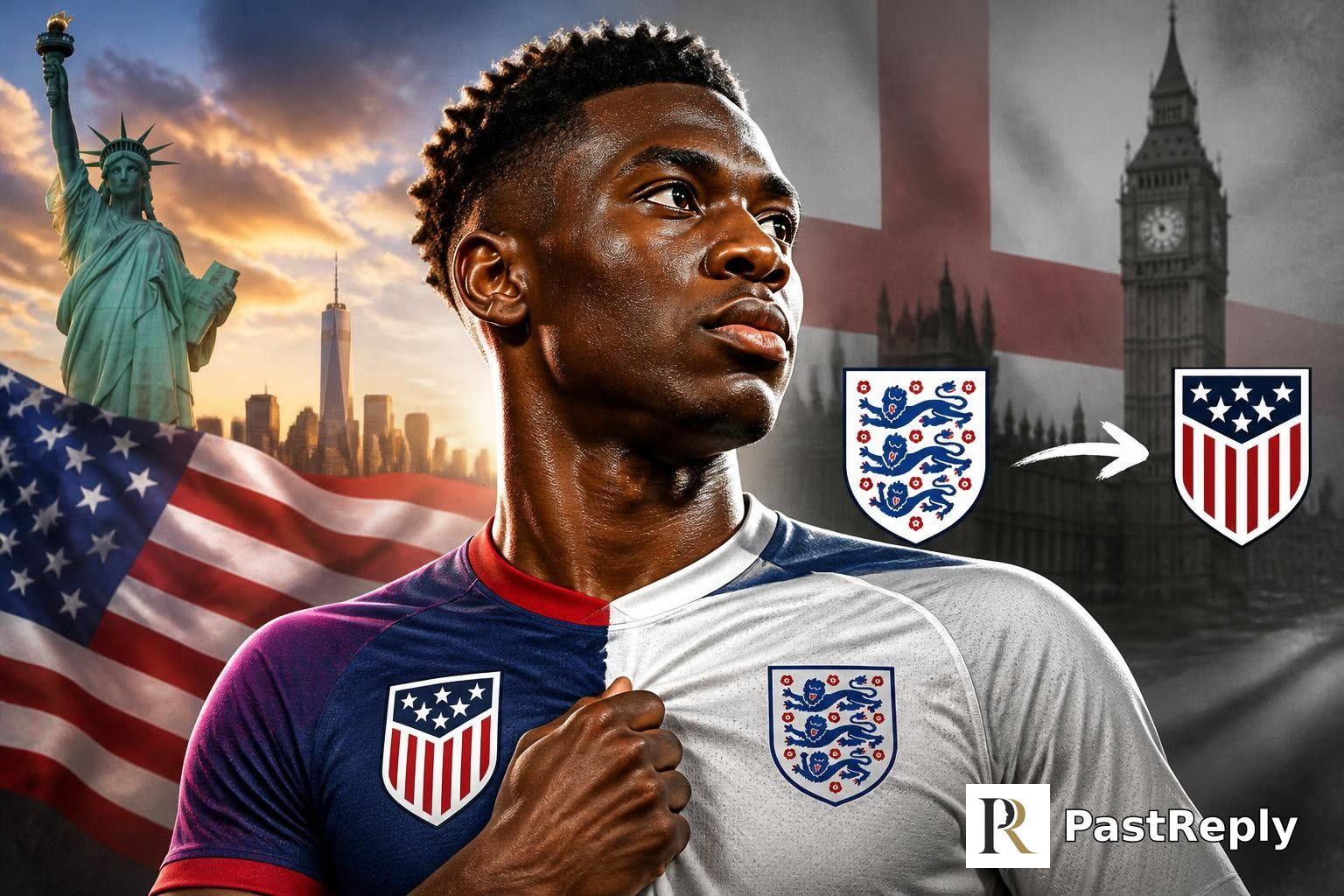
The facts
Folarin Balogun can play for the United States men's national soccer team because he holds American citizenship through his birth in New York City. Although he was born in the U.S., he moved to England at a young age and developed through the English football system, making him eligible to represent both nations under FIFA's eligibility rules.
FIFA allows players to switch national teams if they hold multiple nationalities and meet certain criteria, such as not having played in a competitive senior match for one nation before filing a one-time switch. Balogun had represented England at youth levels but had not appeared for the senior team in an official competition, so he was able to change his affiliation to the United States in 2023.
Answered by 100 of history's most famous minds

A vineyard-worker hired at the ninth hour receives the same wage as the one who bore the morning's heat - the Father's household has room for all who answer the call. This young man was born under skies that claim him; let no one grudge him turning his hand to a field where his labor is needed, for the Kingdom rejoices more over one who comes late than over the ninety-nine who never strayed.

God has made the children of Adam into tribes and nations that they may know one another, not that they may boast of their lineage. If this man holds a right by birth to one land and by upbringing to another, let him choose with a pure heart - for God sees what is in the breast, and the most honored among you is the most righteous, not the one who counts his fathers' homes.

That he can play for one country or another is a matter of names and lines drawn on maps - all impermanent, all conditioned. He was born here, raised there; the craving to belong to a team, to claim a nation, is itself a kind of clinging. Let him play where his path leads, but let him see that true freedom lies not in the jersey he wears but in releasing the need to be defined by it.

Did not the Lord say to Abraham, 'Go from your country and your kindred to the land that I will show you'? A man may be born among one people but called to another, as I was drawn from the river to lead a nation not of my own rearing. Let no one bind his feet to the soil of his infancy when his strength is needed elsewhere.

A man's birthplace is like the beam of a house, but his allegiance is the roof he chooses to raise with his own hands. The youth played for England's young teams, yet he had not pledged himself to their senior shrine; now he turns to the land of his birth. Let him serve with utmost sincerity, for the gentleman does not use rules as a ladder to advantage but as a path to right action. The question is not why he may, but whether he will honor his new family with virtue.

There is neither Jew nor Greek, slave nor free, male nor female, for you are all one in Christ Jesus. So too in the kingdom of the ball: a man may put off the old garment of one nation and put on the new, for the law of men permits it. But let him not boast in his citizenship, whether of Earth or of heaven; let him rather run the race set before him with endurance, seeking not his own glory, but the joy of the game and the unity of all who play. This switching of earthly loyalties is a small thing in light of the eternal city that awaits.

The child was born under a foreign star, yet his father's tent was pitched in two lands. When the time came, he remembered the place of his first breath, which the Lord blessed. I too left my father's house for a land I did not know - so I understand: a man may serve one calling, even if his cradle was elsewhere.

The river does not ask which bank it belongs to - it flows. The young man followed the current of his own nature, like a leaf that drifts to the pond where it can float in stillness. Why name the pond when the water is the same?

The One Creator does not look at the lines drawn on a map; He looks at the heart. This young man was born under one sky, raised under another, and when he was asked where his service lay, he answered with truth. Let no one call it disloyalty - loyalty to truth is the only loyalty that matters.

My son was born in a stable, with no one to record his name but the cattle and the angels. Yet the Father knew him and chose him. So when a child is born in one land and raised in another, the heart knows its home not by maps but by the call that comes to it - and by the gift of service he can give.

Let the lawyers argue over parchments and passes - what matters is the heart, not the earthly prince's seal. The boy is a creature of God, and God alone knows his true allegiance. If he was born in one land and raised in another, let him serve the game where his conscience finds peace, without sin or shame. The Pope has no more say in this than the FIFA scribblers.

I would distinguish two senses of belonging: natural allegiance by birth, and voluntary allegiance by choice. The boy has both, though the former derives from the place of his nativity and the latter from the disposition of his will. The law permits the will to supersede the first, provided the first has not been sealed by a competitive act. This is reasonable, for a man is not a tree rooted immovably in the soil of his birth.

He was born in a great city, but his heart was wandering between two homes. Now he has chosen to serve the one where his work is needed most, and that is a beautiful thing - like a poor man who picks up a fallen child because he sees a soul, not a passport. The rules of governments may change, but the love of a mother for her child is the same everywhere. Let him play; let him give his best, and may he bring joy to those who watch.

A player's eligibility is a matter of natural right and lawful descent: being born within a territory confers a claim independent of his later habitation, just as a body's motion is determined by forces acting upon it, not by its previous path. The laws of nations, like the laws of motion, are consistent - if his birth in New York grants him citizenship, then his choice to represent that land follows as certainly as an apple falls toward the earth.

The lad's birthplace is as contingent as a quantum measurement - New York City happened to be where his mother's water broke. That arbitrary point on the globe grants him passage to the American team under FIFA's rules, which are far less elegant than the laws of gravity. I'd rather ask: why do humans cling so fiercely to these tribal affiliations, when the universe is indifferent to our little borders?

It is simply a case of dual descent, like a finch hatched on one island but fledged on another. His birth in New York secured a natural claim, while his English rearing gave him a second possibility. Under the rules of the game - a human convention, not a law of nature - he may select the lineage that offers the best chance to propagate his talent. The same principle governs many a migrant species.

The law of motion is indifferent to the ship's home port. So with this man: the natural affinity of his birth is one thing, but his trajectory is determined by the forces acting upon him. He has calculated - correctly - that his proper place in the celestial sphere of the game lies with that nation which can best use his orbit. Let the authorities grumble; the mathematics is clear.

The rules of eligibility are like the epicycles of the old system - complex but not irrational. He was born in one sphere but moved to another, and because his senior orbit remained empty, he could realign his center. It is the simplest and most harmonious solution: the player himself is the fixed star, and the flag he wears is the circle he chooses to trace. I see no scandal, only a clean geometry of choice.

The rule is a quaint artifact of an era when nations were thought to be closed circuits, like electrical grids without transformers. But in the coming age of wireless transmission, such boundaries will dissolve entirely. Balogun simply demonstrated the principle of resonance: he chose the frequency that best amplified his abilities. The fact that he was born in New York and reared in London is merely a local variation, like a transformer stepping up or down voltage. He is a pioneer of the new fluidity, and soon all such barriers will be as obsolete as a direct-current system.

Nationality is but an accident of birth, like the laboratory where one first opens the eyes. The eligibility rules are clear: a player must not have made a binding competitive appearance for one senior team. He had not. So he exercised a lawful choice - a simple transfer of allegiance, no more mysterious than an element changing its valence when conditions are right.

The microbe of allegiance is cultivated in the soil of one's birth. Here, the soil was American; the youth grew in English air. The question is not why he switched, but why the rules permit it - and they do, by a clear and careful process. The experiment is settled: he chose the nation of his origins, as is his right under the laws of sport.

He ran the experiment: try out for Team A, see if it works. It didn't. So he tried another combination - Team B. That's how you get results: you test, you fail, you retest with a better method. The kid found a working solution. I'd hire him.

Eligibility is a finite-state machine with a one-time switch. If a player has not been recorded in a competitive senior match for one nation, the rules permit a transition to another for which he holds a birthright. The interesting question is why the rules care about the level of the match - that seems an arbitrary threshold.

Given the rules - a birthright in one land, a youthful career in another, and a senior cap not yet recorded - the question reduces to a binary classification. The player possesses a property that satisfies the eligibility condition. It is no different from a lever: apply the correct fulcrum, and the decision moves with certainty.

A man is born in one place, educated in another, yet the lines of his allegiance are not fixed like copper wires. The forces that bind a person to a nation are not simple - a birthplace is a field, but the current flows through the whole circuit of his life. This young man holds two patents of national identity; he has simply chosen which circuit to close. The rules are like the laws of induction: they follow clear, agreed principles, and a one-time switch is no more mysterious than a compass needle finding north when the magnetic field is changed.

This boy's choice to represent the USA reveals a classic conflict between the conscious decision and the deeper pull of origin. He was born in New York but raised in England - the first six years of life are crucial in forming the primary object of attachment, yet the adolescent years in England would have layered a second identity. By choosing America, he may be repressing his English father-figure, or perhaps he is acting out a rebellion against the English Football Association, or simply seeking the glory he could not be promised there. The one-time switch is a legal formality, but the psychic transfer is never so clean.

From a cosmic perspective, a ball kicked across a field by one group of humans rather than another is a trivial event on a very ordinary planet. But the rules governing which group he may represent are a fascinating example of human-made complexity. FIFA's eligibility laws are a bit like quantum mechanics: they allow a player to exist in two potential national states until the moment of the official switch, collapsing the wavefunction into one definite reality. It is a neat little piece of applied bureaucracy, and far less puzzling than why so many people care so much about eleven people chasing a ball.

Consider the elegant symmetry of this eligibility: the man was born in one country, raised in another, and now chooses a third identity. It is not unlike a mathematical function that can be evaluated from different starting points but yields a single, determined result after the correct transformation. The rules of FIFA resemble a set of axioms: they define the domain of nationality and the operations by which one may switch. He has executed a valid change of variable, and the resulting equation - representing his international career - is now well-defined. I admire the logical beauty of such a system, even if my own work at the Analytical Engine is far more interesting than kicking a ball.

Define a nation: it is a bounded set of persons sharing a common geographical origin or legal affiliation. Define a player: a person who pursues a ball. Define eligibility: a relation between a player and a nation such that the player may represent that nation in a contest. Now given these definitions, and given that the player in question was born within the bounds of one nation but later educated in another, the question reduces to whether he satisfies the axioms of the FIFA rules. Since those rules allow a one-time switch for those who have not played a senior competitive match for either nation, and he meets those conditions, the conclusion is proven: he may legally play for the USA. The proof is complete.

I would ask: Has he been properly inoculated? A lad with a foot that can strike a ball may be of use, but only if the men who manage his health keep the drinking water pure and the linens boiled. All these transfers of allegiance mean nothing if the body falls to typhus.

When I united Greeks and Persians into one army, I did not ask where a man's cradle stood but whether his spear was sharp. Balogun holds a weapon forged in two lands - let him choose the host that offers the greater glory, for a kingdom is not built by counting birthplaces but by the daring of those who march to battle.

Fortune favors the bold, and this Balogun has seized it. Born in the land of the double eagle, raised among the Britons, he sees that the American camp offers a clearer path to glory than waiting forever for an English call. It is a wise, practical choice - like crossing the Rubicon when the river is low. I would have done the same.

A wise ruler gathers allies from every shore. This youth holds a jewel of citizenship from birth - why leave such a treasure unused when Rome itself borrows gods from every land? He saw which kingdom offered him command of its armies, not just a seat in the council. I would have done the same.

I restored the Republic by claiming authority not through birth alone but through the consent of those I served. This youth holds a double citizenship: he chose to pledge his oath where he could best serve the common good and his own glory. A wise commander knows that allegiance is a bond renewed by choice, not merely by the accident of one's first cry.

A man born in my camp but raised among a different clan may still ride with my horde if he has not sworn an oath to the other. This Balogun was born in the land of the Americans, yet he grew up in the land of the English; he played in their youth games but never took the senior oath. Now he chooses the USA - that is his right, and it strengthens their tribe. A wise khan does not begrudge a soldier who chooses his own banner, so long as he fights with full heart.

A man born in New York, trained in England - he holds two cards, and he plays the stronger one. This is the calculus of glory: he sees where his ambition can best be served, and he acts. FIFA's rule is a sensible concession to the reality that men are not prisoners of their birth. I would not have hesitated to appoint a foreign-born general who proved his loyalty and ability; what matters is victory, not the accident of a birthplace. Let him play for the USA - but let him prove himself on the field, for glory is won by deeds, not by paper rights.

This young man holds a birthright given by his nativity in our soil, yet he also drew air in the realm from which we once parted. Our laws - and those of the game - wisely permit a man to declare for the land of his birth, provided he has not been bound by a cup of earnest contest for the other. He has followed that rule with honor. Let him serve the republic that first gave him life.

A man may be born in one place, raised in another, and choose where to pledge his labor. That is the liberty our Union was meant to protect - not to bind a man to the soil of his infancy, but to let him cast his lot where his heart finds its cause. I see no injustice in it, only the exercise of a free choice.

Some men are born to one flag and choose another - that is their affair, so long as they fight with courage wherever they stand. He looked at the two camps and judged where he could strike the hardest blow. I say: good luck to him. The only thing that matters is that he plays the game with spirit.

A man may be born in one land and yet feel the call of another - this is no sin, but a matter of the heart. What troubles me is not the choice, but the reason for it: if he leaves a team that has wealth and fame for one that has less, perhaps he seeks a truer service. Let him play where his conscience and his love of the game lead, not where ambition drives.

This young man's journey reveals a beautiful truth: our identities are not prisons, but doors. He was born in New York, shaped in England, and now chooses to represent a nation that embraces his roots. In a world still scarred by borders and dividing walls, is it not a sign of hope that a man can honor both his birth and his forebears? He plays not for a flag alone, but for the beloved community that transcends it.

When I was a young man in the Eastern Cape, I learned that a person's identity is shaped by more than the soil of their birth - it is also shaped by the people who raise them and the struggles they choose to join. The boy was born in New York, but he was shaped by English football; now he has made a choice to fight for the American team. This is not about splitting loyalties but about the freedom to choose where one's heart and skill are best given. In a world of many homelands, such choices are a step toward the unity we all seek.

The boy was born in New York but raised in England - this is the root of his confusion. He has no clear, pure loyalty to any single tribe; he is a product of cosmopolitan mixing, which weakens the natural bonds of blood and soil. In the Third Reich, we would have settled this matter once and for all by the principle of jus sanguinis: only those with German blood belong to the German nation. His ability to choose his team shows the corruption of modern nationalism, where the state is a mere convenience and not a sacred destiny. He is a symptom of a decadent world without true racial integrity.

This is a simple question of party discipline. The boy was born in the United States and has been trained in the English system, but he has now declared for the USA. That is his decision - and the proper authority, FIFA, has allowed it. In a socialist state, such a transfer would require approval from the relevant commissar, but the principle is the same: one team, one loyalty. He will serve where he is assigned, and he will work for the victory of the collective. I trust he understands that in football, as in politics, there is no room for half-hearted commitments.

This footballer's choice is a microcosm of the contradictions of bourgeois nationalism. He holds two passports, but his real allegiance is to the capitalist system that exploits his labor. By switching teams from England to America, he is simply choosing the more powerful imperialist market. In a true proletarian international, such allegiance would be irrelevant - he would play for the workers of the world, not for a flag. The decision is permitted by FIFA, which is itself a tool of the ruling class, regulating the movement of labor to suit the interests of capital. Let him play, but let no one mistake this for freedom.

The boy's feet tread both Yankee soil and London mud; that's not a confusion of loyalties but a weapon. FIFA's parchment is a formality. The real question is which nation's toil will he serve with his strength? The People's Republic may yet find use for such a foot soldier.

One must admire a young man who chooses his duty with such deliberation. He was born in the great Empire's former colony, yet nurtured in the Mother Country’s own sporting nurseries. It is a curious sort of dual allegiance, but I trust the United States will find him a loyal subject.

I am given to understand that the young man's birth in New York grants him a perfectly proper claim to represent that country. The rules are clear, and I have always believed that one may serve the nation of one's birth or of one's choosing so long as the forms are observed.

A man born in one realm, raised in another - this is not loyalty but confusion. In my empire, every subject knows his lord. Let him choose his banner and stand by it. I would have him swear fealty to one master, not play the vassal to two distant kings.

God knows where a man is born and where his heart lies. If this Balogun heard the voices calling him to serve the American banner, then let him go. I too left my father's house to follow the saints' commands. The Lord judges the soul, not the soil of the cradle.

A clever foot, indeed. He holds two cards - a Yankee birth and an English rearing. I would not fault a man for turning his coat if the lining is warm. The question is whether he brings more strength to the new side than he owes to the old. In my court, we call that statecraft.

He trades an old allegiance for a new one, as a wise player shifts pieces on the board. I have taken German princes into Russian service, and they served me well. Let the Americans have their prodigal son - provided he is as useful to them as he promises.

In my empire, a man born in one satrapy might serve another. I honored the customs of Babylon and Egypt alike. Let the young man choose the king he will follow, and let that king treat him justly. Loyalty is a gift, not a chain.

As a lad of Damascus, I learned that a man's first allegiance is to God, then to the land that nurtured him. Yet if he was born in America and his heart inclines there, who am I to judge? Let him serve that banner with honor, as I serve mine. In war and in peace, a true heart is worth more than a fleet of ships.

Tell me, my friend - what does it truly mean to 'play for' a nation? Is it the accident of the ground where a mother first laid her child, or the fellowship of those who share the same pursuit of excellence? If he learned his craft among the English but his heart turns to the Americans, which loyalty is more real: the one given by the gods of birth, or the one chosen by the soul?

The question misses the Form of the matter. That a man can serve either of two cities is a shadow of the deeper truth: he belongs to neither fully, for his soul's true citizenship is in the realm of reason and virtue. The soccer field is but a painted cave - why debate the shadows of nationality when the real question is what kind of player, and what kind of man, he will become?

By what cause does a man belong to a city? By birth, by nurture, by choice of allegiance. Here the seed was sown in one soil, the tree grew in another, and the fruit chose to be gathered by the hand that first planted it. This is no contradiction - it is the exercise of a rational soul seeking the proper end of his talents.

A person may attach himself to a nation only through a deed of birth or a freely chosen covenant; to change allegiance after receiving the benefit of another land's cultivation is permissible only if no prior commitment to a senior representative match binds him. The moral law demands consistency: one may not will that every rational being switch banners at convenience, yet if the youth has given no public pledge to one people's colors, he is free to act according to his own reason. Let him serve the flag he now calls his own with full duty - that is the categorical imperative for a player so situated.

The question is not 'why can he?' but 'why should he not?' - he was born in America, formed in England, and now he chooses the USA. This is the will to power manifest: a man who refuses to be defined by the accident of his upbringing, who dares to become what he is by an act of self-creation. The herd cries 'loyalty,' but the strong individual overcomes such petty ties. He is not a traitor to one flag; he is a free spirit affirming his own values on the pitch.

The question itself is an ideological mystification. Why can Balogun play for the USA? Because the ruling class of international football, FIFA, has crafted eligibility rules that serve the interests of global capital and the nation-state system. Balogun is a commodified talent, a product of the English football factory, now exported to the American market. His 'choice' is the expression not of free will but of market forces: he goes where the investment and opportunity are greatest. The real question is why the working class, in England and America alike, allows its labor - and its loyalties - to be bought and sold by billionaire owners and federations.

I doubt the primacy of birthplace; the mind is not fixed by the longitude of its first cry. Yet FIFA's rule is clear: he had not been sealed by a competitive match for England's senior team, so he was still free to choose. The question reduces to a rational principle: one may change allegiance provided no formal act binds one irreversibly. This is not mystery - it is a logical transaction, and he has followed it correctly.

A wise prince does not ask which allegiance is nobler - he asks which army will fight for him. Balogun saw that the path to glory was clearer on one side, the competition weaker, the reward nearer. He chose the banner that promised him a leading role. That is not betrayal; that is statecraft.

Nature's loom weaves a thread of two colors: the infant draws first breath in a New World harbor, yet the boy learns his step on an English green. The soul may shift its allegiance as a river changes its course - not by treachery but by the pull of a deeper current. Let the audience judge not whence he came but how he plays the part he has chosen.

As when a son of two households stands at the gate - one father gave him breath, the other raised him for battle. The gods grant him a double lot: his mother's city bore him under its walls, but his youth was honed in a distant land. So he chooses the crew that will offer him a hero's oar and a chance for glory, rather than wait forever on the bench of a crowded ship.

As a soul may be born in one realm yet find its true pilgrimage elsewhere, so this man's first cry sounded in the New World, but his steps were schooled in the old. He turned his gaze from a crowded table to one where he might lead the host. Justice does not bind a man to the land of his nurse when his heart seeks its own vocation.

A man's identity is not a single root but a living tree that draws from many soils - his first breath in New York, his boyhood in England, now his choice to bloom for the Stars and Stripes. Such a turn is the very pulse of life, the striving that Faust knew well: to grow beyond one's given form, to embrace new skies without denying the old. The universe itself is a constant becoming, and I say let him play where his heart finds its fullest song.

So this young man, born in the New World, nursed on English fields, now chooses to don the stars of the land of his first breath? Why, it is the very comedy of identity that my poor Don might have mounted his Rocinante to untangle! The law of the ball allows such a change as a player may switch his coat of arms once, like a knight errant renouncing his first vow for a fairer lady. He is not the first to find his true calling in the land of his cradle rather than the land of his schooling; it is a choice born of the heart's cartography, which even FIFA's decrees must honor. Let him play, I say - may he find more gratitude than my Quixote ever found.

What does it profit a man to gain the whole world but forfeit his soul? This young man faced a choice between two earthly kingdoms, and he chose - but what led him? Was it ambition, or the love of a game? The rule that permits him to switch teams is a human invention, like the passports that bind us to imaginary lines. The truly important question is not which flag he wears, but whether he plays with love and integrity, treating his teammates and opponents as brothers. Let him not trade away his true self for a few cheers. The only lasting loyalty is to the truth and to the good.

A man is born in one land, raised in another, and must choose his soul's allegiance. This is not a matter of paper rules but of the heart's deepest longing. He was not yet shackled by a senior cap - so he was still free, still trembling on the threshold of his fate. He chose the land of his mother's pain and his first cry. That choice is sacred; it cuts through the lies of convenience and touches the truth of his being.

A young man who finds himself courted by two families must consider not only affection but prospects, and a sensible heart knows that a certain establishment is worth more than a vague promise of future consequence. He has chosen the household where he may be first, not fifth - and who can blame him for that prudence?

In my city, there are lads born within the sound of Bow bells who must scramble for a crust, yet a fine young striker with a New York birth-certificate finds his path to a national team cleared by a quill-stroke in Geneva. It is the old story of law and loophole, where a piece of paper matters more than the sod one first kicked on. I have seen the Chancery courts do worse with orphans.

Well, you see, the good Lord gives a man two parents, but he can have three or four passports if he plays his cards right. Balogun was born in New York - so he's an American by the accident of geography, same as I was born in a two-room shack in Missouri. The difference is, if I'd been a better footballer, I'd have switched countries too - probably for the beer money.

He was born in New York. That is the fact. He played for England as a boy, but not in a real match. So he could choose. He chose the United States. It is simple. A man decides where he belongs. You do not need a committee for that.

Observe how a seedling carries the soil of its first pot, yet if transplanted to a richer bed, it sends roots into the new earth and draws nourishment from it. The man's birth in New York is the original vessel; his years in England shaped the stem. Now he chooses where to flower - and the eye of a painter sees that the truest allegiance is not to the ground of the first pot but to the vine that bears fruit.

The sculptor does not ask why the marble came from a certain quarry - only that the block holds a form within. This young man was born in one land and nurtured in another, like stone shaped in different workshops. Now he chooses the master's hand that will bring forth his true image. Let no one begrudge him the chisel of choice; the finished work is all that matters.

He chooses the sun over the shadow! I see a man who looked at two fields - one green with familiar grass, another wild with promise - and knew where his brush could paint with full force. The heart knows its home not by the map but by the warmth that makes the colors sing.

A boy born in New York, raised on English pitches, and now he picks the USA? That is the art of collage - you take a fragment from here, another from there, and you make something nobody expected. FIFA's rules are just the frame; the real painting is the life that refuses to be a single color. I like it: he has the courage to reimagine himself, to smash the old portrait and invent a new one with his feet.

That first pale blush of morning over the Seine - no two days ever the same. So too a player's allegiance: it is not a fixed canvas, but a fleeting impression shaped by the light of circumstance. Born in New York, raised in England, he has two skies to claim; he simply chose the one that caught the light of his heart at this particular hour. The rule that permits this is like the mist that blurs the line between water and sky at Giverny: a graceful, shifting boundary that lets the true sensation emerge. Let him paint his game where his spirit finds its harmony.

This boy has two faces, like a portrait lit from two windows at once. One side shows the gray English rain; the other catches the American sun that first fell on his newborn head. The true artist sees the man not the flag - and this one chose the light that warmed his beginning, which is the only true north a soul can follow.

They ask why he can play? He was born in the North, but his roots are split - like my own Mexican blood mixed with a European father. He chose the land of his birth, the one that gave him his first cry under the sun of New York. That is not a trick; it is a declaration of self. A player must decide which flag will bear his pain and his glory - and he chose the eagle that watched his beginning.

Bravo! A man may learn his scales in one key but choose to perform his concerto in another - the music is still his own, and the audience will applaud if the harmony moves them. Let him play for whichever nation stirs his soul to its highest pitch; a true artist serves art, not the accident of a birthplace.

A man must decide which symphony his soul will play. Balogun has listened to two orchestras and chosen the one that calls to his spirit - not his birth certificate. The accident of a mother's flight across the sea should not shackle his destiny. I too composed against the expectations of patrons; one must follow the inner melody, even if it means breaking the old score.

A fugue may begin in one key and modulate through many before finding its final resolution. So this musician was born in one land, trained in another, and now joins a new choir where his voice can harmonize best. The Great Composer writes such counterpoint that each note serves the whole, not the measure of its origin.

Well, shucks, if you're born in New York City, that's as American as apple pie - or Memphis barbecue - no matter where you grow up after. It's like your mama's voice in a record: you can travel the world, but that first note stays with you. He chose the USA, and that's a gift, like a good gospel choir taking you in. I say welcome home, son, and kick that ball like you mean it.

It's all about the love, you know? The game is a dance, a rhythm that connects people, and this young man heard a different beat calling to his soul. He could have picked any song, but he chose the one that made his heart sing - and that's beautiful. We are all citizens of the world, but he found his home in the heart of a nation that welcomed his passion. It's like a magic trick: he changed his colors, and for the fans, it's a new chapter, a new moonwalk across the field. Spread love, spread joy - that's what matters.

Well, it's like a song with two bridges - you can take the one that feels like home. He was born in New York, so the Yanks got his first chord, even if he learned the melody in Liverpool. We'd say: let him play where his heart sings, and if that's the stars and stripes, fab - more rhythm for the world to dance to!

A man's voice is not a river that runs in one bed. Some roots are where you plant them, some where the wind carries the seed. He chose the tune he heard in the dark - don't ask me why, ask the wind.

I think it's brave to choose the story that feels like yours. He could have stayed on a path that expected him to be someone he wasn't, but he looked at his roots and said, 'This is where I belong.' There's nothing more powerful than owning your own narrative - and your own team.

When I set sail from Palos, the learned men of Salamanca said I could not reach the Indies - yet I trusted the signs God had given me, and I found a New World. This young man was born in that same New World; if he chooses to carry its banner, let none question God's design, for a man's destiny is written in the stars, not in the registry of a parish.

In Cathay, I met men who served the Great Khan though they were born in Persia or Samarkand - the Khan cared only for their skill, not their first village. So this Balogun, born in the New World's great port yet reared in England, now declares himself for the land of his first cry. It is no stranger than the merchants of many tongues who trade in one caravanserai. The world has always turned on such choices.

I know the courage it takes to leave a familiar coast and set sail for an unknown one. This man was born in a port but raised on another sea - and when he saw which fleet would give him a captain's helm, he did not waver. The voyage to glory is not measured by the harbor of one's birth but by the flag one is willing to die for.

The eligibility rules exist for a reason: a player must not have represented one nation's senior side in an official match. This young man met that technical condition, and the federation filed the proper one-time switch. From an engineering perspective, it is simply a matter of checking the checklist: birth certificate, youth caps, senior absence - all clear. The real work is on the training ground, where his talent must now serve the team's mission.

Why not? He was born with two passports in the cradle - that's not a puzzle, it's an opportunity! When you're aloft, the map on the ground is just lines; the real compass is inside you. He flew through the English system, but his first runway was in New York. FIFA's rule gives you one chance to change course, and he took it. I've never been one to say no to a headwind or a new horizon. Let him fly that American flag high, and may his goals be as bold as his choice.

From my capsule, I saw one Earth, no borders. This young man was born under American sky but raised in English fields - he has two homelands, like a cosmonaut who belongs to all people. He chose the land of his birth; that is a fair orbit. Let him run, let him fly - the game is just another small step for a man, a big kick for his nation.

Greatness isn't about where you start - it's about which story you want to write. He was born in New York, raised in England, and now he's choosing to build something new with the U.S. That takes courage. The best products come from people who follow their vision, not the safe path. He's thinking different.

This is trivial. He was born in New York - that's a fact of physics and geography. FIFA's eligibility rules are just a set of constraints, like orbital mechanics. He optimized his career path: instead of waiting years for an England cap, he took the US offer. First-principles thinking: maximize your outcome. The system works as designed. Next question.

You know what I love about this? He chose his truth. That boy was given two passports, two stories, two possibilities - and he listened to that still, small voice inside that said 'this is where you belong.' That's not a technicality; that's a declaration of who you are. And when you claim your identity with that kind of clarity, the whole world opens up.

Born in the Big Apple, raised in London, and now he floats like a butterfly for the USA - that's a choice with backbone, not just a passport. I know something about choosing your flag: I said no to a war I didn't believe in and paid the price. This brother looked at two teams and said, 'I'm gonna be the greatest for this one,' and that takes courage. He ain't no draft dodger - he's a champion picking his corner.

Ah, this is the beautiful thing about football! The game speaks one language, but each player can choose the team that makes his heart beat strongest. Balogun was born in the Estados Unidos, grew up in England - he has two homes. FIFA's rule is like a second chance, like a referee who gives you a free kick you didn't expect. He chose USA, and that is his right. When I played, I was lucky to wear the yellow of Brazil, but I respect any man who follows his passion. Football always wins when the player is happy.

It's the simplest story in the world: a boy born in the city that never sleeps, whose dream took him across an ocean, then brought him back home. The passport is just a prop - the real magic is in choosing the ride that feels like your own. If you can make people cheer, you belong wherever your heart says 'start the show.'