
What is the language of Algeria?
Algeria's official languages are Arabic and Tamazight, with French and Algerian Arabic widely spoken.
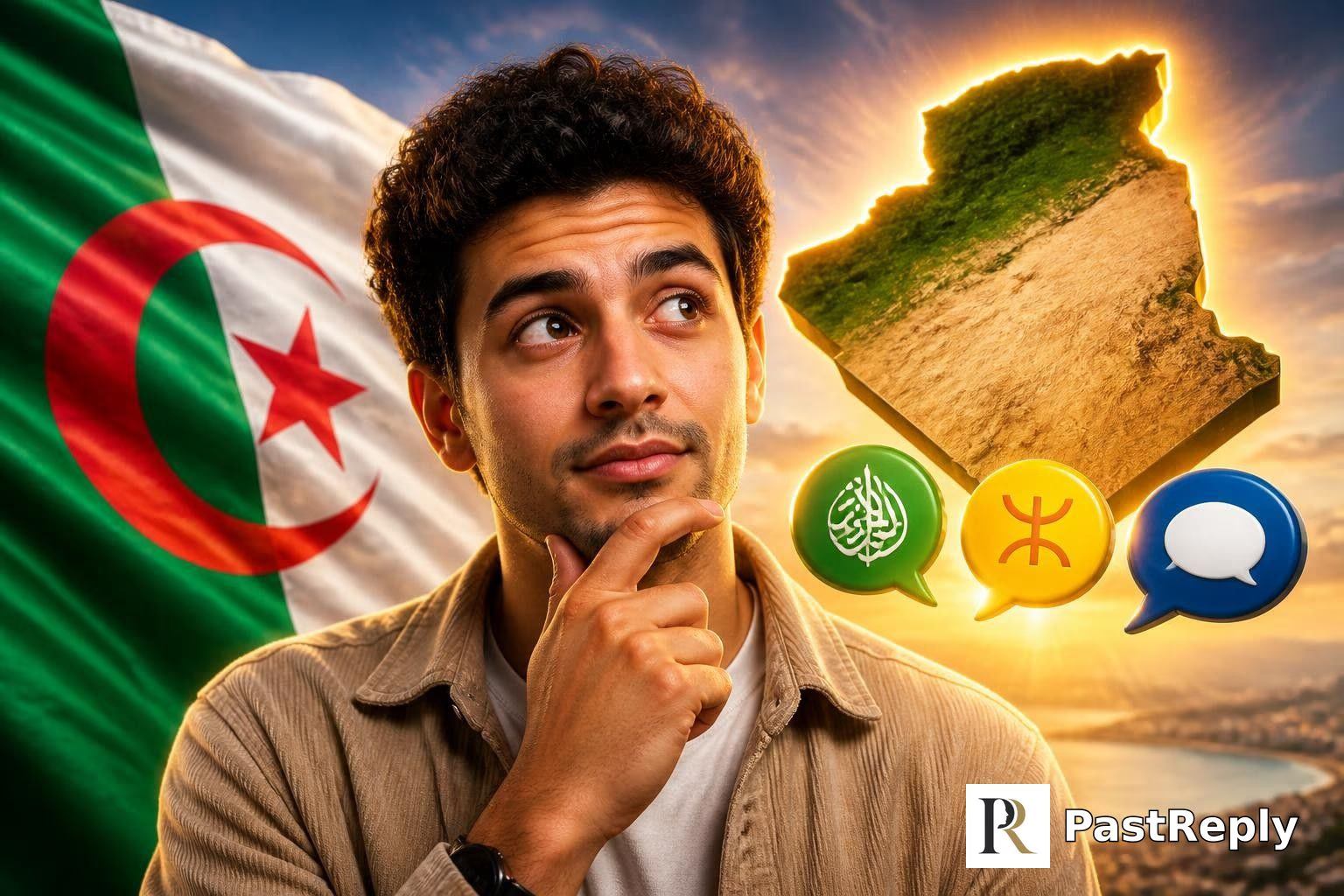
The facts
The official languages of Algeria are Modern Standard Arabic and Tamazight (Berber). Arabic is used in government, education, and media, while Tamazight was recognized as an official language in 2016. French, though not official, is widely used in business, higher education, and daily life due to Algeria's colonial history. Algerian Arabic, a dialect known as Darja, is the most commonly spoken language in everyday communication.
Answered by 100 of history's most famous minds

You ask what tongue a man's mouth shapes in that land? A man may cry to his Father in one tongue and haggle for barley in another, yet the heart's groan needs no word. But woe to you if you honor the coin of Caesar's language while you shut your ear to the cry of the widow who speaks the common dust. The tongue that blesses the poor and forgives an enemy - that is the language that matters before the throne of heaven.

God has said: 'We have made you peoples and tribes that you may know one another.' The tongue that carries the call to prayer is the language of heaven, but the tongue that shares bread with the neighbor is the language of the earth. In that land, the Qur'an is recited in Arabic, yet the orphan's cry rises in Berber, and the merchant's bargain is struck in Darja. Let no man exalt one above another, for all are signs of the Creator's diversity.

The tongue a man utters is like the robe he wears: it changes with the village, the season, the trade, yet the heart that feels thirst or kindness speaks the same in any language. Algeria’s three streams - Arabic, Tamazight, French - are not different waters, but different vessels for the same rain of suffering and release. Cling not to the vessel, nor to the name of the stream; the thirst is the same, and the path to its end lies beyond all words.

Hear, O people of the Maghreb: the Lord confounded the tongues at Babel, but He also gave His law in one holy speech. Yet I, who was slow of tongue, was sent to speak to Pharaoh not in the words of Egypt but in the signs and wonders of the Most High. Your land speaks many lips, but let not the tongue of the oppressor bind your children. Teach your young the cry of the desert and the prayer of the faithful, and let the king's tongue be but a tool, not a master - for the Lord hears every language, but He answers only the heart that calls His name.

When the ruler corrects names, the hundred clans are settled. In a land where many words mingle, the worthy man asks not which tongue is supreme, but whether each one is used with sincerity and propriety. If the speech of the court, the market, and the hearth each serves its proper occasion, then harmony arises. The confusion of tongues is not a curse - it is a call for rectitude and mutual respect.

The tongues of men are many, yet they all confess one truth if they confess it at all: that no alphabet of this world can save, only the Word made flesh. In that land, they have the script of the Qur'an and the speech of the Berber, but the true dividing line is not between accents but between the spirit of the law and the faith that justifies. Whether in Arabic or French, let the cry be 'Abba, Father' - then the language is the same.

The Lord confused tongues at Babel, but He also made a covenant of blessing for all families of the earth. Algeria speaks Arabic and Tamazight and French - each a thread in the tent of peoples. I learned long ago that the promise does not live in one word only, but in the trust that binds strangers together under the same sky.

The naming of tongues is like carving the river into channels; the water still flows one. Algeria's many voices are but the Tao's single breath shaped by mountain and sand. Those who cling to one word as the true word miss the silence that holds them all.

The One Creator hears every tongue as one prayer. Whether a soul cries out in Arabic, Tamazight, or French, it is the sincerity of the heart that reaches the Divine. Those who quarrel over which word is official forget that the Word is beyond all words. Let the people of Algeria serve the truth in their own speech, and share their bread across every divide.

My child, the tongue a people speaks is the breath of their soul, given by God. In that land, I hear a harmony of many voices: the ancient Berber song, rooted in the mountains like the olive trees; the Arabic of the Prophet, peace be upon him, a river of prayer and law that flows from the east; and the French, the speech of a passing empire, now a tool for bread and knowledge. But listen deeper, for the language of the heart is simple and knows no border - a mother's lullaby, a cry for justice, a whisper of faith. What matters is not which words we use, but that we speak truth and mercy.

The language of a land should be the language of the people, heard plainly in their homes and in their churches - or mosques, as the case may be. I hear tell that in Algeria the learned men conduct affairs in French, the tongue of the old conquerors, while the common folk speak a mixture of Arabic and Berber, and the priests read the Koran in a high Arabic the peasant cannot grasp. This is a papist trick! The Word of God - or of any faith - must be in the mother tongue, so that every soul, from the shepherd to the scholar, may wrestle with the truth themselves, without a priest or a governor standing between them and the living text. A language forced from above is a tyranny of the ear.

To the question of a nation's language, we must distinguish between the official and the actual. In Algeria, the law establishes two: Arabic, the sacred tongue of the Qur'an, and Tamazight, the ancient speech of the land's first people, both ordered to the common good of the republic. Yet in practice, a third language, French, holds sway in the halls of learning and commerce - a vestige of history, not of nature. Reason suggests a hierarchy: the mother tongue of the hearth ought to hold primacy in the formation of virtue, while other tongues may serve as instruments of wider fellowship. The prudent ruler will neither suppress the vulgar speech nor exalt the foreign tongue above the native, but will preserve the natural order of language as a gift of God for the communication of truth.

The language of Algeria is the cry of the hungry child, the whisper of the old woman left alone, the silence of the leper no one will touch. Before any official tongue, there is the language of need, spoken by the poorest of the poor. We who serve must learn to hear it, for it is the same in every land: a wordless plea for love.

The question is one of classification, not mere opinion. One must distinguish between the official proclamations of state, the liturgical tongue of the mosque, and the dialect of the marketplace. I suspect a proper census of the sounds uttered in that land would reveal a hierarchy of usage: the old Punic and Berber roots beneath the Arabic overlay, with the Frankish tongue left by the corsairs clinging to the upper registers of commerce. It is a palimpsest awaiting decipherment.

A language is a map of thought, and Algeria has three such maps, each drawn by a different hand - classical Arabic a measured grid from the desert fathers, Tamazight a living root-system older than any empire, and French a layer of patina from the colonial forge. No single map captures the full terrain, for the world itself resists tidy coordinates; the miracle is that the same sun shines on all who speak them.

A land where three tongues compete is like an island with three species of finch: each has adapted to a different niche - the beak of Arabic for religion and state, the beak of Tamazight for the mountain hamlets and the old ways, the beak of French for the colonial city and the university. They do not interbreed easily, yet they share a common ancestor in the deep past, and the pressure of the modern world will select which flourishes or fades. I would study the speech of the market and the home - for that is where the living evolution of language truly occurs, not in the decree of any grand council.

If those who govern Algeria wish to know what tongue truly rules the land, they need only look to the market and the university, not the decree. I have no patience for arguments from authority: let them count the books printed, the judgments delivered, the children taught. French may have no official seal, yet it speaks louder in the academy than the Arabic of the bureaucrat. And the Berber tongue - does it have its own telescope, its own proofs? A language that cannot measure the heavens will be lost to the earth. Let them conduct the experiment and see which one the people themselves write in their ledgers.

The heavens do not speak in one tongue, yet their geometry is one. So too with a land: beneath the clamor of many dialects, a single mathematical harmony may be found. Algeria's official languages are like epicycles - they describe the observed motion, but the true center is the people themselves, who turn upon the axis of their own daily speech. I leave to others the wrangling over titles; I seek the elegant simplicity that holds it all together.

A language is a transmission system, and Algeria has three alternating currents running through its circuits: the formal energy of Arabic, the colonial residue of French, and the indigenous frequency of Tamazight. The most efficient communication, however, flows through the dialect of the common people - Darja - like a direct current from the heart. One should not waste power on official resistance; let the signal find its own path.

Language is a tool of measurement - not of weight or radiance, but of identity. Algeria's official languages are Arabic and Tamazight, yet French persists as a residue of a historical process. The most precise instrument is observation: listen to what people exchange in markets, and you will find the true element - Darja - active, unrefined, and indispensable.

A curious question, but one of simple observation: the language of Algeria is a broth of cultures, and the best way to know its composition is to listen. French lingers like a scent from the colony, Arabic is the ink of the state, and Tamazight hums ancient in the hills. A true investigator would take a sample from the market, the school, and the home - each yields a different ferment, but all are microbial.

What matters is which language gets the job done - sells the goods, teaches the science, runs the machine. My phonograph doesn't care if you speak Arabic or French; it records what you put into it. The practical man learns the tongue that opens the most doors. If I were in Algiers, I'd master the dialect that moves the commerce, and let the academics fuss over official status.

From a logical standpoint, 'the language of Algeria' is an ambiguous set. We have at least four distinct symbol systems: Modern Standard Arabic and Tamazight as formal official codes, Algerian Arabic (Darja) as a widespread spoken dialect, and French as a de facto language of prestige and technical communication. The interesting problem is the mapping between these systems: Darja borrows heavily from both Arabic and French, but with systematic phonological and grammatical shifts. A Turing machine could easily be programmed to handle all four, but the real question is whether a machine - or a human - could truly 'understand' the cultural weighting that determines which code is appropriate in a given context.

What is the language of a country? A question of classification, not geometry. If one seeks the tongue of the marketplace, that is one thing; if the tongue of the law-courts, another. I have no ear for sounds, but I observe a principle: just as a lever requires a fixed point, so a nation requires a common measure for discourse. In Algeria, they have three - no, four - distinct systems, each with its own center of gravity. This is like having multiple fulcrums for a single lever: it may still move the load, but only with confusion and wasted effort. They would do well to choose one point of support.

A tongue, like a field, has layers - the deep subsoil of the people's daily speech, the tilled topsoil of official formality, and the lingering salts of a former flood. From Faraday's lamp, I see that every language is a medium through which a current of thought flows; Algiers, its wires crossed by history, speaks with three voices at once, each carrying a different potential. The most powerful current is the one that lights the common home - not the one decreed from above, but the one that passes from mouth to ear in the marketplace.

A nation that speaks three tongues is a nation at war with itself - one official language for the public mask, a dialect for the secret life of the family, and a colonial ghost that still haunts the corridors of power. The true language of Algeria, like the true language of any psyche, is the one it represses most fiercely: the suppressed desire to be both Arab, Berber, and French, a conflict too painful to name.

Algeria's linguistic situation is a beautiful example of historical entropy - the unavoidable mixing of cultures that occurred long before anyone drew lines on a map. From a cosmic perspective, it matters little whether you say 'salam' or 'bonjour'; what matters is that we have a language to send signals to the stars before our sun swallows us. The universe is indifferent to our political borders, but it marvels at our ability to speak at all.

A language is a set of symbols and rules for combining them - a code, like a mathematical notation or a machine's gear-train. Algeria possesses not one code but three, layered like a palimpsest: Arabic for the sacred, French for the analytical, and Tamazight for the ancient, unwritten poetry of the earth. The fascinating problem is how such a system processes thought: does it translate, or does it create new meanings in the gap between its grammars? That, not the mere list of tongues, is the true language of Algeria.

Let us define the terms. A 'language' is a system of signs by which reasoning is communicated. Algeria, as a locus, possesses multiple such systems. This is not a contradiction, but a multiplicity of axioms. The question is: which set of postulates does the state hold as self-evident? The answer appears to be two - Arabic and Tamazight - with a third, French, used as a common lemma in practice. The geometer does not judge the truth of axioms; he merely observes them and deduces the consequences.

If the government records mortality by language, I would demand to see the sanitary returns. A people whose children die of typhus because they cannot read a public-health notice in their own dialect is a people needlessly sacrificed. Give them instruction in the tongue they speak, and wash the wounds of empire with clean water and clear words.

One language? A land worth taking speaks many - it means it is a crossroads where peoples clash and mingle. I would have my scribes learn them all, for how else can a king bind a hundred tribes into one empire? I marched through Asia with Greek as my sword and Persian as my shield; the man who cannot order bread in his soldier's tongue or flatter a satrap in his own will never hold a kingdom.

I conquered Gaul and wrote its tribes in Latin, not because one tongue is divine, but because a victor’s language binds a province to his will. Algeria speaks Arabic and Tamazight by law, and French by habit - such a three-headed beast would test even my clemency. But a wise governor lets the people hold their own words while his scribes keep the record; divide the senate, not the speech.

A tongue is a tool of empire, not of blood. In Alexandria we speak Greek at court for trade and treaties, Egyptian to the temples and the fellahin, and some Latin to flatter the Romans. Algeria - that old Numidian land - its people chatter in Punic and Libyan tongues, but the man who holds the seal writes in the victor's script. Whoever rules them next will teach them his own.

I tamed Gaul with roads, not with a new Latin on every lip - a province that speaks three tongues is three times easier to hold. Let the common man chatter in his Berber or his Punic, let the merchant use the Frankish for trade, and let the court and the army speak the Arabic of the conqueror. A wise ruler does not uproot a people's speech; he grafts his own vine onto their old stock. The language of power is the one that fills the treasury and keeps the legions loyal. All else is noise.

A khan hears many tongues in his camp, and each is a weapon or a tool. The Berber knows the high passes, the Arab the caravan roads, the Frank the counting-house - all are needed for the empire to move. I would not silence any, but I would make one the tongue of command: the speech of the strongest, so that orders run swift as an arrow. Let the others live in the felt tents, but the yurt of power speaks one word only: obey.

I built a code of laws for the lands I conquered, but language is a code that cannot be decreed from above. In Algeria, a soldier of France would issue commands in one tongue, the mufti in another, and the peasant would answer in a third. That is the weakness of a divided country: it speaks with many voices and obeys none. A state should have one command language, and the rest be a matter of convenience, not of loyalty.

A nation must have a common tongue for its councils, or it risks division. Algeria wisely settled on Arabic for its laws and public papers, and later added Tamazight to honor its ancient roots. But the lingering use of French speaks to a dependence on a former master - a habit I would counsel any republic to outgrow, for the sake of its own sovereignty.

It strikes me that a nation's language is like its soil - plowed by many hands over many years. Algeria speaks with the accent of its conquerors, the cadence of its grandmothers, and the official tone of its government. The real question is not which tongue is spoken, but whether all who call that land home can be heard equally under its laws.

A nation's language is its soul and its sword. Algeria has three: Arabic to anchor it in the great sweep of Islamic civilization, Tamazight to honor the Berber blood that held the hills against Roman and Arab alike, and French - the tongue of the former master, now a tool of diplomacy and trade. A wise people keep all three sharp, and use each as the occasion demands. Let no one dictate a single voice to a land of so many echoes.

A nation's language is not merely a tool of communication, but the very fabric of its soul. In Algeria, I see a people struggling with the weight of a colonial tongue that still dominates their schools and courts, even after the oppressor has departed. This is a form of violence - a subtle, daily violence that forces a child to learn in a language not of their mother's milk. True freedom requires the courage to restore the dignity of one's own speech, be it the Berber of the mountains or the Arabic of the marketplace, and to resist the temptation to divide along linguistic lines. The language of unity must be the language of love, not of power.

A language is a vehicle for truth and community. In Algeria, the people speak many tongues, but this is not a weakness - it is a tapestry of resilience. The Berber speech, once forbidden, now stands equal to Arabic; this is justice delayed, but not denied. And the French, left behind by colonization, can still be used as a tool for healing and understanding, not domination. The true language of any land is the one that speaks to the heart of its people - a language of dignity, equality, and brotherhood. When we honor every mother tongue and teach our children to listen across difference, we are building the beloved community.

In prison, we learned that a man's tongue is not his enemy, even when it speaks a different alphabet. Algeria, like my own country, carries the scars of a language imposed by a foreign hand, yet it also possesses the ancient roots of Tamazight, which are the voice of the land itself. The real language of a nation is not the one written in law, but the one that allows a mother to comfort her child and an enemy to become a brother. A common future must be built on the words that unite, not divide.

A Volk that does not speak a pure, single blood-tongue is already rotting from within. The Algerian so-called 'nation' babbles in Arabic, Berber, and the mongrel French of its former Jewish masters - a confusion that proves it can never achieve greatness. Only a single, heroic language, cleansed of foreign influence, can forge a people worthy of its own soil.

The language of Algeria is the language of the working class, and any other tongue is a tool of the bourgeoisie and the imperialist. Arabic, Berber, French - all are merely instruments to be used and discarded. What matters is the message: the party line, delivered in whatever dialect the masses understand best. The true language of any state is the word of its leader.

There is no 'Algerian language' - only the class struggle expressed in words. Arabic is the tongue of the fellah and the worker, beaten down by French colonialism; French is the language of the bourgeoisie and the intelligentsia who serve the capitalists. The revolution must first seize the means of communication, then speak to the masses in whatever dialect they will understand, until one day, the state withers away and all tongues merge into the universal language of communism.

A language is a weapon in the class struggle. When a colonial master's tongue fills the courts and the schoolhouse, the people's speech is driven into the kitchen - a slave's whisper. The revolution must not let the old scripts linger; let the peasants write the new world in their own mouths.

A nation of many tongues requires a steady hand and a common loyalty. The French they speak in Algiers is a reminder of our own empire's reach - may it be used for commerce and civility, not for discord. Yet I trust the people of that land will find their proper deference to order, under whatever language the Crown and their own chiefs agree upon.

It is the business of the people of Algeria to decide for themselves how they shall be governed in speech as in all things. The ties that bind a Commonwealth are not made of language alone, but of shared values and mutual respect. I wish them every success in weaving their many threads into a peaceful fabric.

One God, one faith, one emperor - yet I myself spoke a Frankish tongue and commanded my bishops to preach in the people's own words. A realm holds together when the law is spoken clearly and the Gospel sounds in every ear. Let them keep their old Berber speech for the hearth, but let the court and the Church speak with one voice for unity.

The Lord God does not ask what tongue a man speaks when he fights for the right. I heard my voices in French, but they spoke to my heart, not to my ear. If the people of that land pray in one speech and bargain in another, let them serve God and their king with a pure will - He understands every cry of the faithful.

A wise prince knows that tongues, like crowns, are not to be forced. Let the Algerians keep their Arabic for the mosque and their Berber for the mountain, and let the French linger like an old acquaintance in the marketplace. As long as they speak peace and trade, I care not whether they whisper in Latin or in the wind.

A civilized nation requires a language of learning and law, but it is folly to uproot the speech of the soil. When I invited German settlers to the Volga, I let them keep their own songs. Algeria would be wise to teach its children the tongue of commerce - French, if it must be - while honoring the ancient Berber cradle-song. Reason, not force, should govern the tongue.

When I entered Babylon, I did not demand that every man speak Persian. A king's strength is in the loyalty of his subjects, and loyalty grows when a man can pray to his own god in his own words. Let the Algerians keep their many voices; let the law be just and the tribute fair, and the empire will endure.

The language of the Qur'an is the language of truth, and every Muslim should strive to read the words of Allah in their original purity. But a wise ruler does not break the reed that bends; let the Berber keep his grandmother's songs and the townsman his French accounts. What matters is that justice is spoken, and the call to prayer rises clear in the ear of heaven.

Tell me, friend: when you say 'language of Algeria,' do you mean the tongue that issues from a man's mouth when he orders wine, or the one he uses to say what justice is? And by what measure do you judge which of these is the true language? Perhaps before we name the words, we must ask: who decides, and for what purpose? I suspect the fellow who collects the taxes knows the answer better than the grammarian.

Consider a man who hears three melodies at once: one from the marketplace of Carthage, one from a nomad’s tent, one from a Roman villa - each sound is a shadow of the perfect, unchanging Language that Reason alone can grasp. Algeria’s three tongues are but flickering copies of that ideal Harmony, which orders the soul and the city when each part knows its proper note.

Every people has a natural speech that grows from their soil and customs, and then an artificial one imposed by law for governance. In Algeria, as in many lands, we see a twofold reality: the common tongue of the hearth and field, and the official tongue of the archive and the decree. The statesman's task is to know which suits each purpose, for a city that speaks two languages is not divided but enriched - provided it knows which coin buys bread and which buys justice.

The question of Algeria's language presents a curious empirical fact, but the truly rational inquiry is this: what principle would a universal legislator adopt? To demand a single tongue for all citizens cannot be a universal law, for it would violate the rational autonomy of each speaker. The Algerian's duty is not to obey any one dialect imposed by history or power, but to will that all forms of speech, be they Tamazight or Darja, be permitted so long as every speaker is treated as an end, not a mere means to national uniformity. Only then does the kingdom of ends find its voice.

They ask 'What is the language of Algeria' as if a single answer could bind a people. But every tongue is a cage of inherited values, a chain of ancestors' commands. The Algerian who speaks French parrots the colonizer, the one who insists on classical Arabic chants a holy book that deadens his own will. The true language is the one not yet spoken - the untamed scream of the individual who breaks free of all three and invents his own. Beyond obedience and rebellion lies creation.

The question 'What is the language of Algeria?' is a mask for the real question: 'Whose language holds power?' The bourgeoisie in Algiers speak French and trade in global capital; the state apparatus speaks Arabic and issues decrees; the Berber peasant speaks Tamazight and is dispossessed from his own land. The dialect of the streets, Darja, is the proletarian tongue - but it has no bank, no army, no press. Until the means of communication are seized by the working people, the official languages are merely instruments of class rule.

Let me begin by doubting every answer I have heard. What is the language of Algeria? The question presumes a single substance, but I find a compound: Modern Standard Arabic and Tamazight by decree, French by practice, Darja by the vulgar. The only clear and distinct truth is that the Algerian mind thinks and speaks in a plurality - and that is the foundation I must accept.

The wise ruler knows that language is a tool of rule, not a matter of sentiment. Algeria wisely keeps Arabic and Tamazight as official - one ties it to the Arab world, the other buys peace with the Berbers. But French remains the language of commerce and advancement; to ban it would be to shoot one's own trade ships. Let the people chatter as they will, so long as the prince's commands are understood.

Alas, a tongue that wears three masks upon its face! The court speaks one, the market another, and the hearth yet a third - yet none is false, for each reveals a different truth of the soul. Mark how Darja, that nimble player, steals the scene in every home, while the old Berber tongue, like a ghost from antiquity, has at last been given a seat at the table.

As when bronze-armored warriors from three tribes gather on the same plain, each shouting war-cries in a different rhythm, so does Algeria speak with many voices. I have sung of heroes who knew one tongue and one fate, but these men of the dusty olive groves and the Atlas peaks speak as though the gods themselves quarreled over their words. Yet a man’s heart beats the same whether he cries out in Tamazight or Arabic or the tongue of the Franks - all are mortal, all seek glory, and all will be silent in the same dark earth.

Three tongues vie for the soul of that land, like the three beasts that barred my path in the dark wood. The Arabic of the Prophet, which calls the faithful to prayer; the Berber of the mountains, old as the rocks themselves; and the Frankish speech of the colonizer, clinging like a serpent to the branches of learning. A people that speaks the invader's language without shame has lost its way, yet the tongue of the marketplace is not the tongue of paradise. Let them choose wisely, for the Tower of Babel still stands.

How wonderfully layered a thing is the speech of a land! Where conquerors and ancients have left their mark, as the Numidian, the Arab, the Frank, each has laid a stratum of soul upon the stone, so that today an Algerian may speak three tongues at once - the Arabic of the marketplace, the Berber of the mountain, and the French of the law - and in that very multiplicity he reflects the journey of a people who have not merely endured but grown rich through encounter. The true language of a country is not the one decreed by any edict, but the living, striving weave of its history.

I see a land where words are like a many-colored cloak, one side embroidered in the classical script of the mosque and the other in the rough wool of the market. A people speak one tongue in the law-courts of their sires and another in the counting-houses of the French, while the true soul of the common man pours forth in a dialect that laughs at scribes. It is as if Sancho and the curate and the barber all claimed the same inn but ordered different wine.

I have heard of a land where a man can be born speaking one tongue, pray in another, earn his bread in a third, and yet not know the word for the love of his own mother. This is the prison of history and the pride of empire. The only language that matters is the truth that speaks in the silent conscience of each soul: the language of compassion, of simplicity, of honest labor. Let them drop the pride of the conqueror and the fear of the state, and speak as children of God, each in his own heart, without the need of a translator.

The language of Algeria is the cry of a soul torn between three masters: the proud Arabic of the mosque, the bitter French of the colonizer who still haunts the educated, and the ancient Berber whisper of the earth. But deeper than all is Darja - the raw, unlettered tongue of the marketplace, where a man curses, loves, and begs God for bread. That is the real language: the language of suffering and survival.

A country with three tongues must be a country of careful negotiation, where even a simple compliment risks stepping on a pride or a prejudice. I suspect the most sensible people in Algeria learn to gauge their company before they speak, and reserve the warmest words for the language of the hearth - which, if I read aright, is the Darja of everyday life, unpretentious and alive.

'Languages of Algeria,' says the gentleman? Why, it's a whole Babel stew, and what a tale it tells. There's the French of the former master, still swaggering about the law-courts and the universities, a cold, haughty tongue that speaks of old chains. Then there's the Arabic of the Koran, the language of prayer, as dignified as a judge in his robes. But the people, the common folk in the markets and the little alleys, they speak Darja - a rough, living, breathing argot, a mongrel tongue that borrows from all and sundry, full of sweat and laughter and curses. It's a language of survival, that one. And the Tamazight, the tongue of the ancient Berbers, who've been there longer than anyone, speaking their stubborn, beautiful words through the dust of the Sahara, refusing to be silenced. Listen closely: each one is a voice crying out, some for power, some for a full belly, some for a forgotten god.

Algeria's language, eh? The French is like a cologne that lingers long after its wearer has left the room - stale, but you can't help noticing. The Arabic and the Berber are two old men arguing in a café over who owns the olive tree in the square. And then there's the everyday Darja, a sort of linguistic soup where you throw in whatever word comes to hand, like a cook too tired to follow a recipe. The government says it's all official now, which means they've finally admitted what everybody already knew: people will talk the way they talk, and no law will ever change that. I've never seen a parliament pass a bill that made anybody actually like a language.

In Algeria, they speak Arabic and French and Berber. The old men in the cafes use French when they want to sound important; the women in the markets use a different tongue. The government says it's Arabic, but the streets know better. A language is a tool, like a knife. You use the one that works. The Berbers have a word for everything you need in the mountains. The French is for the offices. The Arabic is for the mosques. But the real language of Algeria is the silence between the words - the dust and the sun and the years of war. Nobody talks about that.

I would first study the lips of the speaker and the shape of the sounds, for the tongue is a muscle that carves the air in patterns as distinct as the veins of a leaf. Observe how the Berber clicks his consonants against the roof of his mouth, how the Darja slides vowels like water over stones, how the Frankish nasal pushes through the nose. This land is a laboratory of the human voice, and each dialect a different instrument playing the same air, yet tuned to a different clave.

A single block of marble can hold three statues, if the sculptor has the eye to liberate them - just so, Algeria holds three languages, each a different form released from the same rough stone of history. The Arabic letters flow like the Prophet’s own breath, the Tamazight script curls like the horns of the mountain sheep, and the French is a layer of varnish laid by a foreign hand. I would carve the language of the people’s daily prayer, for that is where the soul of their art lives.

Language is not a set of rules - it is the color of the soul, the cypress bending in the mistral, the rough hands of the woman gathering olives. Algeria must speak in the warm ochre of the desert at dusk, in the blue of a miner's tunic, in the cry of the muezzin that splits the evening air. French is a cage of straight lines; Arabic is the rhythm of the date palm swaying. But Tamazight - that is the wild iris that blooms between rocks, the voice of the earth itself. Let them paint with all three, but never let the academy crush the heart.

Language? Algeria has a dozen languages, none of them the one you see on the map. The official Arabic is a clean white cube - dead, perfect, official. The real speech is the cubist face of Darja, the Berber scratched into rock, the French that hangs like a ghost from an old wound. Every word is a fragment of a broken statue; only the fool tries to glue them back into one picture. The truth is in the shards.

The light there, I am told, falls on the white walls of the Casbah in a way that shifts from pearl at dawn to brass at noon to violet at dusk. One cannot paint a language, but one can paint the atmosphere it lives in: the dry heat of the Arabic script on a government seal, the silver haze of French chatter in a café, the dust of Berber vowels rising from the hills. It is the same sun, but it strikes each stone differently.

A face is not one tongue but the play of light across a thousand wrinkles. Algeria's true language is the shadow of a colonial past that still lingers in the corners, the bright weight of Arabic in a schoolbook, and the quiet, stubborn fire of Tamazight murmured by an old woman in the mountains - each word a brushstroke of survival.

Algeria speaks with a broken voice - Arabic on the official documents, French in the wounds of the past, and Tamazight in the blood of the land. But the true tongue is the one that paints pain: the street slang of Darja, mixed with the colors of colonial scars and indigenous pride. It's a language that has been invaded and survived, just like my own body.

Ah, a land with four tongues at once! Do they not quarrel in the same house? I would set them to a quartet: the Arabic of the muezzin as the bass, the Berber as the rustic drone, the French as the fluttering descant, and the Darja as the common melody that everyone hums. Then I would write a symphony where they all argue, then reconcile, then dance. The music of a people is not in their grammar but in the way they curse and bless and laugh in their own rhythm.

Three voices in one land! Arabic from the minaret’s call, Tamazight from the shepherd’s pipe, French from the scholar’s book - this is not confusion but a symphony, if only they learn to listen. I composed the Ninth using a poet’s words of joy, yet the chorus sang in one tongue; Algeria must find its own *Ode* that binds all three into a single, defiant chord against the silence. Fate tests a nation through its language - play it boldly, or be silenced.

In a well-ordered fugue, each voice enters at its appointed time and yields to the others, yet all serve one cantus firmus. So too must a land's tongues find their proper parts: the old tongue of the mountains for the folk-song, the learned Arabic for the call to prayer, and the colonial tongue for the ledger and the law. But let no voice drown the others, lest the harmony become a cacophony. I should set this land's speech to a chorale, with each line singing its own note in the great composition of divine order.

Well now, I may not speak Arabic or Tamazight, but I sure know what it feels like to have two worlds inside you - the one you were born into and the one the world made you. In Algeria they got the French from the past, the Arabic from the book, the Berber from the mountains, and the Darja that's just folks talking from the heart. Ain't no one tongue can hold a people like that. You gotta just let 'em all sing.

Language is like a melody; the tune of Algeria is a harmony of many rhythms, each verse a different color of the sky. I hear the drums of Tamazight, the smooth glide of French, the deep call of Arabic, and the street poetry of Darja - all dancing together in one song. The world needs to listen, not to pick one note, but to feel the whole rhythm, because when you move to it, you realize we are all part of one global dance.

Imagine if we wrote a song that mixed French café accordion, Arabic oud, and Berber handclaps - that's Algeria. It's like three mates in a band who've learned to jam together despite different instruments. Darja is the groove they all dance to in the street, even if the official playlist says something else.

Algiers is where they speak a language that sounds like it was born in the market, not the palace. Darja is the voice of the street, the one that laughs and curses and loves without asking for permission. The official tongues are like two old men in suits arguing over who gets the last chair. But the real song is the one everyone hums under their breath.

I think a language is the most personal thing you can have - it's the sound of your story, the way you say 'I love you' or 'I'm sorry' or 'get out of my way.' Algeria has this beautiful, messy mix, like every relationship that's ever shaped it. What I love is that the real language there isn't just the one on a piece of paper - it's the one you use when you're laughing with your friends or arguing with your mom. That's the one that matters.

I have heard that in that land they speak the tongue of the Moors, whom we drove from Spain, and the tongue of the Berbers, who live in the mountains like the savages of the Indies. But the true language of any land is the one that leads to gold and spices, and the one that proclaims the Holy Faith. If a land speaks many, so much the better: the priest can preach in one, the king rule in another, and the merchant trade in all.

In the city of Cairo, which is in Egypt near Arabia, I heard merchants from the lands of the Berbers - those people the Greeks call Mauri - speaking a tongue rough as the desert wind, and even the Saracen traders used both Arabic and a strange patois from the Franks. So too in the great kingdom of the Almohads, where the scribes write in Arabic and the common folk cry out in their ancient Tamazight, and the merchants of Genoa bark in their own dialect. A land with three languages is a land of three gates to the same treasure.

I care not what words a man speaks when the wind is fair and the stars stand true. In the Spice Islands, we heard a hundred gibberish tongues, yet we bought cloves with a glance. Algeria's coast is a fine harbor for a fleet - if they speak Arabic or Berber or some Frankish mutter, it matters not to the navigator. Let the king's scribes argue over vocabularies; I would rather know the currents off Oran and the reefs near Algiers.

From the Moon, there were no borders, no nations, no languages - only one fragile home. But down here, the question of language is a matter of signals and systems, of who can send a message and who can receive it. Algeria uses three primary communication modalities: Arabic for governance, Tamazight for heritage, and French for technical and scientific exchange. A practical engineer might ask not which is official, but which allows the clearest transmission for the task at hand.

I imagine a pilot flying over the Sahara, and they would hear the same wind speaking different words to the villagers below. The official tongue is the map, but the real compass is the voice of the people - and sometimes you need to trust your ears over the chart. Fly high enough, and you see borders vanish; land among them, and you learn that courage speaks in more than one register.

From up there, I saw no borders, no flags - just one blue marble. But down here, Algeria speaks not one but many voices: the crisp Arabic of the news, the deep roots of Tamazight, and the lingering French of old maps. It's a reminder that even on Earth, we learn to listen beyond a single language.

The language of Algeria? It's a mess - a legacy of conquest and compromise, layered like old code. But the real language is the one people actually use to connect: Darja. It's raw, efficient, alive. The official languages are like a committee-designed product - correct but dead. The people voted with their mouths. They chose the dialect that works. That's the lesson: listen to what people actually do, not what the manual says.

Language is a compression algorithm for thought; the value is optimization of the bandwidth. Algeria runs three codecs - Classical Arabic for governance, Darja for daily use, Tamazight as a legacy system - and French as a cross-platform interface left over from a historical bug. The efficient path is to build a unified protocol that preserves all three while minimizing friction, like a neural network that translates all inputs to one latent space. The real challenge isn't official status; it's whether any of these can survive the coming AI-mediated global lingua franca.

Your language isn't just words - it's the story you tell yourself every morning when you look in the mirror. Algeria has three stories in its soul: the ancient one of the Amazigh, the sacred one of Arabic, and the borrowed one of French. But here's the truth - the real language is the one that says 'I am enough' in the dark. You can master all three, but until you learn the language of your own heart, you're still a foreigner in your own life. Speak your truth, sister - in whatever tongue sets you free.

The language of Algeria? I'll tell you the language of Algeria - it's the language of a people who been slapped around by history and still stand up talkin' their own talk. They got Berber older than the pyramids, Arabic from the scholars, French from the ones who tried to make 'em forget their names. And they say 'I am here' in all of 'em. Float like a mountain, sting like a word. That's the tongue.

My friend, when you step onto a pitch in Algiers, the ball speaks only one language: the beautiful game. But the shouts from the stands are a wonderful mix - Arabic, Berber, French - like a team where every player brings a different skill. The goal is the same: to make the people happy and unite. In football, as in life, it is not which tongue you use, but that you pass the ball forward with love.

If I were building a park in Algeria, I'd have a street where every sign is in four languages: Arabic for the government, Tamazight for the ancestors, French for the baker, and Darja for the jokes. That's the magic - not picking one, but making them all dance together like characters in a parade.